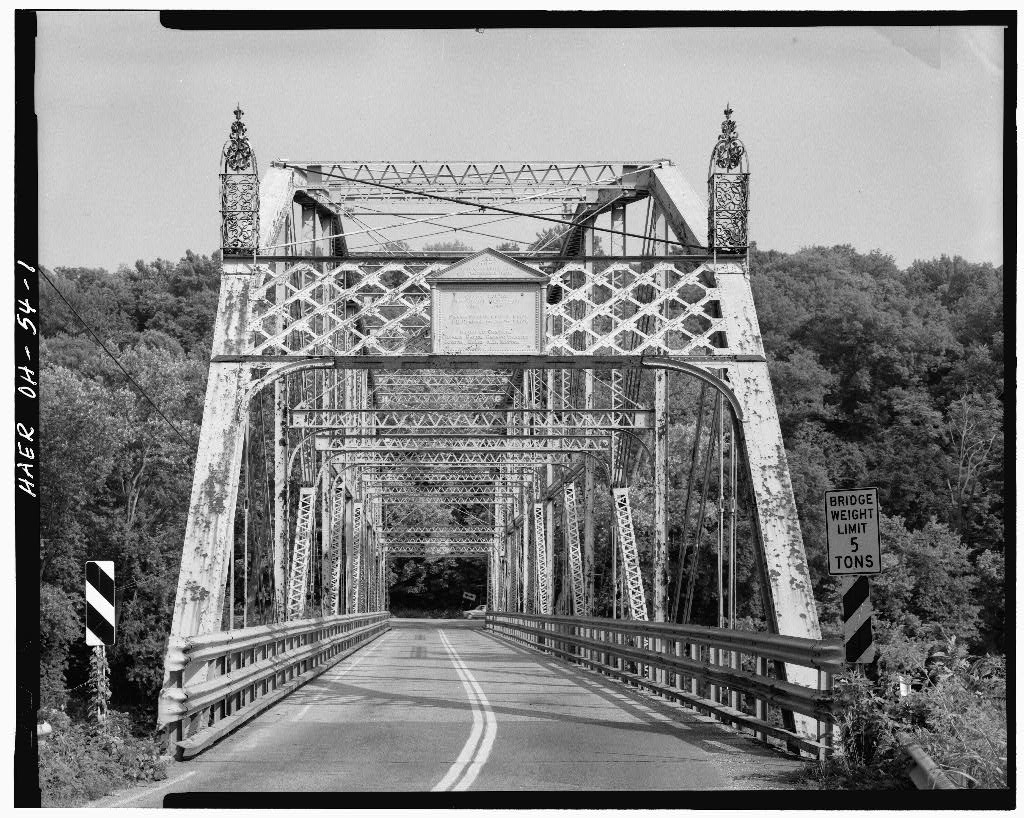
Old Colerain Pennsylvania Through Truss Bridge, Spanning Great Miami River at County Route 463, Ross
Old Colerain Pennsylvania Through Truss Bridge, Spanning Great Miami River at County Route 463, Ross, Butler County, OH. Surveyed as HAER OHIO,31-ROSS.V,1-, with 1 photograph and a 3,688-word written history.
From the record
“The Old Colerain Pennsylvania Through Truss Bridge was built in by the King Bridge Company of Cleveland, Obio, one of the largest and most important bridge concerns in the United States in the late century.”
Written record, HAER OHIO,31-ROSS.V,1- survey. Machine-read text.
surveyed by the federal HAER program as HAER OHIO,31-ROSS.V,1- · the record runs 3688 words · one of 9 surveyed structures published for this county.
Source document
Quoted word for word from HAER OHIO,31-ROSS.V,1-.
Not written, edited or summarised by this site.
The Old Colerain Pennsylvania Through Truss Bridge was built in by the King Bridge Company of Cleveland, Obio, one of the largest and most important bridge concerns in the United States in the late century. Although the company made its reputation by building bowstring bridges, this is a good example of the type of long span bridge that the company became known for towards the end of the century. The Pennsylvania truss was specifically developed for long span bridges. The bridge is listed as a "selected bridge" in the Ohio Department of Transportation's Ohio Historic Bridge Inventory Evaluation and Preservation Plan. Report prepared by: prances A. Jones Project Historian Ohio Historic Bridge Recording Project Summer OLD COLERAIN PENNSYLVANIA THROUGH TRUSS BRIDGE HAER No.
OH-54 Page 2 This bridge was built in by the King Bridge Company. It is a Pennsylvania Through Truss, which is the same as a Parker truss (a polygonal top chord, and vertical posts in compression) but with additional sub-struts. The upper chord consists of channels and plate, while the struts, braces and vertical posts are of channels and lattice work. The sway bracing running between the top chords is also of channels and lattice work. Top lateral bracing is provided by bars. There are lattice work panels above the portals, and curved braces from the upper chord to these panels. Each end post is surmounted by an ornate wrought iron finial. The bridge is 368 feet long, which is quite long for a single span. It has a clear span of 560 feet and a road width of 23 feet, 5 inches.
The bridge is set on stone abutments. On 3 May the venice_Graphic reported the dedication of this bridge referred to as the new iron truss bridge over the Great Miami River at Ross. It said that "There is probably no more perfect highway bridge in the United States". A large ceremony was held, but unfortunately neither the Mayor of Cincinnati, nor the County Commissioners, were able to attend due to prior engagements. H. L. Morey was called upon to speak in place of the Mayor. He said: "We have only to look at this beautiful structure and the massive foundations upon which it rests, and then to look at the remnants OLD COLERAIN PENNSYLVANIA THROUGH TRUSS BRIDGE HAER No.
OH-54 Page 3 of the old piers of the old bridge to see that their children do things and better now than their fathers did before tbem. Progress and improvement have left their mark on the nineteenth century, it is stamped everywhere."^ It was reported that the bridge bad cost to build. It was the fourth to span the Great Miami River at that point. The first two structures were wooden and bad been washed away by floods. The chance of this happening again would presumably have dissuaded the King Bridge Company from building a bridge which had to have piers to support it in the river. The third bridge was also wooden and bad been destroyed by fire "of an incendiary origin".
The King Bridge Company built mainly bowstring bridges at first, but by the it was producing metal trusses of various standard types. 2enas King, the founder, had patented bis bowstring design, and also a design for a swing bridge, but the company did not seem to bold patents of its own for metal truss bridges. Zenas King died in but towards the end of his life he bad become interested in long spans. When spans began to approach or exceed 400 feet, bridge trusses bad to be developed to cope with the specific problems of building a long span bridge. The truss bad to be braced properly. It also had to be possible to fabricate it from easily available materials and sizes of members, as otherwise it would be very expensive to build. OLD COLERAIN PENNSYLVANIA THROUGH TRUSS BRIDGE HAER No.
OH-54 Page 4 Initially standard designs were used, and the popular Wbipple truss, patented in was predominent. This bad parallel chords, and inclined end posts. The verticals were in compression, and the diagonals, which were in tension, ran across two panels, it has beensaid that the history of long span bridges could be understood to have begun when it was necessary to build or replace the original Ohio River bridges with massive enough structures to take the traffic loads that were expected for the rest of the century. Most early railroad bridges over the Ohio were built in iron, as the use of iron in bridge construction was becoming common during that time period.
The first long span bridge over the Ohio River was built at Steubenville, Ohio by the Pittsburgh, Cincinnati, Chicago and St. Louis Railroad. The designer was the railroad's chief engineer, Jacob H. Linville, and the bridge was built in There were seven spans, composed of Wbipple-Murphy combination trusses. The channel span was an unprecedented 320 feet, but despite this the trusses were fairly standard in design. Besides the Wbipple truss, several other designs were used. The "Warren truss (in which diagonals take both tensile and compressive forces) was fairly common in S. S. post invented his bridge design which was quite popular for a while. This was rather like the Wbipple truss, OLD COLERAIN PENNSYLVANIA THROUGH TRUSS BRIDGE HAER No.
OH-54 Page 5 except that the vertical poets were inclined towards the center of the span. Post's design was thought to have improved rigidity under live loads, but actually the distribution of stresses was ambiguous and difficult to predict. It was acceptable in the and 70s not to be able to calculate stresses accurately on a given design. By the however, with the increasing sophistication of the engineering profession, it was important to be able to analyse the stresses and justify a new design in theory before it was actually built. In Albert Fink designed a bridge for a subsidiary of the Pennsylvania Railroad over the Ohio River at Louisville, Kentucky. His design was based in part on the principles of the Pratt and Wbipple trusses.
In Fink's design, however, the panels were divided into smaller units by half diagonals, and moreover the location, cross-sectional profile, dimensions and numbers of individual members were all carefully calculated on the basis of the stresses they would be carrying, pink's design is important for this reason. Although it was complex, it was possible to predict the stresses in each of the members of his design, and these calculations were within the capabilities of any professional engineer. OLD COLERAIN PENNSYLVANIA THROUGH TRUSS BRIDGE HAER No.
OH-54 Page 6 The Pennsylvania Railroad engineers saw the merits of the design at once, "but the calculations were complicated, and the bridge was costly to build because of the numbers of individual members, and the points of multiple intersection. They sought to simplify it by reducing the number of intermediate members within any one panel, and in they developed the "Baltimore" or "Petit" truss. This bad panels divided into fewer, simpler units by a half diagonal and a half vertical member. By that was modified into the Pennsylvania truss (also known as the Petit) of which the Old Colerain Bridge across the Great Miami River is an example.
The Pennsylvania truss has the same web system (pattern of members) as a Baltimore truss, but it also has a polygonal top chord in place of the older form with parallel chords. Almost all basic bridge trusses designed between and had parallel chords, but that design feature did not reflect the increase in bending moment from the ends to the center of the span. If a truss which was the same depth throughout was rigid enough at the center then it had an increasingly redundant amount of material towards the ends. The change in bending moment was recognized early on, and was reflected by the addition of a second set of diagonals in the center panels of the Pratt and Whipple trusses.
The introduction of the polygonal top chord, however, was a logical step forward and became a standard feature of OLD COLERAIN PENNSYLVANIA THROUGH TRUSS BRIDGE HAER NO, OH-54 Page 7 long span "bridges. The one disadvantage was that it was more expensive to produce because of the number of different sizes of the individual members, A variation on the Pennsylvania truss established a new record for the length of a simple span in the It was a bridge for the Chesapeake and Ohio Railway across the Ohio River at Cincinnati, and it was designed by the Phoenix Bridge Company. The river was crossed by three spans, two of 476 feet, and the central one, across the channel, of 545 feet.5
The King Bridge Company
The King Bridge Company, originally known as the King Iron Bridge and Manufacturing Company, was set up by Zenas King. King was not a professionally trained engineer. Like many who practiced engineering in America in the early century, he learned his profession while on the job. He was born in Vermont in and grew up on a farm. In he went to Milan, Erie County, Ohio which was a booming community at that time, due to the completion of the Milan canal completed in Evidently King bad some training in carpentry because there he OLD COLERAIN PENNSYLVANIA THROUGH TRUSS BRIDGE HAER No. OH-54 Page 8 was given contracts to build a variety of structures. King went on to spend some time working as a traveling agent for a Cincinnati cornmill manufacturer.
He did not have any direct involvement with bridge building until when be became an agent for Thomas Moseley of the Moseley Bridge Company in Cincinnati. Moseley was known for having invented the first practical tubular arch bridge in America made from wrought iron boiler plates for which he recieved a patent in The company also produced the bowstring bridge which was popular from about to its attraction being that it had a high carrying capacity, relative to the amount of iron used. King represented Moseley's company at many bridge lettings throughout southern Ohio, and thereby learned a lot about bridge design. When Moseley moved to Boston in King went to Cleveland where he set up his own bridge and boiler works.
He had already begun working on his own design for a tubular bowstring bridge, and it was on this that be established bis bridge building business. King, together with peter Frees (a metal worker), produced a prototype of bis design in Their bridge was not the first to use the tubular compression member for the bowstring, but it was new in that it could be easily mass produced using wrought iron boiler plate. Their design used a rectangular tube with curved parallel strips of wrought iron boiler plate riveted to OLD COLERAIN PENNSYLVANIA THROUGH TRUSS BRIDGE HAER No. OH-54 Page 9 channel bars at tbe top and bottom. On long spans, a third channel bar was riveted to tbe middle of the tube for extra stiffness and strength.
Tbe bridge was not patented until October as the patent office said that tbeir design bad been preceded by the English patent for a tubular bowstring bridge of by Charles DeBergue. Part of tbe patented design was a variation in tbe size of tbe tube, it being smallest at tbe abutments where it was well supported, and largest at tbe crown of the arch. This was actually faulty engineering, and it may never have been built with this variation in tube size since none of tbe existing examples demonstrate it. King carried on refining his design without Frees in the and in be patented an improvement on it. His designs were very successful, and because tbe bowstrings were so light, they were cheaper to build than another design in iron or wood.
So many of King's patent bowstrings were built in Ohio that be set a design standard, with which other firms tried to compete. This helped the popularity of the bowstring bridge in Ohio in the and During this period King built mainly bowstring bridges, examples of which fill the company's catalogues. He also built bis patented tubular swing bridge, although not in such great numbers. One of tbe major bridges built by tbe company during this period however, was of a OLD COLERAIN PENNSYLVANIA THROUGH TRUSS BRIDGE HAER No. OH-54 Page 10 different type altogether. It was a six span Pratt deck truss built over the Mississippi at Minneapolis in It was feet long, and took only four months to build.
As time passed the designs produced by the company did vary, and tbey gradually built fewer bowstrings. Tbey received many contracts for double intersection Pratt through trusses, and by the were building as many of those as they had built bowstring bridges in the and This was following a national trend, as the bowstring bridge was virtually abandoned after Professional engineers bad never been fond of the design. It was difficult to brace properly overhead, and so it bad a strong tendency to sway sideways. King hired more and more professional engineers from the late and it may be because of their influence that the bowstring was gradually abandoned by 4 the company.
King joined up with six other Cleveland businessmen to incorporate the King Iron Bridge and Manufacturing Company (KIBMC) in The other men involved were Thomas A. Reeve, A. B. Stone, Charles E. Barnard, Charles A. Crumb, Dan P. Eells and Henry Chisbolm. The incorporation provided the company with more money and links with the Cleveland iron, legal and financial community. He was not the only Ohio bridge builder OLD COLERAIN PENNSYLVANIA THROUGH TRUSS BRIDGE HAER No. OH-54 Page 11 to incorporate, but be did so earlier on in tbe company's life than was typical. One of tbe biggest differences between tbis company and otber large bridge companies of tbe period was tbe empbasis on advertising and sales techniques.
By tbe late tbe company bad agents or salesmen tbrougbout tbe nation wbo could represent tbe company at bridge lettings. Otber companies also did tbis, but not on tbe same scale. KIBMC also produced impressive catalogues at regular intervals, and it bad so many contracts west of tbe Mississippi that several subsideries of tbe King Bridge Companies were established there. Even if tbe Company was not responsible for a bridge design, it developed innovative methods of construction to overcome a specific problem. Tbey did tbis with tbe Central Viaduct in Cleveland, where tbey produced a method of building the spans without using falsework.
Although tbe company began by concentrating on tbe bowstring, by the late nineteenth century it was building deck trusses, low trusses, various single and multiple intersection through trusses, combination bridges and girder and swing bridges. Many bridge companies also produced a variety of iron and steel work for buildings and roofs. KIBMC produced parts for "furnace plants, mills, or any style of fire-proof construction desired; also boisting and conveying machinery 7 for handling ore, coal etc." OLD COLERAIN PENNSYLVANIA THROUGH TRUSS BRIDGE HAER No. OH-54 Page 12 By tbe late nineteenth century tbe Company bad an impressive and up to date plant.
^_gineering_News wrote about it in in its "Notes on a trip to Chicago and Cleveland": Tbe works are well arranged for tbe progress of work: material is delivered from tbe cars under cover, and proceeds through tbe shops to tbe painting and finishing shop, where it is loaded on to cars on a depressed track. The erection of turntables for drawbridges is done on a floor having a concrete foundation, and there is an overhead circular traveling trolley for tbe handling of tbe materials. The blue print room attached to tbe drawing office is quite large, and has large windows with yellow glass, so that tbe work can be carried on without inconvenience.8 The plant was located on both the Pennsylvania, and Lake Shore and Michigan Southern Railroads.
By it had an area of square feet under cover, and tbe latest machinery bad been installed. In about tbey added a plant for the manufacture of steel eye-bara "by tbe latest and improved methods". Tbey were said by one commentator to be "one of the few manufacturing companies to make this class of 9 material". Attention bad begun to be focused on plant design in the and An American engineer, Alexander Lyman Holley, designed a number of innovative plants for tbe steel industry at this time, and be said that his main aim was "to assure a very large and regular output", plants were designed to make the fullest possible use of existing OLD COLERAIN PENNSYLVANIA THROUGH TRUSS BRIDGE HAER No. OH-54 Page 13 transportation facilities with buildings laid out to follow the curves of railroad tracks.
The site was laid out in order of the processes of production. One of the works Holley designed was so successful that it "became the most efficient steel producer in the United States, or in the world (for more information on Holley and plant design please see the section on the Wrought Iron Bridge Company in the report on the White Bowstring Pony Truss Bridge, HAER No. OH-39). King died in but unlike many family owned corporations, the company carried on, and was still operating through the second World War. After King's death the name of the company was officially shortened to "King Bridge Company" for the sake of convenience. The administration was taken over by Zenas King's son, Harry Wheelock King.
The company began to have some problems, and he was forced to reduce the value and amount of the capital stock in It was in that year that the company was the defendant in a civil action resulting in its official dissolution. Many bridge companies in Ohio had been involved in bridge pools (cartels), a system of agreements between participating companies which enabled them to keep prices at a certain (sometimes very high) level.
Old Colerain Pennsylvania Through Truss Bridge Hash
No. OH-54 Page 14 It meant that there was no true competition for bids, as in many cases the companies had already decided which of the supposedly secret bids submitted by them would be the lowest. These agreements bad been in operation for some years, but companies were not taken to court in Ohio until the early Some of the biggest cartels had been organized by railroad companies, which had bad informal agreements at first. After the onset of the Depression, however, these agreements were formalised in an attempt at mutual protection from bankruptcy.
By the the railroad cartels were clearly breaking down, and they were also forbidden by the Interstate Commerce Act of Bridge cartels were not attacked until much later, but when they were many companies were found to t>e deeply involved, with the King Bridge Company being one of the worst offenders (presumably because it was one of the largest organizations of its kind). The laws in New Jersey were not as stringent, and it is presumably because of the court case that the company technically moved, and became the King Bridge Company of New Jersey. The company was reorganized again in the under Norman C. King, who bad been secretary of the preceding corporation. The firm finally disappeared from the Cleveland City Directories shortly after the Second World War.
12 (For more information on bridge pools please see the report on the Forder Pratt Through Truss Bridge, Paulding County, Ohio HAER No. OH-42). OLD COLERAIN PENNSYLVANIA THROUGH TRUSS BRIDGE HAER No. OH-54 Page 15 NOTES 1 The bridge does not seem to appear in the County Commissioners Journals for the period, which is odd for a bridge of this size. It may be that it is the bridge mentioned as being in or near Venice, for which there are entries for c. 2 Venice Graphic, 3 May quoted in The Cincinnati Enquirer, Friday 6 May C-4 Metro. 3 All information on long spans is from Carl . Condit, American Building Art: The Century (New York: Oxford University Press, pp. 9. 4 David A.
Simmons, "Zenas King: A Bridge Builder of National Proportions" (unpublished article held at the Ohio Historical Society). 5 William Gason Rose, The Making of a City (Cleveland and New York: World Publishing Company7~1950~y 6 David A. Simmons, "Zenas King". 7 Civil Engineers Club of Cleveland, Visitor's Directory to the Engineering Works and Industries of Cleveland, Ohio pp. "Notes on a Trip to Chicago and Cleveland", Engineering News (26 December ~ Civil Engineers Club of Cleveland, Visitor's Directory. 10 Alfred D. Chandler Jr. The Visible Hand: The Managerial Revolution in American Business (Cambridge, Massachusetts: The Belknap Press of Harvard University Press, pp. 11 Alfred D. Chandler Jr. Tj)6_J[lsible_Hand, pp. 12 David A. Simmons, "Zenas King".
OLD COLERAIN PENNSYLVANIA THROUGH TRUSS BRIDGES HAER No. OH-54 Page 16
Bibliography
Chandler, Alfred D. Jr. The Visible Hand: The Managerial Revolution in American__Business (Cambridge, Massachusetts: Tbe Belknap Press of Harvard University Press, Condit, Carl . American Building Art: Tb^l9tb^entury. New York: Oxford University Press, I960. Rose, William Garson. Tbe Jtekjjig^rfja^[it . Cleveland and New York: World Publishing Company, Simmons David A. "Zenas King: A Bridge Builder of National Proportions" (typewritten article, Ohio Historical Society). Civil Engineers Club of Cleveland. Visitor's Directory to tbe Engineer_ing_Wo_rks and Industries of Cleveland, Ohio. "Notes on a Trip to Chicago and Cleveland". .^ B. (2^ December Venice Graphic, 3 May Quoted in tbe Cincinnati Enquirer, Friday 6 May C-4 Metro. Bridge Files, Ohio Historical Society (compiled by David A.
The original filed report, and the sheets the survey produced. Those published here appear above.
Also surveyed in Hamilton
1 record
The federal surveyors worked through Hamilton building by building. These are the other structures
they measured and filed a report on, longest report first.
 Block
Block