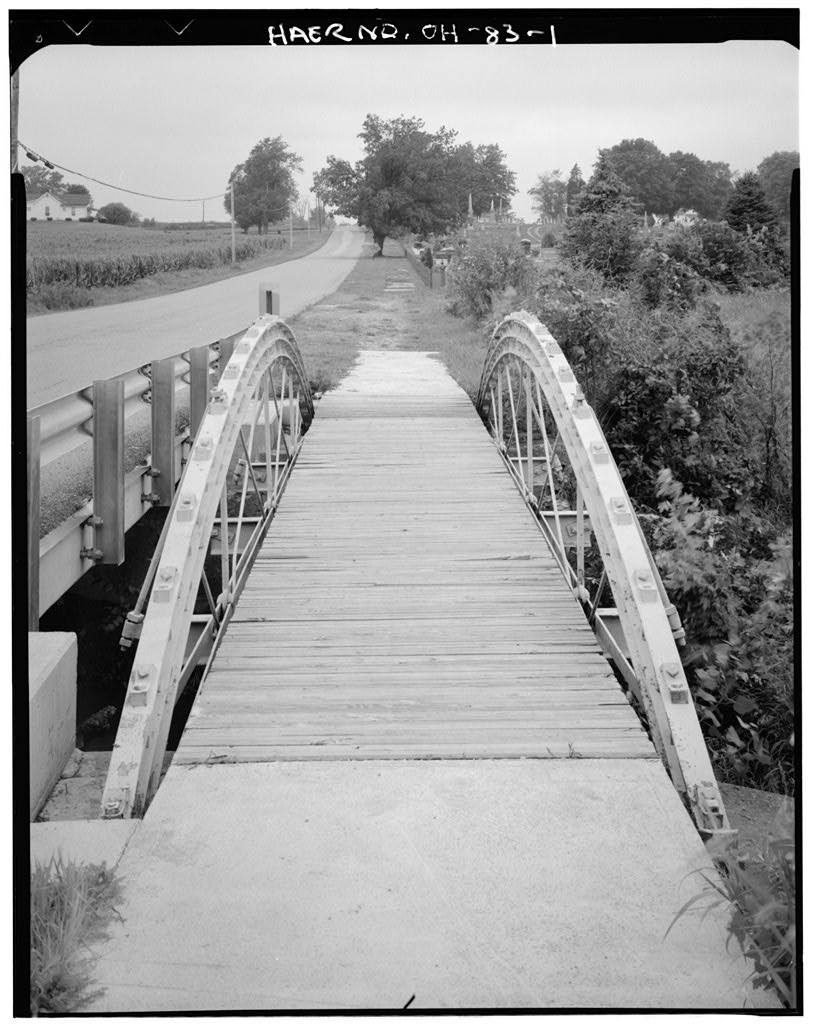
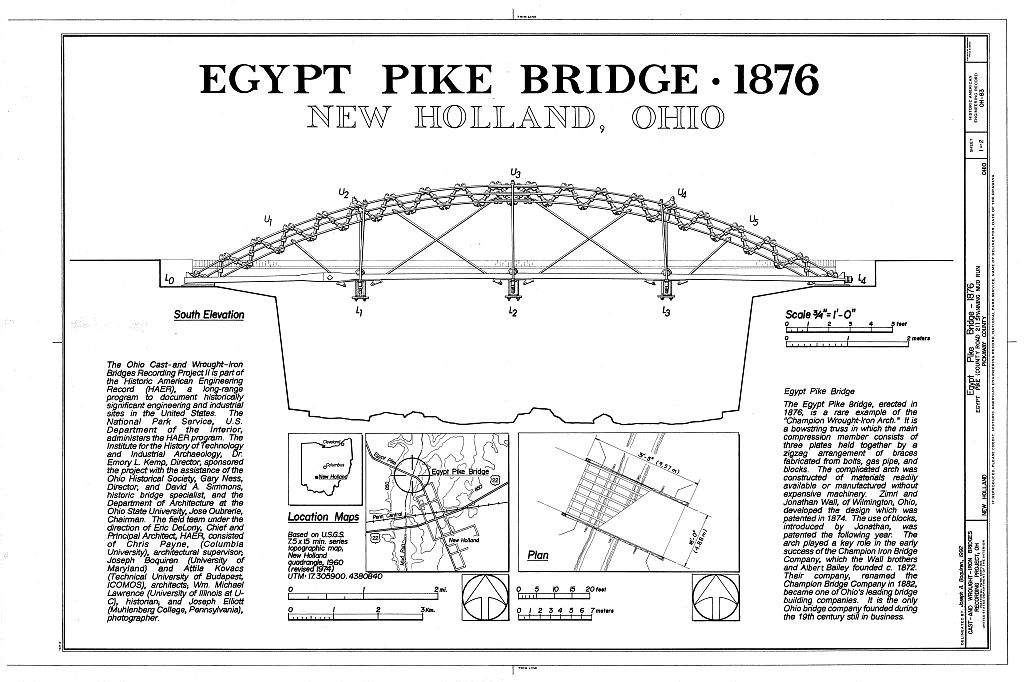
Adjacent Egypt Pike/County Road 21 spanning Mud Run, New Holland, Pickaway County, Ohio. UTM Coordinates: Converted to pedestrian use in Champion Iron Bridge Company, Wilmington, OH Pickaway County, OH (Board of Commissioners), County Courthouse, Circleville, OH Pedestrian use. The bridge is a rare example of the "Champion Wrought Iron Arch Bridge" patented in by Jonathan and Zimri Wall. The design played a key role in the early history of their company, the Champion Iron Bridge Company. Later renamed the Champion Bridge Company, it is the only century Ohio bridge company to survive to the present day. The Ohio Cast- and Wrought-Iron Bridges Project was cosponsored by HAER, Dr. Robert J. Kapsch Chief; the Instute for the History of Technology and Industrial Archaeology, Dr. Emory L.
Kemp, Director; the Ohio Historical Society, Gary Ness, Director and David Simmons, Historic Bridge Specialist; and the Department of Architecture, Ohio State University, Jose Obrerie, Chairman. Wm. Michael Lawrence, Historian EGYPT PIKE BRIDGE HAER No. OH-83 (Page 2) The Egypt Pike bridge, known locally as "the bridge on the Egypt Pike over the Mud Run," 1 is located just north of the Village of New Holland and just south of its cemetery. The Egypt Pike Bridge is a rare example of the "Champion Wrought Iron Arch" marketed by Jonathan and Zimri Wall, founders of the Champion Iron Bridge Company.
They built the bridge in and it was converted to a pedestrian bridge in The Champion Wrought Iron Arch played a key role in the early years of Champion Iron Bridge Company, the only surviving century bridge company. The Egypt Pike bridge is a 31 % bowstring arch truss bridge, a design popular among Ohio bridge builders from to Creating a variety of designs, forty percent of the bridge improvement patents they filed in the last half of the century were for such trusses. 2 The truss employed in the Egypt Pike Bridge is similar to a patent filed on December 1, 3 by Jonathan and Zimri Wall. A patent application filed by Jonathan Wall on March 27, describes certain elements found in the arch of this bridge.
4 A comparison of the patent descriptions with the bridge reveals how the Walls continued to develop this complicated yet economical design. The arch in the Egypt Pike Bridge truss consists of three concentrically arranged wrought iron "plates" 5 held in position by a system of pipes, blocks, and bolts. The plates are separated by squarish cast-iron blocks and tubular "casings" of gas pipe, "an item constituting an important feature of this invention, said pipe being available at comparatively low cost, considering the advantage obtained." 6 Manufacturers used a variety of metals for gas pipe in the late century, but cast and wrought iron appear most commonly. 7 Blocks fit against the plates, and casing ends, bolt heads and nuts bear on them.
These bolts, or "tension rods," pass through the plates, tubes, and blocks, holding them together. Blocks are shaped to hold the pipe casings and bolts at a 45-degree angle to the plates, appearing as a zigzag arrangement through the three plates. According to the first patent description, there were to be two parallel rows of these "arch plate braces," side by side; the Egypt Pike design is not so overbuilt, with only one row. The blocks appeared in the second patent application, which dispensed with the zigzag arrangement of tubes in favor of a configuration similar to a Howe truss with vertical tension bolts and solid rods for diagonals.
The first patent also specified elongated holes in the plates with malleable iron rammed in on either side of the bolts to eliminate the necessity of boring oblique holes. If the manufacturers did this at the Egypt Pike bridge, it is not apparent. EGYPT PIKE BRIDGE HAER No. OH-83 (Page 3) The three plates, at their ends, fit into cast iron shoes. The first patent application called for the use of iron filling blocks between the plates, with plates and blocks stacked vertically and fitting like the heel of a foot inside the shoe. These were dispensed with in the Egypt Pike Bridge by bolting the ends of the lower two arch plates directly to the bottom of each shoe and holding the top plate several inches above with an arch brace.
The Egypt Pike bridge features another improvement over the first patented design, which called for a "loop" or "clevis" at each end of the bottom chord or "arch tie," all of wrought-iron "plate," wrapping around the shoes. At one end of the truss the parallel plates of the arch tie are machined into threaded rods. These fit through a spacer block and washer plate which fit against the "heel" of the shoe. Nuts on the ends of these rods permit tension adjustment in the chord. Bowstring arches require ties or hangers of some sort to transfer live loads to the arch. The first patent prescribed a complicated system of "braces" running through the three plates and down to and between the two parallel plates of the arch tie.
Some of these braces, which were rods, had eyes; through bolts would connect them to the two plates of the arch tie. Others had threaded ends that would fit through "flanged blocks" on the underside of the arch tie. These braces were to be radial, converging on no less than three center points. The Wall brothers dispensed with this complicated geometry in the Egypt Pike Bridge, using a more orthodox arrangement of vertical and diagonal braces. The diagonal braces consisted of tie rods whose threaded ends penetrated the bottom plate of the arch and passed through iron blocks on top of the plate and below the arch tie. Plates with bent ends held the lower blocks in place.
Vertical braces also were threaded at their upper ends and fit through all three arch plates as well as tubes between the lower and middle plates. The lower ends of the vertical braces were U- bolt stirrups with washer plates and nuts that, like the gas pipe, may have been "commonly available." The "pitman box," an assembly embracing the wrist of a drive wheel shaft, was supported by such stirrups. 8 These support the cross floor beams. The stringers currently are wide-flange beams which cannot be original but, considering the short spacing between the cross beams, likely resemble the original wood flooring system. The cross beams extend beyond the bridge on either side and braces run from their ends up to the top plates of the arches or bows, improving lateral stability.
EGYPT PIKE BRIDGE HAER No. OH-83 (Page 4) The Champion Wrought Iron Arch Bridge, in its conception and execution, has a machine-like complexity in the arrangement of its parts. Determining the action of the forces within the arch would require computer analysis, but the parts themselves, however, are quite simple. The wrought-iron plates, cast-iron blocks of a few simple shapes used throughout the arch, pieces of common gas pipe all of one length, the stirrups, and long bolts were all easily available or made in a "village economy." 9 Such materials were easier to acquire or fashion than the rolled plates used in many contemporary tubular bowstring arches.
It is a classic example of a home invention developed by self-trained men rather than the product of professional engineers or a corporation. It was probably not a coincidence that the Wall brothers left the Champion Iron Bridge Company when it incorporated, a decade after they founded it. The system enabled the Wall Brothers to submit and win bids for county bridge work. Examining bids in the Knox County Board of Commissioners noted: It appearing to the Commissioners heretofore the bids of the Champion Iron Bridge Co. were low compared with others. And the said company having constructed several small bridges in the County to the entire satisfaction of the Commissioners and the agent Mr.
Wall being desirous to have the Commissioners examine some of their longer Bridges, the Board in company with the Auditor proceeded to Circleville and thence to the sites of Bridges and made a very thorough examination. 1 0 Circleville is the Pickaway County seat. It is quite possible that the Commissioner's examination included the Egypt Pike Bridge and two other such bridges as well. The Journal 11 of the County Commissioners of Pickaway County and their Annual Report 12 recorded two bridges built by the Champion Iron Bridge Company in Pickaway County at the same time as the Egypt Pike bridge. Records reveal that these bridges were probably Champion Wrought Iron Arches and that the surviving bridge was built in they also provide information about their construction history.
On July 22, the Commissioners, Jackson Thomas, Jackson Hoover, and Ness, received and opened bids for seven bridges over five "creeks" or "runs" in Pickaway County. These were undoubtedly all small bridges, with spans approximating that of EGYPT PIKE BRIDGE HAER No. OH-83 (Page 5) the Egypt Pike bridge. The Champion Iron Bridge Company submitted bids for all eight bridges, but the Commissioners awarded them with a contract for only one, over Yellow Bud Creek on the Washington Turnpike.* The Commissioners awarded the contract for the timber foundations, excavating, and stonework to Thomas Shipley, with a low bid of per perch (at $25 per cubic foot).
His proposal and that of the Champion Iron Bridge were considered "the lowest and best Bids for said parts of said work respectively." This probably means that the low bidders for the superstructure, mainly local men, proposed wood bridges. For this bridge the Commissioners decided in favor of the newer technology, built by a "company." The bridge was built late in the year; Shipley submitted a performance bond on August 17 and on November 6 the Commissioners authorized payment for a 35' superstructure costing and for abutments costing The bids for Yellow Bud Creek bridge may be considered as bids for two other bridges as well. On August 7, the Commissioners, "let by private contract to Thomas S.
Shipley for Masonry for a Bridge on the New Holland and Waterloo in Perry Township," for timber foundations, excavating, and masonry work, at per perch. They also "by private contract let the Superstructure of the Bridge across Hamilton Run at New Holland," to Champion Iron Bridge Company on August 30, at per lineal foot. The company presented a bill for a 31' bridge totaling on October 6. The Commissioners authorized payment of the bill, along with Shipley's bill of on November 6. The bill for lumber presented by Thomas Stocky, on December 4, was The County compensated the Village of New Holland on March 6, for making the approaches.
The Commissioners "let by private contract" another bridge "across Hamilton Run at New Holland, 0., to the Champion Bridge Co...Said Bridge to consist of one span 28 feet in Extreme length at per Lineal foot," on June 20, Three days later, they ratified a contract, signed by Commissioner Jackson Thomas and Noah Holmes, for masonry. Holmes was to reuse some of the masonry from the existing bridge. The final costs would be for the superstructure, completed by August 6, for masonry, and for the approaches. Roads cross Mud Run (Hamilton's Run - there are no other creeks or runs nearby) immediately to the north, west, and south of New Holland. The Egypt Pike bridge is 31* long if measured at the 'Bidders for the superstructure appear in the APPENDIX. EGYPT PIKE BRIDGE HAER No.
OH-83 (Page 6) outer faces of its shoes. Of the two bridges built near New Holland, it must be the one built in The Journal does not describe these as being anything other than iron bridges. But, considering similarities prices, lengths, and the fact that the Commissioners contracted the second and third bridges without a bidding process, presumably because they were satisfied with the proposal for the first bridge, all three of these bridges were probably Champion Wrought Iron Arches. It is also interesting to note the low cost of iron compared with masonry, both more permanent than wood, which County Commissioners throughout Ohio must have been carefully considering at this time. The subsequent history of the bridge was uneventful.
It remained at its rural site for a century with little alteration. When Pickaway County Engineer Robert Parker built a new bridge, he salvaged the old bridge, moved it to the east, and shortened the cross floor beams. It is now a pedestrian bridge and a model for historic bridge preservation. 1 3 The Champion iron Bridge Company 14 The Champion Wrought Iron Arch, with its low cost and ease of fabrication, probably supported the Champion Iron Bridge Company during its infancy, enabling it to survive and become one of Ohio's important bridge building companies. One of the founders, Zimri Wall began his career as a carpenter, building wooden bridges as early as including the Martinsville Road Covered Bridge which still stands. In Zimri's younger brother Jonathan Wall joined him in forming 2.
& J. Wall and Company. Together they developed the Champion Wrought Iron Arch. Albert Israel Bailey joined the partnership around and the partners chose the name of "The Champion Iron Bridge and Manufacturing Company." Their first fabrication shop was in Hamilton, Ohio, where they fabricated at least ten of the wrought-iron arches. Early in the men subscribed in amounts from $10 to as a ten year loan maturing in With this capital they bought land and built a shop in Wilmington. Baily became shop superintendent, Jonathan Wall took charge of engineering and sales, and Zimri Wall was the erection superintendent. At this time, Jonathan developed his variation on the arch lattice. The firm must have fabricated the three bridges in Pickaway County in this shop. EGYPT PIKE BRIDGE HAER No.
OH-83 (Page 7) The partners, along with several others, incorporated the company in The Wall brothers left the company shortly after. Zimri gave up his position as erection foreman on March 1, sold his stock the next year, and returned to building bridges on his own. Jonathan left in August, to work for the Wrought Iron Bridge Company of Canton, Ohio, as a local agent in Circleville. The Board of Directors renamed the company the Champion Bridge Company in February, Under that name it became one of Ohio's most successful bridge companies, erecting bridges all over the country. Of all the bridge building companies founded in Ohio during the century, it is the only one to survive to the present day. Today it manufactures few if any bridges, but produces a wide variety of metal fabrications.
EGYPT PIKE BRIDGE HAER No. OH-83 (Page 8)
Bidders for the superstructure were as follows; Bidder $/foot E.F. Spark & Job F. Best [?](London) Matthias Scott St Deckert (Commercial Pt Warner Carper (Circleville) Removing old Bridge, making roadway, etc. King Iron Company(Cleveland) Geo. W. Ambrose (Darbyville) Thomas (New Holland) Single truss J.E. Nye (Washington) Smith Single Truss Champion Bridge Company (Wilmington) off for wood beams Columbia Bridge Works (Dayton) off for wood beams Jacob Balthuser (Amanda) Open Brace 5. 70 Open arch Odaffer & Co. Smith Bridge Co. (Toledo) Iron truss 9, 25 Combination Wrought Iron Bridge Co. (Canton) Iron beams 9. 00 Blair & Gillett (Lancaster) Plan No. 1 Combination EGYPT PIKE BRIDGE HAER No.
OH-83 (Page 9) ENDNOTES 1.Terry Frazier (Administration and Planning Coordinator of Pickaway County), interview by Wm. Michael Lawrence, 8 July Mr. Frazier is compiling topographical maps and a list of historic place names in Pickaway County to partially fulfill requirements for a degree in Geography. 2.David A. Simmons, "The Risk of Innovation: Ohio Bridge Patents in the Century." In The Proceedings of the First Historic Bridge Conference in Columbus, Ohio (Columbus, Ohio: Ohio State University and Ohio Historical Society, 1 November 3.Patent No. 24 February Copy in the Bridge File at the Ohio Historical Center (compiled by David A. Simmons, OHS). Where possible, the terminology from the two patent applications is used in this report. 4.Patent No. 8 June Bridge File.
5.The Wall brothers, in their patent application, refer to bars as "plates." 6.Patent No. 7. A ppleton's Dictionary of Machines, Mechanics, Engine Work, and Engineering , Vol. 1 (New York: D. Appleton and Co., 8.Edward H. Knight (ed.), Knight's American Mechanical Dictionary , Vol. 1 (Boston: Houghton, Mifflin, and Co., 9.David A. Simmons, "Engineering and Enterprise: Early Metal Truss Bridges in Ohio," Timeline , February-March 25. lO.Knox County, Ohio, Journal of the County Commissioners of Knox County , Vol. G, p, 20 May The incident is used as an example of the economy of the Champion Wrought Iron Arch in David A. Simmons, "Engineering and Enterprise." 11.Pickaway County, Ohio. Journal of the County Commissioners of Pickaway County , Vol. 5, pp. Dates as indicated in the text.
Microfilm at the Ohio Historical Society Library, Columbus, Ohio. 12.Pickaway County, Ohio. The Twenty-first Annual Report of the County Commissioners of Pickaway County, Ohio for the Common Pleas of Said County . Filed 15 September Now at the Ohio Historical Society Library in Columbus, Ohio. EGYPT PIKE BRIDGE HAER No. OH-83 (Page 10) 13.David A. Simmons, "Model Bridge Preservation Project in Pickaway County," Ohio County Engineer . August 16. 14.This is a summary of the early history of the company as related in David H. Miars,~ A Century of Bridges: The History of the Champion Bridge Company and the Development of Industrial Manufacturing in Wilmington, Ohio , a paper prepared for the Clinton County Historical Society for presentation March pp. Miars' father, Ralph J.
Miars, purchased the company in EGYPT PIKE BRIDGE HAER No. OH-83 (Page 11)
Appleton's Dictionary of Machines. Mechanics, Engine Work, and Engineering , Vol. 1 (New York: D. Appleton and Co., Frazier, Terry. (Administration and Planning Coordinator of Pickaway County). Interview by Wm. Michael Lawrence on 8 July Knight, Edward (ed.). Knight's American Mechanical Dictionary , Vol. 1 (Boston: Houghton, Mifflin, and Co., Knox County, Ohio. Journal of the County Commissioners of Knox County . Vol. G, p. 20 May Miars, David H. A Century of Bridges: The History of the Champion Bridge Company and the Development of Industrial Manufacturing in Wilmington. Ohio . Paper prepared for the Clinton County Historical Society for presentation March Patent No. 24 February ** Patent No. 8 June ** Pickaway County, Ohio. Journal of the County Commissioners of Pickaway County , Vol.
5, pp. Microfilm at the Ohio Historical Society Library, Columbus, Ohio. Pickaway County. The Twenty-first Annual Report of the County Commissioners of Pickaway County. Ohio for the Common Pleas of Said County . Filed 15 September Now at the Ohio Historical Society Library, Columbus, Ohio Bridge Files, Ohio Historical Center (Compiled by David A. Simmons, OHS) Simmons, David A. "Engineering and Enterprise: Early Truss Bridges in Ohio," Timeline , February-March Simmons, David A, "The Risk of Innovation: Ohio Bridge Patents in the Century." In The Proceedings of the First Historic Bridge Conference in Columbus, Ohio . Columbus, Ohio: Ohio State University and Ohio Historical Society, 1 November Simmons, David A.
"Model Bridge Preservation Project in Pickaway County," Ohio County Engineer , August 16. m EGYPT PIKE BRIDGE HAER Ho. OH-83 (Page 12) Bridge Files at the Ohio Historical Society (compiled by David A. Simmons, OHS) . ** Denotes materials taken from the Bridge Files.
 Block
Block