Falling Rock Camp Bridge, Spanning Rocky Fork Creek, Hickman
Falling Rock Camp Bridge, Spanning Rocky Fork Creek, Hickman, Licking County, OH. Surveyed as HAER OHIO,45-HICK.V,1-, with 1 photograph, 1 measured drawing and a 2,704-word written history.
From the record
“A composite cast- and wrought iron bridge, the Falling Rock Camp Bridge is one of three surviving Post trusses in the United States.”
Written record, HAER OHIO,45-HICK.V,1- survey. Machine-read text.
surveyed by the federal HAER program as HAER OHIO,45-HICK.V,1- · the record runs 2704 words · one of 2 surveyed structures published for this county.
1 photograph and 1 measured drawing from the federal survey record, Library of Congress.
Location
62 words
Source document
Quoted word for word from HAER OHIO,45-HICK.V,1-.
Not written, edited or summarised by this site.
At the entrance to Falling Rock Boy Scout Camp, just off of Rocky Fork Road (Township Road over the Rocky Fork Creek, Hickman Vicinity, Licking County, Ohio. UTM: Date of Construction; c. Moved to Cumberland Street over the Ohio Canal in Hebron, Ohio, in then to the present site in Fabricator: Likely the Cleveland Car Co. (McNairy, Claflen and Company), Cleveland, Ohio
Significance
2545 words
The headings the report itself prints. Each one jumps to where it begins.
Source document
Quoted word for word from HAER OHIO,45-HICK.V,1-.
Not written, edited or summarised by this site.
A composite cast- and wrought iron bridge, the Falling Rock Camp Bridge is one of three surviving Post trusses in the United States. Project Information The Ohio Cast- and Wrought-Iron Bridges Project was cosponsored by HAER, Dr. Robert J. Kapsch Chief; the Instute for the History of Technology and Industrial Archaeology, Dr. Emory L. Kemp, Director; the Ohio Historical Society, Gary Ness, Director and David Simmons, Historic Bridge Specialist; and the Department of Architecture, Ohio State University, Jose Obrerie, Chairman. Wm. Michael Lawrence, Historian FALLING ROCK CAMP BRIDGE HAER No. OH-89 (Page 2) The Falling Rock Boy Scout Camp Bridge, also known as Bridge No. 411 and "Doc Brown's Bridge" during its history, is one of three Post truss bridges known to exist in the United States.
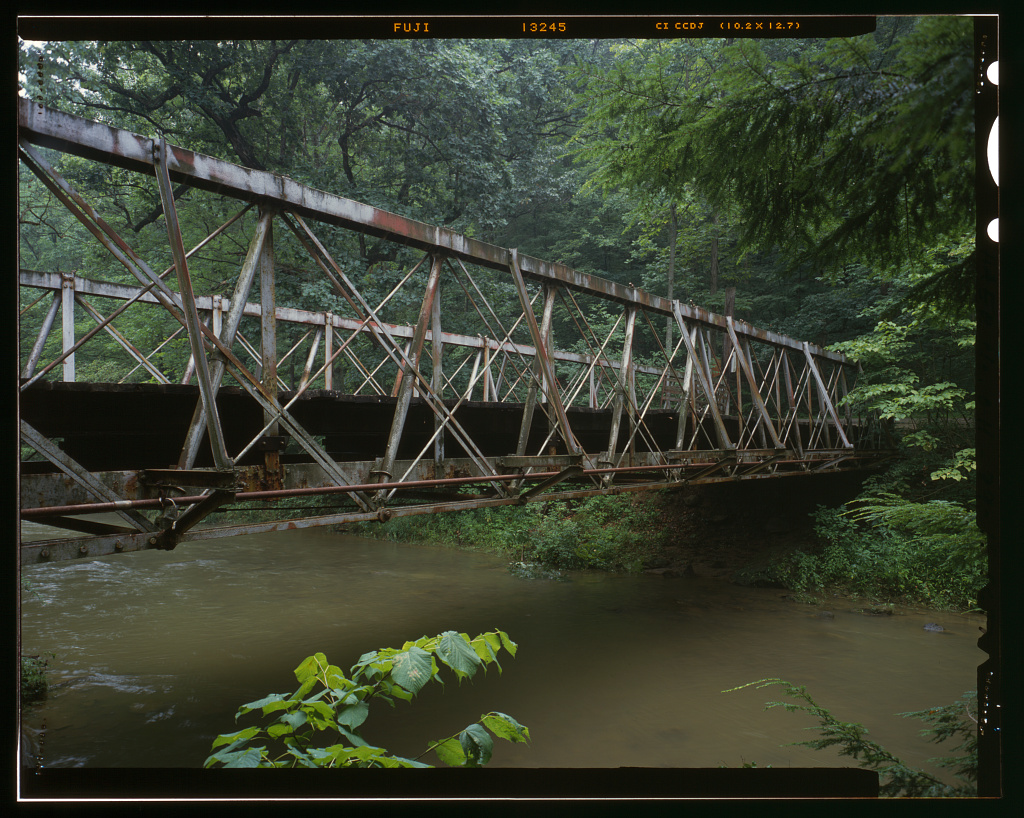
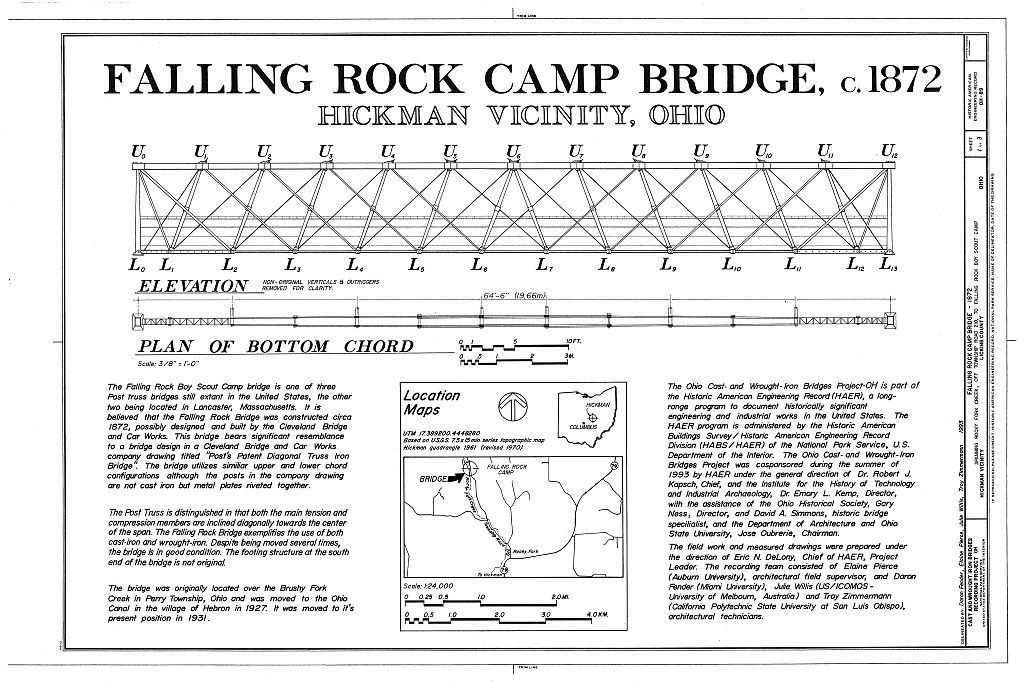
Constructed of cast and wrought iron, the similarities in its detailing to a Post truss design in a company drawing suggest it may have been fabricated by the Cleveland Car Co. (McNairy, Claflen and Company). Because a court house fire destroyed essential records, the bridge can be dated only roughly at Although little is known of its early history, it has played a curious role in the lives of the citizens of Licking County, especially in the town of Hebron. The Falling Rock Camp Bridge is a 66' pony truss. The top chord, or main compression member, consists of a series of massive, squarish cast-iron members that are shaped like an upside-down U in section.
The chord is slightly thicker at the joints, and webs inside each member, about 9" to each side of the joint, create a cavity at this part of the chord. A box fits up inside each cavity and accepts the tops of a post and tie. Their ends fit over a pin which fits into holes in the sides of this box. The boxes do not appear to be held in place by any bolts, but by the compression of the posts and the sway bracing, which passes through them. The upper end of each post, which is pinned inside the box, as well as the lower end, is U-shaped.
These thick posts, which are slanted approximately 15 degrees from the vertical, are flared at the centers to resist buckling in a fashion known as a "fish- belly" in century metal casting.1 The ties, which act in tension, are pairs of flat bars with eyes at each end, and cross the posts at their centers. The sway bracing consists of rods, each with eyes at the lower ends, and threaded upper ends which penetrate the box, the top of the chord, and a large plate holding the nut on the end of the rod. The lower chord, or main tension member, consists of parallel flat eye-bars and pins. The corners of bars at the eyes are cut off at 45 degree angles. The ends of the posts, ties, and sway bracing fit over the pins.
The link in the chain nearest to the end panels consists of two bars held apart by zigzag lattice work. The heavy end posts are rectangular in section, swell at the middle, and are hollow, with oval openings in the faces to lighten them and save material. The means for supporting the deck is rather peculiar, with cross beams hung from the top chords by flat bars held against the posts with U-bolts. Although this design seems to fit neatly into the original scheme, it may date from one of the relocations of the bridge. FALLING ROCK CAMP BRIDGE HAER NO. OH-89 (Page 3) The end posts rest on small piers or miniature towers at the south end of the bridge that also are not original, and their light lattice construction is unlike anything else on the bridge.
Except for some rusting of the piers and an end post cracked by an automobile and crudely repaired with a cover-plate, the bridge is in excellent shape and will probably serve light traffic into the camp for some years to come. This bridge is one of three Post truss bridges known to exist in the United States. The other two are in Lancaster, Massachusetts: the 2Atherton Bridge built by J. H. Cofrode and Co. of Philadelphia, and the Ponakin Bridge 3 built by Watson Manufacturing Co. of Paterson, New Jersey; both constructed in The Post truss, invented by Simeon S.
Post in was distinguished by compression posts inclined from the vertical towards the center of the truss; ties in tension inclined in the opposite direction at 45 degree angles crossing the posts; and sway bracing in the opposite direction at the same angle as the ties, within the panels. Many of these trusses were built of cast and wrought iron. The distribution of stresses in this system is difficult to calculate, but its supposed rigidity 4made it popular for about 15 years in the mid-nineteenth century. Most of the bridge's components are of cast iron to accommodate their complicated shapes; tension members are of wrought iron. Wrought iron, strong in both tension and compression, is superior to cast.
This type of construction was typical of early metal truss bridges; it was only around that mechanical methods for rolling iron shapes were developed, permitting its large scale use as a structural element.5 It would be a number of years, however, before diffusion of new technology rendered cast- and wrought-iron bridges such as this one obsolete. Rapidity and ease in construction made the pinned connection so prominent in this bridge popular in 19th-century bridge construction, especially in America.
Some engineers even resisted replacing the "American system" of pins and screw-end connections with the "European" system using rivets, claiming that field rivets could not be properly inspected.6 The similarity between the details in this bridge and a Post truss design by the Cleveland Bridge and Car Works (McNairy, Claflen, & Co.), suggests the possibility that the Cleveland firm built the Falling Rock Camp Bridge.7 A careful comparison of the bridge with a drawing by the company, entitled "Post's Patent Diagonal Truss Iron Bridge," is most revealing. The chords in the drawing consist of tubes which are squarish, like the U- shaped members of the bridge, with a similar swelling at the joints. The connection of the diagonals to the top chords is FALLING ROCK CAMP BRIDGE HAER No.
OH-89 (Page 4) identical. The posts in the Cleveland Bridge and Car Works drawing are made of metal plates riveted together, but swell in the middle to resist buckling from the compressive forces like the cast-iron posts of the Falling Rock Camp bridge. In both, the ties are flat eye-bars and the sway bracing consists of rods threaded at the upper ends that penetrate the joint boxes, the top of the chord, and plates on top of the chord. The bottom chords in both designs consist of eye-bars in which even the eyes are identical in shape. In both designs the chords at the end panels consist of two bars held apart by members between them. Holes in the top chord depicted in the drawing are identical to those in the end posts of the Falling Rock Camp bridge.
Even the shapes of the base plates are the same.8 If the bridge was built by the Cleveland Bridge and Car Works, then it represents the work of a major bridge building company. The history of the company begins in when Peter Thatcher gained control of the Howe patent truss bridge and founded the firm of Thatcher, Burt and Company with offices in Springfield, Massachusetts and Cleveland, Ohio.
It was one of the major bridge building firms9 in "the West" (today's Midwest) until its dissolution in Various directories, beginning in included advertisements for "McNairy, Claflen & Co., Successors to Thatcher, Burt, and Co., Bridge Builders and Proprietors of Howe's Patent Truss."10 By the Directories list the Company as the Cleveland Bridge and Car Works, adding railroad cars to its line of products.11 Albert C. McNairy and Henry M. Claflen both started working with the firm under Thatcher, but Claflen was the driving force behind it. By he was listed as President, while McNairy's name fails to appear in the advertisements. Under Clafen's leadership, the firm grew into a company employing 800 to men, building cars for leading railroads and bridges all over the United States.
The company built the12 iron portion of the Superior Street Viaduct in Cleveland. They were constructing Post trusses for railroads before and in that year circulated a flyer addressed to county commissioners advocating Post's Patent Diagonal Truss Bridge for use on highways.13 The company replaced the Center Street bridge in l4Cleveland with an iron draw Post Patent Diagonal Truss in The Falling Rock bridge may be one result of their efforts to market Post's invention.
The construction date of the Falling Rock Camp Bridge cannot be ascertained because a fire on April 3, destroyed important records in the Licking County court house.15 A thorough search of contemporary newspapers failed to reveal any other information about the bridge.16 The minutes of the Village Council of FALLING ROCK CAMP BRIDGE HAER No. OH-89 (Page 5) Hebron, Ohio, provides some information about its later history: July 6, The Council received a petition from a large number of people in the Cumberland Street vicinity and other interested people requesting a bridge over the Ohio Canal at the West end of Cumberland St. and also to obtain a right of way from landowner Francis Hand at the west end of the bridge.
August 3, Licking County Commissioners offered a 66 foot surplus bridge in Perry Township free to the Village of Hebron for moving it. March 3, Hebron Village Clerk authorized to advertise for bids to have bridge # 411 over Brushy Fork Creek in Perry Township dismantled and erected on concrete abutments over the Ohio Canal at the west end of Cumberland St. April 3, C. B. Patterson was hired for 300 dollars to dismantle bridge in Perry Township and leave at site on Cumberland St. in Hebron and to erect concrete abutments as per his bid. April 20, Council approved bill of 500 dollars to Patterson for bridge erected over Ohio Canal at west end of Cumberland St. June 24, Special Council meeting to consider sale of Canal bridge to Licking County Commissioners for 100 dollars.
The proposal was unanimously accepted.17 According to their Journal, the County Commissioners hired W. H. Lane to "remove the old Whxpple Low Truss Bridge at Hebron, Ohio, and move and erect the same at Boy Scout Camp for $ "18 The recorder was unfamiliar with the somewhat obscure Post truss. On the same day the Village Council decided to sell the bridge, the Commissioners decided to "purchase the old Whipple Bridge at Hebron, Ohio, for the sum of $ The official records failed to record one detail of this history. The President of the Village Council, Dr. Brown, convinced the councilmen that he, as personal physician of Frances Hand, could persuade her to grant the necessary right of way for a new street, and that they could proceed to have the bridge erected. But, Frances Hand refused.
"Consequently, the bridge was never used while erected in Hebron. It was and always will be known here as fDoc Brown's Bridge.'"20 FALLING ROCK CAMP BRIDGE HAER No. OH-89 (Page 6) ENDNOTES 1. David A. Simmons, "Licking County Bridge is Rare Example of Early Metal Bridge Technology," Ohio County Engineer. February 19 84, 9. 2. HAER No. MA-17. The bridge was listed in the National Register in 3. HAER No. Placed on the National Register in ? [This info not available in Bridge File. National Register form states that the bridge is "known to HAER"]. 4. Carl W. Condit, American Building Art in the Nineteenth Century (New York: Oxford University Press, 5. Ibid., 6. Alfred P.
Boiler, Practical Treatise on the Construction of Iron Highway Bridges for the Use of Town Committees (New York: John Wiley & Sons, 7. S immons. 8. Cleveland Bridge and Car Works, McNairy, Claflen & Co., proprietors. S. S. Post's Patent Diagonal Truss Bridge. Safety negative at the Ohio Historical Society Library. Original in the Morrison Family Collection at Beaver, Pennsylvania. 9. History of Cuvahoga County Bridge Files at the Ohio Historical Society (compiled by David A. Simmons, OHS) . 10. Baker's Cleveland Directory 53; Cleveland Directory and William's Ohio State Business Directory Bridge Files. 11. Williams Ohio State Business Directory 256 and Cleveland Directory Bridge Files. 12. "The World's" History of Cleveland (Cleveland: The Cleveland World, and 13.
Cleveland Bridge and Car Works, Office Cleveland Bridge & Car Works (Cleveland, O., February I, From the Richard Howe Papers, Ohio Historical Society Library, Columbus, Ohio. 14. Samuel Orth, History of Cleveland, Vol. 1 66. Bridge File. FALLING ROCK CAMP BRIDGE HAER No. OH-89 (Page 7) 15. Newark Advocate (Newark, Ohio), 9 April Bridge File. 16. Bridge File. 17. Hebron, Ohio. Minutes of the Village Council of Hebron, Ohio, according to Dave Morrow, in a letter to Beverly B. Kelley at the Ohio Historical Society, 5 February Bridge File. 18. Licking County, Ohio. Journal of the County Commissioners of Licking County, Vol. 23, p. As noted in the Bridge Files. 19. Ibid., p. 24 June 20. David Morrow, letter.
Morrow also visited the bridge at the Falling Rock Boy Scout Camp to verify that it was the same one that he knew as a child. FALLING ROCK CAMP BRIDGE HAER No. OH-89 (Page 8)
Bibliography
Baker's Cleveland Directory. Boiler, Alfred P. Practical Treatise on the Construction of Iron Highway Bridges for the Use of Town Committees. New York: John Wiley & Sons, Cleveland Bridge and Car Works, Office Cleveland Bridge & Car Works (Cleveland, 0., 1 February From the Richard Howe Papers, Ohio Historical Society Library, Columbus, Ohio.** Cleveland Bridge and Car Works, S. S. Post's Patent Diagonal Truss Bridge. Safety negative at the Ohio Historical Society Library. Original in the Morrison Family Collection, Beaver, Pennsylvania. Cleveland Directory. Cleveland Directory. Condit, Carl W. American Building Art in the Nineteenth Century. New York: Oxford University Press, 19 60. HAER No. MA-17, Atherton Bridge, Lancaster vicinity, Worcester County, Massachusetts. Hebron, Ohio.
Minutes of the Village Council of Hebron, Ohio. According to Dave Morrow, in a letter to Beverly B. Kelley {Ohio Historical Society), 5 February History of Cuvahoga County. Licking County, Journal of the County Commissioners of Licking County. Vol. 23, p. Ibid., p. 24 June National Register of Historic Places. Newark Advocate (Newark, Ohio), 9 April ** Orth, Samuel. History of Cleveland. Vol. 1 ** FALLING ROCK CAMP BRIDGE HAER No. OH-89 (Page 9) Simmons, David A. "Licking County Bridge is Rare Example of Early Metal Bridge Technology," Ohio County Engineer, February 9. William's Ohio State Business Directory. Ibid. "The World's" History of Cleveland. Cleveland: The Cleveland World, Bridge File at the Ohio Historical Society (compiled by David A. Simmons, OHS).
** Denotes materials taken from the Bridge Files. ADDENDUM TO HAER No. OH-89 FALLING ROCK CAMP BRIDGE (BRIDGE NO. , . (DOC BROWN'S BRIDGE) Cast and Wrought Iron Bridges Project /y. Spanning Rocky Fork Creek iV" Hickman Vicinity ~*^ ""* U . \> / Licking County } _, Ohio XEROGRAPHIC COPIES OF COLOR TRANSPARENCIES HISTORIC AMERICAN ENGINEERING RECORD National Park Service U.S. Department of the Interior Washington,
The original filed report, and the sheets the survey produced. Those published here appear above.
Also surveyed in Licking County
1 record
The federal survey recorded these other structures elsewhere in Licking County. These are the other structures
they measured and filed a report on, longest report first.
 Block
Block