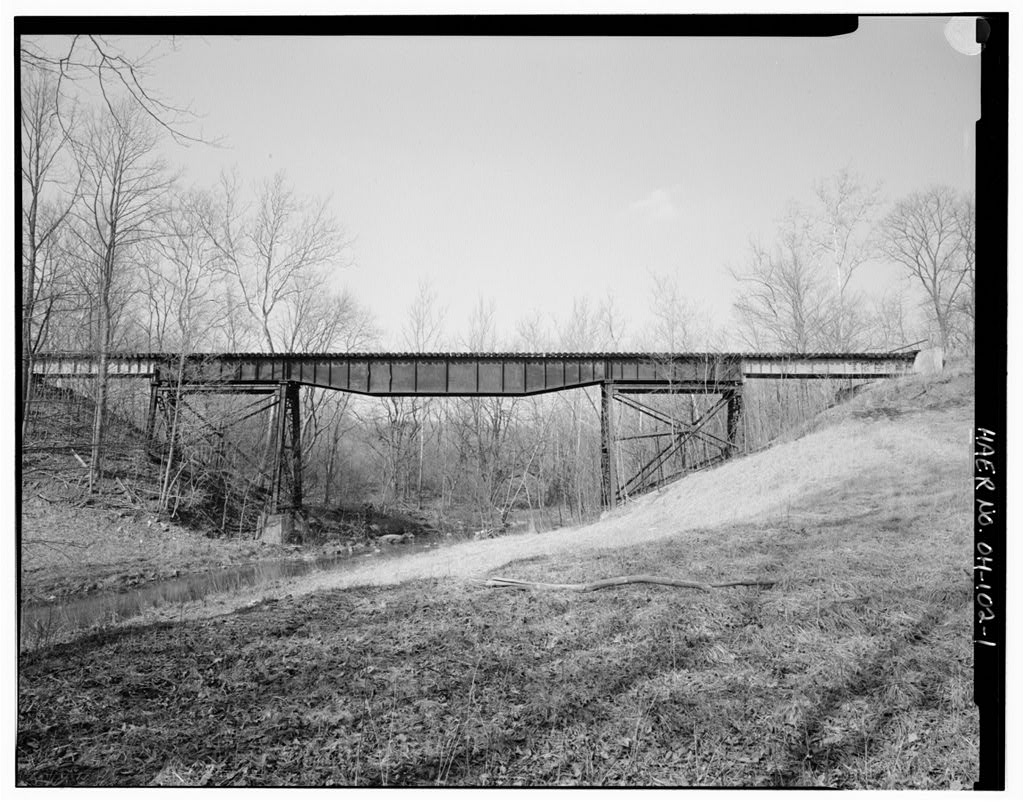
The photographic and narrative recordation of this bridge is not subject to Section 106 regulations. The bridge owners wish to donate this record prior to its projected demolition in Rita Walsh Gray & Pape, Inc. Main Street Cincinnati, Ohio CINCINNATI, JACKSON & MACKINAW RAILROAD BRIDGE HAER No. OH-l 0 2 (Page 2) Historical Context This steel deck plate girder bridge was built in the over Tom's Run in Jackson Township, Montgomery County, Ohio. The bridge is one of the earliest remaining bridges on the former Cincinnati, Jackson, and Mackinaw Railroad line and is a rare example of nineteenth century bridge engineering construction.
The railroad line had its beginnings in the when a route was proposed in a north- south direction through the western tier of Ohio counties connecting Cincinnati with the Straits of Mackinaw. The line was originally named the Cincinnati & Mackinaw Railroad Company when it was incorporated in in Van Wert, Ohio. The optimistic promotion of the line during that decade was based on the bright prospects afforded by its advantage as the only line through these counties and its connection with the rich mineral resources of northern Michigan and the vast agricultural hinterlands of Cincinnati, which was also the third largest industrial city in the country at mid-century.
Despite these promising factors, the line did not materialize although some survey and grading work was accomplished in the late In the project was revived and followed a similar projected route through the county seats of the western counties of (north to south) Williams, Defiance, Paulding, Van Wert, Mercer, Darke, Preble, Montgomery, Butler and Warren. Like the earlier line, the railroad company was incorporated in Van Wert, but was re-named the Cincinnati, Van Wert & Michigan Railroad. Although this line made its appearance much later than most of Ohio's railroads, its announcement caused just as much speculation and interest as the mid-nineteenth century lines.
The line was constructed from the north, using the previously built lines of small railroads and connecting them with miles of new steel rail. The railroad's north-south route was re-directed to the southeast at the northern line of Preble County, due to the disinterest of the county seat of Eaton and the prompt and substantial support of four small towns south and east of it, which included Farmersville and the nearby community of Germantown. The re-direction was fortuitous for these towns, as one of the railroad's two early terminals was located near the distillery in Germantown, while the other was at the quarries in Lewisburg to the north in Preble County, east of Eaton.
In the line was consolidated with the Jackson & Ohio Railroad Company of Michigan and was incorporated as the Cincinnati, Jackson & Mackinaw Railroad Company. The following year, the railroad completed its main line from Addison, Michigan, down to Carlisle near Franklin, Warren County, Ohio. The line was never actually built to its two projected termini of Cincinnati and Mackinaw City, Michigan. In the line was in receivership and remained in that state throughout most of the next decade. By the deteriorated condition of the rails and structures was noted by the State Inspector in the annual report on railroads. In this same year, the railroad was purchased CINCINNATI, JACKSON & MACKINAW RAILROAD BRIDGE HAER No.
OH-102 (Page3) by a group of businessmen mainly from New York and Philadelphia. The president was Calvin S. Brice, one of the most capable railroad promoters in the country, and an Ohio senator from Lima who acquired several midwestern railroads and gas pipelines during this decade. The involvement of this syndicate of wealthy eastern investors seems to have made a difference since the State Inspector approvingly noted "...many improvements made to roadway and structures" in his annual report.1 The Cincinnati, Jackson & Mackinaw Railroad finally made its way into Cincinnati in when it acquired passage and freight trackage rights on the Cincinnati, Lebanon and Northern Railroad. Never a profitable company and almost constantly in receivership, the line was finally purchased by Calvin S.
Brice from his partners at a foreclosure sale in The line was re-organized as the Cincinnati Northern Railroad, a name already informally assigned to the Cincinnati, Lebanon and Northern Railroad during this period. Although it is possible that the Tom's Run bridge was constructed after this re-organization, the earlier name is used in this report to clearly distinguish these lines. The Cleveland, Cincinnati, Chicago and & St. Louis took over the Cincinnati Northern line in but it shortly became the property of the New York Central in Later twentieth century names of the line were the Penn Central, formed from a merger of the New York Central and the Pennsylvania Railroad Company, and Conrail.
The line appears to have been abandoned by the late The construction date for this bridge is not conclusive. The bridge is the second at this site because it is known that a wood deck Howe truss was built here in when the line was first built through Jackson Township. Detailed information on new bridge construction for each line was presented in the Commissioner of Railroads and Telegraph's annual reports prior to 18 89; beginning with this edition, only an accounting of the number of bridges by construction material was included. The annual report of the Commissioner of Railroads and Telegraphs for indicated that the Cincinnati, Jackson & Mackinaw line had three iron, one wood, and twelve combination bridges and 173 trestles.
The number of iron bridges steadily rose to ten by and jumped to 24 by The reference to iron as the construction material for these bridges was probably a generic term, since structural steel was widely used for railroad bridges after about It seems likely that the replacement steel bridge would have been built within years after the first bridge due to is less permanent construction and the increased traffic loads. It is not known why the replacement bridge, which measures nearly is twice the length of the original bridge. By me turn of the century, most railroad bridges which spanned short distances of 15* to were plate girder types.
The plate girder bridge was preferred by railroad engineers for its ease of construction in the field, its solidity and rigidity, economy of manufacture, and its relative immunity to damage from train accidents because its top members barely projected above the CINCINNATI, JACKSON & MACKINAW RAILROAD BRIDGE HAER No. OH-l 0 2 (Page 4) track. The type was also widely adopted by most railroads by the turn of the century to replace earlier truss bridges due to the great increase in traffic and train loads. Most of the elements in its design were fairly standardized throughout the country, though some variations existed. Generally the plate girder spans were supported only by abutments because of their relatively short lengths.
The deeper center of the Cincinnati, Jackson & Mackinaw bridge follows in the tradition of the earliest railway bridges in England, which were constructed of cast-iron beams that were deep in the middle and shallow at the ends. The first plate girder span in American was built on the Baltimore and Susquehanna Railroad in with a span of although British examples appeared at the same time. These early plate girder bridges were built of wrought iron, which possessed a bendable quality, unlike cast iron.
The fishbelly design of some plate girder bridges, designed in the belief that it provided extra support for heavier traffic loads, was discounted in the nineteenth century and in infrequent use by the The straight, shallow undersides of plate girder bridges was most commonly seen in this decade and continuing into the twentieth century. The Cincinnati, Jackson & Mackinaw Railroad Bridge is significant for its unusual fishbelly span, which is not known to exist anywhere else on the former railroad line nor in great numbers in Ohio. Physical Description of Bridge and Setting The superstructure of the Cincinnati, Jackson & Mackinaw Railroad bridge rises about 40* over Tom's Run northwest of the small town of Farmersville in Jackson Township in western Montgomery County.
The bridge is situated in a fairly isolated and rural area which still contains large farmsteads with nineteenth century buildings and remains largely undeveloped otherwise. Except for the steep rises adjacent to the creek, the surrounding land is relatively level. A pipeline dating from c. is located just south of the bridge and generally follows the route of the abandoned railroad line. The rails and ties have been removed from the route, although the latter is intact on the bridge. A recreational area with a lake and campground is located nearby to the west. The approximately deck plate-girder bridge is five spans wide; the three center spans are original, while the two end steel plate girders date from c.
The original sections of the bridge are constructed of steel mill shapes which are riveted together. The center span is distinctive for its concave underside, commonly called a fishbelly, which was designed to purportedly better accommodate heavier loads. CINCINNATI, JACKSON & MACKINAW RAILROAD BRIDGE HAER No. OH-l 02 (Page5) The lengths of the three original center spans are 34* on the two outer spans flanking the fishbelly central span, which is 72' long. The replacement end spans are each 38' long. The girder depths are deep on the new ends, on the original outer spans, and in the deepest portion of the center span which bevels upward to at the ends.
The girders are spaced 8' apart on centers and horizontally braced by a series of horizonal lateral diagonals in the planes of the top and bottom flanges. The spacing of these horizonal diagonals is greater for the original segments, which is than for the replacement spans, which are at 9' intervals. The girders have transverse vertical bracing, or sway frames, provided at approximately 18' intervals for the outer and center original spans and again to approximately at the replacement end spans. The girders of both the original and replacement spans are fabricated with webs of thick plate and flanges assembled by the attachment of four 6" x 6" x angles and two x 14" plates to the top and bottom of the plates.
The girder webs are reinforced with vertical stiffener angles placed at varying locations along the girder lengths. The wooden ties on the bridge are 9" wide by 11" deep and are laid 15" on center. The ties are bolted to the girders with diameter hook bolts at every fourth tie. Two by 3" continuous strap braces join the tops of every tie. Two steel towers provide support for the bridge's connecting spans. Each tower has four splayed main support columns, diagonally braced with struts fabricated of reinforced channel pairs. All of the tower members are connected by large riveted gusset plates. The tower supports are anchored in poured concrete bases which average approximately 4* high. Each of the outer support columns are composed of two zig-zag braced 12" channels which are 17* tall.
Each of the inner support columns are also composed of two zig-zag braced channels, which are 15" wide and 24' high. On the towers' north and south sides, the inner and outer columns are connected by 10" channel beams at both the top and bottom. The east tower is further strengthened on its longer sides (north and south) by a horizontal beam which connects from the center of the inner column support to the intersection of the diagonal cross-bracing. Cross- braces, made up of by 3" angles joined by zig-zag bracing, connect diagonally with the opposite corners of the outer supports, while two stacked cross braces strengthen the taller inner support columns.
The original abutments may have been cut limestone blocks, evidenced by the worked limestone pieces strewn down the hillside on the north side. The existing abutments and tower bases appear to date from the early twentieth century, seen in the board-formed, parged concrete CINCINNATI, JACKSON & MACKINAW RAILROAD BRIDGE HAER No. OH-1 02 (Pageo) surfaces of some of the tower support bases, and the when the smaller end spans were added to replace the deeper original end spans. 1 Annual Report of the Commissioner of Railroads and Telegraphs to the Governor of the State of Ohio for the Year p. 12. Bibliography Annual Reports of the Commissioner of Railroads and Telegraphs to the Governor of the State of Ohio. American Technical Society. Civil Engineering: A Reading Course.
Chicago: American Technical Society, Condit, Carl W. American Building Art. New York: Oxford University Press, Hauck, John W. Narrow Gauge in Ohio. Boulder, Colorado: Pruett Publishing Company, Kirby, Richard Shelton and Philip Gustav Laurson. The Early Years ofModern Civil Engineering. Yale University Press, New Haven, Connecticut, Lowry, R. E. History of Preble County, Ohio: Her People, Industries and Institutions. Owensboro, Kentucky: Cook & McDowell Publications, (facsimile) Skinner, Frank. Types and Details of Bridge Construction. New York: McGraw Publishing Company, Cincinnati, Jackson & Mackinaw Railroad Bridge ( ^ iHAERNo. OH- 102 _ _ ,(paj?p..7), ; Source of Map: Farmersville, Ohio Quad (Photorevised #
 Block
Block