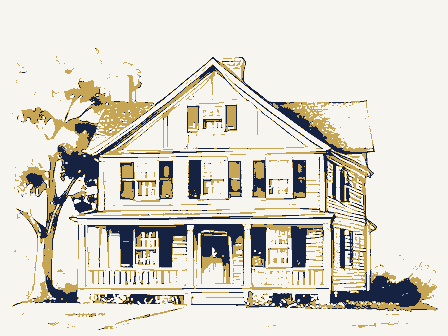
The Hunt-Wilke Farm was listed on the National Register of Historic Places for its agricultural and architectural significance in The farm was determined to have a high degree of historical integrity for farms located in the Cuyahoga Valley during the period The Hunt-Wilke Farm buildings represent the distinctive construction practices associated with the development of Cuyahoga Valley, and their spatial organization convey the functional workings of residential farm. Description: The farm is set among cottonwood trees beside an unwatered historic portion of the Ohio & Erie Canal that ceased to operate in The canal forms the west boundary of the Hunt property. There are farm fields to the south and east, but most of the farm's fields have reverted to successional forest.
Historic buildings include the house, garage and privy. The barn stands about 100 feet east of the house. This former schoolhouse was relocated to the property in the by William J. Fiedler. All of the buildings on the property are of wood frame construction. History: Introduction: In February the Cuyahoga Valley National Park changed the name of the Hunt Farm Visitor Information Center to simply the Hunt House. This change is appropriate given the lack of information available about the house, the namesake of the house, and amount of farming that actually occurred on the site. Presumably, Hunt Farm was originally named as such because the house was built while the Hunts were living and farming on the property.
However, the extent of land that was farmed and by whom is very much a mystery during the Hunt s occupation. HUNT-WILKE FARM HALS NO. OH-11 PAGE 2 It is known that members of the Hunt family owned the property from to However, it can only be verified that they lived as a family in the house until Little documentation about the Hunts during the years can be found revealing little about the family and which of its members actually lived on the farm during this time period. Therefore, a longer, broader view of this little farm s history must be taken to fully grasp the significance of this farmstead and its place in history.
History: The story of Hunt Farm begins with the purchase of the property by Walter Waite somewhere between and from James Root.1 James was the brother having power of attorney from Ephraim Root, who originally purchased the property as an investment from the Connecticut Land Company in the early before the Ohio and Erie Canal was built. Therefore, Walter was the first owner who actually inhabited the land.
Walter bought the Hunt Farm property as part of a 43-acre tract that was originally part of Lot 15 located west of the Cuyahoga River in Northampton Township, Summit County, Ohio.2 Walter already owned and farmed 112 acres of Lot 71 located directly to the east and across the Cuyahoga River from the 43- acre tract.3 Buying this land from James Root provided Walter with more prime farmland and direct access to the Ohio and Erie Canal. To understand the significance of this purchase, one must first understand how Northampton Township was platted by the Connecticut Land Company and then bifurcated by the construction of the Ohio and Erie Canal. When lots were first platted in Northampton, they were broken into two general categories: Lots West of the River and Lots East of the River (ER).
This was an important distinction because originally there were few bridge crossings of the Cuyahoga River. In fact, an map of Northampton Township only shows one such crossing of the river at Botzum.4 Therefore, owners of lots on one side of the river did not have reliable access to the land and lots on the other side of the river. To further complicate things, when the Ohio and Erie Canal was built in it became another linear water body bisecting existing lots into even smaller, isolated lots. In Northampton s case, there were now lots west of the canal, lots between the canal and the river, and lots east of the river. Having access to the canal was at least as important to a farmer as having access to the river.
Canal access provided a transportation connection to markets both 1 Hunt-Wilke Farm Listing 2 Summit County Tax Maps and 3 Summit County Tax Maps 4 Atlas of Summit County HUNT-WILKE FARM HALS NO. OH-11 PAGE 3 north (Cleveland) and south (Akron). As we shall see, we know for sure that it improved Walter s ability to sell cheese in distant markets. Figure 1 shows the relationship of the Waite Farm (including the 43 acres purchased from Root) to the canal and the river in circa Walter Waite was a native of Massachusetts being born in Shortly after his marriage to his first wife, Elizabeth in the couple began their westward trek to the Western Reserve with, reportedly, only a horse, a wagon, a skillet, a gun and an ax.
They first settled in Cuyahoga County, Ohio but moved to Richfield Township in Summit County, Ohio around On April 11, Elizabeth died having become the mother of six children.5 In October of that same year, 40-year old Walter was re-married to Mary Hovey the daughter of Abiel and Martha Hovey. The newlyweds purchased 112 acres in Lot 71 ER and began farming. Mary s parents, Abiel and Martha Hovey, were also natives of Massachusetts who slowly migrated westward having a prolonged stop near Montreal, Canada where Mary was born in The Hovey s first moved into the Western Reserve in settling in Boston Township. Eventually they had ten children including Mary.6 Several descendants of the Hovey s became well-known farmers in the Cuyahoga Valley.
By Walter and Mary Waite had a son Abiel named after Mary s father. Next, another son, John was born and named after Mary s brother. In a daughter was born and named Martha after Mary s mother.7 Four more siblings were subsequently born to Walter and Mary, but Abiel and Martha Waite are the two important offspring in this story. Abiel Waite grew up on the family farm and married in taking over more of his 64-year old father s farm duties. It is around this same time period that Walter purchased the 43-acre tract from James Root in Lot 15 WR. The population census for Northampton Township lists two separate dwellings for the Waites: the first is headed by Walter and likely is the original residence on the 112-acre farm; the second is headed by Abiel and its location is unknown.
Within Walter s residence reside Mary and his two youngest children (ages 19 and Within Abiel s dwelling resides his wife (also named Mary), and their three young children (ages 6 and under).9 The question is where was the second residence located since both Walter and Abiel farmed the same land? Curiously, an tax map shows a 9-acre portion of the Lot 15 WR tract as a subdivision of the 43-acre parcel that Walter had purchased from Root. Both the 5 Perrin, History of Summit County 6 Ibid 7 Ibid 8 Ibid 9 U.S. Bureau of Census, Population HUNT-WILKE FARM HALS NO. OH-11 PAGE 4 9-acre tract and the remaining 34-acre parcel were still in Walter s ownership in This suggests that Walter (who was now 70) had subdivided this parcel to become a site for a second residence on his farm.
It seems most plausible that Walter separated this 9-acre tract from the remainder of the farm for Abiel to build a home and raise his family while still working on his father s farm. It is this 9-acre tract that has historically been referred to as Hunt Farm and thus is referred to for the remainder of this discussion. Figure 2 is a copy of the tax map clearly showing the 9-acre tract highlighted in yellow color. In looking at the 9-acre Hunt Farm tract, it is interesting to note that it has the least amount of prime farmland on the entire 43-acre portion of the Waite Farm.
To this day, if you look at the 9-acre tract historically associated with Hunt Farm you realize that only about 25% of it is worthy of farming with the vast majority of it lying within the floodplain of Furnace Run and typically soggy and wet. Aerial photos from (when the land was still being farmed) show that except for a 1.4-acre area planted directly north of the Hunt House and another 0.6-acre garden plot north of Furnace Run, the majority of the farm is in woodland (Figure 3). The L-shape of the Hunt Farm parcel is also interesting. Typically, in the when land was subdivided in the Western Reserve it was done on a north-south grid to match the original lot lines. This parcel was purposely designed in an L- shape to exclude some of the best farmland from the 9-acre parcel.
This further suggests that the major purpose of this site was to become a home site and not a farm site. In this manner, Walter s son Abiel, could continue to farm the remaining 146 acres of the family farm yet raise his family in a separate residence, across the river, from that of his parents. Remembering that Abiel was married in and that the tax map shows the 9-acre parcel as a subdivision suggests that sometime between and Abiel built a home on the Hunt Farm site. This first home is not likely the current Hunt House which, according to the nomination report was built around Walter Waite died on September 2, one year after his second wife Mary.12 However, a couple of years prior to their deaths, Walter and Mary had a survey of the 9-acre Hunt Farm tract completed by H.
Paul on May 13, It is likely that this survey was completed so that the 9-acre tract could be transferred to Abiel. However, according to the nomination report, Abiel transferred the 9-acre tract to his sister Martha that same year This suggests that in 10 Summit County Tax Maps 11 Hunt-Wilke Farm Listing 12 Perrin, History of Summit County 13 Summit County Recorder, Deeds, Vol. pp. HUNT-WILKE FARM HALS NO.
OH-11 PAGE 5 the entire Waite Farm was first transferred to Abiel and then the 9-acre parcel was transferred to Martha, likely as part of her inheritance.14 It is clear from tax maps that in Martha owned the 9-acre tract and that Abiel owned the remaining 34 acres ins Lot 15 WR and 112 acres in Lot 71 ER.15 Throughout the Abiel would add 40 more acres to his holdings from Lot 61 ER for a self-proclaimed total of 187 acres by However, Martha s holdings would never increase in size beyond 9 acres, and only 2 of them were very suitable for farming. Less is known about Martha Waite. As earlier stated she was born in and grew up on the Walter Waite Family farm. The census shows her as a sixteen year-old daughter living in Walter s residence.17 She cannot be found in the census for Northampton.
In the census she reappears in the Northampton census as Martha E.
Hunt, wife of Norman Hunt and mother of nine children ranging in age from 16 to less than 1 year old.18 More interestingly, the census shows that Martha gave birth to five of her then nine children from to in the State of Wisconsin suggesting that Martha and Norman moved to Wisconsin shortly after their marriage in presumably and did not move back to Ohio until The biography of Martha s brother Abiel Waite confirms that he also lived in Wisconsin for five years; however, the dates for his hiatus are unknown.20 Another interesting find during this period is that the tax maps show the eastern half (80 acres) of Lot 61 ER in Northampton being owned by Norman Hunt.21 Lot 61 ER abuts Lot 71 ER owned by Abiel Waite (see Figure 6).
Remember that this is at the same time that his wife Martha Hunt is listed as the owner of the 9-acre parcel in Lot 15 WR. Apparently both parcels were farmed by the large Hunt family, even though they were, apparently, living on the 9-acre tract. tax maps show that Norman Hunt no longer owns the 80-acre parcel in Lot 61 ER but the census for that year indicates that he lives on the 9-acre tract owned by his wife. The census suggests that the two oldest Hunt children have moved out and that only Norman, Martha and five of their children remain at Hunt Farm.22 According to the nomination, the Hunt House was built 14 Hunt-Wilke Farm Listing 15 Summit County Tax Maps 16 Perrin, History of Summit County 17 U.S. Bureau of Census, Population 18 U.S. Bureau of Census, Population 19 U.S.
Bureau of Census, Population 20 Perrin, History of Summit County 21 Summit County Tax Maps 22 U.S. Bureau of Census, Population HUNT-WILKE FARM HALS NO. OH-11 PAGE 6 in as evidenced by a doubling of taxes for the parcel that year.23 A property card for this parcel prepared by Summit County lists as the year that the house was built.24 Norman Hunt was nine years older than Martha. He was born in in Northfield Township, Ohio to parents who had also emigrated from Massachusetts. His younger brother Calvin (the namesake of one of Norman and Martha s children) inherited the family farm and married Victoria Waite from Richfield Township, Ohio in It is unknown if Victoria Waite is related to Abiel and Martha Waite, but it is quite possible as all of their parents once lived in Richfield Township.
The Federal Population Schedules for Summit County were completely destroyed by fire in the Commerce Department Building in January so it is impossible to determine what happened to the Abiel Waite and Martha Hunt families by then. However, the census indicates that Norman (now age 75) is married to a second wife named Eliza, suggesting that Martha had died sometime between and The tax map still shows the 9-acre parcel being owned by Martha Hunt, however, it also shows two small parcels acres total) abutting the 9-acre parcel being added sometime after and labeled as being owned by the Heirs of Martha Hunt .27 This suggests that Martha died between and with multiple heirs and not with just her husband as sole survivor. The and tax maps show the same thing as the tax map.
It is interesting to note that while Norman and Eliza can be found in the census for Northampton, they cannot be found on the tax maps, suggesting that they continued to live at Hunt Farm until Norman s death, even though the property was still in Martha Hunt s name. From these same tax maps, it appears that Abiel Waite s 187-acre farm was transferred first to Frank Reifsnider by and then to Frederick Bolanz by Thus by Waite/Hunt family involvement in farming on Waite Farm that had begun 60 years earlier by Walter Waite was either completely finished or nearly so. One can only guess what happened to the Hunt Family after Why the farm remained in Martha s name until it was finally sold in even though she had died sometime in the is unclear.
Furthermore it is unclear who the Heirs of Martha Hunt included. When the farm was sold in seven of the 23 Hunt-Wilke Farm Listing 24 Summit County Fiscal Office Property Card 25 Perrin, History of Summit County 26 U.S. Bureau of Census, Population 27 Summit County Tax Maps HUNT-WILKE FARM HALS NO. OH-11 PAGE 7 surviving children of Martha Hunt identified themselves as all the heirs at law of Martha Hunt . However, when they transferred the now acre parcel to August Wilke in for they only sold the portion of the parcel that the heirs owned in common. It is unknown who owned the other portion of this parcel and how, if ever, this portion was transferred to Wilke.28 August Wilke and his wife Johanna were both age 62 when they purchased Hunt Farm.
This is hardly the age that you become a farmer, suggesting that they were simply looking for a small home in which to live. In fact, according to the nomination, Mr. Wilke died five years later and his widow conveyed the property to her son who sold it to Amanda Point Stull (born somewhere between and her death in Amanda also owned two parcels of land directly to the north of the Hunt Farm that had been owned by her prominent Boston Township family of farmers, the Points. One of these parcels was 11 acres in size and the other was 14 acres in size. These two parcels were (and are) located in adjoining Boston Township, Summit County.
By Amanda s daughter Nelle May Stull (born had married William James Fiedler (born and moved into the Hunt House.30 Now the farm was 35 acres in size, with about 27 of those acres being prime farmland (See Figure 4). In the Fiedlers sold the two northern parcels to the Szalay s who farm these parcels to this day. In Nelle May died and later in William Fiedler died. Not long afterwards, the original 9-acre Hunt Farm tract was sold to the United States for incorporation into the Cuyahoga Valley National Park.31 A wonderful description of the Hunt Farm and its residents beginning with Amanda Point Stull, the Fiedlers, and the Fiedler s offspring can be found in Reminiscences of My Days in Everett, Ohio by Helyn May Fiedler Toth, daughter of William and Nelle May Fiedler.
Toth passed away in but through her writings and oral histories, readily available on the internet, it becomes evident that the most farming that ever occurred on Hunt Farm was done so by her father William ( Bill ) Fiedler. Today when one visits Hunt Farm, the first question that they ask is Where is the farm? To the west of the Hunt House lies the Ohio and Erie Canal, to the south of it runs Bolanz Road, to the north of it is a wooded floodplain bifurcated by Furnace Run, and to the east of it lays a cornfield that is owned by someone else and not part of the 9-acre parcel. There is no true barn on the property.
The Wilkes or Amanda Stull likely added a garage (or shed as referred to by Helyn Toth and currently repurposed as a restroom) and the Fiedlers moved an old one- room school house from Botzum to serve as a makeshift barn in the It is undeniable that Norman and Martha Hunt did live on this 9-acre parcel and 28 Summit County Recorder, Deeds, Vol. pp. 29 Hunt-Wilke Farm Listing 30 Toth, Reminiscences of My Days in Everett, Ohio 31 Ibid HUNT-WILKE FARM HALS NO. OH-11 PAGE 8 did farm what little land on this parcel was suitable for this use. However, with a large family to feed, it is unlikely that this farm was capable of ever providing enough food and/or income to support their family.
Therefore, they also likely farmed the 80-acres that they owned in Lot 61 ER and/or helped Abiel Waite farm his 187-acres. The nomination notes that the Agricultural Census shows Norman Hunt farmed 29 acres that produced 70 bushels of winter wheat, 300 bushels of Indian Corn, and 280 bushels of oats. Additional products included molasses and maple sugar .32 This indicates that Norman was farming on both parcels in However, as earlier noted, by Norman no longer owned the 80-acre parcel on Lot 61 ER and it is unclear what he was doing to support his family. It is known that Walter Waite was a successful farmer.
Perrin notes that Walter Waite purchased a large tract in Lot 71, where he built a house and set an orchard, the trees of which are standing yet, and the fruit is enjoyed by his children's children. 33 Typically, orchards were grown on the hillsides and uplands to avoid late spring frosts that settle down into the valley. The Agricultural Census reports that Walter Waite produced 20 tons of hay, 30 bushels of Indian Corn, 500 pounds of butter and pounds of cheese in addition to his orchards.34 Walter was likely already utilizing the canal to ship cheese to Cleveland and Akron by the time he purchased the 43-acre parcel from Root.
There are no records for what Walter produced when he first began farming in Row crops and grains on alluvial soils bordering the Cuyahoga River remained the most important crops during the first half of the century, including corn, wheat, oats, and potatoes. All of these crops could be easily loaded on to canal boats and shipped to either Cleveland or Akron for distribution without fear of spoilage. In the mid-1800s, the number of dairy farmers began to increase in the Cuyahoga Valley. This occurred due to the construction of numerous cheese factories that allowed farmers to sell their milk to be made into cheese, thereby reducing spoilage. The cheese was then shipped to Akron or Cleveland for distribution.
Later, once the Valley Railway had been built, milk products could be delivered to these cities daily without worrying about spoilage. As a result, the Waite Farm was heavily involved in dairy farming during the second half of the century. The Cuyahoga Valley National Park website notes that the value of milk produced in the valley tripled in value between and 32 Hunt-Wilke Farm Listing 33 Perrin, History of Summit County 34 U.S. Bureau of Census, Agriculture 35 NPS Website, HUNT-WILKE FARM HALS NO. OH-11 PAGE 9 It is interesting to note that while dairy farming was very important on the Waite farm, the Point farm focused more on the production of oats in the mid- nineteenth century.
The listing for the Point farm credits this to the demand that Akron s Schumacher rolled oats cereal business created for this grain after the Civil War.36 Similarly, the Farm Census for Norman Hunt s farms indicates that he also produced high volumes of oats, suggesting that his farm was more similar to Point s than Waite s. With time, much larger farms to the west of the Cuyahoga Valley could produce milk products and deliver them via trains less expensively than the small family farms in the Valley. This led to the next transition of valley farms from With improved roads, truck farming and roadside stands became more popular in the Cuyahoga Valley during the early century. This is the type of farm that the Fiedlers operated.
Crops grown by them included melons, tomatoes, beans, peas, lettuce, beets, turnips and squash. In addition to trucking these crops to markets in Cleveland and Akron, farmers typically put roadside stands at their farms. In many ways the truck farming/roadside stand farm model continues to this day in the Cuyahoga Valley. In summary, it can be argued that the Hunt Farm site is most significant as a smaller part of a larger heritage of farming in the Cuyahoga Valley. Its major stages include: 1. As part of Walter Waite s 155-acre, canal-era, dairy farm The Hunt site provided access to the Ohio and Erie Canal allowing Walter to ship his cheese, fruits and grains to Cleveland and/or Akron.
Towards the end of Walter s life, it became a home site for his children to reside and thus continue the tradition of the family farm. 2. As part of a larger Hunt Farm or as part of Abiel Waite s adjoining 187-acre, train-era dairy farm While it is likely that cows grazed on the Hunt Farm site during this time period, the main focus of the farm was to provide a home for Abiel s sister Martha Hunt and her family. Farming during this period would have been limited at Hunt Farm; however, there was plenty to do on the adjoining Waite Farm and at Hunt s second farm on Lot 61 ER. 3.
As part of William Fiedler s truck farm Adding the 25 acres of prime agricultural land located to the north of the original Hunt Farm made this a larger farm capable of supporting the Fiedler family through the Great Depression and World War II. To this day, the Szalay family grows corn on the 25-acre parcels to sell at their farm market. Today, the Hunt House and related out-buildings serve as an attraction for the 36 Point Farm Listing HUNT-WILKE FARM HALS NO. OH-11 PAGE 10 thousands of users along the Towpath. While the full history of the Hunt House may never be determined, the land associated with it can be deciphered in three logical stages.
 Block
Block