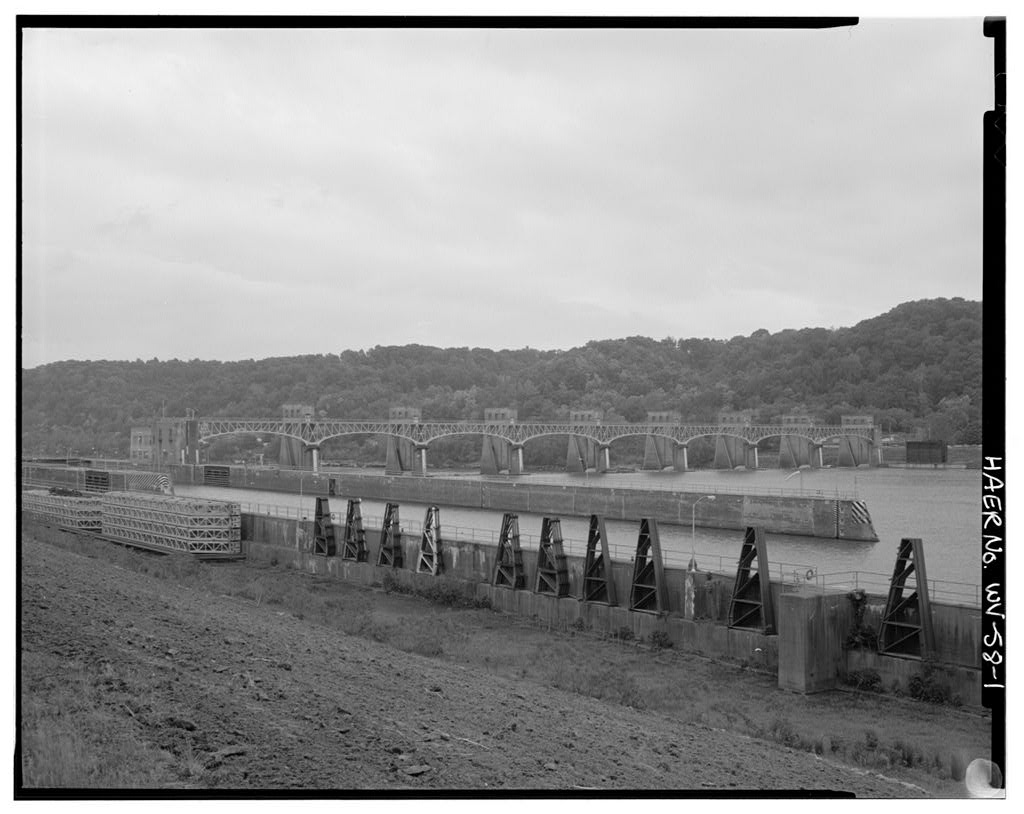
,V1 HAER No. Gallipolis- vicinity, Mason County, West Virginia UTM: Locks A 17 B 17 C 17 D 17 UTM: Dam E 17 F 17 Quad: U.S.G.S. Applegrove Dravo Corporation, Pittsburgh U.S. Army Corps of Engineers Locks and Dam on Ohio River The Ohio River navigation is one of the principal waterways of the United States. Improvements were made in the natural waterway by the construction of a whole series of locks and dams. During the in response to increased river traffic, all of the locks and dams were to be upgraded or replaced by large modern 600 ft. locks. The Gallipolis locks and dam, completed in were not only unusual in the use of roller gates but this new location provided the lowest pool for a series of locks and dams on the Great Kanawha River.
This engineering work was the first hydraulic structure at this location on the Ohio River. Except for replacement of original electric motors, the addition of partitions in the lock house and routine maintenance of the lock machinery and gates, the structure remains in original condition. This large engineering work is composed of two locks and a gated dam. The locks are located on the West Virginia bank of the river. The Gallipolis Locks and Dam were recorded in by Past and Present. The principal investigor on the project was Emory L. Kemp, project historians were Michael Workman, Billy Joe Peyton and Janet Kemp, archival photographers were John Nicely and Joe Condie. Gallipolis Locks and Dam (Robert C. Locks and Dam) HAER No.
(Page 2f Early Navigation on the Mississippi and Ohio Rivers The Mississippi River and its tributaries drain nearly three-fifths of the United States, including some of the most fertile and productive territory in the nation. Since even in its "unimproved" state it has always been nominally navigable, this vast river system has played a large role in the development of the nation, especially in the nineteenth century. American civilization expanded westward along the route of the "Western waters," moving in an irresistible tide from the Upper Ohio frontier to the south and west.
Because of its important role in peopling and supplying the western frontier, the Ohio river has been aptly called the "Gateway to the West." Later, as towns were founded along the banks of the Western waters, the trade and communications of the nation flowed through the rivers' channels. Until the triumph of the railroad in the the Mississippi waterway was the nation's most important interior transportation system. Before the Mississippi-Ohio river network was largely unimproved, and navigation was contingent upon natural conditions. Various river improvement projects were projected, but little was actually accomplished. The Commonwealth of Pennsylvania undertook several small projects, including the removal of snags and obstructions on the Monongahela.
The federal government, despite its willingness to undertake the National Road, which was completed from Baltimore to Wheeling in did even less than the states for river improvement. The Jeffersonians were bound by the view that federal intervention in the internal affairs of states was unconstitutional. However, a precedent was set in when the federal government made its first authorization of money for the Mississippi river system, a paltry for a survey of the tributaries of the Mississippi and Ohio rivers (Schubert, p. 9). In the laissez-faire policy of the federal government on river improvement began to change.
The new policy can be attributed, in part, to the triumph of the Nationalists, such as Presidents Monroe and Adams, i; Henry Clay and Albert Gallatin, who advocated an active role for the federal government in making "internal improvements." The "Nationalists" thought that the Interstate Commerce clause of the Constitution provided ample authority for federal action. Also, the public had become convinced that both commercial development and national defense, as shown during the War of required more reliable transportation arteries. In the space of Gallipolis Locks and Dam (Robert C. Locks and Dam) HAER No. (Page 3j one month in May, President Monroe signed two bills which signalled the beginning of the nation's river improvement policy.
The first was the General Survey Act, championed by Henry Clay. This legislation sought "to procure the necessary surveys, plans, and estimates" for river improvements, canals, and roads. Congress provided to cover expenses. While this was only planning legislation, the second, the Waterway Bill of appropriated to improve navigation on the Ohio and Mississippi rivers. This bill directed that the president employ "any of the engineers in the public service which he may deem proper." For the most part, the president chose engineers from the U.S. Army Corps of Engineers, founded in The engineers used the appropriation to remove snags and construct wing dams at bars to provide a minimum of three feet of water for navigation from Pittsburgh to St. Louis (Schubert, p. 9).
Congress continued to provide annual appropriations for Ohio and Mississippi river improvements from until when the Panic of forced President Martin Van Buren to curtail federal expenditures and stop all waterway projects. Appropriations were renewed briefly from to but were halted by the Mexican War. A major river and harbor bill was enacted in but this was the last one enacted until after the Civil War. In retrospect, the inland waterways improvement program of the federal government during the ante- bellum period must be judged a failure. As Colonel Stephen H. Long of the Corps of Engineers told Congress in the major problem had been the irregularity of Congressional funding.
The Corps was obliged to build a dredge and snag fleet three times, and three times they were forced to sell it at a great loss. In all, nearly half of all the funds provided were wasted (Johnson, pp. The Development of Waterways Engineering As the nation developed in the ante-bellum period, its waterways assumed a greater importance as arteries of transportation and communication. And, as cities situated along the Mississippi and Ohio river system grew, flooding became a problem, especially on the lower Mississippi. In response to the need for better navigation and flood protection, federal and state governments and private companies improved rivers and harbors, built canals, bridges, and aqueducts, and erected floodwalls and ievees.
The great demand for knowledge and practical Gallipoiis Locks and Dam (Robert C. Locks and Dam) HAER No. (Page 4) experience about waterways spurred the development of the engineering profession and provided a stimulus for the advancement of engineering science. There were army engineers serving during the Revolutionary War and even during the Colonial period. After the founding of the Republic, the federal government led the way in training and providing engineers, creating the U.S. Army Corps of Engineers in and the U.S. Army Topographical Engineers in (Schubert, p. In addition, there were a number of engineers who provided their services to governments or private companies on a contract basis.
One of the primary stimuli for the development of waterways engineering in this period, as well as later, was the flooding problem on the lower Mississippi. In Congress asked for the appointment of a board of engineers to study flood problems there. Consisting initially of Charles Ellet, a civil engineer, Colonel Stephen H. Long, and Captain Andrew A. Humphreys, U.S. Army Topographical Engineers of high repute, the board produced two of the most influential reports on waterways engineering in the nation's history. The first, The Mississippi and Ohio Rivers, was written by Ellet and published in It recommended the construction of reservoirs for flood control and multiple purposes on the tributaries of the Mississippi.
The second, Physics and Hydraulics of the Mississippi River was written by Humphreys and Henry L. Abbot (Long's replacement) and published in The Humphreys-Abbot report contained definitive hydraulic information about the lower Mississippi and proposed that flood control be maintained mainly by levees (Johnson, p. These two reports guided federal waterways policy from the time of the Civil War until the present. From the year of its publication until about the Humphreys-Abbot report and its "levees only" policy was the standard for all federal action on flood control on the Mississippi. From that date forward, the "levees only" policy was superseded by Ellet's reservoir scheme, which is still being carried forward today. Charles Ellet, Jr.
and the Reservoir Plan Leland Johnson notes in his work, The Headwaters District, that planning for the system of reservoirs on the Upper Ohio began in with the work of Charles Ellet, Jr. (Johnson, p. Since Ellet's ideas Gallipolis Locks and Dam (Robert C. Locks and Dam) HAER No. (Page 5) played such a important role in the development of American waterways engineering, they merit further discussion. Born in near Philadelphia, Charles Ellet, Jr. was one of the most notable engineers of the nineteenth century. Ellet began his career as a canal engineer, serving from to with the James River and Kanawha Canal Company. Later, he served in a similar capacity for the Schuylkill Navigation Company.
In the he turned to bridge building, first publishing a pamphlet, A Popular Notice of Suspension Bridges, setting-out his ideas and proposing the construction of a suspension bridge across the Schuylkill River near Philadelphia, which was built in In he designed and completed a suspension bridge across the Niagara River. In he was hired by the Wheeling & Belmont Bridge Company to supervise the design and construction of the Wheeling suspension bridge, which was completed in (Lewis, p. Despite the significance of Ellet's work on suspension bridges, his main claim to national recognition was his work on the western rivers. In he turned his full attention to the study of the problem of improving the nation's rivers.
The exact origin of Ellet's ideas cannot be determined, but it is clear that much of his empirical work was accomplished on the Ohio River while he was at work on the Wheeling bridge. Here, he studied historic flood and flow records, established a discharge measurement section, recorded surface velocities with loaded floats, and developed a stage-discharge curve for the Ohio, contributing a great deal to the development of the science of hydrology (Lewis, p. Johnson, p. According to Johnson, Ellet came to his conclusions on river improvement after the Wheeling experience: "He had engineered canals and reservoirs as canal feeders, and that experience plus data on the flow of the Ohio clicked in his mind.
He concluded [that] a five-foot depth for navigation could be maintained on the Ohio through regulated releases from reservoirs built on tributaries."(Johnson, p. Ellet took his ideas to Congress and found support from Senator Henry Clay, proponent of the American Plan for internal improvements. In Congress appointed Ellet to the aforementioned board of engineers to study the flood problem on the lower Mississippi. Humphreys and Long desired more detailed information about the rivers before making recommendations, and, with Henry L. Abbot replacing Long, they continued their surveys Gallipolis Locks and Dam (Robert C. Locks and Dam) HAER No. (Page 6) and studies until when their Physics and Hydraulics of the Mississippi River was published.
Ellet, very much the individualist, chose to work independently. He first presented his views on reservoirs in a paper entitled "The Physical Geography of the Mississippi, with Suggestions for the Improvement of the Navigation of the Ohio and Other Rivers. "(Smithsonian Contributions to Knowledge, Later in he submitted his report to Congress.(U.S. Congress, S. Ex. Doc. 20, The report was also published in the same year as a book entitled The Mississipp i and Ohio Rivers (Johnson, p. Pittsburgh Flood Commission, p.
In these works, Ellet proposed the construction of high masonry dams on headwater tributaries of the Ohio to retain flood water for release during droughts, thereby reducing flood crest heights and flood damages and also maintaining navigable depths on the lower Allegheny, Monongahela, and the Ohio during periods of low flow. The reservoirs would obviate the need for the construction of locks and dams. Reservoir releases, he claimed, could also power water mills and abate stream pollution. Thus, his system of waterways development would have several benefits. It is notable that this was the first multipurpose waterways plan in the U.S. (Johnson, p.
Ellet believed that the reservoir system could be constructed and managed according to scientific principals: "These things will be effected, not by main force, but by skill," he declared. "The rain gauge will indicate the approaching danger from the summits of the distant mountains; the telegraph will announce the fact at the flood-gates, and the whole may thus be controlled by the provisions of science. In fact, the desired effect can be produced by a few dams in the mountain gorges, and the constant attention of some twenty men." (Johnson, p. It should be noted that Ellet did not advocate reservoirs as the sole means of flood control for the Mississippi.
In the Congressional report and in The Mississi ppi and Ohio Rivers, he recommended that the reservoirs be built in conjunction with improvements in the Mississippi River levee system. (Pittsburgh Flood Commission, p. Under the leadership of Henry Clay, the Senate approved Ellet's plan and provided for an appropriation for a survey of reservoir sites in the Allegheny and Monongahela basins in The bill was defeated in the Galiipolis Locks and Dam (Robert C. Locks and Dam) HAER No. (Page 7) House, however, because many of the members were devoting their attention to the Compromise of (Lewis, p. Roberts' Devastating Critique Ellet's reservoir scheme was dealt another blow in when William Milner Roberts published a devastating critique.
Roberts was a civil engineer who had worked on the Pennsylvania mainline canal in the early-1830s and was chief engineer under General James K. Moorehead for the Monongahela Navigation Company from to where he surveyed the Monongahela River and designed the first four locks and dams for the company (Johnson, p.
In his paper "Practical Views on the Proposed Improvement of the Ohio River," Roberts contended that Ellet's reservoir plan was "impracticable," both as a means of regulating floods and as a way to maintain a constant flow of five to six feet in the Ohio River (Franklin Institute, XCVII, Roberts contended that the engineering and construction of a reservoir system would be more complex than Ellet imagined, that coordination of operations would present problems, and that Ellet had not fully considered the costs of relocating towns, railroads and other property from reservoir sites. Roberts argued that the reservoir dams would destroy flatboat and raft traffic.
He estimated that the cost of building the reservoirs would be $60 million, a sum which he considered prohibitive and not in keeping with the benefits to be obtained. Instead of reservoirs, Roberts proposed a system of locks and dams, similar to those he helped build on the Monongahela, to improve navigation on the Ohio River (Johnson, p. Pittsburgh Flood Commission, pp. Although Roberts' views gained sway over those of Ellet, there was some support for Ellet, as indicated by a paper written by Elwood Morris, C.E., "Review of the Practical Views of W.
Milnor Roberts," which was published in the Journal of the Frankli n Institute in In this short piece the writer "avows, that having closely studied this subject, and being personally familiar with the Ohio River, he has become strongly impressed with the superiority of the system of reservoirs proposed by Charles Ellet, Esq., C.E., and fully satisfied that an ^B accurate survey alone is all that is necessary to find adequate sites for reservoirs to demonstrate both the Gallipolis Locks and Dam (Robert C. Locks and Dam) HAER No. (Page 8) practicability of the plan and its pre-eminence over all others.... No discussion will obviate the necessity of a suitable survey." (Pittsburgh Flood Commission, p.
There would be no survey of reservoir sites for decades, however, because the reservoir plan was shelved during the early years of the Civil War. The nation's first comprehensive plan of flood control would not be realized for decades. The plan lost its greatest proponent in when Charles Ellet, Jr. died as a result of a wound he received while commanding the Union ram fleet near Memphis. Even more damaging than Roberts' criticism to the EHet plan was the favorable reception given to the Humphreys-Abbot report, Physics and Hydraulics of the Mississipp i. It set flood control policy for the federal government on the Mississippi for the next three-quarters of a century.
In bis "Letter of Transmittal" for the report, Humphreys confidently surmised that "every important fact connected with the various physical conditions of the river and the laws united them being ascertained, the great problem of protection against inundation was solved." After condemning the reservoir plan of EHet on the same grounds as Roberts its impracticability and high cost the two engineers recommended protection of the Mississippi by a "levees only" policy (Johnson, pp. Morgan, pp. Although the conclusions of Humphreys and Abbot, as well as Roberts, on Ellet's reservoir plan have subsequently been proven fallacious, it should be recognized that at that time they were probably correct. Reservoirs were "impracticable." The art of large dam construction had not been developed.
Construction technology had not advanced to the point that would allow economical movement of large quantities of earth. Portland cement had not been invented. As Colonel William Merrill, Roberts' successor as Chief Engineer, put it: "How can one build a dam a hundred feet high when we have difficulty building fifty-foot dams that are watertight?" Charles EHet, Jr. was indeed a visionary (Morgan, p. Johnson, p.
According to Arthur Morgan, the real problem with the rejection of Ellet's plan and the Corps' acceptance of a "levees only" policy for flood control, as well as a slackwater only policy for navigation, was that it was ^P accepted almost blindly by the Corps of Engineers for nearly seventy-five years, even after the technology for realizing the reservoir plan had been developed (Morgan, p. Gallipolis Locks and Dam (Robert C. Locks and Dam) HAER No. (Page 9) Slackwater for the Ohio River In William Milnor Roberts was named the Pittsburgh District Engineer. Roberts was directed to clear the Ohio River of obstructions and prepare for further improvement of the river.
In "Survey of the Ohio River," Roberts repeated the conclusions that he had reached in in opposition to reservoirs and, based on his experience with the Monongahela Navigation Company, proposed a "radical plan," the construction of 66 locks and dams between Pittsburgh and Cairo to provide six-foot slackwater for navigation. No action was taken for several years on the construction of the locks and dams, however, because of meager funding from Congress (Executive Documents, congress, Johnson, p. Roberts'successor at the Pittsburgh District was Major William E. Merrill, who held the position of Engineer from to In his "Report on Improvement of the Ohio River," published in Merrill accepted Robert's conclusions on the impracticability of reservoirs for the Ohio River.
In his report, he compared the feasibility of two plans: "one is to retain surplus water by huge reservoirs on the upper tributaries, preserving an unobstructed channel, and the other is to retain a sufficient depth for navigation by locks and dams, thus making shallow reservoirs in the main river." For the reservoir system, Merrill simply referred to the previous paper of William Milnor Roberts and gave a summary of his objections to the reservoir system. As for the slackwater system, Merrill listed seven advantages compared to reservoirs: 1. It has long been tried and is now in use on the Monongahela, where it meets the demands of the same commerce that navigates the Ohio. 2.
There are no great hazards connected with the system, as the dams are low and the destruction of one will not necessarily injure the one next below. 3. It is known positively that locks and dams can be built that will fully answer their purpose, and their cost can be determined before hand with very fair accuracy. 4. There would be nodamages from overflow, or destruction of property of any kind. 5. No special care is needed in the use of the slackwater system. The pools are themselves reservoirs containing the minimum amount of water needed and at the exact place where it is to be used. 6. The cost of this system would probably be less than the other. rf 7.
The pools would make excellent harbors for all river craft, an improvement that is greatly needed at the large cities, especially at Pittsburgh (Pittsburgh Flood Commission, pp. # Gallipolis Locks and Dam (Robert C. Locks and Dam) HAER No. (Page 10) Under Merrill's leadership, the Corps of Engineers began to implement Robert's "radical plan," the funding of the construction of the Davis Island Dam on the Upper Ohio in initiating this program. In settling on the Humphreys and Abbot "levees only" policy for flood control and the Roberts and Merrill slackwater plan for the navigation of the Ohio, the Corps of Engineers had opted for the tried and true methods of the past.
The Chittenden Report Rejoins the Debate Despite the Corps' rejection of the reservoir plan, Ellet's vision had not vanished. Renewed interest in reservoirs as a means of flood control and navigation came after the publication of the Chittenden report in General Hiram Chittenden was one of the most accomplished engineers in the U.S. Army. Chittenden directed the preservation of Yellowstone National Park, surveyed the Lake Erie to Ohio River canal routes in invented the drum weir, and, in his spare time, wrote monumental histories of the American West. In his Ohio canal surveys, Chittenden had projected dams and reservoirs to supply water to the canals (Johnson, p. Morgan, pp.
These conclusions must have influenced his report, "Examination of Reservoir Sites in Wyoming and Colorado," which dealt with improvements of the upper Missouri River basin (House Document No. In this report, he pointed out that "the ideal stream would be one in which the flow should be uniform from one year's end to the other, or, if not uniform, varying directly with the magnitude of the uses to which it is put." To attain this ideal, he proposed federal construction of dams and reservoirs for multiple purposes (Pittsburgh Flood Commission, pp. The Chittenden report had a large impact.
His proposals for reservoirs on the Upper Missouri were endorsed, in part, by President Theodore Roosevelt, who secured the enactment of the National Irrigation Act of This bill authorized federal funding for reservoir construction in the arid West, mainly for irrigation. This was the first federal sponsorship of dam and reservoir construction in the nation's history. However, the bill had ^p no impact on federal policy in the east (Johnson, p. Gallipolis Locks and Dam (Robert C. Locks and Dam) HAERNo. (Page 11) Although it was not well received by Pittsburgh District Engineers, Chittenden's report was well received by civilian engineers and Progressive leaders in the cities and towns along the Upper Ohio, especially Pittsburgh.
In the to period, many Ohio river towns were devastated by floods. In response, Progressive engineers, politicians and business leaders joined in an effort to deal with the flood problem. Many embraced the reservoir plan and challenged the Corps' conservative policy. In Pittsburgh, the Chamber of Commerce endorsed the reservoir concept following the flood of In the group sent a representative to the National Board of Trade convention to urge support for federal construction of flood control reservoirs. The National Board of Trade lobbied for federal funding of reservoirs during the early Progressive period and played a leading role in passage of the National Irrigation Act.
In Pittsburgh, the Chamber of Commerce's action marks the beginning of the flood control movement that led to the establishment of the Pittsburgh Flood Commission in (Johnson, p. Pittsburgh Flood Commission, pp. According to Arthur Morgan, the Corps' conservative policy on the reservoir question was the result of blind acceptance of "authoritative dogma," especially the Roberts report. In his controversial book, Dams. and Other Disasters, in which he criticizes the Corps on several fronts, Morgan argued that the primary reason for the Corps' "petrified" attitude was the military education of the its engineers. According to Morgan, "members of the Corps of Engineers [are] taught at West Point not to critically think, but to follow authority." (Morgan, p.
While there may be some merit to Morgan's contention, the biggest barrier to federal action on reservoirs in the East was not the military thinking of the Corps, but the lack of a mandate from Congress. Until the Corps had legislative authority to engage in river improvements only, for navigation. According to Joseph L. Arnold, author of Evolution of the Flood Co ntrol Act "Congress passed no legislation that was directly and openly aimed at flood control until Federal action on flood control until that time was limited to special projects on the lower Mississippi River, As a result, the Corps was placed in a "strait-jacket by Congress itself," complained Francis Newlands, the Nevada Senator who led a campaign in Congress for multipurpose reservoir Gallipolis Locks and Dam (Robert C.
Locks and Dam) HAERNo. (Page 12) construction. The Corps was forced to justify each project solely in terms of its benefits to navigation. As Corps engineers acknowledged in calculating the cost-benefit equation for new projects, the benefit of reservoirs for navigation alone was not great enough to justify their high cost (Arnold, p. 3. Johnson, p. The Decline of River Navigation In the to period, the Corps of Engineers was placed in the position of having navigation cany the burden for all their work and improvements. This was an impossible task.
Although traffic on the lower Monongahcla River continued to grow until when the decline of the coal industry ied to a dip in tonnage, overall traffic on the nation's rivers declined dramatically in the late-nineteenth and early-twentieth centuries. Despite the Corps' slackwater improvements of the Upper Monongahela, Allegheny, and Ohio Rivers, the railroads became the nation's principal form of transportation. Flood Control to the Forefront With the decline of navigation, the reservoir controversy revolved around the question of flood control. The disastrous "Fifty Million Dollar" flood in Pittsburgh in brought the flood problem to the forefront. Pittsburgh's engineers and civic leaders looked for a solution. In July of Thomas Roberts, U.S.
Corps Assistant Engineer, presented the Corps' answer to the Pittsburgh flooding problem in a paper presented before the Engineers' Society of Western Pennsylvania. In the paper, "Floods and Means of their Prevention in our Western Rivers," Roberts advocated the raising of the flood-prone areas and the building of walls along the rivers in Pittsburgh for the purpose of flood protection. Although Roberts acknowledged the advantages of flood control by storage reservoirs, he stated that the probability of finding adequate storage areas was slight (Johnson, p. Pittsburgh Flood Commission, pp. Roberts found no allies for his proposal in the Engineers' Society of Western Pennsylvania. His paper was roundly criticized by Morris Knowles, Emil Swensson and E.K. Morse.
Citing the Chittenden report, Morris Knowles proposed a multipurpose reservoir system to protect Pittsburgh from floods and to augment low water Gallipolis Locks and Dam (Robert C. Locks and Dam) HAER No. (Page 13) flows, thereby benefiting navigation, reducing the effects of pollution, and increasing the industrial water supply. He told the Society that the "Fifty Million Dollar" flood "should be used to agitate and prepare the public mind that funds for this purpose can be obtained. It is a worthy object in which this Society and other civic organizations can unite in a strong effort." Swensson and Morse agreed with Knowles. The Engineers' Society of Western Pennsylvania became a rallying ground for opponents of the Corps (Johnson, p.
Morris Knowles, along with other American engineers in the Progressive era, had a different view on the role of engineers in society than that which had prevailed previously. Rather than the narrowly-constricted role adhered to (by law) by the Corps, Progressives thought that engineers could solve the ills of society. Knowles said, "the engineering profession can contribute more than any other class of citizen, for the engineer is the true conservationist of society." He further stated that engineers are "better equipped, by training and habits of thought," than any other citizens to determine public policy issues (Johnson, p. The Pittsburgh Flood Commission After the Pittsburgh flood of the Pittsburgh Chamber of Commerce set up a committee to undertake a study of flood damages.
On February 20, the Chamber appointed industrialist Howard J. Heinz to chair the committee. Morris Knowles was also appointed, along with other independent engineers and business leaders. Pittsburgh District Engineer Henry C. Newcomer was selected for the engineering sub-committee. The original purpose of the committee was simply to calculate flood damages, but soon its mission was enlarged to study the Pittsburgh flood problem and recommend remedial measures. Colonel Newcomer resigned after he learned of the committee's expanded mission. Financed by donations from businesses and contributions from the city and county, the original committee became the Flood Commission of Pittsburgh. The Flood Commission soon became one of the nation's leading proponents of multipurpose reservoirs.
After Newcomer's departure, the Flood Commission expanded its membership to include engineers E.K. Morse, Emil Swensson, William G. Wilkins, George S. Davison, A.B. Shephard, Long, Paul Didier, and Julian Kennedy. The commission began a full-scale study Gallipolis Locks and Dam (Robert C. Locks and Dam) HAERNo. (Page 14) and employed Kenneth C. Grant as principal engineer (Pittsburgh Flood Commission, p. 1. Johnson, pp. The Pittsburgh flood also had an impact on the federal level. It led to the creation of the Inland Waterways Commission in With Senator Francis G.
Newlands (R-Nevada) arguing that traditional rivers and harbors navigation projects should not be considered separately from other possible water resources uses, President Theodore Roosevelt appointed the commission to study the entire question of water resources. With Newlands 1 guidance, the commission solicited papers and testimony on the question. Marshall O. Leighton, Chief Hydrographer of the U.S. Geological Survey, was named engineer for the commission (Arnold, p. The Debate Continues Leighton submitted a paper, "Relation of Water Conservation to Flood Prevention and Navigation in Ohio River," to the Inland Waterways Commission in which was published in the commission's report of that year.
He argued for reservoirs mainly on the basis of flood control, but also noted that a reservoir system would benefit navigation and generate water power. He met Roberts' and Merrill's objection of impracticality of the reservoirs by pointing-out that ninety-seven reservoir projects had already been accomplished in different parts of the world. Using figures from these projects, he estimated that the cost of a reservoir system on the Ohio would be million, a sum not greatly exceeded by the million in estimated damages in the Ohio valley from the floods (Pittsburgh Flood commission, pp. Criticism of Leighton's paper came almost immediately from Corps' officers. Captain William D.
Connor responded with a paper, "The Application of the Reservoir System to the Improvement of the Ohio River." (Engineering News, Vol. 59, Connor addressed the reservoir question in terms of three potential benefits, flood protection, assistance to navigation, and water power development, but admitted that "there is no question but that today its relation to navigability is the most important test that must be applied to the system in discussing its practicability." Echoing the contentions of Roberts and Merrill, he concluded that a reservoir system could be of benefit for flood control and navigation, but it would be not be practicable. Furthermore, he argued that by itself a Galiipolis Locks and Dam (Robert C. Locks and Dam) HAER No.
(Page 15) reservoir system would not be sufficient to completely improve the Ohio River for navigation (Pittsburgh Flood Commission, pp. Lieutenant Colonel Newcomer, District Engineer of the Pittsburgh District, also wrote a critique of Leighton's paper. His "Proposed Reservoir System in Ohio River Basin," appeared in Engineering News on October 8, Newcomer contended that storage reservoirs would be of little importance in improving the navigability of rivers. Instead, improvement would come from the completion of the Ohio River slackwater project. Newcomer also doubted that it would be possible to find adequate reservoir sites, and that the whole scheme would be impracticable (Pittsburgh Flood Commission, pp.
The debate between Leighton and Corps officers was also waged in various engineering journals, especially Engineering News. While Corps engineers cited Milnor Roberts' arguments in his and reports, Leighton contended that things had changed since then. Roberts had complained that high dams would destroy fiatboat and raft traffic; Leighton said that traffic had virtually ended. Roberts had argued that construction and land acquisition costs would be prohibitive; Leighton said costs would be less than benefits. Roberts had contended that management of a reservoir system would be too complex; Leighton thought the telegraph and telephone could overcome the problem. Roberts had warned that high dams could fail; Leighton argued that engineering advances had obviated that object (Johnson, p.
In the middle of the controversy, the editors of Engineering News published an editorial of great insight in its June edition. The editorial broke through a conceptual barrier that had constrained both sides in the debate. Up until this time, both the proponents and opponents of the reservoir concept had argued as if it were an either-or proposition. No consideration was given to the possibility that faoih. reservoirs and a system of locks and dams were needed for navigation. And with the exception of Ellet's report, nor was there consideration given to the idea that hoik levees and reservoirs would be needed for flood control.
The Engineering News editorial, in comparing the merits of locks and dams and reservoirs for improvement of navigation on the Ohio, stated that "each is needed to supplement the other." In considering flood control, the editorial noted that "a system of reservoirs can be made to supplement the protection furnished by dikes and levees." The editors also noted, as did # Gallipolis Locks and Dam (Robert C. Locks and Dam) HAERNo. (Page 16) Arthur Morgan in his Dams and other Disasters, that there had been no detailed field surveys of possible reservoir sites. Because of the lack of reliable information, the whole debate on reservoirs had been conducted in a vacuum.
The editors urged that the feasibility of the reservoir system be tested by making detailed surveys and estimates for reservoirs in the Allegheny and Monongahela basins. They concluded: "If the reservoir system of river control can be made practicable anywhere in the Ohio River basin, it is on the rivers which meet at Pittsburgh. Here, then, is the place to make the first test." (Pittsburgh Flood Commission, pp. The Report of the Pittsburgh Flood Commission On April 16, the Flood Commission of Pittsburgh released its report, the result of an exhaustive four-year study which included extensive field surveys and visits to foreign countries in order to observe comparable waterways projects. The report was revealed at a dinner at the Schenley Hotel; Senator Newlands and Marshall O.
Leighlon were the main speakers. With over 400 pages, the report was an impressive document (Johnson, p. The authors based their recommendations on extensive surveys and investigations of waterways projects in Germany and Russia. They recommended that both flood protection and flood prevention measures be taken to protect the city. To obtain protection, a flood wall would be built.
Maintaining that "flood prevention by storage reservoirs is possible and practicable," the commission recommended them because: (a) The flood relief would be extended over hundreds of miles of tributaries and of the main rivers, including the Ohio, for many miles below Pittsburgh, (b) The impounded flood water, with proper manipulation of the reservoir system, would considerably increase the low-water flow of the tributaries and of the main rivers. (c) The increased low-water flow would greatly aid navigation and interstate commerce. (d) The increased low-water flow would notably improve the quality of water for domestic and industrial purposes. (e) The sewerage problem of Pittsburgh and of many other communities along the rivers would be simplified.
(f) The public health would be protected against the dangers arising from the unsanitary conditions ^ caused by overflow and by extreme low water. ; (g) A considerable amount of water power would be incidentally developed (Pittsburgh Flood Commission, pp. Gailipolis Locks and Dam (Robert C. Locks and Dam) HAERNo. (Page 17) The commission considered a total of forty-four reservoir projects on the Allegheny and Monongahela Rivers and surveyed thirty-two of them. The commission recommended the construction of seventeen reservoirs. It estimated that the costs of the project would be near $24 million, but its benefits would be about $96 million.
The benefits would be achieved through flood damage reductions, water power development, and low flow augmentation to improve navigation and water quality (Pittsburgh Flood Commission, p. The report of the Pittsburgh Flood Commission was influential in progressive engineering circles, but it had little immediate impact on the thinking of the Corps of Engineers. Nor was it accepted by the people in the city of Pittsburgh or in the tributary regions. On November 5, Pittsburghers rejected a bond issue that would have funded the proposed flood wall. In December, a board of Corps officers who had been appointed to review the report in order to ascertain how the proposed reservoirs would benefit navigation, made an unfavorable report.
And, people living near the proposed reservoir sites vigorously opposed the commission's plans to inundate their homes and businesses to save Pittsburgh (Johnson, p. Ohioans Test Reservoir Plan In March of the Ohio River and its tributaries overflowed their banks once again, but this time most of the damages were suffered by Ohioans rather than Pittsburghers. The flood was particularly disastrous in Dayton and the Miami Valley area, where more than 300 persons were killed and million suffered in damages. In the aftermath of the disaster, the great Progressive Theodore Roosevelt declared that the Federal Government should build reservoirs to conserve flood waters to use for irrigation, hydroelectric power generation, and dry-season water flow.
However, President Woodrow Wilson took a more conservative action: he appointed a board of Army Engineers to investigate the problem. The Ohio River Flood Board visited fifty-two cities that had suffered damages during the flood. The board's report was released after seven months. It stated that all feasible flood protection measures, including reservoirs, should be used, but it recommended no specific plan because of insufficient data. The board recommended further studies, and more importantly that a definite federal flood control policy be established (Johnson, p. Gallipolis Locks and Dam (Robert C. Locks and Dam) HAER No. (Page 18) Ohioans were unhappy with the report and unwilling to await federal action.
On the Mahoning, Shenango, and Miami Rivers, citizens decided to take action on their own. In Youngstown, an industrial city on the Mahoning River, the city needed an improved water supply as well as flood control. In plans were made and funding provided by the city to dam the Mahoning at Milton. The Milton Dam, a feet long and 40 feet high compacted sand and clay structure, was completed in at a cost of million. It was the first multipurpose reservoir in the Pittsburgh Engineer District (Johnson, p. On the Miami, citizens formed a Flood Prevention Committee and hired the Morgan Engineering Company, led by civil engineer (and later author), Arthur Morgan, to study all methods of flood control.
The scope and authority of the committee was enlarged in as nine cities became involved, and, its name was changed to the Miami Conservancy District. Its consulting board recommended levee and channel improvements and a system of five reservoirs to provide flood prevention. With Morgan's leadership, the improvements, including the reservoirs, were completed by This was the first multipurpose reservoir system in the Pittsburgh Engineer District (Morgan, pp. In Sharon and New Castle, Pennsylvania, on the Shenango River, the flood problem was addressed shortly after the flood. New Castle engineers developed a plan calling for the construction of a dam closing the outlet of Pymatuning swamp. Since the reservoir would be partially in Ohio, the project was delayed because of legal complications.
Financed by federal funds for Depression work relief, construction work began in and Pymatuning Dam was completed in (Johnson, p. Federal Flood Control Legislation According to Arthur Morgan, the success of the Ohio projects convinced some Corps officers of the feasibility of multipurpose reservoirs. However, the main obstacle to federal funding and construction of vast, multi-state reservoir projects such as the one recommended by the Pittsburgh Flood Commission continued to be congressional intransigence. This, however, was changing. In congressmen from the lower Mississippi Gatlipolis Locks and Dam (Robert C. Locks and Dam) HAER No. (Page 19) states were successful in creating a House Committee on Flood Control.
This committee created a permanent forum for congressional flood control proponents (Morgan, p. Arnold, p. The House Committee on Flood Control played a leadership role in the passage of the Flood Control Act of According to Arnold, this bill was the "most concrete result of the Progressive Era's flood control movement." Arnold notes that the bill was important in four respects. First, it marked the first time that Congress appropriated funds openly and primarily for the purpose of flood control. Second, it established a congressional commitment to fund a long-range program of comprehensive flood control for two rivers, the lower Mississippi and the Sacramento. Third, the act introduced the principle of requiring local financial contributions for federal flood control projects.
Finally, the act authorized the Corps of Engineers to undertake examinations and surveys for flood control improvements. These were to be comprehensive studies of an entire watershed for the purpose of providing information regarding the relationship of flood control to navigation, water power, and other uses (Arnold, pp. Although the Pittsburgh Flood Commission had been thwarted in its earlier attempt to accomplish its program, the commission continued to lobby Congress for flood control legislation.
With the changing climate of opinion, the commission was successful in helping to convince Congress to pass the Flood Control Act of By the act, the commission secured a matching federal-state grant to fund flood control studies by the Pittsburgh Engineer District of the Monongahela and Allegheny basins. The scope of this survey was extended the following year with the passage of the River and Harbor Act of March This legislation recognized the growing importance of water power in waterways planning. It authorized an investigation of those navigable streams of the country where water power development appeared to be feasible and practicable in conjunction with flood control and navigation.
Armed with these mandates, Pittsburgh District engineers began an intense study of the Allegheny and Monongahela basins in (Johnson, pp. Styer, p. As Pittsburgh District engineers studied the Allegheny and Monongahela basins, an event occurred which severely strained the credibility of the Corps of Engineers. In the lower Mississippi rose to unprecedented levels and flooded over square miles in seven states. With 250 deaths and million in damages, Gallipolis Locks and Dam (Robert C. Locks and Dam) HAER No. (Page 20) Secretary of Commerce Herbert Hoover called it the "greatest disaster of peace times in our history." The Corps was attacked in Congress and in the press for its outmoded ideas on flood control.
The public outcry led to the passage of the Flood Control Act of which authorized an expenditure of million for flood control on the lower Mississippi. It also led to the founding of the Waterways Experimental Station in Vicksburg, Mississippi, which performed hydraulic modeling and testing. The flood also led the Corps to change its "levees only" policy and reconsider reservoirs as a means of flood control. Even the Chief of Engineers, General Edgar Jadwin, a long-standing opponent of reservoirs, stated that "while not accepting reservoirs as cure-alls, [he] believed that they might form a valuable part of a complete Mississippi flood project." (Arnold, pp. Morgan, pp.
When Jadwin retired in September, President Hoover passed over a long list of recommended candidates for the post in order to name a proponent of reservoirs, General Lytle Brown, as Chief of Engineers. A revolution in waterways engineering the change from the theories of Humphreys-Abbot to those of Ellel had been effected. By the Pittsburgh District had completed its comprehensive river basin report. (Meanwhile, in the Corps began surveying the nation's rivers for the purpose of considering multipurpose water resource development.
Known as Reports," because they were proposed in House Document Congress, 1st session, the river basin studies were completed in There were no Reports" for the Monongahela and Allegheny Rivers, however.) A draft of the District's report (which was never published) on the Allegheny and Monongahela basins was circulated among members of the Pittsburgh Flood Commission, who refused to approve it. The commission complained that the report overestimated the costs of multipurpose reservoirs and underestimated their benefits. It hired two engineers, Harold A.
Thomas and Ross Riegle, to prepare an alternate plan, which was produced in The Pittsburgh District considered this plan, and proposed other alternatives in the years prior to the signing of the National Industrial Recovery Act of (Johnson, p. Gallipolis Locks and Dam (Robert C. Locks and Dam) HAER No. (Page 21) Navigation on the Great Kanawha River The Internal Improvements Movement, which antedates the founding of the Republic, sought to provide a network of roads, canals, and later, railways to exploit the vast natural resources beyond the Appalachian mountains. One of the earliest proponents of this movement was George Washington who had a vision of developing a canal along the James River across the mountains to join the Kanawha River watershed.
Washington's vision was never to materialize in terms of a navigable waterway from Tidewater, Virginia to the Ohio River. Nevertheless, the Corps of Engineers undertook studies on the Central Waterline, which was essentially the James River and Kanawha Canal, in to determine whether Washington's dream was a feasible engineering project. Thus, the canalization in the century of the lower reaches of the Great Kanawha River represent the only successful portion of the century project. In Washington, in the company of colleagues and Indian scouts, explored the upper reaches of the Ohio River to acquire land and determine the suitability of the Ohio River as a national waterway.
Thus, Washington was involved in projecting schemes for navigation for both the Ohio River and, its tributary, the Kanawha. It was not, however, until coal became the primary energy source which fueled the industrial revolution, that serious consideration was given to improving the Kanawha for navigation. The earlier efforts were simply to improve the river channel by removing snags, enlarging chutes over ledges, and dredging shoals. This work was undertaken under the aegis of the Kanawha Board established in West Virginia in A decade later, a federal appropriation established the Corps of Engineers in the Kanawha Valley. It was at this time that Colonel William E.
Merrill a leading military engineer involved in a number of navigation projects including the responsibility for the Kanawha River, proposed the construction of locks long and wide. This was later to become the standard for navigation on the Ohio, until the completion of recent locks and dams which maintain the width but increase the length of the locks to In suggesting a wide lock, Merrill developed a new type of lock gate which he called a "rolling" gate which slid across the lock chamber rather like a pocket door. Because of its great width and weight it was mounted on wheels rather than being swung from the traditional miter gate cudgeon and pivot system. Gallipolis Locks and Dam (Robert C. Locks and Dam) HAER No.
(Page 22) In a system often locks and dams had been completed on the Kanawha River providing navigation nearly 100 miles upstream to the Great Fails of the Kanawha. This was the first (canalized) river navigation to incorporate moveable wicket dams on all but the upper two dam locations, which were of the fixed crest design. By the late the Kanawha navigation system was inadequate to cope efficiently with an annual movement of nearly two million tons of coal and an increasing traffic in other commodities such as chemicals. Work began in with an authorization from Congress, to build four new locks and dams to replace the ten original structures on the Kanawha.
After alternative designs were evaluated, it was decided to build the first lock and dam not at the mouth of the Kanawha, but rather ten miles downstream from Gallipolis on the Ohio River. In this location the lock and dam provided a pool to the lock and dam at Racine 42 miles up the Ohio and 31 miles up the Kanawha to the location of the Winfield lock and dam. Thus, the new locks and dam at Gallipolis replaced old locks and dams numbered 24, 25 and 26 on the Ohio as well as lock and dam 9, 10 and 11 on the Kanawha.
This location obviously helped to improve navigation on the Ohio but by being located on the Ohio rather than at the mouth of the Kanawha, it overcame what was perceived to be serious silting problems which would have resulted had the lock and dam been built on the Kanawha rather than the Ohio River. This was part of a program during the to upgrade or replace the locks and dams on the Ohio River with large modern locks by wide. As finally located, the Kanawha navigation provided new locks and dams at London, Marmet and Winfield, as well as the Gallipolis locks and dam.
The upper locks and dams at London and Marmet were completed in whereas the Winfield and Gallipolis locks and dam were placed in service in All of these structures were built by the Dravo Corporation of Pittsburgh who held the American license for roller gate dams. Thus, it is not surprising that all of these structures featured this patented German moveable gate system. Because of increased tonnage being moved on the Ohio River and the greatly increased size of the towboats and barges moving on the river, a replacement program was undertaken beginning in to replace 46 locks and lowlift dams on the Ohio with 20 newer highlift structures featuring x wide main lock chambers and x auxiliary locks at each lock and dam location.
The program had progressed to the point where the older Gallipolis locks created a bottleneck for river traffic. Thus, the construction of a twin lock system Gallipolis Locks and Dam (Robert C. Locks and Dam) HAER No. (Page 23) which will bypass the present structure became an urgent issue. The dam will be upgraded but remain in essentially its original condition, whereas the present main and auxiliary locks will be filled in after the new twin locks are placed, providing a much improved alignment since the present locks are located in the bend of the river which makes navigation during high water a sometimes risky business.
Engineering Aspects of Locks and Dams In creating a navigable waterway, a combination of locks and dams is used to provide a series of slack water pools in a stairstep arrangement to guarantee minimum navigation depths in a river or canal. At each dam a lock or locks provides the means of transferring vessels from one pool level to another. Whether fixed or moveable, the dams on the Ohio and Kanawha rivers were not intended to provide for flood control. In order, however, to provide free navigation on the river during high water, the army engineers turned to a French moveable dam system. The French were interested in improving river navigation in their country during the and centuries.
They achieved this, in part, by the construction of "navigable passes" in selected dams across various rivers. The passes were originally 26 feet wide and later enlarged to 40 feet. These passes were built much like spillways on conventional dams with sidewalls and spillway aprons. The passes were closed with wooden needles placed side by side across the entire pass. The vertical needles were held in place by resting on a sill on the dam and against a wooden beam which was cable-supported at the top and braced against the sidewalls. In while working on improvements to the River Yonne, Poiree invented a moveable dam consisting of a series of iron bents which supported the top beams which, in turn, supported the upper end of the wooden needles.
The iron bents were pinned so that they could fold sideways and could lie flat across the top of the dam. With the needles removed and the bents folded down, the pass was free for navigation during high water. The first moveable needle dam constructed in America, between and was across a tributary of the Big Sandy at Louisa, Kentucky. In another French engineer, Boule, introduced a modification of the Poiree system composed of wooden gates resting on iron frames. This Boule system was widely applied in France and even used in Russia. Gallipolis Locks and Dam (Robert C. Locks and Dam) HAER No. (Page 24) The next development was introduced by yet another French engineer, Chanoine, who used horizontally supported shutters to close a navigation pass.
Apparently, it was first introduced in and he later applied for a patent in These shutters were released from a Poiree-type collapsible iron frame. The term "wicket" instead of shutter was applied in America where the first application of the Chanoine moveable dam was erected on the Great Kanawha River. These patented wickets could be quickly released and would fall flat on the dam. This provided an unrestricted opening for all manner of vessels, including log rafts, during high water. At other river levels the wickets were raised to provide a minimum depth of navigation in the pool. The lock at the site of the dam would still operate for deep draft barges and tows during levels of high water. The first two dams on the Kanawha were completed in with others following at a later date.
These moveable dams had a pass of 248 feet and formed part of the lock and dam system in the river. It should be noted that a Poiree-type auxiliary dam also was erected at the Gallipolis Lock and Dam to serve as a auxiliary system principally used for maintaining the roller gates. The next stage in the development of moveable dams was to use roller "Tainter" vertical lift gates and other devices that allowed water to pass over the top of the dam during high water, but was not a navigable-type pass in the French sense of the word. The Tainter gates consisted of a segment of a circle which pivoted about its center and could be raised to allow water to pass between the gate and the crest of the dam.
The gate was lifted by a moveable crane which raised the gate off the crest of the dam and allowed controlled amounts of water to pass. Radial gates had been used by American engineers from the beginning of the century. The first patent applied for was as early as by Marshall Lewis. This was followed by the patents of George Hildreth in and George Heath in both of which claimed similar improvements upon the original radial-gate design. These improvements were, indeed, so similar that lengthy litigation ensued. The originator of the Poiree moveable dam also used a circular arch gate with trunion support in some of his moveable dams.
The name is, however, associated with Jeremiah Burnham Tainter who obtained the rights to a circular gate design from Theodore Palmer and proceeded to patent the design. It was the improved Tainter gate that eventually became the standard for moveable dams used by the U.S. Army Corps of Engineers. Gallipolis Locks and Dam (Robert C. Locks and Dam) HAER No. {Page 25) The roller gate achieved the same means of control by raising a large steel tube or roller off the dam crest. The roller gate was invented by Max Karstanjen of Mainz, Germany and patented in He was the director of the bridge department of the Maschinenfabrik Augsburg-Nurnberg, Germany.
Although there were numerous early references in journal and trade publications on roller dams, it was not until with the appearance of Hilgard's book, " Bewegliche Wehre " that there was a comprehensive engineering treatment of the subject. However, Professor Hilgard read a paper on the roller dam at the International Engineering Conference in St. Louis. This paper first brought the roller dam to the attention of American engineers. By the end of two power dams and two irrigation dams were either completed or under construction in Washington, Idaho and Colorado. Dam No. 15 on the Mississippi River, at Rock Island, Illinois was the first roller dam designed by the U.S. Army Corps of Engineers. The next Corps of Engineers roller dams were on the Kanawha river at London and Marmet.
They were completed in by the Dravo Contracting Company who held the American patent rights from the famous Krupp Company. The Rock Island roller gates were built under rights granted by the M. A.N. Company of Germany. By the time of the construction of the Gallipolis Dam and its sister structures on the Kanawha River, more than 160 roller gate dams had been constructed in Europe. This type of gate did not, however, receive widespread application in America. The Gallipolis roller gate dam is the largest of a limited number of such structures in America. It has performed in an exemplary fashion for more than half a century and remains today in substantially original condition.
A prominent feature of the other three locks which form part of the Kanawha navigation improvement is the roller gate dams. When roller gates were first introduced by the Corps of Engineers it was believed they were superior to vertical lift gates, horizontal roller gates, or to Tainter or various radial gate designs. This was because of the inherent stiffness of the roller tube which allowed openings of much greater length than previous moveable dams. As a result, they provided a freer passage for ice and other drift materials. This satisfied the principal design goal of the Corps of Engineers, which was to provide the maximum free flow of water over a fixed dam crest during Gallipolis Locks and Dam (Robert C. Locks and Dam) HAER No. (Page 26) high waters to avoid flooding upstream.
The roller form was also favored because of its rugged construction which promised low maintenance and trouble-free operation under adverse conditions. In constructing the 9 foot channel on the upper Mississippi it was learned that the roller gates had to be raised above the level to maintain the minimum pool elevation behind the dam in order to pass ice floes. With the gates wide open not only was the pool lowered, but the great volume of water which was passed over the dam tended to erode the toe of the dam. Thus, began a long process of design modifications by the Corps of Engineers which first considered submerged roller gates and ultimately led to such refinement of the Tainter gates that they superseded the roller gate in American navigation engineering.
The 9 foot channel system stretching from St. Louis to Minneapolis originally featured roller gate dams which were replaced in whole, or in part, by later Tainter gate construction so that the present system has a mixture of both types. Even the improved roller gates were no longer considered state of the art and were not constructed after the second World War. Thus, the roller gate dams at Gallipolis and on the Great Kanawha represent a period of lock and dam design which was not only significant but represented considerable improvement over the earlier moveable dams. The roller gates were, in turn, superseded by the Tainter gate in subsequent design of locks and dams by the Corps of Engineers. The two locks significantly represent the technology of the Ohio River and that of the Kanawha.
The main lock is x wide and was the standard lock for the Ohio River at the time of its construction. The second is an auxiliary lock long which was a standard on the Kanawha River but it was constructed to a width of rather than the 55' or 56' for the Kanawha locks and dams. Gallipolis Locks and Dam (Robert C. Locks and Dam) HAER No. (Page 27) BIBLIOGRAPHY BOOKS Arnold, Joseph, Evoluti on of the Flo od Control Act (Washington: U.S. Army Corps of Engineers, Dunaway, Wayland F., "History of the James River and Kanawha Company" in Columbia University Studies in History, Economics and Public Law, V.
CIV (New York: Ellet, Charles, Report on t he Improvement of the Kanawha and Incidentally of the Ohio River by Means of Artificial Lakes, (Thiladelphia: Johnson, LelandR., The Headwaters District: A History of the Pittsburgh District U.S. Army Corps of Eng i nee r s , (Pittsburgh: U.S. Army Corps of Engineers, Johnson, Leland R., An Illustrated History of the Huntingdon District U f S. Army Corps of Engineers, (Washington: Lewis. Gene P., Charles Ellet The Engineer as Individuali st, (Urbana: Morgan, Arthur, Dams and Other Disasters. (Boston: Porter Sargent, O'Brien, William P., Mary Yeater Rathbun, Patrick O'Bannon. Gateways to Commerce, (Denver: National Park Service, Report of th e Pittsburgh Flood Commission.
Schubert, Frank N, editor, The Nation Builders: A Sesquicentennial History of the Corps of Topographical Engineers, 1 (Fort Belvoir, Virginia: U.S. Army Corps of Engineers, Wegmarm, Edward, The Design and Construction of Dams. (New York: , Smithsonian Contributions to Knowledge. II (Washington: JOURNALS Conley, Phil, "Early Coal Development in the Kanawha Valley", West Virg inia History. VIII (January, Hale, John P., "History of the Great Kanawha River Slackwater Improvements", West Virginia Historical Ma gazine, I (April, Sprague, John C, "Concrete for the Kanawha River Project", Civil Engineering , V. 8, No. 12 (December, Styer, "The Tygart River Reservoir Project", Civil Engineering, V. 5, No. 6 (June, En gineering News, V. 59 No. 24 (June, Gallipolis Locks and Dam (Robert C.
Locks and Dam) HAER No. (Page 28) En gineering News Record, V. 76 (July 6, V. 99 (December 8, V. Ill (September21, V. 112 (March29, V. 115 (November 21, V. 118 (Februarys Engineering Record, V. 68 (August V. 68 (November V. 68 (December 13, GOVERNMENT DOCUMENTS U.S. Army Corps of Engineers, Gallipolis Locks and Dam r Ohio River, Design Memorandum No. 7. (November U.S. Congress, House, H. Document No. Congress, 2nd session U.S. Congress, House, Kanawha River, WV r H. Document No. Congress, 1st session U. S. Congress, House, Kanawha River, WV From Lock 5 To Its Mouth. H. Document No. 31, Congress, 1st session U.S. Congress, House, Kanawha River. H. Document No. 91, Congress, 1st session U.S. Congress, Senate, Reports in Reference to the Inundations of the Mississippi River, S. Ex.
Document 20, Congress, 1st session U.S. Congress, Senate, Committee on Appropriations, Hearings on Public Works for Water and Power Resources. Congress, 2nd session .GALLIPOLIS LOCKS AND DAM (ROBERT C. LOCKS AND DAM) HAER No. (PAGE 29 ) PT. PLEASANT GALLIPOLIS OHIO FORMER SITE LOCK AND DAM - 26 MILE _ GALLIPOLIS. LOCKS AND DAM ^CHAMBER SBUR6 SCALE /2 0 GALLIPOLIS LOCKS AND DAM (ROBERT C. LOCKS AND DAM) HAER No. (PAGE WEST VIRGINIA SITE PLAN SCALE 300 O I, % I , I . I 300 FT J ^ZX CT GALLIPOLIS LOCKS AND DAM (ROBERT C. LOCKS AND DAM) HAER No. (PAGE 31) OHIO RIVER ,__ OLD LOCK OPERATIONS / lAl D. PIER 9 GATE 8 PIER 8 GATE 7 PIER 7 GATE 6 PIER 6 GATE 5 PER 5 GATE 4 PIER 4 GATE 3 PIER 3 GATE 2 PIER 2 GATE 1 PIER ! OLD AUXILIARY L-0 C K y OLD MAIN LOCK O L
No Scale
 Block
Block