 Block
Block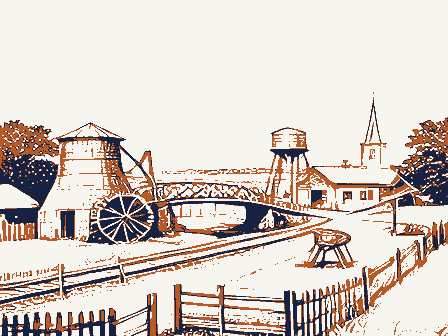
Green City (part 10 of 14)
Part 10 of 14 of the account of this township in Fifty Years and Over of Akron and Summit County, published 1892. 15,946 words, covering 78 settlements. Source changes inside the text are labelled at the exact paragraph where the next book begins.
Contents
19 sectionsThe section headings the book prints inside this chapter, on this part. Each one jumps to where it begins.
- Name, Organization, Etc
- Utopian Visions Not Fully Realized
- First Recorded Labor Strike
- Dr. Daniel Upson
- George Allison
- Agricultural, Mechanical, Etc
- Lucius W. Hitchcock
- Hon. Ira P. Sperry
- Later Business Operations
- George Peck Sperry
- A Proud Military Record
- Military Matters
- Tallmadge In Public Office
- Honorable Civil Record
- Present Business And Official Status
- Conclusion
- Homicide
- Early Fatalities, Pioneer Trials, Etc
- Early Modes Of Travel, Business, Etc
Parts
14 pagesThe source prints this as one continuous account. It is split here so no single page grows too heavy to load; the text runs straight on across the parts and nothing is omitted.
The chapter
15,946 wordsReproduced complete and unedited from Fifty Years and Over of Akron and Summit County, published 1892. The text is machine-read from scans, so expect recognition errors: misspelled names, dropped words, and stray characters. Nothing has been corrected, because correcting a proper name invents one. The headings below are the books' own; source changes are labelled in place.
Hence, Mr. Bacon's first work, before any settlements whatever were made, was to re-survey and re-arrange the lots and the roads of the township, so as to bring every portion thereof, as nearly as possible, upon a direct road leading to the contemplated sanctuary. The lands of the township had already been laid out, by Gen. Simon Perkins, of Warren, as agent of the Connecticut Land Company, into twenty-five sections of one mile square, each, with east and west and north and south roads, crossing at right angles. ae
The survey ordered by Mr. Bacon, divided the township into sixteen great lots of one and a-fourth miles square, not only divided by north and south, and east and west roads, but also subdividing one-half of the lots with diagonal roads from the northeast to the southwest, and from the northwest to the southeast corners, the other half of the lots also cornering upon said diagonal roads, all, like the east and west and north and south roads, leading directly to the center of the town.
At the center a commodious public square, of seven and onehalf acres, was laid out by Mr. Bacon, on which, and around which, was to be planted the church, the school-house, the store, the tavern, and the various mechanics' shops and private residences that were to form the future business emporium of the township, and as they have existed for the past three-fourths of a century.
PuzzLinc AS WELL AS CONVENIENT. - This arrangement of the roads produced eight corners at the center, and six corners midway between the center and each of the four corners of the township, designated by the inhabitants as the northeast, northwest, southeast and southwest six corners respectively. This multiplicity of "corners" has often been very puzzling to strangers - not always well posted on the points of the compass - though the local authorities have been exceptionally careful to keep a good supply of guide-boards at the several points designated.
After the country became settled up, with thriving communities and villages on every hand, and before the public square had been fenced in and planted to the beautiful shade trees by which it is now adorned, an eight-fingered guide-board was placed near the center of the square, with an arm pointing towards each of the eight diverging roads, with the proper legend inscribed on each side thereof. This octuple guide-board, with sixteen to twenty different directions upon it, was a great source of curiosity and study to travelers passing through the town, often eliciting many facetious remarks and much boisterous merriment.
It is related that one day the people living about the square were attracted by loud and repeated peals of laughter and on looking out of their doors and windows discovered a stranger rolling upon the ground, near the guide-board, indulging in the most extravagant contortions and paroxysms of laughter. He was soon surrounded by quite a crowd, who, from his hilarious antics and prolonged and vigorous guffaws, thought the stranger must have been taken suddenly crazy. After awhile, in response to their anxious inquiries, he raised himself on end and replied:
"T've often heard (ha! ha! ha!) of the (ho! ho! ho!) center of creation (hi! hi! hi!) but I never expected to (he! he! he!) see it - and now (ha! ha! ha!) I've got there!" ;
-At each of the six corners named, a school house was established at an early day, thus giving the inhabitants of every portion of the township easy access to the school as well as to the sanctuary, other school houses being erected from time to time in convenient localities as the necessities of the people required.
TALLMADGE'S First SETTLER. - Previous to the arrangement between Mr. Bacon and the principal proprietor of the township, as above stated, a few lots had been sold to private parties, Mr. Jotham Blakeslee, of Kent, Connecticut, having,in 1805, purchased from Ephraim Starr a portion of lot six, tract fourteen, of the Perkins survey, on the middle south line of the township. Mr. Blakeslee soon afterwards removed from Connecticut to Ravenna, though a few years later permanently locating in Tallmadge.
There is some diversity of opinion as to who was the first actual settler in the township. The generally accepted belief has been that it was Mr. Bacon himself, Hon. EB. N. Sill, Dr. Leonard Bacon and other speakers at the semi-centennial celebration, June 24, 1857, taking that ground. Mr. Bronson, however, gives the precedence to Mr. George Boosinger, who with his father had settled in Ravenna in 1801. Mr. Bronson states, that Boosinger, havin bought seventy-five acres of Mr. Blakeslee's land, in March, 1807, accompanied by Mr. Blakeslee, and some eight or ten other Ravenna neighbors, came over to Tallmadge, and in a single day cut the logs and built a 16x20 foot cabin, covering it with long split shingles, and laying a floor of split and hewed puncheons, the door being constructed of the same material, with wooden hinges, _ latch, etc. Into this cabin, the latter part of March, or fore part of
April, Boosinger moved his family, though a few weeks later Mrs. B. returned to Ravenna for a brief period, while there giving birth to twins - boy and girl - the boy dying shortly after her return to her new home in Tallmadge.
The same Spring (1807) Mr. Bacon, who had been temporarily sojourning in Hudson, hired a newly arrived Vermonter, by the name of Justin E. Frink, to clear a piece of ground for a garden, and on which to build a house. The ground selected was about a mile west of Boosinger's cabin, near the south line of the township. Of the removal of the family, on the completion of the regulation log cabin, the late Dr. Leonard Bacon (son of Rev. David
Name, Organization, Etc
Bacon, born at Detroit, February 19, 1802) in his semi-centennial address said: "I well remember, among the dim and early reminiscences of early childhood, the pleasant day in the month of July, if I mistake not, when the family made its removal from the center of Hudson to the new log house that had been prepared for it, in the township which had no other designation than No. 2, Range 10." I think, therefore, it may be accepted as a fixed fact that George Boosinger was the first actual settler in the township, and that, too, without detracting in the slightest degree from the honor due to Mr. Bacon, as the founder of the township, and the forerunner of its sterling population. Boosinger sold his property in 1836 and removed to Illinois, where he died in 1862. a i
OTHER PIONEER SETTLERS. - Up to February, 1808, there were in the township nine persons only - Boosinger, wife and child; Mr. and Mrs. Bacon and their three children, and Justin E. Frink. Karly in 1808, came Ephraim Clark, Jr., of Southington, Conn., with his newly married wife,a Miss Sperry, of Mesopotamia, Ohio, in which vicinity he had lived about nine years. The next settler is supposed to have been Jonathan Sprague, also in 1808, followed the same year, by Nathaniel Chapman, his father, Titus Chapman, William Neal, George Kilbourne, and Charles Chittenden, the latter moving into Springfield some two or three years later.
In rapid succession came Aaron Norton, Dr. Amos C. Wright, Moses Bradford, Thomas Dunlap, Eli Hill, Edmund Strong, Captain John Wright, John Wright, Jr., Jotham Blakeslee, Alpha Wright, Conrad Boosinger, Elizur Wright, David Preston, John S. Preston, Drake Fellows, Samuel McCoy, Deacon Salmon Sackett, John Caruthers, Luther Chamberlain, Deacon Nathaniel Gillett, Hosea Wilcox, Reuben Upson, fesse Neal, followed still later by the Treats, the Fenns, the Hines, the Carters, the Stones, the Sperrys, the Upsons, the Barnes', the Wolcotts, the Pecks, the Lymans, the Morrises, the Hinmans, the Ashmuns, the Sewards, the Upsons, the Pierces, the Roots, the Bronsons, the Betteses, the Battersons, etc. The majority of the early residents of Tallmadge, were from Connecticut, with a slight sprinkling from other New England States, New York, Pennsylvania and Virginia, and in the beginning was almost exclusively a Yankee town, though many other nationalities are at the present time represented in its population.
It will be impossible, within the limits of this chapter, to follow the individual fortunes of the pioneer settlers of Tallmadge township, all of whom, almost without an exception - though not all indorsing the peculiar notions of its founder - making firstclass citizens, each cheerfully bearing his or her share of the labors and responsibilities of shaping the destinies of the township and in supporting the material, moral and religious institutions of the county, State and nation.
Namek, ORGANIZATION, Etc. - Originally, Tallmadge, like all the townships of the western Reserve, was five miles square, bounded on the north by Stow, east by Brimfield (Portage county), south by Springfield, and west by Portage. On the erection of the township of Cuyahoga Falls, in 1851, out of the four contiguous corners of Tallmadge, Stow, Northampton and Portage, about 1,000 acres, embracing all of tract one, and about one-fifth of tract five, were contributed by Tallmadge, while, in like manner, in 1858, lots three and five, and part of lots four and six, containing about 300 acres were attached to the new township of Middlebury, then erected, and now constitute a part of the Sixth Ward of Akron. As supposed by Mr. Bronson, some time in June, 1808, the settlers of the township met at the house of Mr. Bacon, to determine upon a name, the only designation, up to that time being Town 2, Range 10. Mr. Bacon suggested that in honor to Col. Tallmadge, the largest individual proprietary land owner of the township, it should be named after him, which was unanimously assented to.
As stated in another chapter, Tallmadge, though at first rather a dependency of Hudson, was under township organization with Springfield, Coventry, Suffield and Randolph, under the general name of Randolph, and after separate organizations had been provided for the others, affiliated with Springfield until November 11, 1812, when it was duly organized under its own proper name. The first town clerk was Elizur Wright, and the first justice of the peace, Nathaniel Chapman; other officers not remembered.
The first death in the township was the twin boy of the Boosingers, heretofore alluded to, in 1807; the first birth was a daughter, Clarissa, to Mr. and Mrs. Charles Chittenden, in 1808, which child, grown to womanhood, married Mr. Isaac Newton, son of Middlebury's well-known hotel keeper of fifty years ago, Mr. Samuel Newton, and brother of Mrs. Elizabeth R. Johnston, still living in Akron. Mrs. Newton (who was a sister of the late Mrs. Huldah Bowen, widow of the late Dr. Bowen, of Akron), is still living in Dakota, her husband having died some five or six years ago. The first male child born in Tallmadge, October 5, 1808, was the present well-preserved octogenarian, Dr. Amos Wright; the first marriage being Sally Chapman, daughter of Deacon Nathaniel Chapman to John Collins, January 7, 1809; the first adult death in the township being that of Mr. Titus Chapman, November 18, 1808.
TOPOGRAPHY, PoPpuLaTIon, Erc. - The face of the township is generally gently rolling, though a mile or so west of the center is quite an abrupt eminence, known as Coal Hill, while there are also pretty steep hills and bluffs overlooking the valley of the Little Cuyahoga river, near the southwest corner. A point on Coal Hill, onthe tarm of Mr. Daniel Hine, a short distance south of his residence, is 636 feet above the surface of Lake Erie, and the highest ground in Summit county, excepting a portion of the township of Richfield.
In 1840 the population of Tallmadge was 2,134, the census of 1880 giving her a total of 1,455, and that of 1890 giving her 1,145 inhabitants, only. This apparent large falling off is due to the fact that, during the intervening fifty years, she had been despoiled of the two most populous corners of her territory, at Cuyahoga Falls and Middlebury (now Akron) the probability being that she has not only not retrograded, like some of the other townships of the county, but that the number of inhabitants within the present limits of the township, is considerably greater than that of the same territory in 1840.
__ The soil is generally a light loam, but with the most excellent tillage given to it by its industrious and intelligent occupants, extremely fertile and productive, the original forests, generally oak and chestnut, embracing also quite a sprinkling of ash, elm hickory, black-walnut, cucumber, beech, maple, etc. The drainage of the north and northwestern portion, is into the Big Cuyahoga river, which skirts the northern border, penetrating the township at one point only, by a sharp bend on the old Adna Sperry farm, and crossing that portion of the northwest corner now embraced in the township of Cuyahoga Falls. On the south and southwest, the drainage is into the Little Cuyahoga, which, traversing the extreme north part of Springfield, and the Sixth Ward of Akron, cuts across the southwest corner of the township near the Old Forge. Several small creeks and rivulets traverse different parts of the township, the most important of which is Camp Brook in the southwest portion, emptying into the Little Cuyahoga. Water power for manufacturing purposes, was therefore not very abundant one or two water-propelled saw-mills, only, finding a shortlived existence, excepting such milling and manufacturing operations as may have existed within the original limits of the township, at Cuyahoga Falls, upon the Big Cuyahoga, and at Middlebury and Old Forge upon the Little Cuyahoga. .
Utopian Visions Not Fully Realized
Although the early efforts of its truly pious and devoted founder, David Bacon, peopled the township with an exceptionally worthy class of inhabitants, and though the adjustment of lots, roads, etc., was most admirable, the good man failed to realize the fruition of his scheme in an ecclesiastical point of view. Ithad been his desire to conform the entire township to the support of the church to which he himself belonged. To this end he caused to be inserted in the contracts and deeds of conveyance a clause binding each 100 acres sold to the annual payment of $2 for the support of the "Gospel Ministry of the Calvinistic Faith of the Congregational Order forever," and also, in said deeds reserving the right and power to distrain for said annuity in case the same should be in arrears.
In addition to this, the Congregational society, when organized in 1809, adopted a voluntary schedule of taxation for its support, fixing the valuation of property, as a basis therefor, as follows: Timber land, $4 per acre; girdled and underbrushed land, $10; cleared land, $15; horses, three years old or over, $30; oxen, four years old or over, $20; steers and cows, $15; buildings to be valued by listers.
The first plan, though lived up to for several years, by a portion of the land-owners, finally proved a failure, several persons, who, though good and pious men, but not subscribing to the Calvinistic faith, refusing to pay the stipulated annuity. Mr. Edmund Strong being a leading recusant, in 1811 was'sued by Mr. Bacon for the amount levied on his land, as a test of the legality of such contracts. The late Peter Hitchcock, afterwards a member of Congress and judge of the Supreme Court of Ohio, acted as attorney for Mr. Strong, the case being decided in his favor.
Thus ended the perpetual land tax scheme devised by Mr. Bacon, for the support of the gospel in Tallmadge, though the maintenance of the gospel, and the Congregational Church there, was by no means a failure. How long the other scheme adopted by the society, of taxation on valuation, continued, the writer is founder of Tallmadge township, as herein written, was born at Woodstock, Connecticut, in 1871, being baptized September 15, of that year. Piously reared and educated, he was ordained a minister by the missionary society of Connecticut, December 31, 1800, and assigned to duty among the western Indians, with headquarters at Detroit, having already, the previous autumn, made a preliminary survey of the field, performing the journey either way mostly on foot. His salary, paying his own expenses, was fixed at one hundred and ten cents per day. On his second journey, in January, 1801, he was accompanied by his young wife, having meantime, December 24, 1800, been married to Miss Alice Parks, of Lebanon, Connecticut, then but 17 years of age, the first part of the journey by sleigh, and the balance on horseback. Here the devoted couple, amid great dis- couragements and privations,labored faithfully some four years, their first son, the since celebrated Dr. Leonard Bacon, having been born there, February 14, 1802. Want of adequate stpport by the parent society, and other untoward circumstances,finally compelled the abandonment of their cherished enterprise, and late in the Fall of 1804, they regretfully turned their stepseastward. The balance of
Bacon was the founder and pioneer. Mr. Bacon died at Hartford, Connecticut, August 27, 1817, in the 46th year of his age, Mrs. Bacon dying at New Haven, Connecticut, in 1850. Dr. Leonard Bacon, the son, after a long and useful life, as minister, educator and philanthropist, died at New Haven, December 24, 1881 - the grandson, Rev. Leonard Woolsey Bacon, D. D., being now pastor of the Second
Mr. Bacon SHAKES THE Dust oF TALLMADGE FRom His FEET. - Realizing the failure of his pet scheme and deploring, the unexpected opposition to his general plans, both temporal and spiritual, not only from the "outsiders'' who had found lodgment in the township, but from some of the members of the church which he had founded, and also having become somewhat financially embarrassed, Mr. Bacon, early in 1812, returned with his family to Connecticut, selecting for the text of his farewell sermon the ninth verse of the third chapter of Paul's Second Epistle to Timothy: "But they shall proceed no farther; for their folly shall be made manifest unto all men, as theirs was also,' his remarks being very pointed, and somewhat bitter towards those who had opposed, and possibly thwarted, his cherished plans. Mr. Bacon died at Hartford, Conn., August 27, 1817, at the early age of 46 years, his son, Rev. Dr. Leonard Bacon, noted for his learning, piety, philanthropy and patriotism, five years of whose boyhood were spent in Tallmadge, dying at New Haven, Conn., December 24, 1881, at the age of 79 years, 10 months and 5 days. Through the courtesy of Rev. Leonard W. Bacon, D. D., of Norwich, Conn., grandson of Rev. David Bacon, we are enabled to present to the readers of this work the accompanying most excellent portrait of 'the earnest and self-sacrificing founder of this, in all respects, model township - reliable Old Tallmadge.
Though the planting of the church was the first and paramount duty performed by the pioneer settlers of Tallmadge, the cause of education was by no means neglected. The first school, in a small log house built for the purpose at the south four- 'corners, was kept by Miss Lucy Foster, afterwards Mrs. Alpha Wright, mother of Mrs. Homer S. Carter, the late Mrs. Sidney Edgerton, and Clement and Benjamin ). Wright. Other similar schools were opened in convenient localities, as the population increased, but who taught them is not now remembered.
EP HA "Ww RiEG HT, - - born: at Winsted, Connecticut, December 26, 1788 ; removed with parents to Ashtabula county, Ohio, in 1802, and to Tallmadge, in 1808, being among the earliest settlers of that township ; December 12, 1811, was married to Miss Lucy Foster, a native of Hanover, New Hampshire, who taught the first school in Tallmadge, in a log house, erected in 1810; in the War of 1812 was a member of Captain Rial McArthur's rifle company, April Ss. 18, 1814, being promoted from ser- A geant to ensign; in 1827, with others, WG \\ ° -organized a school for the instruction I sini of deaf mutes (the first in Ohio), the Legislature, in 1828, appropriating $100.00 for its support, the pupils being transferred to the State Asylum -on its establishment at Columbus, in 1829. A great reader and a deep thinker, Mr. Wright was a leader in all religious, educational and moral -enterprises, and especially in the largely prevailing anti-slavery sentiment of his township; a fine singer 'and ready speaker, was the life and soul of religious and social gatherings, and his home the seat of an enlightened and generous hospitality. Mr. and Mrs. Wright were the parents of twelve children - Philo, born October 2, 1812, died December 3, 1844; Rev. William Wheeler, born May 12, 1814, now deceased; Lucy Ann, now widow of Rev. Luther Shaw, in Tallmadge; Clement, died in
Loomis Chandler, of Holly, Michigan; Clement, for 40 years a merchant, and for thirty-seven years treasurer and many years postmaster of Tallmadge; Amelia, deceased; Martha and Mary, Martha, wife of Mr. HomerS. Carter, of Tallmadge; Mary, late wife of Hon. Sidney Edgerton; Benjamin Demming, now secretary Akron Underwriters' Association, still residing in Tallmadge; Handel, deceased; Charles Storrs, deceased. Mr. Wright died March 1, 1856, at the age of 67 years, 2 months and 5 days, Mrs. Wright dying September 30, 1875, aged 85 years.
frame, upon the ground where the Congregational Church now stands, commenced in 1814, but not completed until the following year. The lower story was used for the district school, and the 'upper story as an academy, and for religious meetings and other public purposes. "Tallmadge Academy" was incorporated, by act of Legislature, February 27, 1816, Rev. Simeon Woodruff and Elizur Wright being among the earliest teachers. The academy building was destroyed by fire on the night*of January 12, 1820. A new building was erected, exclusively for an academy, upon the corner of the square and the southwest diagonal road, where the store of Mr. Clement Wright now stands, which building was afterwards removed to the place where it still stands, southeast of the N. Y., P. & O. depot, a separate district school house having been erected at the corner of the square and the southeast diagonal road.
R. AMOS WRIGHT, - born October 8, 1808, the first white boy baby born in Tallmadge, his parents, Dr. Amos Wright, Sr., and Lydia (Kinney) Wright, natives of Connecticut, having settled in Tallmadge that ear, after a residence of six years in ernon, Trumbull county; educated at Tallmadge Academy till 14, and working on farm till 19 years of age, then read medicine with his father two years, in 1831 and 1832, attending lectures in Yale College; in 1833, opened drug store in Tallmadge, continuing one year; then practiced medicine in Trumbull county two years, returning to Tallmadge in 1836, where he has been in continuous practice ever since, fifty-five years. March 31, 1831, Dr. Wright was married to Miss Clemence C. Fenn, of Tallmadge, having duly and appropriately celebrated their 60th wedding anniversary on March 31, 1891. Nine children have been born to them - Stella, Ellen M., Julia IL, Darwin E., now living, and H. M., Sarah E. and Alice, deceased. The doctor, at 83, is still hale and hearty, and can interestingly rehearse the many thrilling pioneer incidents with which his still unimpaired memory is filled.
The third academy building was erected on the ground now occupied by the Baldwin carriage shop, corner of the square and the north center road, this building also subsequently being burned. A town hall being built upon the south side of the public square about this time, an upper story was added, by voluntary donations, to be used for academical purposes (of which Hon. Sidney Edgerton, in the early forties, was principal) and was so used until that institution was superseded by the present graded school system, embracing a district a mile and a quarter square, when a nice four-room union school building was erected, a short distance north of the public square, the High School department graduating a goodly number of thoroughly educated pupils every year.
In addition to the above, Mr. Ephraim T. Sturtevant, having bought the second academy building, and removed it to the place where it now stands, east of the depot, sometime in the middle thirties, for several years taught a select classical school, with very great acceptance to his pupils and patrons.
PIONEER DEAF AND DumB ScHoor. - In the middle twenties among the children of the township, of school age, there Rene three deaf mutes, all daughters of Mr. Justus Bradley, and the question of providing them with an education was discussed. There was at the same time residing in Middlebury a young deaf mute by the name of Colonel Smith, who had been educated at the Deaf and Dumb School in Hartford, Conn. An arrangement was therefore made with Mr. Smith to undertake the education of the three children in question, and such other mutes as might desire to avail themselves of his instruction. This school was opened May Ist, 1827, in a room at the house of Mr. Alpha Wright, one mile south of the center, on the farm now owned by Mr. Cornelius A. Johnson. This was, undoubtedly, the first deaf and dumb school in the State, if not the first west of the Allegheny Mountains. In 1829 the deaf and dumb asylum was opened at Columbus, Smith's pupils being sent thither, and the Tallmadge school discontinued.
; Pusiic Lisrary. - In connection with educational matters, it is worthy of note, that a public library was established, in 1813, on the joint stock plan, supported by sales of shares, fines, assessments, donations, etc., which has maintained an unbroken existence of over three-fourths ofa century, and contains at the present time some 800 volumes.
CHURCH AND SprrituAL Marrers. - Though the cherished plan of its founder was to make the township purely and exclusively Congregational, in religious sentiment and government, the effort was, as before intimated, a failure, not only believers in other forms of faith, but many non-believers, even to downright infidelity, finding a lodgment within the township; the overwhelming sentiment, however, remaining uncompromisingly orthqdox with Congregationalism in the lead.
The first sermon in the township was preached by Mr. Bacon, in his own house, where, and in the houses of other settlers, as they were built, Sabbath and other occasional services were held for several years. The first church organization was effected in Mr. Bacon's cabin, January 22, 1809, Rev. Jonathan Leslie acting as moderator. George Kilbourn and his wife, Almira; Ephraim Clark, Jr., and his wife, Amelia; Alice Bacon; Amos C. Wright and his wife, Lydia; Hepzibah Chapman and Justin E. Frink being duly constituted a Church of Christ, the Sacrament of the Lord's Supper being then and there for the first time administered in the township, with the ordinance of baptism upon four children: Juliana and Alice, daughters of Mr. Bacon; Amos, son of Dr. Amos C. Wright, and Eliza, daughter of George Kilbourn.
The first regular pastor to the church was Rev. Simeon Woodruff, a native of Litchfield, Conn., who was installed, in the barn of Ephraim Clark, May 18, 1813, closing his labors with the church September 19, 1823. Successive pastors to the present time: Rev. John Keys, September 9, 1824, to April 16, 1832; Rev. Jedediah E. Parmelee, acting pastor, January 18, 1833, to April 14, 1840; Rev. William Magill, 1840 to 1843; Rev. Carlos Smith, acting pastor, 1847 to 1862; Rev. Seth W. Segur, 1862 to 1871; Rev. Charles Cutler, 1871 to 1875; Rev. Wm. B. Marsh, acting pastor, 1875 to 1885; Rev. A. E. Thompson, September, 1887 to September 1889; Rev. S. D. Gammell, December 1889 to present time, December, 1891. Present membership, 295; scholars in Sunday school, 298, with an average attendance of 190; benevolent contributions in the past year: by Sunday school, $135; by church, including one $500 legacy, $1,002.
SENSIBLE CHURCH DISCIPLINE. - As showing the thorough church discipline maintained in the early days, as well as the sound horse-sense of its members, Mr. Daniel Hine relates the following: The old Revolutionary hero, Captain Nathaniel Bettes, was summoned before the church to answer to the charge of hunting on Sunday. The charge being read, and the statements of his accusers duly listened to, the Captain arose in his defense. " Brethren," said he, "I started for meeting on Sunday morning, and had gone but a short distance when I saw a nice fat buck standing right in my pathway. Being rather short of provisions, I asked the Lord if I might shoot that deer, and the Lord said ' yes. So I went back to the house, got my rifle, killed the deer, took it home and dressed it, and then continued on to meeting. Brethren, did I do right or wrong in obeying the voice of the Lord?" The vote is said to have been unanimous that the Captain did just exactly right.
Tue First Cuurcu Epririce. - The first and only house of worship of the Congregational Society of Tallmadge, stands upon the north side of the public square, on the same site occupied by the original Academy building, and was erected in 1822: It is 44x56 feet in size, surmounted in front by a handsome belfry and tower 100 feet high, supported by massive columns, and was at the first a handsome structure, though sundry modern improvements, both outside and in, have from time to time been made thereon. It was the fifth steeple church built upon the Western Reserve, and as it was then the very best, it will still, though nearly three score and ten years of age, compare favorably, in point of architecture and ornamentation, with the majority of the rural church structures of the present time.
THe MetuHopist DENOMINATION. - Under the ministrations of Rev. Billings O. Plympton, then preaching on the Canton Circuit of the Methodist Episcopal church, a society of that denomination was organized in Tallmadge about 1825, the first class, consisting of Jotham Blakeslee, Milo Stone, Sarah B. Stone (wife of Milo), Mrs. Martha Stephens, Shubel H..Lowrey and Anna P. Lowrey, his wife, with Jotham Blakeslee, as leader. The meetings of the society were held in the school houses and private residences of the neighborhood until 1832, when a plain house of worship, costing" about $1,500, was erected some 200 rods from the public square, on the northeast diagonal road. This modest structure served the purposes of the gradually increasing congregation until 1874, when a larger and more attractive edifice was erected on the south side of the public square, at a cost of about $8,000. The old structure, after its dismantlement as a church, was moved to near the northeast corner of the square and the east and west center road and for several years used as a carriage shop, and is now doing duty asa stable for horses used in hauling clay to the contiguous sewer pipe works of the Messrs. Sperry.
A Curtous Prizk, Currousty Won. - Though all good and pious men, the early'settlers in Tallmadge, as was then the custom everywhere, regarded the use of spirituous liquors as indispensable articles of domestic economy, and as particularly conducive to: social good cheer and public enterprise. Hence the whisky bottle was wont to "adorn" every family side-board and to pass freely at all raisings, huskings, trainings and other public and festive gatherings.
First Recorded Labor Strike
generally, whether members of the church or not. The contractors for building the church were Sebbens Saxton, Lemuel Porter, Wylys Fenn and Joseph Richardson, with Reuben Beach as superintendent of construction. Having previously selected and blazed the trees that were to be cut by the several contributors, with the length designated thereon, the 24th day of December, 1821, was appointed as the day for hauling in the logs, and as an incentive to prompt action, Superintendent Beach offered a gallon of whisky as a prize to the man who should be first upon the ground with his stick of timber.
Gen. Bierce, in his "Reminiscences," published in 1854, says that one Daniel Beach, while preparing none himself, hitched his oxen on to the stick that had been got in readiness by his neighbor, Mr. Justus Barnes, before that gentleman was astir, drew it upon the ground just as daylight was appearing, and got the whisky, while Hon. E. N. Sill, in his semi-centennial address, in 1857, says: "Before 1 o'clock in the morning, timber had been brought upon the site from each of the eight roads coming into the public square, Amadeus N. Sperry winning the honors of the occasion." Mr. Bronson is silent upon the subject.
STRONG TEMPERANCE SENTIMENT. - Early, however, the good people of the township began to take an interest in temperance matters, and for the past fifty years Tallmadge - always remarkable for sobriety and good order - has been in the very van of temperance reform, though it is even now hinted that an occasional occupant of her "sacred soil" is still rather too ardently attached to the ruddy juice of the luscious apple so abundantly grown in every portion of the township.
Tue First "STRIKE" ON RECORD. - Though in no sense agrarian or anarchical in sentiment, Tallmadge may justly claim the honor, if honor it be, of inaugurating the strike system now so common the world over. It was not a strike for an increase of wages, for everybody - mechanic and farm laborer alike - was then satisfied to work for from fifty to seventy-five cents per day. It was nota strike for shorter hours, for then everybody expected to work from sun to sun, and, in the Winter season, two or three hours by candle light. It was nota strike for cash payments, for nobody expected cash in payment for anything, for there was very little money afloat in those days, the "truck and dicker" system heretofore described, being everywhere in vogue.
But it was a strike for wool! "A curious cause for a strike," says the modern reader, but not so curious to those familiar with early times and circumstances by which the first settlers of the western country were surrounded. The subscriptions for the building of the church, aggregating $3,500, were payable in labor, lumber, wheat and other farm produce, in installments of one, two and three years, wheat being the only commodity convertible into cash at all, and that only selling at about twenty-five cents per bushel - a little money, of course, being needed for the purchase of nails, hardware, glass, paints, etc., for the new edifice.
But clothing for the workmen and their families was also an absolute necessity, and wool was needed for its fabrication. The local demand for wool being greater than the local supply, made it a decidedly cash article, non-purchasable with ordinary farm produce, and therefore impossible of procurement by the workmen in exchange for the commodities in which they were paid. Hence the suspension of work upon the church, until the needed supply of wool should be forthcoming.
The building committee, consisting of Capt. Amos Seward, Asaph Whittlesey, Richard Fenn, Reuben Beach, Peck Fenn, Lemuel Porter and Aaron Hine, called a meeting to consider the matter, and, regarding the demand of the men reasonable and just, by an extraordinary effort, raised the quantity of wool required - he strike was declared off and the sanctuary duly finished.
Aso ANTI-SLAVERY TO THE CorE. - The cause of the freedom of the down-trodden slave obtained an early hearing, and the most hearty co-operation in Tallmadge, the anti-slavery sentiment being stronger and more unanimous there than perhaps in any other township on the Western Reserve, excepting, possibly, the neighboring township of Hudson. Many are the traditions still extant among the people, in regard to the assistance given to fugitives from slavery, while timorously journeying through the pretended, to the real land of freedom - Canada - in spite of the threatened pains and penalties of the infamous Fugitive Slave Law: and as Mr. Bronson well remarks, the man who would betray a fleeing slave, or inform on his succorer, 'would have found Tallmadge rather-a warm climate to live in.' And when, because of this
'sympathy, and because of the growing determination in the free North that the encroachments of slavery should cease, the oligarchy impiously struck at the life of the Nation, Tallmadge buckled on her armor and fought bravely in its defense, as will be seen by the full roster of her volunteer soldiery herewith given.
CoaL AND MininG INTERESTS. - For what might properly be called a purely agricultural town, Tallmadge has also achieved marked success as a mining and manufacturing town. As early as 1808 or 1809, Mr. Jotham Blakeslee, working at his trade asa blacksmith, found coal on the land of Col. Meacham, in the southeast part of the township, which he used on his forge, and in 1810 procured coal from a vein found on the land of Deacon Elizur Wright, one mile west of the Center, a tradition running to the effect that this vein was discovered by means of small pieces of coal being brought to the surface by a woodchuck in digging his burrow. Other veins were soon afterwards discovered along the east side of what has since come to be known as 'Coal Hill," and worked to some extent by Asaph Whittlesey and Samuel Newton, who, in connection with Messrs. Laird and Norton, of Middlebury Furnace fame, built and operated a forge for the manufacture of bar iron, at what is now known as the "Old Forge," about 1817.
Timber was so abundant in those days that there was very little demand for coal, as fuel, or for manufacturing purposes, and for a decade and a half, but little was mined. About 1825, Mr. Henry Newberry, the owner of 1,000 acres of land in the northwest corner of Tallmadge, discovered and opened a vein of coal near the northwest six-corners, and about 1828 tried the experiment of shipping it to Cleveland by hauling it in wagons to Lock 16, on the Ohio Canal. It did not, however, prove a very profitable venture, though, according to Col. Whittlesey, the canal receipts at Cleveland for four years, and before shipments from Massillon and other points south of Akron, commenced (1833), being as follows: 1829, 108 tons; 1830, 178 tons; 1831, 294 tons; 1832, 431 tons.
_ About the year 1832, Dr. Daniel Upson, of Worthington, Franklin county, O., where he had been several times honored with a seat in the Legislature, removed to Tallmadge, purchasing quite a property and engaging in farming. His attention being called to the coal indications alluded to, the Doctor, soon, by purchase and lease, secured control of a large portion of Coal Hill, a mile or more west of the Center, from which were mined, from 1833 to 1840, considerable quantities of coal for the Akron, Cuyahoga Falls and home market.
ioe DANIEL UPSON, - born in Southington, Connecticut, March 18, 1786; youth spent on farm, and in securing an education; taught school several years, meantime studying medicine; on completion of studies, located in Hartford,Trumbull county, Ohio; in 1818, removed to Worthington, Franklin county, during his fourteen years residence there, serving several terms in the State Legislature ; in 1832, removed to Tallmadge, relinquishing his practice and engaging extensively in farming and coal mining, being the pioneer in the development of that industry in Northern Ohio; in 1836, '37, served as State senator for Portage county, later taking an active partin securing the erection of the new county of Summit; May 19,1814, was married to Miss Polly Wright, daughter of Deacon Elizur Wright, of Tallmadge, who bore him six children - Dr. Francis Wright Upson, now deceased;
Dr. Daniel Upson
Imore Upson, wife of Prof. Elias Loomis, of Yale College, died in 1854; Daniel A. Upson, now occupying the old homestead; William H. Upson, now Judge of Circuit, for the past forty-five years a resident of Akron; and James W., now living in Clevenessed the trial trip of Robert Fulton's first steamboat on the Hudson river, in 1807, and lived to see steam universally applied, both to river and ocean navigation, and world-wide land travel and machinery propulsion. Dr. Upson died June 21, 1863, aged 77 years, 3 months and 3 days,
EARLY RAILROAD ENTERPRISE. - In 1838, in anticipation of the completion of the Pennsylvania and Ohio Canal, a charter was obtained from the Legislature incorporating the "Tallmadge Coal Company," the stock of which was principally owned by Daniel Upson, Francis H. Wright and Charles Whittlesey. This company constructed a tramway from their mines to the canal, near what was known as the "Nine Locks," a distance of about two miles. The track was composed of large logs,-faced on one side, laid lengthwise, on which four-inch scantling were firmly pinned for the trucks torun upon. The cars used had a capacity of about three tons each, a train of three or four cars being drawn by two and three horses from the mines to the chutes upon the canal.
Tallmadge coal was nearly, if not quite, the first coal used upon the Lake Erie steamers, the company in question furnishing the Northern Transportation Company with over 3,000 tons in 1841. Changes in the firm were made from time to time, D. Upson
& Co. succeeding the Tallmadge Coal Co.; Upson & Sons following, and after the doctor's death, June 21, 1863, at the age of 77, the business was continued by Upson Brothers, until, by reason of the substantial exhaustion of the veins they were then working, and the dismantlement of the canal, the business was abandoned, except for purely domestic use and local supply, the mines, in: 1887, being under lease to Philip Thomas, and worked to a limited extent by Henry Thomas & Co.
It is estimated that there are yet about fifty acres of coal in the township unworked, Mr. Horace B. Camp having recently sunk a shaft upon the Richardson farm, near the southeast corner of Cuyahoga Falls township. By careful computation, it is thought that for fifty years the average output of the Tallmadge mines was at least 12,000 tons a year, making a grand total of 600,000 tons, a very material factor in the unrivaled prosperity of the township during that period.
EORGE ALLISON, - born inWestmoreland, North of England, in 1822; came with parents to America when about three years old; aftera short sojourn at Middlebury, family started for Galena, Illinois, via the Ohio river, but on reaching Beaver, Pennsylvania, both parents died, leaving their five children among strangers destitute. George founda home with a farmer named Potter, at fourteen being apprenticed to a brick mason named Dellzell. On completing his trade he moved to Tallmadge, near Middlebury, where he has ever since resided. In 1851, '52, Mr. Allison was superintendent of masonry on the C., Z. & C., now the C., A. & C. R. R., and later built the Summit County Infirmary and the Cuyahoga Falls and Kent High Schools, besides numerous brick stores and residences in Akron, at the same time carrying on extensive farming operations in Tallmadge. Mr. Allison's father, George Allison,
George Allison
Sr., was a soldier in the British army, participating in the celebrated battle of Waterloo, where Wellington defeated the great Napoleon. Mr.
of Captain Nathaniel Bettes, a Revolutionary soldier, their only son, Byron M. Allison, being now the successful manager and secretary of the Akron Fire Brick Company in the Sixth Ward.
BLAST FURNACE IN TALLMADGE. - In addition to the abundant supply of coal, above written of, there were also considerable veins of iron ore in the neighborhood, one on Mr. Asaph Whittlesey's land, and another just over the line in Springfield, on the Brittain farm, and perhaps others. About 1844 or 1845 some Welsh gentlemen from Pittsburg, having some knowledge of iron making,. erected a blast furnace near the coal chutes of the Tallmadge Coal Company at an expense of several thousand dollars, giving to it the name of Cambria Furnace, the name of the firm being Vinton,, Lewis, Reese & Co.
Agricultural, Mechanical, Etc
expense, and the stack refilled, the blast was again turned on with > precisely the same result. After several similar failures to produce marketable pig-iron - the company, by this time having
UCIUS W. HITCHCOCK, - born in Cheshire, Connecticut, October 10, 1801; common school education ; raised a farmer; in 1822, came on foot to Tallmadge, where he bought a farm, on which he lived over half a century, moving to Akron in 1873. April 20, 1826, Mr. Hitchcock was married to Miss Eleanor Wolcott, of Tallmadge, who bore him seven children - Wolcott Warner, born September 14, 1827, deceased ; Frederick, born July 29, 1829, deceased; Ellen Arabella, born February 11, 1831, died in infancy; Elizur, born August 15, 1832, now a physician in Akron; George Ellsworth, born July 1, 1835, deceased; Oella Pamphila, born March 31, 1839, now Mrs. Charles Harris, residing in the State of Washington; and Herbert Paschal, born July 18, 1841, now a successful business man in Akron, as elsewhere noted. Mrs. Hitchcock dying January 11,1873, Mr. Hitchcock was again married, January 3, 1877, to rs.
Matilda L. (Randall) Harvey, a native of Newburg, Orange county, New York, and for over twenty years one of Akron's most successful teachers, who still survives, Mr. Hitchcock dying April 2, 1881, at the age of 79
Lucius W. Hitchcock
THE CARRIAGE-MAkKING Busriness. - Tallmadge was for many years favored with one of the most extensive carriage manufactories in the Western country, which added greatly to the prosperity of the village and township. About the year 1827, Mr.. Amos Avery opened a small wagon and repair shop at the Center,. Mr. William C. Oviatt, of Milford, Conn., having started a custom: - blacksmith shop in the same locality, about the same time.
These gentlemen, associating with themselves Mr. Isaac C. B. Robinson, about 1836, under the firm name of Avery, Oviatt & Robinson, built shops on the southwest diagonal road, and engaged quite extensively in the carriage-making business, Mr. Oviatt claiming the honor of making the first elliptic buggy springs ever made in Ohio, in which he was assisted by Mr. James M. Hale, now living in Akron, who was a workman in the estahblishment for several years.
Later, Mr. Avery sold out to William Smith and Marcus Brundige, the firm name changing to Oviatt, Robinson & Co, In 1841, Mr. Ira P. Sperry succeeded Messrs. Smith & Brundige, the firm name of Oviatt & Sperry continuing for nearly a quarter of a century, when Mr. Samuel J. Ritchie became a partner in the concern, Oviatt, Sperry & Ritchie running the works until the death of the senior partner, Mr. Oviatt, February 1, 1869, the surviving partners finally closing out the business in April, 1871.
In addition to supplying a considerable portion of Northern Ohio with fine carriages, the firm for many years maintained a large repository in Cincinnati, at which from $20,000 to $25,000 worth of their carriages were yearly sold. Quite extensive carriage-making operations were also carried on by Mr. James E. Baldwin, Mr. Lucius V. Bierce and others for several years.
ON. IRA P. SPERRY,--born in Watertown, Connecticut, November 24, 1818; at one year of age came with parents to Tallmadge, settling on farm; common school education ; 14 to 17, blacksmith's apprentice; 17 to 20, apprentice to carriage ironer's trade; at 21, a year in school at Cuyahoga Falls; then worked for William C. Oviatt two years at carriage ironing, in 1841, purchasing an interest in the works, which, under different partnership relations, he successfully carried on for nearly a third of a century, as elsewhere detailed. In 1870, with his brother, Dr. Willis Sperry, and Mr. Samuel J. Ritchie, he established extensive sewer pipe works in Tallmadge, which, in connection with his son, George P. Sperry, he is still successfully conducting. An early anti-slavery man, Mr. Sperry, in 1858, was elected on the Republican ticket, as Summit county's representative to the State Legislature, ably serving two years.
Hon. Ira P. Sperry
September 27, 1841, he was married to Miss Clarissa Carlton, of Portage county, who has borne him six children - Willis C., born December 12, 1847, now practicing medicine in Julesburg, Colorado; Charles O., died in infancy; Mary A., born July 30, 1853, died in Oberlin, October 17, 1870, aged 17 years, 2 months and 17 days; George P., born September 30, 1858, sewer pipe manufacturer, Tallmadge; Francis L., born October 22, 1861, chemist for Canada Copper Company, at Sudbury, Canada; and Henry B., born November 1, 1863, assistant secretary and treasurer of Pennsylvania Sewer Pipe Company,
SEWER-PIPE, STONEWARE, Erc. - About the year 1868, Messrs. Charles Tryon, Benjamin D. Wright and Alfred Sperry, under the firm name of Tryon, Wright & Co., established sewer-pipe works at the center of Tallmadge, the clay for which was found in abundant supply a short distance west of the center, Mr. Tryon's interest subsequently passing into the hands of Mr. Henry M. Camp.
In 1871, Messrs. Ira P. Sperry and Samuel J. Ritchie, having closed out their carriage business as stated, in connection with Dr. Willis Sperry, purchased the sewer-pipe works in question, materially increasing their facilities, and filling large contracts in the city of Washington and other municipal corporations, both
Later Business Operations
After an interregnum of about three years, the works were rebuilt by Mr. Ira P. Sperry, and his son, George P. Sperry, and are now (1891) manufacturing from 500 to 600 car-loads of the very best quality of sewer pipe per annum.
AMUEL J. RITCHIE, - born in Boston township, November 24, 1838; educated in district schools, Twinsburg Institute and Grammar School of Western Reserve College; raised on farm, early engaging in lumbering and railroad business; June 15, 1865, was married to Miss Sophronia Hale, daughter of the late Andrew Hale, of Bath, in 1867, associated himself with Messrs. Oviatt & Sperry, in the carriage making business, in Tallmadge, under the firm name of Oviatt, Sperry & Ritchie, closing out that business in 1871, and engaging in the.manufacture of sewer pipe, under the firm name of Sperry, Ritchie & Co., until the burning of the works in 1878. In 1881, Mr. Ritchie became connected with Canadian enterprises - the Central Ontario Railway, of which company he was president - the Anglo-American Iron Company, and the Canadian Copper
Company, composed of Akron and Cleveland capitalists, Mr. Ritchie being also the first president of the latter organization, with Mr. Thomas W. Cornell, of Akron, as his successor. Though thoroughly Republican, Mr. Ritchie has never sought or held office, but is zealously exerting his influence in bringing about closer or reciprocal trade relations between the United States and Canada, and by his intelligent advocacy of that cause, has secured the hearty co-operation of Hon. Erastus Wiman, Hon. Benjamin Butterworth and other able statesmen therein. Mr. and Mrs. Ritchie have thrée children - Lewis Andrew, born October 20, 1867; Clara Bell, born April 24, 1869; and Charles Edward, born July 16, 1877.
Two or three establishments for the manufacture of stoneware have also existed in the township at different times; the flower-pot works of Charles L. Clark, and the drain-tile works of Messrs. P. B. McNeal and William Seiz being among the later establishments of the kind in operation there.
In the days of sorghum culture, some twenty years ago, Mr. John A. Caruthers established a steam sorghum mill upon his farm one mile east of the Center, which, on the decline of that industry was converted into an apple butter factory, which did quite a large business for several years.
Mr. Albert A. Viall is the proprietor of a steam saw-mill on the farm adjoining Mr. Caruthers, which being the only mill in the township at the present time has quite a run of business.
TRADE AND TRAFFIC. - In the mercantile line, the names of Fenn & Howard, Christopher C. Sturtevant and Charles Clark, Wiswell & Groff, Eleazer C. Sackett, William A. Hanford, Homer S. Carter, Elbert V. Carter, Clement Wright and Benjamin D. Wright are remembered as local merchants, Mr. Clement Wright being the present (1891) genial and accommodating incumbent of
- C.C. Conaghan and F, E. Hinman, for many years successful grocers and dealers in meats and other family supplies, having sold their former place at the southeast corner, to the Messrs. 'Sperry, about 1887 located near the southwest corner of the public square.
G,ROESE PECK SPERRY, - second son of Ira Peck and Clarissa (Carlton) Sperry, was born in Tallmadge, September 30, 1858; educated in Tallmadge public schools, and at Oberlin College; at 14 engaged as clerk in store of Mr. Clement Wright, in Tallmadge, later entering the employ of Mr. William M. Dee, an extensive sewer pipe dealer in Chicago, remaining in charge of the yards there about two years, returning thence to Tallmadge and taking a position in the sewer pipe works of Sperry, Ritchie & Co., there; on the destruction of the works by fire, in 1878, he engaged as manager of the sewer pipe works of Mr. James H. Cooke, at Cuyahoga Falis, on the death of Mr. Cooke, in 1880, leasing and successfully running the works upon his own account, until the rebuilding of the Tallmadge factory, in 1882, of which he assumed control, and is now an acknowledged authority in all matters pertaining to the manufacture of sewer pipe in the United States. September 27, 1882, he was married to Miss Jessie R. Stevens, of Glendale, Hamilton county, Ohio.
George Peck Sperry
TRAVEL, TRANSPORTATION, Erc. - Though the Pennsylvania and Ohio Canal was made available for the shipment of coal as before stated, and though the "Akron Branch" railroad (now the C., A. & C.) completed from Hudson to Akron in 1852, traversed the township upon the west side, Tallmadge had no special means of communication with the "outer world," until the completion of the Atlantic and Great Western Railway (now the N. Y., P. & O.) in 1863. By this road not only is the large output of sewer pipe, and other wares manufactured, shipped to distant points, but it is © also a great convenience to persons desiring to get to or from the town by other means than private conveyance. Later, the Pittsburg & Western, now a part of the Baltimore and Ohio sytem, skirting the northern and western borders of the township, has materially added to transportation facilities.
CLEAN CRIMINAL REcoRD. - During the three-quarters of a century, and over, of its existence, Tallmadge has been exceptionally exempt from startling crimes, not a single homicide having occurred within her borders, nor more than two or three penitentiary offenses, unless in those portions of the township embraced in the villages of Middlebury and Cuyahoga Falls. Some minor irregularities have from time to time prevailed, the most, if not all, of which were traceable to the influence of the village tavern, when
A Proud Military Record
'under whisky management, and the outside roughs which such institutions naturally attract, coupled with the dime novel litera- "ture, that so seriously poisoned the minds of some of the young -men and boys of the township a few years ago. :
Military Matters
The military record of Tallmadge, is second to none on the. Reserve. Among the. early residents of Tallmadge, who were in 'the Revolutionary Army, the names of Captain Nathaniel Bettes, who was at the storming of Quebec on the night of December 31, 1775, under the ill-fated Gen. Montgomery, and who, at his death -at Bettes' Corners, January 15, 1840, at the age of ninety-four years, was buried with military honors by Akron's first Independent Military Company - the "Summit Guards,' - of which the late "Gen. Philo Chamberlin was then captain; Hosea Wilcox, also a participant in the attack upon Quebec; David Preston, who was. 'taken prisoner and for some time confined at the "Cedars," above .Fort Ticonderoga; Conrad Boosinger, Capt. John Wright, Deacon Nathaniel Gillett, William Neal, Reuben Beach, Isaac Dudley, 'Thomas Granger, Ephraim Clark, Salmon Sackett and Alexander _ -Griswold, the latter being captured by the British and for some 'time confined in the prison-ship in New York harbor.
Other early settlers were undoubtedly enrolled in the Continental Army, whose names have not been handed down, but the list already given is sufficiently glorious for a single township.
THE WAR OF 1812. - The writer is indebted to Andrew Fenn, Esq., for the following full rosters of the volunteer soldiery of 'Tallmadge in the War of 1812, and the War of the Rebellion, no .soldiers having gone to the Mexican War from that township.
Previous to the War of 1812 the "Tailmadge Independent Rifle Company" had been organized with Rial McArthur as -captain, and Charles Powers as lieutenant, and the following privates: Almon Norton, Alpha Wright, Justin Barnes, Justin EB. .Prink, Shubel H. Lowrey, Titus Chapman, Samuel and Lot Preston, Liberton Dixon, Joseph Tousley, Edmund Strong and -Samuel Fogger. On the surrender of Hull's army, at Detroit, in August, 1812, these fourteen men volunteered in a body to go to the defense of the frontier, and afterwards there were drafted from -the general militia, six more, as follows: Reuben Upson, John 'Caruthers, Norman Sackett, Moses Bradford, Asa Gillett and _Jotham Blakeslee, who served in various places during the war -
THe War OF THE REBELLION. - The following named volun- -teer soldiers and marines represented Tallmadge in the Union _ :army during the War of the Rebellion: George Ashmun, Williston Alling, Erastus Albert, James Buchanan, Silas W. Bettes, Lorin _Barnhart, William Boyd, Jr., Edward Butler, George Blakeslee, H. M. Baldwin, Wellington Bettes, Albert B. Clark, Perez Clark, John Condon, A. S. Carr, T. J. Conley, J. F. Conway, Clinton 'Chambers, C. C. Caruthers, E. P. Caruthers, William Dimmock, 'John Davis, Alexander Douglass, Thomas Dixon, David Evans, "Thomas Evans, Edward Ellis, George Ellis, BE. P. Fenn, J. E. Fenn, John Freeze, Thomas Foley, F. C. Fulkerson, Chris Fisher, Ed. 'Gearhart, Henry Golden, James Gordon, Otis Graham, James 'Gauie, Jahn Harris, George Hunter, John Honoddle, Michael
" SQUIRREL HuntsErs.'"' - Early in September, 1862, the Government became apprehensive of an attempt by the rebels, under General Kirby Smith, to make an attack upon Cincinnati and other river towns, and in the absence of sufficient regular troopsin that vicinity to cope with them, temporary volunteers, to respond forthwith, were called for by Governor Tod, Akron and a number of the towns of Summit county turning out in considerable force. These "troops," dressed in every variety of costume known to civil life, armed with every variety of weapon known to domestic gunnery and sport, and without any military training whatever, were called "Squirrel Hunters." The following is Tallmadge's contingent in that "organization:" Dr. Amos Wright, L. C. Walton, William B. Ashmun, G. T. Preston, L. H. Ashmun, D. B. Treat, Joseph Upson, Henry Tilden, J. KE. Baldwin, Hon. Sidney Edgerton, (then member of Congress and being at his home in Tallmadge during vacation), C. Callahan, F. H. Wright and J. O. Curtiss - thirteen in all. The "Squirrel Hunters" were on duty about one week, when, the scare being over (General Smith undoubtedly being intimidated by their presence), they were dismissed by the Governor with thanks, being transported from and to their homes and subsisted during their absence at the expense of the State.
THE Onto NaTIonAL Guarp. - In the Spring of 1864, when all the trained forces of the Nation were needed by General Grant for the final struggle, Governor Brough, at a meeting called at his suggestion for that purpose, proposed to the governors of those states that Indiana, Illinois, Iowa and Wisconsin should join Ohio in tendering to President Lincoln 85,000 of the State militia services were needed, for the period of 100 days. This tender was accordingly made and accepted. Of this force Ohio furnished 30,000 men, consisting of forty-one regiments, averaging about 730 meneach. Summit county's contingent to this force were assigned to the 164th regiment, under Colonel John C. Lee, and mustered in at Camp Taylor May 11, the regiment, 865 strong, starting for Washington May 14. .
Tallmadge In Public Office
Thus it will be seen that Puritanic old Tallmadge has never acted upon the unpatriotic motto "invincible in peace - invisible in war'' - for while she has manifested a good degree of invincibility in the prosecution of the arts of peace, industry and morality, she has been conspicuously visible, when brave hearts and strong hands were needed to establish or defend those free institutions which have made her own, and the Nation's past and present prosperous condition possible.
Honorable Civil Record
Dr. DanreL Upson. - Besides serving several terms in the Legislature as the representative of Franklin county, before removing to Tallmadge, in 1832, Dr. Upson was elected State senator for Portage county in October, 1836, holding the position two years.
RussELL H. ASHMUN was Summit county's first county surveyor, elected in April, 1840, re-elected in October, 1840, holding the office three years and seven months.
CapTaIn AMOS SEWARD was elected representative of Portage county to the Legislature in 1834; as representative of the new county of Summit in October, 1842, and again elected (as a " float'') in 1847, giving to that important position three years of faithful service. ;
NE.son B. STONE, in 1841, entered upon the duties of deputy clerk, under the administration of Clerk Lucian Swift, serving in that capacity until 1851, when he succeeded to the clerkship for the term of three years, making in all respects a first-class officer. Portrait and biography on page 260.
DupLEY SEWARD, for several years a resident of Tallmadge, after serving five years as deputy, under sheriffs Janes and Clarke, was elected sheriff in 1852, and re-elected in 1854, thus giving to the duties of that office nine years of continuous. service. After a brilliant career, in the War of the Rebellion, in both the volunteer and regular service, Colonel Seward was repeatedly elected justice of the peace for Portage township, holding the position to the time of his sudden death, May 24, 1882. Portrait and biography on page 379.
IrA P. Sperry, from infancy a resident of Tallmadge, and one of its most intelligent and enterprising mechanics and business men, was, in October, 1857, elected representative to the State Legislature, being, during the regular session of 1857, '58, and the adjourned session of 1858, '59, an extremely useful and influential member of that body.
SIDNEY EDGERTON, while a resident of Tallmadge (having previously served two terms as prosecuting attorney, from 1852 to 1856), was elected to Congress from the Eighteenth District, composed of Summit, Stark and Portage counties, in October, 1858, and re-elected in 1860, giving to the position, during the most critical period in the history of the government, the most faithful and valuable service, supporting and voting for all the important measures necessary for the suppression of the rebellion, and the preservation of the Union. In 1863, Mr. Edgerton was appointed chief justice of the new territory of Idaho, by President Lincoln, a year later, on the division of the territory, being appointed governor of Montana. Resigning that office in 1865, he returned to Tallmadge, soon afterwards removing to Akron and resuming his law practice. Portrait and biography on page 180.
WiLuiAM H. Upson, an early adopted son of Tallmadge, served as prosecuting attorney from 1848 to 1850; was State Senator for Summit and Portage counties from 1853 to 1855; was member of Congress from the eighteenth district (then composed of Summit, Cuyahoga and Lake counties) from March 4, 1869, to March 4, 1873; was a delegate to the Republican National Convention, at Baltimore, which renominated Abraham Lincoln, in 1864, and delegate at large from Ohio to the Cincinnati convention, which nominated Rutherford B. Hayes for the presidency, in 1876. On the death of Chief Justice William White, in March, 1883, Mr. Upson was appointed, by Gov. Foster, to fill the vacancy upon the Supreme bench, holding that exalted position until the following December. On the enactment of the law creating the present Circuit Court system of the State, Mr. Upson was elected one of the Judges for the Eighth Circuit, composed of Summit, Cuyahoga, Medina and Lorain counties, in October, 1885, drawing, by lot, the fractional term of one year, and in 1886 was re-elected for the fullterm of five years, in which position he is giving the most perfect satisfaction. Portrait and biography on page 172.
Joun W. SEWARD, was elected county surveyor, in October, 1874, acceptably performing the intricate and responsible duties of that office for the full term of three years, and is now one of the township justices of the peace.
Joun C, MEANS, born in Northfield, but reared in Tallmadge, having received a thorough legal training under the tuition of Judge N. D. Tibbals, and successfully engaged in the practice of the law, was, in 1884, elected to the office of prosecuting attorney, which office he administered with energy and ability, until his sudden death, which occurred at the residence of his mother, in Tallmadge, May 8, 1886, Edwin F. Voris, of Akron, being appointed by the court to fill the vacancy for the balance of the term.
ANDREW FENN, EsqQ., besides serving as a justice of the peace for many years, was one of Internal Revenue Assessor John E. Hurlbut's most efficient deputies, during and for several years after the close of the War.
Present Business And Official Status
. TALLMADGE'S PRESENT OFFICIAL ROSTER (1891). - Trustees, Wvlis P. Fenn, Samuel W. Harris, Robert P. Denmead; clerk, C. C. 'Conaghan; treasurer, Clement Wright; justices of the peace, Williston Alling, John W. Seward; constables, William G. Seiz, John Chapman; postmaster, Clement Wright; the latter gentleman having continuously officiated as treasurer of township since 1852.
Conclusion
Thus has Tallmadge played well her part, both physically, morally and politically - in the counsels of the county, State and Nation, and upon the field of battle; and in the brilliant record she has made, as above but faintly set forth, the minor faults and foibles, that have at long intervals slightly beclouded her fair fame may well be graciously overlooked and remembered against her nevermore.
Homicide
TWINSBURG'S BEGINNING - FIRST CALLED "MILLSVILLE" - HOW AND WHY CHANGED - TOPOGRAPHY, RESOURCES, ETC, - FIRST SETTLER A SEVENTEENYEAR-OLD BOY, WHO BECOMES THE PIONEER FARMER, THE PIONEER DAIRYMAN, THE PIONEER HOTEL KEEPER, THE PIONEER STAGE PROPRIETOR, THE PIONEER MERCHANT, ETC. - SINGULAR COINCIDENTS - EARLY BUILDINGS, EARLY PRICES, EARLY BIRTHS, EARLY MARRIAGES AND DEATHS - PEDESTRIANISM VERSUS EQUESTRIANISM - BUSINESS AFFAIRS - FATAL MISTAKE ON THE RAILROAD QUESTION - CHURCH MATTERS - SPLENDID EDUCATIONAL RECORD - OVER SIX THOUSAND SCHOLARS IN SIXTY YEARS - WONDERFUL PLUCK AND PERSEVERANCE - STILL HALE AND HEARTY IN HIS NINETY-FIFTH YEAR - MAGNIFICENT MILITARY SHOWING - ENDURING MONUMENT TO THE VALOR OF THE SONS, AND THE GRATITUDE OF THE FATHERS - FULL ROSTER OF SOLDIERS - CIVIL STATUS - MEAGER CRIMINAL RECORD - NOT QUITE A HOMICIDE.
county - was, for reasons not now explainable, the last township in the county to be settled. In the survey of the Western Reserve into townships, in 1796, as elsewhere detailed, what is now called Twinsburg was designated as township 5, range 10, and has thus 'continued to be known upon the records of both Portage and Summit counties.
In the distribution of the lands of the Connecticut Land Company, by draft, as already explained, the north and northeasterly -portion of township 5, range 10, fellto Moses and Aaron Wilcox; south and southeasterly portion to Mills & Hoadley, and the west and northwesterly portion to Henry Champion.
TopoGrRAPHy, NAME, Erc. - Topographically, Twinsburg will average with the townships of the county. It is well watered and drained by numerous springs and runs rising in the highlands on either side and flowing into Tinker's creek, a considerable stream which, rising in Streetsboro and Hudson, traverses the entire township from the southeast to the northwest, emptying into the Cuyahoga, in the township of Bedford. This creek was named by Gen. Moses Cleveland, while making his preliminary survey ofe the Western Reserve, in 1796, in honor of Joseph Tinker, one of his most efficient assistants, Mr. Tinker being drowned by the capsizing of one of their boats on Lake Erie, on the return trip to Connecticut,in the Pall of that year.
With the exception of certain portions of the bottom lands of the creek, and certain stony ridges both upon the east and upon the west, the soil, generally clay, with intervals of loam, is well adapted to general agriculture, and especially valuable for grazing and dairy purposes.
By reason of his large interest, as one of the proprietors of the township, and of the early laying out of a village, at the falls of the creek, some two miles southeast of the center, the name of Millsville was at first given to the township by Mr. Isaac Mills, senior partner of the firm of Mills & Hoadley, Mr. Mills, presumably being a brother of Gideon Mills, Esq., and Doctor Oliver Mills, well known early citizens of Hudson.
SINGULAR CorncipENnTs. - Moses and Aaron Wilcox were twins, natives of North Killingworth, Conn., and at the time of coming. into the ownership of that portion of the township 5, range 10, drawn by them, were prosperous young merchants in their native: town. They did not, at first, personally visit their new posses: sions, though a few years later becoming prominent citizens of the township. After considerable settlement had been made, the: brothers made a proposition to the settlers, to donate six acres of land at the center fora public square, and $20 in money towards the erection of a school house, for the privilege of naming the township, which proposition was accepted, whereupon the twin brothers, Moses and Aaron, sharing the honor equally, named it +'Twinsburg."
It is related of these brothers,as a singular concatenation of events, that besides being born upon the same day, May 11, 1770, educated in the same school, going into business together when grown to manhood, and so near alike in feature, voice and manners, their most intimate friends could scarcely tell.them apart, that they married sisters, Huldah and Mabel Lord, of Killingworth, at the same time, had the same number of children, moved to Ohio together, held their property in common, were taken sick with the same disease on the same day, died within a few days of each other, and were buried in the same grave in September, 1827.
TwiInsBurRG's First SETTLER. - Though certain settlers in Hudson and Aurora, for the accommodation of the people of those townships, had previously begun preparations for the building of a saw-mill at the falls on Tinker's Creek, erecting and partly finishing a log shanty, and hauling several sticks of hewn timber on the ground for the frame of the mill, the first actual settler in the township, was undoubtedly the late Ethan Alling, father of Akron's well known citizen, Mr. Ethan Lewis Alling. Mr. Ethan Alling's father, Lewis Alling, was raised to the occupation of a farmer, in North Milford, Conn., but in the earlier years of the century, sold his farm and engaged in trade in the city of New Haven. This 'calling was a few years later re-exchanged for a small farm and hotel, four miles west of New Haven "bir, -Alling's first' born, Ethan, (born August 13, 1800), after a very limited common school education was, when about fourteen years of age, placed in the grocery store of Loomis & Johnson, of New Haven, as clerk, his father paying his board the first year, and a merely nominal salary being paid him for his services the second year.
In the Winter of 1816, '17, the elder Alling sold his farm and other property, mostly taking notes therefor, which (guaranteeing" payment) he exchanged with Mills & Hoadley, for 1,000 acres of land in tract 3, township 5, range 10, of Connecticut Western Reserve, consideration $5,000, or at the rate of $5 per acre. A considerable portion of the paper thus guaranteed proving worthless, - only about 400 acres of the land thus purchased was finally retained by Mr. Alling. -
Early in the Spring of 1817, Mr. Alling, placing the fullest confidence in the judgment and ability of the boy Ethan, then less: than 17 years of age, started him with three hired men, Zeri Alling, Rodolphus Wolcott and Lex Johnson, to locate the land, and prepare for the settlement of the family thereon. Young Alling and his three companions started from Connecticut, March 3, presumably on foot, and arrived in Hudson, March 31. Having a letter of introduction from the senior member of the firm of Mills & Hoadley to Esquire Gideon Mills, of Hudson, young Alling and his companions were welcomed by that gentleman, who, the next day, April 1, 1817, went with them to point out the lands from which they were to make their selection.
Following the marked line, which Mr. Mills designated the Chagrin road, they at length came to a point which Mr. Mills said was the geographical center of the township, which point was at the present southeast corner of the public square. The lay of the land at this point, and in the immediate vicinity, was so uneven and forbidding, that young Alling determined to look for a more favorable location. The party accordingly followed Tinker's creek southeasterly to the falls, above spoken of, and thence passed over the hill, for many years past known as the Hawkins farm, and returned to Hudson.
The next two weeks were spent by young Alling and his men in clearing a portion of Mr. Mill's slashing, for raising a crop of corn on shares, one or two trips having been made in the mean time into the new township and a location selected on the hill spoken of. Ina sketch of Twinsburg, published by Mr. Alling, in 1861, he gives these reasons for locating here, instead of at the center: "First - there we found excellent plow and grass land, water, stone, timber, sugar trees, etc.; second - the water power at the falls was the best for miles around, probably three times the water that there is there now, and we believed that the business would center there as it had centered at Middlebury, and other places, regardless of the center; and I still think there would have been a smart village built up had not the owners, Mills & Hoadley, attempted a foolish speculation by laying out a village and asking from $50 to $200 for lots containing less than half an acre of land, thus shutting out mechanics, etc."
First Burtpinc CompLeTeD. - Young Alling and his men temporarily took possession of the unfinished log shanty at the falls, above alluded to, April 15, taking with them, as supplies, purchased from Captain Heman Oviatt: one barrel of pork at $25; one barrel of flour, $8; ten bushels of potatoes, $5; one gallon whisky, $1.50; the entire outfit of kitchen utensils being one bailless bake-kettle, two tin bake-pans, one case knife, one iron spoon and a board two by six feet, intended for a door, but temporarily used for a table; individual jack knives being pressed into service at meal times, with sharpened sticks for forks, and clean broad chips for plates, Mr. Alling being commissary general, and the "chief cook and bottle-washer"' of the party.
Mav 20. Elisha Loomis and Tester Davis arrived from New Haven, putting up at ~ motel Alling,' tollowed by Frederick Stanley, May 31; Lewis Alling Jr. (younger brother of Ethan), Gideon Thompson and Zenas Alling, July 1; and by Lewis Alling, Sr., wife, and daughter Elizabeth, Irena Thomas, Amos Cook Taylor and Wilson Whittacus (colored boy called "Tone"), July 27. Upto the latter date mentioned there had been fifteen arrivals in the township, though in the mean time two - Lex Johnson and Lester Davis - becoming disgusted with pioneer life, had taken the back track, thus reducing the colony to a round " baker's dozen."
Previous to this, however, young Alling and his men had erected a commodious log house upon the hill, into which the family moved, on the arrival of father and mother Alling, Mr. Loomis having meantime built a cabin at the falls, where he also that year erected a saw-mill, long afterwards known as Loomis's mill; Mr. Elias W. Mather erecting a grist mill on the opposite side of the creek, in 1818; a distillery also being erected 'in 1821 by Joel W. Thompson. .
Early in the Spring of 1818, the Allings built a frame barn, and later in the same season raised and partly finished a frame house, the first structures of this kind in the township; the first house (of logs) erected at the center being that of Mr. Elijah W. Bronson, agent of the Wilcox brothers, probably about 1820, on the east side of the square, the Wilcoxes building a small frame house for themselves on the north side of the square in 1823. These gentlemen, instead of holding their lands at speculative prices, as had Mills & Hoadley, at the falls, sold their lots adjacent to the square at very low figures, and giving outright to mechanics and tradesmen, to induce them to settle there, so that within five or six years there were from twelve to fifteen families congregated about and near the public square, the Twinsburg postoffice being established in 1823, with Moses Wilcox as postmaster.
The Wilcox brothers were thoroughly upright men, but in the purchase of their land they had unfortunately incumbered it with mortgages to the State of Connecticut, while in selling they had in most instances received payment in full. Had they lived, all would undoubtedly have been well, but their early death caused very great-embarrassment to those who had purchased under them, and was a very great hindrance to the full development of that portion of the township for a number of years. At length © Rev. Samuel Bissell, whose philanthropic labors in the cause of education had become favorably known in the East, interceded with the Connecticut school fund commissioner arid secured proper relief, after which the Wilcox tract became rapidly settled and improved. j .
PIONEER PrIcES. - Provisions, except such wild game as could be secured in the woods, and such vegetables as could be raised, as well as all kinds of merchandise, were very high, Mr. Alling and Mr. Luman Lane, quoting prices from 1817 to 1820 as follows: Pork, $8.00 per cwt.; flour, $8.00 per bbl.; salt, $10.00 per bbl.; cotton shirting, 34 yard wide, 50 cents per yard; calico, 75 cents; coarse woolen cloth, $3.00; lead, 25 cents per Ib.; nails, 12% cents
(and poor at that), Mr. Alling paying transportation on a box of log chains, wedges, etc., from New Haven to Cleveland, $16.00 per cwt. Prices of farm produce were at the other exttfeme, Mr. Alling, in his memoirs, speaking of having, in 1819, received from Mr. Oliver Brown, of Hudson, twenty-four bushels of the best white seed wheat in payment of $9.00 in money which he had previously loaned him.
Lane, was born in Killingworth, Con- * (U1, ay necticut, October 17, 1796; his six {% SQ) '\ yin i brothers were, Henry, Harvey, Chaun- (aS eo cey, Julius, Abner and Nathan, and his three sisters, Lovina, Harriet and Polly. He came on foot from Killingworth to Twinsburg, in November, 1820, settling upon the farm in the north part of the township, where he resided until his death, April 17, 1879. Mr. Lane was married November 25, 1823, to Miss Irena Thomas, who bore him seven children - Charles, Albert, Charlotte, Augusta, Edward, Emeline and Sarah. Mrs. Lane dying, May 19, 1838, (in childbed, and not from hydrophobia, as has been erroneously stated), Mr. Lane was again married, to Mrs. Emma Parish, a native of Vermont, April 16, 1839, who bore him one child, Mary Philena, the second Mrs. Lane dying June 4, 1879, surviving her husband only one month and fourteen days. Four of Mr. Lane's children, only, are now living - Charles, on the old homestead; Albert, of Hopkins, Michigan; Augusta, wife of O. O. Kelsey; and Sarah, wife of G. H. Mills, of Twinsburg. Two of Mr. Lane's brothers - Chauncey and Julius - also settled in Twinsburg, where their descendants still live.
TOWNSHIP ORGANIZATION, Etc. - By proclamation of the commissioners of Portage county, Twinsburg township was organized in April, 1819. Atthis date the voters of the township, according to the recollection of Mr. Luman Lane were: Lewis Alling, Sr., William Allen, Elisha Loomis, Elias W. Mather, Joel W. Thompson, Josiah Myrick, Noah P. Nichols, N. J. Palmer, Henry Bennett, Amos C. Taylor, Lyman Richmond, Reuben Chamberlain, Frederick Stanley, John Bassett, Samuel Vail, Edwin B. Vail, Homer G. Vail, John Dodge, Isaiah Humphrey, Roman Humphrey, Nestor Hurlbut, Ezra Osborn, Preston Pond, Samuel Alger, Cyrus Hodgskin, N.S. Barnett, Cotton M. Leach, Emery Alger, Elijah W. Bronson, Asa Upson, Orrin Tucker, Leonard Kilbourn, Oliver Clark and Messrs. Perkins, Sawyer, Davis and Darling, whose given names were not remembered by Mr. Lane.
There is no authentic record now extant of .this first election except that Frederick Stanley was elected clerk; the first commissioned justices of the peace, elected in October, 1819, being Lewis Alling and Samuel Vail. Township clerk: in 1820, Elisha Loomis; in 1821, Elijah W. Bronson; in 1822, Luman Lane. The first marriage was that of Emery W. Alger to Eliza Dodge, by Justice Lewis Alling, March 19, 1821; the first birth, that of Maria
Early Fatalities, Pioneer Trials, Etc
Barty Fararitres. - The decomposition of vegetation (as was supposed) caused by the erection of the dam and the overflowing of the bottom lands of Tinker's Creek, produced a great amount of sickness and many deaths, from bilious, intermittent and typhus fevers, in the vicinity of Loomis's Mill, in the years 1822 and 1823, hardly an adult person living within one mile of the pond escaping an attack, and not more than two of the age of forty years or over recovering therefrom; among the victims, being Mr. and Mrs. Lewis Alling, who were laid in one grave, September 7, 1823.
ETHAN ALLING'S SUBSEQUENT LiFE. - April 24, 1824, Mr. Alling was married to Miss Eliza Blackman, of Bridgeport, Conn., immediately installing her as the mistress of his Ohio farm. In 1825, Mr. and Mrs. Alling went into the dairy business with twentytwo cows, for which they paid $12 per head, marketing their butter in Akron (where the locks of the Ohio canal were then being built) at eight cents per pound, and selling such portions of their cheese as, from imperfect manufacture, did not spoil upon their hands, in Aurora; at five cents per pound; this being the first cheese manufactured in the township for sale.
That Fall (1825) Mr. Alling commenced the erection of a hotel opposite the southeast corner of the public square, moving into it December 6, 1826, and formally opening it to the public by a grand opening ball, on Monday evening, December 25.
PIONEER MERCHANT. - Previous to 1829, all articles of merchandise had to be obtained elsewhere, chiefly in Hudson and Aurora. In the Fall of 1829, however, Mr. Alling commenced keeping a few "'necessaries" for sale in addition to the stock of liquors every well-regulated tavern was then obliged to keep, his first investment being $3.50 for snuff and tobacco, his "store" being kept in the six by eight apartment occupied by the bar. Other articles were from time to time added to the stock, until at length a separate building was found to be necessary to accommodate his growing trade.
Having sold his two-hundred acre farm, with all its betterments, for $1,500, ($7.50 per acre), in 1831 he rented his hotel to Samuel Edgerly, (afterwards landlord of the American House, in Hudson and the Summit House, in Akron), and moved his family and goods into a building which he had in the meantime erected upon the west side of the public square, placing therein the first stock of goods brought into the township from New York. \In 1835, Mr. Alling built and stocked the commodious store still standing at the northwest corner of the public square, where he continued to do business until 1847, which, in that year, exclusive of salt, flour and farm and dairy products, amounted to over $14,000. In 1848, the business was relegated to his two eldest sons, Francis A, and George Hoadley, the latter buying out the former, in 1851, and continuing the business until his death, in November, 1856, the former having deceased in October, 1854, the store now (1891) being occupied by Mr. Seth R. Hanchett, merchant, postmaster, etc.
In October, 1827, on the death of Mr. Moses Wilcox, Mr. Alling was appointed postmaster, which office he continuously held until 1839- - the amount received for postage the first year of his incumbency being $36.01; the last year, $256.67.
PIONEER STAGE LINE. - In the earlier years the stage route from Cleveland southeasterly to Hudson, Ravenna, Pittsburg, etc., was through Northfield, on what was then, as now, known as the State road. With the view of enhancing the business interests of Twinsburg, in the Spring of 1828, in connection with Mr. Jabez Gilbert, Mr. Alling bought out the stage line from Cleveland to Hudson, changing the route from Bedford directly to Twinsburg, over what was then designated the turnpike, to the building and maintenance of which the land owners and business men of Twinsburg were liberal contributors.
This enterprise was a success, so far as increasing the business of the hotel, and the general prosperity of the town was concerned, the public travel following the stage route, the hotel barns sometimes stabling as many as fifty horses over night, with a corresponding patronage for the hotelitself; though it in reality came very near swamping the enterprising proprietors, Mr. Alling's individual loss, in running the line, being over $600, the first seven months. Subsequently Mr. Alling became the sole proprietor of the line, running it for several years thereafter, if not with profit, yet without serious loss.
BENEVOLENCE, DEATH, Etc. - Mr.. Alling died April 22, 1867, aged 66 years, 8 months and 9 days. Though not wealthy, in the modern acceptation of the term, besides his ever generous hospitality, and his liberal contributions to all public improvements and benevolent and patriotic enterprises of the town, Mr. Alling left an estate of about $40,000, in his will, besides providing liberally for his own immediate family, making quite a number of bequests to worthy but needy friends, and about $5,000 to church, Sabbath school and benevolent purposes; among the latter being a bequest of $300 to the Baptist Church at Twinsburg; $1,000 to the American Sunday School Union; $50 to each church Sunday school in Twinsburg at the time of his decease, to replenish their libraries; to the mayors of the cities of Cleveland and Akron (in trust for said cities), all dividends upon twelve and eight shares, respectively, of the capital stock of the Cleveland, Columbus & Cincinnati Railroad Company, "for the express purpose of rendering assistance, by way of food and clothing, to, and thereby promoting the temporal and spiritual condition of, the poor orphan, cast off and destitute children of said cities, in providing ways and means by which they may enjoy the blessings of the Sabbath school," etc.
Mrs. Alling, though for several years helpless from paralysis, was kindly cared for by her only surviving son, Ethan Lewis Alling, Ksq., and his estimable wife, at their home, 113 Prospect street, in the city of Akron, until her death, on the 24th day of April, 1889, at the age of 87 years, 8 months and 8 days.
PIONEER INCIDENTS. - Twinsburg has no pioneer Indian traditions, the aboriginal denizens of that township having "vamosed the ranch" several years before white settlement began. The usual pioneer exploits with wild beasts, and of individual pluck and daring are still rife among the people, but cannot be here recorded because of the space which the more recent history of the township will occupy in this chapter.
Early Modes Of Travel, Business, Etc
of travel between Connecticut and Ohio, even as late as the middle twenties, were so meager, that it was no uncommon thing for emigrants to make the entire journey, of over 600 miles, on foot, Mr. Luman Lane and Mr. Hanford White traveling in that Re in November, 1820, the last day of their journey walking 46 miles.
Ture DEADLY MassasAuGER. - In 1831, Mr. Luman Lane was bitten on the foot by a massasauger, but his life was saved by his hired man cutting open the wound with his pocket knife and sucking out the poison, though he nearly bled to death before the nearest physician, Dr. Town, of Hudson,,could be summoned, and, in fact, suffered more or less pain from it to the day of his death.
GREATER ENDURANCE THAN A Horss. - Mr. Nestor Hurlbut, an uncle of Henry Ward Ingersoll, Esq., of Akron, walked the entire distance between Goshen, Conn., and Twinsburg, five times. On his last trip he made a wager with a man who was about to set out on horseback, that he would beat himin. Starting at the same time, the horseman, of course, left the footman behind early in the day, but by making a little longer day of it, the footman slept at the same place as the horseman over night. Then, by getting an earlier start in the morning and traveling later at night, they kept along pretty evenly together until near the end of their journey, when the horse, as well as its rider, began to show symptoms of fatigue, and by making a little extra exertion on the "home stretch," Hurlbut actually arrived at Twinsburg about six hours ahead of his equestrian competitor.
Even in local travel from town to town, and from county to county, pedestrianism was rather the rule than the exception, the writer, in the latter thirties, having often footed it from Akron to Ravenna, Aurora, Painesville, etc.; it being related that Mr. Isaiah Humphrey, grandfather of C. P. Humphrey, Esq., of Akron, having purchased an old-fashioned, heavy bull-nosed plow in Richfield, shouldered it and walked the entire distance to Twinsburg, fifteen miles, without stopping to rest.
In 1817, Lewis Alling, Jr. (then 15 years old), Zenas Alling and Gideon Thompson, started on foot from Derby, Conn., with 104 Merino sheep, which they drove safely through to Hudson, 650 miles, in thirty days, though between the wolves, the dogs and disease, it proved a poor investment, nearly all being lost.
Busingss STATUS OF TwINsBURG. - In the two decades, from 1835 to 1855, Twinsburg was decidedly a business town. In addition tu the original hotel, then (1835) kept by David Grant, another house of entertainment at the northeast corner of the public square had been erected about 1830, by Otis and Eli Boise, for many years past known as Clark's hotel, and still owned by the widow of its late proprietor, Elmore W. Clark, Esq.
Other merchants than Mr. Alling also abounded, with the average degree of enterprise and success, or non-success, incident to mercantile operations. Mr. Apollos White erected mills, in the northern part of the township, and for many years maufactured large quantities of lumber, the writer having, in the latter thirties and early forties, purchased from Mr. White many thousands of feet of the very best whitewood, oak, ash and hickory lumber at from $6 to $8 per thousand. The village also had its full complement of mechanics, Mr. James Alexander for many years carrying on quite an extensive carriage manufactory; the handling of the large dairy product of the township (under the old process) by Mr. Alling and others, being quite a large factor in the business activity and prosperity of the village; all of which was augmented by the liberality of the people of Twinsburg and other towns along the line, in converting the old mud turnpike from Hudson to Cleveland, into a plank road, sometime in the middle forties, which greatly facilitated stage and other travel, transportation of produce to, and merchandise from, Cleveland, etc., a hotel being established and for many years maintained upon this road, near the northwest corner of the township, by Mr. Ezra Starkweather.
THE RaitRoaAD Era. - The advent of the railroad into Ohio, however, very materially changed the business aspects and prospects of Twinsburg, in common with many of the other rural villages of the county and State. When the Cleveland & Pittsburg Railroad was projected, the route through Twinsburg was deemed both feasible and desirable, being on the direct line between Cleveland and Ravenna, but, under the mistaken notion that it would be a detriment instead of an advantage, the people manifested so much hostility to the project that the road was finally located three and a half miles to the west of the Center in the township of Northfield, and on to Hudson, largely increasing business there, and building up a rival business point at Macedonia Depot, besides placing the citizens of the township ata disadvantage with their neighbors in the matter of travel and transportation. Being thus isolated from railroad facilities the commercial and mechanical importance of the village rapidly declined, without any of the compensating advantages to the rural population incident to railroad proximity. But the completion of the Connotton Valley road (now Cleveland & Canton) through the township, a short distance east of the Center, in 1880, while not very materially increasing the mercantile and industrial operations of the village, is proving otherwise convenient and beneficial, not only as a great means of travel to Cleveland, Kent and other points, but also for shipment of the immense product of her several stone quarries, hereinafter more particularly referred to. But the chief value of the road to the people of Twinsburg, in addition to the advantages named, and the ready means thus afforded of supplying themselves with coal, lumber, etc., is the opportunity which it offers to contiguous farmers of daily sending the product of their dairies to Cleveland, milk stations being established at nearly every cross road, and special trains run for that purpose.
CHURCH ORGANIZATIONS, Erc. - In chuch matters, Twinsburg has, from the start, held a fair average with her neighbors. Religious meetings were held from the very beginning of settlement, generally in private houses, Lewis Alling, Sr.. and Asa Upson taking turns in leading (when no preacher was present) until the death of Mr. Alling, in 1823, when Mr. Moses Wilcox took his place.
In 1822, an itinerant Methodist minister (name not remembered) formed a class, with Emery Alger and Asa Upson as members. In 1821, '22, Rev. John Seward (Congregationalist) preached one-fourth of the time on the Sabbath, after which Rev. Willian Hanford did likewise for several years; a Congregational church being formed in 1822, with Lewis Alling, Sr., Robert Hurd and wife, J. H. Kelsey and wife, Belizer Beach and wife, Julia Ann White (wife of William White), Comfort' Nichols (wife of N. P. Nichols), Irena Thomas, Luman Lane, Hanford White and John A. 'Wells as members, Lewis Alling, Sr., being chosen deacon. Rev. Samuel Bissell, of Aurora, was ordained as pastor April 20, 1828, being succeeded by Rev. Mr. Hair in 1835. Differences arising, now difficult of explanation, a second Congregational church was organized with Mr. Bissell as its pastor, the pulpit of the first church being successively tilled by Revs. Treat, Ward and Chapin until 1843, when the two churches were united with»Rev. Robert .C. Learned as pastor, followed, April 5, 1848, by Rev. Horace W. Palmer; November, 1853, Rev. Joseph H. Scott; November 21, 1860, Rev. Sidney Bryant, an interregnum of about two years, 1859, '60, being filled by President Pierce and Prof. Hosford, of Western Reserve College, alternately. Successive pastors since, Revs. Andrew Sharp, Post, Charles McNulty, William Haynes and Charles H. Lemmon, present incumbent, whose pastorate commenced March 1, 1890. Present membership 150, Macedonia branch 22, total 178.
Cuurcn Epirices. - In 1823 the Congregationalists undertook to build a small two-story house upon the public square, the upper story to be used as a place of worship and the lower story as a school room, hauling the timber upon the ground for that purpose. Exceptions being taken, a town meeting was called at which it was voted "that the public square shall remain unoccupied by any public building at present." Notwithstanding such action, a onestory house was soon after built, and jointly used as indicated for several years, being twice removed and finally torn down.
Provenance
Text from Fifty Years and Over of Akron and Summit County, published 1892, in the public domain in the United States and digitised by the Internet Archive. The settlements listed against this township are matched by point-in-polygon test of each Geographic Names Information System coordinate against the Census Bureau's county subdivision boundary, not by name.