 Block
Block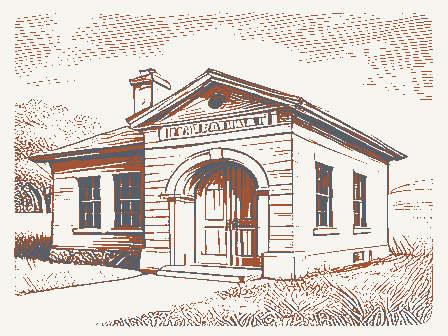
Liverpool Township
The complete chapter on this township from History of Columbiana County, Ohio, published in 1879. 9,999 words, covering 3 settlements.
What happened here
One passage from this chapter, in the words of 1879.
Musical Organizations
The first band organized in the town dated its existence from early in 1850, when J. L. Rule instructed a chosen few, and remained as instructor until the enterprise was fairly under way. There were fifteen pieces in the band, which was led at first by Luke Parker, and afterwards by Peter Lee, who went into the service in 1861 as trumpeter in an Ohio battery, and was killed in action.
Contents
22 sectionsThe section headings the book prints inside this chapter. Each one jumps to where it begins.
- Liverpool Township
- Early Settlement
- Early Industries
- East Liverpool
- The Protestant Episcopal Church
- The First Catholic Church
- The First Presbyterian Church Of East Liverpool
- The Methodist Episcopal Church Of East Liverpool
- The United Presbyterian Church Of East Liverpool
- The First Methodist Protestant Church Of East
- Industrial Pursuits The East Liverpool Potteries
- Decorating Establishment Of Thomas Haden
- Cliff Mine Terra-Cotta Works
- Other Industries
- Gas- Wells
- Post-Office
- The Town-Hall
- Crockery City Hook-And-Ladder Company
- Musical Organizations
- East Liverpool Lodge, No. 379, 1. O. O. E.
- Division No. 4, A. 0. H.
- The Father Mathew T. A. Society Water- Works
The people it describes
2 namedEveryone the 1879 history stops to write about in this chapter. Each name opens the passage itself.
The modern record here
3 settlementsWhat the federal record holds for each settlement inside this township: wildfires and storm reports since the 1950s, mineral workings, and museum specimens collected nearby. These are counted within a few miles of each settlement, so neighbours share them and the columns are deliberately not added up. Every row links to the settlement's own page, where each figure is broken out.
| Settlement | Fires | Storm reports | Mines and quarries | Specimens |
|---|---|---|---|---|
| La Croft | 42 | - | 4 | 468 |
| Spring Grove | 41 | - | 3 | 393 |
| Walkers | 38 | - | 3 | 393 |
Settlements in this township
3 placesEvery populated place the Geographic Names Information System records inside this township's Census boundary. 1 of the 3 are named in the chapter; the rest were founded later or were never more than a post office.
The chapter
9,999 wordsReproduced complete and unedited. The text is machine-read from a scan of the 1879 printing, so expect the errors a machine makes reading a century-old page: misspelled names, dropped words, stray characters. Nothing has been corrected, because correcting a proper name invents one. The headings below are the book's own.
Liverpool Township
Dr. B. B. Ogden began the practice of medicine in East Liverpool in 1829, and may properly be termed one of the pioneer practitioners of the county. By an extensive practice he became wrell known, and was highly esteemed as a physician and honored as a man. He bore well his part as a public-spirited citizen, and, after nearly half a century's active service in this profession among the people of Liverpool, died in the year 1878.
Dr. Samuel Quigly was Dr. Ogden's contemporary, and settled in practice in Liverpool about the same year, - 1829. He was faithful and skillful as a physician, and a true man in all the relations of life. He died in 1869 at a ripe old age.
The following physicians practiced in Liverpool, some of them for a number of years, but the dates of their settlement and removal have not been ascertained: Dr. Josiah Forbes, Dr. W. L. S. Wilson, Dr. Paully, Dr. W. F. Ball, Dr. Harrah, Dr. Stewart, Dr. William Rose.
The following are at present practicing in the township: Drs. I. W. Gardner, Hall, I. I. Ikard, George Ikard, R. Lyon, McCreedy, McCluer, Mrs. Mix, C. B. Ogden, Robinson, Russel, G. A. Scroggs, Stcbbins, W. S. Thompson.
Liverpool township, numbered 5 and 6 in range 1, occupying tbe southeastern corner of Columbiana County, lies upon the north bank of the Ohio River, and has upon the north the township of St. Clair; upon the south, the Ohio River, which separates it from the State of Virginia ; upon the east, the Pennsylvania line; and upon the west, the townships of Yellow Creek and Madison. The Cleveland and Pittsburgh Railroad, skirting the entire southern border of the township, follows therein the course of the Ohio, which at East Liverpool describes a crescent.
Apart from the village of East Liverpool the township has no concentrated settlement, nor has it, outside of that place, any industry of consequence, except farming. Near the river the soil is stony, and not generally richly productive ; but farther north the region is fruitful, and contains many excellent farms.
Early Settlement
That portion of St. Clair township known at first as the "fractional section," and afterwards incorporated as Liverpool township, received its first settlers shortly before the year 1800, - perhaps 1795. One of the early settlers in the neighborhood was Joseph McKinnon, father of George D. McKinnon, of East Liverpool, who, with bis father, Daniel, emigrated from the Isle of Skye to America, and landed at Philadelphia about 1774. Daniel was called upon to take the oath of allegiance to the colonics, but, declaring that he was true to Kiug George and proposed to remain so, refused to take the oath, and returned to the mothercountry. Joseph, his son, took the oath, however, and settled in Abbottstown, where he followed the business of tanning three years; he subsequently removed to Washington, Pa., and to Virginia ; returning, he located, about 1799, upon the " fractional section" in St. Clair township, upon a place in section 33 now occupied by John Connell, two miles northwest of G. D. McKinnon's residence. George D. McKinnon was born there, and claims to have been the first white child born in Columbiana County. Mr. Mc- Kinnon still lives in East Liverpool, hale and hearty, at. the age of eighty. He says that for forty years he has never worn shoes from the time of tbe departure of frost in the spring until its coming in the fall. II is father, who was a
Noah Grant, a shoemaker, the grandfather of Gen. U. S. Grant, settled upon a place in Swamp Meadow, two miles and a half above Fawcettstown, in April, 1799, and married Annie, daughter of John Kelly, also an early settler. An autographic letter from Jesse Grant, now in the possession of Col H. R. Hill, relates that he was six years old when his father settled near Fawcettstown, and that he recollected hearing Robert Dobbins preach there Christmas day in 1799. The Grant family removed from tbe county four years after their first settlement, to Wooster, Ohio, from whence they had come.
Thomas Fawcett, migrating from Pennsylvania with Robert Boyce, halted at what is now East Liverpool, about 1798 or 1800, and there purchased a tract of 1100 acres of land, fronting on the river, and reaching from where Union Street now is to Jethro. Fawcett made a clearing and built a log cabin, the first in that vicinity, on a lot now owned by James Gaston. Robert Boyce settled on tbe uplands near the present Spring Grove camp-ground, east of Little Yellow Creek.
Among the settlers who were located in what is now Liverpool township, about the year 1S00, or shortly thereafter, were the following: John Rauch, who came over from Germany, settled between Yellow Creek and Fawcettstown, aud was a shoemaker as well as farmer ; Thomas Ashton, a Quaker, who is supposed to have kept the first store in Fawcettstown or the neighborhood, lived near Rauch ; Angus McBane, a farmer and tanner, lived on the hill above Jethro, where James McBane afterwards lived ; Joseph Hamilton, a farmer, lived near his father-in-law, Thomas Fawcett, who was a Quaker, and worked at his trade as carpenter, as well as on his farm ; Edward Devoe, a colored man, lived in 1800 upon the place now known as Spring Grove camp-ground.
Thomas Fawcett was the father of Fawcettstown, which occupied a portion of his tract of 1 100 acres. He laid out the town, and called it first St. Clair, after the township, by which name it is known upon the county records where reference is made to Fawcett's land deeds, but the inhabitants christened the place Fawcettstown, in honor of its founder, and by that name it was known until its rechristening as Liverpool. Fawcett erected on Carpenter's Run, at the foot of the hill, on the New Lisbon road, the first flour-mill in the county, and, near what is now Jethro, the first saw-mill in the township. The second grist-mill was built by Aaron Brooks, who used horse-power, and who put up also the second carding-machine, the first having been operated by Thomas Fawcett and John Barcroft where Croxall & Cartwright now have a pottery. The second saw-mill was probably erected by John Beaver and Thomas Moore on the Little Beaver.
Continuing the list of early settlers, note may be made of Abraham Wellington, a farmer, who located near where Knowles, Taylor & Knowles' pottery now is. Then there was Win. C. Larwell, of Baltimore, who was the first lawyer to locate in the place, and Harvey Heath, the first blacksmith, whose shop was where Gaston's drug-store now is. Wm. Moore carried on the business of a carpenter and undertaker on the site now occupied by Nath's bakery. Richard Taggart, who lived where Croxall & Cartwright now have a pottery, was drowned while fishing in the Little Beaver. Joseph Smith operated the grist-mill built by Thomas Fawcett, and back of the town, near where Geo. Gaston now lives, was Griffith Williams, a Welsh tanner, who bought fifty acres of land there, and started a tannery. North of his place was Michael McKinnon. East of the town was John Babb, a blacksmith, who put up on Babb's Island the first blacksmith-shop in the county, and so on up the river, Mr. Wise, a farmer, Adam and Geo. Miller, and Peter Wells (the latter living at the mouth of the Little Beaver). Up the creek were Adam Burdeaux, Peter Hyatt, James Burns, and Thomas Moore, who managed the mills built by John Beaver on the creek, and gathered a small settlement, known as Moore's Mills, Beaver's Mills, and Little Beaver Bridge. Moore kept here, besides a grist- and saw-mill, a tavern, store, and blacksmith-shop. John Beaver, who erected the mills, came from Georgetown, and was a sturdy, industrious, and enterprising pioneer.
John Kelly, from Brownsville, "Pa. (whose sister Annie married Noah Grant), settled on Dry Run, where also his sons John and Isaiah, aud his son-in-law, William Stout, located. John Kelly, like a good many of his neighbors, was given to illicit distilling, but he was the only one of them who was broken up by the " whisky boys," as the government raiders were called in those days. His misfortunes made him poor, and he moved out of the county to a place near Vinton, Ohio. Edward Carroll settled about 1800, and shortly afterwards removed to Hanover township. On the hill, west of the creek, were Charles Hoy, Nicholas. Dawson, Thomas McCartney, John Gaddis (Scotch weaver), Solomon Cable, Jacob Darner, and Alexander Gaddis (all farmers).
Hon. Josiah Thompson, of East Liverpool, has in his possession the original patent granted by Thomas Jefferson, President of the United States, to Charles Blackmore, of section No. 34, in Liverpool township, occupied now in part by Mr. D. J. Smith, two miles north of East Liverpool, on the Calcutta road. The document bears date Aug. 15, 1808, is signed by Thomas Jefferson as President and James Madison, Secretary of State, and reads as follows:
" Know ye, that Charles Blackmore, a-signee of Thomas Dougherty, having deposited in the Treasury a certificate of the Register of the Land-office at Steubenville, whereby it appears that full payment has been made for a lot or section number Thirty-four of Township number Six in Range number One of the lands directed to be sold at Steubenville by the Act of Congress entitled 'An act providing for the sale of the Lands of the United States in the Territory northwest of the Ohio, and above the mouth of Kentucky River,' and of the acts amendatory of the same; There is granted by the United States unto the said Charles Blackmore the lot or section of land above described; To Have and to Hold the said lot or section of land with the appurtenances, unto the said Charles Blackmore, his heirs and assigns forever.
" Given under my Hand at the City of Washington the Fifteenth day of August, in the j'ear of our Lord one thousand eight hundred and eight, and of the Independence of the United States of America the thirty-third.
The first shingled roof seen in the town was put upon Robert Boyce's log cabin by " Old Gauge," a carpenter, whose right name was Wm. Hudson. "Old Gauge" was a famous character, and the greatest whisky-drinker in the county, but never got drunk, could maul four hundred logs a day, and was, despite his drinking ways, a man of such steady nerve and industrious habits that there was not so excellent a workman for miles around. Incredible as it may appear, he drank a gallon of whisky every day, - so the story goes, - taking a pint at a certain hour each day, wherefore he was called " Old Gauge." He never made a bargain to work for a man without stipulating for the regular supply of whisky, and always got it. Although he was never known to be drunk while in Liverpool, early habits told upon him in his old age, which he passed in Virginia.
Returning to the subject of distilleries, passing mention may be made that whisky was cheap in the early days, else " Old Gauge" would have sometimes failed on his daily gallon. Besides Kelly's distillery, there were those of G. D. McKinnon, James Montgomery, Wm. Badders, Benjamin Blackmore, Geo. Ilurlbut, Thomas Gaddis, Robert Wallace, John Polk, John Ainsley, Anthony Blackburn, and Alex. Young.
Of the early settlers who had taken part in the war of the Revolution were Joseph McKinnon, Wm. C. Oarnagy, John Black, Wm. Ligans, John Moore, and James Moore. Those who served in the war of 1812 were Capt. Wm. Folks, John Jackson, T. A. McKinnon, Mathew Riley, James Gaddis, Nicholas Dawson, Wm. Moore, Wm. Moffatt, John Chamberlain, John Cheney, Wm. Cheney, Arthur Burbeck, John Taggart, Wm. Taggart, Andrew Darner, Joseph Green, Wm. Green, Andrew Green, Thomas George, Wm. Phillips, and Richard Boyce. Wm. C. Larwell issued in 1812 " a call to men of patriotism to enlist in the cavalry service for the war of 1812."
As early as 1809, or before, Thomas Fawcett, Jr., opened a tavern in Fawcettstown, at what is now called Gaston's Corners, on Second Street, in a hewn-log house, and estab-
The first frame house in the town was raised by Joseph McKinnon, near where the town-hall now stands, and sold by him to Jacob Courtney. The first brick house was built by Postmaster Collins, about opposite the site of the Brunt House.
July 4, 1811, a monster barbecue was held in a sugargrove, on the river-bank, near where Manley & Cartwright's pottery now is. People gathered from miles around to the number of 4000. William C. Larwell, the lawyer, read the Declaration of Independence, and Capt. John Wilcox, at the head of a grand array of militiamen, shot one of his side-whiskers off by accident, to the great amusement of everybody. -
When St. Clair, or Fawcettstown, was well under way, and a county-seat was to be established, an attempt was made to make it the county-seat, but the effort was a failure, although only four votes were lacking to make it a success. This failure somewhat disheartened the inhabitants, and the place thrived but poorly for some time. In 1816 matters revived somewhat with the advent of John Fawcett, Daniel Moore, and James Pemberton, three merchants from Wheeling, who, purchasing Thomas Fawcett's old mill and 200 acres, now occupied by East Liverpool, laid out the town anew and called it Liverpool.
"Lots for sale adjoining Fawcettstown. This place is situated on a handsome bottom of the Ohio River, and has a good harbor for boats. It is forty-five miles below Pittsburgh by water, twenty-five above Steubenville, and nearly on a direct line from Washington, Pa., to New Lisbon, 0., - thirty-eight, miles from the former and fourteen from the latter. This is the nearest point of the river to Lake Erie, being about eighty or eighty-five miles from Cleveland. As a place of deposit, it has many advantages, having good roads, and the nearest point of the river to New Lisbon, Canton, Warren, etc.
"The site for a town is beautiful, in full view of the river, and has good springs of water, and buildings convenient and plenty. The country around is well settled and has good grist- and saw-mills in the neighborhood.
"The subscribers will offer a number of lots for salo in the abovementioned place, Sopt. 5, 1810, at public auction, one quarter of the purchase-money to bo cash, and the balance on easy payments.
They sold about twenty lots at from $20 to $30 each, gave two lots for school purposes, and donated lots to John Smith and Philip Cooper, conditioned upon their erecting houses at once. They laid out a road up the hill on the opposite side of the river, and proposed establishing glassworks, but that scheme miscarried.
In 1817, Fawcett, Moore & Pemberton took a government contract to supply forts on the Missouri River, and, discouraged at the failure of Liverpool's expected prosperity, gave up their efforts in its behalf, and moved away.
The town had so lost its population that in 1823 there were but "six families and two bachelors" within its borders, and the only street a wide sward, with a horse-path through its centre, that street being the Second Street of the present.
In 1824 a turnpike from Cleveland to Liverpool via New Lisbon was 'completed, and about that time Claiburn Simms, purchasing Fawcett, Moore & Pemberton's interests, became the third proprietor of the tract now occupied by East Liverpool. In 1826 the town was still a forlorn place. There was no post-office ; mail had to be obtained at Calcutta, Beaver Bridge, or Wellsville ; there was no steamboat-landing except at high water; and altogether the outlook was cheerless. With the building of Scott & Hill's steam saw-mill, however, in 1830, the prospect brightened, and in that year a post-office was established, with John Collins as postmaster, when the town was called East Liverpool, to distinguish it from Liverpool in Medina Co., Ohio. Shortly after this, Theophilus A. McKinnon set up a hat-shop, one Coffin began to build boats where Homer Laughlin's pottery is, and George D. McKinnon, with Abraham Davidson, engaged in the flatboat building business, while farther along the steamboat " Liverpool" was built at Coffin's yard, and put into the trade between Pittsburgh and Wheeling, under command of Capt. Richard Huston. Capt. Huston, who still resides in East Liverpool, aged eighty-one, settled in that place in 1823, and started a tannery. Subsequently he began to build flat-boats in East Liverpool, and in one season constructed as many as twenty-six. He ran the " Liverpool" between Pittsburgh and Wheeling one season, and took her to the Arkansas River, where she was wrecked soon after. Mr. Coffin built two steamboats besides the " Liverpool," and other boats were also built at the same point.
Early Industries
In 1805 or 1806, John Beaver and John Coulter built a paper-mill, for making writing-paper, on Little Beaver Creek, near its mouth, and called it the Ohio Paper-Mill. It was the first industry of its kind in Ohio, and the second west of the Alleghanies. The mill-dam was carried away some years after the enterprise was started, and the papermill became a thing of the past.
The first grist-mill in the county was built by Joseph Fawcett, on Carpenter's Run, just below the present site of East Liverpool. The second grist-mill was built by John Beaver, on Little Beaver Creek, one and a half miles from the river. Opposite the grist-mill Beaver built a saw-mill, which was the first saw-mill in the township. The second saw-mill was built by Joseph Fawcett at Jethro.
A steam saw-mill was erected about 1830 by William Scott and John Hill on the Ohio River, about where Manley & Cartwright's pottery now stands. The mill was, not long after, destroyed by fire.
The Sandy and Beaver Canal, which reached from Bolivar, on the Ohio Canal, to Glasgow, on the Ohio River, was begun in 1835, and discontinued upon the appearance of the panic in 1837. In 1845 work upon it was resumed and carried to completion. The canal was about seventy miles in length, of which twenty-five miles, from New Lisbon to the Ohio, followed the course of Little Beaver Creek. The creek was made a part of the canal, and the old canal-locks are yet to be seen.
The venture was at no time a paying one, and, after a vain struggle, was abandoned upon the completion of the Cleveland and Pittsburgh Railroad to Wellsville.
One of the most prominent of Liverpool's early physicians was Dr. B. B. Ogden, who practiced in East Liverpool from 1830 to 1878, a period of forty-eight consecutive years, and who occupied a proud place in the esteem of his fellow-citizens.
The territory now occupied by Liverpool was a part of St. Clair township until June 3, 1834, when Liverpool township was created by the board of county commissioners, Michael Arter, John Smith, and Thomas Cannon, as shown by the following extracts from their records :
"Tuesday, June 3, 1834. - The petition of sundry citizens of St. Clair Township for the erection of a new township, to be composed of fraction 5 and the following sections in township 6, to wit, 31, 32, 33, 34, 35, and 36, which had been presented at the March sitting and postponed to the present meeting, and no objection being made thereto, and the Board being satisfied of the justness of the prayers of the petitioners, they do hereby create said fraction 5 and the following sections of township 6, to wit, 31, 32, 33, 34, 35, and 36, a township, and call it Liverpool. The Board orders an election of officers on Monday, June 23, at the house of Aaron Brawdy, in the town of Liverpool.
The first book of township records has been lost, and the list of those who have served the township as trustees, treasurer, and clerk can be given from 1851 to 1879 only, as follows :
The township of Liverpool, as organized and at present constituted, embraces sections 31, 32, 33, 34, 35, and 36, attached originally to township No 6, or St. Clair, and sections 6, 12, 17, 18, 23, 24, 29, 30, 35, and 36 of the original fraction 5.
The entire tract measures nearly eleven miles across its northern boundary, about three on the western, and less than one and a quarter miles on the eastern border. From north to south the widest part of the township is from the centre of the north line direct to East Liverpool, a distance of three miles. The Ohio, bordering the southern line, gives it a ragged shape, and materially narrows the township on both the east and the west.
East Liverpool
The village of East Liverpool was incorporated Jan. 4, 1834, and is the only village in the township. It is the seat of the most important pottery-manufacturing interest in America, is a landing-place for all steamboats plying on the Ohio between Pittsburgh and Cairo, and is also an important station on the Cleveland and Pittsburgh Railroad, being four miles below the State line, forty-four miles below Pittsburgh, and the same distance above Wheeling.
It had in 1878 a population of 4160, and bids fair to increase in that direction in the future more rapidly even than it has in the past. It fronts on the river, and occupies in its major portion a commanding elevation, whence the view of the river and the Virginia hills is exceedingly picturesque. It contains several imposing church-edifices, a fine townhall and I. 0. 0. F. brick block, a costly common school building, two public halls, many fine private residences, three hotels, and numerous stores, besides the potteries and other industries elsewhere referred to.
It is a thriving place, full of business activity, and, as its pottery interests have been growing from the outset and are still expanding, the future is fruitful with promise to those who are interested in its prosperous development.
In the early days of the town's settlement, the privileges of religious worship were very few and far between. Occasional journeys to far-distant churches or places of meeting, over rudely-broken roads, or rare opportunities to listen to some circuit rider or itinerant preacher nearer home, comprised about all the advantages the early settler had to pursue his religious education.
Ministers from Virginia used to visit the settlement, and once in a while a roving preacher from other parts would tarry over Sunday and hold service in some settler's rude habitation, so that the pioneers were happily not absolutely cut off from the public worship of God.
The earliest preacher of whom there is any record or remembrance in Liverpool was Robert Dobbins, a Methodist circuit rider, living in Yellow Creek, or what is now Yellow Creek township. Mr. Dobbins preached in Liverpool as early as 1800, and perhaps before. After him the earliest preachers were Thomas E. Hughes and John Scott, both Presbyterians.
The Protestant Episcopal Church
was organized in 1834 or '35, with about 15 members, and in the latter part of 1834 a frame church-building was erected on Fourth Street. The first rector was Rev. Thomas Mitchell, whose successors have been Revs. Thomas
A fine brick house of worship is now in progress of construction, on a site adjoining the old church-building, and will be occupied by the society in the autumn of 1879. The cost of the new edifice, fully completed, will be $6000.
The First Catholic Church
erected in East Liverpool was a brick structure, built in 1838, upon the lot which is now occupied by the pottery of Vodrey Bros. The building was destroyed by fire directly after it was finished and before public worship was held therein.
After that the Catholics had occasional worship in private dwellings until 1852, when the present Catholic church on Fifth Street was built. Services were held in it once a month by priests sent from Summitville, until 1876, when Rev. P. J. McGuire (who for eight years had supplied Wellsville and East Liverpool) was permanently stationed at East Liverpool, and has since then served the church. The church is fairly prosperous, and has about 350 attendants.
The First Presbyterian Church Of East Liverpool
was organized Jan. 31, 1845, with the following members : Nancy McKinnon, Elizabeth Fisher, Sarah Hill, Eliza F. Hill, Wm. Miller, Nancy Riley, Belinda Riley, Nancy Riley, Jr., Anna E. Lewis, Josiah Scott, Jr., Susanna
Scott, Sarah Scott, and Mary Gibson. Eliza F. Hill - now Mrs. T. Blythe - is still a member of the church. To the above eight others were added a few days afterwards.
The ruling elders were Michael McKinnon, John Fisher, Sanford C. Hill, and trustees, R. S. Irwin, Andrew Blythe, and M. McKinnon, Jr. In addition to the above, the ruling elders have been John McCamon, J. W. Gaston, J. H. Lowe, Thos. Blythe, J. D. Corey, Jas. Logan, T. B. Harrison, John Smith, Henry Agner,' N. B. Hickman, John Smith, Jr. The acting ruling elders at present are J. W. Gaston, T. B. Harrison, N. B. Hickman, Wm. Fisher, George Morton, and J. M. Aten. The deacons are Henry Agner, M. S. Hill, Sam'l Beale, Frank Croxall, and F. McHenry, and the trustees, Bernard Walper,
The Rev. Reuben Lewis was the first minister to preach for the church, although he officiated only as stated supply, and, in turn, stated supplies were provided by Revs. T. P. Gordon, John Moore, W. W. Lanertz, and Wm. Dickson.
The first pastor, Rev. G. W. Riggle, was installed July; 1867. He was succeeded February, 1877, by Rev. S. H. McKown, who was in December, 1877, followed by Rev.
The first church -building, erected in 1848, is now used as a store at the corner of Third and Jackson Streets. The new brick edifice on Fourth Street was built in 1869. The church membership is now 306, and the church, free from debt, is in a highly prosperous condition.
The Methodist Episcopal Church Of East Liverpool
dates its organization from about the year 1827, but upon that head, as well as upon others touching the history of the church, the chronicler is able to treat only with that approximation to certainty gained from oral testimony, since the early church records are lost. From the best evidence obtainable, however, the church was organized in 1827 at the house of Claiburn Simms, Sr., in Liverpool, by Rev. George Brown, who became afterwards president of the Reformed Methodist church.
There was Methodist preaching in East Liverpool long before that date, however, for, as already related in the early history of Liverpool, Robert Dobbins, a Methodist circuit rider, came as early as 1799, and preached in and about what is now East Liverpool.
It was the custom then for the minister to send a preliminary notice that he would preach the ensuing Sunday at some certain citizen's house, and intelligence of this fact would be disseminated through the community as it best could be.
There were but eight or ten original members of the church, among them being Claiburn Simms, Sr., Henry Kountz, Mary Ann Simms, Mary Simms, and Elizabeth Simms. Henry Kountz was one of the first class-leaders, if not the very first. William Smith was also a class-leader about that time.
Upon the erection of the old log school-house upon the site of the present common-school building in East Liverpool, the Methodists held religious services therein, and
The first church-building was erected upon the lot now occupied by the Methodist Episcopal church. It was a brick structure of plain construction, but it was not thought to be well built, and after standing eight years was demolished, and replaced in 1845 by a somewhat more pretentious edifice. This church was succeeded in 1874 by the fine house of worship now in use, commonly known as the Tabernacle, and erected at a total cost of $70,000. The church is in a highly prosperous condition, has a membership of 400, and owns, besides the church-building, a handsome brick parsonage.
The names of the pastors who have occupied the pulpit since 1854 are Revs. Andrew Huston, F. B. Fast, D. B. Campbell, H. W. Baker, A. Baker, J. M. Carr, E. Williams, M. W. Dallas, A. W. Taylor, W. D. Stevens, W. Smith, M. S. Kendig, W. Brown, G. A. Lowman, George Crook, A. Scott, W. P. Turner, E. Hingely, A. W. Butts, and S. Burt, the latter being the present pastor, - -May, 1879.
The United Presbyterian Church Of East Liverpool
was organized in 1851 or 1852, under the direction of the Associate Reformed Presbyterian Presbytery of Steubenville, and in connection with that denomination continued until the union of the churches forming the United Presbyterian church in 1858. The original members numbered 18, and were as follows : Alexander Young, George Anderson, Mrs. Isabel Anderson, Mrs. Mary Anderson, Nancy J. Anderson, William Blythe, Mrs. Harriet Blythe, William Dever, Mrs. Nancy Dever, Mrs. Mary Marks, Alfred B. Marks, Miss Elsina Marks, Mrs. Finley, Miss Rebecca Finley, James McCormick, Mrs. Ellen McCormick, James Gibson, Mrs. Gibson. Of the foregoing, who are living, George and Mrs. Isabel Anderson, William and Harriet Blythe, Mrs. Nancy Dever, Alfred Marks, Miss Rebecca Finley, and Mr. and Mrs. James McCormick are still members of the church. Miss Elsina Marks is a member of the Presbyterian church of East Liverpool.
Rev. S. W. Clark, pastor of a church in St. Clair township, preached occasionally to the Presbyterians in East Liverpool before the organization of the church in 1851, and after that date served the church as its pastor until the union of the churches.
For a year or two the congregation worshiped in the town school-house and in various churches, but in 1854 built and occupied a frame edifice at the corner of Fifth and Market Streets, now occupied as a store. In 187(3 the present house of worship was begun, and Sept. 8, 1878, was formally dedicated and occupied. It occupies a corner of Fifth and Market Streets, and cost $1G,()00.
The pastors who served the church after Mr. Martin were Rev. Thos. Andrews (in whose time the church was united in a pastoral charge with the church at Calcutta), J. W. Martin (who served the Calcutta church as well until 18G7), and J. C. Taggart. The latter is the pastor now in charge, and has filled the office since May, 1869. Three hundred and twenty-four members have been connected with the church since its organization, and of these 166 were on the roll May 1, 1879. During Mr. Taggart's pastorate the church has raised for congregational and missionary purposes $30,000. When he began his labors the membership was 95. Since then 168 have been added, 21 have died, and 76 have been dismissed.
The First Methodist Protestant Church Of East
was organized in May, 1855, by Rev. E. A. Brindley, of Well.sville. The original members numbered 11, and until 1857 services were held in Bradshaw's Hall, on Broadway. In that year the church purchased the Sons of Temperance hall, which then occupied on Fifth Street the site whereon stands the new church-edifice. There they worshiped until May, 1879, when the present fine church-building - begun May, 1878 - was completed and occupied. It is an imposing brick structure, and cost about $10,000.
This church was originally attached to the Muskingum Conference, whence, in 1871, it was transferred to the Pittsburgh Conference. The membership is now 200, and that of the Sunday-school about the same.
The church has been served by pastors as follows : Revs. E. A. Brinley, Win. Hastings, Geo. Burns, Win. Case, John Hodgkinson, J. H. Hull, Henry Palmer, J. B. Lucas, the latter, who began his pastorate in 1877, being in charge May, 1879.
is an outgrowth of two German religious organizations (the Reformed Protestant and Evangelical Lutheran) whose members enjoyed occasional worship in East Liverpool as early as 1854. They employed preachers in common, and met in school-houses and dwellings as convenience served. Rev. Mr. Lenakemper preached for them about four years after 1854, and then for several years they had no meetings. About 1864 there was a revival of interest, and meetings were resumed under the ministrations of Rev. Henry Reit, who, remaining two years, was succeeded by Rev. Geiser, professor of theology at the Phillipsburg, Pa., College. During his pastorate the organizations joined in the erection of the brick edifice on Third Street known as the German Lutheran church, and since 1867 have worshiped there. Following Mr. Geiser have been Revs. Steinbach, John
Of other denominations, passing mention may be made that up to 1877, the sect called Disciples or Campbellites flourished for some years and held regular worship, but latterly, as indicated, have declined in numerical strength.
For a few years also, to 1878, one Andrew Rattra, a Mormon elder and a resident of East Liverpool, gathered a chosen band within his fold, and held weekly services in a meeting-house which lie had fashioned out of his stable on Seventh Street. He discontinued his services iu 1878, and the church was then converted into a dwelling. The elder continues his labors elsewhere, however, traveling about the country and teaching the Mormon doctrine, although his residence is still at East Liverpool.
The first school-teacher in East Liverpool of whom there is any recollection seems to have been one Tera Jones, an Irishman, who taught perhaps before the year 1820, in a log school-house erected about that year, by individual subscription, on a lot north of the village, near the house of Bazaleel Simms.
The school-house was a remarkably primitive structure, and, in lieu of glass window-panes, had upon the south and west sides paper-covered openings, through which light was admitted. The seats were rough boards, and a wide board laid upon wooden pins below the " paper" windowpanes served as a common desk. Tera Jones taught a select school there about twelve years, and after him James Smith, William Smith (called Bill Smith the Yankee), and William Taggart also taught there.
Later, on the lot now occupied by the common school (donated for school purposes by Fawcett, Moore, and Pemberton, when they laid out the town in 1816), a hewn log school-house was erected, and in that school Sanford C. Hill was a teacher.
In 1848 a "red-brick" school-house succeeded the old log cabin on the same site, and in that year a common school was organized with A. H. Martin as teacher. William C. Orr taught the school in 1852, and following him were Messrs. Fast, Ogle, Luckey, Norris, Borton, Cameron, Gillespie, Crawford, Miss Gaston, and Messrs. Erskine, Hastings, and Burns.
In 1869 the present imposing common-school building was erected at a cost, including furniture, etc., of $35,000, and in 1870 was opened under the direction of Prof. T. Duncan.
The superintendent's report for the year ending Aug. 31, 1878, gave the departments as follows: high-school, grammar-school, third intermediate, second intermediate, first intermediate, with 'seven primary departments, and an average daily attendance of 441, out of an enumeration - between the ages of six and twenty-one - of 1103.
Apart from the town the township has four district schools, with an enrollment of 252 scholars. The cost of the four schools in 1878 was $1485.15.
Industrial Pursuits The East Liverpool Potteries
The most important interest of East Liverpool is the manufacture of pottery, in which respect the town is conspicuous for being the place where yellow-ware was first made in America, and as the point where the annual production of crockery surpasses in value that of any town in the United States.
The founder of this branch of industry in East Liverpool, and in the United States as well, was James Bennett, an Englishman, who in 1839 emigrated from Wooden-Box, Derbyshire, England (where he was a " packer" in a yellowware pottery), to America. Traveling late in 1839 from Cincinnati afoot through Ohio in search of employment, Bennett tarried en route at East Liverpool, and, discovering thereabouts the presence of clay well adapted to the production of yellow-ware, he conceived the idea of engaging in the manufacture of that article. He had no means of his own, but, interesting Messrs. Anthony Kearns and Benjamin Harker in his behalf, he was enabled, with their assistance, to build a small pottery, 40 by 20, and to enter at once upon the matter in hand. In building the kiln Bennett had the assistance of Geo. Hollingsworth and Geo. Thomas. This pottery was near the river, at the foot of Second Street, and in 1853 was purchased by Mr. I. W. Knowles, who transferred the most of the structure to the pottery now occupied by Knowles, Taylor & Knowles. The ground upon which it stood has since been washed into the river.
Bennett burned his first kiln (mostly mugs) in 1840, and of that kiln I. W. Knowles purchased two crates of glost-ware, which he took down the river on a trading-boat. Bennett himself took out the balance of the kiln in wagons and peddled it through the country, clearing eventually a net profit of $250 on his first kiln.
The East Liverpool Pottery Works of Knowles, Tay- J three kilns, necessary warehouses, shops, machinery, etc. lor & Knowles were established in 1853 by Isaac W. - to the exclusive manufacture of white granite and Knowles and Isaac A. Harvey, decorated ware. This was the ingham- and yellow- ware. In 1867, Mr. Knowles purchased the interest of Mr. Harvey, and continued the business alone until 1872, at which time he associated with him in the business his son-in-law, John N.
Knowles, under the firm-name of Knowles, Taylor & Knowles, who continued the manufacture of Rockingham- and yellow-ware until the spring of 1873, they commencing, meanwhile, in September, 1872, the manufacture of white granite ware, in connection with their other business.
In the spring of 1873 they refitted their entire works throughout, made extensive improvements, added a decorating department, am time forward devoted their works business in East Liverpool. In 1876 they again enlarged their pottery by adding two large kilns, necessary buildings, machinery, etc., and increasing their capacity to about 5000 casks of white granite and decorated goods per annum.
Isaac W. Knowles was born in Beaver Co., Pa., in 1819, and came to East Liverpool in 1832. He was the inventor and patentee of many of the appliances and labor-saving machinery now in use in the business.
claims that he leased Bennett a piece of land in 1840, and j make yellow-ware until 1845, when they removed to Birthat from that land Bennett obtained the clay for his first mingham, Pa., and engaged in the manufacture of ware, at kiln. Whether it was Harker's clay or McKinnon's clay , which they grew wealthy.
In 1841, Bennett was getting on famously in the busi- j 1842, and established the pottery now occupied by Croxall ness, and sent out to England for his brothers, Daniel, i & Cartwright.
Decorating Establishment Of Thomas Haden
was founded by Isaac W. Knowles in 1853. In 1870 this firm began the manufacture of white-ware, and were first, after Wm. Bloor, in the making of that ware in East Liverpool, the productions previous to that date having been confined to Rockingham- and yellow-ware.
twenty-four potteries, with sixty-seven kilns, employing two thousand people, - men, women, and children, - to whom the money disbursed for wages aggregates $20,000 weekly.
In 1860, Wm. Bloor, who, with Wm. Brunt, had been engaged in making door-knobs, experimented in the manufacture of porcelain in East Liverpool, and, according to the opinions of old potters now there, succeeded in making an excellent grade of goods. His effort was, however, but an experiment, - his being the second attempt to make porcelain in this country, - and, the civil war of 1861 setting in before he had fairly tested the matter, he became financially embarrassed, and, his limited capital giving out, he was compelled to abandon the undertaking, although authorities agree that if he had had more extensive means to tide him over the crisis he would have achieved a financial, as he did an artistic, success. His pottery was where the pottery of Wm. Brunt, Jr., & Co. is now located.
this production will be largely increased within the next twelvemonth, since many of the potteries are projecting material additions to their works, while the erection of one or two new potteries is confidently expected.
The process by which white-ware of the kind known as stone-china is manufactured is substantially as follows : Certain proportions of the crude material being mixed in a vessel called a Hunger or churn to the consistency of cream, the mixture is run into the sifters or bolters, which extract the grit, and, thence passing into a cistern, the material is pumped into hydraulic presses, where the liquid is forced out ; and the clay, being then placed in a wedgingmachine, comes out in blocks prepared for use. The next process is the pressing or moulding, and, after drying, the clay vessels are burned in the " bisque" kiln, where they remain about seventy hours. They are afterwards glazed by dipping them into a solution of feldspar, silica, carbonate of lead, borax, carbonate of lime, etc., and burned in the gloss-kiln, whence they are taken in a finished state, save such as are set apart for decorated wares. These latter, after being decorated, are burned a third time in a mufflekiln, where the colors become fluxed and unite with the glaze. Subsequent burnishing with agate instruments completes the work of decoration. For the manufacture of Rockingham- and yellow-ware the soil in the vicinity of Liverpool furnishes an abundance of clay ; but in the manufacture of white-ware other portions of the country are called upon to supply the crude material, which consists chiefly of feldspar, flint, kaolin, and ball- or pipe-clay, gathered from Maine, Missouri, Delaware, and Pennsylvania.
The fine stone-china wares produced at East Liverpool take high rank, and at the Centennial Exposition in Philadelphia competed successfully with other like exhibits. Decorative pottery is an artistic feature, and employs at this place the skill of a large number of experienced and intelligent artists. The major portion of the people employed in the potteries are English, or of English extraction, although there are many representatives of other nationalities.
Cliff Mine Terra-Cotta Works
These extensive works, located upon the bank of the Ohio and the line of the Cleveland and Pittsburgh Railroad, midway between Wellsville and East Liverpool, were founded, in 1842, by George McCullough, and are now owned by N. U. Walker.
The works are said to be the most extensive and the oldest of any similar enterprise in America, and manufacture of fire-clay various articles, such as fire-brick, sewerpipe, water-pipe, chimney flues, ventilating flues, chimney tops, hot-air flues, cold-air flues, patent chimneys, lawn vases, flower pots, statuary, stove linings, grate, boiler, flue, and flooring tiles, window-caps, sills, brackets, cornices, etc.
Mr. Walker utilizes the mineral privileges of a 250-acre farm set upon the high slope which overlooks the works, and thence obtains an abundant supply of clay, as well as considerable coal.
Upon his grounds, which have a river front of about half a mile, are, besides the manufactories, tenements for his employees, of whom there are fully one hundred and twenty-five. Upwards of $150,000 are invested in these manufactories, which contribute largely towards the value of productions in Liverpool township, and which have been an important interest in this locality for thirty-seven years.
Other Industries
The other manufacturing industries of the town include the extensive flint-mills of Golding & Co., - started in 1876, - where a large quantity of the material used in the manufacture of white- ware at East Liverpool and Trenton, N. J., is ground ; the Union Planing-Mill of Hall & Bevington, built by A. C. and J. C. McIntosh in 1867 ; the grist-mill of C. Metsch ; the steam brick-manufactories of H. H. Surles and Surles & Gambel ; and the foundries of A. J. Boyce and Morley, Dixson & Patterson. Bituminous coal is found to some extent near East Liverpool, the thickest veins being from three to four feet ; and oil likewise abounds.
Gas- Wells
The discovery of oil at Smith's Ferry, Pa., led directly thereafter to explorations in the vicinity of East Liverpool by a company of capitalists from Pittsburgh.
After sinking several wells, and finding nothing better than a flow of natural gas, which they regarded as worthless, the company abandoned their undertaking. One of the wells, sunk near Jethro, about 1860, by C. B. Simms, produced salt water as well as gas, and for a time the gas was used as fuel in the extraction of the salt, of which latter the well yielded from eight to ten barrels daily, and until a few years ago was profitably worked. Until 1875 no special effort was made to utilize the gas, which abounded largely in various places within East Liverpool.
In the last-named year Col. H. R. Hill and Mr. William Brunt, Jr., conceived the idea of turning the natural gas to use. Accordingly, they laid pipes from a well near the river, just above the town - this well having been sunk in 1860 - to their respective dwellings, and from that time to the present they have used the gas exclusively for fuel and light with the most gratifying success, and at a merely nominal cost.
The excellent results attendant upon this experiment led Messrs. Brunt, Hill, and others to purchase the stock of the East Liverpool Gas Company, - organized April 21, 1870, by Pittsburgh parties, who engaged in the manufacture of artificial gas until 1875, - and to furnish the natural gas to the inhabitants of the town, and with it to light the town's streets.
The gas is now generally used for light and heating purposes in the dwellings, stores, and business offices, and to a considerable extent in the potteries in making steam and burning ware.
The supply is supposed to be inexhaustible, and to consumers the cost varies from $12 to $50 yearly, in accordance with the number of lights and fires used, while the expense for street lights is so trifling that instead of employing a person to extinguish the street lamps each morning, the town permits the lights to burn day and night.
Post-Office
An early record states that there was a post-office at East Liverpool, or Fawcettstown, in 1810, when the place was called St. Clair or Fawcettstown, and that a William Larwell, father of Joseph, William, John, and Jabez Larwell, of Wooster, Ohio, was postmaster. The office was discontinued shortly afterwards, and the settlers had then to go to Beavertown and Georgetown, Pa., or Steubenville, Ohio, for their mail.
About or before 1820, Thomas Moore was appointed a postmaster at Little Beaver Bridge, where the second postoffice in what is now Liverpool township was established. Mathew Laughliu (father of Homer Laughlin) was postmaster there after Mr. Moore's time, and upon the establishing of a post-office at East Liverpool, about 1830, John Collins was appointed postmaster. Of Mr. Collins it is told that he used to keep the post-office in his hat, and when, in his travels, he encountered a citizen in quest of letters, Collins would doff his beaver, search for the mail, deliver it, and pass on.
Mr. Collins' successors in the office were Wm. P. Morris, Joseph Forbes, John Taylor, Sanford C. Hill, Kirk Armstrong, G. A. Humrickhouse, and H. H. Surles, the latter being the postmaster at present. For the quarter ending April 1, 1879, the sale of stamps at the office amounted to $1384.77. In the money-order department about $27,300 are received for orders and $28,000 paid out on orders annually.
The first newspaper published in Liverpool township was issued May 23, 1861, in East Liverpool, by George J. Luckey and J. W. Harris. It was Republican in politics, was called the East Liverpool Mercury, and was printed at the corner of Union and Second streets. It lived but a year and passed away - for lack of paying patronage - in the summer of 1862.
1867, when the East Liverpool Record was issued by W. G. Forster, who had previously conducted the Wellsville Union, at Wellsville, aud continued to publish both journals until 1869, when he suspended the publication of the Record and devoted his entire attention to the Union. The Record was a Republican paper and was published on Second Street, adjoining the Dobbins House.
Meanwhile, - in 1868, - -one Murphy, of Wellsburg, W. Va., occupied an office where the First National Bank is now located, aud began the publication of the Liverpool Local , but abandoned it after an eight weeks' profitless experience.
The next candidate for public favor was the Liverpool Democrat , the first number of which was issued in 1869, by Enoch Bradshaw, whose office of publication on Broadway is now known as Bradshaw's Hall. Mr. Bradshaw purchased the type, etc., used in Murphy's Local. The paper was Democratic in politics, and prospered fairly until January, 1876, when the material was transferred to J. H. Simms aud T. R. Bradshaw, who issued, Jan. 22, 1876, the first number of the East Liverpool Tribune, a twenty-column paper. The firm continued to publish the paper at an office on Second Street, over the post-office, until Jan. 1, 1877, when Bradshaw retired. Simms has since then conducted it on his own account, and in January, 1878, removed the publication office to the present location, adjoining Thompson's music-store, on Broadway.
In November, 1871, D. B. Martin, who had been publishing the Wellsville Local since 1870, transferred his office to East Liverpool, and began the publication of the East Liverpool Gazette. In March, 1876, he changed its name to the East Liverpool Potters' Gazette, and in June the same year changed the name to The Potters' Gazette, which it still retains. It is not, as its name might imply, devoted exclusively to the pottery interest, but is strictly a local journal. It is issued every Thursday by its original editor and proprietor, contains thirty-two columns of matter, and has a circulation of about five hundred.
The first banking institution organized in East Liverpool was the private bank of Huff & Co., who began business in 1870, and had their banking-house on Second Street, where the Dobbins House now is. The firm was composed of William M. Lloyd, of Altoona, Pa., and George F. Huff, of Greensburg, Pa. In 1873 they built and occupied the banking-house now occupied by the First National Bank. Mr. Lloyd was interested in ten other banks, and these, including the East Liverpool Bank, failed in November, 1873, when the bank of Lloyd, Hamilton & Co., of New York City, went down. Mr. F. D. Kitchell, who wras cashier of the bank from its organization, wound up its affairs, and paid the creditors eighty per cent, of their claims.
In October, 1873, the East Liverpool Banking Company was organized under the State banking laws, with a capital of $30,060. The directors were David Boyce, William S. George, Josiah Thompson, N. B. Hickman, George Morley,
In May, 1874, the institution was reorganized as the First National Bank, with a capital of $50,000. The directors, May 1, 1879, were Josiah Thompson, J. M. Kelly, David Boyce, Andrew Blythe, William H. Vodrey, and N. B. Hickman. The president was Josiah Thompson, and the cashier N. G. Macrum. The bank's circulation, April 4, 1879, was $45,000 ; its deposit account, $68,608.16 ; and its loans and discounts, $55,091.13.
The cemetery of East Liverpool, occupying an elevated site at the western end of Fifth Street, is a neatly-kept and handsomely-shaded spot, and contains many handsome tombstones.
It embraces the acre of ground donated to the town by Thomas Fawcett shortly after the year 1800 for a cemetery. To the original tract additions have been made from time to time by purchase. The first person buried there was " Granny" Snodgrass, whose two children were the next to be laid there, and after them James Kelly and " Granny" Taggart.
In 1832, G. D. McKinnon donated an acre and a half on his farm, north of the village, for a burying-ground, to be used for the members of the religious denomination called the Disciples and for the poor of the town.
The first railway enterprise with which East Liverpool was concerned was the Ashtabula, Warren and East Liverpool Railroad, in the promotion of which one John Patrick, a sometime itinerant preacher, actively engaged his energies. Patrick went to New York in 1835, and managed to so awaken attention that the company was organized, stock subscribed for, and the survey of the route commenced in 1836. He obtained, moreover, a large stock of goods in New York, and upon returning to East Liverpool opened a store, and projected, likewise, a bank, to be called the East Liverpool Bank. These brisk movements, predicated upon the probable prosperity in store for the town upon the completion of the railway, imparted bright hopes to all the inhabitants of the town, which began to look confidently towards future greatness. Unfortunately for all these rosy speculations, the panic of 1837 demolished the railway project, and, with it, Patrick and the hopes of the community.
Edward Carroll had begun the erection of the Mansion House, which was expected to be the finest hotel in this pai't of Ohio, but the bursting of the railway bubble checked the career of the hotel enterprise also.
Sept. 16, 1856, the first through railroad-train from East Liverpool to Pittsburgh, over the Cincinnati and Pittsburgh Railroad, went out with an excursion-party to a Fremont barbecue at the latter city. There was no depot at the town, and Mr. Andrew Blythe, the company's first agent, sold tickets from the front door-step of his house, on Broadway near the river. Previous to the date named trains had been running from Cleveland to Wellsville, and also from East Liverpool to Rochester, but the first through passenger-train was sent out as above noted.
The Town-Hall
This fine brick edifice, standing on the corner of Market and Third Streets, in East Liverpool, is one of the town's ornaments. It was built in 1877, by the village and township, and is used jointly for public purposes. Previous to its erection, public business was transacted in a. small brick building, which was put up in 1864.
The hall is three stories in height, surmounted by a mansard roof and observatory, and cost upwards of $6000. It contains a council-chamber, mayor's office, trial-room, jail, marshal's room, fire-engine room, and offices.
Crockery City Hook-And-Ladder Company
East Liverpool has been fortunately free from conflagrations, and, encouraged by that experience, has never had a fire-engine company. The " bucket brigade" has thus far served every purpose, although in 1877 a hook-aud-ladder company was organized, but as yet has not been called to active duty. Robert Hague is the captain, Wm. Chisholm lieutenant ; and the membership 50. The company has a fine apparatus, which has quarters in the town-hall.
Musical Organizations
The first band organized in the town dated its existence from early in 1850, when J. L. Rule instructed a chosen few, and remained as instructor until the enterprise was fairly under way. There were fifteen pieces in the band, which was led at first by Luke Parker, and afterwards by Peter Lee, who went into the service in 1861 as trumpeter in an Ohio battery, and was killed in action. Upon the breaking out of the war of the Rebellion the band organization was broken up.
In 1865, Harry Martin organized the East Liverpool Silver Cornet Band, and continued its leader until 1872, when it was reorganized by William Manley and others, Mr. Manley having since then been the leader. The organization numbers fifteen pieces, and has a band-room in the town-hall.
The Independent Cornet Band was organized in 1872 by B. AV. Haynes, who is still the leader. It has fourteen pieces, has a band-room near Fifth Street, and has lately donned a new uniform.
East Liverpool Lodge, No. 379, 1. O. O. E.
organized July, 1866, and has the following officers : 1). H. Jessup, P. G. ; Geo. W. Croxall, N. G. ; George W. Burford, Y. G. ; Jesse Croxall, T. ; W. D. Moore, C. S. ; Felix Hulz, P. S. The Lodge numbers 120, and owns a fine brick edifice (built in 1874) at the corner of Fifth and Washington Streets, in which is their capacious hall.
Division No. 4, A. 0. H.
organized in 1876, has 12 members and the following officers; John Sullivan, Pres. ; Thomas Cannon, Y. P. ; John Morgan, R. S. ; George McNichol, F. S. ; Daniel McNichol, Ti -eas. The county officers are Thomas Glenn, County Delegate ; John Morgan, County Secretary.
The Father Mathew T. A. Society Water- Works
The act authorizing the construction of water-works in the village of East Liverpool was passed February, 1879, and in April, 1879, Messrs. Josiah Thompson, I. W. Knowles, and Thomas II. Arbuckle were elected trustees. It is proposed to conduct water from the Ohio River to a reservoir (of the capacity of 1,900,000 gallons) on Thompson's Hill, east of the village, where the elevation is 320 feet above low-water mark. Thence pipes will supply the town.
The contract for building the works was awarded May 24, 1879, and it was then understood that the works would be fully completed in the fall of that year.
For over half a century one of the best known citizens of the county was Sanford C. Hill, who was born near Pughtown, W. Va., on the 20th day of June, 1796. From the time he was old enough he regularly attended school, and obtained an early, liberal education. In 1813, with the consent of his parents, he was employed as a clerk in a Pittsburgh bookstore. In 1818 he looked out a situation in Ohio, and entered into the mercantile business at a public crossroad now within the limits of the town of Wellsville. In 1819 he made a purchase in the town of East Liverpool, and removed his store to that place, being the first dry-goods store opened in the town.
W.Va. Soon thereafter he sold out his stock of goods, and entered into a business far more congenial to his taste. He procured a complete set of surveying and mathematical instruments, and for more than forty years made I practical surveying his chief business, besides teaching students in the theory and practice of civil engineering. For many years he spent his leisure time in studying astronomy and all the various branches of mathematics. September 6, 1832, his wife died, leaving four children. November 10, 1833, he was again married, to Mrs. Sarah Sansbury, of Achor, Ohio, who died June 25. 1866, also leaving four children.
a controlling voice ; was elected a justice of the peace for over twenty consecutive years, and did more office work as a conveyancer and counselor than, perhaps, any other man in the county. The allotment of the different additions to the town of East Liverpool were nearly all laid out by him.
the country. It was through this instrumentality that his name became a household word, and Sanford C. Hill's almanacs were to be found in almost every family, especially in the West and South.
He was a frequent contributor of mathematical and astronomical articles to the leading periodicals of the country, and was regarded as high authority upon all subjects of that nature. His talents and acquirements were recognized and acknowledged among men of science.
He died on the 17th day of April, 1871, aged seventyfour years, nine months, and twenty-seven days. His remains are interred in the East Liverpool Cemetery, and the grave is marked by a plain marble monument, bearing the text of the funeral discourse pronounced in his memory in the Presbyterian Church, in which he had long been a ruling elder: "Mark the perfect man, and behold the upright; for the end of that man is peace."
Provenance
Text from History of Columbiana County, Ohio, published 1879 and in the public domain in the United States. Digitised by the Internet Archive. The settlements listed against this township are matched by point-in-polygon test of each Geographic Names Information System coordinate against the Census Bureau's county subdivision boundary, not by name.