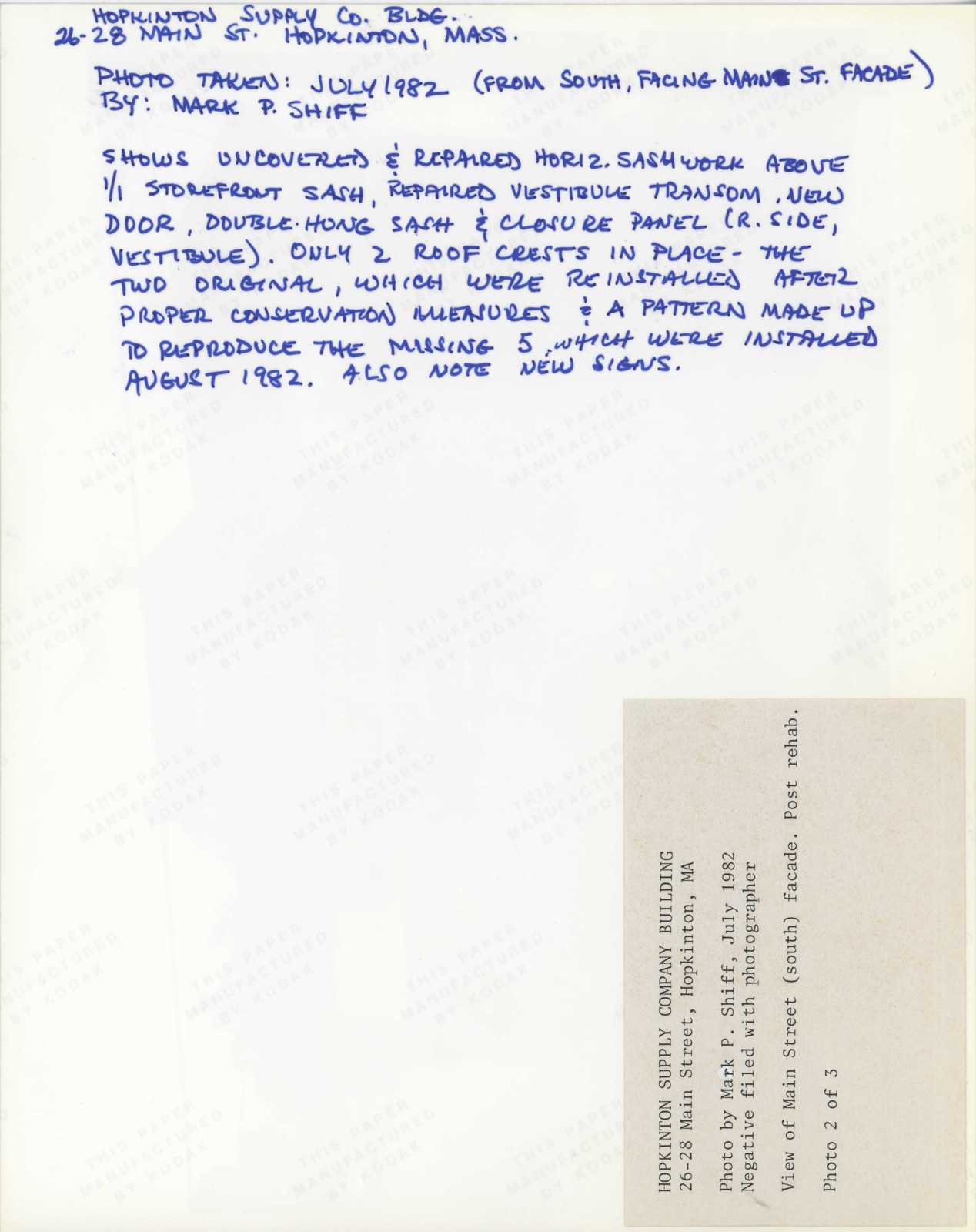
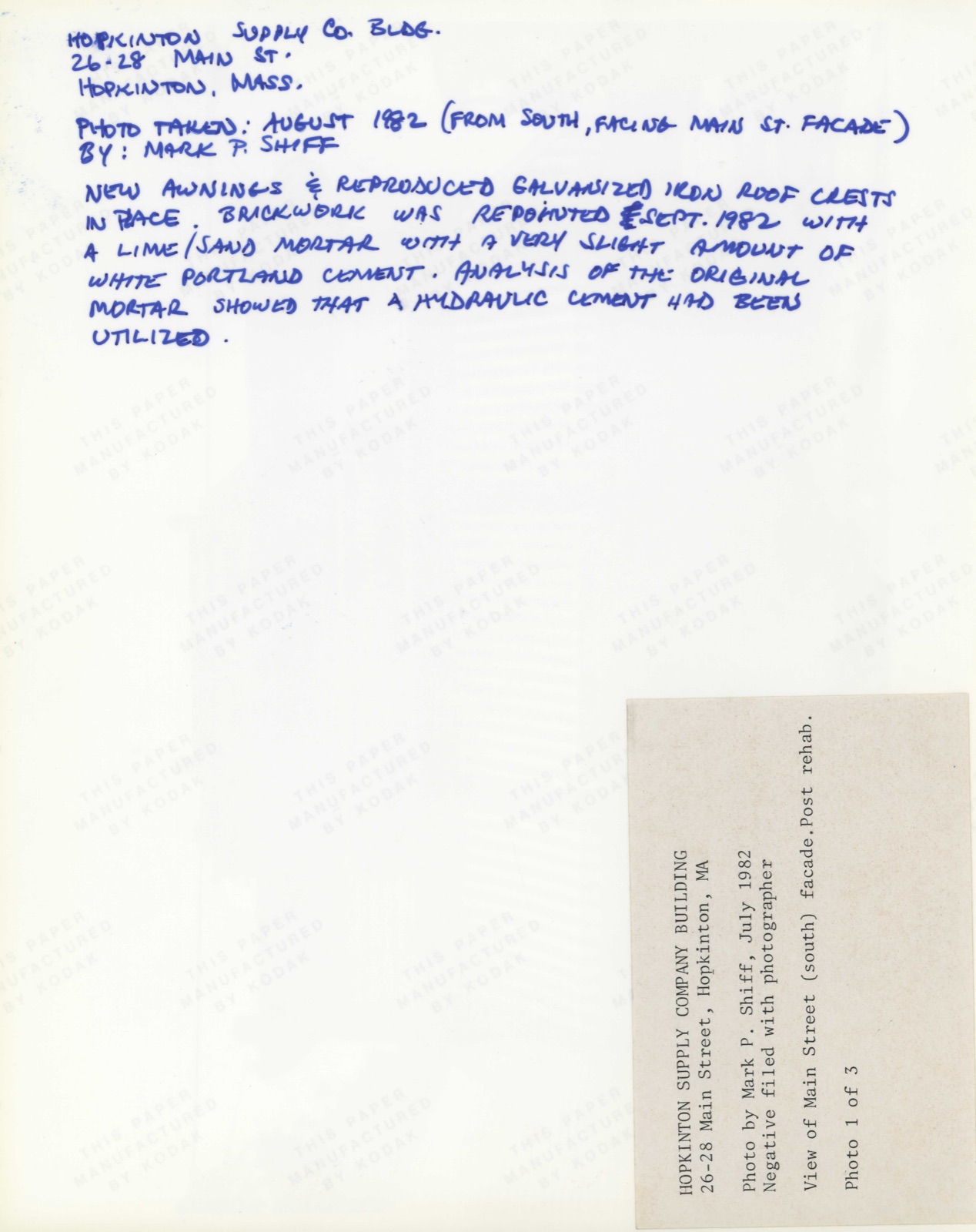
Photographs from the nomination case file, National Park Service records.
Hopkinton Supply Co. Building
Listed on the National Register of Historic Places in
1983. A historic map-sheet match is not published yet. The record needs a coordinate-quality review before it can be joined to a sheet boundary.
From the record
“Upon the removal of Father Barry, Father Minetti, an Italian by birth, assumed charge April 23, 1870, remaining in charge until Oct., 1872, at which time he returned to Italy, giving place to Father Ryan, formerly assistant rector of St. Soon after the advent of Father Minetti the Boston diocese was divided, Springfield being the new See, with Right Rev.”
History of Middlesex County, Massachusetts, with Biographical Sketches of Many of Its Pioneers and Prominent Men (1890). Machine-read text.
one of 1100 National Register listings in Middlesex County · listed in 1983 · category: Building · one of 3 National Historic Landmarks in Middlesex County.
National Register reference number.83000810- the number the National Park Service assigned this property when it was listed, and the key its nomination file is catalogued under at the National Archives.
Hopkinton furnished four hundred and twenty-five men for the w.ar, which was a surplus of sixteen over and above all demands ; three were commissioned officers. The total amount of money appropriated and expended by the town on account of the war exclusive of State aid was thirty thousand dollars ($30,- 000.00).
Catholicity in Hopkinton.' - Time rolls his restless course ; the changing years flit on, and, one by one, unbidden to-morrows burst forth to-days only to lose themselves again in the yesterdays of the sombre, silent past. Life is one continual change, and to none can this be more evident than to him who will carefully pause and reflect on the wonderful transformations that have been eftected during the past forty years, since the inauguration of the Parish of Hopkinton. Who, in those early days would have presumed to predict so glorious a future for this little hamlet? Who then dared hope that the day would ever come when the Catholics of Hopkinton could claim the proud distinction of having erected to the honor and glory of God the grandest edifice within the confines of New England. Truly it seems the finger of God had pointed out the way for His devoted children, and strengthened their hearts in the hour of darkness against the attacks of a bigoted and unrelenting world. But few of the early settlers survive to tell the story of the suflerings and privations undergone in the cause of Christ when the faithful were forced to travel many weary miles over almost impassable roads to receive the consolations of our holy religion. As early as 1846 the Parish of Milford was formed, which included the present parishes of Hopkinton, Medway, HoUiston, Ashland, Upton, Marlboro', Maynard, Rock Bottom, Westboro', Cordaville and Saxonville. Rev. Father Boyce of Worcester was appointed fir.st pastor, assisted by Rev. Father Gibson, by whom regular monthly services were instituted in the surrounding towns ; the priest being obliged to travel from place to place, oftentimes exposed to the inclemency of the weather, to care for the wants of his devoted flock. Previous to this time the Catholics of Hopkinton attended Mass at the homes of Dominic McDevitt and Edward Mc- Govern, both of Milford ; but upon the arrival of Father Boyce as pastor of Milford, services were held at the residence of John McDonough, who sympathized with !ind materially aided these early pioneers in their unswerving fidelity to their holy cause. Still they remained unsatisfied and longed for a church wherein they might worship God according to the dictates of conscience. The faith of Saints Patrick and Columba glowed in their hearts ; nor could they rest until they had a place wherein a priest might dwell and preach the word of God. With this object in view, a meeting was called in November, 1849, by John Wilson, a Protestant, at his home on Mt. Auburn Street, where were assembled all the Catholic men, twenty-two in number, from the outlying districts - very few then resided in the town proper. What transpired at that meeting is best told in the words of Michael Raferty, an eyewitness, and the oldest Catholic resident living : " I have attended many meetings, both political and re- ligious, but never have I witnessed such enthusiasm displayed as at that first meeting of the Catholics of Hopkinton, and to John Wilson must be given the honor of being the first to propose the establishment of a Catholic Church in our town. His actions on that occasion were something not soon to be forgotten, and his generosity is worthy of record. Seven hundred dollars were subscribed in a few moments, and we voted to build a House of Prayer."
Regional context, not property-specific
evidence. The
federal wildfire occurrence database
lists 121 fires within 5 miles of Hopkinton Supply Co. Building between
2015 and 2020, burning about 204 acres in total. None started naturally. 38 were recorded as arson.
Distance is straight-line from the map coordinates, so a fire counted
here may appear on a neighbouring settlement's page as well.
Reported cause
Fires
Arson/incendiarism
38
Debris and open burning
34
Missing data/not specified/undetermined
24
Recreation and ceremony
14
Equipment and vehicle use
3
Smoking
3
Misuse of fire by a minor
2
Power generation/transmission/distribution
1
Fireworks
1
Other causes
1
The most recent of
them, most recent first, with the day each was reported and the service
that recorded it.
Regional context, not property-specific
evidence. Museums hold 607 specimens
collected within 10 miles of Hopkinton Supply Co. Building between 1898 and
1975: 480 Animalia, 113 Plantae, 14 Fungi. 12 distinct Species records are shown.
Collected by A. Strong, Altpeter, Arthur French and others. Each is a
physical object with a catalogue
number, and each entry opens the museum's record. This is what was
collected and kept, not a survey of what lives here - nothing can be
concluded from a species being absent.
Regional context, not property-specific
evidence. The federal mineral resources record lists
21 workings within 5 miles of Hopkinton Supply Co. Building: 16 past producers, 3 producers, 1 unknown, 1 plant.
4 still produce. What was taken out: Sand and Gravel, Construction, Granite, Stone, Crushed/Broken. Distance is straight-line from the
map coordinates, so a quarry counted here may appear on a neighbouring
settlement's page as well.
Regional context, not property-specific
evidence. The National Weather Service names
Hopkinton, the town this property stands in, in 17 storm reports between 1995 and 2021: 11 thunderstorm wind, 4 hail, 1 heavy rain, 1 flood.
No death or injury is recorded in these reports. Each account below is quoted exactly as the forecast office
filed it, from the NOAA Storm Events Database, and each date
opens the federal record of that event.
Penny to golf ball size hail fell in Hopkinton. So much hail fell that two hours after the storm moved out of the area, hail was still piled three inches deep in numerous locations.
No historic map-sheet match is published
for this property yet. That does not mean no map exists. This record needs
a coordinate-quality review before it can be joined to a sheet boundary.
Browse the county's mapped places while that work is
pending.
Named in the fire insurance atlases
Sanborn surveyors printed an index of the
town's establishments at the front of each atlas. This property is named in
one, read straight off the scanned sheet.
When this property was proposed for the
National Register, someone wrote the case for it: what the building is,
and why it matters. That document is a federal record in the public domain.
It is quoted below word for word, never summarised. The text was read off the scanned case file by machine, so the
occasional stray character is the recogniser's and the 1970s
typewriter's.
Description of the property
The Hopkinton Supply Company Building is a one story, pressed metal store located on the corner of Main and Walcott Streets in downtown Hopkinton. The rhomboidal plan building rises from a fieldstone and brick foundation and is capped by a shed roof which slopes east. Attached to the rear (north) of the building is a small storage shed with a west sloping shed roof. Galvanized, pressed sheet metal clads the west, south, and east elevations, while the rear (north side) is sheathed in galvinized, flat-seam rolled steel. The shed is enclosed by sheet metal on its east side and by wood shingles on r thagtes on tea norei and wost sado . Compositionally, the building is dominated by its classically-inspired storefront.
On the facade, two large plate glass windows with transoms flank a recessed center entrance with splayed sides. Plate glass windows are found on the 'east and west sides of the storefront às well, the latter being canted for greater prominence: Dividing the window and doot bays are decoratively stamped, galvanized metal pilasters, which extend past a rock siding frieze to a galvanized entablature. Brackets and cornice blocks display the distinctive George L. Mesker "Morning Glory" pattern. Galvanized iron acroteria surmount the pilasters at the roofline, which is further ornamented by a central parapet cónsisting of a rectangular panel with stamped metal posts, flanked by triangular fans.
sides of the building are covered entirely with the stamped rock siding and red entstely e The east and west have smal1 functional windows and service doors. On the interior, side walls feature a cross-bead, stamped metal wainscoting with a stamped rosette design above. The metal ceiling is also stamped with a' rosette design, with metal crown moldings.
/Architect George L. Mesker & Company Statement of Significance (in one paragraph) The Hopkinton Supply Company Building is locally significant as an example of "mail order" commercial architecture of the early 20th century. The building retains integrity of location, design, setting, materials, and workmanship, and meets criteria C of the National Register. Hopkinton is a small hill town on the edge of metropolitan Boston. The shoe and straw bonnet industries contributed to loçal prosperity in the mid 19th century, with buildings which dominate the town center, today. Belated railroad connections and industrial decline toward the end of the century, resulted in i little development of any kind after the 1880s.
The Hopkinton Supply Company Building thus represents the town's later and more modest evolution as a suburban center. In addition, this property exemplifies changing building technology of the late 19th and early 20th centuries. The building is one of the few remaining intact examples of the "mail order" commercial storefronts which were manufactured by the George I. Mesker Co. of Evansville, Indiana. Only 27 of these structures were built in Massachusetts by 1910, and their survival rate is believed, to be low. This is an especially important example because of its excellent state of preservation and recent rehabilitation.
The Hopkinton Supply Company Building exemplifies turn of the century manufacturing capabilities in several categories: modular construction, standardization of design elements, sales and distribution, and imitation of noble building materials. Specifically, this storefront system uses uniform sizes of metal, sashwork, and glass; it was sold through a nationally distributed trade catalogue (the 1905 Catalogue of Iron Store Fronts, Geo. L. Mesker & Co.); it was shipped from a centralized manufacturing and distribution center; and lastly, the inexpensive stamped metal imitates such distinguished materials as terracotta, rough ashlar stone, and cast iron.
Quoted from the National Register nomination
for reference 83000810, 15 pages, held by the National Archives in Record
Group 79. See the
catalogue record.
Listed places nearby
6 within 8 miles
Other National Register properties close
enough to walk or drive between, ordered by distance from this one. Both
positions come from the same geocoding pass that matched these properties
to their map sheets.
Listing record. National Park Service National Register of Historic Places, listed-properties dataset, current to 2026-05-22.
Map join. Address geocoded through the United States Census geocoder, then tested against the published boundary of every sheet in the USGS Historical Topographic Map Collection.
How this page is made. Listing fields come from federal records; map-sheet coverage is a labelled coordinate-to-boundary calculation, not a source-field claim.
Wildfire. Short, Karen C. 2022. Spatial wildfire occurrence data for the United States, 1992-2020 [FPA_FOD_20221014]. 6th Edition. Fort Collins, CO: Forest Service Research Data Archive. https://doi.org/10.2737/RDS-2013-0009.6 Collected with United States Government funding and usable without additional permissions or fees.
Specimens. Global Biodiversity Information Facility (GBIF), https://www.gbif.org/. Only records licensed CC0 or CC BY are used. Records licensed CC BY-NC are excluded because this site carries advertising. Images are checked individually and any whose licence is non-commercial, no-derivatives or unreadable is refused.
Mines and quarries. USGS Mineral Resources Data System (MRDS) https://mrdata.usgs.gov/mrds/ A work of the United States government, no copyright under 17 U.S.C. 105.
Storms. NOAA National Centers for Environmental Information, Storm Events Database https://www.ncei.noaa.gov/stormevents/ A work of the United States government, no copyright under 17 U.S.C. 105. Narratives are quoted verbatim from the National Weather Service report and are not edited or summarised.
 Block
Block