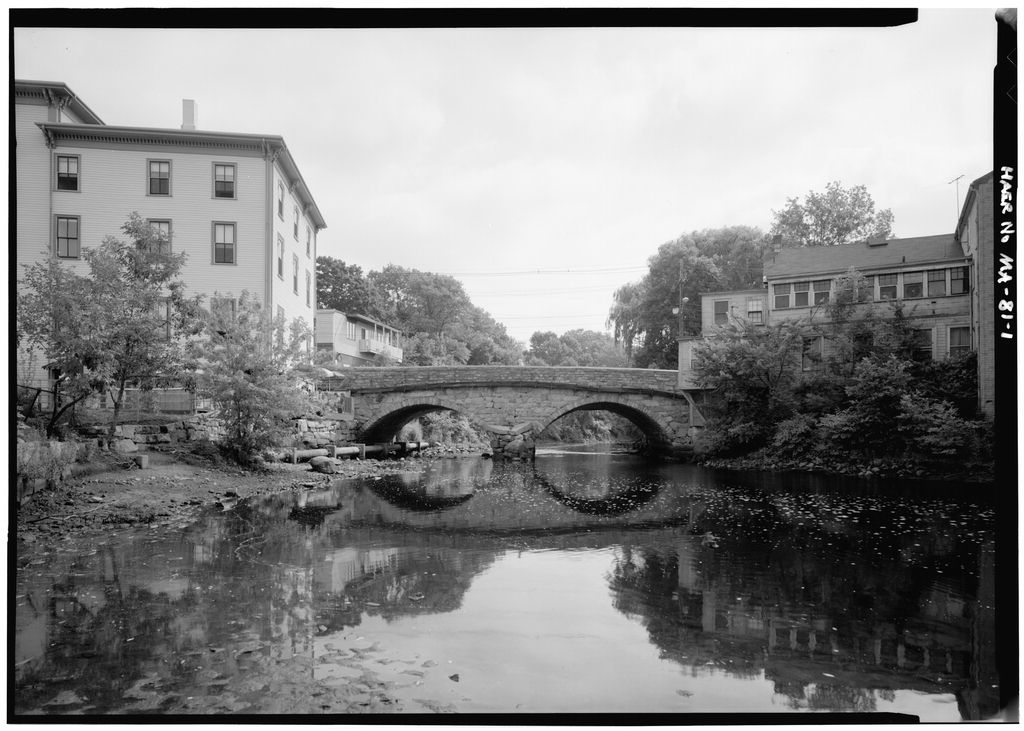
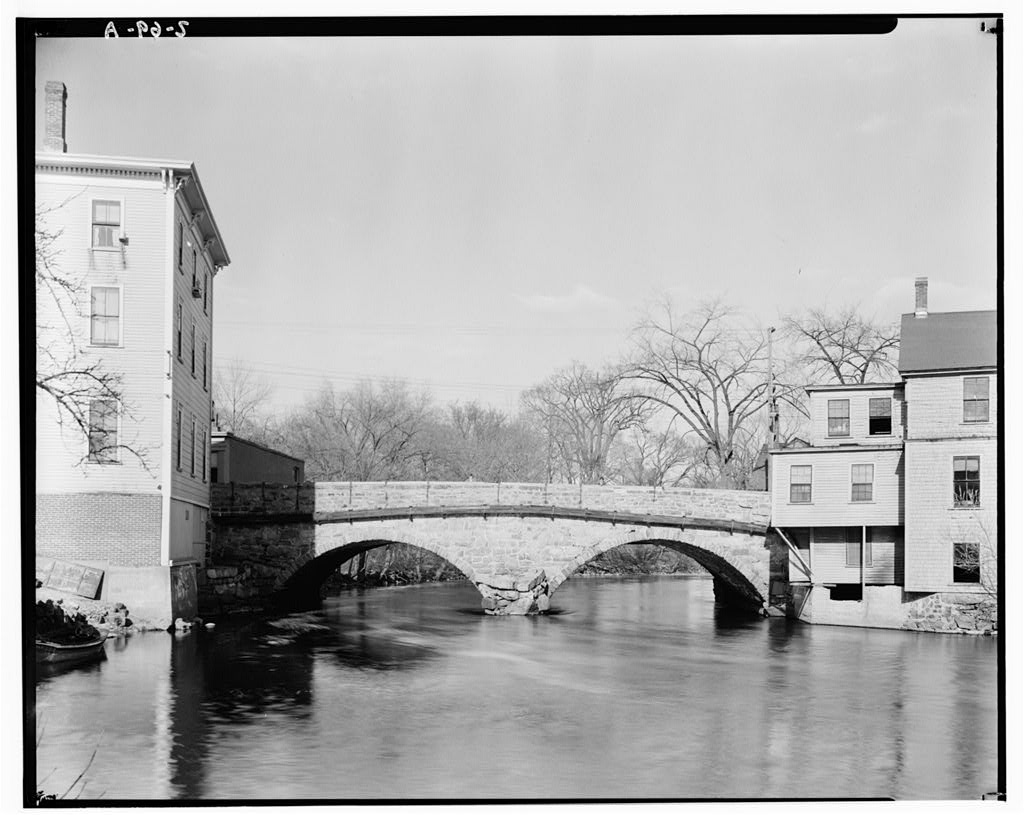
A. G. Lichtenstein and Associates Fair Lawn Avenue, Fair Lawn, 07410),was engaged by the Town of Ipswich to document the bridge. The narrative was prepared by Mary E. McCahon of AGLAS, with assistance from Mary Conley, Ipswich Historical Commission. Martin Stupich was the photographer, and Abba G. Lichtenstein supervised the project, completing it in July Choate Bridge HAER No. MA-81 (Page ) 3 Choate Bridge is located on Massachusetts State Route 1A, the historic main, north-south roadway along the north shore, where it crosses the tidal portion of the Ipswich River in the center of Ipswich. The bridge has a total length of and is composed of two elliptical arches, each 30' long at the spring line and with an approximately 9' rise between the spring line and crown.
It is wide and accommodates 2-lane vehicular traffic [see HAER Photographs No. MA-81-12 and MA-81-13]. The westerly (original) portion was constructed in of random-coursed, granite, ashlar blocks [see HAER Photograph No. MA-81-14]. In a 15-foot-wideextension of similar construction was added to the east, or downstream, side [see HAER Photograph No. MA-81-8]. The bridge is flanked on the northwest corner by the handsome Italianate-style Caldwell block [see HAER Photograph No. MA-81-13] and on the southwest by an early-nineteenth century, two-story, frame building with storefronts on the first level [see HAER Photograph No. MA-81- Both structures are built to the street, and the gently curving bridge parapet extends to their foundations [see HAER Photographs No.
MA-81-14, MA-81-16, and MA-81-19]- A ca. 1900brick and frame commercial buildingand rubble-coursed retaining wall occupy the northeast corner, while the southeast corner is open [see HAER Photograph No. MA-81-11]. The buildings adjacent to the bridge are stylistically representative of those in the center. Ranking among the oldest, if not the oldest, bridges in the Commonwealth, Choate Bridge has been in continuous use since and it survives in a remarkably complete state of preservation, and the more significant, owing to its location on a major arterial highway that carries a heavy volume of commercial truck traffic.
With the exception of the addition of a twentieth-century utility box and water main, the bridge has apparently not been modified since the widening, making it a complete and unaltered example of mid-eighteenth century bridge technology. The Ipswich River was crossed by a bridge neAr or at this site as early as (Waters, Ipswich River, p. Local historian Thomas Franklin Waters carefully chronicled the history of the crossing in a paper entitled Ipswich River. Its Bridges. Wharves and Industries, published posthumouslyby the Ipswich Historical Society in The first specific mention of a cart bridge across the river is in the town Minutes of January 4, where the names of those who agreed to provide two days work for the privilege of using the "cart bridge," was listed.
In March, it was "ordered that the Surveyors shall take care to make good the passage at both ends of the Cart Bridge sufficient for passages of horses and carts soe soon as () carpenters have made it capable" (Ibid., p. By a new bridge was needed, and the Quarter Sessions Court appointed John Appleton and Jonathan Wade to compute the cost and construct it. On June they reported that the replacement span would cost about 80 pounds, and that work was already underway. An item in the town accounts of "trying to save the old bridge" suggests that the bridge was damaged, possibly by a freshet in the river. Salvage efforts were not successful, for in September the Essex County Court received an itemized bill from John Appleton and Nehemiah Jewett for a new bridge. Choate Bridge HAER No.
MA-81 (Page $ The longevity of wooden or timber bridges was not great, and by the 1683bridgewasinpoor condition. On May 9, the town voted that "Coll. John Appleton Esq. & Col. Jno WainwrightEsq., Major Francis Wainwright, Lieut John Whipple & Mr. James Burnham be a committee to consider what way be most proper in regard to our "Great Bridge" (ibid., p. Again, in the Selectmen were instructed to "provide a suitable foot bridge over the River with all convenient expedition and also what they wait on the next Quarter Sessions to consult and advise with them about the erecting a new bridge" (Ibid., p. In the volume of traffic over the county road serviced by the bridge had become so great that yet another, wider replacement span was needed.
The genesis of new bridge is well documented in the minutes of the town county court, which illustrated the influence of John Choate, as well as the desire of both the town and General Court to achieve a more lasting solution to the crossing problem. On March 6, the town meeting appointed a committee, which included John Choate, and charged them with "considering" the bridge affair and making a report to the members.
Ten days later, on March 16, The Committee appointed to review the Town & County bridge over Ipswich River in this Town, have attended that service and report that the said bridge is in such circumstances that it will not afford safe and convenient travelling over it for any long time without a thorough repair and that it is now by six or eight feet too narrow for safe passing for horses and carts and other carriages which meet one another. Thy are therefore of opinion that the said bridge be with all convenient speed repaired and made 20 feet wide between the rails the one half the whole cost of such repair to be born by this Town on consideration & Hon. Court of Gen*l Sessions of the Peace will agree to such repair <fc order the other half of such charge to be born & pd.
by the county and committee further report that it would be built on the whole cheapest if suitable (sic) floor stones can be obtained and the said court wi.l agree to it that the said bridge be repaired with stone in the following manner and degrees. Viz.
That the two abutments already built in the said bridge be [ ] further into the river not exceeding three foot each and that there be two pillars of stone not under nor more than five feet thick raised at each end of said bridge the first of which to be eleven or twelve feet from said abutment and the next the same distance from that toward the center of the river so that the two pillars next center shall save a passage for the ice and water between them not less than 28 or more than 30 feet wide and that the whole 4 pillars be carried up to convenient height with both sides jetted over toward each other when above the water so as to make the opening a top over each sluice as narrow as with safety to such abutments may be done.
That those sluices except the middle one be covered with proper floor rocks and the middle one with a set of strings and planks of a suitable length and width and as it is apprehended this middle passage may be reduced to 22 or 24 feet wide at top it will of course reduce the wood covering of said bridge to one quarter of width is now and perhaps after a tryall all of this will be found best to reduce the whole to stone which may be done by one pillar more being raised in the middle sluice. They therefore propose that a committee be appointed to apply to the Honorable Court of Session to be holden in the Town the next week praying them to agree to the term above proposed and also Choate Bridge HAER No.
MA-81 (Page#) tr in consort with such a committee at the said Court shall appoint for the purpose to procure any necessary materials and accomplish said work as soon and with as much dispatch as they conveniently can. John Choate And thereon voted that John Choate, Aaron Potter Esq., Capt. Isaac Smith, John Appleton & Isaac Dodge be a committee fully authorized and impowered for the purposes above.
The local Ipswich committee was successful in gaining a hearing before the Court of General Session, and at its deliberations held the last Tuesday in March of the Court On reading the petition of a committee of the town of Ipswich showing that the bridge over the town river on the great county road is in such circumstances that it wants a thorough repair from the foundation and proposing that it be repaired some part with stone all the charge of the county & said town in equal halves and praying said court will pass an order for rebuilding said bridge in such a manner as is proposed by said town or such other manner as the Court shall see meet. Thereupon it is ordered that Caleb Cushing, Nath'l Roper, Benja. Mulliken, Nathan Brown and Nathan Bowen Esq.
be a committee to inquire into the matter View of the said bridge and make report to the Court as soon as may be. And the said committee made report this same term in the words following. Viz...We have viewed the bridge there in mentioned & find the same in a ruinous and unsafe condition & must [ ] rebuild and are of opinion that it will be most for the public service that the same be rebuilt wholly of stone of not less than 20 feet wide within the rail, in manner following.
Viz: The two end abutments to be extended so far into the river as to leave about 68 feet space between them, that in the middle of said river be erected abutment about 20 long & about 8 feet wide that from the said middle to the [ ] abutment an arch be turned so as to leave about 30 feet for the passage of water under each arch which we apprehend will at all times be sufficient therefore.
That the interstices be filled up and fitted for public use and that the said bridge be properly secured by rails on each side and for effectuating that work a Committee be appointed by this court who with such persons as the town of Ipswich in equal halves and that the committee or the major part of them from time to time draw out of the respective treasury as it may be wanted for that service the committee to be accountable to the said county and town respectively. Choate was selected as one of the Ipswich representatives, and all freeholders and inhabitants of the town were requested to attend a meeting on April to respond to the Court's decision to rebuild the bridge in stone.
John Choate was voted moderator of the meeting, and after consideration and debate, the stone bridge "passed in the affirmative by a large majority" (Minutes, April 18, Work proceeded through the summer under the supervision of John Choate, who was absent from his judicial seat from June 17 through October 26. On September 10, the freeholders and inhabitants voted to build a stone "wall guard" not to exceed fifteen inches at the bottom and nine inches at the top and about three feet high. Work was apparently completed by November, as subsequent town meeting minutes contain several items authorizing payment for the bridge. Choate Bridge HAER No.
MA-81 (Page $) John Choate (l697-1768),for whom the bridge was named by order of the Court of General Sessions, in recognition of the "great Care and Assiduity of the Honorable John Choate, Esq. (Wardell), as a man of considerable influence and standing in Ipswich. A lawyer by profession, he was continuously elected as one of the two Ipswich representatives to the Massachusetts General Assembly from to as well as in several subsequent years.
He served simultaneously as judge of the Court of General Sessions, Chief of the Court of Common Pleas, a town moderator, county treasurer, and a member of the Governor's Council as well as one of the founding members of South Parish, a new congregation established in on the south side of the Ipswich River, or Town River as it is sometimes identified in period documents. Choate's house is not extant. It was located on the South Main Street site of the Whipple House, which was moved there in and currently serves as the headquarters of the Ipswich Historical Society. When and how John Choate, the respected lawyer and successful public official, acquired his technical knowledge about masonry construction is not definitely chronicled.
Tradition holds that Choate became familiar with stone structures as a result of his military service during the French and Indian wars (Wardell). In during King George's War (1744-1748),he joined Governor William Shirley's largely Massachusetts-supported campaign against the French and their fort at Louisburg on Cape Breton Island. The somewhat naively conceived and prepared was nevertheless successful, and the much-feared masonry fortification was captured and dismantled. Choate was enrolled as a "Colonel and Captain of the First Company of the 8th Massachusetts Regiment" (Waters, p.
Experience in putting up rather than taking down masonry structures may have been gained in when, again as part of Shirley's forces, the 59-year-old Choate served at Albany forwarding stores and supplies during the New York campaign. It was no doubt as a result of John Choate's considerable stature and influence that the "great bridge" on the "great county road" was built as a stone arch span, adding prestige as well as permanence to the crossing and the community, but how much of the specific mechanics of the undertaking were contributed by Choate remains undocumented. An interesting account of the bridge was published in the August 7, edition of the Boston Evening Transcript, some 125years after it was completed.
Although a somewhat romanticized and exaggerated interpretation, the article demonstrates the reverence in which the bridge was held by a society beginning to appreciate its colonial past as well as the main who is remembered as being most responsible for its construction. Report that the plan of building the Bridge of stone was his own and it had little support from others. The people did not believe that a stone bridge could be made to stand on that soil. Looking at the spot today, their want of confidence does not seem reasonable. Then, again, they did not believe that the money appropriated would prove sufficient for accomplishing the work; last of all, the idea prevailed that, even if it were possible, Colonel Choate was not the man to do it.
There is a good deal of historical and traditional interest connected with that Old Bridge as closely as the mosses cling in the chinks of its uncemented stones. We are able to fix the seAson, the length of time, as well as the year in which it was built. The records of the General Court show that Colonel Choate was not in attendance upon its sessions from June 17, to October 27, following. This absence is accounted for when we learn that in this year he built the Bridge. Choate Bridge HAER No. MA-81 (Page 0) The article goes on to recount a story about Choate being on the north side of the bridge, ready to flee to Canada, if the bridge collapsed as the falsework was being removed.
It is probably quite true that Choate, the prime mover of the stone arch bridge concept, was confronted with some nay-sayers,but the fact that previous timber spans were relatively shortlived and requiring of continual maintenance and that the freeholders and inhabitants of Ipswich "passed (the resolution to build the stone arch bridge) in the affirmative by a large majority" suggests that the account of overwhelming skepticism to Choate's plan was exaggerated. While stone arch masonry bridges were not technically innovative in the mid-eighteenth century, it is noteworthy that such a monumental span was undertaken on the local level. The handsome, well-constructed, dry-laid ashlar bridge was both an immediate and continued engineering marvel.
In the town of Ipswich, as part of its anniversary of its founding, published a poem reportedly composed by Mr. Clark from Rowley, Massachusetts, in in honor of Choate's completion of the bridge. Behold this bridge of lime and stone! The like before was never known For beauty and magnificence,-- Considering the small expense. How it excels what was expected, Upon the day it was projected! When faithful men are put in trust They'll not let all the money rust. But some advance for public good Is by this fabric understood; And after this is will be wrote In honor of brave COLONEL CHOATE! It was his wisdom built the same. And added lustre to his fame, That filled this country with renown, And did with honor Ipswich crown.
Choate Bridge was the first of five stone bridges built in Ipswich during the eighteenth and nineteenth centuries. In Ipswich and Essex County officials began to consider plans for widening the bridge. Nothing was done until when Joseph Wait and 194 others came before the town asking that in addition to widening the bridge, the town should purchase the Joseph L. Ross property at the northeast corner and remove the house, barn and blacksmith shop, so that the road up the hill into the center could also be widened. Choate Bridge HAER No.
MA-81 (Page X) In the town and county agreed to widen Choate Bridge 15" 6" by an addition to the east side in a manner nearly identical to that used in The town voted to be liable for no more than for their portion of the widening project, but contentions arose as to the location of the road and the widening of the bridge with a variety of makeshift proposals by the town to avoid its share of the expense. The town's efforts were in vain, and the bridge was widened in The county ordered Ipswich to pay its portion ($l,037.50)in January (Waters, p. Although there have been periodic repairs, Choate Bridge survives basically unaltered since the widening.
The western side, with its handsome, drylaid intrados of rusticated ashlar blocks and parapet, battered on the interior face, is particularly complete, including the retention of the beveled wooden coping anchored by iron straps that is clearly shown on Mary Jane Derby's ca. sketch [see HAER Photograph No. MA-81-17; location of original is unknown]. When the parapet was first pointed is not known. An photograph of the east elevation used on the cover of Water's Ipswich River. Its Bridges. Wharves and Industries suggests that the outside was not pointed at that date.
A photograph in an undated and untitled bound album in the Ipswich Room at the Ipswich Public Library appears to also date from the late-nineteenth century, and it clearly shows that while the outer face of the eastern parapet is not pointed, the inside of the west (original) parapet is pointed with very light colored mortar. When the venerable bridge was recorded by the Historic American Buildings Survey in (HABS No. MASS includes one drawing and 2 photographs), a utility box was attached to the west elevation. No longer extant, it may well have been the conduit carrying the telephone lines that are now depressed in the roadway.
The water main on the outside of the east elevation, installed in the early twentieth century, is carried on concrete and ferrous piers and concealed behind a frame casing (see HAER Photographs No. MA-81-8, MA-81-9, and MA-81-11). It is not known if the cutwater pier on the west elevation is original or an early addition to project the upstream pier from freshets in the river (see HAER Photographs No. MA-81-14 and MA-81-17). During the early some remedial work, under the direction of George Morse, was done to the bridge (Conley). The parapet has been rebuilt many times, as a result of being damaged by vehicular impact.
A variety of inappropriate mortars have been used on both the inside and outside of the parapets and the stones have been reset with joints that are too wide to be effective or historically accurate (see HAER Photographs No. MA-81-11 and MA-81-17). Prior to Choate Bridge was certified as a Massachusetts Historic Landmark and, on August 21, it was individually listed in the National Register of Historic Places for its State significance in engineering and transportation. It is also part of the South Green National Register Historic District, which recognizes not only the importance and preservation of the bridge itself but also its historic setting. Choate Bridge HAER No. MA-81 (Page ) Note added September 8, by A. G.
Lichtenstein as follows: In connection with the rehabilitation project of the Choate Bridge, in June the firm, Preservation Technology Associates, Inc. (PTAI) of Boston, Massachusetts, performed a detailed examinationof the Choate Bridge for the purpose of recommending the proper repointing mortar to be applied in the joints. The examination by PTAI was two-fold: a close, hands-on inspection of the joints in the field, and a careful review and study of available historic photographs, includingthose located at the Society for the Preservation of New England Antiquities (SPNEA).
In the opinion of PTAI, the original portion of the Bridge "was laid up in lime mortar at time of its construction." On the other hand, the newer portion of the Bridge was found by PTAI to have been "originally laid up as dry stone work with no mortar."
Boston Evening Transcript. "Choate Bridge,", August 7, Conley, Mary John). Personal interview with Mary E. McCahon, March Essex County. Court of General Sessions. Records. March-December Historic American Buildings Survey. Choate Bridge (MASS Washington, Department of the Interior, Ipswich. Town Meeting Minutes. March 1794-March Ipswich Public Library. Ca. Photograph Album. Untitled and updated bound manuscript in Ipswich Room collection. Keenan, Alice. Ipswich Yesterday. Ipswich: Today Newspapers, Inc., Russell, Francis. The French and Indian Wars. New York: American Heritage Publishing Co., Inc., Thompson, Katherine. "Choate Bridge." Ipswich Chronicle. February 4, Wardell, Ann. "Choate Bridge." Nomination to the National Register of Historic Places.
Boston: Massachusetts Historical Commission, Choate Bridge HAER No. MA-81 (Page ?) Bibliography, cont'd. Waters, Thomas Franklin. Ipswich in the Massachusetts Bay Colony Vol. H. Ipswich Historical Society, Ipswich: Ipswich Historical Society, CHOATE BRIDGE HAER. No. MA-.3JL (Page J#) _J . <J p>i -fi~.^- -* ** Zi c V o c .a c > rfl f ". i : " r 3 T" .' ' ; L ' '-! * 1 1 i^fj i^Z J . :.cO 1_ : L-H J Th I .' u K > 1 ' " ' .' ! ' J v I- : -J *o (i-L-_; <o >-* ;'r.;u O ! ( Hr\ C( 41 k ^-v ' - * ^"1 ' U : i JA o > ' > n ' ii .- o X uJ li-^J l^i uro. i^hi QU"L'/ HI3 O c3 O C B H O I \ U'._ "*r " l- - 5 ! s .: 1 gj^r^sgi :,il ; \ CHOATE BRIDGE HAER No. MA-81 (Page ]A) CO _i'if en ^S ^T v i ; j , , > - p w W o o / s < p. s;,:7Si:;,'" :"~ :*::aimx CHOATE BRIDGE HAER No.
MA-81 (Page J*) *T *4- ?4- o+ S^ s x H I 1 1 U i i u 5
 Block
Block