Spanning the Mill River on Clement Street, in the Bay State section of the City of Northampton, Hampshire County, Massachusetts UTM: Easthampton, Mass., Quad. Wrought-iron Pratt through truss bridge Unknown Unknown City of Northampton, Massachusetts Vehicular and pedestrian bridge The Bay State Bridge is the sixth oldest of nine Pratt through trusses in Massachusetts, identified in the Massachusetts Department of Public Works database. It has a somewhat uncommon upper lateral bracing system, and has some unusual decorative features, such as curved brackets and a latticed guardrail. The Bay State Bridge has served for nearly a century as the only river crossing in Northampton's Bay State Village section, one of the city's principal nineteenth-century manufacturing districts.
Documentation of the Bay State Bridge is part of the Massachusetts Historic Bridge Recording Project, conducted during the summer of under the co-sponsorship of HABS/HAER and the Massachusetts Department of Public Works, in cooperation with the Massachusetts Historical Commission, Lola Bennett, HAER Historian, August BAY STATE BRIDGE (CLEMENT STREET BRIDGE) HAER No. MA-110 (page 2) Description The Bay State Bridge is a single-span, 94-foot, pin-connected Pratt through truss, resting on rubble masonry abutments.
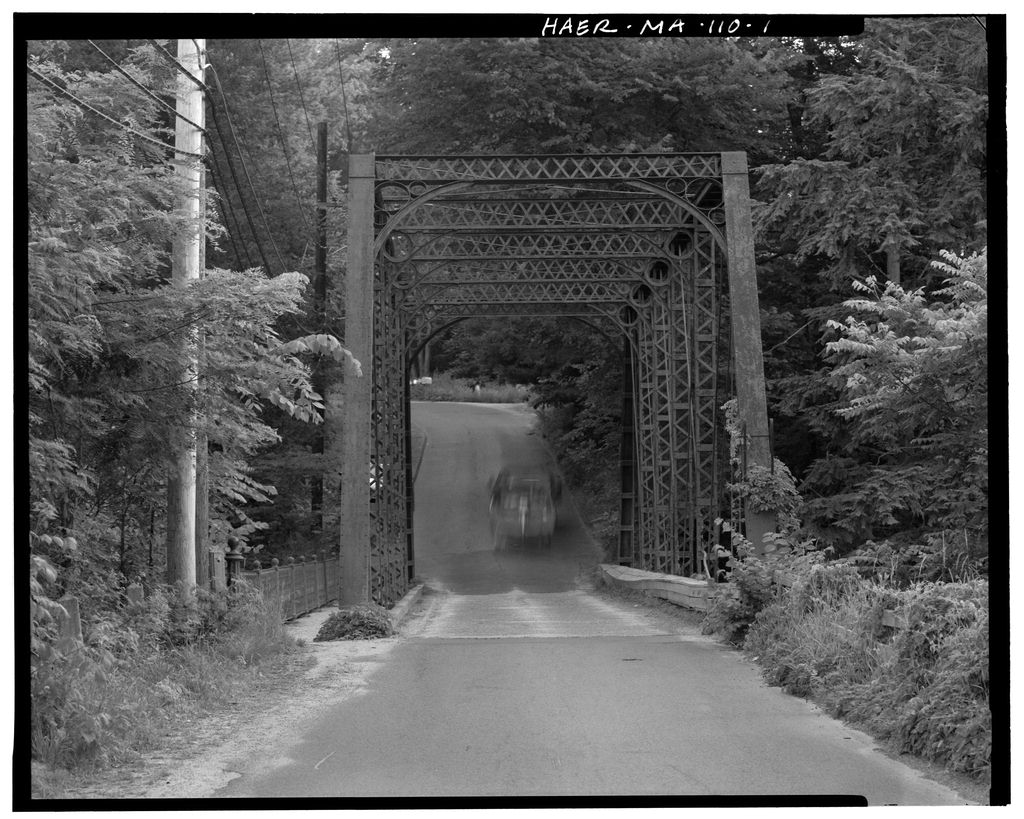
Each seven-panel truss is comprised of a built-up upper chord (two channels covered with a solid plate), connected to the bottom chord (two parallel % n x4 M eyebars) by verticals (two channels with batten plates and lacing--the batten plates appear to be original; the lacing was added in The trusses are braced with paired diagonal bars angling up toward the ends in all but the center and end panels, and single (1 M diameter) rods with turnbuckles, angling down toward the ends in the three center panels. The hip verticals in the end panels are paired eye-bars whose principal function is to suspend the outer floor beams.
The built-up floor beams, comprised of a plate and angles, hang from the verticals by U-bolts, which loop over the pin at each lower panel point, pass through the flanges of the floor beams, and are secured underneath with a plate and two nuts. The original stringers were replaced in with rolled steel members, which support a reinforced concrete deck, 16' wide, and a 3' sidewalk on the southeast side of the bridge. The upper chords of the trusses are joined and braced by latticed, lateral struts at each panel point, with decorative curved brackets below. Within each panel between the upper chords, four rods, with loop-welded eyes, pinned at the chord ends, meet at a central iron tension ring, where they are secured with nuts on the inner side of the ring.
The two portals are defined by the inclined end posts of the trusses (two channels covered with a plate on the upper side, and tie plates on the under side), with an inclined latticed portal strut and decorative curved brackets at the top. A latticed railing, anchored with decorative cast iron posts, runs along the southeast edge of the sidewalk.(See Figures Bav State Village The City of Northampton, Massachusetts, is situated on the west side of the Connecticut River, midway between Greenfield to the north, and Springfield to the south. The Mill River crosses the city diagonally, entering at the northwest corner, and exiting into the Connecticut River at the southeast corner.
Along this river, just to the northwest of the city center, are located the historic manufacturing villages of Leeds, Florence and Bay State. Beginning in the late-seventeenth century, the water power of the Mill River had been harnessed for manufacturing purposes. As the settlement of Northampton grew, this Industry consequently increased. By the latter part of the nineteenth century, Northampton had become a prosperous manufacturing center. In industries consisted chiefly of: silks, machines, cutlery, wire, tacks, tinware, buttons and trimmings, baskets, cotton hose, paper and paper boxes, lumber, agricultural implements, spools, emery agricultural implements, spools, emery wheels and cloth, furniture, brushes, brooms, leather, wrought stone, brick, clothing, and others.
1 BAY STATE BRIDGE (CLEMENT STREET BRIDGE) HAER No. MA-110 (page 3) Small yet distinct villages grew up around the mills and factories supporting the largest of the industries. The village of Leeds, about four-and-a-half miles northwest of Northampton center, was established early in the nineteenth century around the woolen mills, and named for Leeds, England, a woolen manufacturing district. The village of Florence, about three miles northwest of the city center, grew up around the enterprise of silk manufacturing, which began in and took its name from the famous silk-producing city in Italy.
Somewhat later than Leeds and Florence, the Village of Bay State, about one- and-a-half miles from Northampton center, developed around the Bay State Tool Company, which had its beginning in The Bay State Company, employing 150 men its first year, manufactured agricultural implements. For some reason the company failed four years later, and the plant was sold to Clement, C.A. Maynard, and Hawkes, who continued the business of making tools, mainly for the South. 2 The company was incorporated in and during the Civil War was engaged in the manufacture of guns and bayonets.
Later the company specialized in the manufacture of cutlery, and eventually two companies emerged--the Northampton Cutlery Company of which manufactured knives, and the Clement Manufacturing Company of which manufactured cutlery. At their peak, in the and these two companies employed between 350 and 400 men. 3 By the late nineteenth century the cutlery industries had completely overshadowed the older textile and button Industries in Bay State Village. Construction of the Bav State Bridge The growth of the industries at Bay State Village was followed by a consequential increase in the amount of traffic to and from that area.
But while Leeds and Florence both had bridges across the Mill River early on, Bay State had none, which often meant long detours of several miles around the village for those wishing to cross the river. 4 Apparently there had been some agitation about this, because in the Mayor's annual address for he made the following statement: I may be wrong, but in my opinion a bridge ought to be provided somewhere across Mill river between the old bridge and the railroad bridge. I think it would be well to have the whole city council meet those people, "in mass meeting," on the dike, to decide the question.
5 The city fathers decided to go ahead with the plan, and a bridge was constructed across Mill River at Bay State during the summer of Unfortunately, very little documentation exists relating to the construction of the Bay State Bridge, and the engineer and builder remain unknown. City documents only contain references to the amount of money appropriated for, and spent on, the bridge, and local newspapers carried very little news about its construction. The one small item of interest that appeared in June of stated, "There has been some delay in getting the iron for the Bay State bridge, as the strikes in the coal region have caused a scarcity of coal for the founderies. " 6 BAY STATE BRIDGE (CLEMENT STREET BRIDGE) HAER No.
MA-110 (page 4) In any case, the bridge and a new street, named "Clement Street," were completed that year, and in his annual report, the city engineer stated, "A new iron bridge over Mill River at Bay State with abutments to the same has been completed and the new street graded." 7 The city treasurer's report for that same year indicates that the total cost of the bridge was 8 Later annual reports indicate that the bridge received several new coats of paint and new flooring over the years. The only major repairs on the bridge occurred in This report stated: During the year the condition of the bridge at Clement Street, Bay State, became so dangerous that repairs were imperative.
The bridge was strengthened with a cement floor, steel reinforced at a cost of The work was done by Kiely & Gleason of this city. 9 Preservation Efforts Based on a engineering study which concluded that the Clement Street Bridge was dangerously corroded, the city of Northampton and the Massachusetts Department of Public Works considered having the bridge replaced, and began studying a number of proposals. In however, the Massachusetts Historical Commission declared that the Clement Street Bridge was a potential landmark, and that they would not approve its being torn down. Under Section 106 of the National Historic Preservation Act, without the commission's approval, the city cannot obtain much-needed state and federal funds for the bridge.
A neighborhood group known as the Clement Street Bridge Action Committee is actively championing preservation of the nearly century-old structure. This group, composed mainly of residents of the Bay State section of Northampton have opposed all previous suggestions for replacement, because they realize that a new two-lane bridge will draw cross-town traffic and change the character of their historic neighborhood. The city has recently come up with a plan for the rehabilitation of the structure. This plan is presently in the process of being reviewed by the federal and state highway administrations, and is subject to funding limitations. BAY STATE BRIDGE (CLEMENT STREET BRIDGE) HAER No. MA-110 (page 5) Figure 1. photo of Bay State Bridge, from southwest portal BAY STATE BRIDGE .
(CLEKENT STREET BRIDGE) HAER No. MA-110 (page 6) > si 0) *0 u 0) % p (0 % u w CO <u 0 C 0 iJ > a u: 5 BAY STATE BRIDGE (CLEMENT STREET BRIDGE) HAER No. MA-110 (page 7) DETAIL OF BRACKET (Not to Scale) ELEVATION OF SOUTHWEST PORTAL DETAIL OF RAILING AND POST (Not to Scale) Figure 3. Details of Bay State Bridge BAY STATE BRIDGE (CLEMENT STREET BRIDGE) HAER No. MA-110 (page 8) ENDNOTES 1. Elias Nascm, A Gazetteer of the State of Massachusetts , revised and enlarged by George J. Varney (Boston: Russell, 2. Agnes Hannay, "A Chronicle of Industry on the Mill River," Smith College Studies in History , vol. XXI, nos.1-4, October 1935-July (Northampton, Mass.: Smith College Department of History, 3. Ibid. 4. Atlas of Northampton City. Massachusetts (Boston: George H. Walker and Co., 5.
Annual Reports of the City of Northampton. . Northampton, Massachusetts, 6. Daily Hampshire Gazette . Northampton, Massachusetts, June 15, p. 5. 7. Annual Reports of the City of Northampton. . Northampton, Massachusetts, 8. Ibid. , 9. Annual Reports of the City of Northampton. . Northampton, Massachusetts, p. BAY STATE BRIDGE (CLEMENT STREET BRIDGE) HAER No. MA-110 (page 9)
Atlas of the City of Northampton and Town of Easthampton. Hampshire County. Massachusetts . Philadelphia: Miller and Co., Atlas of Northampton City. Massachusetts . Boston: George H. Walker and Co., City of Northampton Annual Reports, County Atlas of Hampshire. Massachusetts . New York: Beers and Co., Daily Hampshire Gazette , Northampton, Massachusetts, Everts, Louis H. History of the Connecticut Valley in Massachusetts . Philadelphia: Lippincott and Co., Hampshire County Journal . Northampton, Massachusetts, Hannay, Agnes. "A Chronicle of Industry on the Mill River," Smith College Studies in History , vol. XXI, nos. October 1935-July Northampton, Mass.: Smith College Department of History, Kneeland, and Bryant. Northampton: The Meadow Citv . Northampton, Lockwood, John H., ed.
Western Massachusetts. A History. . New York/Chicago, Nason. Elias. A Gazetteer of the State of Massachusetts , revised and enlarged by George J. Varney. Boston: Russell, The Northampton Book: Chapters from 300 Years in the Life of a New England Town. . Northampton, Massachusetts: Northampton Tercentenary Committee, Trumbull, History of Northampton. Massachusetts . Northampton, Mass.,
 Block
Block