 Block
Ipswich Town (part 1 of 3)
Part 1 of 3 of the account of this town in History of Essex County, Massachusetts, with Biographical Sketches of Many of Its Pioneers and Prominent Men, published 1888. 15,934 words, covering 6 settlements. Source changes inside the text are labelled at the exact paragraph where the next book begins.
Contents
8 sectionsThe section headings the book prints inside this chapter, on this part. Each one jumps to where it begins.
Parts
3 pagesThe source prints this as one continuous account. It is split here so no single page grows too heavy to load; the text runs straight on across the parts and nothing is omitted.
The people it describes
3 namedEveryone the 1888 history stops to write about in this chapter. Each name opens the passage itself.
The modern record here
6 settlementsWhat the federal record holds for each settlement inside this town: wildfires and storm reports since the 1950s, mineral workings, and museum specimens collected nearby. These are counted within a few miles of each settlement, so neighbours share them and the columns are deliberately not added up. Every row links to the settlement's own page, where each figure is broken out.
| Settlement | Fires | Storm reports | Mines and quarries | Specimens |
|---|---|---|---|---|
| Aqawam (historical) | 41 | - | 7 | 4,556 |
| Camp Sea Haven | 17 | - | 3 | 3,179 |
| Ipswich | 41 | 18 | 7 | 4,556 |
| Linebrook | 68 | 1 | 9 | 3,207 |
| Little Neck | 24 | - | 4 | 4,963 |
| Pinefield | 64 | - | 7 | 3,277 |
Settlements in this township
6 placesEvery populated place the Geographic Names Information System records inside this township's Census boundary. 3 of the 6 are named in the chapter; the rest were founded later or were never more than a post office.
The chapter
15,934 wordsReproduced complete and unedited from History of Essex County, Massachusetts, with Biographical Sketches of Many of Its Pioneers and Prominent Men, published 1888. The text is machine-read from scans, so expect recognition errors: misspelled names, dropped words, and stray characters. Nothing has been corrected, because correcting a proper name invents one. The headings below are the books' own; source changes are labelled in place.
Ipswich Town
the employ of the Plymouth Company, and belonged to Robert Gorges' party, who settled at Wessagusset, in September, 1623. Mr. Fewkes' old cellars and wells, evincing to him traces of the Norsemen, referred to above, may have been Jeffrey's trading and fishing station; and so to Jeffrey's diminutive cityby-the-sea the Court of Assistants may have referred, when, in 1630, by warrant, they " ordered those planted at Agawam forthwith to come away." However this may be, William Jeffrey, in 1660, to satisfy his claim to Jeffi'ey's Neck within the bounds of Ipswich, is granted five hundred acres of land on the south side " of our patent, to be a final issue of all claims by virtue of any grant heretofore made by any Indians whatsoever."
4. Notice. - Mr. Jeffrey is referred to in one of the company's letters of instruction as " William Jeffries, Gentleman." He was an Episcopalian ; was made freeman May 18, 1637; was one of the proprietors of Weymouth, in 1641-42, where he was commissioned to solemnize marriages. Very early he had property rights at the Isles of Shoal<. He and his business associates, - Hilton, Blackstone, Barslin and Thomson's widow contributed to meet the expense of the expedition, that dislodged that " merry, rollicking, scholar, adventurer and scape-grace, Thomas Morton, Gentleman," from Merry-Mouiit, about 1628. In 1634 Morton called him "My very good gossip." He witnessed the will of William Waltham, of Weymouth, in lGi2; and his daughter Mary was born . there "20 : 1 : " of the same year.
Settlement
1. Pioneers. - About twelve years after the Pilgrims landed at Plymouth, four and a half years after Captain John Endicott colonized Salem, and three years after Governor John Winthrop established the colony of Massachusetts Bay, a rumor spread in Boston that the Jesuits were about to establish a mission. This it was a part of the Governor's duty to prevent, and he immediately organized a company of thirteen men with his son John as leader, to forestall the movement. Accordingly Mr. John Winthrop, Jr., Mr. John Thorndyke, Mr. William Clark, John Biggs, Robert Cole, John Gage, Thomas Hardy, Thomas Howlett, William Perkins, William Sergeant and three others, in March, 1633, wooed and wed the virgin soil of Agawam.
Aggawam shallbe called Ipswitch," wherefore August 16th, new style, 1634, dates the beginning of our corporate capacity. The name is derived from Ipswich, England, "in acknowledgment of the great honor and kindness done to our people who took shipping there.'' The House of Commons, in the memorable resolve of the 10th of March, 1642, gave New England the title of Kingdom, and Wonder-working Providence, in consonance, calls Ipswich an Earldottie.
3. Deed. - The colonial records read that Masconnomet sold his fee in Ipswich to John Winthrop, Jr., March 13, 1638, and that he expressed himself satisfied with the consideration, March 5, 1639. The following is the deed:
" I Masconnomet Sagamore of Agawam do by these presents acknowledge to have received of Mr. John Winthrop the sum of £2(i, in full satisfaction of all the right, property, and claim I have or ought to have, unto all the land, lying and being in the Bay of Agawam, alias Ipswich, being so called now by the English, as well as such land, as I formerly reserved unto my own use at Chebacco, as also all other laud, belonging to me in these parts, Sir. Dunimer's farm excepted only; and I hereby relinquish all the right and tuterest I have unto all the havens, rivers, creeks, islands, huntings, and fishings, with all the woods, swamps, timber, and whatever else is, or maj' bo, in or upon the said ground to me belonging ; and I do hereby acknowledge to have received full satisfaction from the said John Winthrop for all former agreements, touching the premises and parts of them; and I do hereby bind myself to make good the aforesaid bargain and sale unto the said John Winthi'op, his heirs and assigns forever, and to secure him against the title and claim of all other Indians and natives whatsoever.
Ipswich is ordered November, 5, 1639, by the Court, to refund to John Winthrop, Jr., the twenty pounds named in the above deed. The town voted February 22, 1705, " That Samuel Appleton, Esq., and our two representatives, Nehemiah Jewett and Nathaniel Knowlton, treat with Hon. Wait Winthrop about Masconnomefs deed of Agawam, made to his father, deceased.
4. Extent. When the town was settled in 1633, the boundary on the north and west was the boundary of ancient Agawam; on the east the ocean; on the southeast Cape Ann, (Gloucester) ; and on the south Jeffrey's Creek, (Manchester) ; Enon, (Wenham) ; and Salem Village, (Danvers), four hamlets then belonging to Salem. Newbury, 12,300 acres, was set off in 1635, and contributed to the sisterhood Newburyport, 4575 acres, in 1764, and Parsons, 8072 acres, in 1819, which became West Newbury, June 14, 1820. The court, in 1636, established our western limit six miles in the country, the southern and eastern boundaries remaining the same. In 1639, Ipswich with Newbury contributed Rowley, 10,310 acres, for which the two towns received £800, and out of which were cut the towns of Bradford, 4564 acres, in 1675, of Boxford, 14,200 acres, in 1685, of Middleton, in part, about 2500 acres, in 1728, of Georgetown, 7548 acres, in 1838, and of Groveland, 5230 acres, in 1850. In 1650 Ipswich contributed tlie part of Topsfield, north of the river, part of 7375 acres. The Hamlet of Ipswich, 9440 acres, was incorporated Harailton in 1793, and the Chebacco of Ipswich, 7839 acres, became Essex in 1819. In 1774, certain families of Ipswich were set off to Topsfield ; in 1784 certain others to Eowley ; and in 1846 still others to Boxford, and there now remains 25,478 acres, the heart of the grand old town, pulsating strong in her original integrity and enterprise, and in her wealth and pleasant memories.
5. First Settlers. These men were largely citizens of wealth and learning, and some were merchants. They were thoughtful, conscientious, heroic, righteous. God-fearing; thoughtful, for they had clear views of the tenets of their religion and of civil life ; conscientious, for they could not brook known errors: heroic, for they suffered for principle; righteous, for they made a righteous civil code ; God-fearing, for it was their purpose in all things to serve Him.
" The peopling of this towne is by men of good ranke and quality, many of them having the yearly revenue of large estates in England before they came to this wildernesse." In Kev. Joseph Felt's history of the town, we read: "A large proportion of the inhabitants possessed intelligent minds, virtuous hearts, useful influence and remarkable character. They well understood how the elements of society should be for the promotion of its welfare, and how such elements should be formed and kept pure from ignorance and ii religion. They were careful of their own example, and thereby gave force to their precepts. They attended to the concerns of society as persons, who felt bound to consult the benefit "of posterity as well as their own immediate good."
6. Citizenship. The next month after the settlement by Winthrop and his associates, April 1, 1633, it was ordered by the Court of Assistants, that "noe pson wtsoeuer shall goe to plant or inhabitt att Aggawam, without leave from the Court." This order obtained for some time ; there for a considerable period the rule and practice obtained that no one should be admitted as townsman without the consent of the town's freemen. This practice served to preserve the unity of their religious belief and the high standard of their civil and social life, by excluding the immoral and the idle, the ignorant and the contentious.
7. Names. The following catalogue has been gleaned from the town records, and, probably, contains nearly all the names of settlers in the town during the first twenty years, arranged in the years when they were first observed : to Connecticutt ; Rev. Thomas Parker and his company of about one hundred, from Wiltshire, England, sojourned here about a year before settling Newbury ; there were also, -
Government And Officers
1. Object and Origin. - The object of our early ancestors was religious freedom, aud when they had obtained the right and privilege to exercise it, they established governments to protect, sustain and foster it. The Bible was to them the Book of books : it contained the principles of all municipal, moral and religious governments, and was absolute authority in all such matters. Here is the origin of our unique town-government - a pure democracy - a government of the people, by the people, and for the people, which was confirmed and established by law, in 1636, when the General Court conferred upon the towns the power to grant lots of land, to make by-laws for their own common weal, under colonial approval, to impose and collect fines not above twenty shillings, and to elect such ofiicers as necessity required. But March 3, 1635-36, it was ordered that at the next term of the General Court, Ipswich, with other towns, "shall have libertie to stay soe many of their ffreemen att home for the safety of their towne as they judge needful, and that the saide fireemen that are appointed by the town to stay att home shall have libertie for this Court to send their voices by proxy." Thus, necessity foreshadowed our present representative form, which was afterwards inaugurated in place of the unwieldy assemblies of the congregated towns. In 1631, it was enacted that only church members could vote, a law which was practically repealed in 1644. In 1692, a voter for representative must be worth a realty of forty shillings a year, or other estate of forty pounds, yet it was practically a government of equal rights.
2. Sevenmen. - The highest office in the municipal gift was the committee called The Sevenmen, a title suggested, doubtless, by such scriptures as these : "Wisdom has hewn out her seven pillars," "Seven men that can render a reason," "Look out seven men of honest report to appoint over this business." The Sevenmen are now called the Selectmen. They were entrusted with the concerns of church and town, and managed them ; cardinal questions and general principles being settled in town-meeting. The duty of exercising this duplex order, civil and religious, was a most important and responsible one ; but notwithstanding the weight of responsibility, the breadth of trust, and the possibility of satisfaction, they, from year to year, acquitted themselves so justly, that they long since received, as a badge of honor, the title: " The Town Fathers." They began their work when the town began. In 1638 they were expanded to eleven men. For 1723 the number was five. After 1740 the seven seems to have lost its power. In 1794 one man was selected from the north side of the river, one from the south side, and one from Chebacco. In 1798 it was voted to have five selectmen, at a salary of nineteen dollars. Fifteen men were chosen, and all declined to serve. Afterwards the salary was made thirty-eight dollars, and the five were thereupon elected. In 1791 their office was in the school-house chamber. The present chairman of the Board, Nathaniel Rogers Farley, Esq., was first elected in 1844, and this is his nineteenth year of service.
3. Clerks. - To be clerk of a town was then, as now, a most important service. His records become history as time advances ; they may be the basis of legal investigation, and so be arbiter between man and man ; they must approach absolute correctness, to be trustful. It has been the practice of this town to continue this officer for a series of years. Elder Robert Paine and William Bartholomew are said to have been the first elected to this office. Daniel Penison was chosen in 1635-36, and probably was continued till 1639, when Samuel Symonds was chosen. Mr. Symonds was successively chosen till 1645, when Robert Lord succeeded, and served till his death, August 21, 1683. John Appleton appears to have been his immediate successor till 1688. Thomas Wade, was clerk, 1688 to 1696-97 ; Francis Wainwright, 1696-97 to 1699-1700; Daniel Rogers, 1699-1700; John Wainwright, 1719-20 to 1739; Samuel Rogers, 1739 to 1773 ; Major John Baker, 1773 to 1785; Nathaniel Wade, 1785 to 1814; Joseph Swazey, 1814 to 1816; Ebenezer Burnham, 1816 to 1843; Samuel Newman, one month; Ebenezer Burnham, 1843 to 1846; Alfred Kimball, 1846 to 1855; John A. Newman, 1855 ; Alfred Kimball, 1856 to 1864; George R. Lord, 1864; Wesley K. Bell, 1865, his twenty-third year to the present time. He has been an obliging and efficient officer.
office was a staff, some five or six feet long, and tipped with brass. A similar badge may now be seen in the hand of the court-crier, an officer who announces the opening of a court. The officer, however, with all its insignia and distinction, often sought the man, and not the man the office. In 1738 Robert Wallis was chosen, and paid a fine of five pounds rather than serve. The records show several such cases at earlier dates. This duty appertains to the officer now if a collector is not chosen.
5. Tithingmert. - The General Court as early as 1677 ordered tithingraen to be chosen in the several towns, and Ipswich, December 20, 1677, chose twentyfive. In 1681 thirteen were chosen for the north side of the river, and twelve for the south side. Their duty was to guard the public morals, to note infractions of laws, and cite offenders to justice. But, in the presence of a vigilant police, they were not needed, and so they were not chosen after 1871.
6. Treasurer. - The duties of this office were the same then as now. Most, if not all, of them were at the same time county treasurers. The following are confidently named as long time in office: Robert Paine (1665-83), John Appleton, Nathaniel Appleton, Aaron Porter ( 1766), Michael Farley
7. Surveyors. - These were the guardians of the king's highways - sometimes builders, but commonly only repairers of roads and bridges. The town was divided into districts for the purpose by the selectmen, pretty much as the business is conducted now.
8. Firemen. - In relation to fires, our ancestors showed a characteristic caution and precaution. Their houses had wooden chimneys, plastered with clay, and thatched roofs - a condition which rendered care particularly necessary. In 1642 it was voted that "as much hurt hath been done by fire, through neglect of having ladders in readiness at men*s houses, and also by the insufficiency of chimneys and due cleaning of them, every householder shall have a ladder in constant readiness, twenty feet long, at his house." In 1649 the town adopted the following order : " Whereas complaint hath'been made of the great danger that may accrue to the inhabitants by reason of some men'ssettingstacksof hay near their dwelling houses, if fire should happen, ordered that whosoever hath any hay, or English corn, or straw by their houses, or hath set any hay-stacks within three rods of their houses, shall remove it within six days after notice, on fine of 20s." In 1681 it is ordered that every house must be provided with a ladder, and the tithingmen were instructed to note infractions of the order. In 1804 smoking in the streets was considered dangerous to buildings, and the practice which had become prevalent was prohibited, on penalty of one dollar for each offence. In 1803 the town, by subscription, raised money to purchase a fire-engine, and January 3, 1804, the South Parish voted to join with the North Parish and build a house for it. In 1808 the town voted to have four fire-ladders and four hooks with chains, two of each to be kept in the body of the town, one of each to be kept at Chebacco, and one of each at Linebrook." In March 13, 1821, the selectmen were ordered to purchase a fire-engine and to build a house for it- The cost of the engine was four hundred and fifty dollars. The department now is in good, serviceable condition, and is constituted of the Warren Engine Company, a hand-machine, with fifty-five men ; the Barnicoat Engine Company, another hand-machine, with fifty-five men ; and the Hook-and-Ladder Company, of twenty men. The fire apparatus is valued at $5000 ; the cost of running the department is nearly $800.
9. Commigsioner of Taxes. - Here is a long name for a short service. The duty was to assist the selectmen in assessing the tax. A commissioner was chosen in 1646, and continued to be for several years thereafter.
10. Hog-reeves, Hog-Ringers, etc. - In the primitive days of the town swine ran at large. How naturally they would poke their noses in human affairs. As a badge of their mischievousness, they wore a ring in their snout. In 1640 they should be yoked; in 1661 they were liable to be arrested and impounded, and in 1794 should not go at large at all. Deer-reeves are mentioned in 1739. The woods between Chebacco and Gloucester abounded in those animals.
11. Hay-wards. - This word found little favor with us. Our forefathers brought it from England, but seldom used it. It is from an obsolete word "hay," which meant hedge, and it signified persons whose duty it was to guard the hedges, and hence to keep cattle from breaking through them, and then to impound cattle running at large. It seems to have combined the duties of our field-driver and fenceviewer.
12. Fence-viewer. - It was enjoined by the General Court, October 31, 1653, that all farms of less than one hundred acres be fenced "of pales well nayled or pined, or of fine rayles well fitted, or of a stone wall three foote and a haUe high at least, or with a good ditch between three and foure foot wyde, with a good banke of two rayles or a good hedge upon the banke, or such as is equivolante to these." As might be supposed, this order was not complied with in haste. In March, 1663, the town ordered that all " fences general and particular be made sufficient before April 4 next." Fence-viewers, or judges of legal fences, were chosen as early as 1668, and are now annually chosen.
13. Town-crier. - This service, by law of the Colony, began in 1642. The office was a walking advertisement to announce sales by vendue, the lost, strayed or stolen, or to give immediately any public notice. The pay was two pence per article cried.
14. Clerk of the Market. - In 1637, by Colonial order, the purchase of venison was forbidden unless legalized by the town. Buns and cakes must not be sold except for funeral or marriage occasions. The Indians used to steal the townspeople's swine and then return them by way of sale ; and so, in 1672, the English were ordered to mark one ear of their swine. The Indian must not mark his at all, neither must he offer for sale a swine without ears. The medium of exchange in those days was largely the vital commodities. Taxes were paid in them and the minister stipulated to receive a part of .his salary in them. The town in its corporate capacity bought and sold them, and thus helped the poor and facilitated business. In the latter part of the eighteenth century there was also the Clerk of the Hay-Market. Other officers, whose duties are obvious, were eai'ly mentioned in the records: Sealers of weights and measures, in 1677 ; Packers of fish, in 1678 ; and cullers of fish, in 1715 ; cullers of boards and staves in 1686, and of bricks in 1801 ; corders of wood in 168- ; gangers of casks, in 1691 ; surveyors of boards and timber, in 1760, and of leather in 1681 ; and measurers of grain and salt in 1801.
15. Inference. - These various offices indicate somewhat the varied mechanical skill of our ancestors. The town then plied quite all the practical arts that now employ the county. The exchange, now by transportation, was then between townsmen and neighbors. They made their implements of husbandry, converted the raw hide into wearable leather, and the wool of the sheep and the flax of the field into garments. Conspicuous among the common trades were coopers, whitesmiths, cabinet-makers, cloth and leather tailors, millers, mill-sawyers, tanners, curriers, spinners, weavers, fullers.
Ways And Means
1. Roads. - The early roads were generally laid out one and a half rods wide, but in practice were hardly more than pathways, since walking and horseback riding were the common modes of traveling. The earliest carriage-roads led to the marshes and meadows, whence our ancestors derived hay for their cattle and peat for fuel ; and the earliest of these was the river road which led to the great meadow, and over which Governor Winthrop passed in 1634. In 1637, "all those who have planting-grounds by the river side, beyond Mr. Appleton's, are to take the lotlayers and lay out a highway most convenient for them." The General Court, March 5, 1639, ordered all roads to be laid out. This act gave all roads a legal status and assured proper care of them. It relieved travelers of trespass, and protected them in their public rights. The position of the town laid upon it a vigilant care of its own roads. The town is in the direct communication between Boston and Salem on the south and Newburyport, commercial New Hampshire and Maine on the North ; so Haver-
In 1635 a pathway to Newbury was opened ; in 1641 the road to Salem was determined ; in 1652 the road to Andover. The present Andover road in town was a footpath in 1692. The highway to Essex was laid out about 1651 ; that from Newbury to Topsfield through Linebrook Parish, in 1717. The bridge in the Salem road, at Mile Brook, was " broken up by the flood " in 1665. In 1667 John, Nathaniel and Samuel Adams, Joseph Saflbrd, Nicholas Wallis and Thomas Stacey had built a bridge over the river and were exempted from highway service " for seaven years." In 1730 John Lamson, John Lamson, Jr., Joseph Cummings and Israel Cummings, Jr., ask for an allowance, having built a bridge over the river, and a way having been laid out from the old Lamson house, on the south side, to Gravelly Brook. In 1832 the length of our roads was seventy-two miles. Our public ways are pronounced by bicyclists the best of country roads.
2. Turnpikes. - "The Ipswich Turnpike" was incorporated March 1, 1803. The corporators' names were John Heard, Stephen Choate, Wm. Gray, Jr., Jacob Ashton, Asa Andrews, Joseph Swasey, Israel Thorndyke, Nathan Dane, Wm. Bartlett and James Prince. The road began at the blacksmith's shop of Nathaniel " Batchelder " in Beverly, ran by Nathan Brown's in Hamilton, over the "old road" to the stone bridge in Ipswich ; thence through Rowley, over the Parker bridge to Newburyport, - four rods wide, with toll-gates. This road was built in the interest of the town, and it served its purpose well. How long it was a road with pikes, or if it paid well we know not. It certainly was the great thoroughfare for land transit between the east and south, and its width and quality to-day attest the excellence of its construction. The railroad robbed it of its prestige and left it only a county road.
3. " The Newburyport Turnpike Corporation " was incorporated March 8, 1803, and the corporators were Michael Sawyer, William Coombs, Nicholas Pike, Arnold Welles, Wm. Bartlett, John Pittingell, Wm. Smith, John Codman and James Prince. This route was to be the passenger express, the dispatch for freight, the swift mail, - in short, the rapid transit from Newburyport to Boston. Perhaps it was designed to favor Newburyport especially, by setting Ipswich one side, but Ipswich enterprise was equal to the emergency. The Ipswich road was incorporated a week earlier. This route was thirty-two miles long, and so straight, that all the angles together in the first twenty miles increased the distance only eighty-three feet. Many a strange story is told of the drivers' skill, of short-time passages, of equestrian speed, of frightened passengers, and of the fearful, headlong drives down the precipitous hills. Tradition says, that the construction was done with wheelbarrows, and not with dump-carts, as is the practice in road-building at present. It is further told that the road was ultimately to be straight and level, condition consonant with absolute dispatch. The task was herculean. It was the wonder of the people, the glad era of the laborer, the joy of the proprietors, the hesperian garden of the capitalist. One thousand less five shares were sold. The construction was begun August 23, 1803, completed in 1806, and cost nearly four hundred and twenty thousand dollars. Many of the heaviest capitalists were involved in it. As an enterprise it deserved a better fate, and a generous remuneration ; but taste and the exigencies of business led the traveling public over the Ipswich road, through the shires of Ipswich and Salem, and away from this, which is now only a costly monument of the enterprise and perseverance of its proprietors. That portion of the road lying in this county was sold to the County Commissioners May 10, 1849, for two thousand two hundred dollars. Ipswich's share of it was two miles less seven rods, and the town was fortunate ; for one mile of it has been very serviceable and none of it very expensive.
4. The Railroad. - This is a more satisfactory route than its air-line predecessor. It runs where the people want to go, where business and taste lead the way. It introduced comfort and speed. "The Eastern Railroad Company " was incorporated April 14, 1836. The iron-horse entered the town first in 1839. It was thought to be the beginning of a golden era ; general business would be urged forward by steam, workshops enlarged, dwellings erected, wharves extended, vessels multiplied, the streets more populous, manufactories more varied and extensive, farms more remunerative, merchants busier and less exacting, and the whole hive of industry more alive by perpetual endowment. But the corporation has not cultivated our soil, nor built our houses, nor much enlarged our factories, nor removed the river impediments, nor retained our courts, nor fostered our commerce, nor enlarged our fisheries. It has, however, removed " the center " of the county to the extremes, and clustered the various trades around other manufacturing and commercial points. Yet we must not undervalue the road ; it has uses peculiarly our own, which the crowded city and summer heat, and our taste and enterprise are developing year by year, and which will bring full compensation.
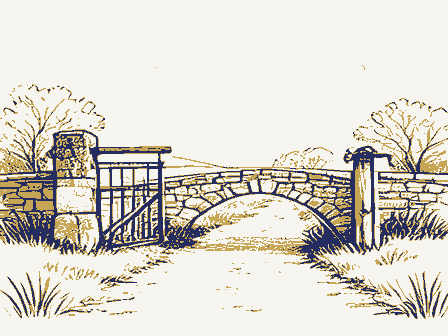
5. Tlie Choate Bridge. - This bridge deserves a particular notice, because it was the first of such construction in these parts, and hence was so wonderful during its construction and has been so serviceable since. The Town and County built it in equal shares of the expense. The width was to be not less than twenty feet, the length between the abutments sixtyeight feet, with one pier, twenty by eight feet, and a water passage beneath each arch thirty feet. The guards were to be three feet high, fifteen inches thick at the bottom, and nine at the top. The building committee were Hon. John Choate, Aaron Potter, Esq.,
6. The Canal. - In 1652, 22: 12, Thomas Clark and Eeginal Foster were " to have ten pounds for cutting a passage from this river to Chebacco river of ten foot wide and soe deepe as a lighter laden may pass, and making a forde and foote bridge over." In 1669, the selectmen are "to take care that the bargain concerning the cutting of the creek at Castlehill be forwarded." In 1681, February 7, any townsman has liberty to " perfect the cutting the Cut that comes up to Mr. Eppes, his bridge." In 1694, whoever will cut the Cut through the marsh at Mr. Eppes' shall have liberty, - who pays five shillings towards it " shall have liberty forever to pass as they have occasion ; " others must pay three pence a cord or a ton, in money. "The Proprietors of the Essex Canal " were incorporated June 15, 1820. The corporators' names were William Andrews, Jr., Adam Boyd, Tristram Brown, Eobert Crowell, John Dexter, Moses Marshall, Parker, Jonathan, Benjamin, Samuel, Francis, Jacob, Jr., Ebenezer, Jr., and Nathan Burnham : Dudley, George and Joseph Choate; Enoch, Winthrop and Joshua Low ; Jonathan 4th, Jacob, Jonathan, Abel, Daniel, Perkins and Epes Story. The canal was opened in 1821 ; was half a mile long and cost one thousand, one hundred dollars. The stock was twenty-seven shares at forty dollars each, and paid nearly six per centum. It connected the Merrimack River with Chebacco Eiver and so let in ship-timber at reduced rates. Late years it has been of little use, and within a year its walls have fallen in decay.
7. Carriages. - These were at first the rudest sort of vehicles, a cumbersome hay-rack, or a pair of wheels. Conveyance for business or to church was on horseback by saddle for a man, side-saddle for a female, or saddle and pillion for both. The first kind of vehicle for personal conveyance was introduced about 1725, and consisted of the body of a chaise upon a pair of wheels, and called a curricle. Richard Rogers, Esq., had one in 1730. About 1750, a top was put to the seat, which made it a full-grown chaise, one of which a year or two latter was owned by Rev. Samuel Wigglesworth. Family conveyance to chui'ch or social party was upon clean straw in the bottom of the cumbersome dray. In 1762 John Stavers began to run a two-horse curricle between Portsmouth and Boston, making the round trip in five days, and stopping two nights at Ipswich. The advent of the stage with four horses was as early as 1774. This welcome conveyance made two trips weekly between Newburyport and Boston, passing through Ipswich both ways. About 1800, horse-wagons began to be used. Merchandise by horse had formerly been carried in saddle-bags, wallets and panniers. The wagon-body at first set firmly upon the axle-trees, next upon woodensprings, upon the principle of a spring-hole; then upon long leather straps, or thorough-braces ; and, lastly, as now upon steel-springs. Rev. Felt remarked, in 1834 : " Should the improvements in journeying be as great for two centuries to come as they have been in the two already elapsed, posterity will as much wonder that we are contented with the present degree of such improvements, as we do, that our ancestors were satisfied with their mode of travelling." This remark was penned five years before the steam-cars entered the town.
8. The Mail Service. - The earliest method of forwarding letters was by such means as chance offered. Thus William Jeffrey, " the old planter," brought a letter to John Winthrop, Jr., from Merry Morton in 1634, Jeffrey doubtless having been over to Morton's on business. The earliest stated carrying of the mails was on horseback, and during the early Indian Wars the messengers were watched for with the greatest anxiety and hailed with the greatest earnestness and suspense. The Essex Gazette, established 1768, the first newspaper published in Salem, was delivered to the subscribers here and as far east as Newburyport. by a post-rider for that express purpose. One of the most active of the distributors of that paper was Thomas Dimon, doubtless a descendant of our Mr. Andrew Diamond, who died in 1708. Early in 1775, our town chose five delegates to a convention of delegates from the several towns concerned, to establish a regular post between Newburyport and Cambridge. The convention met May 4th in this town ; their action was to be binding upon all alike. Immediately following this convention - before May 24th - a post-office was established here by the Provincial Congress, and Deacon James Foster was the post-master. The following is a list of the post-masters that have served since Deacon Foster, with the dates of their respective appointments : Daniel Noyes, October 5, 1775 ; Joseph Lord, November 25, 1800 ; Isaac Smith, July 1, 1805; Nathan Jaques, September 14, 1807; Ammi Smith, October 5, 1818; James H. Kendall, August 10, 1829; Stephen Coburn, August 28, 1832; John H. Varrell, April 18, 1861; Joseph L. Ackerman, July 20, 1865; John H. Cogswell, January 3, 1868; Edward P. Kimball, August 2, 1886.
9. Town-House. - About two years after the full completion of the church edifice, the people began to desire a town-house and a school-house. They proposed a two-story building, with school-room on the first floor and town-house above. Accordingly, May 11. 1704, the town voted to build "forthwith, if the county would pay half, as it did for the town-house in Salem." Thus their economy devised the triple service of school, town and court-house in one. The same year, December 28th, a committee was chosen to contract for a building " about 32 feet long, about 28 feet wide and about 18 or 19 feet stud, with a flat roof raised about 5 feet." Abraham Felton was the contractor. A steeisle was constructed upon it at a cost of £29 7s. 8d, which was voted August 2, 1767,
Another town-liouse was built about 1794-95. This was also used for a court-house, and the county paid half the cost. Its use as a town-house was discontinued in 1841, when, October 12th, the town sold its interest to the county for twelve hundred and fifty dollars. From that time to 1843 they had no townhouse. In that year, January 23d, the town instructed a committee to purchase the unused Unitarian church edifice, if it could be bought at two thousand dollars or less. Early in that year the purchase was made. The building has undergone considerable alteration and enlargement, and now is very serviceable for all the purposes of the town, for which such building is needed.
11. Villaijes. - The Town Village, with the First Church as a centre, is about o^e mile from the sea in latitude 42^ 41^ N. and longitude 70° 50^ T^., - or exactly, according to the United States Coast Survey in 1850, the former runs along and crosses High Street from the front of the Lord Mansion to Mineral Street, and the latter crosses Market Street into Union. It is five and a half miles from the Linebrook Church ; five and a quarter from Castle Neck or Patch's Beach, and three from the Almshouse. It is 27.8 miles from Boston, the State capital; 11.5 from Salem, the county capital ; and 9.5 from Newburyport. Other villages, as reported by the United States Census of 1880, were Argilla, Candlewood, Goose, Ipswich, Linebrook, Mill, Peatfield, Turkeyshore and Willowdale.
12. Population. - The population about 1650, according to Wonder-working Providence, was "about one hundred and forty-families," which, we compute, was about 700 inhabitants. In 1680 there were one hundred and twenty-six voters, which, we presume, represented about 825 people. The growth has been slow, many decades making little increase, a few slightly retrograding. The population in 1830 was 2951 ; in 1885, 4207, with a proportion of 47 males to 53 females. The growth in fifty-five years has been 42 per centum, making an average //er annum of 77-100 of 1 per centum. The growth of the last decade has been \2 per centum. There are at present, by the Manual of the Legislature for 1887, 1,016 voters. The census of 1880 reports 694 dwellings and 861 families, and a population of 3,699, of whom 3,257 are native-born and 442 are foreign-born ; 219 being Irish, 129 English, 64 Canadians, 16 Nova Scotians, 11 Scotch and 6 Germans. There were 25 colored persons of African descent.
Scenery
1. Its Character. - Our town has no White Mountains, nor Berkshire Hills, - nothing wild, awful, or grand ; but our landscape affords an agreeable variety and a peculiar beauty. The diversity of hill and vale, of meadow and marsh, of woodland and field, of river, and pond, and brook, - enhanced by the variety of the seasons ; verdure and flower, the cattle upon the hillside and the husbandman in the field, the fruit-setting and the waving grass, the ripening apple and the purpling plum, the yellow corn and the nodding grain, and the enchanting beauty of our frost-painted forests, gratifies the eye, educates the heart and sheds over the mind a soft radiance of perennial joy.
2. Po7id. - In the Linebrook District is a beautiful sheet of water, called successively Baker's, Pritchard's. Great and Hood's Pond, by which last name it is now known. Its surface is eighty feet above Town Hill, or one hundred and ninety-two feet above sealevel. It might be made an excellent reservoir for fire or other purpose, for the village of Topsfield, or Ipswich, or perhaps both. Rev. Jacob Hood, of Lynnfiekl, who died, in 1885, at the age of ninetyfour years, surveyed it, in his youth, and computed the area, at nearly eighty acres. In the winter of 1861-62, the writer surveyed it, and made, by traverse-table, sixty-five and nine-tenths acres. A third of the pond is in Topsfield, and a dozen years ago that town stocked it with perch and black bass, thus availing itself of a State law, which, for that purpose, gave that town exclusive control of the waters for fifteen years. On its bosom blooms the fragrant, ed lily ; and boats for rowing and sailing invite to healthful recreation ; and it lends a charm to the surrounding hills. On the west, rising seventy feet jabove its surface, is a broad grazing field, General Israel Putnam, in his boyhood, in the tutelage of his stepfather, went to find and " fetch " the cows ; and on the east is Burnham's Hill, named from James Burnham, who, in 1717, owned the land.
3. Streams. - The principal streams are Winthrop's, Norton's, Howlet's, Mile and Bull Brooks, which used to be good fishing for pickerel and trout. Other streams are North, or Egypt River (now Bull Brook), and Muddy and Ipswich Rivers, all of which have been serviceable for fishing, for irrigation and for mill-privileges. The Ipswich River rises in " Maple Meadow Brook," in the town of Burlington, and meanders through Wilmington, North Reading, Middleton and Topsfield, entering our town upon the southwest border. Upon its banks, throughout its length, are saw, grist, paper, cotton and woolenmills, enhancing its picturesqueness by its utility.
4. Elevation. - The seeming discrepancy in the area of the pond, above mentioned, and the subsidence of Egypt River, serve to illu-trate the fact of a general elevation of the territory. Old deeds 8p(>ak of ponds in the vicinity of the West Meadow, are unknown to the present generation ; yet there are swamps which answer to the location and size.
5. Hills. - We have two hills more than two hundred and fifty feet high, three more than two hundred, and nine more than a hundred and fifty. A thoughtful view from either is delightful and instructive. It was Heartbreak Hill, one hundred and ninety-six feet high, from which an ancient hunter's fair daughter watched in vain for the return of her sailor-lover, and died of a broken heart. Turner's Hill, two hundred and fifty feet high, shows the State Asylum at Dauvers, and the nearer and magnificent view of forest, and farm, and river. The hill is upon the " Bracket Farm," in Willowdale. It is surmounted by a commanding look-out ; the grove upon its slope has been prepared for picnic parties, an artificial pond of an acre's extent, drawing its supply from a generous spring above, is furnished with boat for recreation, and a huckleberry field, from which fifty bushels have been gathered in a day, is near and free to all. Drive-ways, and stables, and pond, and boat, and spring, and field, invite the weary to rest and recuperation, and the grounds which have recently been christened "Mount Turner," are fast becoming a noted public resort for peoples far and near. There is also Bartholomew's Hill, two hundred and four feet high, at whose foot once dw^elt William Bartholomew, an early benefactor of the town ; Turkey, two hundred and forty feet high ; Jewett's, or Muzzy's, two hundred and twelve feet high ; Little Turner, one hundred and ninetyseven feet high ; Bush, one hundred and ninety-three feet high; Scott's, one hundred and eighty feet high; and Sagamore, one hundred and seventy-two feet high, where, instead of Sagamore in Hamilton, should rest the bones of our Masconnomet. Prospect Hill is two hundred and sixty feet above the sea-level, and shows us the White Mountains, Old Monadnock and Wachusett. Town, or Cemetery Hill, is one hundred and eighty-four feet high, and shows the village and surrounding farms, the Pow-wow Hill of Amesbury and the white church spires of Newburyport. Castle Hill, the grand old sentinel of " ye anciente tyme," located on the famous Ipswich Beach, at the mouths of Ipswich and Plum-Island Rivers, rises one hundred and sixty-eight feet, and embraces in her view the winding stretch of the river, the busy mills, the cattle-grazed hillsides, the cultivated fields, the bustling village, far lonely Agamenticus, the island-bound coast of Maine, the Isles of Shoals, the white crests of the ocean, the spreading sails of commerce, the headland and silvery beach and rolling surf of Cape Ann, the villages of Lanesville, Bay View and Annisquam, and the summer homes of Col. French and Gen. Butler, depicting a panorama of exquisite beauty and rare interest. This is the native hill of Mr. John B. Brown, of Chicago, who, after years of absence and success, having never forgotten the haunts of his boyhood, is now grading and terracing it, planting upon it trees and laying out drive-ways, and otherwise beautifying it and making it as attractive as the view from the summit.
Biographical
1. John Winthrop, Jr., the founder of this town, was born in Groton, County Essex, England, February 12, 1606. He was a son of Governor John Winthrop of the Massachusetts Bay Colony. He graduated at Dublin University, at the age of nineteen ; he became a barrister of the Inner Temple ; he was a member of the relief expedition to the Huguenots, at Rochelle, in 1627 ; he came to this country in 1631, and to this town in 1633. He had two houses in town, one on the Essex Road, and one at Castle Hill. Soon after the settlement of the town, his first wife died ; he had a second wife, Elizabeth, youngest daughter of Edmund Reade, of Wickford, County Essex, England. She was the mother of all his chil- dren. After her father's death, her mother married the celebrated Hugh Peters. John visited England many times, and while there was serviceable in many wayy to the colony. He was one of the founders of the Royal Society, and so wore the honorable title F.R.S. He was the founder of the Connecticut Colony, and several years its Governor. He was efficient in all his enterprises. He belonged to a highly esteemed family. After the dissolution of the monasteries almost the whole of the parish was given to them as their future domain. Why they resigned their wealth and distinction for the wilderness can hardly be conjectured. Governor Winthrop, the younger, "appears in history without a blemish. Highly educated and accomplished, he was no less upright and generous. In the bloom of life, he left all his brilliant prospects in the old M'orld to follow the fortunes of the new. When his father had made himself poor in nourishing the Massachusetts Bay Colony, this noble son gave up voluntarily his own large inheritance to further the good work." He died in Boston, April 5, 1676.
2. Governor Ihomas Dudley was born in Northampton, England, in 1576. He settled in this town soon after the settlement, and during or shortly after his first term as Colonial-Governor. He owned land on the north side of the town upon which he built a house, all of which he afterwards sold to Mr. Hubbard. He also owned land near Heartbreak Hill. He disposed of most of his estate in the town about the time of his second inauguration as Governor. He was a resident here some nine or ten years. He was assistant six years, Deputy-Governor thirteen years, and Governor four years. He died July 27, 1653.
3. Oovernor Simon Bradsfreet was born in Holling, Horbling, Lincolnshire, England, March, 1603. He matriculated, July 9, 1618, as a sizer, Emmanuel College, when he was fourteen years old. In two years he took the degree of Bachelor of Arts, and, in 1624, the Master's degree. When he was about twentyfive years old, he married Anne Dudley, daughter of Governor Dudley, who became the first New England poetess. He came here in 1630. He was assistant forty-eight years, colonial secretary thirteen years, Deputy-Governor five years, and Governor ten years. He was a resident of this town about twenty years. In March, 1658, he was a resident of Andover. He died in Salem, March 27, 1697, at the great age of ninety-four years.
4. Deputy- Governor Samuel Symonds came from Yieldham, County Essex, England, and settled here in 1637-38. He was made fireman in 1638, was town clerk from 1639 to 1645, was professor of the Grammar School, deputy to the General Court from 1638 to 1643, then assistant to 1673, when he was elected Deputy-Governor, an office which he held till his death. He was long time a justice of the Quarter Court. He was one of the committee to draft a body of laws in 1645. He addressed Governor Winthrop, in 1646, urging more activity in the divine purpose in the settlement of New England - Christianizing the Indians. He was of the committee " to pass the articles of Confederation with the United Colonies," in 1643, and to examine the proceedings of the commissioners in May 10, 1648. The Legislature granted him five hundred acres of Pequod land, and in 1651 he was granted three hundred acres of the land beyond the Merriraac. He was one of these several committees: To visit and settle a government at Piscataqua, 1652 ; to prepare the case of the United Colonies against the Dutch and Indians, 1653 ; to prepare and present the case of the Colony to Cromwell, 1654; to receive the allegiance of the natives to Colonial authority, July 13, 1658; to consider the matter between the King's Commissioners and the Assembly, in 1665; to revise certain laws annulled by the King, one of which abolished the observance of Christmas, as a relic of Episcopacy, 1667. He held court in York County in 1672 ; and he often performed such service outside the jurisdiction of the Ipswich Court. He was away from home so much on public business, and his house was so remote from neighbors, that two men were appointed to guard it, during the war, in 1675. In December the enemy burned his mills at " Lamperee River."
He died in October, 1678. The Legislature as a token of respect, voted £20 towards his funeral charges. His first wife was daughter of Governor Winthrop, and was living September 30, 1648. His second wife was Rebecca, widow of Daniel Eppes, and died July 21, 1695, aged seventy-eight years. His estate was £2534 9s. His Argilla Farm is a noted district in town at present.
5. Joseph Metcalfe was born about 1605 ; he died August or September, 1665, aged sixty years. He held various town offices ; he was deputy eight years between 1635 and 1661. He was a committee to collect gifts made by friends in England, in 1655, and also one of the Essex committee for trade. He owned an estate in the village, and lands in the Linebrook district, which continued in the family name till 1829, when it was sold to Samuel Dane Dodge.
6. Nehemiah Jewett was son of Jeremiah, who died in 1714. He was town officer in several capacities, was deputy sixteen years, between 1689 and 1709, three of which he was speaker. He was a justice of the Court of Sessions. He was on a committee to compensate for damages in the witchcraft trials. He was esteemed and respected in every walk in life. He died near the beginning of 1720.
7. Robert Paine was born in 1601. He was influential in town affairs. He was professor of the grammar school, and contributed very largely of his estate to its permanent establishment. He was a deputy three years. He was one of the Essex Committee for trade, in 1655 ; was county treasurer from 1665 to 1683, inclusive ; was ruling elder of the First Church. He was an exemplary man. Wonder-working Provi-
8. Francis Wainvjright lived with Alexander Knight, inn-keeper in Chelmsford, England, and came with him to Ipswich. He was a soldier in the Pequod War, and was greatly applauded for his brave exploits. He became a wealthy merchant. He died suddenly, May 19, 1692.
His son Francis was born August 25, 1664 ; he graduated at Harvard, 1686. His first wife, Sarah Whipple, married March 12, 1686, died March 16, 1709, aged thirty-eight years. He made an engagement with Mrs. Elizabeth Hirst, of Salem, but died before married. He was engaged in commerce and as merchant. He bequeathed five pounds to the First Church. His estate was valued at nineteen hundred and fourteen pounds. He was a member of the Ancient and Honorable Artillery Company; was colonel, town clerk, representative, feoffee, general sessions, justice, commissioner and collector of excise for Essex. He died in the strength of ripe manhood, August 3, 1711.
9. Among the early settlers was that Spartan company who met at the Appleton Mansion, the 23d of August, 1687, and settled the question for themselves, that Andros, the King appointed Governor, had no right to tax the people without the consent of an assembly, and who dared " render a reason." That miniature Provincial Congress, who counseled for righteousness, principle and honest government, were Rev. John Wise, John Andrew, John Appleton, Robert Kinsman, William Goodhue, Samuel Appleton and Thomas French. The first two were of Chebacco, the rest doubtless of Ipswich. Goodhue had a house-lot in town in 1635, was afterwards large land owner, was commoner, was a Denison subscriber, was selectman, representative and a deacon. He was a man of rank and influence. He died in 1700, at the age of eighty-five. John Appleton was born about 1622, and came here with his father, Samuel, from Waldringfield, England, in 1635. His parental home in this town was a grant of six hundred acres of land, bounded by the river and Mile Brook, a part of which is still retained in the family name. He married 1651, Priscilla, daughter of Rev. Jesse Glover. She died February 18, 1697 ; he, November 4, 1699. He had been selectman, militia captain, marine captain, county treasurer, representative to the General Court sixteen years. Samuel Appleton, brother of the above John, was born about 1626. He married, first, Hannah, daughter of William Payne, and had Samuel, born 1644 ; second, Mary, daughter of John Oliver, of Newbury, December 2, 1656, and had ten children. She was born June 7, 1640, and died February 15, 1697. He was selectman, lieutenant-major, colonel, and with his regiment achieved distinction in the war against King Philip, in 1676. He was assistant six years, and was a member of the first council under the charter of William and Mary, 1692. He died May 15, 1696. Of his sisters, Sarah married Rev. Samuel Phillips, of Rowley, and Judith, Samuel Rogers, son of Rev. Samuel, April 8, 1657.
The First Church
1. Origin and Methods. - The church at this time was the object and end of government; and there can be no doubt that the organization of the government here and an organization for religious instruction and worship were practically simultaneous. Governor Winthrop recorded in his journal, November 26, 1633, that " Mr. Wilson (by leave of the congregation of Boston, whereof he is pastor), went to Agawam to teach the people of that plantation, because they have yet no minister." Again, he wrote, April 3, 1634, that himself " went on foot to Agawam, and because the people wanted a minister, spent the Sabbath with them, and exercised by way of prophecy, and returned home on the 10th." There was, therefore, ho church organized at that time, but there must have been shortly thereafter ; for Mr. Parker came the next month and Mr. Ward the second month. According to James Cudsworth, 1634, " a plantation was made up this year, Mr. Ward P[astor] and Mr. Parker T[eacher]." This was the ninth church in the colony and the third in the county.
The teacher appears to have been an assistant who might or might not be ordained. His service was merged into the duty of the pastor about 1745, though the idea still obtains in many parishes where the minister is installed as pastor and teacher. The Sabbath service ran thus : The pastor began it with prayer; the teacher then read and expounded a chapter; the ruling elders announced a Psalm, which was sung ; the pastor read a sermon, and sometimes followed it with an extemporaneous address, consuming frequently an hour or more ; singing followed ; then a prayer and the benediction. In the afternoon service, just before the benediction, the congregation recited : " Blessed are they that hear the word of God and keep it." The singing was peculiar. One of the ruling elders read a single line of the Psalm, then such of the congregation as could sing, rose in different parts of the house and sang it ; then other lines were successively read and sung till the conclusion of the Psalm. When elders were not chosen the deacons performed their duty, which gave rise to the phrase, "Deaconing the hymn." About 1790 the whole stanza was read at once, and about three years later the whole hymn was read at once by the pastor. Singing choirs began to form as early as 1763, when seats were assigned them, but they were not elevated to the gallery till about 1781. A contribution every Sabbath was the rule till some part of 1763. To deposit the offerings, the magistrates and chief men first walked up to the deacon's seat, then the elders and then the congregation. There was also weekly service, which was as carefully observed as the service of the Sabbath. It was called " The Lecture," and was attended each week on Thursday, which was known as "Lecture Day." It consumed the best part of the day, beginning at eleven o'clock. It became monthly, in 1753, and our weekly prayer-meeting is its successor. The old churches had a practice of holding a Fast just before and in reference to calling a pastor. The practice has much fallen into disuse, much to our disadvantage and discredit, for if prayer with fasting means anything, to discontinue it is like cutting the telegraph wires when we need a message of instruction from a friend. It is observable that the various town offices, the status of eligibility to them, the offices in the church, the church services and requirements were a practical, business-like method of securing a punctual observance of religion and a highly moral and religious community. Cotton Mather said, in 1638, that this " was a renouned church, consisting mostly of such illuminated Christians, that their pastors in the exercise of the ministry might, in the language of Jerome, perceive that they had not disciples so much as judges."
The first to come among this people as pastor or teacher was Eev. Thomas Parker. He came in May, 1634, with a colony of about one hundred, who subsequently settled in Newbury. They sojourned here about a year, and Mr. Parker meanwhile exercised the office of teacher. He labored, says Mr. Sewell, " preaching and proving, that the passengers came over on good grounds, and that God would multiply them as he did the children of Israel."
The following will treat the several church societies by pastorates ; for in all the work of the church and society the pastor takes the lead, and as is the pastor so are the people.
2. First Pastorate. - The first pastor of this church was Eev. Nathaniel Ward. He was the son of Eev. Johr Ward, and was born in Haverhill, England, about 1570. He was educated at Cambridge ; he studied and practiced law, and he traveled on the Continent. On his return to England, he was ordained a minister of the gospel, at Standon, where, for the expression of his Puritan views, he was suspended, till he made a public recantation. He became a Puritan exile, and soon after his arrival here, in June, 1634, became pastor of this church. The early church records were destroyed by fire, and we have no account of him as undershepherd. His great learning fitted him for any of the professions; his want of health was the only Impediment to a very high distinction. His legal attainments fitted him pre-eminently for the important civil and legal service of the colony, wherein he received many appointments, and they served him well in expounding clearly and cogently the immutable law of God, wherein he exercised his gifts of jDrophecy even after his resignation of his pastorate, which took place February 20, 1637.
3. Church Edifice. - It is probable that during the early part of his ministry the first house of worship was built. The earliest record referring to it is found in the public laws of September 3, 1635, which reads Lhat "Noe dwelling house shallbe builte above halfe a myle from the meeting-house," (excej^t mill-houses and farm-houses of such as have their dwelling houses in town), in Ipswich, Newbury, Hingham and Weymouth. It stood on the rise of ground where the Wonder- Working Providence says it "was a very good prospect to a great part of the town and was beautifully built."
Mr. Ward was appointed March 12, 1638, on a committee to draft a code of public laws. He was the leader and learning of the committee. He handed the result of their labors to the Governor in September, 1639.
About the middle of 1640 he, with assistance from Newbury, formed a settlement at Haverhill, where his son John became the minister. He was granted six hundred acres of land near Haverhill, May 10, 1643, probably, as Mr. Felt expresses it, "for his public services." He was chosen May 25, 1645, on a committee to codify the laws for the consideration of the next Legislature. The laws were printed in 1648. The justice and foresight which the laws embodied, are conspicuous in our present code. Soon after completing the work, he returned to England, and became minister of Shenfield, in county Essex. He once preached before the House of Commons. He published, in New and Old England, several works of a religious character, the most noticeable of which were " The Simple Cobbler of Agawam," and " The Simple Cobbler's Boy." He brought out the former in 1647. It illustrates the length to which good people cotild go in vindication of intolei'ance in days when antinomian and aggressive views were troubling many minds. " It is a sparkling satire," says one, " known and appreciated for its keenness and wit. Its character and style were suited to the times, and it served to encourage opposition to King and Parliament, and to moderate party excess."
He died in 1653, at the age of eighty-three years. He was a man, says Mr. Felt, whose " talents, attainments and piety were of a high order ; and after an examination of his public and religious service, and with a good knowledge of the public's opinion of him, - since he had probably then left the colony, the Wonder-ioorking Providence declared him, a judicious man, a very able preacher, and much desired."
Mr. Felt speaks of a Rev. Thomas Bracey, who resided here in 1635. Cotton Mather did not know him. He probably assisted Mr. Ward a short time, and early returned to England.
4. Second Pastorate. - The second pastorate was begun by Eev. Johk Nortois\ Eev. E. B. Palmer, of the tenth pastorate, says that Mr. Norton " was settled here in 1636, and continued in his relations to the church till about the year 1653, when he removed to Boston and became pastor of the old church of that place." He was probably -a colleague with Mr. Ward, who resigned in 1637, and then became acting pastor till the settlement of Rev. Nathaniel Rogers, February 20, 1638, when he was ordained teacher. Mr. Norton was born May 6, 1606, in Starford, county Hertford, England. He entered Cambridge at fourteen years of age, was a brilliant scholar, and took his first degree. On account of parental pecuniary embarrassment, he left college to become usher and curate in his native place. His intellectual promise attracted the attention of many. A prominent Catholic sought to win him to Popery ; his uncle offered him a " considerable benefice; " he declined a fellowshin at Cambridge ; he served meanwhile as chaplain to Sir William Masham. He could not subscribe to the church conformity, and cast in his lot with the Pilgrims.
He arrived at Plymouth October, 1635, and settled here the next year. He expected friends to follow him, and he asked for grants of land to be held in reserve for them. Accordingly, lands were reserved in several parts of the town. His friends did not come, and the lands are now known as the "Norton Reserves." He wis an influential member of the Synod that heard the case of Mrs. Hutchinson in 1637; he composed, in 1645, the reply of the New England ministers to the questions on ecclesiastical government, proposed by Rev. William Apollonius, of Middlebury, - a work in Latin, the first book in that language printed in this country, - an ahl^exposi of the usages of the church fathers. He was influential in the formation of the Cambridge Platform in 1647 ; and in 1651 he made the reply before the General Court to the treatise of Mr. William Pynchion. Rev. John Cotton, of Boston, who died in 1652, advised his church to call Mr. Norton. They did call him, and his friends and admirers here demurred. The controversy was long and warm, but he, having accepted the pastorate in 1653, was installed July 23, 1656. While of Boston he published several works, and was for two years in England as colonial agent. He was twice married, but had no children. He died April 5, 1663, in his fifty-seventh year.
He is said to have been learned and eloquent, an able disputant and a ready writer, a warm friend and a pious man. If failing he had, it was a natural irascibility, and a weakening under compliments, of which few men received or merited more. In this ordeal, among the most searching, his good sense and sterling piety kept his mind and heart. AVhen he left England, a venerable minister remarked that " he believed that there was not more grace and holiness left in all Essex, than what Mr. Norton had carried with him." Mr. Felt remarks, " He was, undoubtedly, one of the greatest divines, who ever graced this or any other country. He was emphatically 'diligent in business, fervent in spirit, serving the Lord.' As a result of this, many souls were given him as the seals of his ministry."
The pastor of the church at this time was Rev. Nathaniel Rogers. He was the second son of John, best known as minister of Dedham, in England, and was born in 1598, while his father ministered in Haverhill, England. He was a lineal descendant of the Smithfield martyr. He had a pious mother, and rewarded her Christian care and instruction with evidence of early piety. He entered Emmanuel College, Cambridge, when about fourteen years old, and was eminently scholarly in his attainments and Christian in his deportment. He began his labors as chaplain, then he was curate, but conformity to the established church troubled him and he must flee its power. He had married Margaret Crane, of Coggshall, daughter of a gentleman of wealth, who offered to maintain him and his family if he would remain at home. His heart spoke his conviction, and he declined the generous offer. He arrived in Boston in November, 1636, " after a long and tedious voyage."
In 1637 he was a member of the Synod convened in reference to the antinomiaus; he received a call to settle at Dorchester, but chose to fraternize with Ward and Norton and Winthrop, and he was ordained here February 20, 1638. The same year he took the oath of freeman. Mr. Palmer says that "seventeen male members of his church in England came with him to this town," and that tradition names them, - William Goodhue, Nathaniel Hart, Nathaniel Dav, Robert Lord and Messrs. Warner, Quilter, Waite, Scott, Littlefield, Lambert, Lumax, Bradstreet, Dane and Noyes.
He was long in feeble health, and in consequence was subjected to periods of despondency. Hemorrhage of the lungs was his boding trouble. He was obliged to reduce his manual labors to their minimum, and his later sermons were not written. He, however, kept a diary ; but, as he requested, it was burned after his death. He little realized how much value for other days he thus destroyed. He left a manuscript production, in fine, classical Latin, a jilea for Congregational church government. He was much exercised in mind and heart when Mr. Norton went to Boston. He was burdened with his infirmity and with cares, and an attack of an epidemical influenza proved fatal. With his latest breath, he ex- claimed, - "My times are in Thy hands." Thus the " reverend and holy man of God fell on slee])," July 3, 1655. During this pastorate, " this church, says Wonder- Working Providence, consisted of about one hundred and sixty souls, being exact in their conversation, and free from the epidemical diseases of all reforming churches, which under Christ, is procured by their pious Learned and Orthodox ministry." It calls the pastor " a very sweet, heavenlyminded man, . . . whose mouth the Lord was pleased to fill with many arguments for the defense of his truth." Rev. William Hubbard, his son-inlaw, says of him, - " He had eminent learning, singular piety and holy zeal. His auditory was his epistle, seen and read of all that knew him." He left an estate of £1200. His widow died January 23, IGGG. His children were John, Nathaniel, Samuel, Timothy, Ezekiel and the wife of Mr. Hubbard. The amount of all the salaries had been £140 previous to 1652, but was then changed to £160, which in 1656 was paid "three parts in wheat and barley and fourth part in Indian."
Third Pastorate. From the death of Mr. Rogers till Mr, Cobbett's settlement, the church was without a pastor. This was the Rev. Thomas Cobbett, who was born in Newbury, England, in 1608. He s*^udied at Oxford, then with Dr. Twiss. of his native town, and prepared for the ministry. Soon after his settlement, he was confronted with conformity. He came to this country, arriving June 26, 1637. He was colleague at Lynn, till he was invited to succeed Mr. Rogers. Mr. Palmer says he was settled in 1656.
5. Ckurch Edifice. - During his pastorate a new house of worship was built. Ezekiel Woodward and Freegrace Norton contracted, June 10, 1667, to furnish timber, and June 18, 1668, to furnish shingles for a new meeting-house. The steeple was completed October 22, 1667, when the committee was discharged with thanks. In 1673 they voted to repair the house " with speed." In 1674 seats were put in the gallery. Early in 1677 a committee was to see about keeping the house " tite." In 1681 it had a " pouder Roome." It stood where the present First Church edifice stands. In 1665 the salaries amounted to £210.
Mr. Cobbett was a noted public man, sought out for his learning, his diligence, his readiness in debate, the dexterous use of his pen and his stability of purpose and action. Yet amid arduous public labors he found time to attend carefully and dutifully to his flock. In about four months, beginning in December, 1673, nearly ninety were added to the church, some in full communion and some by " taking the covenant." There were sixty-five males. Twenty-four of the " young generation " took the covenant. He conferred special privileges on the children of his laity in full communion, thus enacting in advance a half-way covenant, like that sanctioned by the synod shortly after and drafted, doubtless, by his own hand ; a covenant so noble in purpose, so mischievous in practice. He was watchful of the needs of the pious poor, and promptly excommunicated the scandalous. His ministry was noted for its Christian fervor.
In 1643 his pen advocated a negative vote for the Assistants; in 1644 he preached the Election Sermon ; in 1657 was of a committee of thirteen to answer ecclesiastical questions, proposed by the Legislature of Connecticut ; in 1661 was one of a committee on " our patent," our laws and privileges and duty to His Majesty; in 1668 was one of six ministers to reason several Baptists out of their peculiar views ; in 1676 was one of twenty-four to counsel in the case of Gorges and Mason ; in 1677 he handed Increase Mather " a Narrative of Striking Events." He published, in 1645, " Defense of Infant Baptism," " Prayer," " First, Second and Fifth Commandments," "Toleration and Duties of Civil Magistrates;" in 1653, " Vindication of the New England Government, " "Civil Magistrates in Religious Matters;" in 1656, " Duties of Children to Parents and of Parents to Children ;" and in 1666 an Election Sermon. " He wrote more books than any man of his generation, yet not one has survived to this day."
He was a great man. The great and learned and wise of his day regarded him as their noble peer. He was equally at home in matters of Church and State. No invective deterred him, no flattery swerved him; once planted on his judgment of duty and righteousness, he remained firm and garnered success in the end. Says Mr. Felt, "So far as human imperfections permitted, he was a pastor after God's own heart." He went to his reward November 5, 1685, at the age of seventy-seven. Provisions for his funeral included a barrel of wine, half a hundred weight of sugar, men's and women's gloves, and spice and ginger for " Syder.'' His widow, Elizabeth, died the next year. Three children crossed the bound of life before he did and three remained to mourn, - Samuel, Thomas, John, who was located at Newbury at the time, and Elizabeth. His estate was valued at £607. His epitaph, as conceived by the great Cotton Mather, ran thus : " Stay, passenger, for here lies a treasure, Thomas Cobbett, of whose availing prayers and most approved manners, you, if an inhabitant of New England, need not be told. If you cultivate piety, admire him ; if you wish for happiness, follow him."
Rev. William Hubbard
Whose father was William and who was born in England in 1621, and crossed the ocean with his father in 1630. He graduated at Harvard College in 1642, a member of the first class. The same year, 4th July, he was called as colleague with Mr. Cobbett, and, says Mr. Palmer, was "probably settled as such in 1656," which statement seems corroborated by a vote of the town, recorded in Mr. Cobbett's pastorate. This pastorate he occupied till his death, September 14, 1704, when he was eighty-three.
In 1667 lie testified against the '' Old South, in Boston, in the settlement there of John Davenport; in 1671 he and fourteen others memorialized the Legislature against the censure of its committee for advising the formation of South Church Society in Boston ; in 1675 he was of a council to advise in Mr. Jeremiah Shepard's case, as minister in Rowley ; in 1676 he preached the Election Sermon. About ]677 he brought out his "Troubles with the Indians in 1676- 77," to which was appended " The War with the Pequods " in 1637, and also " Troubles with the Indians from Piscataqua to Pemaquid." The works are now known as "' Hubbard's Indian Wars." In May, 1680, he had compiled a history of New England. The Legislature voted him £50 for the work. It was then much needed, was done in a commendable manner and has proved to be of great value. He was appointed to "manage" the Commencement of Harvard College, July 1, 1684 ; and, in June, 1688, he was appointed by Andros acting president at the following Commencement, a high honor which he probably did not accept. In J 699 he arraigned the Brattle Street Church, in Boston, for irregularity in doctrine, baptism and communion. In 1701 his decrepit age was overburdensome and he asked for more assistance ; and in 1702 gave up pastoral labors entirely, when his people voted him a gift of £60, and in 1704 he rested from his toils.
6. Church Edifice. - In 1686 all the salaries paid were £160, and in 1696 the salaries were paid, onethird money and " the rest in pay." The same year the church edifice was repaired, but November 4th, two years later, Abraham Perkins contracted to build a new house, for £900 - £500 money and £400 as money. The house was to be " 26 feet stud, 66 feet long and 60 feet wide, with f gables on every side, with one Teer of gallery round said house ; as far as necessary, having five seats in the gallery on every side thereof, with as many windows or lights as the committee or said Perkins can agree for." In 1700 Abraham Tilton agreed to finish the meeting-house, and Abraham Perkins is released. The house stood where the present First Church edifice stands. The same year the old bell, the gift of " Hon. Richard Saltonstall," was sold to Marblehead for £37^, and a new one, weighing 200 pounds, was bought in England for £72. In 1702 a clock was purchased.
Mr. Hubbard's first wife was Margaret Rogers, daughter of Rev. Nathaniel, alady of raresocial worth. Their children were John and Nathaniel, and Margaret, the wife of John Pynchon, of Springfield. His last wife was Mary, widow of Samuel Pearce, who died in 1691. She was alive in 1710.
He was a judicious adviser, a faithful laborer in the Master's vineyard and righteous in his intercourse with men. John Dunton said of him: "The benefit of nature and the fatigue of study have equally contributed to his eminence. He is learned without ostentation or vanity, and gave all his productions such a delicate turn and grace
George, David, James, Jonathan, William, Hephzibah, Joseph and Mehitable. This family left Linebrook March 6, 1780, and was nine days making the journey of eighty miles, there being at that time no roads worthy the name. Their privations the first year were great, provisions were obtainable only at a distance of thirty or forty miles. Their first winter was unusually long, a burden of snow lasting from October till late the next spring. Of the people's cattle twenty-seven died of starvation. They lost their only cow, and were the while without salt, a bushel of which in the spring cost five dollars. The society observed a day of fasting and prayer in view of the dismal prospect.
Mr. Lesslie was installed at Washington, July 12, 1780, in a barn belonging to John Safford, his house of worship not being completed till 1789. His salary was fifty-five pounds, payable in eatables and wearing apparel, and his settlement was two hundred acres of land "to him and his heirs forever." He died September 11, 1800, at the age of seventy-two years.
6. Inter-pastorate. - During this period of nine years the records are very unsatisfactory. In 1780 Rev. Joseph Motley supplied ; in 1783 Rev. Joshua Spaulding who, by vote, March 31st, was requested to " draft rules for the government of the chui'ch on the basis of the Cambridge platform ; in 1785, Mr. Ebenezer Cleaves supplied. Each one was called to settle.
7. Second Pastorate. - Rev. Gilbert Tennent Williams was invited, December 23, 1788, to preach here six months, and February 18, 1789, the church called him to the i)astorate. He was ordained and installed, August 5, 1789, when the membership was nine males and fifteen females. His salary was one hundred pounds lawful money. He lived in the house formerly owned and occupied by Mr. Lesslie. Eight members were added during his pastorate. The society was small and unable to give him adequate support, and April 19, 1813, according to advice of council, dismissed him from pastorate and membership. His farewell discourse, which was printed, was preached May 2, 1813.
He was well armed with " the sword of the Spirit, which is the word of God ;" was a plain and easy writer ; was a man of sound orthodoxy, of pure motives, of lovely temper, of sterling integrity, of deep piety, and an earnest laborer for the common good.
He was son of Rev. Simon Williams, of Windham, N. H., born at Fagg's Manor, Pa., October 8, 1761. He graduated at Dartmouth College, 1784, and studied for the ministry with Rev. John Murray, of Newburyport.
He was installed at West Newbury First Church, June 1, 1814, and labored till a paralytic shock unfitted him for parochial duties. He was dismissed September 26, 1821, and died atFarmington, September 24, 1824.
His wife was Martha Morrison, of Windham, N. H. She left this church. May 25, 1814, and in 1834 resided in Boston. Their children's names and births in Linebrook were: Simon Tennent, 1790; Martha, 1792; Samuel Morrison, 1794; John Adams, 1799; Constant Floyd, 1802.
8. Inter-pastorate. - From this time to 1860 this church was without a pastor. It was a period of decay, darkness and trial resulting in a new lease of life. From 1829 the society had pecuniary aid from the Domestic Missionary Society. In 1814, when the membership was only one male and three females, an effort was made to establish a Baptist church. The faction called a quasi parish meeting and voted to relinquish the church to the new society every alternate Sabbath. The Congregational Society held to their purpose, Rev. Joseph Emerson, of the Byfield Female Seminary, supplied, and the effort was baffled. In 1819 the parish voted to occupy the church to the exclusion of the Baptist brothers. This action augmented the strife, deepened the bitterness, and bandied threats ; but legal advice showed that " possession was nine points of the law," and wisdom brought in peace. Rev. Joseph Emerson, in the kindness of his heart, was very serviceable to this society during his four years at Byfield, from 1818.
During these years was the dark period. The society had preaching but part of the time, till 1824, when Rev. David Tullar became the stated supply. In 1818 Deacon Foster died, at the age of eighty-two years; September 3, 1819, Mrs. Martha Perley died, aged eighty years and ten months, and October 8 (6), 1831 , Mrs. Mehitable Chapman died, aged eighty-five years. Mrs. Chapman was lame and unable to get about, so Mrs. Ruth Conant was practically alone in the church from 1819 to 1826, when three males and two females joined. Between 1826 and 1831, when, by reason of age and infirmity, Mr. Tullar retired, eight males and nine females became members. The membership, January 1, 1829, was four males and five females. A particular notice of this truly good man belongs to Rowley history, and we will only remark that he was a judicious and faithful undershepherd. He purchased half of the Joseph Holt farm of William P. Kimball, December 14,1825, and sold it to Jeremiah Ellsworth, December 31, 1835.
Rev. Moses Welch took charge of this church January 1, 1831, and labored with success. Four males and five females were added in that year, two males and four females the next year, and three females in 1833 and 1834. The membership in 1833 was thirty-four.
Mr. Welch was born in Plaistow, N. H., in 1784, and was son of Colonel Joseph Welch, a Revolutionary patriot. He was a member of the first class of the Bangor Theological Seminary. While there he was licensed a missionary in that State, where he labored several years. He thence came to Amesbury, where he became a stated supply for five years. Then he returned home to Plaistow, where he was installed and continued five years more. His people were devotedly attached to him, but ill health forced his resignation. Before coming here he preached awhile on Cape Ann, that the climate might help his complaint. His salary here was $300. Our older people remember him with affection.
Rev. James W. Shepherd followed. He proved a physician, indeed. After service, May 24, 1835, he asked the church to remain. The question of the schism was discussed, and the 30th instant was agreed upon as a day of fasting and prayer. The day was duly observed and the church voted a Public Confession, on the first Sabbath in June, when accordingly all but two males and one female stood forth in and made public confession." In 1835 three males and four females became members.
Rev. Samuel Harris was the stated supply in 1836. In this year eight males and one female joined. Mr, Harris' father, Deacon Jacob, was a native of this town and born in 1741. Samuel studied divinity with Rev. Seth Payson, D.D. (1809), of Ringe, N. H. He was ordained and installed at Windham, N. H., in 1805. He lost the use of his voice, and was dismissed in 1826, after a long and useful pastorate. A partial recovery permitted a limited parochial service, and he preached in several places, including this parish. He died at Windham September 5, 1848, aged seventy-four years. He had twelve children ; ten were learned, influential and useful citizens ; five of the six sons were professionally educated.
Rev. Moses Dow was born in Atkinson, N. H., February 4, 1771. He studied in part at the Atkinson Academy, and prepared to enter Dartmouth College. He studied divinity with Rev. Jonathan French, of Andover. He married Miss Hannah Knight, of Atkinson, and had two daughters and one son, who died at the ages of forty-one, forty and fortyfour respectively.
He was settled over the First Church, York, Maine, November 9, 1815. Rev. Benjamin Wadsworth, of Danvers, preached the installing sermon, and said, - " We are not strangers to Mr. Dow. We have long known him. We have loved and esteemed him. We believe him to be an able and faithful, a discreet and devoted minister of Christ." He was dismissed in 1829, and he removed to Hampton Falls, N. H., " where he supplied the pulpit, and also in the adjoining town of Kensington." In the spring of 1833 he removed to Plaistow, N. H., and preached in several pulpits, including this. He died at Plaistow, of paralysis. May 9, 1837.
farmer, of Hampstead, N. H., where he was born March 30, 1805. Rev. Moses Welch above and Rev. Francis Welch, of Amesbury, were his uncles, and sons of Joseph Welch, of Plaistow, who was a colonel in the Revolution. They were lineal descendants of Philip Welch, who was kidnapped in Ireland, and sold in Ipswich as a slave for twenty-nine pounds in corn or cattle in 1654; and Samuel Welch, of Bow, N. H., who was a grandson of Philip, and who died at the age of one hundred and twelve years and seven months, was Rev. Moses' great-uncle.
Francis studied at the Hampton Academy and in Bowdoin College. He was approved a minister by the Haverhill Association May 15, 1833. He preached at Brentwood, N. H., where he was ordained, at Perry, Maine, and in this pulpit. He has for many years resided upon his farm in Topsfield. He married, April 4, 1839, Miss Harriet Atwood Conant, daughter of William, Esq., and Mrs. Ruth Conant, of this parish. She was born March 9, 1818, and died at Topsfield October 22, 1886. She had ten children; nine survive her, one of whom is a lawyer in St. Paul, Minn.
In 1838 and 1839 six males and four females became members, which made the membership between forty and fifty ; from 1840 to 1843, inclusive, one male and five females.
Rev. Jacob Coggik followed and continued till 1848. He preached the last sermon in the old meeting-house, and also the dedicatory sermon in the new house. Rev. Isaac Braman making the prayer.
Mr. Coggin was born in Woburn September 5, 1781, to Jacob Coggin, who graduated at Harvard College in 1761, and became a teacher by profession, though he sometimes preached. Jacob, the son, graduated at Harvard College in 1803, studied divinity with his pastor. Rev. Joseph Chickering, of Woburn, and was ordained pastor of the Congregational Church in Tewksbury October 22, 1806, and continued in that relation till his death, serving the last years as senior pastor.
He represented his town in the State Legislature two successive years ; he was a member of the convention called to revise the State Constitution in 1853 ; he was a Presidential elector in 1852 ; was an inspector of the State Almshouse from its institution, and the chaplain there till his death, from congestion of the lungs, December 12, 1854, at the age of seventy-three.
Mr. Coggin was one of the acceptable preachers ot his day, sound in doctrine and faithful in its presentation. He was a careful, wise, social and beloved pastor. He was the author of the Ladies' Benevolent Society here, the fruit of whose earnest, meritorious work furnished the new church in 1848 - a society which, after some years' relapse, was revived in the acting pastorate of Rev. Joseph W. Healy. The writer, then a mere lad, now well remembers the tall, erect, manly form of that servant of God, as he ascended the pulpit stairs, and his polite and genial manner in his visits. His labors here covered a period of some three or four years and were blessed. In the years 1840 to 1843, inclusive, one male and five females became members, and from 1844 to 1852, inclusive, eight males and sixteen females.
Rev. Eliphalet Birchard was the first minister to occupy the new church edifice. He preached here while an undergraduate at the Andover Theological Seminary, and, after completing his course there, became the stated supply here. He was born in licbanon. Conn., January 21, 1812, and died there September 20, 1854. He was always an invalid; he called his affliction rheumatism, but it ended in consumption. He was a great sufferer, but patient and hopeful. His parents were Arial and Abigail-Metcalf Birchard. He had a brother, Rev. William Metcalf Birchard, born February 14, 1810, died March 20, 1883, and a sister, Abbie Correlia. He graduated at Harvard in 1843. This church ^voted February 24, 1849, to call him to settle on a salary of four hundred dollars. He did not accept. He drafted a government for the Church, which was adopted May 28, 1849. In 1850 Rev. James Galagher, a revivalist, labored with Mr. Birchard, and there was a very general awakening. Many indulged a hope; but only four joined the Church. In 1850 there was a membership of fifty-six. He remained here about three years, and afterwards preached at Andover, Conn. In the pulpit he was serious, awak. ening and effective, and left a very desirable impression upon the peojile; he was excellent in visitations, a reliable spiritual counselor and a firm friend.
Rev. Willard Holbrook and his wife joined this church April 14, 1851, He began to preach here some time before, and remained about four years. A sketch of him properly belongs to Rowley history. He was one of those noble spiritual workers whom this church must hold in grateful remembrance, - Tullar, Holbrook, Kimball and Dana, - names to be respected everywhere, but here to be revered for their labors, advice and prayers.
Rev. Joseph Warren Healy, M.D., D.D., LL.D., was, by this church, made a life-member of the Foreign Missionary Society, April 10, 1856. He then had been preaching here probably about six months. He was at the time the enterprising, able and popular principal of the Topsfield Academy. This church under his guidance enjoyed a period of harmony and prosperity, and grew in numbers and healthful strength. He remained about three years.
He was born in South Hero, Vt., April 11, 1827, to Nathaniel and Jane-Tabor Healy. He fitted for college at Newbury Seminary and Bradford Academy, Vt. He graduated at the University of Vermont in 1852. He was principal of the Bath Academy, N. H., and afterwards of the Topsfield Academy, He attended lectures at the Andover Theological Seminary, and was licensed by the Salem Congregational Association. After supplying this pulpit, he preached at Royalston, Gardner and Walpole. Then removing to the West, he preached six years in Milwaukee, and four years in Chicago. While there he was called to the pastorate and presidency of Straight University, in New Orleans, La. There he attended medical lectures and received the medical degree. In 1871, Olivet College, Mich., conferred upon him the doctorate of divinity. The same year he was delegated by the American Missionary Association to visit Great Britain, and organize an auxiliary to that society. He resided in London as its secretary for three years. While abroad, he visited the Continent and the East, and lectured in the principal cities of Great Britain, Returning home he was elected professor of English literature and pastoral theology in Maryville College, Tenn. Preferring an active pastorate to the routine of professional life, he returned to Milwaukee in 1878. The death of his wife prostrated him. Subsequently he went to California for his health. In 1853 he was a pastor in Oakland, Cal. Upon the incorporation of Sierra-Madre College, at Passadena, in 1884, he was selected as the president, a position which he now holds.
The writer remembers him at the academy with sentiments of high esteem. He excelled as a teacher, and readily won the regard of his pupils. He was an exemplary man - one of nature's noblemen. He was magic to untie purse-strings. Several societies regard him as their pecuniary savior. He has risen by his own exertions, and achieved a grand success. His titles are emblems of his character and attainments.
He married, October 8, 1848, Miss Jane Hibbard Clark, who was born in Groton, Vt,, May 12, 1830. She studied in the Female Seminary, Burlington, Vt., taught with her husband at Bath and Topsfield, and adorned the place of a pastor's wife wherever he labored. She died at her mother's home in Corinth, Vt., September 12, 1880, beloved and lamented, a pure and gentle spirit. Their children, - Jane Corinne, born March 6th, and died October 8, 1850 ; and Frank Joseph, born March 4, 1857, studied at Olivet College and London Universities, admitted to the bar, 1878, and is now editor of The Gazette, Fort Wayne, Ind,
9. Third Pastorate. - Rev. Ezekiel Dow was settled. He was born April 9, 1807, His father was James, of Warren, N. H., and was born in Plaistow, April 23, 1775 ; his mother was Hannah Merrill, and was born in Warren, May 24, 1781. Ezekiel was the second son of five children, four of whom were sons and became farmers. He studied at the Academy, Haverhill, N. H. He commenced preaching as a Universalist, but early in his ministry changed in his belief, and studied in the Theological Seminary, Andover, for the Congregational pulpit. He preached in Massachusetts, at South Welfieet, Monument, Chiltonville, Linebrook, Huntington and Becket, where he closed his labors in 1880. He was settled over this society December 25, 1860, and dismissed November 14, 1866. He was a good-hearted man, socially peculiar yet agreeable, took good care of his pastorate, had a good mind, never overworked, and we may say was fairly successful.
10. Fourth Pastorate. - Rev. Alvah Mills Richardson was born in Woburn - now Winchester - April 30, 1833, to Gilbert and Hannah-Davis Richardson. He had four brothers - Gilbert Brainard, who died February 20, 1883, and Martin Luther - who were ministers, and two sisters. He fitted for college at the Warren and Phillips Academies, Woburn and Andover, and graduated at Amherst College in 1862. He entered the service against the Rebellion for nine months in September, 1862, a member of the band of the Forty-fifth Massachusetts Regiment. He graduated at the Andover Theological Seminary in 1866. He was ordained and installed here November 14th, the same year. He tendered his resignation October 10, 1870, and his pastorate closed when his successor was installed, May 3, 1871. (He left the church with a membership of fifty-nine). Part of 1871 and 1872 he managed for the Lincoln County, Me., Bible Society, and since then has superintended his widowed mother's farm. He was a jjious man, scrupulously exact, conscientious, studious, a good writer, but an unsuccessful preachei". He has never married.
11. Fifth Pastorate. - Rev. Benjamin Howe was a native of this parish, and born November 4, 1807. His parents were Joseph and Mehitable-Stickney Howe, He was eighth in a family of ten children. When a mere lad, he was thrown upon his own resources. Any acquisition he made was wholly his. He commenced his studies at the Topsfield Academy, shortly after the founding of that institution, in 1828, and completed his preparatory course at the Meriden Academy, N. H. He graduated at Amherst College in 1838, and at the Theological Seminary, Hartford, Conn., in 1841.
He married. May 31, 1842, Miss Waty Williams Tyler, born August 27, 1814, a lady of excellent worth, of a gentle and godly spirit. They had two children : Homer, who was born August 16, 1848, and Cecil Putnam, who was born November 8, 1857, and died February 13, 1866.
Provenance
Text from History of Essex County, Massachusetts, with Biographical Sketches of Many of Its Pioneers and Prominent Men, published 1888, in the public domain in the United States and digitised by the Internet Archive. The settlements listed against this township are matched by point-in-polygon test of each Geographic Names Information System coordinate against the Census Bureau's county subdivision boundary, not by name.