 Block
Block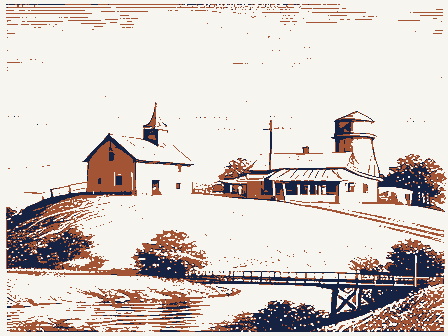
College Township (part 3 of 3)
Part 3 of 3 of the account of this township in History Knox County, Ohio, published 1881. 11,873 words, covering 1 settlement. Source changes inside the text are labelled at the exact paragraph where the next book begins.
Contents
8 sectionsThe section headings the book prints inside this chapter, on this part. Each one jumps to where it begins.
Parts
3 pagesThe source prints this as one continuous account. It is split here so no single page grows too heavy to load; the text runs straight on across the parts and nothing is omitted.
The chapter
11,873 wordsReproduced complete and unedited from History Knox County, Ohio, published 1881. The text is machine-read from scans, so expect recognition errors: misspelled names, dropped words, and stray characters. Nothing has been corrected, because correcting a proper name invents one. The headings below are the books' own; source changes are labelled in place.
J. H. was the head carpenter on Gambier hill, and often was he with the writer in consultation on the ways and means of proceeding with the buildings. Onentering the college service, he had agreed, as all the rest had agreed, to refrain from the use of spiritous liquors. The writer thought him friendly to this measure, and as he was a Baptist missionary, that he would second the views of the bishop in promoting temperance. But in this there was sad disappointment. What with the love of liquor, the fondness for being the head of-a party to maintain the ''unalienable rights of an oppressed people," and the desire of humbling the bishop, the promise made when he came on the hill was laid aside, and a combination with the hands was formed, and their grievances were made known by petition. Mr. H. was the ''scribe,'' and the first to subscribe; and a majority of the rest, to the number of nineteen, chief men of the company, ''men of renown," followed his example. This famous petition was in the following words:
Sir: We, the undersigned, being mechanics and laborers under your employ, have agreed, after mature reflection, and a consultation held upon the subject, to address you a line by way of petition, thereby to make known to you our united request, which request, we presume to think, and humbly trust, will not, by you, be considered unreasonable; and from many considerations we are inclined to believe it not only necessary, but beneficial, both for the preservation of our health and the as follows: That you will grant us the use of spiritous liquors three times a day, while we may be occupied in your service, in quantity, one small glass at each time; inasmuch as it has become a custom, not only in this State, but throughout the United States, to have it more or less at places where public works are going forward, a moderate use of which, in our opinion, would greatly forward the business in which we are engaged. The principal reasons which we urge for asking the foregoing, are the following, to wit: Having to work the principal part of the time under the influence of the sun's rays, and our provisions, though good, ae principally of the salt kind, and not having constantly a supply, of good fresh water at hand; and in consequence of the reasons here assigned, we have many times drank more than was really good for us, and to remedy this we have made the preceding request. If it meet your approbation, we think the expense will be repaid the institution ten fold; if not, we shall await your command, and abide the consequences with due respect. We have the honor to be yours very respectfully, [Names signed. ]"'
This petition was sent to the writer when in his log cabin all alone. He read it, and was considering its unhappy consequences, when a voice struck his ear from behind him. ''Mr. H. wants an answer,'' said the little boy, who had waited on the hands. ''Tell Mr. H. to please get the hands together under the shady trees near the timber, and I will come and talk with them about the matter.
As he approached the place where the hands were seated, there were signs of great unanimity - significant nods and bold looks; none spoke, and the suppressed, yet half-uttered laugh, indicated their expected speedy triumph.
The writer now took his seat on an elevated piece of eenbier; with a view to say something, yet found himself unable to utter a word, and fora considerable period there was nothing said; and when he did begin to say a word or two, it was not in language of reproach of their conduct, nor in any way an attempt to display his own oratory. Something different was now required. Their affections were to be won, their minds enlightened, and their will persuaded. In short, he saw it was necessary to speak to them as members of the human family, and make them friends to himself, to their own selves, and to the true interests of the institution. To this end he told them his own history, and in so doing gained their sympathy, and enlisted their affections in his hehalf. Many of them were in tears, and all arose and went to. work without a drop of whiskey.
The following history of the college is from the versatile pen of President Bodine, who has guided the college so successfully several years past. It is well worth a place in these pages and is given entire:
The traveller in central Ohio, journeying by the new railroad from Columbus to Cleveland, by way of Mt. Vernon, finds himself, for several miles of his course, skirting the banks of a sparkling stream, to which the old Indians gave the euphonious name ''Kokosing."' The valley through which the river flows is a charming one, and the ride delightful, for new beauties greet the eye at almost every turn, and rocks and hills and venerable woods utter together their voice of praise. At one of the sudden turns of this winding stream, a few miles beyond Mt. Vernon, upon a hill beautiful for situation, rises the village of Gambier, the seat of Kenyon College.
" Kokosing ! loveliest streamlet of the west, Where Nature stands in beauteous garments drest, How oft along thy winding banks I've strayed, Enchanted by the song thy murmurings made. Thy sloping shores are decked with verdant meads, And proud majestic hills that lift their heads With foliage and waving forests crowned ; Here Nature sits enthroned, while all around, Above, below, presents a charming view, Lovely as Eden, glittering with the dew Beneath a morning sun."
Halt a century ago there was probably no institution of learning in our land more talked about than Kenyon college, for it was one of the first literary ventures of the west, and its needs and expectations were heralded far and near. There is a certain charm about infancy which we do not recognize in manhood. This, doubtless, is one of the reasons why Kenyon has recently occupied a less prominent place before the public'than in her early days. Besides, her development has not altogether been fn the line anticipated. She has failed where success was dreamed of; she has won honor in ways that were not contemplated.
The corner-stone of Kenyon college was laid in the month of June, 1827, so that Gambier has just begun her second half century of earnest life. By a happy coincidence, the fiftieth year marked the elevation of one of Kenyon's sons to the Presidency of the United States. One of the trustees of Kenyon college, Hon. Morrison R. Waite, is now the highest judicial officer of the country. Kenyon's sons, also, are found in the halls of Congress, so that she has links binding her to every department of the Government - legistative, judicial, executive.
The list of the alumni at Kenyon has already grown to fair proportions. From the beginning her standard has been high, and many of those who have studied in Gambier have left before completing the course; but five hundred have been graduated. A large number of Kenyon's sons have become men of mark in church and state, and five of them had attained to a wide national reputation. Henry Winter Davis, that ''prince of parliamentary orators," in his early days practiced economy, and wrought with brain and muscle at Kenyon. Edwin M. Stanton, the great War Secretary, came in the spring-time of his life to Gambier. His college experience proved to be a turningpoint, so that afterward he was accustomed to say: ''If I am anything, I owe it to Kenyon college.'' David Davis, late Justice of the United States, now senator from Illinois, was an associate ot Stanton in college days. Starley Matthews, also, an eminent lawyer of Cincinnati, who won great distinction by his arguments before the Electoral commission, and who has lately retired from the Senate of the United States, was at Kenyon a friend and companion of President Hayes. Kenyon is proud of her alumni roll.
The founder of Kenyon college was Philander Chase, the first bishop of the Protestant Iipiscopal church in Ohio. A friend writes thus concerning him:
"Tn height he was six feet and over; the span of his chest was nearly, if not quite, equal to his height, and with that noble trunk his limbs were in full and admirable proportion. In a crowd his giant figure, in front or back, excited, wherever he moved, universal attention. Large and heavy in stature as he was, he was remarkably light and graceful in his movements, and when not ruffled with opposition or displeasure, exceedingly agreeable, polished and finished in his manner. Toward those who betrayed hauteur in their deportment with him, or whom he suspected as actuated by such a spirit, or who positively differed with him as to his policy, and especially toward those whom he looked upon as his enemies, he was generally distant and overbearing, and sometimes, when offended, herhaps morose. In his bearing toward, them his noble countenance was always heavy and lowering, and his deportment frigid and unmistakably repulsive; but in his general intercourse, and always with his particular and intimate friends, his address and social qualities were polished, delightful and captivating; his countenance was sunlight, his manner warm and genial 'as
Bishop Chase came of a sturdy New England stock. He was born in Cornish, New Hampshire, where he spent the days of his youth. When manhood came, however, he could not content himself with such quiet and settled surroundings, for, of him, as afterward of his nephew, the Secretary, ambition was a most marked characteristic. He was first a missionary in western New York, and then he was stationed in Poughkeepsie, but soon afterward removed to New Orleans. He was the first Protestant minister in the State of Louisiana. After five years of-hard and successful labor, he removed again to the north, and for six years was a minister in Hartford, Connecticut. But Philander Chase was a man too restless, too ambitious, too great, to remaia long contented in any quiet and peaceful nook. He craved the contests and the storms of life. So, early in the spring of the year 1817, resolved ''not to build upon another man's foundations," he started for what was then the far west - the newly admitted State of Ohio. consecrated bishop in February, 1819.
He began his work with rare earnestness. No pecuniary support had been provided. Indeed, for several years all that he received for his public ministrations was not enough to pay his postage; so, to gain his daily bread, he had to become a tiller of the soil.
He soon became convinced that he must have assistance in his work. In four years his list of three clergymen had grown to six, but what could six men do in so yasta field? Moreover, he became convinced that for western work the best laborers were western men, more accustomed than others to the hardships of the new civilization, and more likely to be contented with the labor and its returns. So his mind began to be filled with a dream of a ''school of the prophets," which, before long, took definite shape in his mind. Happily, the bishop's son suggested that favorable mention had been made in a prominent English journal of the new missionary work in far-off Ohio. The bishop immediately determined that the ocean must be crossed, and the mother church asked tohelp. He first appointed his son for this service; but his son's failing health required a journey to a southern clime, so the resolute bishop determined to go himself.
At once he made his plans known to his brethren. Some of them approved, while others disapproved, and one went so far as to violently oppose him.
Bishop White, the father of the American church, made objection firmly, but gently, as was consistent with his saintly character. He thought it undesirable that application should be made to a foreign source for aid, because of the probable effect upon the church at home. What countenance, it was said, will be given to the odium, which some would fain cast upon our church, as in a state of dependence on another church, incorporated with a foreign State. The lessening of the respectability of the church was also insisted upon; the American
Bishop Chase, however, was resolute. He thought he knew the needs of his own field of labor, and determined to provide for them as best he could.
He bade his son good-bye in New York, the last good-bye he was ever to say tohim. His son, he knew, was appointed to die, and it would have been a privilege to minister to him in his last moments. The claims of nature, however, must yield to
A month upon the ocean followed, for those were days when steamships were unknown. From Liverpool, Bishop Chase went to Manchester, and so on to London.
He met at once with a most formidable obstacle in the opposition of the bishop of New York. He was publicly attacked in the British Critic, and for months his hands were tied; he could do nothing.
But after a while the tide turned. It so happened that the British parliament was then divided on the question of the emancipation of West India slaves. The subject was being everywhere discussed with intense feeling. Asa consequence, any one who was known to have made sacrifices for the negro was sure to find friends.
Wilberforce's particular friend, Butterworth, who was also a member of parliament, lived near to the house where Bishop Chase had taken lodgings. One day a Dr. Dow, from New Orleans, called on Mr. Butterworth, when, in the course of conversation, something like this was said:
'Singular! I never knew anything singular in him but his emancipating his yellow slave, and that, I should suppose, would not injure him herein England."
The story was then told of his emancipation. A negro named Jack had belonged to Philander Chase while was living in New Orleans. Jack absconded. Years afterwards, when Philander Chase had become bishop of Ohio, Jack was caught and put in prison, where he was kept, awaiting an order from his master for his sale. Bishop Chase thought the matter over, and wrote his southern friends to let Jack go free.
The story made Butterworth Bishop Chase's friend, He invited him to his house, introduced him to great and good men, and soon the Ohio cause grew and waxed strong. Subscriptions were received from hundreds of sources. There was a genuine, almost an enthusiastic, outflow of British beneficence. Wealthy friends were gathered, and the pioneer bishop was the hero of the hour, delighting all with his thrilling sketches of frontier hardships, and with his glowing prophecies of magnificent triumphs sure to be achieved. Lord Gambier helped him greatly, Lord Kenyon, also, and Sir Thomas Ackland, and Lady Rosse, and Hannah Moore. The total result of this first appeal was more than five thousand pounds.
The largest single donor was Lady Rosse. We give the story of the way in which Bishop Chase became acquainted with her, inasmuch as it shows very clearly how mysteriously the links of the chain of life are bound together by the good providence of God.
In the winter of 1819-20 Bishop Chase had a letter from his friend, Dr. Jarvis, of Boston, making inquiry as to the manner of his support. The letter came at a time when the good bishop's burthens were more than ordinarily heavy. He was caring as well as he could for the scattered sheep of Christ ; besides, he was providing for his family by his own manual labor. He
Bishop Chase replied to Dr. Jarvis's letter frankly, drawing an accurate picture ofa frontier bishop's life. The letter thus written, upon bad paper, with bad ink, and with fingers stiffened by labor, was sent by Dr: Jarvis to a Scottish bishop, who was desirous to know something about western life and work. The thought of this letter had entirely faded from Bishop Chase's mind. Judge therefore, of his surprise, when it was shown to him one day in London, and he learned that, in consequence of it, a bequest of money had been made to him by an English citizen. Nor was this all. The Scotch bishop's daughter became his friend, told his story to Lady Rosse, secured his interest, and gained thereby for his cause some thousands of dollars.
Bishop Chase returned to his home a poor rich man, For those days, in Ohio, thirty thousand dollars was a very large sum of money, and so, doubtless, Bishop Chase would have considered it when he started to go abroad. Meanwhile, however, his ideas had grown. At one time a theological school would have contented him; but now larger and more dazzling ideas took possession of his brain.
His school was first established upon his farm near Worthington, where before, he had taught, amongst others, his nephew, afterwards Chief Justice Salmon P. Chase. This, however, was but a temporary arrangement. A permanent location had to be selected.
Aout this time Bishop Chase's attention was called to a tract of land, consisting of eight thousand acres, in Knox county. He at once came to Mount Vernon, the county seat, upona tour of observation, rode with friends across the country, and followed for a while the valley of the Kokosing, until he came to the hill where the college at present stands. It was suggested that, possibly, at the top of this hill there might be found a good site for building. The general reply was, ''No." The bishop said, ''Let us see." He scrambled upon the hill-side with a single companion. Once at the top, he climbed upon a fallen log, and as his eye stretched hither and thither, taking in the splendid sweep of the country round about, he exclaimed with satisfaction, '' 7//s will do." In that instant the location of the new institution was practically fixed.
The assent of the diocesan convention had to be secured. It was not certain that this could easily be done, for there was hardly a town in the State that had not fixed its covetous eye upon the infant college. More than seven cities contended for the boon, not one of whlch carried off the prize, for Bishop Chase was a man of will, and his will was that the school should be located inthe country. ''Put your seminary," said he, ''on your own domain; be owners of the soil on which you dwell, and let the tenure of every lease and deed depend on the express condition that nothing detrimental to the morals and studies of youth be allowed on the premises."
A still broader question, also, must needs be settled. What would be the nature of the new institution? Should it be simply a school for the education of clergymen? or should it open its doors to all classes of citizens? Some said, have nothing but a theological seminary. Mr. Charles Hammond, a trustee, and a very influential citizen of Ohio, said this most earnestly, and indeed went so far as to prepare and carry through the legislature a bill forthe incorporation of '' The Theological Seminary of the Protestant Episcopal Church in the State of Ohio," and so fixed the legal title of the new institution.
of the church - his second and greater thought now was ''to be of service to his country, without regard to denomination or religion.'' ''But two courses," said he, in his address before the convention, ''are before us--either to confine our seminary to theological candidates only; or, if we receive students in general science, to lay a foundation sufficiently strong and large to sustain the magnitude of the college, which must be reared to do those students justice. In the former case, nothing more is necessary than to turn your attention to the deed of gift of my own estate in Worthington. In the latter case, the only thing presented worthy of your attention is the proposed lands in Knox county. Here is a foundation on which to erect an edifice worthy of the kind expectations of our esteemed benefactors. On this we can build, and justly expect the patronage of our civil Government. Anything less than this would be to degrade, not to improve, our present blessings. There wll be no college for all professions if the Knox county plan fail. No other can give any adequate encouragement."
A most favorable report was received from the committee of the convention to whom this matter was referred, declaring that '' the lands in Knox county afforded an eligible site for the seminary and college, and combined advantages of greater magnitude than any offer that had been made." So it was decided that the Theological seminary of the diocese of Ohio, and Kenyon college, should be forever established upon these lands, and the broad plan was adopted of laboring to build up, not only a school of theology, but a college as well. The
_ English funds were to be appropriated sacredly to the purpose for which they were given. The college endowment, it was hoped, might, in some other way, be secured.
'This choice of a location amid well-nigh untrodden forests involved, as a matter of course, heavy sacrifices and large outlays of labor. It was necessary to begin with the very elements of civilization. Workmen must be gathered, land made ready for tilling, crops raised and harvested, and cabins built for shelter. In fact, for some.years, farming, milling and merchandising were carried on in the name of the college, and the institution came to be possessed of a store, a hotel, a printing- Office, a saw-mill, a grist-mill, a carpenter and a shoemaker's 'shop, with houses for the miller, rhe dairymen and the workmen to dwell in. So ere long the funds contributed by English friends were spent, and the resources of the pioneer bishop were quite exhausted.
It was needful, therefore, to make additional appeals for aid, and very naturally the '' public crib' was thought of as a ready source of succor. So in December, A. D. 1827, Bishop Chase went to Columbus, addressed the legislature, and received from that body an endorsement of an appeal to Congress for a donation from the public lands. Soon after, a bill was introduced into the U. S. Senate making a grant of a township of land. The bill was advocated by prominent Senators (among others by Thomas H. Benton and William Henry Harrison), but in the House of Representatives party spirit was roaring like a flood, and drowned the voice of the infant college. The bill failed in committee, and, amid the rush of other business, was pushed aside.
The good bishop was keenly disappointed, but not in despair. Renewed effort was his refuge: So at once he scattered broadcast a public appeal entitled ''The Star in the West, or Kenyon College in the year of our Lord 1828." of seventy dollars a year; never, before has the light of science beamed thus on the cottages of the poor. Who, then, would not give his mite to expedite the completion of a college erected in the woods at great personal sacrifice, and for such benevolent purposes? A small sum only is asked of every friend, of every name and class. In this way numbers will make amends for deficiency in quantity, and in this way the wound occasioned by the late disappointment in Congress will be healed by the hand of individual beneficence. In this way the commenced buildings may be finished, and the great work accomplished. Whoever reads this is, therefore, most respectfully and earnestly entreated immediately to enclose one dollar, in aid of the present struggles of Kenyon college, in a letter addressed to P. Chase, P. M., Gambier, Ohio."
This method of begging has since had ample following, but then it hv.d the charm of novely, and so succeeded. The dollars, it is said, came to Gambier as the leaves fall in autumn. Larger subscriptions were not neglected. John Quincy Adams, then President of the United States, gave a hundred dollars. 'Kenyon Circles'' were formed in towns near and distant, and thousands of ladies were busy sewing for Kenyon college. In all, some twenty-five thousand dollars were received through this appeal.
Meanwhile a goodly number of students had assembled at Gambier, and the work of the college went bravely on. dishop Chase nominally occupied the office of president. He really filled most efficiently the post of general manager and superintendent. Every morning the ''head men" had to be directed by him as to their daily work; every evening they were gathered to give accounts of labor. 'There was the tilling of the sands of broad acres to be looked after, the quarrying of stone, the erection of buildings, the industries of the village, and all this in addition to the wants, bodily, mental and spiritual, of the student community. Besides, there was the keeping of detailed accounts, and the maintenance of a most extensive correspondence. The burden was altogether a very heavy one; but Bishop Chases' broad shoulders were well fitted to bear it, particularly as he had a most efficient helpmate in his noble wife. ''Mrs. Chase entered with her whole soul into her husband's plans. She was a lady perfectly at home in all the arts and minutiae of housewifery; as happy in darning stockings for the boys as in entertaining her visitors in the parlor; in making 4 bargain - with a farmer in his rough boots and hunting blouse, as in completing a purchase from an intelligent and accomplished merchant, and as perfectly at home in doing business with the world about her, and in keeping the multifarious accounts of her increasing household, as in presiding at her dinner table, or dispensing courtesy in her drawing-room."
Through her efficiency and wisdom, and her husband's untiring and marvelous activity, Kenyon''s affairs were for a time prosperous. A corps of able professors was gathered; there were more students than could be well accommodated, while the building known as Old Kenyon, with walls four feet in thickness» rose solidly as though it were intended to stand forever.
The president received eight hundred dollars per annum, and each professor five hundred dollars; and in addition, the professors were supplied from the farms with everything they needed to sustain life, groceries only being excepted. The larger the family, therefore, the larger was the pay in butter, eggs and meat, in flour, milk and corn, in lights and firewood. One can not help wondering, nowadays, how they managed all this - whether, once in awhile some one did not get the cream, and some one else the skim milk, and whether eveything was lovely in consequence.
The college not only formed a large landed estate, and kepta hotel and shops, mills and stores; it boarded, also, its entire family of professors and students. One looks curiously to-day at its inventory of goods - pots, pans, pails, tubs, saucers, spoons, white dimity bed-curtains, mixed all up with oxen, cows, and vinegar. Then what could have been the need of ''trundle-beds?' Possibly to put to bed some homesick freshman.
The charge for board, tuition, room-rent, lights and fuel varied from fifty dollars to seventy dollars per annum. Perhaps it is not to be wondered at that the provender afforded should have come in for its share of adverse criticism. An early college publication advertises, '' cash will be given at the seminary store for hats and old shoes suitable for making coffee;'' it also chronicles an ''Awful Catastrophe - Died very suddenly, on Wednesday last, seventeen interesting hogs, of sore throat, endeared to the students by their unassuming manners, gentlemanly deportment, and a life devoted to the public service. The funeral of each of them will be attended every day until the end, in the dining-hall."
Those were the days when discipline was somewhat stern. We read of asophomore who was commanded to the room of a professor, and severely beaten with a rod. For the first time in his life a Mississippi freshman received bodily chastisement, and even Doctor Sparrow, the vice-president, took care to see that it was well laid on.
Nor was Bishop Chase's course in Gambier all smooth sailing. Difficulties appeared which grew to great proportions. 'Kenyon college," he wrote at the time, ''is like other colleges in some respects, and unlike all in many other respects. The fundamental principle in which it differs from all others is, that the whole institution is patriarchal. Like Abraham on the plains of Mamre, it hath pitched its tent under the trees of Gambier hill, it hath its flocks and its herds, and its different families of teachers, scholars, mechanics, and laborers, all united under one head, pursuing one common interest, and receiving their maintenance and food from one common source, the funds and farms of the college." The picture, it must be confessed, is not without its beauties, though the coloring is certainly more occidental than oriental. Accurately drawn, it would have shown western workmen ready to cry ''independence," a western faculty to question the limits of authority, and western Young America to cheer them on. Pecuniary troubles added to the embarrassments of the situation. Soon the ninth of September, 1831, Bishop Chase resigned the presidency of the college and the episcopate of Ohio. The next day he mounted ''Cincinnatus,' and rode sorrowfully away, and Gambier saw his face no more. He was afterwards elected Bishop of Illinois, and died at 'Robin's Nest,'' where he had founded Jubilee college.
In the language of one well qualified to judge with accuracy, '«thus closés the record of Bishop Chase's labors in founding a theological seminary and college. He probably had no superior in all the qualities necessary to originate such an institution. The versatility of his manners was such that he could adapt himself readily to any condition of society. Whether he were in the log-cabin of Ohio, where the whole family slept, ate, cooked, received guests,» and lodged them in the same apartment, or in the magnificent halls of Lord Kenyon, surrounded with the refinement of the old world, Bishop Chase was equally at home, and capable of winning golden opinions. Add to this an energy that never flagged, a will that never succumbed, and a physical system that never tired, and we have such a character as is seldom produced, but which was precisely adapted to the great work that he accomplished. Bishop Chase was equally remarkable for industry and endurance. Daylight seldom found him in bed, and he seemed as fond of working or travelling in the rain as though water were his native element. He would preach at Perry (fifteen miles from Gambier), and as soon as daylight peeped in the east on Monday morning, take his bridle himself, go to the field, catch 'Cincinnatus,' mount and be off to set his head men at work in Gambier. Bishop Chase began a work for the church in Ohio, and in truth for the whole west, such as no other man then living would have attempted, or probably could have accomplished."
What the subsequent history of Kenyon college might have been, had Bishop Chase remained at its head, it is idle to speculate and vain to surmise. In laying its foundations his great work was done. <A lawyer of Ohio was wont to say concerning him that he was an almighty man. Nor did the countryman come very wide of the mark, who, when meeting him one day, called him ''general.'' ''I am not general,'' was the somewhat curt reply. ''I beg pardon; I mean judge." ""T am not judge."' ''Well, then, bishop.'' ''Why do you call me bishop? How do you know that lama bishop?" '' Well, I knowed," said the man of homespun sense, '' that whatever you was, you was at the top.' The countryman was right. Philander Chase was not only a lover of men, but a leader of men; now gentle as a child, most sweet and winning; now, again, imperious, invincible. All honor to his memory!
Kenyon's second president was Charles Pettit Mcllvaine, D.D., D. C. L. (oxon), who came to Gambier at the early age of thirty-three. Born in the same year in which George Washington died, he bore a close resemblence to the Father of his Country, both in appearance and character. He looked a king among men; he was great, also, as a thinker and an orator. He had already filled the office of chapiain at West Point, and had won renown in the great centers of Washington and New York.
Such a man, coming to Gambier, could not but be warmly welcomed. He saw at once, moreover, the importance of the institutions, and girded himself to labor in their behalf. New buildings were much needed. Besides, there was an accumulation of debt. Bishop Mcllvaine, therefore, before establishing himself in Ohio, solicited aid, chiefly in the eastern cities, and received in all nearly thirty thousand dollars, the larger part of which was contributed by friends in Brooklyn and New York. This was done in 1833. Without the help thus opportunely given by the new bishop, Kenyon must have perished, the trustees having determined that it would be impossible for them, as things were, to carry on the college.
The first by-law passed under bishop Mcllvaine's administration is characteristic : ''It shall be the duty of every student of the college and giammar-school, on meeting or passing the president, vice-president, any professor, or other officer of the institution, to salute him or them by touching the hat, or uncovering the head, and it is equally required of each officer to return the salutation." recitation was held at twenty minutes after five. Inthe summer the first bell rang before sunrise, and the second at sunrise, for prayers. At nine o'clock in the evening all lights had to be put out, and all students to go to bed. The professor of chemistry was also physician to the college. Each morning he attended at his office to see the sick, and excuse persons to be absent on that account. No plea of sickness was allowed without, the doctor's written certificate.
In those days the diocese of Ohio was poor, and so Kenyon college paid the salary of the bishop. The arrangement was not strictly just, for Kenyon received only a part of the bishop's time and energy. So strongly did bishop Mcllvaine feel the injustice of this arrangement that he finally took a resolute stand, and the college was no longer taxed for his support.
He was necessarily absent from Gambier much of the time ; so a vice-president was elected, who was his representative when absent, and who governed in the ordinary college affairs. Dr. - William Sparrow was the first vice-president.
President Hayes entered Kenyon as a student in the fall of the year 1838, and was graduated in 1842. A classmate writes that for the first two years of his course he did not really lead his class, but had a reputation as a reader of newspapers, and asa person well informed in politics. He afterward came rapidly to the front in scholarship, taking a particularly high stand in mathematics and logic, and was graduated with the honors of his class. His commencement address, ''College Life," with the valedictory, is still spoken of in terms of the highest recom-
"mendation. The uniform suit of the class, worn at graduation, would now look somewhat strange. It consisted of a coat of blue Kentucky jeans, with black velvet collar, a white waistcoat and white liren trowsers.
A college friend of President Hayes has written: ''I recollect him as one of the purest boys I ever knew. I have always recollected of him that in our most intimate, unreserved, private intercourse, I never knew him to entertain for a moment an unmanly, dishonest or demoralizing thought. And when we met in after life, in scenes which called for the highest manhood and patriotism, I found the man to be exactly what his boyhood had promised.
Hon. Stanley Matthews says of him: '' Hayes, asa boy, was notorious for having on his shoulders not only the levelest but the oldest head in college. He never got in any scrapes, he never had, any boyish foolishness ; he never had any wild oats to sow ; he was sensible, not as some men are, at the last, but sensible from the beginning."
The following incident of President Hayes' college life may almost seem prophetic. We give it in the words of his intimate friend, Hon. Guy M. Bryan, of Texas, the facts having been certified to us by the President himself :
"'There were in those days two rival literary societies in the college - the Philomathesian and the Nu Pi Kappa; the last known as the Southern society, and the first as the Northern, because the students of the slave States belonged tothe one, and those from the free States to the other. - The college for years had been largely patronized from the Southern States, but this patronage gradually waned until, in the winter of 1841, there were so few Southern students in the college that the members of the Nu Pi Kappa were apprehensive that the society would cease to exist for want of new members. This was a serious question with the members of the society. I determincd to open the subject to my intimate friend Hayes, to see if we could not devise some mode to prevent the extinction of the society, which was chartered by the State, and had valuable property. We talked over the subject with all the feeling and interest with which we would now discuss the best means of bringing about an era of good feeling between the two sections of the country. At last Hayes said, 'Well, I will get ''Old Trow,'' Comstock and some others to join with me, and we will send overa delegation from our society to yours, and then we can make new arrangements so that both societies can live in the old college.' He and I then went to work to consummate our plan. Ten members of the Philomathesian joined the Nu Pi Kappa. A joint committee was then appointed from the two societies, that reported a plan by which students could enter either society without reference to North or South. Thus Hayes, by his magnanimity, perpetuated the existence of the Nu Pi Kappa society, and should he be elected President, I earnestly hope that he may be equally successful in his best efforts in behalf of a civil policy which will wipe out forever the distinction between North and South in the government of our common country."
The following letter from President Hayes, written after his last election as Governor, may be taken as fairly representative of the kindly feelings entertained by the graduates of the college in general:
My KENYON FRIENDS: A host of congratulatory dispatches are before me. I can not acknowledge with even a word of thanks the most of them. But yours, first to be replied to, touches me particularly. Accept my thanks for it. I hope you will all have reason to remember old Kenyon with as much satisfaction asI do. I have no more cherished recollections than those which are associated with college life. Except the four years spent in the Union army, no other period of my life is to be compared with it. I hope you may all have equal reason always to think of Kenyon as I do,
For instruction, thirty dollars; for board at the college table, forty dollars; room rent ina room with a stove, four dollars; room rent in a room with a fire-place, six dollars; for theologidal students and sons of clergymen the total charge was fifty dollars.
Those were the days when the boys were required ''to sweep their own rooms, make their own beds and fires, bring their own water, black their own boots, if they ever were blacked, and take an occasional turn at grubbing in the field, or working on the roads."" The discipline was somewhat strict, and the toil perhaps severe, but the few pleasures that were allowed were thoroughly enjoyed.
linger in the place concerning Professor Ross clearly show that he was possessed of remarkable power; but Bishop Mcllyaine and Dr. Sparrow were pre-eminently great men - men whose greatness has been felt as an educating influence on both sides of the Alleghanies. Bishop Mcllvaine's was a divided duty, for in addition to his college labors he had the care of a large and struggling diocese; while Dr. Sparrow gave to Kenyon his full and undivided strength, and so had the stronger hold upon the students. He led them not oniy wisely and bravely, but him as ''one of the giants;" Secretary Stanton also honored him through life, and sent for him in his later days that he might be baptized at his hands. '
Until-the year 1840 there was a joint faculty of theology and arts in Gambier. At that time separate faculties were constituted with separate heads, Bishop Mcllvaine continuing at the head of the Theological seminary, while Major D. B. Douglass, LL.D., was elected to the presidency of the college. Major Douglass was an accomplished civil engineer, a soldier and 'every inch a man.'" He began his work earnestly in Gambier, and improvement was the order of the day. But the time was not ripe for him. He was succeeded within a few years by Rev. Dr. S. A. Bronson.
The chief event accomplished during Dr. Bronson's presidency was a sale of a large portion of the college lands. Though of very considerable value, these lands, from the first, had brought to the institution only the scantiest returns. One agent after another had been employed to oversee them. The raising of sheep proved disastrous; the culture of wheat could not be made to pay. Many of the tenants turned out to be either shiftless or dishonest. So, in the year 1850, after much discussion, it was determined that the form of the investment should be changed, and the lands were ordered to be sold.
Almost immediately there came increased prosperity. Happily, too, at this juncture, Lorin Andrews, LL.D., was elected president. The friend and champion of popular education in Ohio, he found helpers in every county of the State. The list of students was quickly swelled, so that in 1855 ''room for enlargement" was a thing of netessity. President Andrews resigned in 1861 to enter the Union army. He was the first volunteer from Ohio, entering the service as colonel of the Fourth Ohio infantry. Very soon, however, he contracted disease, from the effects of which he died. His body rests ina quiet nook of that college park, which so often echoed to his step. With President Hayes, he was for a time a member of the class of 1842.
His successors in the office of president of Kenyon college have been Charles Short, LL.D. (1863-67), James Kent Stone, A.M. (1867-68), Eli T. Tappan, LL.D. (1868-75), William B. Bodine, D.D., the present incumbent.
The rolling years have brought added endowments to Kenyon, though she still waits for such large benefactions as have been given to colleges in the eastern states. Upon the occasion of his latest visits to his native land, Mr. George Peabody contributed the endowment of one professorship (twenty-five thousand dollars), chiefly out of regard and affection for Bishop Mc- Ilvaine, his early and life-long friend. Mrs. R. B. Bowler, of Clifton, Cincinnati, gave the sum requisite for another professorship, in memory of her husband, whose interest in Kenyon had Mr. Jay Cooke bestowed thirty thousand dollars in the days of his large prosperity. Other considerable sums have also been received, chiefly through the exertions of a long tried and devoted advocate and helper, Rt. Rev. Gregory Thurston Bedell, D.D. By his ardent and faithful endeavors, Bishop Bedell has secured contributions for Gambier, in all amounting to nearly two hundred thousand dollars.
This sketch has been written with special reference to Kenyon in the past. A rapid glance at the buildings of the institution may help to give an idea of her development and growth, and of her capacities for present usefulness.
Bexley Hall
Bexley hall stands upon a knoll at the northern extremity of the village. It was erected for the exclusive use of the Theological seminary, after a design given by the architect of the London crystal palace. It contains the library of the seminary - about seven thousand volumes - and furnished rooms, each with separate bed-rooms, for thirty-four students.
tion; a broad and well shaded avenue leads the way thereto. Near the southernmost point of this park, just upon the brow of the hill, and overlooking for miles the charming Kokosing valley, stands the more massive and venerable edifice of Kenyon college. This building is of plain stone, one hundred and ninety feet long, and four stories high, including the basement; with battlements, pinnacles, belfry, anda spire one hundred and seventeen feet high. It contains upwards of fifty rooms for students; also the libraries of the Philomathesian and Nu Pi Kappa societies.
Close by old Kenyon stands Ascension hall, an imposing structure, and one of the finest college buildings in the land. It contains two spacious and elaborately furnished halls for the literary societies, six recitation and lecture rooms, the library of Kenyon college, with its museum, and twenty-six rooms for students. The tower is used for an observatory.
Directly north of Ascension, and about fifty yards from the village street, stands the college church, the ''Church of the Holy Spirit," which was finished-in 1871. This most beautiful of all the buildings in Gambier is cruciform - with the tower in one of the angles - the nae and chancel being ninety feet and transepts eighty feet in length - all the windows are f stained glass - the church finished in oak, and the walls tastefully illuminated. The building is of the same freestone as Ascension hall, laid in courses, with dressed quoins and facings. It will accommodate a congregation of about six hundred. Ivy, transplanted from Melrose abbey, has already begun to adorn its walls. Within, the coloring and the carving are most attractive. The funds for the erection of this college church
Ascension Hall
To the north and east of the village, and some-distance from the main street, environed by trees, and commanding an extensive and beautiful prospect of the valley of the Kokosing, stands Milnor hall, built for the use of the preparatory school. This is a plain structure of brick, the main buildings four stories high.
In all her requisites for admission, and in the course of study, Kenyon does not materially differ from the leading colleges of the Eastern States. She aims to give a thorough liberal education, and believes in the value of hard mental discipline. She believes also in right religious influences, and labors to afford them, pursuing steadily ''the true, the beautiful, the good.'' In her view, ''Christianity is the science of manhood," and all truth, being God's truth, should lead finally to Him. So her faith is liberal, conservative, evangelical, catholic.
The new college chapel should be seen to be appreciated. It is a poem in stone and mortar, and both within and without is surpassingly attractive. Used, as the chapel is, for daily college prayers, it has a steady influence for good. A new clock and full chime of bells have been added, to make it all complete:
Its construction was due to the liberality of the former parishioners of Bishop Bedell, of the Church of the Ascension, New York; and those munificent donors have planted a thing of beauty, ''a joy forever," on as exquisite a site as ever was graced by the house of God.
And Southern Ohio
ELECTED BY THE CONVENTIONS OF THE DIOCESES OF OHIO AND SOUTHERN OHIO. Under Constitution, Article VI. Rev. Alfred F. Blake, of Cincinnati. Mr. George W. Jones, of Cincinnati. Rev. John W. Brown, S. T. D., of Cleveland. Gen. J. H. Devereux, of Cleveland. Rey. I. Newton Stanger, of Cincinnati. Mr. William J. Boardman, of Cleveland.
Elected By The Alumni
ELECTED BY THE ALUMNI. Rev. J. Mills Kendrick, of Cincinnati. Mr. Levi Buttles, of Cleveland. Rev. William W. Farr, D. D., of Philadelphia. Mr. Charles E. Burr, of Columbus. MARDENBRO WHITE, ESQ., of Gambier, Secretary, Treasurer and Agent.
College Faculty
There are two examinations in arithmetic. The first is on the primary rules, factoring, greatest common measure and least common multiple of integers, compound numbers (including the metric system), fractions and decimals. The second examination is on percentage and interest, circulates, greatest common measure and least common multiple of fractions, and extraction of roots.
Mythology - A hand-book, such as Baird's Classical Manual, should be studied in connection with Virgiland Homer. A good classical dictionary and a dictionary of antiquities are necessary to every classical student.
Fair equivalents are received for any of the above named books, or for parts of them. The books named serve to indicate the amount required.
If a student is further advanced in some studies than in others he may pursue the studies for which he is prepared. Opportunities are furnished such irregular students to make up the defective study.
Candidates for admission must present testimonials of good moral character; and, if they come from other colleges, certificates of dismission in good standing.
A. M. Another examination is held on the day before the opening of the Christmas term, at the same hour. Students may be examined for any advanced standing at any time before the commencement of the second term of the senior year.
Gambier isa small country village, situated in the central part of Ohio, and is noted for its beautiful scenery, and its healthful and invigorating climate. No better place could well be found for quiet study, or for moral and religious culture. There are no saloons in the place. Gambier is distant by rail two hours from Columbus, five hours from Cleveland, and six hours from Cincinnati. The station of the Cleveland, Mt. Vernon & Columbus railroad is immediately in the rear of the college grounds.
The buildings are among the best in the United States. The halls of the literary societies are unsurpassed. The college park contains about a hundred acres, well shaded with maples, and with the grand old oaks of the native forest. To the east, the west, and the south, it sldpes most beautifully toward the valley of the Kokosing.
Trinity term begins at the close of Easter term, and continues thirteen weeks; and Commencement is on Thursday at the close of Trinity term.
There is a recess of one week in Trinity term, immediately following Easter day; and when Easter falls in Easter term, the recess is the first week of the period assigned to Trinity term.
Students not in their places at the opening of the term must show by written statement from their parents or guardians that the absence was necessary.
Every student is required to attend punctually upon all the academical and religious exercises. In case of necessary absence from any exercise, the student must inform the officer in charge beforehand, if possible; if not possible, he is required to present his excuse as soon as may be after the absence has occurred.
Students are required to attend morning and evening prayers in the college chapel, also the public services on Sundays, and on the principal holy days of the church.
A weekly lectureship has been established for the elucidation and enforcement of the great doctrines of the Christian religion, for the discussion of great moral questions, for meeting individual difficulties of belief, and making plain the harmony between God's work and His word.
This lectureship will be under the charge of Rev. Dr. Bates (whose extraordinary qualifications for this special work have been abundantly proven), with occasional aid from the president of the college, and the bishop of Ohio.
A student is admitted to matriculation when he has sustained a satisfactory probation. 'Matriculation gives accredited membership to the institution, and entitles the student to an honorable dismission. For misconduct, he may be reduced to the condition of a probationer.
may be influenced to good conduct and literary exertion by higher motives than the fear of punishment, and it mainly relies for the success of the institutlon, as designed for liberal education, on religious and moral principle, a sense of duty, and the generous feelings which belong to young men engaged in honorable pursuits; but when such motives fail, the faculty will use friendly caution and warning, admonition, and official notice of delinquency to parents and guardians, reduction of rank, refusa to grant privileges and indulgences allowed to meritorious students, withholding of honors, which would otherwise be conferred; and to suspension, removal or expulsion. Students will be required to observe the utmost decorum and courtesy towards each other at all times, and the practice of hazing will be rigor_ ously suppressed. J
The degree of bachelor of arts is conferred upon all students in good standing who are approved at the final examinations of the senior class.
The degree of bachelor of philosophy is conferred upon those who have successfully pursued the study of modern languages instead of Greek, and who have sustained satisfactory examinations upon all other studies of the regular course.
Candidates for the degree of master of arts in course must show that they have, since taking the Bachelor's degree, been engaged for three years in the study or practice of the learned professions, or in other scientific or literary pursuits; and each candidate must deliver to the faculty an essay upon some literary or scientific theme.
The two literary societies, the Philomathesian and Nu Pi Kappa, have always been fostered by the college. The society halls are very commodious, and have been fitted up at great ex pense, occupying the whole of the second and third stories of the central portion of Ascension hall. All the students are active members. The meetings are held every week, for practice in declamation, essay, oratory, and discussion. These exercises, with the mutual criticism which forms a part of the regular work, and the generous rivalry maintained between the societies, contribute very much to the education of the students as writers and speakers.
Arrangements have been made whereby instructions in this important subject will hereafter be given by the distinguished elocutionist, Professor Kidd, M. A. .
The students have access to the libraries of the theologicay seminary, Kenyon college, the Philomathesian society, and the Nu Pi Kappa society. The aggregate number of volumes in these four libraries is about twenty-two thousand.
The Kenyon Advance is published monthly during the college year, and is under the control of a board of editors chosen from among the students.
Two reading rooms have been fitted up by the members of the Philomathesian and Nu Pi Kappa societies, where copies of the leading English and American periodicals and newspapers are kept on file.
A perpetual scholarship has been founded by Mrs. Mary N. Bliss, of Columbus, by the gift of one thousand dollars. The income of this scholarship will be given to some student of high character and ability, who shall be nominated by the president
Residence Of Prof. R. B. Marsh Mt. Vernon, Ohio
Other friends have indicated their purpose to give annually, sums varying from one to two-hundred dollars to aid in the education of students of the highest order of character and ability.
These scholarships will ordinarily be given'only to those who have proved their superiority by success in college work, and to those who stand highest at the entrance examinations.
Rooms are provided in the college buildings in which aly students must lodge, unless they obtain permission from the president to room elsewhere. The college makes no special provision for boatd. This can be readily obtained in private families, or, at times, in clubs.
Each room is sufficiently large and convenient to accommodate two students. The rooms are provided with stoves, and are neatly painted and papered by the college. Students provide their own beds, furniture, light, books and stationery. Furniture can be bought, as well as sold, at second-hand, and the expense incurred by its use need not be great.
The college: charges are: For tuition, ten dollars per term; for room rent, five dollars per, term; and for incidentals, ten dollars perannum. A matriculation fee of five dollars is charged to every student at his entrance. There are also some minor expenses, consisting of taxes voluntarily imposed by the students in their classes and literary societies, and the expenses of graduation.
Every student on entering the college must deposit five dollars with the treasurer, as security for damage. The charges on this fund have averaged less than one dollar per year to each student. The balance is returned to the student on leaving.
When a student is absent for a term, and is afterwards, upon examination, allowed to go on with his class, tuition is charged for the time of his absence. Room rent is charged when a room is reserved for a student.
Fuel is supplied by the agent of the college, and must be paid for in advance, at the same time with the bill for tuition. The charge is six dollars per term for the first and second term, and three dollars for the third term, and twice these sums when a room is occupied by a single student.
Board in private families costs from three dollars to three dollars and fifty cents per week. Clubs are sometimes formed, and the expense for board is thereby materially reduced.
"All students shall be required to pay their regular bills in advance. The treasurer's receipt shall be required by the president before h2 shall sign a certificate of matriculation, or, after the first term, before the student shall attend recitation." ~
The Grammar School Of Kenyon College Officers Of Instruction And Government
From the time of the foundation of Kenyon college it has been necessary to provide, in connection with the college, efficient preparatory instructien, For this purpose Milnor hall was established nearly fifty years ago. Its object was, and is, by God's blessing, to provide a church school where boys can receive thorough training under influences which tend towards the development of high Christian character.
The school has recently been placed under the control of the regents named above. They intend that it shall be one of the best training schools in the land. The school will be under the immediate charge of a head master, who will be assisted by a full corps of competent teachers and a matron. The buildings have been thoroughly repaired. Other important improvements have also been made by which the attractiveness of the school has been greatly increased.
The distinctive work of the grammar school is the preparation of boys for Kenyon college; but, whenever desired, they will be trained with reference to the special requirements of any leading The school will be divided into four forms. In the first form the pupil's time will be spent exclusively upon English studies. In the second form he will continue the study of reading and penmanship, of mental arithmetic, geography and grammar, and will begin the study of Latin. In the third form he will begin Greek (or German), finish the Latin reader and Ceesar's commentaries, written arithmetic, commercial arithmetic, and bookkeeping. In the fourth form, he will finish preparatory work in Xenophon's Anabasis and Homer's Iliad (or Otto's German reader), Cicero's Orations and Virgil's neid, Ray's algebra and Tappan's geometry, besides studying an outline of ancient history and geography. In all the forms special attention will be paid to the correct use of the English language.
designed to give thorough preparation for business. The studies of this course will be English, including geography, grammar, and history, mathematics, penmanship, and bookkeeping, and, if desired, Latin and the modern languages.
The pupils live in the same building with the head master and the assistant teachers, and take their meals at the same table. They are thus brought under the personal control of the teachers, and the school is madea home. The intercourse between teachers and pupils is free and cordial. The pupils are allowed and encouraged at all times to seek help from the teachers, and thus valuable instruction is constantly imparted as well out of, as during, study hours.
The regents believe that the health and good moral training of the younger pupils can be best guarded by a system which requires them to sleep in single alcoves in dormitories, under the charge of teachers; but, whenever desired by parents, any boy can occupy a room with a single companion., All pupils of the fourth form are provided with rooms, two pupils occupying one room. Upon payment of an extra charge pupils will be allowed toroom alone. Each pupil is provided with a single bed.
The system of discipline and the general management of the school are based on the principle that the authority of the parent is supreme to the child, and that the teacher in charge of a school stands in the place of the parent. The conscience of the pupil and his own conviction as to right and wrong are appealed to, so as to make him manly and self-reliant. The laws are such as are needed in every large family to insure regularity, comfort and harmony of action.
Generous liberties are allowed, with the understanding that they shall be well and wisely used, and while authority (and respect for it) is, and must-be maintained, it is always enforced with kindness and affection.
The quality of every recitation is carefully registered, monthly reports thereof, together with other information relative to the standing of each pupil in punctuality, application and deportment, are forwarded to the parents or guardians. Parents are particularly requested to.take notice of these reports, and to keep themselves intormed thereby of the progress and behavior of their sons,
The college libraries contain twenty-two thousand volumes, covering every department of literature. By the payment of a small fee the scholars of the hall have access to these libraries. They may also attend, as visitors, upon the exercises of the literary societies of the college. ;
A service of daily morning prayer is held at the hall. The pupils also attend daily evening prayer at the chapel of the college, and the public religious worship of the Lord's day.
A weekly lecture is given upon the great truths of Christianity, with moral instruction intended to develope a genuine and manly Christian character.
Particular attention is given to physical culture. The playgrounds are large, and all manly sports are encouraged. Ample opportunities are afforded for bathing and skating. To promote personal cleanliness the pupils have access to a bathroom in the building.
*No pupil who fails to answer a certain percentage of the questions in these examinations will be allowed to pass into a higher class; nor will any so failing be recommended for the entrance examination to college.
Applicants for admission to advanced standing must pass an examination upon the studies of the lower forms. After the examination they will be placed in that form for which they seem to be, on the whole, best fitted. In all cases in which there is any hope of success, an effort will be made, by private instruction, to bring up such pupils in the studies wherein they are deficient, rather than put them back in those in which they are more advanced.
Students who expect to enter college will find it greatly to their advantage to take their preparatory training at the grammar school. In most high schools attention is given to certain studies which are of no avail in an examination for admission to college, and which are much more thoroughly taught in the regular college course. A year, or even two years, of valuable time may thus be saved.
Students of mature years, well trained in mathematics and English, may make more rapid advancement towards entrance to college by devoting themselves with special energy to the study of the classical or the modern languages. Arrangements will be made for this class of students.
The charge for tuition, board, fuel, lights, washing, and mending, will be three hundred dollars for the entire session. This is payable as follows: one hundred and fifty dollars on entrance, the balance the first day of February thereafter.
A deposit of ten dollars will be required from each pupil to cover damages done to the property of the school. Whatever is not required in payment of such damages will be returned at the end of each session.
An extra charge will be made for books, stationery and medical attendance; and a sufficient deposit, not less than ten dollars, is required for these and for other '' incidentals."
Pupils must be entered for the whole of the school year. But they will be received at any time when the school is not full, .and a proportionate deduction will be made; but subsequently no deduction will be made for absence, except in case of protracted sickness, when the loss will be equally divided.
The session begins the first Wednesday in September and closes the Friday before the last Thursday in June. There isa vacation of three weeks at Christmas, and of one week at Easter. A charge of five dollars per week will be made for those who remain at the school during the vacations.
Each pupil should bring with him an umbrella, a pair of overshoes, blacking-brush and blacking, clothes-brush, a coverlet, two pairs of sheets and blankets (single), pillow-cases, towels, napkins a plain napkin ring, and clothes-bag.
The department of military drill and instruction is under the charge of an officer of the United States Army, by whom the pupils are regularly drilled. The system will be made subordinate to the higher purposes of the school as a literary in-
Stitution. Its advantages are: (1.) It secures agreeable and healthful exercise. (2.) It- tends to give an erect carriage and good manners. (3.) It promotes habits of order and obedience, important elements of success, both at school and in after life.
For such a school as Milnor hall there are great advantages in uniformity of dress: (r.) In the matter of expense, giving the advantage of wholesale rates. (2.) As a great help in producing a, feeling of esprit du corps, among the pupils, leading them to be careful, lest they should discredit the organization whose badge they wear. (3.) Asa means of avoiding unpleasant comparisons by placing all upon the same footing in the matter of dress.
A uniform has been adopted for the school, consisting of coat, pants and vest of fine, dark blue cloth trimmed with neat brass buttons and a small gilt stripe. The uniform is such that, by removing the trimmings, it will answer for wear when the pupils are away from school. It is distinctive, but not peculiar.
The cost of each suit will vary from twenty to twenty-five dollars, depending upon the size of the wearer. A sample of the cloth used will be sent on application.
Parents and friends are earnestly: requested not to furnish the pupils with pocket money, except through the rector, or head master. A deposit for this purpose should always be made.
Believing the use of tobacco to be especially injurious to the young students, the regents desire the cooperation of their patrons in discouraging its use on the part of any pupil at Milnor hall. Smoking*in the students' rooms will be prohibited.
To encourage habits of punctuality, a careful record of tardiness at meals, and at all school exercises, is kept and forwarded to parents with the monthly report.
All letters should be addressed to the care of the school. Pupils are not allowed to have private boxes in the post-office, and express packages must be always prepaid.
Forty years ago Bishop Mcllvaine wrote: ''It should be recollected that in the west a college can hardly be expected to sustain a dignified stand as to the requisites for admission, to enforce a vigorous system 'of internal discipline and carry out such a course of study as becomes its profession and its degrees, without sacrificing for a long time numbers for attainments. ' It is the determination of those in the administration of Kenyon college to endeavor to attain an enlarged patronage without compromise with any defective notions of educations, or any humoring of popular caprice. A few young men, well educated, are worth a host superficially taught. Such a determination in this country requires much patience and firmness in its prosecution, but I trust it will never yield to
Harcourt Place Academy
The Rev. A. Blake, D. D., the founder of the Harcourt Place Academy, was a native of Keene, N. H. - the home of Chief Justice, Salmon P. Chase. When probably about twenty years old Young Blake came to Ohio and entered S. P. Chase's school, as a student at Worthington, Ohio. In 1828 he came to Gambier with the other members of the school. The first winter was pretty hard on the boys.
Mr. Blake was a member of the first class that graduated at Kenyon college, (1829.) The members of the class, beside himself, were: Jas. B. Chase, Samuel Chase, Geo. Denison, P. C. Freeman and B. B. Sayre. Four of the six were near relatives of the bishop, and five of the six were from New England. Mr. Blake graduated from the Theological seminary in 1835. During the next fifteen years Mr. Blake was engaged, a portion of the time, as president of Milnor hall and city missionary in Cincinnati under the auspices of Christ church. In 1852 he purchased the house built for B. J. McIlvaine and several acres of land. connected with it, and opened his select school for boys. Mr. Blake, having many warm friends in Cincinnati, the school was patronized at once by the better class of people of that city and other places. He continued at the head of the school until his decease, July, 1877. His first assistant for many years was Rev. E. C. Benson, a very popular and efficient teacher. Mr. Blake and his estimable wife had a peculiar aptitude for managing boys, and the school has been a favorite institution from its first opening. For several years Mr. McKinley has had charge of the school. He has now associated with him Mr. Blake's son Leonard; both are graduates of Kenyon college. The school has never been more successful than it is at the present time.
Mr. Blake was universally esteemed by the citizens of Gambier - not only as a clergyman, butasa benevolent, kind-hearted, Christian gentleman; and it is safe to say that he had not an enemy in the world. For several years Mr. Blake was an efficient member of the board of trustees of Kenyon college.
Provenance
Text from History Knox County, Ohio, published 1881, in the public domain in the United States and digitised by the Internet Archive. The settlements listed against this township are matched by point-in-polygon test of each Geographic Names Information System coordinate against the Census Bureau's county subdivision boundary, not by name.