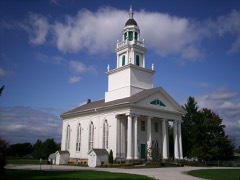
Listed on the National Register of Historic Places in
1976. A historic map-sheet match is not published yet. The record needs a coordinate-quality review before it can be joined to a sheet boundary.
From the record
“Baldwin from Warren, Litchfield Co., Conn., bringing his wife and three sons, Alva, John and Tibbals. They arrived July 7, and their wagon was the second that came through by the " Old Palmyra Eoad," there being at the time not a single house between Canfield and Campbellsport.”
History of Portage County, Ohio (1885). Machine-read text.
one of 42 National Register listings in Portage County · listed in 1976 · category: Building.
National Register reference number.76001514- the number the National Park Service assigned this property when it was listed, and the key its nomination file is catalogued under at the National Archives.
The ground it stands on
5,036 words
The chapter on Palmyra Township in History of Portage County, Ohio, published 1885 names Palmyra. This is what it says, exactly as the scans read.
David Daniels, the leader in the vanguard of the little band of soldiers of civilization who settled and helped make habitable this tine township of Palmyra, arrived on the scene of action June 4, 1799, and settling on Lot 21, one mile and a half south of the Center. This hardy pioneer was born in Gratton, Conn., and as a reward for his daring and determination in venturing into a country that had hardly felt the tread of a white man, and when everything was as wild as nature had originally formed it, was given 100 acres of land by the proprietors. Soon after he had made a small clearing and thrown together a rude cabin, he put out an acre and a half of wheat, which he cut the following season, and carried one bushel of the grain on his back to Poland, thirty miles distant, had it ground and brought it back. His wife was Lucinda Meigs, cousin of Gov. Meigs, of Ohio. Daniels died July 13, 1813, highly respected by all, and much honored as the first Justice of the Peace of the township. He had also been a gallant soldier of the Revolutionary Army. His widow survived him till 1849, having lived to the advanced age of eighty-three years. They had six children: Electa, Frederick, Horace, Orville, Harvey W. and Almira. The first two were born in Connecticut, the third in Mahoning County, and the last three in Palmyra.
In this year, 1805, also came Capt. John T. Baldwin from Warren, Litchfield Co., Conn., bringing his wife and three sons, Alva, John and Tibbals. They arrived July 7, and their wagon was the second that came through by the " Old Palmyra Eoad," there being at the time not a single house between Canfield and Campbellsport. They camped at what is now the Square at the Center, along side of a post that had been erected to designate where the Center was. They then moved into a small log-house that had been built by Baker, where they lived two months, when they moved to the farm where his son, Squire Alva Baldwin, now lives. Two years afterward the Captain opened a tavern, and in 1825 moved to Toledo, where he died. He and David Waller brought the first load of salt from Cleveland, the trip occupying five days, but the salt was worth $20 per barrel, which paid them a handsome profit, having cost them about $12. The old gentleman was a kind and generous man, and had a fund of wit and humor that always made his tavern a great place of resort. Many stories are told of his playful jokes, one of which is how he shaved a vain young fellow who had no beard, with the back of a razor, having lathered him carefully, and the primitive "dude" never knew any better. His son Alva still occupies the old homestead, and is as hearty and genial an old gentleman, apparently, as his father. ^ He is now eighty-nine years of age, having been born in 1795. He was in the war of 1812-14, although only seventeen or eighteen years of age. His father, the Captain, served with Gen. Harrison in the position of Commissary, which gave him his title. There is a rose bush in the front yard of Squire Alva Baldwin's residence that was planted by his mother in 1805, and it still blooms. Capt. Baldwin was one of the first Commissioners of the county. John Baldwin was for many years a steamboat Captain on the lakes. John McArthur, a brother of the wife of Capt. Baldwin, came in at the time the Baldwins did, and settled on a piece of land in the southwest portion of the township. He was a Justice of the Peace, and died in 1818.
Regional context, not property-specific
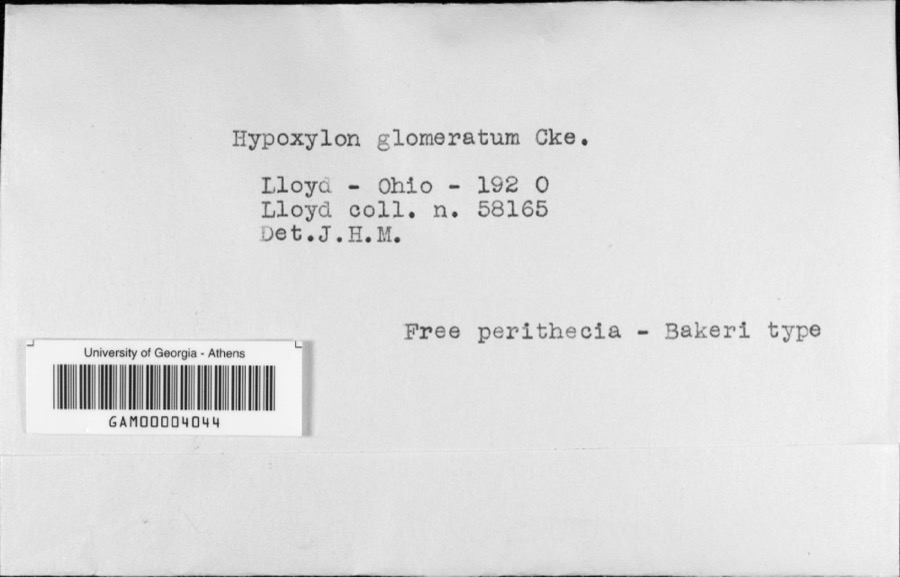
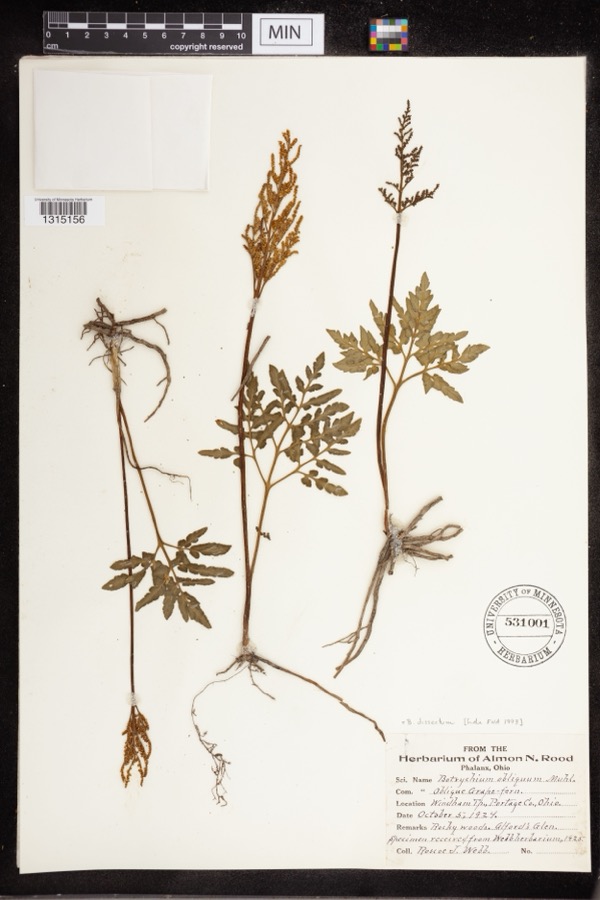
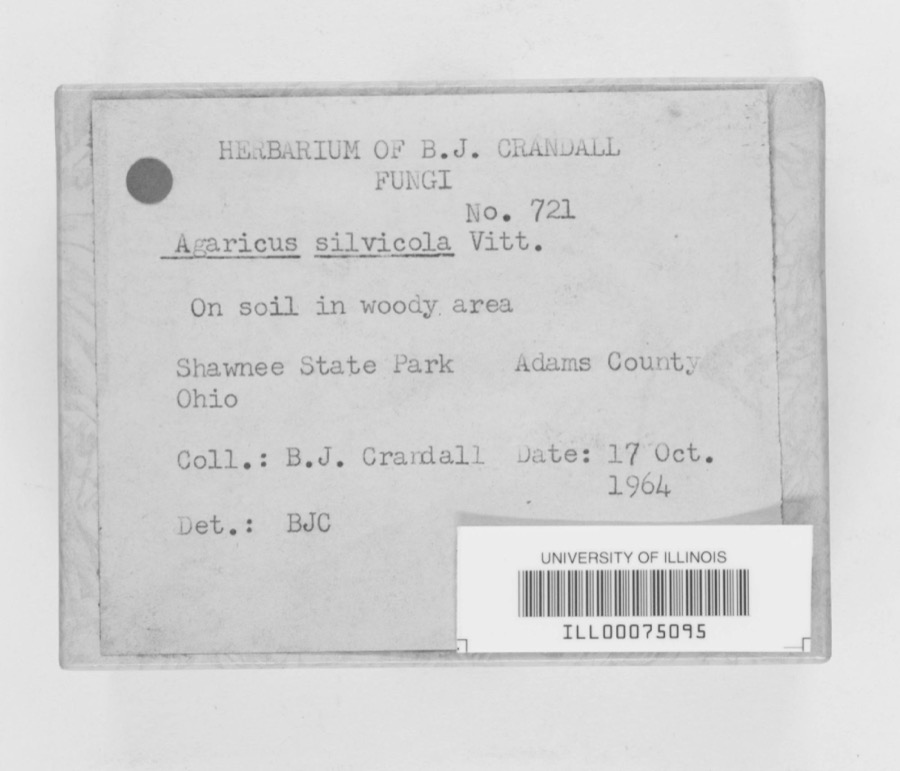
evidence. Museums hold 274 specimens
collected within 10 miles of Palmyra Center Hotel between 1880 and
1975: 231 Animalia, 33 Plantae, 10 Fungi. 12 distinct Species records are shown.
Collected by A. D. Huryn, A. F. Clewell, Andre F. Clewell and others. Each is a
physical object with a catalogue
number, and each entry opens the museum's record. This is what was
collected and kept, not a survey of what lives here - nothing can be
concluded from a species being absent.
Regional context, not property-specific
evidence. The federal mineral resources record lists
1 working within 5 miles of Palmyra Center Hotel: 1 producer.
All of them still produce. What was taken out: Sand and Gravel, Construction. Distance is straight-line from the
map coordinates, so a quarry counted here may appear on a neighbouring
settlement's page as well.
Regional context, not property-specific
evidence. The National Weather Service names
Palmyra, the town this property stands in, in 4 storm reports between 1997 and 2023: 3 thunderstorm wind, 1 hail.
No death or injury is recorded in these reports. Each account below is quoted exactly as the forecast office
filed it, from the NOAA Storm Events Database, and each date
opens the federal record of that event.
No historic map-sheet match is published
for this property yet. That does not mean no map exists. This record needs
a coordinate-quality review before it can be joined to a sheet boundary.
Browse the county's mapped places while that work is
pending.
From the nomination file
1,695 words on record
When this property was proposed for the
National Register, someone wrote the case for it: what the building is,
and why it matters. That document is a federal record in the public domain.
It is quoted below word for word, never summarised. The text was read off the scanned case file by machine, so the
occasional stray character is the recogniser's and the 1970s
typewriter's.
Description of the property
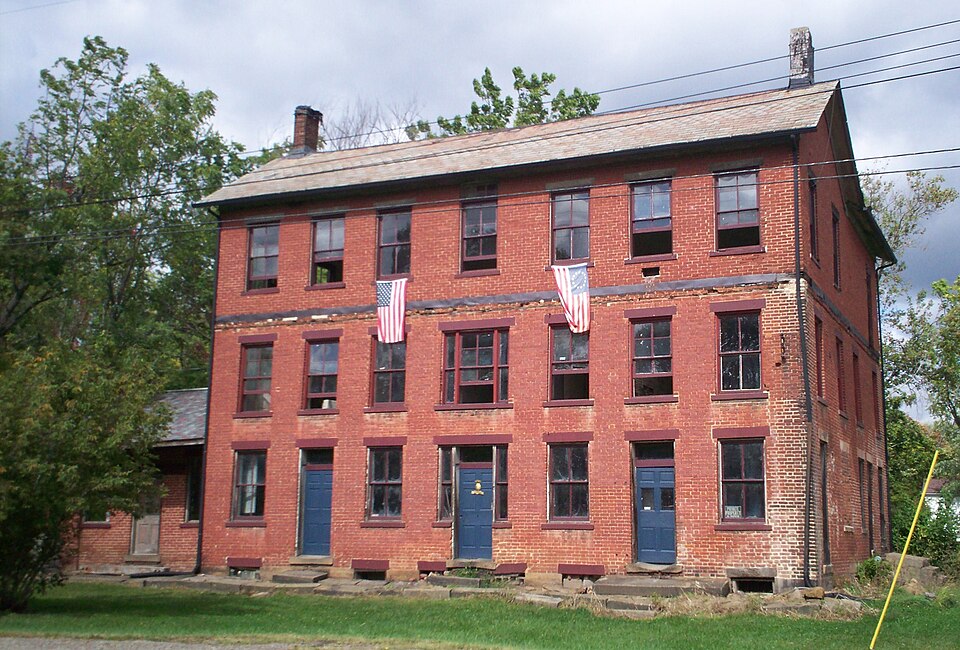
Set back, its roof forms a recessed porch. The great majority of the window sash have two-over-two panes, undoubtedly late nineteenth century replacements. Unaccountably, two windows on the east elevation roof have only a rudimentary frieze board, with neither an elaborate unoccupied, the interior is not available for inspection. CONDITION DESCRIPTION EXCELLENT DETERIORATED RUINS UNALTERED have their original twelve-over-twelve sash. CHECK ONE on the second story has the same three-part division.The east elevation brick construction, but is closed with temporary framing and siding.
sandstone foundation, sills and lintels.The long facade has seven above the second story, suggest that originally there was a full-width The third story was added fifty-six years after the original This is an L-shaped three-story building in the Greek Revival style, structure.It harmonizes exactly in construction and window treatment, first built in 1832.The walls are of common brick construction, with The center entrance has sidelights and transom, and the center window Foundation stones in front of the building.plus mortise notches except that the center window is a single unit.
The eaves of the gable The explanation of this is not known.As the.bullding is presently XORIGINAL SITE or "ell has two original doors, one window which has been bricked in portico.The third floor on the north end of the east ell is not of cornice nor gable ornament of the period (l888). and one which has been made into a door with a concrete stoop of four _GOOD openings, which are alternating doors and windows on the ground floor. XFAIR steps. There is a short one-story shed at the west end of the main wing. DATE. AREAS OF
Statement of significance
story. Its primary significance is architectural. route. In 1885 the hotel was called the Bidlake House, the proprietors 1500-1599 1400-1499 ART INVENTION LAW THEATER ARCHEOLOGY-HISTORIC deserted. AGRICULTURE BUILDER/ARCHITECT EDUCATION PERIOD ARCHEOLOGY-PREHISTORIC POLITICS/GOVERNMENT CONSERVATION INDUSTRY MILITARY 1900- SIGNIFICANCE LITERATURE MUSIC X800-1899 _EXPLORATION/SETTLEMENT 1600-1699 _TRANSPORTATION residence and an antique store, when not standing vacant and The hotel at the northwest corner of the Center was built in was the first house built at the Center, and the first sawmill and XARCHITECTURE modified in the late nineteenth century by the addition of a third gristmill were erected in 1824 and 1828 respectively.
being Ira Bidlake and Son.In 1888 the third story was added by the _1700-1799 _COMMUNICATIONS XCOMMERCE _PHILOSOPHY increased slowly in the early years of the nineteenth century, and This is an unusual example of a simple Greek Revival inn Palmyra Township was first settled in 1799 at the time of the surveying of the Western Reserve lands.The number of settlers nearby.The road was located on a Pittsburgh to Cleveland stage the first store was established at the Center in 18l3.Not until 1820 - RELIGION 1832 by John Lewis. It is constructed of local brick manufactured building. In recent years the building has served as a private local lodge of the Knights of Pythias, who later owned the entire
Quoted from the National Register nomination
for reference 76001514, 16 pages, held by the National Archives in Record
Group 79. See the
catalogue record.
Listed places nearby
3 within 8 miles
Other National Register properties close
enough to walk or drive between, ordered by distance from this one. Both
positions come from the same geocoding pass that matched these properties
to their map sheets.
Listing record. National Park Service National Register of Historic Places, listed-properties dataset, current to 2026-05-22.
Map join. Address geocoded through the United States Census geocoder, then tested against the published boundary of every sheet in the USGS Historical Topographic Map Collection.
How this page is made. Listing fields come from federal records; map-sheet coverage is a labelled coordinate-to-boundary calculation, not a source-field claim.
Specimens. Global Biodiversity Information Facility (GBIF), https://www.gbif.org/. Only records licensed CC0 or CC BY are used. Records licensed CC BY-NC are excluded because this site carries advertising. Images are checked individually and any whose licence is non-commercial, no-derivatives or unreadable is refused.
Mines and quarries. USGS Mineral Resources Data System (MRDS) https://mrdata.usgs.gov/mrds/ A work of the United States government, no copyright under 17 U.S.C. 105.
Storms. NOAA National Centers for Environmental Information, Storm Events Database https://www.ncei.noaa.gov/stormevents/ A work of the United States government, no copyright under 17 U.S.C. 105. Narratives are quoted verbatim from the National Weather Service report and are not edited or summarised.
 Block
Block