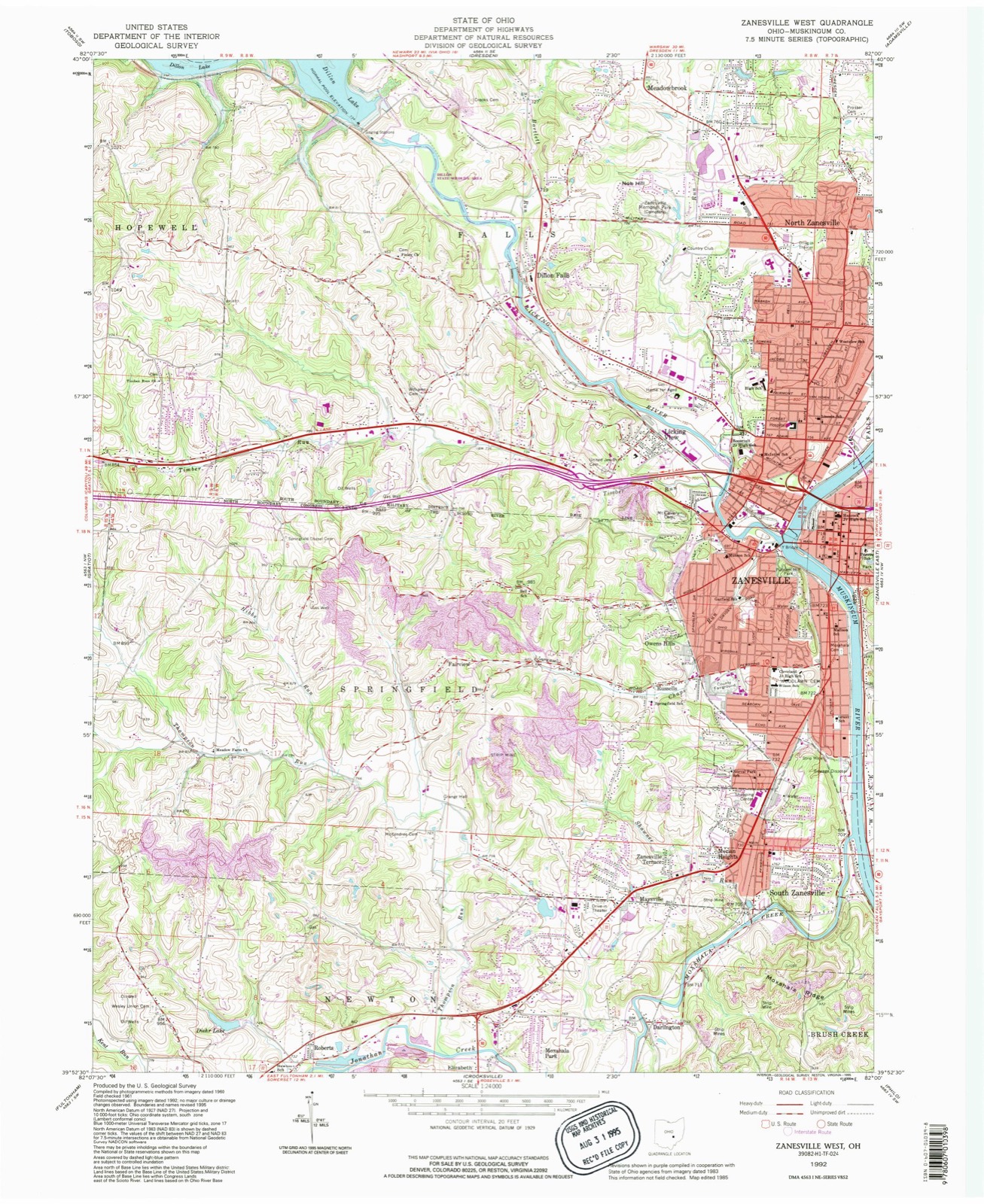
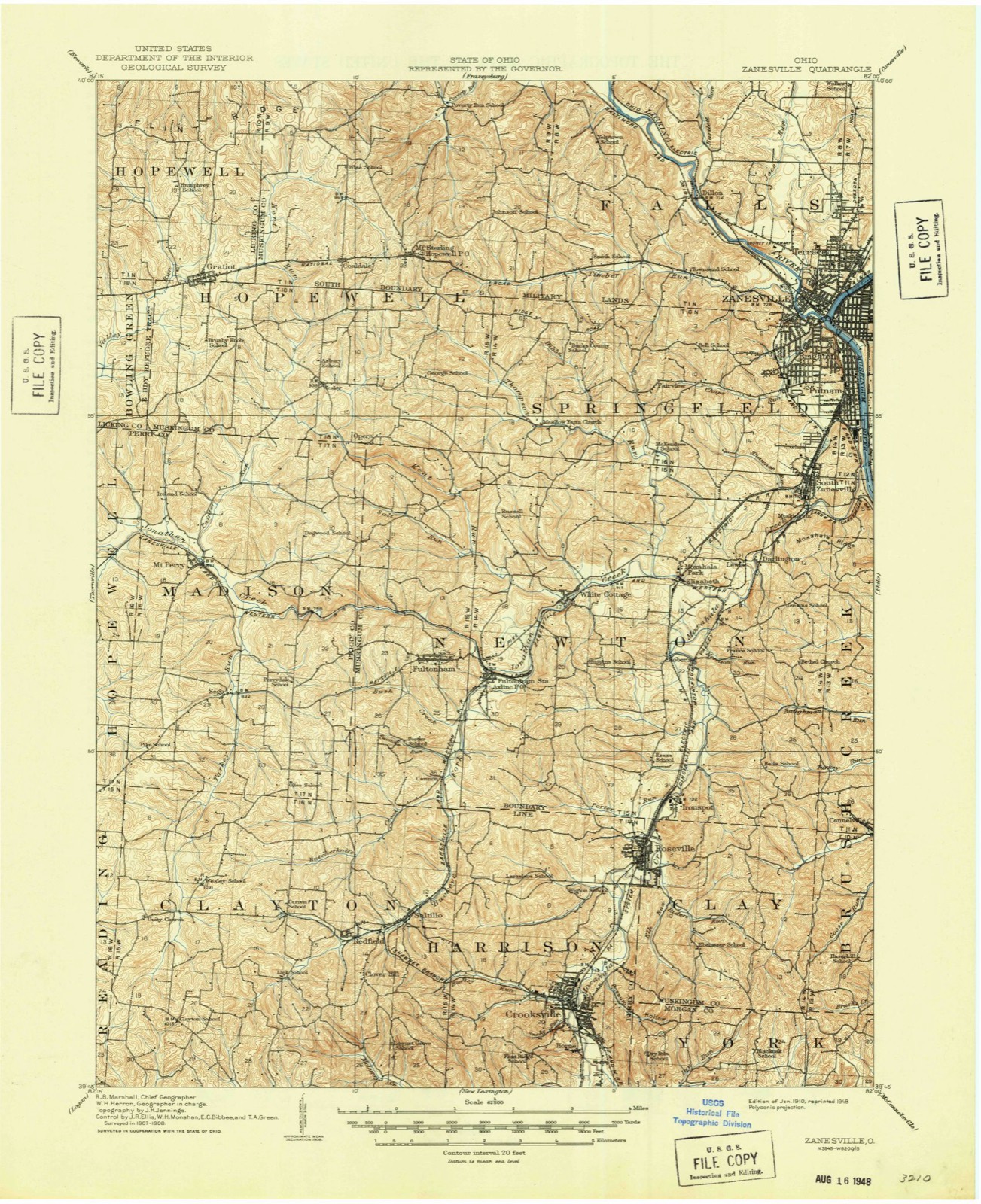
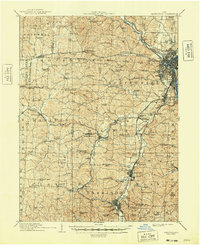
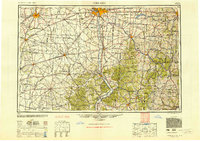
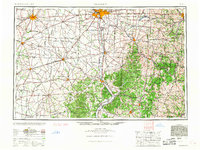
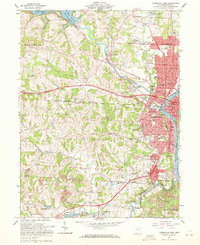
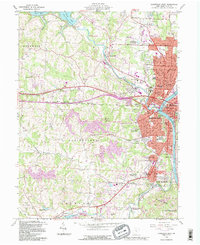
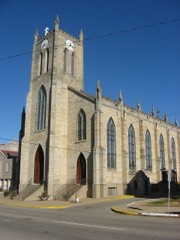
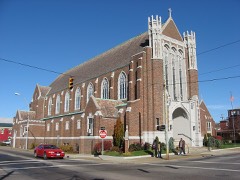
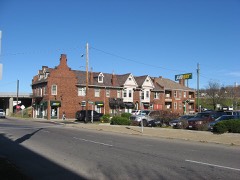
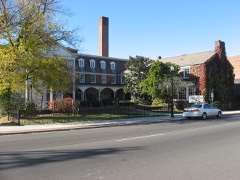
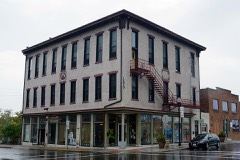
Built in 1843 (Gothic Revival). Listed on the National Register of Historic Places in 1978. 8 historic topographic surveys show this location, the earliest from 1910.
From the record
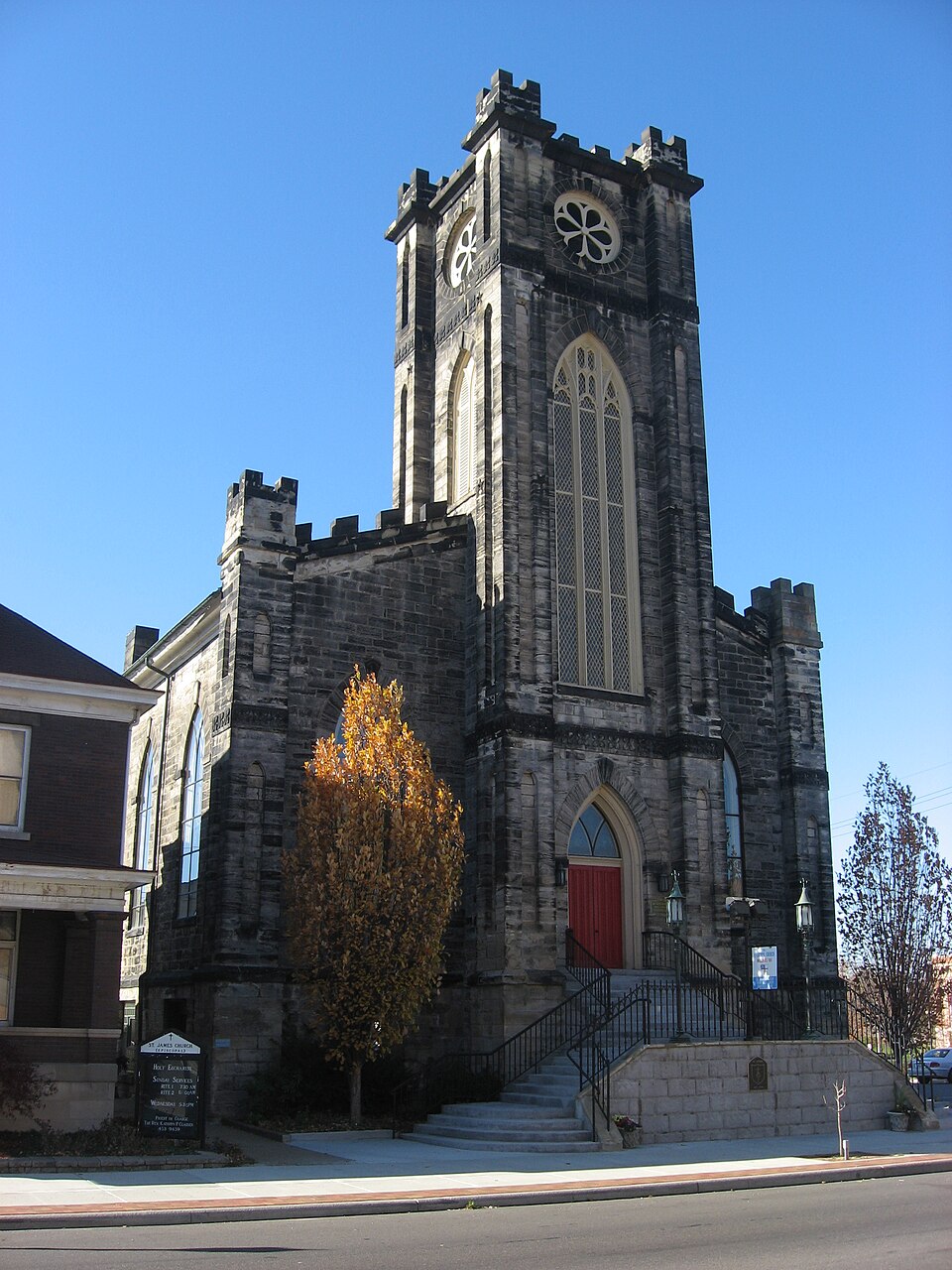
“James Episcopal Church is a historic church at 155 N. 6th Street in Zanesville, in the U.S. state of Ohio. It is a congregation of the Episcopal Diocese of Southern Ohio.”
Wikipedia article St. James Episcopal Church (Zanesville, Ohio), CC BY-SA 4.0.
One of 81 National Register listings published here for Muskingum County · listed in 1978 · category: Building · built in 1843, Gothic Revival.
National Register reference number.78002167- the number the National Park Service assigned this property when it was listed, and the key its nomination file is catalogued under at the National Archives.
Then and now
1910 to 1992
The ground this property stands on, surveyed
82 years apart. Drag the handle to wipe between them. Both sheets are
United States Geological Survey originals; neither has been altered.
19101992
What happened here
An account from the chapter on Zanesville city. The inset identifies its exact
source book and publication year.
was so named in honor of Captain John C. Hazlett, of 2d O. V. I., and his cousin, Harry Hazlett, of the 5th U.S. Artillery, both of whom were killed during the Civil war; the post was organized June 1, 1881, with the following officers: C. C. Goddard, post commander; M. V. B. Kennedy, senior vice commander; Wilson C.
Zanesville and its immediate vicinity possess facilities for manufacturing in nearly, if not quite, all the industries requiring skilled labor, it is believed, all things considered, equal, if not superior to those of any place East or West. In every item to be taken into account in the make-up of a manufacturing city comparison is challenged. It was the remark of the late John Quincy Adams made in reference to the water power here existing, that "Zanesville was the Lowell of the West." Henry Clay, in one of his letters, after personal inspection of the water power at this point, said: "The water power furnished by the James river at Richmond makes it the best manufacturing site in the United States save that at Zanesville, Ohio." These opinions were expressed before the era of coal and railway transportation.
The manufacturing interest of Zanesville are at this time its leading attraction. It is a growing interest and is imparting to the city a permanent and solid character, and placing it among the most prosperous cities of the West. The progress made in this direction has been rapid during recent years. Old industries have been enlarged and extended, and new ones added which bid fair to become large and prosperous enterprises. This stimulus to manufacturing industry is attributed to the fact that fuel and living are so cheap, market supplies of all kinds so abundant, the facilities for shipment so superior, and the location so central and generally so advantageous. Besides a more enlightened and liberalized sentiment than heretofore existed now prevails, and there is exhibited more of a disposition to encourage productive enterprises by furnishing money at liberal rates to aid in their prosecution.
Regional context, not property-specific
evidence. The
federal wildfire occurrence database
lists 60 fires within 5 miles of St. James Episcopal Church
between 2002 and 2020, burning about 47 acres in total. None started naturally. 2 were recorded as arson.
Distance is straight-line from the map coordinates, so a fire counted
here may appear on a neighbouring settlement's page as well.
Reported cause
Fires
Debris and open burning
34
Power generation/transmission/distribution
7
Equipment and vehicle use
6
Missing data/not specified/undetermined
5
Smoking
3
Arson/incendiarism
2
Recreation and ceremony
2
Other causes
1
The most recent of
them, most recent first, with the day each was reported and the service
that recorded it.
Regional context, not property-specific
evidence. Museums hold 858 specimens
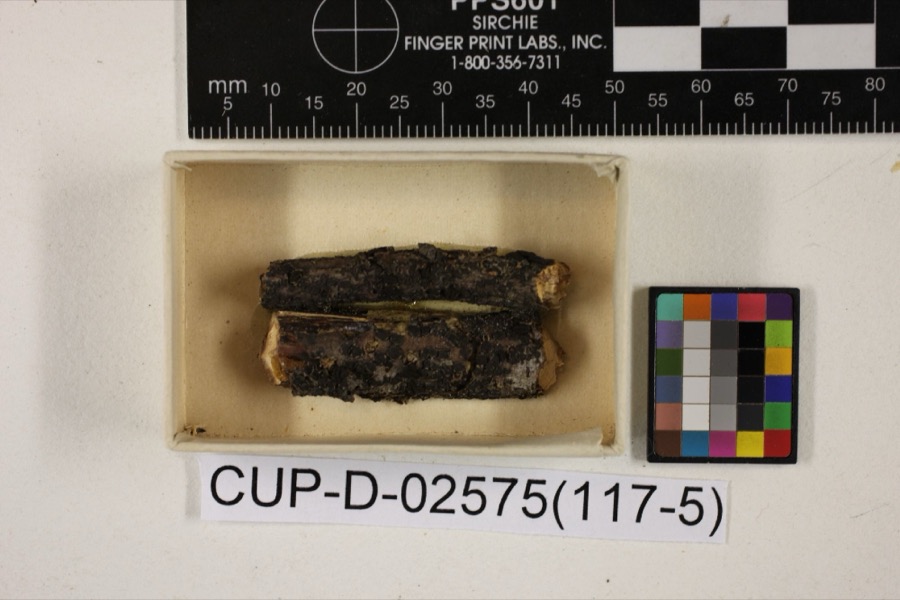
collected within 10 miles of St. James Episcopal Church between 1873 and 1975: 737 Animalia, 96 Plantae, 15 Fungi, 5 Protozoa, 4 Unrecorded, 1 Chromista.
12 distinct Species records are shown.
Collected by A.E. Miller, Adams, W. (William), Trautman, M. B. (Milton Bernard) et al., Adams, W. M. and others. Each is a
physical object with a catalogue
number, and each entry opens the museum's record. This is what was
collected and kept, not a survey of what lives here - nothing can be
concluded from a species being absent.
Regional context, not property-specific
evidence. The federal mineral resources record lists
8 workings within 5 miles of St. James Episcopal Church: 5 producers, 3 past producers.
5 still produce. What was taken out: Sand and Gravel, Construction, Iron. Distance is straight-line from the
map coordinates, so a quarry counted here may appear on a neighbouring
settlement's page as well.
Regional context, not property-specific
evidence. The National Weather Service names
Zanesville, the town this property stands in, in 113 storm reports between 1994 and 2026: 62 thunderstorm wind, 26 hail, 17 flash flood, 5 flood.
The reports record 1 death. Each account below is quoted exactly as the forecast office
filed it, from the NOAA Storm Events Database, and each date
opens the federal record of that event.
Thunderstorm winds blew down four power poles and power lines just north of Zanesville. Several trees were also reported down across the eastern part of the county.
Street flooding was reported in and near Zanesville after 1.30 inches fell in 20 minutes. Large branches were downed east of Zanesville. One branch fell on a passing motorist's car. There was no mention of any injuries.
United States Geological Survey topographic
sheets whose coverage includes this point. Matched by taking the coordinate the National Park Service records for this property, then
testing that coordinate against the published boundary of every sheet.
When this property was proposed for the
National Register, someone wrote the case for it: what the building is,
and why it matters. That document is a federal record in the public domain.
It is quoted below word for word, never summarised. The text was read off the scanned case file by machine, so the
occasional stray character is the recogniser's and the 1970s
typewriter's.
Description of the property
that of the walls of the building, and rises to a height of about ten feet and on each plane of the tower, is located a multifoil. The tower is capped with During St. James' long life various alterations have been made to the damage to the nave, amounting to more than $23,000 in repair costs, including St. James' Church faces east on North Sixth Street, about two blocks north residential-type buildings, in an area of the city that is changing from a CONDITION outbuildings. UNALTERED UNEXPOSED DETERIORATED XALTERED FAIR CHECK ONE St.James' Episcopal Church is constructed of smooth-dressed sandstone. replacement of the original transparent colored glass windows with stained glass.
above the ground.There is a beveled stone water table.The church isa This is a trabeated door with the remaining void filled by a three-panel stained- north and south sides of the church feature five bays with lancet windows of glass windows.Flanking the main entrance are two lancet windows set in the north three-bay edifice, with the center bay (which projects about four feet) featur- misceallaneous plaster work and the replacement of the pews.A brick addition rise only slightly above the level of the roof and which terminate in 4-merlon Also at this time the present front retaining wall and stairs were added.The church's stained glass constructed ina manner similar to those on the east front of The material used in the laying of the foundation is cut somewhat larger than X.EXCELLENT course of stone paterae across the entire facade of the church and tower.The on each side of the tower.Above the belfry just below the top of the tower has been made to the rear (west) of the church.
-RUINS -GOOD and south bays of the facade. These are set on plain lug sills and capped with church.
gregation was apparently comparatively affluent, and as a result was able to 1853. As far as can be determined, the total cost of the building was about $20,000. St. James' Church is the second oldest church building still standing in Muskingum County, and remains an outstanding example of Gothic Revival ecclesiastical In addition to its architectural significance, St. James' Church is also notable Charles P. McIlvane, D.D. began his tenure as Bishop of Ohio by preaching in this 1859 and 1875, respectively. Daniel Convers, one of the founders of Zanesville, was a member of this church, as was Moses M. Granger, long-time lawyer and local the most outstanding contributors to St. James' Church was the family of William D.
Schlutz, whose father founded the Shultz Soap Company and built and operated various items which continue in use today, and in 1935 his lavish home on Putnam but also as an irreplacable segment of Zanesville's, Muskingum County's, and 1400-1499 1700-1799 1600-1699 COMMERCE ENGINEERING ARCHEOLOGY-HISTORIC THEATER EDUCATION ART PERIOD CONSERVATION XEXPLORATION/SETTLEMENT PREHISTORIC TRANSPORTATION XARCHITECTURE SIGNIFICANCE MILITARY LITERATURE _POLITICS/GOVERNMENT ARCHEOLOGY-PREHISTORIC southeastern Ohio's architectural heritage. _SOCIAL/HUMANITARIAN architecture in the midwest. milestones in Episcopal history in this part of the state.In 1838 the Rt. Rev. _COMMUNICATIONS St.James Parish is the oldest Episcopal congregation in southeastern Ohio, use today as the parish's rectory.
Quoted from the National Register nomination
for reference 78002167, 9 pages, held by the National Archives in Record
Group 79. See the
catalogue record.
Listed places nearby
6 within 8 miles
Other National Register properties close
enough to walk or drive between, ordered by distance from this one. Both
positions come from the same geocoding pass that matched these properties
to their map sheets.
Listing record. National Park Service National Register of Historic Places, listed-properties dataset, current to 2026-05-22.
Map join. Address geocoded through the United States Census geocoder, then tested against the published boundary of every sheet in the USGS Historical Topographic Map Collection.
How this page is made. Listing fields come from federal records; map-sheet coverage is a labelled coordinate-to-boundary calculation, not a source-field claim.
Wildfire. Short, Karen C. 2022. Spatial wildfire occurrence data for the United States, 1992-2020 [FPA_FOD_20221014]. 6th Edition. Fort Collins, CO: Forest Service Research Data Archive. https://doi.org/10.2737/RDS-2013-0009.6 Collected with United States Government funding and usable without additional permissions or fees.
Specimens. Global Biodiversity Information Facility (GBIF), https://www.gbif.org/. Only records licensed CC0 or CC BY are used. Records licensed CC BY-NC are excluded because this site carries advertising. Images are checked individually and any whose licence is non-commercial, no-derivatives or unreadable is refused.
Mines and quarries. USGS Mineral Resources Data System (MRDS) https://mrdata.usgs.gov/mrds/ A work of the United States government, no copyright under 17 U.S.C. 105.
Storms. NOAA National Centers for Environmental Information, Storm Events Database https://www.ncei.noaa.gov/stormevents/ A work of the United States government, no copyright under 17 U.S.C. 105. Narratives are quoted verbatim from the National Weather Service report and are not edited or summarised.
 Block