 Block
Paradise, Illinois
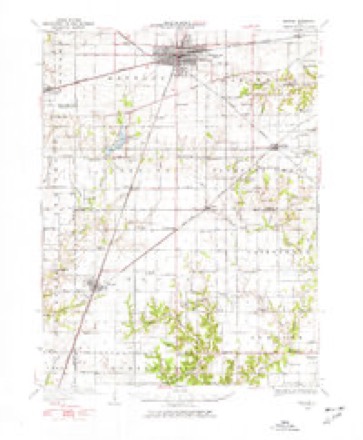
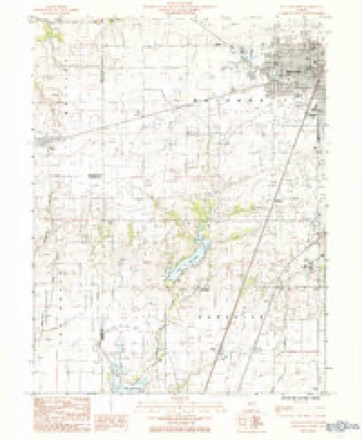
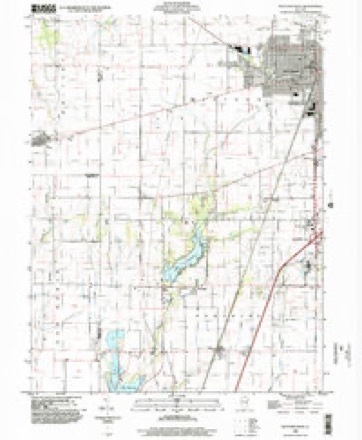
14 topographic sheets cover this place, the earliest surveyed in 1934 and the latest in 1998. It stands in Paradise Township. It lies in ZIP code area 61938. The Survey maps it on the Mattoon West quadrangle. It stands 676 feet above sea level.
Topographic sheets covering this place
7 surveys from 14 printed sheetsMatched by testing this settlement's coordinate against the published boundary of every sheet in the United States Geological Survey's historical collection. Each opens the scanned sheet at the Survey.
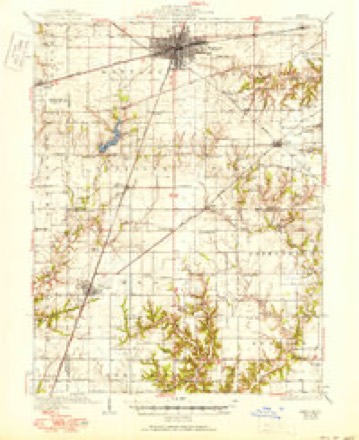
- 1934 USGS Mattoon quadrangle1:62500, 2 printings
- 1937 USGS Mattoon quadrangle1:62500, 3 printings
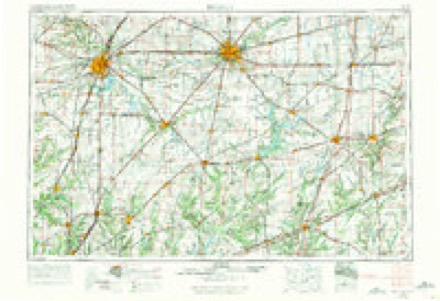
- 1958 USGS Decatur quadrangle1:250000, 3 printings
- 1961 USGS Decatur quadrangle1:250000, 2 printings
- 1984 USGS Mattoon West quadrangle1:24000
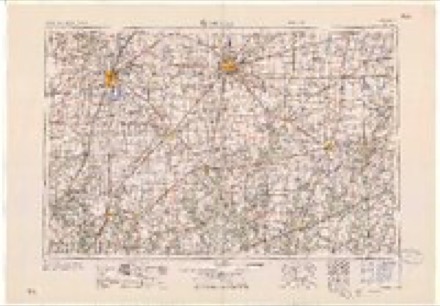
- 1986 USGS Effingham quadrangle1:100000, 2 printings
- 1998 USGS Mattoon West quadrangle1:24000
In the county-history sources
11,660 words on this townshipThe History of Coles County, Illinois ... Map of Coles County; History of Illinois ... History of Northwest ... Constitution of the United States, Miscellaneous Matters, &c., &c, published 1879 names this settlement in its chapter on Paradise Township. These are the passages that mention it, exactly as the scans read.
This township is situated in the extreme southwest corner of the county, and is bounded on the north by Mattoon Township ; east, by Pleasant Grove Township ; south, by Cumberland County, and west, by Shelby County. In its primitive state, before the timber and underbrush were cleared away, for the earliest-made farms, three-fourths of iis surface were woodland to one-fourth prairie. Its surface is for the most part rolling, and easily admits of drainage. The Little Wabash, a stream rising a little south of the center of Mattoon Township, flows in a southern direction through the western half of the township, and, with its tributaries, effectually drains the central and western portions. Dry Grove Run, a small stream rising in the northeast corner of the township, and flowing south through a belt of timber of the same name, affords drainage for the eastern half. The extreme eastern and western portions are prairie, while the timber is found lining either side of the Little Wabash. There is, however, a small belt of timber in the eastern portion called Dry Grove, the average width of which does not exceed one-half mile, and its length not more than two miles and a half. How it acquired its name, Dry Grove, we have not been able to determine. The soil, for the most part, is of a deep-black cast, very rich, and prodvices well. The soil of the woodland, in the eastern portion, reduced to a state of cultivation, exceeds in richness and fertility even the adjacent prairie. Like the surrounding townships, it is well adapted to the growth of the various cereals, but corn is the staple product. The western portion produces fine wheat, and, for the past few years, quite an amount has been sown. Taking it one season with another, those possessing woodland farms are much surer of a good crop, than those upon the prairie, as the soil is generally more rolling, and of such a character as to withstand either a wet or dry season better. Much valuable timber has been removed from her groves, since the days of the early pioneers, and still there is much remaining. In different parts may be seen large tracts of woodland, from which the underbrush has been removed, well set in blue grass, which yields excellent pasturage. The Chicago Branch of the Illinois Central Railroad enters the township at the northeast corner of Section 3 and passing through in a general southwestern direction, leaves it at or near the center of the southern boundary of Section 21. The Grayville & Mattoon Railroad just touches the northeast corner of the township. Paradise contains no cities or towns, and but two small villages. Paradise and Etna, neither of which is incorporated. Of these, we will speak more specifically at the close of the township history. To offer, as a complete history of this section of the county, only what may be truthfully written of the township since reduced to her present limits, would be an act of great injustice to the descendants of her pioneers ; and yet, the early history and settlement are so intimately blended with that of the surrounding townships that to separate them with any degree of accuracy will be a task attended with no little labor and diflficulty. Soon after the formation of Coles County, the territory comprising it was divided into three voting precincts, Charleston, Woodbury and Paradise. Paradise, at that time, included in addition to its present limitsall the territory now embraced in Mattoon and Pleasant Grove Townships, a portion of North Okaw and a large scope of country in the present limits of Cumberland County. Thus we find that the name Paradise, as applied to a portion of the county, was almost cotemporary with the formation of the county itself. At a later date, we find it became necessary, in order to retain it, to submit it to a vote of the citizens. In the division of the county into townships. Paradise was made a full Congressional township ; but a few years later, when Cumberland County was erected, she was shorn of her two southern tiers of sections ; this gave her her present limits, four miles north and south by six east and west. When the question of naming the township came before the people, two parties appeared in the field. The one, led by H. B. Worley, proposed the name Wabash, while the other, headed by Aaron W. Hart, adhered to the ancient landmark, and voted for Paradise. Hart and his friends carried the day. It is said by some, that as the village of Etna was just then starting up, and Worley was largely interested in her welfare, he designed, if the name Wabash carried, to go before the Commissioners, and, through his personal influence, secure a change from Wabash to Etna. A decided majority in favor of Paradise put a quietus on all further proceedings in the matter of name.
Passage source: The History of Coles County, Illinois ... Map of Coles County; History of Illinois ... History of Northwest ... Constitution of the United States, Miscellaneous Matters, &c., &c, published 1879.
No little difficulty has been experienced in the attempt made to determine when, where and by whom the first settlement was made in the township. The statements of the oldest citizens of the present day are very much at variance on this point. The claims of one Daniel Drake seem to be more fully established than those of any other, and perhaps to him may be justly accorded the honor of building the first cabin and making the first improvement in what is now Paradise Township. Thomas Hart, son of Miles H. Hart, still resides in the village of Paradise, and from him we have gained the following statement of facts: In the fall of 1826, the Hart families came from Hardin County, Ky., to Wayne County, 111., with a view to settling there. Silas Hart had settled in Wayne County as early as 1822. Disappointed in their expectations, the Harts determined to prospect the country further north, with the avowed intention of returning to Kentucky should they fail in their attempts to find a desirable location. In the winter of 1826-27, Miles H., Moses and Thomas Hart, Jr., left Wayne County and came north. On reaching that portion of the Little Wabash timber now included in Paradise Township, they determined to locate. Moses and Thomas, both single men, remained, and, during the winter, constructed a cabin, near the site of the present residence of W. B. Ferguson, on what is now known as the Cunningham farm. Miles H. returned to his family in Wayne County, and, in March, 1827, Uncle Tommy and wife. Miles H. and family, came and occupied the cabin erected by Moses and Thomas. Soon after coming, they found, about four miles west of them, on the bank of the Little Wabash, about one mile south of the site of the present village of Paradise, Daniel Drake, from Tennessee, and from the appearance of his improvements, Mr. Thomas Hart is of the opinion that he must have come as early as the fall of 1825 or the spring of 1826. Settlements were made, no doubt, at an earlier date on the South Kickapoo, in what is now Pleasant Grove Township, east of the Hart settlement ; but the evidence is pretty conclusive that Drake was the first man to make an improvement in Paradise Township. It is maintained by some that one Thomas Wilmuth, a sort of second-rate shoemaker, had built and occupied a cabin or half-faced camp east of the Hart settlement, and prior to their coming, in March, 1827, and that he made the first settlement in the township. His claims, however, seem not to be so well authenticated as those of Drake. In June, 1827, Charles Sawyer, who is recorded as the first settler of Mattoon Township, stopped a few days at the Hart settlement, and then moved north and west to his place of settlement. The settlers of 1827 were Daniel Drake, Uncle Tommy Hart and his sons Miles H., Moses and Thomas. There may, indeed, have been two or three other families, but, if so, their names have been lost or are incorporated with those of a later date. In February, 1828,
Passage source: The History of Coles County, Illinois ... Map of Coles County; History of Illinois ... History of Northwest ... Constitution of the United States, Miscellaneous Matters, &c., &c, published 1879.
The people of to-day living in comfortable homes, equipped with the many improvements and inventions of modern times and beautified and adorned by art, have but faint conceptions of the difficulties and privations endured by the early settlers of this Western country. Most of them were men of large families, and poor in this world's goods ; but they were men of stout hearts and willing hands, and, leaving the older-settled portions, came here in the fond hope of bettering their condition. The first care of the early settler, on arriving at the end of his wearisome journey, was to provide for himself and family a suitable shelter from the bleak winds and pelting storms. Their homes, as a a matter of course, were of rude construction, but, by certain appliances well known to the pioneer, they were made very comfortable, and to-day many an old pioneer recounts as among the happiest days of his life those spent beneath the clapboard roof of his little old log-cabin. The homes of the early settlers presented to the eye much the same appearance both internally and externally ; their chief difference consisted in size, most of them being single, while a few were built double. As the manner of constructing them has been accurately portrayed in other portions of this work, we deem it unnecessary to particularize. A house provided, next came the necessity of laying in supplies for man and beast. Game of all kinds abound on every hand. Deer, turkeys, rabbits, squirrels, quails and such like, were here in plenteous profusion. The faithful dog and the unerring rifle seldom fail to bring the fat buck and plump, rich turkey to the cabin-door. Meat is easily supplied, but bread, the mainstay of life, is not so readily obtained. Corn is far away in the older settlements and must be brought by that fast express of early times, the ox-team. And when at hand, often the settler must make a pilgrimage of twenty-five to thirty miles to mill and wait a day and night for his "turn." And, gentle reader, should you wonder why the old pioneer speaks so often of the "johnny-cake" and hoe-cake, to the utter disregard of the snowy, light bread and flaky biscuit which you so much enjoy, let me remind you that one biscuit to each member of the family on Sunday morning of each week, or, perchance, once a month, was a luxury that few families enjoyed. Around the rude table, often consisting of a goodsbox turned on its side, loaded with venison or fat turkey, with his johnny-cake, smoking-hot from the board, and that added luxury, wild honey, obtained from the bee-trees near his cabin, the pioneer, with his family, sat down and fared sumptuously every day. Generally speaking, the pioneers were men of simple habits, noted for their hospitality. They knew how to receive and bestow a favor. In this age of cultivation and refinement, they would, doubtless, be regarded by many as rude and uncouth ; but this was not the fact. The latch-string of their cabin-doors hung out by day, and this was a standing invitation to enter and share their comforts. Often a simple act of kindness has resulted in the establishment of a friendship between those who were strangers at the time which has remained unbroken throughout remaining life. Such an instance occurred in Paradise Township in an early day. Soon after the coming of Dr. Apperson, Silas Hart, in passing near his cabin, concluded to call and form the acquaintance of the new-comers. Riding up to the cabin, he discovered Mrs. Apperson weeping and in great distress. Exchanging the usual salutations with the Doctor, Hart inquired, " How are you prospering, and how do you like your new home?" The Doctor replied that he was well pleased, but that his wife was fearful that starvation would overtake them, as their only supply was a small amount of meal. Without a word of encouragement or sympathy. Hart turned about his horse and rode away. In speaking of this in after years, Dr. Apperson often remarked that, at that time, he looked upon Hart as a man in whose soul there was no sympathy. Hart had not been long gone when the clear, ringing report of his trusty rifle resounded through the woods. He had sighted a fine, fat doe, and the game was his. Hastily removing the entrails, he placed the deer on his horse, in front of his saddle, and, in half an hour from the time of his departure, he again rode up to the Doctor's cabin, and, tumbling oflf his load, quietly rode away, leaving the Doctor in full possession. From this simple act, there grew up a firm friendship between these two men which remained unbroken for almost half a century. Dr. Apperson was Hart's family physician as long as he lived, and for all his services he would never receive one cent of compensation.
Passage source: The History of Coles County, Illinois ... Map of Coles County; History of Illinois ... History of Northwest ... Constitution of the United States, Miscellaneous Matters, &c., &c, published 1879.
Machine-read from a century-old scan, so expect the errors a machine makes: misspelled names, dropped words, stray characters.
Read the whole chapter on Paradise Township - it names this place 31 more 31 times.
Fires near this place
2 since 2011Regional context, not property-specific evidence. The federal wildfire occurrence database lists 2 fires within 5 miles of Paradise between 2011 and 2018, burning about 1 acre in total. None started naturally. None was recorded as arson. Distance is straight-line from the map coordinates, so a fire counted here may appear on a neighbouring settlement's page as well.
| Reported cause | Fires |
|---|---|
| Missing data/not specified/undetermined | 2 |
The most recent of them, most recent first, with the day each was reported and the service that recorded it.
| Date | Cause | Size | Reported by | Name on the report |
|---|---|---|---|---|
| 22 March 2011 | Missing data/not specified/undetermined | under an acre | Illinois Division of Forestry Resources | 1113 |
| 26 December 2018 | Missing data/not specified/undetermined | under an acre | Illinois Division of Forestry Resources | 2018-2931 |
Settlements close enough to share some of these fires:
Mines and quarries near this place
2 within 5 milesRegional context, not property-specific evidence. The federal mineral resources record lists 2 workings within 5 miles of Paradise: 1 past producer, 1 producer. 1 still produces. What was taken out: Sand and Gravel, Construction. Distance is straight-line from the map coordinates, so a quarry counted here may appear on a neighbouring settlement's page as well.
| Where | Site | Commodity | Status | Recorded |
|---|---|---|---|---|
| Diepholz Dredge | Sand and Gravel, Construction | Past Producer | ||
| Matton Sand & Gravel | Sand and Gravel, Construction | Producer |
Storms near this place
6 since 2010Regional context, not property-specific evidence. The National Weather Service names Paradise in 6 storm reports between 2010 and 2025: 3 thunderstorm wind, 2 flash flood, 1 flood. No death or injury is recorded in these reports. Each account below is quoted exactly as the forecast office filed it, from the NOAA Storm Events Database, and each date opens the federal record of that event.
| When | Event | Place named | Harm | What the report says |
|---|---|---|---|---|
| June 2010 | Thunderstorm Wind | Paradise | $15,000 | Several trees were uprooted near Lake Paradise. |
| June 2025 | Thunderstorm Wind | Paradise | - | Numerous large tree branches were blown down near Lake Paradise. |
| April 2020 | Thunderstorm Wind | Paradise | - | Several large tree branches were blown down, knocking out power. |
| June 2015 | Flash Flood | Paradise | - | Several periods of rainfall occurred as a result of the remnants of Tropical Storm Bill. Rainfall totals ranged from 3.00 to 6.00 on already saturated ground. Numerous creeks in Coles County flooded out of their banks. Extensive flooding of rural roads from Mattoon to Humboldt was reported. Parts of Illinois Route 121 and U.S. Highway 45 were also impassable. |
| June 2015 | Flood | Paradise | - | Several periods of rainfall occurred as a result of the remnants of Tropical Storm Bill. Rainfall totals ranged from 3.00 to 6.00 on already saturated ground. Numerous creeks in Coles County flooded out of their banks. Extensive flooding of rural roads from Mattoon to Humboldt was reported. Parts of Illinois Route 121 and U.S. Highway 45 were also impassable. The periods of rainfall persisted through all of June 19th and into June 20th. This caused roadways to remain flooded. The flooding subsided by the morning of June 20th. |
| July 2011 | Flash Flood | Paradise | - | Heavy rainfall amounts ranging from 4.00 to 5.00 inches were reported in a two hour period ending just after Midnight. Many rural roads were inundated, and parts of U.S. Highway 45 southwest of Mattoon were impassable. |
Nearest settlements
The eight closest, with where each one stands in the county. Distances are straight-line, computed from the Geographic Names Information System coordinates.
| Map | Place | Distance | Sheets |
|---|---|---|---|
| Etna | 1.7 miles | 14 | |
| Wabash Point | 2.4 miles | 14 | |
| Magnet | 2.9 miles | 14 | |
| Lane Acres | 5.1 miles | 14 | |
| Trilla | 5.2 miles | 14 | |
| Lipsey | 5.7 miles | 14 | |
| Mattoon | 6.1 miles | 14 | |
| Jones | 6.1 miles | 14 |
Elsewhere
Matched on this settlement's Geographic Names Information System number rather than its name, so it cannot be a different place of the same name in another state.
| Wikipedia article on Paradise | An encyclopaedic summary. Its text is share-alike, so it is linked here rather than copied. |
| Wikidata item Q14688005 | The structured record the population and elevation above come from. Public domain (CC0). |
Provenance
This settlement is recorded in the Geographic Names Information System as feature 415368. The sheet list is computed by point-in-boundary test against the United States Geological Survey's historical topographic inventory. Both are works of the United States government and carry no copyright under 17 U.S.C. 105.
Wildfire. Short, Karen C. 2022. Spatial wildfire occurrence data for the United States, 1992-2020 [FPA_FOD_20221014]. 6th Edition. Fort Collins, CO: Forest Service Research Data Archive. https://doi.org/10.2737/RDS-2013-0009.6 Collected with United States Government funding and usable without additional permissions or fees.
Mines and quarries. USGS Mineral Resources Data System (MRDS) https://mrdata.usgs.gov/mrds/ A work of the United States government, no copyright under 17 U.S.C. 105.
Storms. NOAA National Centers for Environmental Information, Storm Events Database https://www.ncei.noaa.gov/stormevents/ A work of the United States government, no copyright under 17 U.S.C. 105. Narratives are quoted verbatim from the National Weather Service report and are not edited or summarised.