This documentation was undertaken in June/July by the Massachusetts Water Resources Authority (MWRA) in accordance with a Memorandum of Agreement. Portions of the Shipyard will serve as a staging area and shipping point during construction of sewage treatment facilities on Deer Island in Boston Harbor and for other water supply and waste-treatment related activities. Preparen Virginia A. Fitch The Public Archaeology Laboratory, Inc. 387 Lonsdale Avenue Pawtucket, RI
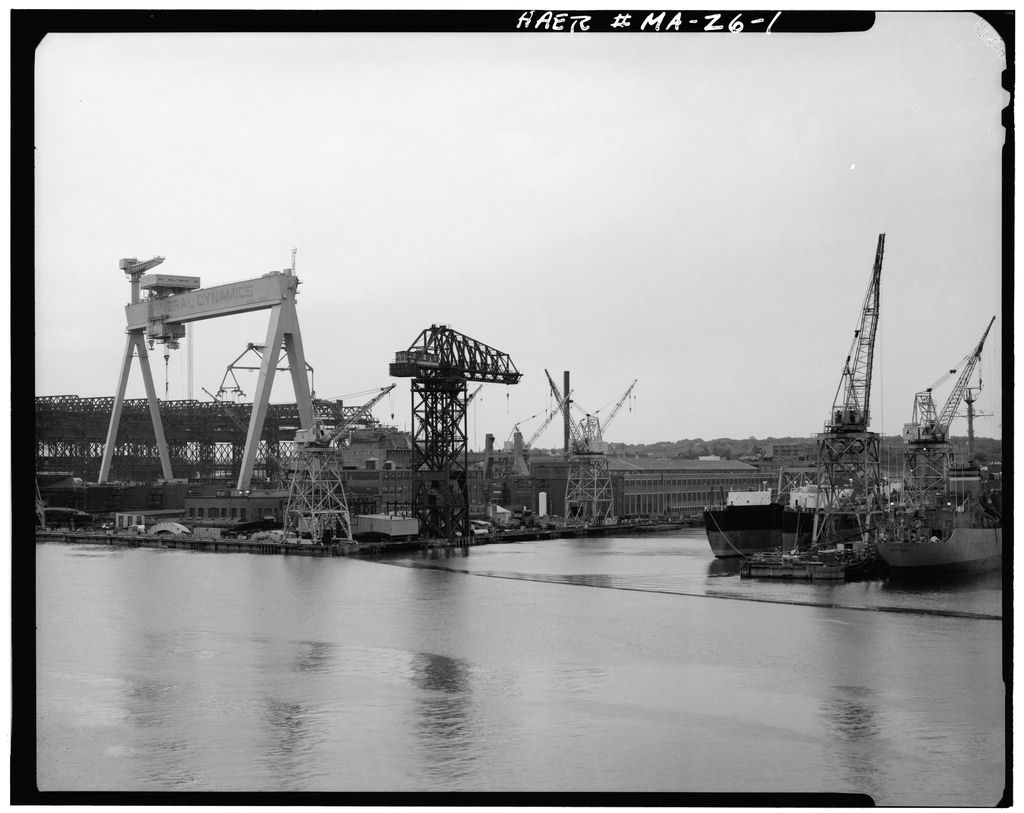
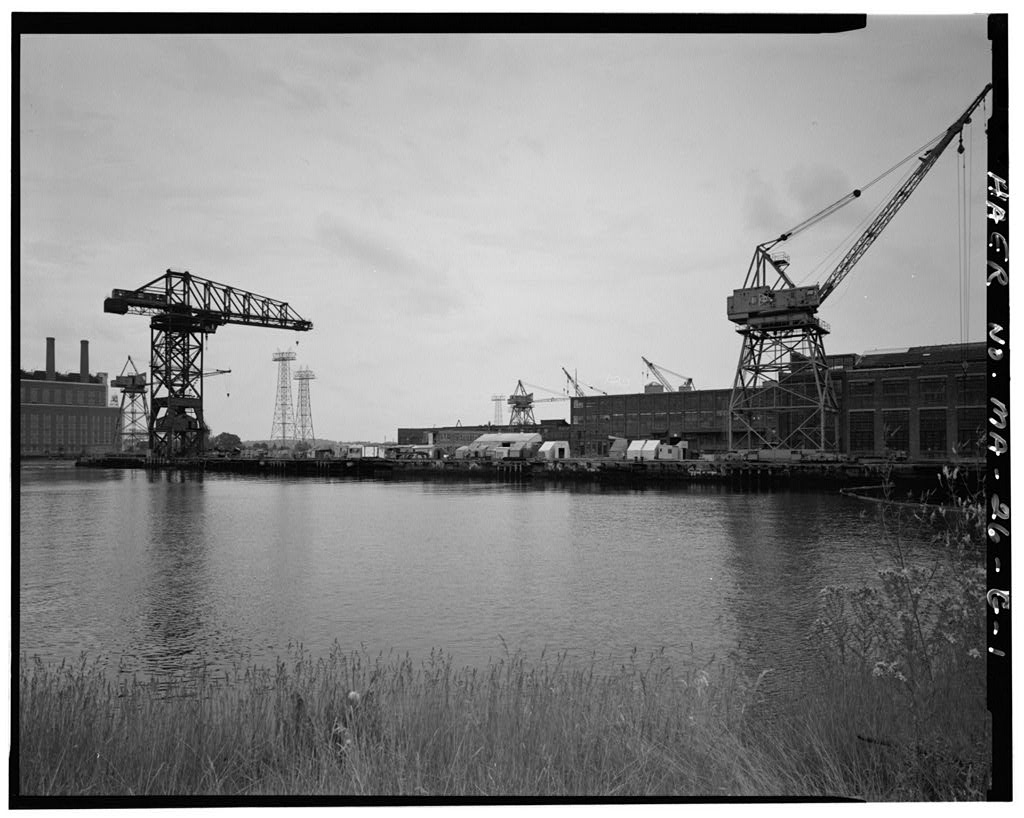
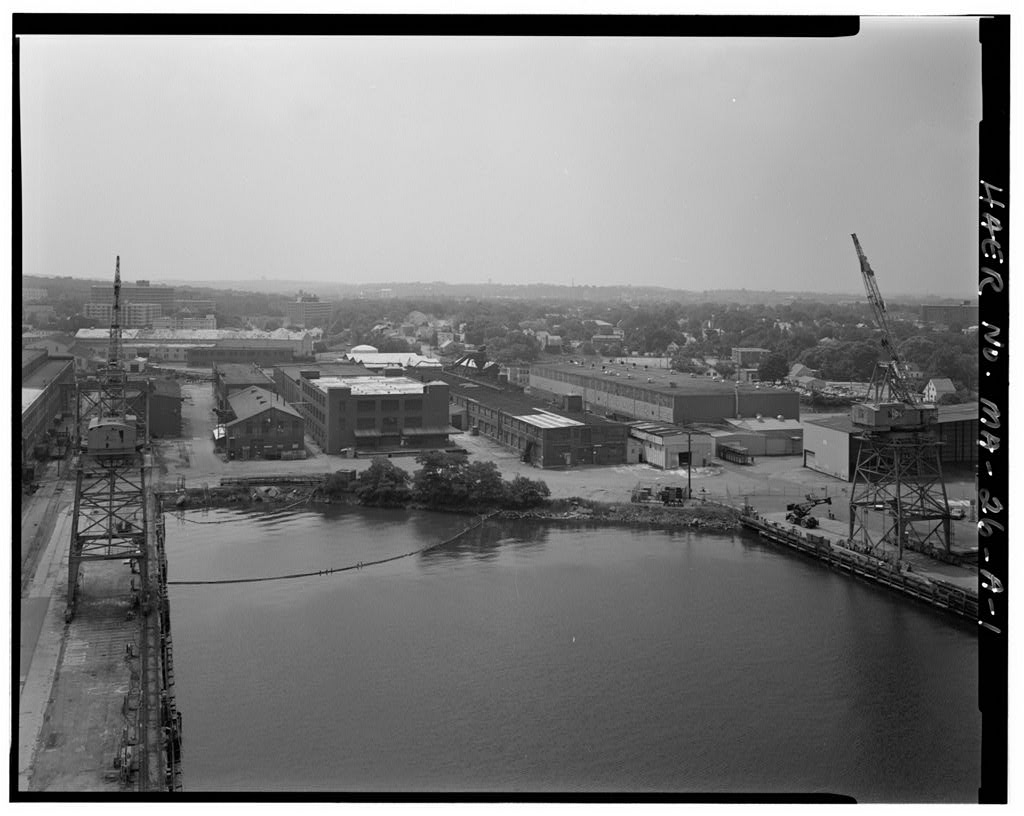
Addendum HAER No. MA-26 (PagifS) [Note: Text extracted and adapted from Boston Affiliates, Inc., Quincv-Fore River Shipyard Historic Resources Survey and Addendum (Prepared for Massachusetts Water Resources Authority, October 20, and January 2, SITE DESCRIPTION AND OPERATIONS OVERVIEW The former General Dynamics shipyard, historically known as the Quincy-Fore River shipyard, is located on the Weymouth Fore River in the cities of Quincy and Braintree, Massachusetts, southeast of Quincy center. The 183 acre site is bounded by Washington Street and the Fore River Bridge on the north, East Howard Street on the west, Quincy Avenue on the south, and the Weymouth Fore River on the east. The mailing address for the site is 97 East Howard Street, Quincy, Massachusetts.
The facility consists of a 162 acre main facility located on the Braintree-Quincy town line, four satellite lots totalling 8.5 acres located in Quincy and eight satellite parcels containing 9.5 acres in Braintree (Leggat & McCall, Appraisal Report: General Dynamics Shipyard, p. 9). There are six shipbuilding basins, five of which are dry docks and one a wet basin, ranging in length from 812 to 940 feet and in width from 120 to 150 feet (Leggat & McCall, p. In area, the six basins cover approximately square feet or acres. There are four outfitting piers in the northeast portion of the site, ranging in length from 560 feet to 880 feet and in width from 23 feet to more than 42 feet, totalling approximately square feet (Leggat & McCall, p.
A floating drydock is located to the south of the dry basins. The shipyard property has a frontage on the Weymouth Fore River of approximately feet. The 162 acre main yard site consists of approximately 84 acres of upland, 34 acres of filled land, 15 acres of land for dry docks and basins, and approximately 29 acres of water. The ship channel in the river is dredged to a depth of 35 feet to the sea. The yard is organized along traditional lines for a shipyard of its size. Management, design, and engineering offices are located near the yard's entrance, away from valuable shore frontage. Plate storage areas are located on the inland portion of the site as well, for the storage of the large steel plates used in ship construction.
Ship designs are translated from plans into exact pattern forms in the yard's spacious mold lofts, "where the lines of the hull, the shapes of the frames and other parts of the hull, are drawn out full size" (Watson, p. In the pattern ships, wood patterns are fashioned as models for the fabrication of the actual ship components. Within the massive fabrication ships, flat steel plates, support beams, and other pieces of the vessel are shaped, rolled, bent, punched and cut according to design. Some of these pieces are then pre-assembled on platens, fields of adjustable supports where angled and curved hull plates are connected. This was originally accomplished by rivets and now by welding. In the building basins, or drydocks, the keel is laid, and construction of the hull is begun.
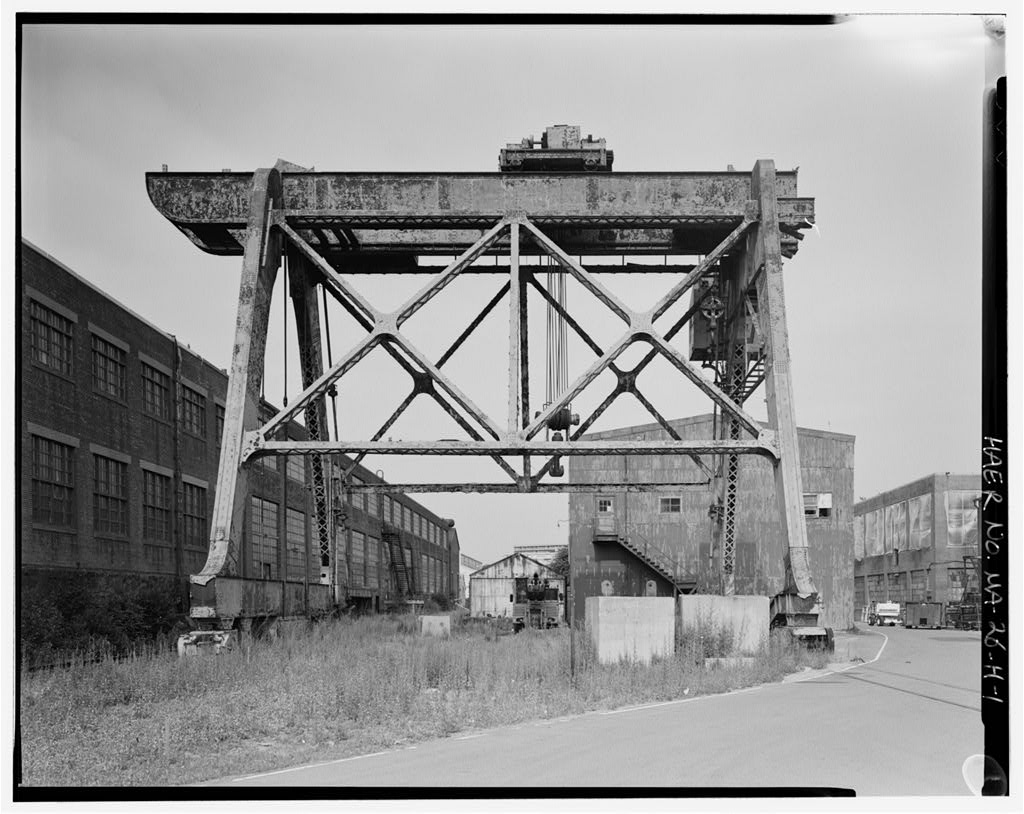
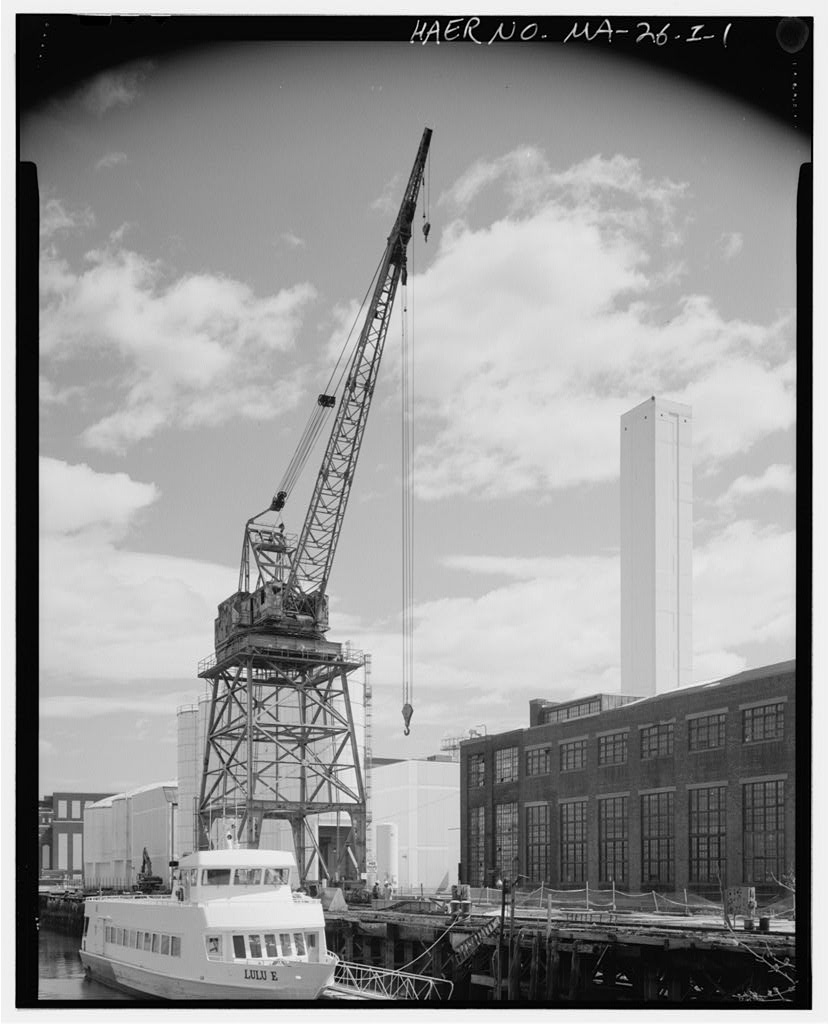
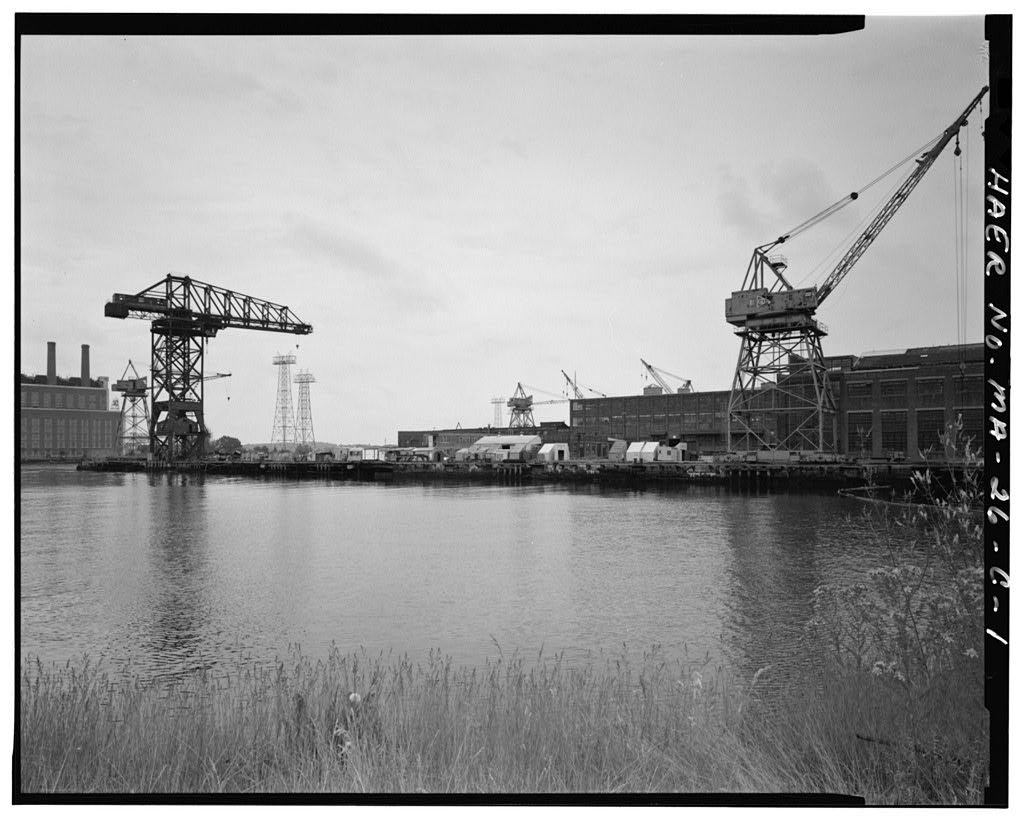
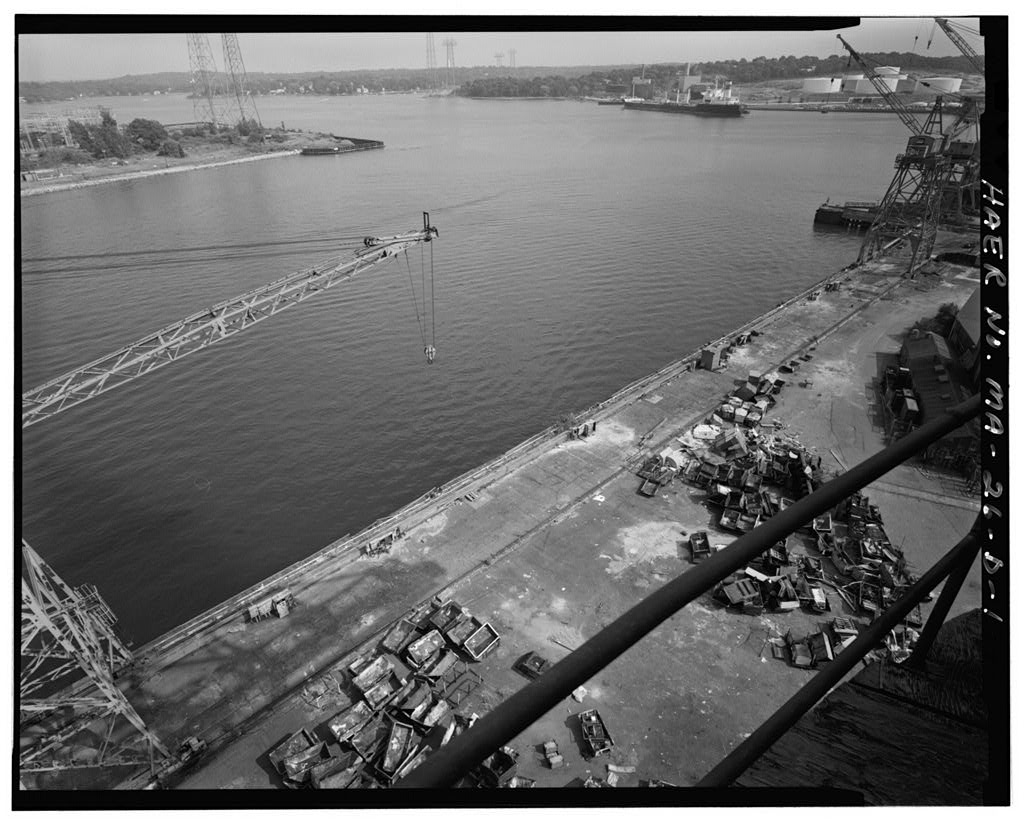
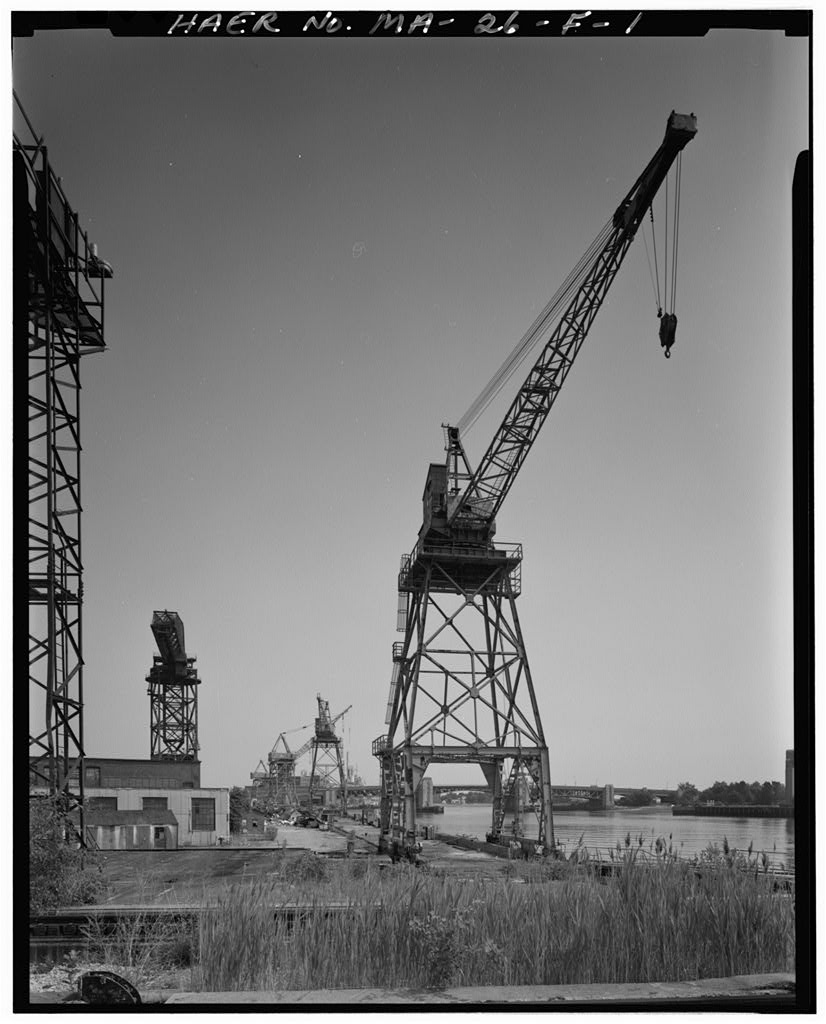
The massive steel framework structure surrounding these basins is equipped with cranes to supply ship GENERAL DYNAMICS CORPORATION SHIPYARD Addendum I1AER No. MA-26 (Page^tt components. Engines are built in the machine shops; superstructure and compartments in the sheet metal ships. Once the hull and superstructure(s) are fairly complete, the vessel is launched and placed in the outfitting pier. The outfitting pier is equipped with various cranes, so that the remainder of the construction can be completed, including the ship's internal systems and deck gear.
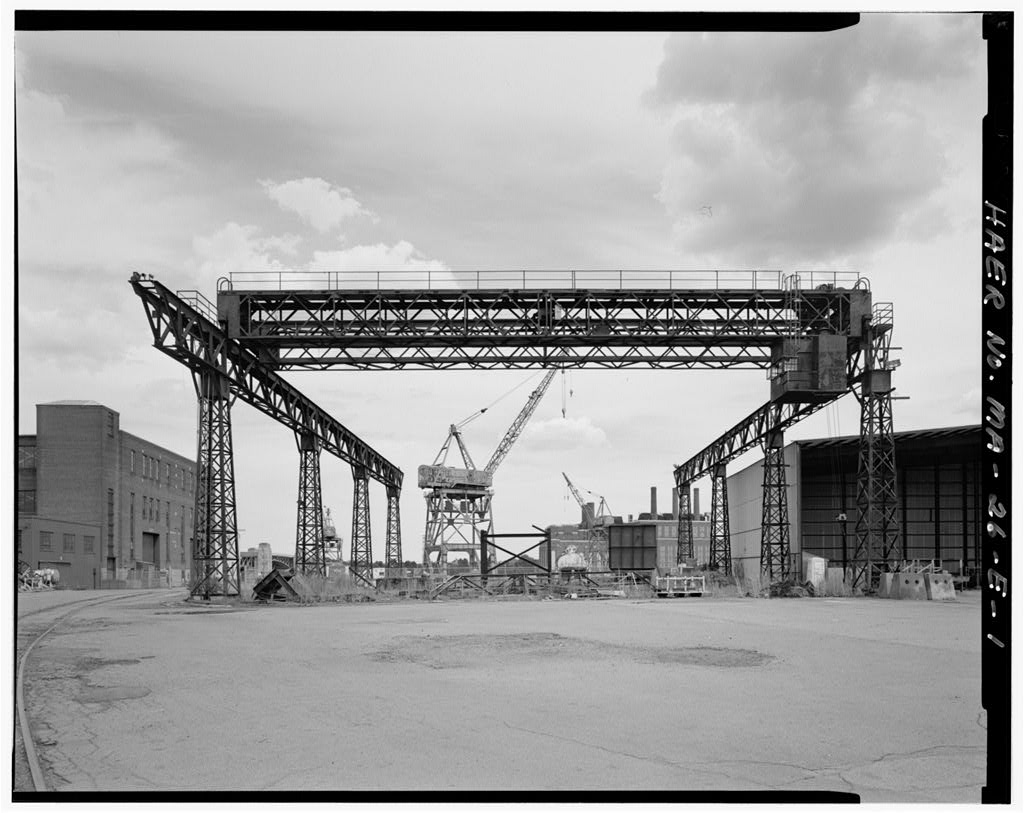
Interior details and decking are manufactured in the woodworking shop, and many other important minor departments such as annealing furnaces, galvanizing tanks, piping shops, and shot blast and paint facilities also contribute to the fitting-out process (Watson, p. There are 24 cranes serving these basins with capacities ranging from 20 to 150 tons. The Goliath gantry crane, which spans basins #6 and #7, has a capacity of tons and is the largest crane in the western hemisphere. It is a major Quincy landmark. There are 78 industrial type buildings within the shipyard, containing approximately square feet, ranging from manufacturing shops and ware houses to administrative offices, to steel sheds.
They were built between the early and the late and are generally in fair to average condition for their age, but there is physical and functional obsolescence of many of the buildings. In height, the buildings vary from 9 feet to 70 feet, and in size anywhere from square feet to square feet. The land on which the Quincy Shipyard is situated has been greatly modified since the beginning of this century. Prior to the year the central portion of the property existed as "Quincy Point," a peninsula of dry land that extended from west to east into the Weymouth Fore River.
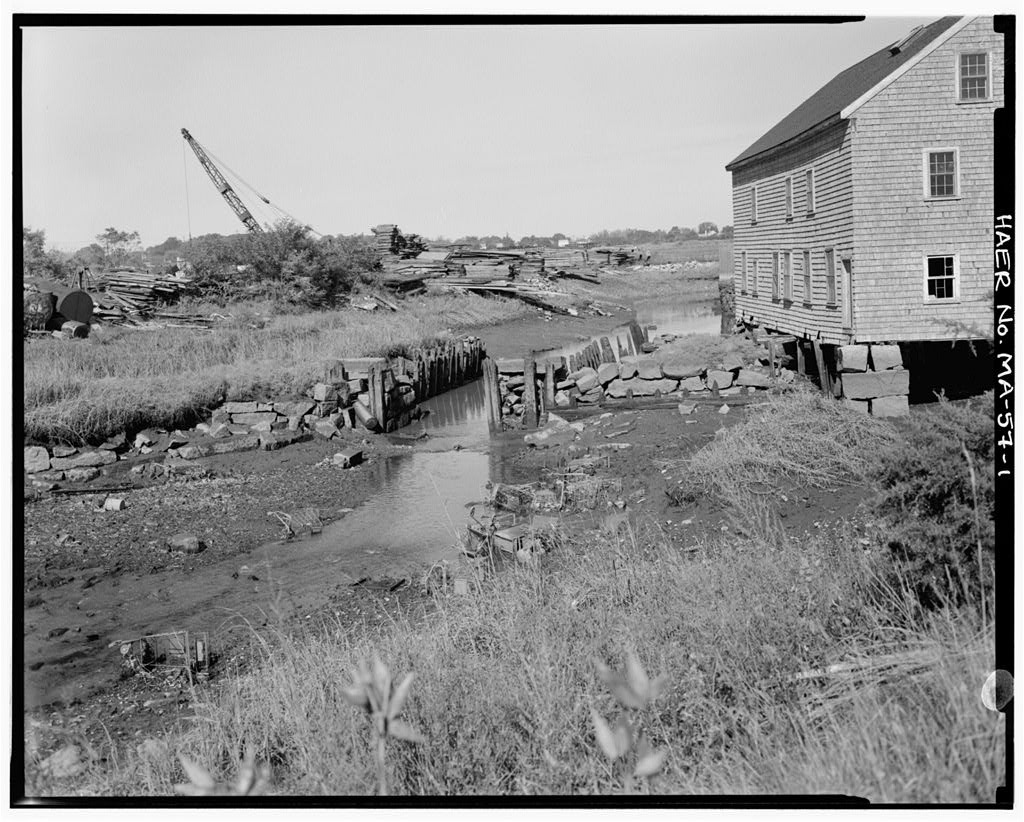
At that time, Quincy Point was a privately-owned residential area accessed by Howard Avenue, which extended from roughly the area of the present on-site hospital (Building to the east end of the Weld Assembly Building (Building #3) to the west. Quincy Point was separated from the surrounding land by two tidal creeks to the north and south. These creeks, Bent's Creek to the north and Hayward's Creek to the south, discharged to the Weymouth Fore River near what is now the area between Piers 1 and 2 and the No. 12 Basin. Both creeks are now filled in. At the present time, land use to the north and west of the site is primarily residential, but also includes large parking areas, gasoline stations, automotive service facilities, and restaurants.
To the north, across Washington Street, is the large manufacturing plant of Proctor & Gamble. To the south, land use is dominated by a petroleum product tank farm and hazardous waste treatment and storage facilities. An automotive salvage yard, a tree pruning service, a rivet company, and private residences are also located on the rocky highland immediately adjacent to the site's southern boundary. GENERAL DYNAMICS CORPORATION SHIPYARD Addendum HAER No.
MA-26 (Page*}) HISTORICAL DEVELOPMENT AND ACHIEVEMENTS INTRODUCTION The Fore River Engine Company was founded in and moved to the Quincy-Fore River site in From that time onward, until its closing in the Quincy-Fore River yard's history exemplifies three major aspects of the twentieth century shipbuilding industry: 1) the need to keep pace with rapidly changing technologies; 2) the need to balance military contracts with merchant marine production in the boom-and-bust cycles created by war and peace; and 3) the financial difficulties inherent in operating facilities where large amounts of capital are tied up in the production of each ship. These factors resulted in periodic changes of ownership, each time involving acquisition by a larger entity.
Fore River Engine Company changed from a partnership to a corporation in and sold stock in in it sold out to Bethlehem Shipbuilding Company, which had far larger capital resources. Bethlehem, in turn, sold out to General Dynamics, one of the nation's largest defense contractors, in The yard's history encompasses three periods: 1) the years leading up to and including World War I; 2) the through World War II; and 3) the post-war years from to In the first period, the Fore River Engine Company grew from a small producer of marine engines to a large shipyard producing all kinds of naval ships, benefitting from the U.S. naval buildup promoted by Alfred Thayer Mahan and Theodore Roosevelt.
After a significant infusion of capital by Bethlehem, it became the largest supplier of Navy ships for World War I. In the second period, Bethlehem's major up-grading of facilities in the laid the foundations for Quincy's impressive production in World War II. Vessels produced ranged from landing craft, to destroyers and destroyer escorts, to the majority of U.S. Navy cruisers, to battleships and aircraft carriers. They included such famous ships as the Massachusetts and the Wasp.
In the third period, Bethlehem and General Dynamics used the yard's traditional flexibility and continued to update its technologies to respond to new market demands, pioneering in the design and production of nuclear-powered guided missile cruisers, frigates and submarines, and of ever larger tankers, including ten Liquified Natural Gas tankers. PREWAR AND WORLD WAR I PERIODS Pre Shipbuilding has been carried on in Quincy since when the fishing ketch Unity was launched from Ship's Cove, the area now known as Quincy Neck. In the latter half of the eighteenth century, Quincy was internationally known as a shipbuilding center.
Vessels such as the 116-foot Massachusetts were launched in and carried on commerce with European and Chinese ports (Quincy School Board, Quincy Historical Booklets, p. GENERAL DYNAMICS CORPORATION SHIPYARD Addendum HAER No. MA-26 (Page*8) Shipbuilding at Quincy Point, later home of the Fore River Engine Company, started in A Mr. John Souther founded Souther's wharf, a large shipbuilding establishment. Many famous and swift clipper ships called Quincy their birthplace. The most famous shipbuilder at Quincy Point was a Mr. Thomas of Rockland, Maine, who built 19 large ships, one brig and six schooners between and (Helen M. Lincoln, Recollection of Quincy Point and Shipbuilding, pp. However, by steam power began to tell over sail, and shipbuilding ceased on Quincy Point for a time.
In Thomas A. Watson, former assistant to telephone inventor Alexander Graham Bell, founded the Fore River Engine Company. Located on the shore of the Weymouth Fore River in East Braintree, the firm began producing successful marine steam engines for yachts and other types of vessels. In Fore River won a Navy contract to construct two 400-ton boat destroyers, the Lawrence and Macdonough, with a bid of Several years later, a larger site was required for construction of a newly contracted ship, the Des Moines, and the company relocated to Quincy Point. In Quincy Point consisted of a point of sparsely-populated, residential land extending into the Fore River with a creek on either side: Bent's Creek to the north and Hayward's Creek to the south.
The former became the yard's early wet basin, and both were eventually filled in. The original width of the Weymouth Fore River at Quincy Point was 200 feet and the depth at low tide was 25 feet {Atlas, This original shipbuilding operation occupied a total of 78 acres along the mile shoreline of Quincy Point. Between and the Shipyard consisted of machine and tool shops, warehouses, a forge, a carpentry and rigging shop, and a separate shop for yard construction. Other buildings were a storehouse, ship tool shop, patterns storage shop, joiner, .pattern and mold loft, a power house and boiler room, and cranes. All were of wood except for the power and boiler houses which were of brick (Sarcone and Rines, p. 7).
The Fore River Engine Company's original four-story office building was floated over from East Braintree. Early development on the site was oriented to Bent's Creek, which, by had a bulkhead along its southern edge. This bulkhead was the forerunner of Outfitting Pier No. 2 (Structure A number of building slips entered the Fore River between the two creeks. By when the yard was officially started, there was a total of 11 acres under cover. Light and power cables were run underground in tunnels build of Quincy granite. The yard had some of the largest shipbuilding equipment of its day. Two 100 ton hammers were used to shape materials, while specially built 75 ton and 25 ton cranes were used to drop materials into place.
The forge was the largest in the United States at the time, and did all sorts of tasks, including miscellaneous jobs for other shipyards in the area. The forge was so busy that it operated on a 24 hour a day, 6 day a week schedule. The yard also had its own railroad. GENERAL DYNAMICS CORPORATION SHIPYARD Addendum HAER No. MA-26 (Page^ /o Existing buildings of which at least portions date from this period include the Angle Layout Shop (Building 5), the No. 2 Warehouse, the Blacksmith Shop (Building and the Electrical Shop (Building 33) (Herbert S. Houston, "Growth of a Great Shipyard," World's Work, p.
By the end of its first ten years at the Quincy yard, Fore River shipyard had produced over 75 vessels, including battleships, destroyers, cruisers, steamers, submarines, and private vessels, of all sizes and descriptions. Major military contracts included U.S. Government orders for two ton battleships, the Rhode Island and the New Jersey feet long, top speed 17 knots), delivered battleship Vermont feet long, top speed 17 knots); the ton North Dakota of the Delaware class feet long, top speed 22 knots); as well as tugboats, scout cruisers, lightships, and torpedo boat destroyers. The last contract won by the Fore River Ship and Engine Company management was for the famous U.S. Navy battleship Nevada.
In addition, the shipyard delivered five submarines to the Japanese Navy and the battleship Rivadavia (launched to the Argentinian Navy. Civilian contracts included the world's seven-masted schooner, Thomas W. Lawson feet long); freight steamer Boston; and a passenger steamer Providence of the Fall River Line, among other types of vessels. The building of the Rivadavia, while testifying to the shipyard's success, also highlighted serious shortcomings in the business of shipbuilding. It placed a huge strain on available resources of capital and manpower. In response, Admiral Bowles, President of the Fore River Ship and Engine Company recommended that the yard be sold to a corporation with greater capital resources.
Bethlehem Shipbuilding In the Quincy shipyard was purchased by the Bethlehem Steel Company for Bethlehem Steel's owner, Charles Schwab, envisioned an empire capable of "turning out all iron and steel products used on land and sea." At the time of the sale, the shipyard was doing an annual business of between 6 and 12 million dollars. Under construction in the yard at that time were 23 vessels worth about $20 million. The yard was about 110 acres in area and could turn out about tons of shipping annually (General Dynamics, p. 6). It was in large part Schwab's vision and genius that made Quincy into the great facility that it became during World War I and World War II. Almost immediately after the purchase of the yard, Bethlehem began to make capital improvements.
Besides material investments, Bethlehem also added a company Service Department that took responsibility for many human services at the yard. The Service Department staffed the shipyard hospital, organized a band, a glee club, ball teams, and social events, as well as publishing the monthly Fore River Log (Sarcone and Rines, pp. Before American entry into the war, the yard contracted to build ten submarines for the Royal Navy of Great Britain in but American neutrality in World War I prohibited construction of warships for belligerents. Bethlehem instead had Fore River prefabricate the submarines, then ship GENERAL DYNAMICS CORPORATION SHIPYARD Addendum IIAER No. MA-26 (Page**) the parts to Canada, where Quincy labor assembled the submarines, all in the space of about ten months.
World War I At the time of World War I, Bethlehem Steel owned seven shipyards in the United States. These were located at Sparrow's Point and Baltimore, Maryland; Wilmington, Delaware; Elizabeth, New Jersey; Boston and Quincy, Massachusetts; and two West Coast yards at Los Angeles and San Francisco. The only plants comparable to Quincy in scale and capability were Sparrow's Point and the Union Yard in San Francisco (The Properties of Bethlehem Steel Corporation, pp. The U.S. entry into World War I had a huge effect on the Quincy shipyard. Knowing that wartime contracts were imminent, the yard began massive capital improvements. Fabrication Ship 1 was built in A large steel construction framework was built around the southern basins in (General Dynamics, p. 5).
The first major enlargement of the Shipyard by the Bethlehem Shipbuilding Company came during when a steel mill was constructed, measuring 770 feet long and about 188 feet wide. The top floor contained a sheet metal shop and the new mold loft. On the ground was one of the world's largest plate and angle shops. The building had 75 machines served by eight cranes, and the shop could fabricate 250 tons of steel a day.. Another major improvement was a new concrete and steel shipbuilding slip feet long. The slip had three 7 1/2 ton cranes 144 feet above the slip and one 50 ton crane 122 feet above the slip. During the war, the Navy placed an initial order for a total of 28 destroyers, 15 submarines, and one battlecruiser.
In order to fill the large number of destroyer contracts, Bethlehem constructed a new shipyard devoted solely to destroyer construction. The yard was located to the north of the main Quincy-Fore River yard, in another part of Quincy and became known as the Squantum yard. It was started in and deactivated in after turning out 35 destroyers. During the World War I period, Quincy and Squantum delivered a total of 71 destroyers, more than all other U.S. shipyards combined. At the main Quincy-Fore River yard, 35 destroyers were produced, including the record-setting construction of the destroyer Mohan, built in only 174 days during Later in the war, the Squantum yard bettered that record, completing the destroyer Reid in 45 and 1/2 days, a record for that time (Quincy School Department, p.
This remarkable shortening of construction time illustrates the pace at which the Quincy-Bethlehem yards operated during the war. These World War I achievements established Fore River as one of the foremost American shipyards. In Quincy won a ten thousand dollar bet with the Union Shipyard in San Francisco on which yard could build the most destroyers that year. Quincy won, building 18 destroyers to Union's 6, plus 10 submarines, and 6 merchant ships (A Century of Pride, p. 5). GENERAL DYNAMICS CORPORATION SHIPYARD Addendum HAER No. MA-26 (Page***} Post World War I Surprisingly, Fore River did not suffer an immediate depression after the war as was typical in the American shipbuilding industry.
There were several wartime contracts to finish out, including three merchant vessels for the Emergency Fleet Corporation. There was also a contract for two Navy scout cruisers, the Raleigh and Detroit. There were two new naval contracts in but after this, no new work came into the yard until In as a result of the Washington Naval Conference, the keel of the U.S.S. Lexington was laid, not as a battleship as originally planned, but as an aircraft carrier. She was launched in and delivered in She was the largest warship Quincy had built to date, with a length of 888 feet, and a beam of 105 feet. The Lexington was one of the most famous ships ever built by Quincy. She was the first true aircraft carrier in U.S.
Navy service, and served with distinction as one of the main American carriers in the Pacific until sunk in the battle of the Coral Sea in May of It was during this lull that Bethlehem took the opportunity to do some expansion work at Quincy. One vitally important addition was a ton floating drydock moved to the yard from East Boston in Another addition that increased the yard's capacity was the construction of a new battleship slip that could hold vessels of a size never before built in Quincy. By most of Hayward's Creek had been filled and was flowing through a culvert that discharged into the Weymouth Fore River near the westerly end of what is presently the #12 basin.
The filling of Bent's creek began sometime after and was generally completed by when it was filled to a point near the western end of basin #2. With a lack of post-war contracts, the yard did a great volume of repair work in the mid-1920s, from naval vessels to floating hotels, and even railroad locomotives. The management of Quincy shipyard hoped to keep the skilled, specialized workers employed, as their collective skills were as valuable to the yard as any machinery. This strategy proved a success when the Navy ordered two new cruisers and five new cutters. The saw a downturn in the productivity of the yard in the Great Depression. The effect of the Depression on Fore River can be seen in the employment figures at the yard during that period.
In there were workers at the yard, and by as unemployment was peaking nationally, the yard was employing only 812 workers, with work at a virtual standstill. The yard's recovery came with the Naval Expansion Program of At this time, Bethlehem changed the yard's name to the Bethlehem Steel Company, Shipbuilding Division. By employment at the yard was up to (Sarcone and Rines, p. The major work undertaken at this time was on U.S. Navy contracts for two more cruisers, nine destroyers, and the carrier Wasp. GENERAL DYNAMICS CORPORATION SHIPYARD Addendum IIAER No. MA-26 (Page *H) 13 World War II The coming of World War II had a huge effect on the Quincy yard. As a modern shipyard with massive production potential, it was in a position to excel at war-related shipbuilding.
Quincy had a long-standing tradition of warship construction, and the U.S. Navy looked to Quincy to provide a large part of the wartime fleet. Peak employment at the Fore River yard was reached in when some (including women) were occupied on three full-strength shifts. Payroll in this peak year was million annually, and ship contracts for that period amounted to some million (Sarcone and Rines, p. The main Fore River shipyard in Quincy built 92 naval vessels of 11 different types in the period from to the most notable being a battleship, carriers, heavy and light cruisers, and destroyers, for which the yard was widely known. The major reason that Quincy could be so productive was the substantial physical plant built by Bethlehem Shipbuilding Division.
To measure the historic significance of the vessels produced at the Quincy-Fore river shipyard in World War II is a difficult task. The majority of the U.S. Navy cruisers were built at Quincy, as were many fleet destroyers and destroyer escorts, which did valuable convoy duty in both theaters. Some of the better known vessels were the battleship Massachusetts, the Essex class carriers Lexington (II), Bunker Hill, Wasp, Hancock, and Philippine Sea. There were numerous cruisers produced, including the heavy cruisers Baltimore, Boston, Canberra, Quincy, Pittsburgh, St. Paul, Columbus, Helena, Oregon City, Albany, and Rochester. There were six light cruisers, two anti- aircraft cruisers and nineteen destroyers of various classes.
For excellence in production performance, Quincy shipyard received the coveted Navy E, with four additional stars. One destroyer escort was built in just 23 working days from keel laying to launching. At one point, five were delivered in a span of only 50 hours (A Century of Pride, p. 6). During the war, a $25 million expansion was undertaken at the Quincy-Fore River shipyard to facilitate work on large numbers of naval vessels, and to modernize existing facilities at the yard for both construction and repair. A new fabrication shop was constructed, with two bays, Bay #1 measuring 766 x 188 feet, and Bay #2 measuring x 102 feet. Inside were 17 bridge cranes, 6 foot angle furnaces, 36 foot plate furnaces, 36 foot planers, and a ton hydraulic press.
There was a plate storage area with an ton capacity, served by 6 revolving cranes, and a covered welding platen area totalling feet. It was one of the few shops in the country capable of designing and constructing gun turrets. A new machine shop was also built, measuring 892 by 120 feet square feet) with eight bridge cranes; nine boring mills; nine lathes larger than the largest being and ten planes above 36" and gear and turbine cutting machines. The new mold loft was the largest in the United States at the time, encompassing square feet. A new brass foundry could produce GENERAL DYNAMICS CORPORATION SHIPYARD Addendum HAER No. MA-26 (Page 13} pounds per week during the war.
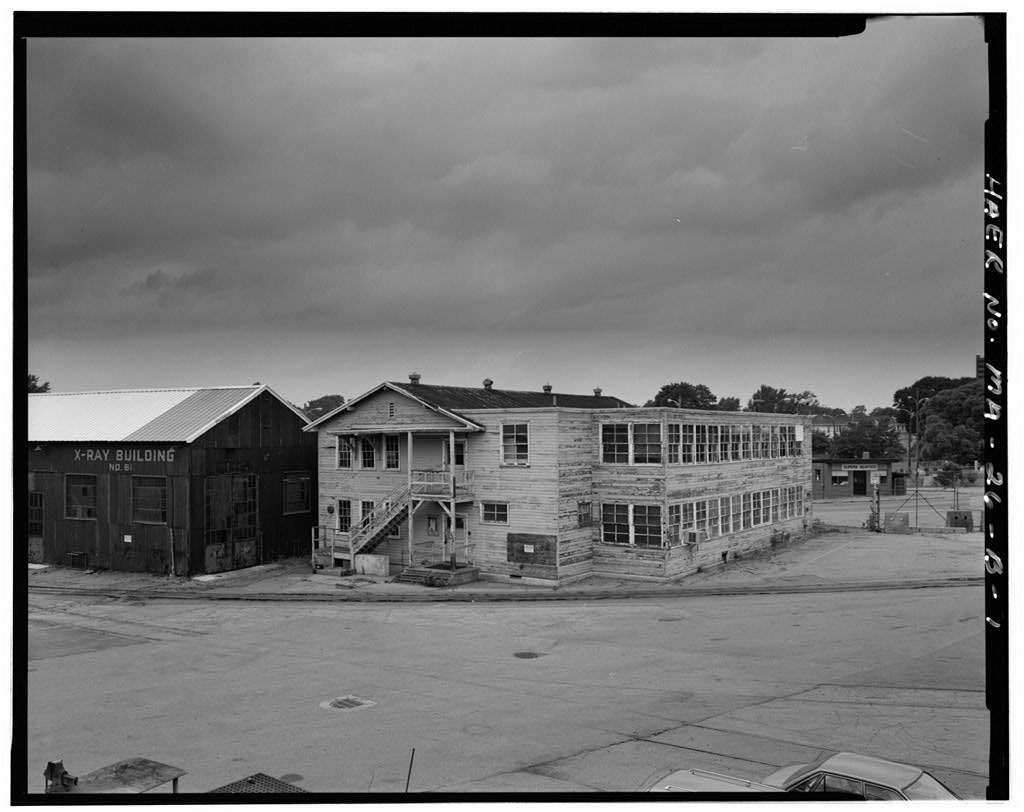
Other features included two new wet basins, 12 building slips, buildings for X-ray and gamma ray inspection of welds and castings as well as portable X-ray machines. One of the interesting sidelights to Quincy's wartime history is that the yard may have been the origin for the famous "Kilroy was here" phenomenon. In a search conducted by the American Transit Association in the conclusion was drawn that a Quincy-Fore River welding inspector named James J. Kilroy verified the riveters' piece work by writing "Kilroy was here" on his inspected areas to prevent fraud on the part of the riveters.
He apparently scrawled the now famous phrase on dozens of troopships, naval and landing craft, and from that origin, the custom spread wherever the American armed forces campaigned (Sarcone and Rines, p. The Post-War Period During the post-war period, Quincy could no longer rely on the plentiful and profitable government wartime contracts, and had to look toward new ways of shipbuilding in order to survive. In those years, inflation, high material costs, high wages and strong union pressures threatened the shipbuilding industry as a whole. One of the main problems for the industry was a repercussion of the Ship Sales Act of under which the government sold surplus merchant vessels at extremely low prices, leaving shipyards with no new construction orders. While this created a strong U.S.
merchant Marine, it also created one that would need few new vessels until the At the end of the immediate post-war slump, in the early several sleek "new American" merchant ships were designed and built by the yard for American Export Lines. These ships, the Independence and Constitution were the most advanced ships of their day. Other cargo ships such as C-4 cargo vessels were delivered in It was at this time that tankers became the prime item for the yard. Several were produced for Gulf Oil, and one for the Navy. One highly unusual job was the construction of the chemical tanker the Marine Dow-Chem. This 554 foot, ton vessel was constructed of nickel steel and could safely carry many different types of chemicals.
Political developments played a role in the shipyard's lack of business as well. Contracts for eight Forrestal class carriers all went to the Newport News Shipyard in Virginia, with none going to Quincy. During this period Quincy did win contracts for three frigates worth about $52 million, and a few other Navy contracts, but they were few, given the size of the post-war Navy. In an attempt to become more competitive, Bethlehem decided in to renovate the building areas at Fore River in a $14 million expansion program. The chief features of this expansion program were a x building basin that replaced six of the old pre-World War I sliding ways. Depending on the vessels' size, the basin could accommodate three to six ships.
In the later to there was also substantial renovation of the buildings. GENERAL DYNAMICS CORPORATION SHIPYARD Addendum HAER No. MA-26 (Page "M^ Toward the end of the more tanker contracts began to come in, and Fore River set several records for constructing the largest tankers of their day. The sister ships World Glory and World Beauty were long, and could carry million gallons of crude oil. In the yard built the Princess Sophie, a giant tanker over long. In all, the yard produced 14 tankers in the decade of with total ship contracts valued at more than million. During the early Quincy led the way in the area of nuclear surface ship engineering. In a six year, million project, Quincy developed and built the nuclear propelled guided missile cruiser Long Beach.
The Long Beach was the first nuclear powered surface vessel in the United States Navy, and a major engineering accomplishment. The entire vessel was designed by the Central Technical Department at the shipyard. She was quickly followed by the frigate Bainbridge, another nuclear powered, Quincy-built vessel (Sarcone and Rines, p. By the facility had produced several nuclear vessels, including nuclear attack submarines, guided missile cruisers, and nuclear frigates. In the yard also produced the tanker Manhattan, at the time of her completion the largest commercial vessel ever built (General Dynamics, p. 7). The new decade had not started well for shipyard management, however. A five month strike that began in January of brought all work to a grinding halt.
The issues were never clearly addressed or dealt with, and while the strike was not the worst in the shipyard's history, it came at a very inopportune time. Work was set back a year, and new contracts were sluggish to come in. In addition to the strike, the yard was accused of overcharging about $5 million in the construction of the frigate Bainbridge. Increased costs, a lowered confidence in the yard, and the fact that the U.S. Merchant Marine had begun a long decline into virtual nonexistence, forced Bethlehem to sell the yard in In its 60 years of ownership, Bethlehem had saved the yard from financial ruin in guided it through two world wars, massive growth and profit; and had made Fore River one of the foremost shipbuilding establishments in the world.
Quincy Shipbuilding Division In the Shipyard was put up for sale, and in it was purchased by the General Dynamics Corporation, one of the largest defense contractors in the United States. General Dynamics bought the shipyard property, but did not buy the business itself. At the time of the purchase, General Dynamics owned a total of 136 acres of the Shipyard, and the United States Government owned 39 acres of land near the site's southern boundary. Although the exact procedure is unclear, General Dynamics obtained the 39 acres and began to expand new facilities into the area. General Dynamics established the Quincy Shipbuilding Division in and began plant improvement projects totalling $23 million.
million was spent on improving and updating the yard's cranes, million on new shot blast and paint facilities, and $3 million on the yard and buildings. The rest of the investment went towards the purchase of numerically controlled burning machines, new shape handling ammunition ships, submarine tenders, supply ships, fleet replenishment oilers, deck landing ships, and Sea Bee barge transport ships. The GENERAL DYNAMICS CORPORATION SHIPYARD Addendum HAER No. MA-26 (Page * > yard also produced three converted ships for the Apollo space program, known as Apollo instrument ships or "big ears," the Vanguard, Redstone and Mercury. In the energy field the yard also built and delivered the Energy Independence in the first coal carrying, coal fired ship built in the U.S.
since the (Sarcone and Rines, p. Toward the end of the shipyard's career as a General Dynamics yard, contracts were not coming in at a sufficient rate to keep the yard employed. To help stave off impending layoffs there were many naval repair jobs taken up, but on the whole the future for the yard looked grim. Despite the LNG contracts, Quincy shipyard could not obtain a degree of consistency in building ships of one type of class. The tradition of diverse construction had never allowed Quincy-Fore River shipyard to specialize in one type of vessel. Such specialization would have allowed the development of labor-saving methods and would have improved Quincy's competitive position against other shipyards.
Thomas Watson had tried, unsuccessfully, to attain this goal as early as and it remained a problem throughout the yard's history. The last ship produced at Fore River, the William R. Button, was delivered May 22, and the process of deactivation began that same year. SOURCES OF INFORMATION In the course of this documentation, archival materials of the following repositories possessing major collections of shipyard materials were reviewed. Due to the vast quantities of materials, not all items in the collections were viewed. However, important plans and historic views were identified for the documented resource. In addition to these collections, additional materials may exist in the corporate archives of the Bethlehem Steel Company and the General Dynamics Corporation.
Bethlehem Steel Collection, Hart Nautical Collections, The MIT Museum, Cambridge, Massachusetts. Working drawings, photographs, and project files The bulk of this collection consists of approximately negatives. In addition, there are 3 "Real Estate Data Pertaining to Buildings" notebooks containing mounted photographs (ca. and approximately 20 notebooks containing mounted views of the shipyard (1902-ca. General Dynamics Corporation Collection, Hart Nautical Collections, The MIT Museum, Cambridge, Massachusetts. Photographic negatives GENERAL DYNAMICS CORPORATION SHIPYARD Addendum HAER No. MA-26 (Page>6) 19- Quincy-Fore River Shipyard Collection, Quincy Historical Society, Quincy, Massachusetts.
A variety of materials including artifacts, photographs, information on ships constructed and a copy set of Yard Plans H. V. Bisbee) (ca. Quincy-Fore River Shipyard Files (Massachusetts Water Resources Authority), Quincy, Massachusetts. Located in the Administration Building. Working drawings (ca. and project files (ca. GENERAL DYNAMICS CORPORATION SHIPYARD Addendum HAER No. MA-26 (Page*!*) Bibliography Bethlehem Steel Company The Properties and Plans of Bethlehem Steel Corporation. Bethlehem Steel Company Shipbuilding Division. Fore River Yard. Yard Plans. Boston Affiliates, Inc. Quincv-Fore River Shipyard Historic Resources Survey and Addendum. Prepared for the Massachusetts Water Resources Authority, Boston, MA, October 20, and January 2, Branch, Ernest W.
Atlas of the City of Quincv, Norfolk County. Massachusetts. Boston, Quincy: Ernest W. Branch, Branch, Ernest W. Atlas of the City of Quincv, Massachusetts. Quincy: Ernest W. Branch, General Dynamics Corporation A Century of Pride. Quincy: General Dynamics Corporation, Leggat McCall Advisors, Inc. Appraisal Report: General Dynamics Shipyard Quincy/Braintree, Massachusetts. Lincoln, Helen M. "Recollections of Quincy Point and Shipbuilding," unpublished, Quincy School Department Quincy Historical Booklets. Book IV: Industries of Quincv. Sarcone, Anthony F. and Rines, Lawrence S. A History of Shipbuilding on the Fore River. GENERAL DYNAMICS CORPORATION SHIPYARD Addendum HAER No. MA-26 (PageT*^ Location Map GENERAL DYNAMICS CORPORATION SHIPYARD Addendum HAER No.
MA-26 (Page t9) J i A LM) S T e u c i u t t 3 DATC ! tt [ OUH( j Pa<[ 11" NO D: :; i i s 11 c N NO P. If> I ION u/.rrrojir NO t 71 HOD; L i NAVT tuoc_ 6 II^IAT f^ - N ~o'7~ 'noi'c' jibeACr t Tt T U AJ, Ab AL i AC DtPTi c 1 I9JI i C -ij u if * tid'jK NO 4" i tr y_' t - 4 74 ni5C. itevict biDc C m? 1 (MO wet c n sno>"& ~nYi;&JK p i4il D-6 75 ANNtALINC fUENAtt !)L DC c Lunbtc siocr 76 7 uAitnouif HO.a ^4i ;r-i 77 UMDIMC iUb- ilATlON c cw; r-t '*" pIPC "a, cQPPte 73 . 6 19* 2 o-a [ 9~ 79 COMTEOL b 194 Z C-6 10 naiN OfriCE AO II nacniMC JHOP 61 TEANiPOETATION OrMCt b 194 2 b-5 \l_ PlATt L ANCLt SHOP 0? UAEtnOUit KO II c 194 2 CO O beajj roiiNDBT 0> NO 1?
c 194 2 U_ YAEO CAEACt 056 40 b-5 64 KO r> 6 mia t-4 15 rum CAH nouJt 05 FAPtE ECCLAiniNC PtANT b 6 17 '6 06 uAEtnouit NO io & 194 > A" J2 nouAto AVC CATE noun^ j c 07 jcuin - _fT ~ c^l 56 t9 nOOtL IrtOP A o-a 09 HILL AVt. CATC MOUiC c 20 TAHO PIPAftlntHT C-a 90 UtlDINC iUOilAIION c n-i 7\ AOniNliUAllON AJO A-'7 91 bATTEEY 510BACC PIDC t> 6 C-9 21 TOIltl 4 OITICC )i N OLOC b C-5 11 UASf-nOOiC HO. > P^" I C-9 91 YABD TOUCT C I94> C-A 1L IHClNeBAToa 6LOO. 94 TcnPOEABT orricf blOC C M45 b-6 J5_ OOllte WO- b-5 95 H nOUlO LOM G I9d) D-> ?6 PAINT G-5 94 UtLDINC SCtlOOL C I9 > II COn&tHAIlOU DIOC wo*; e-6 97 - - 1* naTceiALS orrict f-T 90 c-a II con put 5 speiTAjtcw )# wia r-7 99 ACtTTLtNt JTOEACt b io POUtP. PLANT NO. I t t 100 Oil BtCLAiniNC PlAXr 0 I94> r-2 2L TBANirOEIItB MATlOJT ma C-Z . . .
friACKSmrn inop W054I 102 PunP noust r- b rai9 n-6 _55 tLtCTUCAX 5 OP 105 & ityrjioust 06 104 UtLDINd JUb-STATlOM b n-4 : 21 UtlDING JUbjJTATIOH >9 10) UAT roetnANi ornct G t-9 56 6AIVANI2IKG 5nOP 106 UtLDINC iUb-STAllON C 94l r-s >1 IT! bUlltMNG I91fl C-l 107 " . - " 6 r-4 ?6. PAIN HOSPITAL tOC"- C A-7 106 OUTtlTTINi ' C d-a >? SUITCnfflC 3TATI0H t-7 109 TUEEtT 0LO6--AUX.. . b I9 p*o J UASLtnQUit UP. I G-5 110 APPECNTICC scnooL C. mi-4JJ C-i III . , 5UITCHIHO STATION & m<> r-a 112 MtTAL iPBAT b I9A> 6-4 _ >. r9 r-z 113 LOCO. CEANf EtPAIC b l*>44c-i 44. bOLT ECCLAiniNC. PtAwTO^ I9>0 f"7 114 (j 45 YAED HOSPITAL M. IW4J t-5 46 PIPC nAiNTtKANtr inop G S4i D-5 -," , 47_ UCIPIKC SUb-STATIOH t -p 4S OLD BJiGINt LOfT - 49 AUX.. POWMt.
MOUit: FT o^7 90 UAT roernANj ornct 941 t-o gt- AlUHIMUn 5CEAP C-l 52 UAECriOUSt NO 7 C-\ - O.UTNTTINt; 5> OH JTOP-ACC- PIT I9TT FT i - PITE 50 b W5-}i C-3 54_ TUBECT & Aonoe snop 2 6 b C-4 15_ nousr P-U 5 40 c rt .1 56 nisc. orncc WILDING 4? b-6 UtT bAJIK M02-I56 c I94[ 57_ UCLDINC 5U6-MATI0N C-2 56 UAT roEtnANi omef i-Z '5MIPUAY3"" ' ' '- '. UABtnOU5t NO. 9 C-6 i frUILCMNC JLIPSR1-20. 150 0 a-i 60_ TtnPLAT.E iTOEACt D-C 2 iLIP 40 . 575 c n-2 61 X-BAT C-) > 40. 573 c n-2 "Tz TOUtT & LOCKCE [ f -2 4 95 550 b C-5 i2_ > 90. 700 t> I9I5-JC C-6 64 D -k) f. 76 . 675 b C-6 6? PIPt 5TOeACt bLOC DO 7 64. 675 b C-6 66 i, tt> fl 0 POALTnCWTlj rt 64. 675 b I90K42J C-7 67 SUb-STATIOH NO. 2 C-* 9 62.
650 b I9W50 <-7 UtlPINC JUP-5TATK)rf 10 075 b 0 H-6 c rtiii* r-a riEST AID E tli 11 n c i94i NOTC -.CEAPCS or ALL c: moors AKP or ALL stutcj - CITT or OUINCT bASC. "ALL OTntl CtAPCJ 'Ifli' AtriT tMClNttES bASC GENERAL DYNAMICS CORPORATION SHIPYARD Addendum HAER No. MA-26 (Page-&0) 14 I !;:.ifu 11 ( * 11 re J>0 j GENERAL DYNAMICS CORPORATION SHIPYARD Addendum HAER No. MA-26 (Page^l UP.t 5 QUN:D OAU NO. 0 CSCCI PTION ar A. tiCAD nouit 1 P 10 CL UABCMOOSt 1 C- 6 c 'POUCC nouic NQ.i I e-5 SniPUCIGHT 1 D-5 fzkHsroznCz STA. 1 r PIPC UCLDING 5nOP C-3 MOUAED AVt GATE MOUSE 1 rcia M PIPC CCPAIP, SNOP K C-6 1 5UD. STOfcC I J GECASC nousc D-9 rt 5TO AGtyiiTrt5nop 1 D-6 L EtCLAiniNG SHED 1 P-t n UAsniNCTON 5T. GATE no I f-l M GAS Punp nouic 193a r-3 n ANHCAUHfi BUILDING 1 M -p TURECT ASSCnDLTBLW.
1 )M9 r-s Q. TueerT riACtimc snop E TUE.8.CT 3U6-A5SCnOLT 1 5 STOEAGC 6UXS. P l9iA i*t r TOILCF SLIP UO.IO. 1 t- j. 1 NO SHIPUATS 4 SLIP 95 x 530 t$io J SLIP 90 i -. 700 1915-Ja -6 6 SLIP 76 x 560 <t* 7 SLIP M * 560 t9o: d-6 6 SLIP M x 560 190 6-7 9 . SLIP CZ 650 I9U-* in SLIP 110 x 675 J?IJ-3t r-e xr,i SLI P IQO* 700 G-2 P 1 UUTrfTTlHS PICES PI t d 30 x 1 6-3 ? PIE E. . 65 1 * I r?a G-+ 5 PI CC 20 1 raa5 4 PICH 23 I P-5 J . 50 COHC 1 l K5 6-9 ' &0 x sun. > " - UCT BASINS - UCT BASIN O PICK. HO.I 120 * 930 UCT CASIN - PI CC NO.Z 120 * 800 LKT M5IN P| CC 120 * 400 UCT DA5IN - PICK. Ma^ C^ 100 x 500 UCT DA3IN PICR- H05 120 * 700 TAED PtOPrETT ARTA ACZtS' LAND4UATCP, &UILWN65 A TO 0& 5 * T DCSTEOYCD DUHDING5 P. a. fc. RELOCATED GENERAL DYNAMICS CORPORATION SHIPYARD Addendum HAER No.
MA-26 (Page 23) GENERAL DYNAMICS CORPORATION SHIPYARD Addendum HAER No. MA-26 (Page ^ 2-1 ADDENDUM TO: HAER MA-26 GENERAL DYNAMICS CORPORATION SHIPYARD HAER MASS,11-QUI,10- (Quincy Shipyard) 97 East Howard Street Quincy Norfolk County Massachusetts FIELD RECORDS HISTORIC AMERICAN ENGINEERING RECORD National Park Service U.S. Department of the Interior C Street NW Washington, DC
 Block
Block