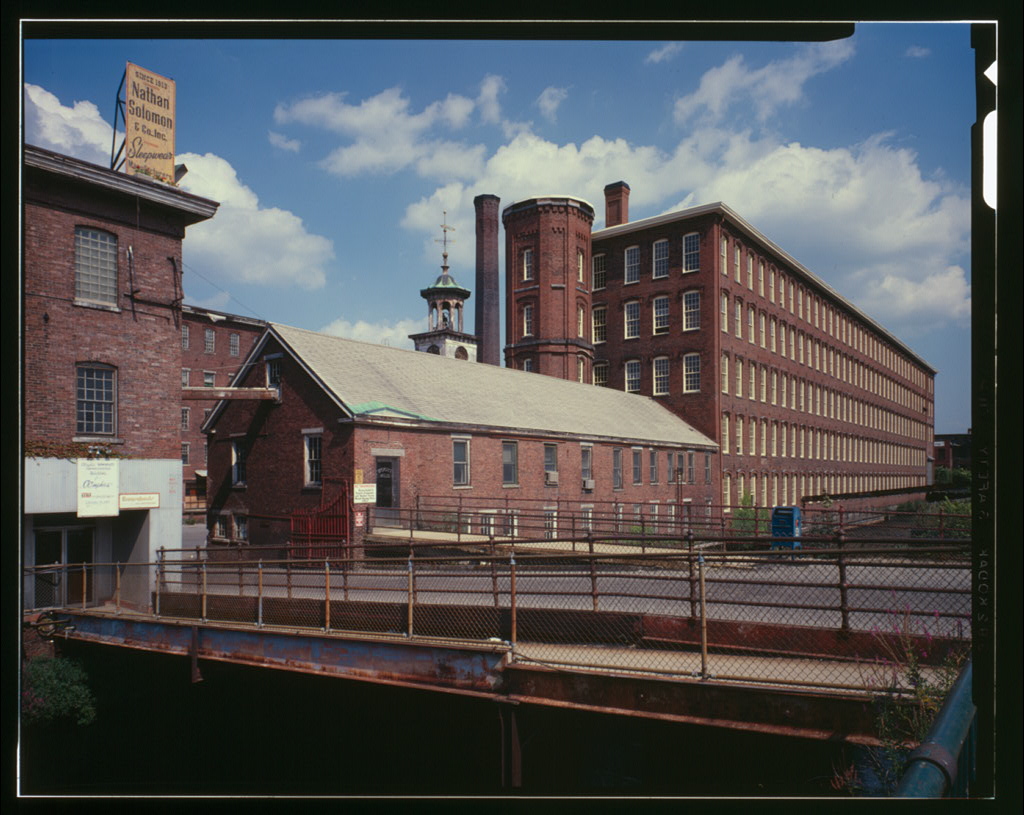
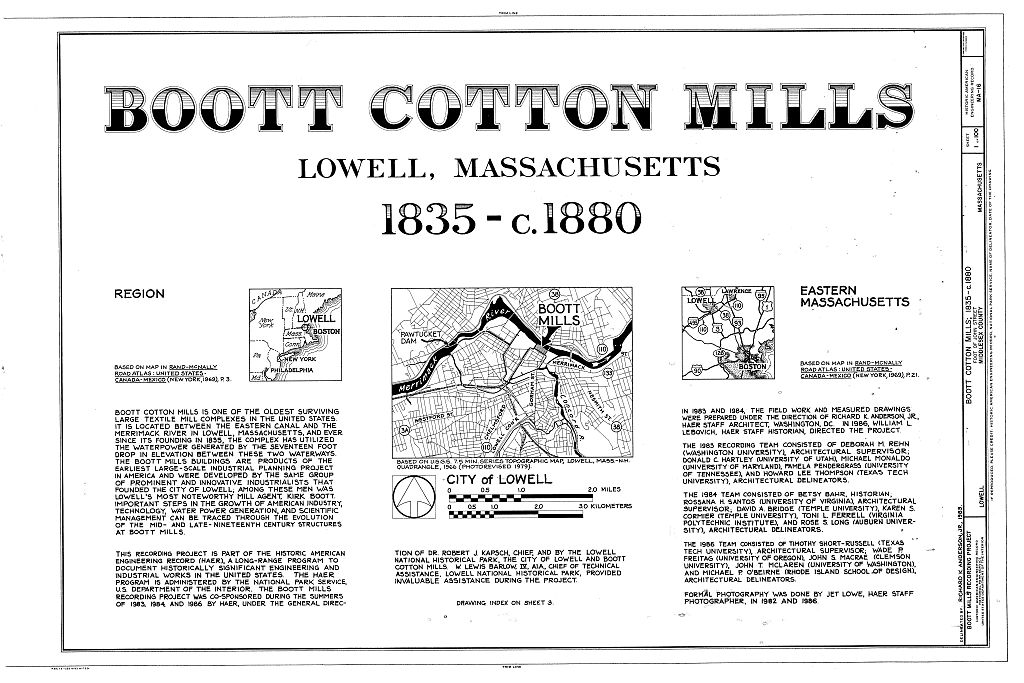
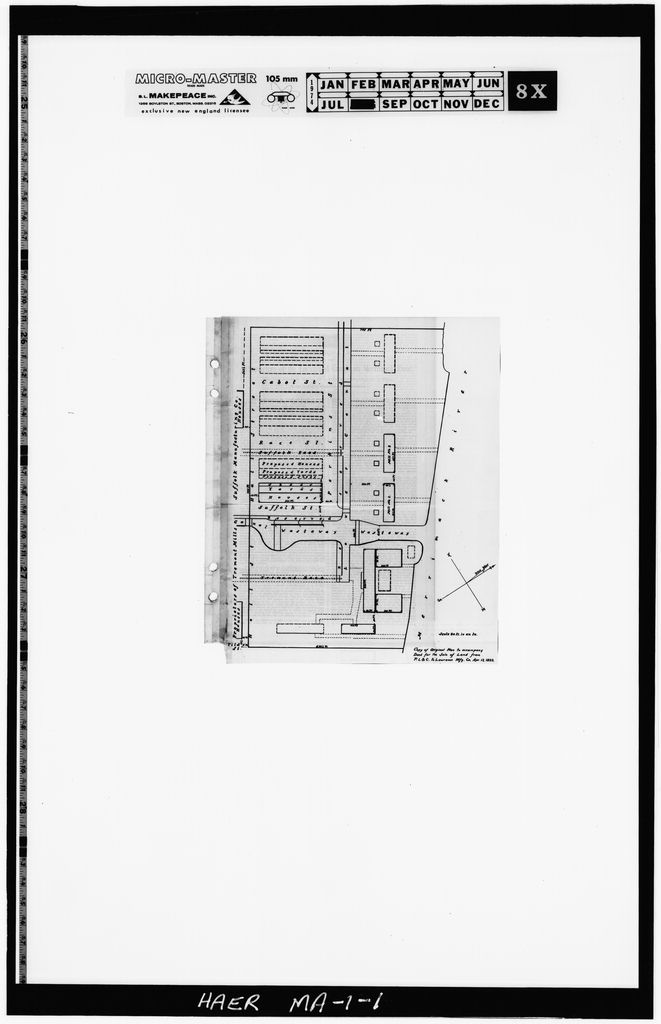
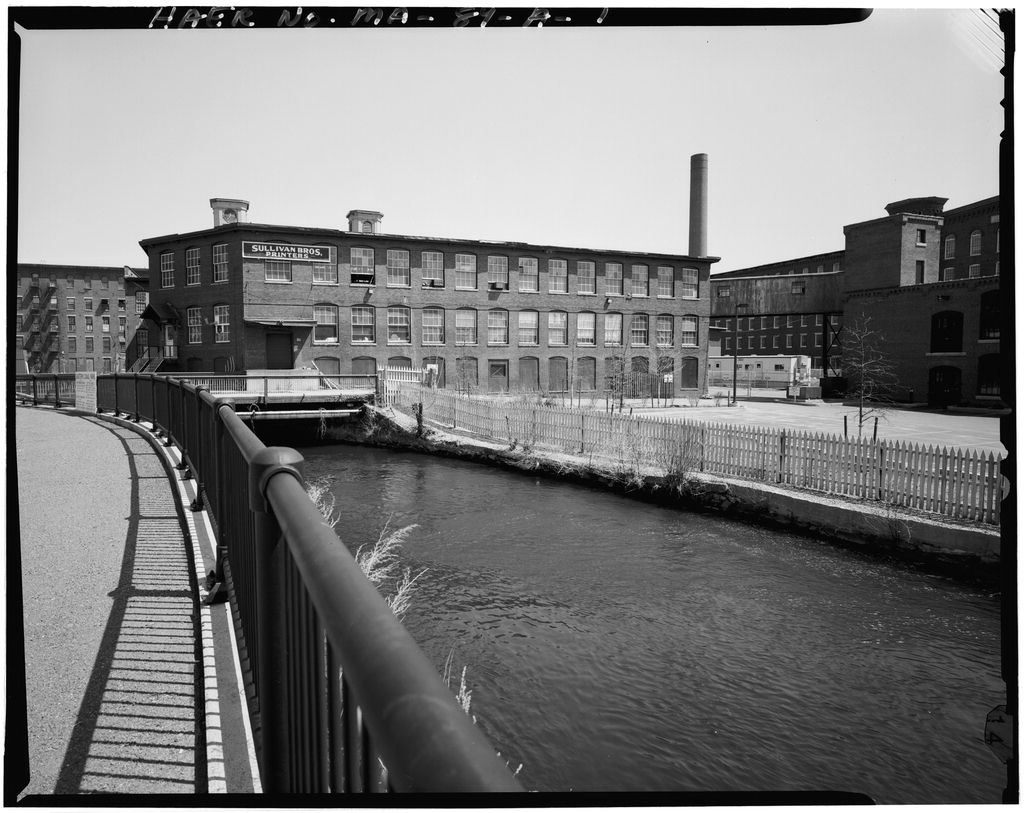
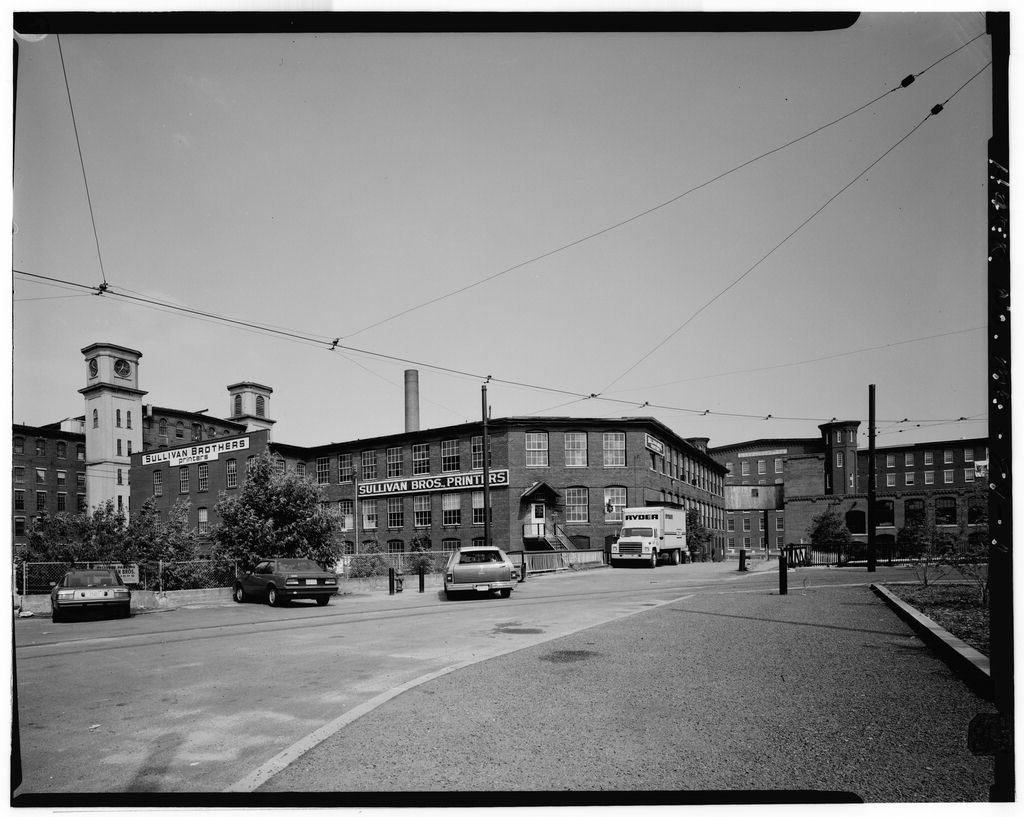
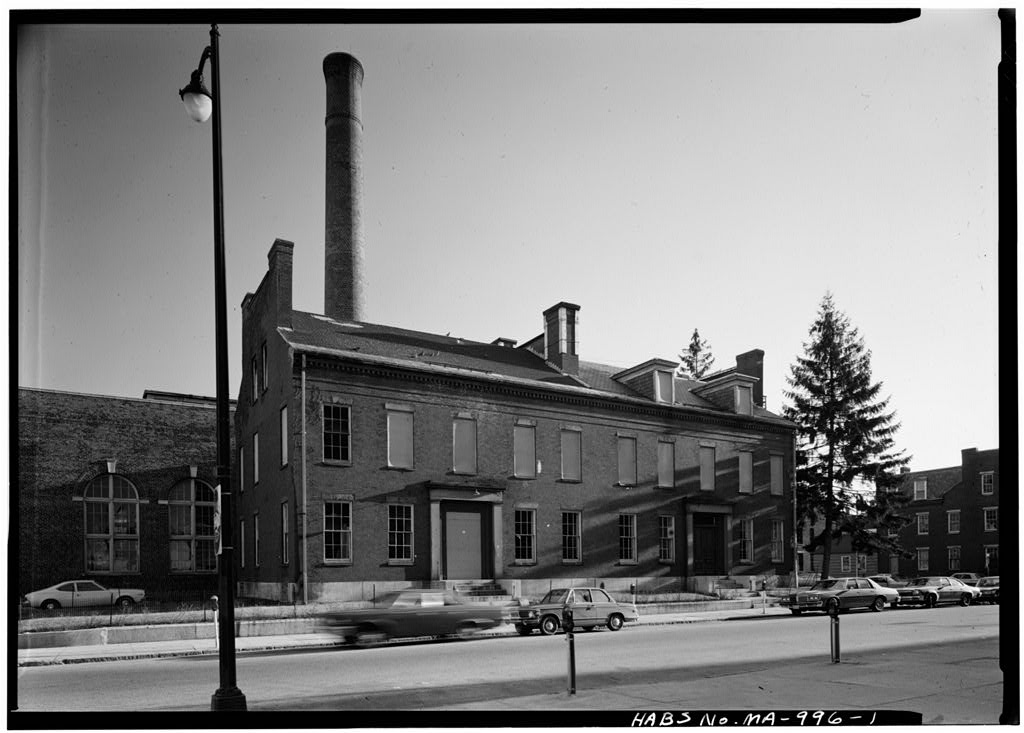
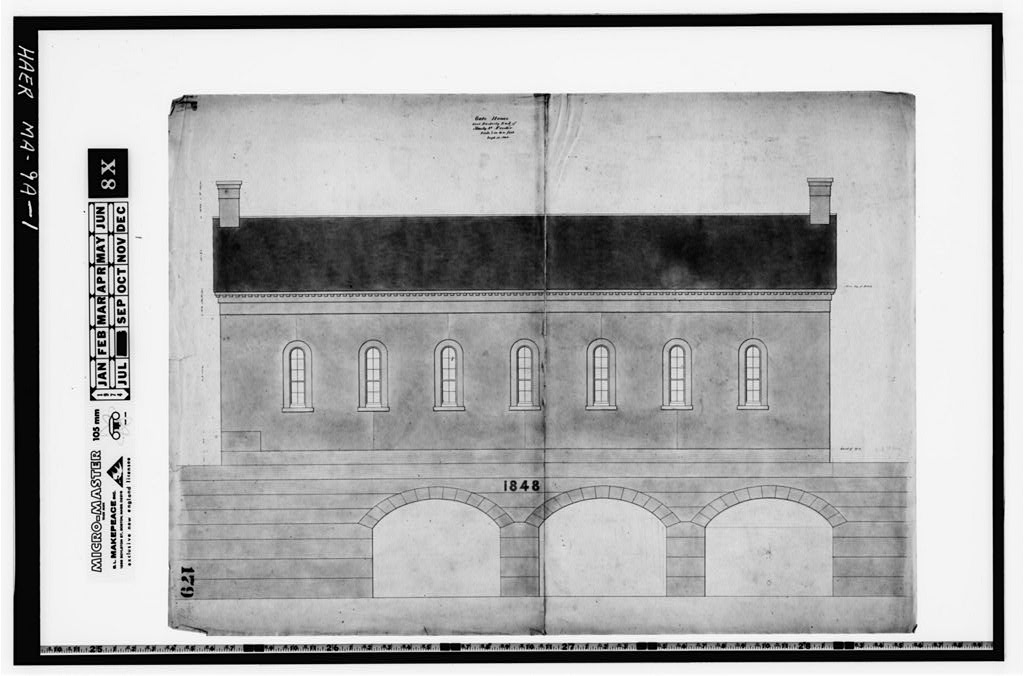
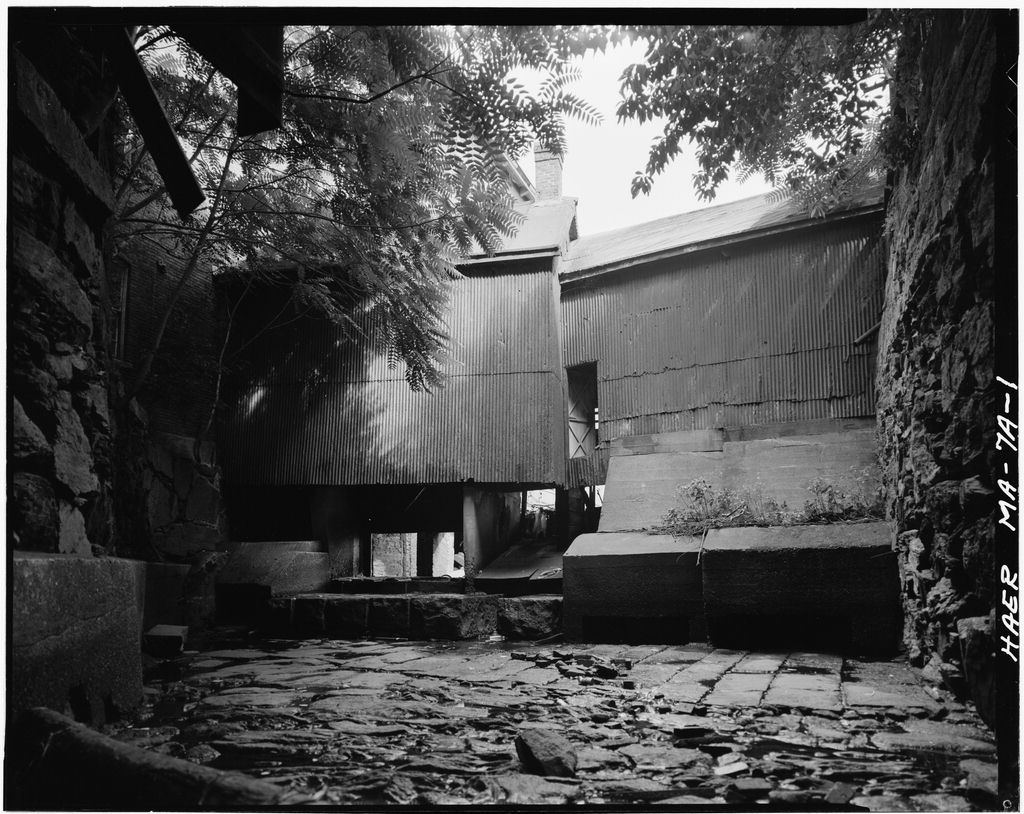
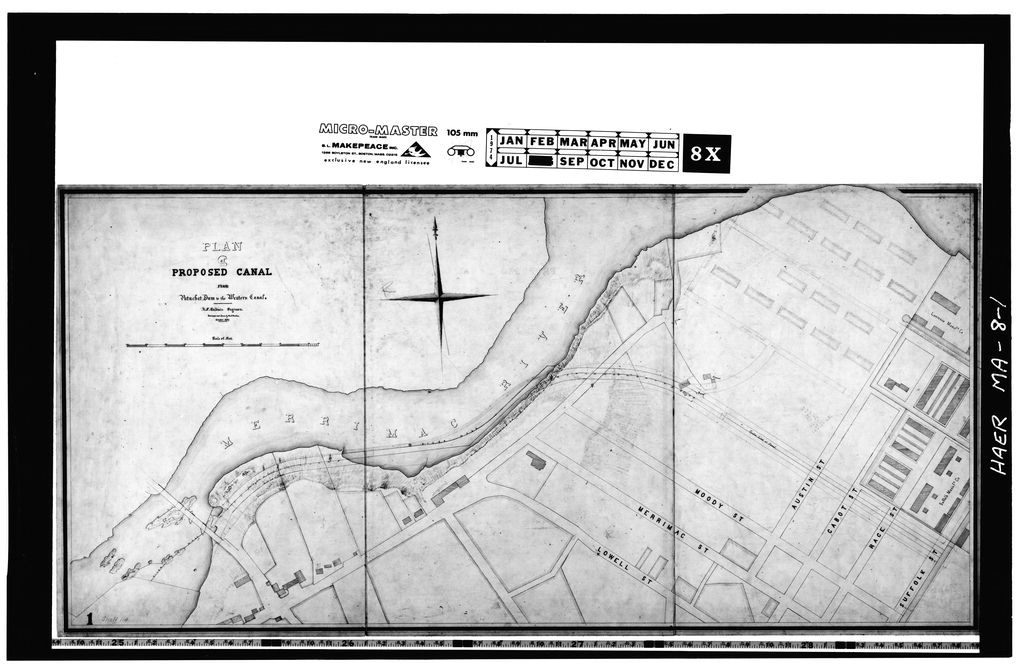
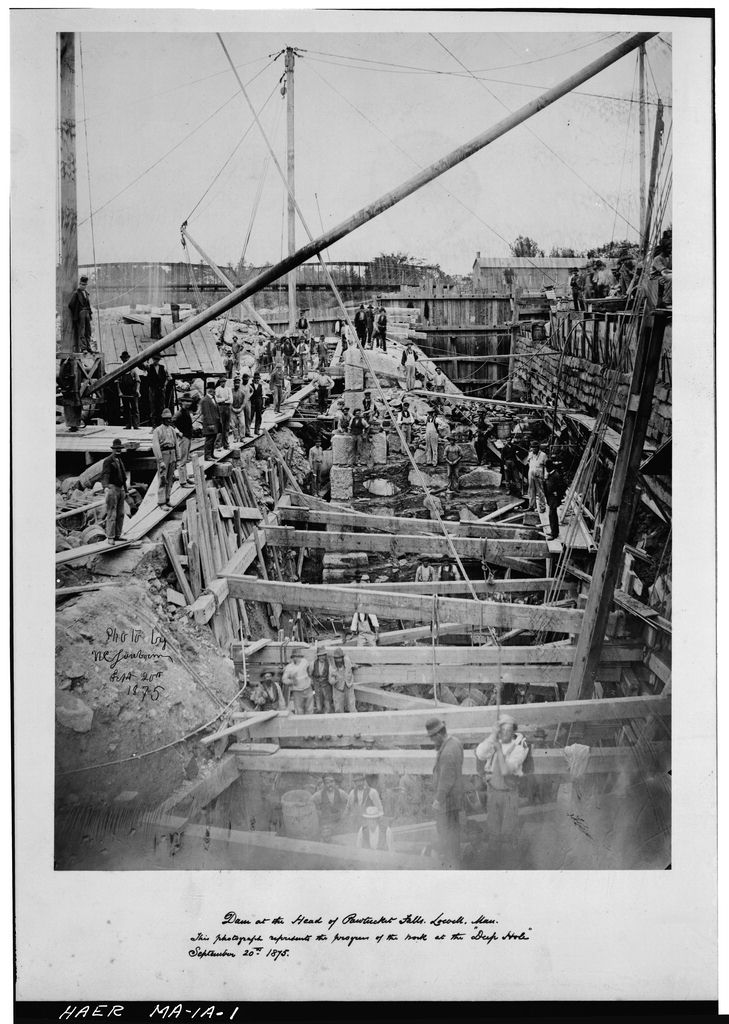
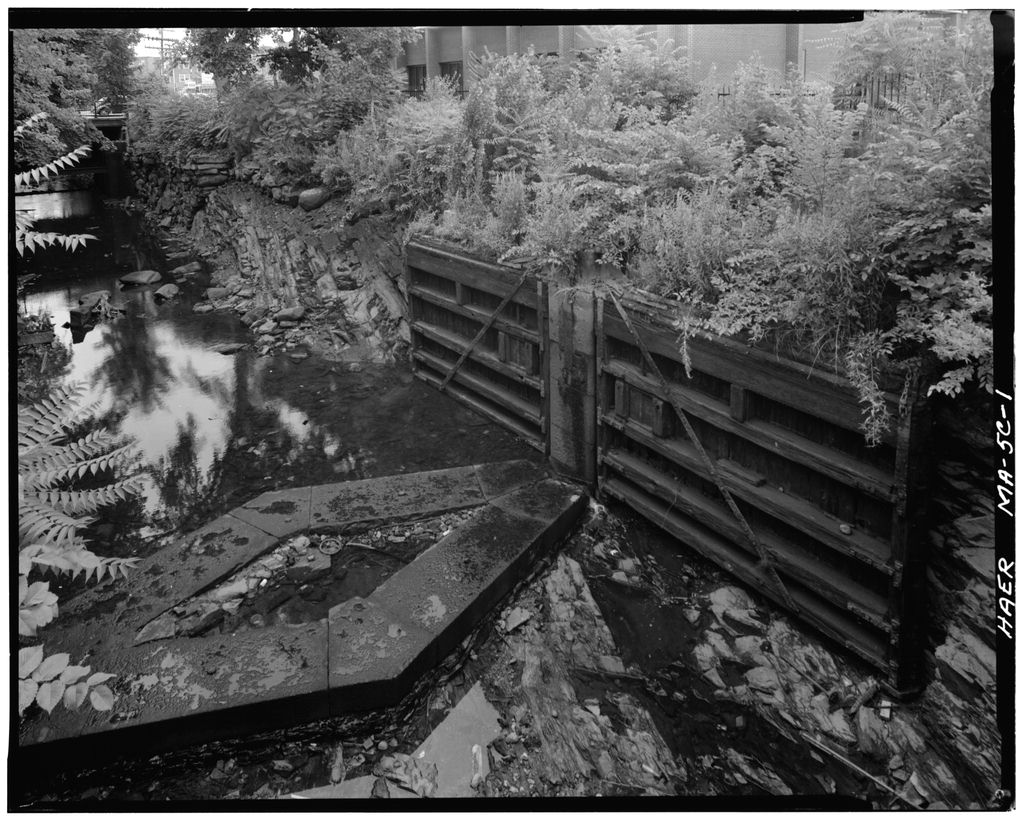
Boott Cotton Mills, John Street at Merrimack River, Lowell
Boott Cotton Mills, John Street at Merrimack River, Lowell, Middlesex County, MA. Surveyed as HAER MASS,9-LOW,7-, with 1 photograph, 1 measured drawing and a 19,759-word written history.
From the record
“Boott Cotton Mills is one of the oldest surviving large-scale textile mill complexes in the United States.”
Written record, HAER MASS,9-LOW,7- survey. Machine-read text.
surveyed by the federal HAER program as HAER MASS,9-LOW,7- · the record runs 19759 words · one of 333 surveyed structures published for this county.
Source document
Quoted word for word from HAER MASS,9-LOW,7-.
Not written, edited or summarised by this site.
Boott Cotton Mills is one of the oldest surviving large-scale textile mill complexes in the United States. Built as an original, and integral, part of the City of Lowell, the Boott Cotton Mills has utilized the 17-foot drop between the Eastern Canal and the Merrimack River for water power purposes ever since Important steps in the growth of American industry, technology, water power generation and scientific management can be traced through the evolution of mid-and late-19th century structures at Boott Cotton Mills. Historical report prepared by: Betsy Bahr, Edited for transmittal by: Donald C. Jackson, Boott Cotton Mills HAER No. MA-16 (Page 2) A GUIDE TO HISTORICAL RESOURCES on the
Boott Cotton Mills Complex
Table of Contents INTRODUCTION I. LITERARY SOURCES 6 A. Manuscript Collections . 11 B. Unpublished Reports. 13 C. Published Material, Dissertations, and Typescripts. II. VISUAL RESOURCES A. Photographs B. Architectural and Engineering Drawings C. Maps, Atlases, Plans, and Insurance Surveys 9A III. OPPORTUNITIES FOR STUDY The following Appendices are located in the Field Records for Boott Cotton Mills: A. Inventory of the Flather/Boott Mills Collection . B. Flather/Library/Introduction C. Channing Whitaker Book Collection D. Inventory of Ariel C. Thomas E. Notes on Boott Mill Turbines. F. Cultural Resource Inventory Research Report, Boott Cotton Mills **SEVERA COPIES OF HISTORIC PHOTOGRAPHS,SITE PLANS, AND DRAWINGS ARE
Included in the Field Records
Boott Cotton Mills HAER No. MA-16 (Page 3) INTRODUCTION In the summers of and a HAER recording team prepared measured drawings of textile mill buildings at the Boott Mills complex in Lowell, Massachusetts. The summer team completed phase two of this three year project sponsored by the Lowell National Historical Park and the city of Lowell. The purpose of the project was to visually document and record the architectural, engineering and structural features of this historic textile mill complex one of the few remaining Lowell mill sites that contains buildings surviving from the through the mid-twentieth century.
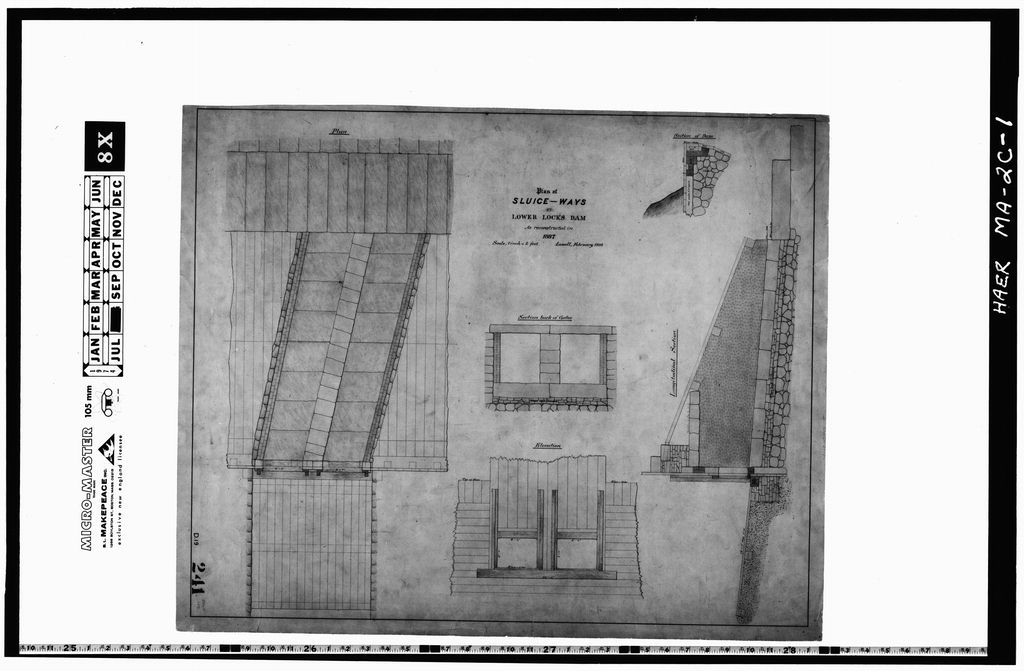
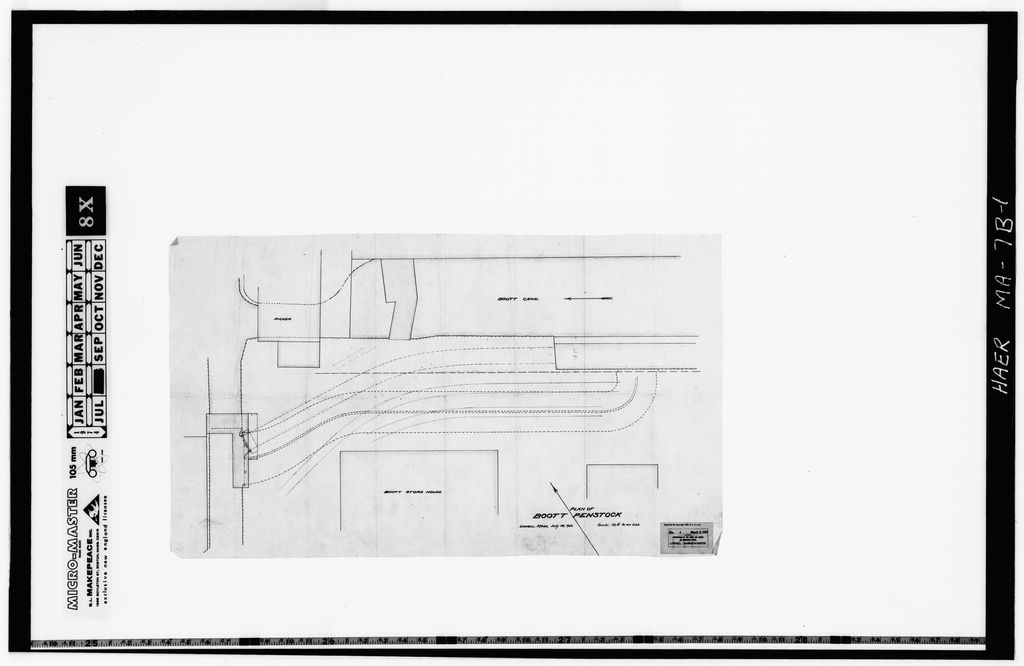
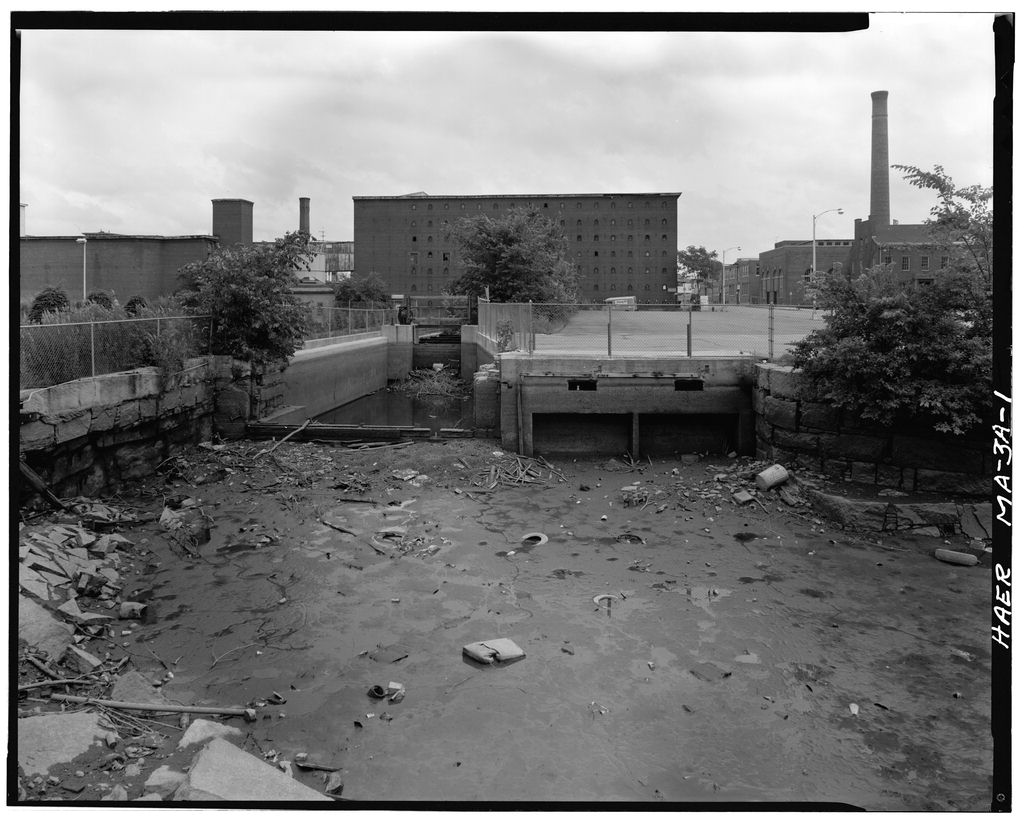
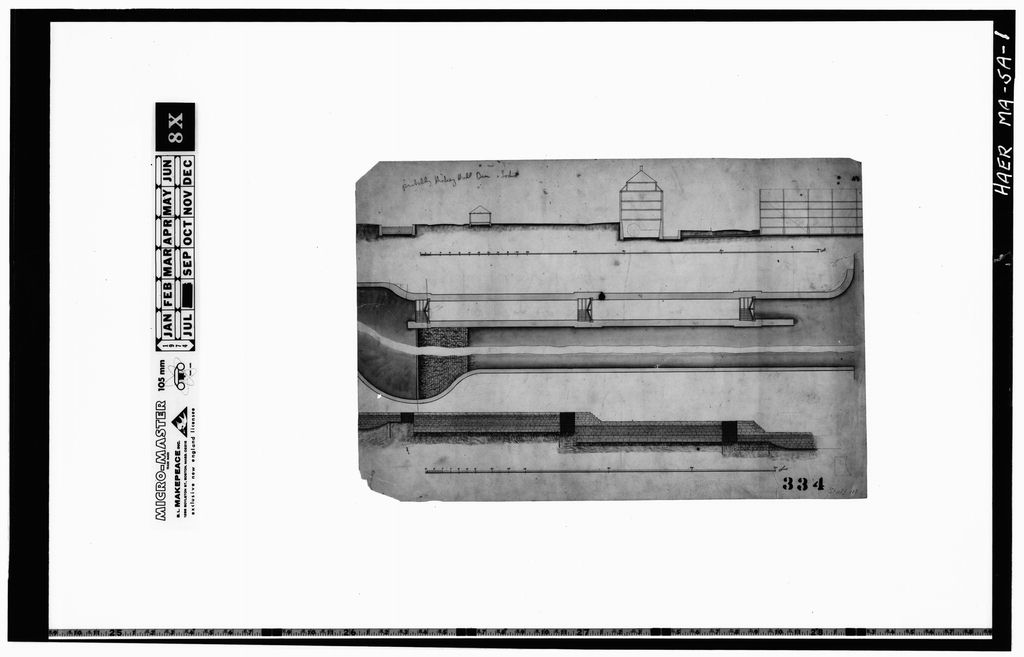
These measured drawings show the site in its present condition and note significant building design and power development features that contributed to the mill complex's growth and expansion. Along with written historical data, these drawings are to be deposited in the Prints and Photographic Division of the Library of Congress for use by the American public without copyright restriction. It is expected that the measured drawings will also assist future building occupants and industrial and architectural developers interested in using the Boott Mills. In this regard, HAER documentation of Boott Mills will contribute significantly to the preservation of Lowell's historic and cultural resources.
As a property located within the boundaries of the Lowell National Historical Park and the Lowell Historic Preservation District, the Boott Mills complex has been the subject of historical research and documentary efforts in the recent past. The most complete site-specific structural history was prepared Boott Cotton Mills HAER No. MA-16 (Page 4) INTRODUCTION (cont.) as part of the Lowell Cultural Resource Inventory, by Shepley, Bulfinch, Richardson, and Abbott in A copy of the summary research report for Boott Mills that utilizes existing documentary resources accompanies this report (Appendix F). A second in-depth research and documentation effort was the Historic Structures Report for Boott Mills No.
6, prepared under the aegis of Flanberg and Associates in coordination with the Denver Service Center, National Park Service. A third historical focus on the site is anticipated for the forthcoming year as a part of a major exhibit development project which is planned for installation in the Mill No. 6 building. Given the above combination of research conducted to date, the future prospectus for exhibit and site development, and the continuing historical interests of the Lowell National Historical Park, it was determined that a guide to historic resources on Boott Mills would enhance, rather than duplicate, previous work and would best facilitate forthcoming projects.
In addition to augmenting the value and utility of existing studies, this resource guide would assist the historical researcher utilizing the Boott Mills architectural drawings by identifying information and issues related to the historical development of the Boott Mills site. Such a resource guide constitutes the HABS/HAER historical report on Boott Mill. Boott Cotton Mills HAER No. MA-16 (Page 5) INTRODUCTION (cont. The HABS/HAER report is divided into three main sections. The first section identifies literary sources, including manuscript and archival material, as well as existing documentary reports that contain data and historical information specifically about Boott Mills.
It also highlights published material, dissertations, and typescript histories that address topics on or related to the Boott Mills complex. This latter material is presented as a bibliographic essay in order to provide some evaluation and a brief description of the titles cited. The second section consists of a catalogue of visual resources including photographs, maps, plans, drawings, and insurance surveys that graphically document or illustrate the physical development of the site. The third and final section includes an essay suggesting opportunities for historical research and study that can draw on a combination of the resources identified in the guide. Boott Cotton Mills HAER No. MA-16 (Page 6) I. LITERARY SOURCES A. Manuscript Collections 1.
Division of Manuscripts and Archives, Baker Library, Harvard Graduate School of Business Administration, Boston, Massachusetts. a) Proprietors of Locks and Canals on Merrimack River, Lowell. vols., 2 cases) The Proprietors of Locks and Canals, organized originally as a turnpike cornpany in began devoting its business to waterpower and real estate development for manufacturing purposes in the under the direction of the Boston Associates. Surviving records date mostly from to The general collection contains an extensive bound series of incoming letters and papers, a series of letter books, general accounting records, and payrolls. There are records for the construction of canals, for kyanizing of lumber, for materials used in mill construction, and for mutual fire insurance standards.
Also included are the professional papers of James B. Francis, William Badger, Hiram F. Mills, Patrick T. Jackson, Kirk Boott, and George w. Whistler. The following list identifies portions of the collection of general research interest and related to the physical development of Lowell's mill and canal system: Letter Books Jackson Letter Books Francis Letter Books Morse Letters and treatsies on hydraulics by Francis 2nd edition of Lowell Hydraulic Experiments, Francis Letter Books of Francis Letter Books re: mutual insurance, Letter Books Francis Paymasters letter book, F.E. Appleton Directors' Records film of nine vols.
(originals in possession of Locks & Canals) Stockholders' Information, Ledgers for Treasurers Ledgers for Machine Shop Ledgers for Agent Indexes for real estate, buildings, materials, and supplies, Boott Cotton Mills HAER No.
MA-16 (Page 7) LITERARY SOURCES - MSS (cont.) Journals, Chelmsford, Lowell Treasurers' Journals, Boston, Agents' Journals, Cash books for Treasurers, Cash books for Agents, Daybook records, Materials on Construction Plans about canal digging, photographs Catalog of 113 land lots sold in Catalog of 123 land lots sold in Catalog of 65 land lots sold in Rents Insurance records Massachusetts Cotton Mills construction estimates, Inventories Payrolls Survey of fire regulations by Francis, Employees' Accounts, Bricks received Delivered to Customers, # Customers: Hamilton, Appleton, Lawrence, Lowell, Merrimack, Suffolk, Tremont, and Boott manufacturing companies. Account of stone to be charged to Boott Cotton Mills, Work done for Boott block, Amount of lumber in one Cotton Mill, c.
Schedule of mills and buildings in Boott Cotton Mills yard, Of additional interest in this collection are the Francis Files (A-l - A-87a). These comprise manuscript and printed materials dating from to which company Agent James B. Francis carefully bound in 85 volumes or placed into boxes simulating volumes. Each item is numbered from C-l to in rough chronological order. The material in these files is catalogued by subject in the main Francis Library catalogue at the University of Lowell Special Collections library. Baker Library also maintains a subject and date index to the Francis Files in the Proprietors of Locks and Canals collection inventory. Among the volumes containing material related to Boott Mills are: Boott Cotton Mills HAER No.
MA-16 (Page 8) LITERARY SOURCES - MSS (cont.) Vol. XIV No. 60 - Rough Draft of Report on experiment of 72" Swain Turbine in Boott Mill No. 5, Vol. XV No. 75-Boott Penstock, Vol. LXII No. 413 - Experiments on Wheel in Boott Weaving Mill, Vol. XI No. 30 - Fire apparatus previous to Vol. IXX No. 96 - Turbines, Vol. XXI No. 109 - Sprinklers, Vol. XXVII No. 134 - Appraisement, Lowell Mills for Mutual Insurance, (Boott Mills incl.) Vol. - Nos. - Tests and experiments of Swain turbines at Boott Cotton Mills b) Boott Cotton Mills, (1 vol., 1 folder) MS 442 Although the Division of Manuscripts and Archives at Baker Library houses company records for most large Lowell corporations of the nineteenth century, no such body of material is available for the early years of Boott Mills' operations.
This collection contains two miscellaneous record items: 1 volume of semi-annual accounts folder, "Report of Committee appointed bi-annual meeting Boott Mills, March 6, to investigate the affairs of the Company." Boott Cotton Mills HAER No. MA-16 (Page 9) LITERARY SOURCES - MSS (cont.) 2. Proprietors of Locks and Canals Company, Boott Mills, Lowell, Massachusetts Early bound records, notebooks, and an original typescript of Directors' Minutes are maintained within a storage vault and in company offices at the present operating location of the Proprietors of Locks and Canals. Included in this colletion are Francis1 work journals; all deeds and records relating to land holdings and transactions since and corporate business records to complete the collection held jointly with Baker Library.
3. University of Lowell Library, Special Collections, Lowell, Massachusetts a) Flather Collection This run of recently acquired manuscript records documents the business and daily operations of Boott Mills and covers the period from c. to The collection offers valuable information about the firm's managerial policies in the early twentieth century, a period of industrial decline in the New England textile industry and of growing competition with southern manufacturers. Several engineering reports dating from offer excellent site specific information about the condition of buildings, machinery, and employee facilities at the turn of the century. A complete inventory of this collection is duplicated and included at the end of this report (Appendix A).
Also worthy of note, and maintained as part of this acquisition, is the business library of Frederick and John Rogers Flather, managing officers of Boott Mills corporation after The titles in this library reflect the personal and business interests of the company's officers and illustrate managerial trends of the latter nineteenth and early twentieth centuries. A catalogue of titles in this collection is included in the field records (Appendix B). Boott Cotton Mills HAER No.
MA-16 (Page 10) LITERARY SOURCES - MSS (cont.) b) Lambert (Channing Whittaker) Collection, The records in this collection, although not pertaining specifically to Boott Mills, contain information about mill construction and engineering activities taken place in Lowell and related to textile nsanufacturing sites in the latter nineteenth century. Included are the working papers of Channing Whittaker, a university trained mill engineer, MIT mechanical engineering instructor, mill building consultant, and textile machinery patentee. About one hundred small record notebooks feature field notes and drawings of machinery, water supply piping, and architectural designs related to Lowell's textile mills and those of the surrounding New England area.
Additional material includes patent correspondence copies of student engineering projects; lectures and records at MIT; and miscellaneous personal papers. Whittaker's personal and professional library is also held as part of this archival group and features many titles depicting contemporary mill engineering practice and design. A copy of Whittaker's book list appears in the field records. (Appendix C). 4. Division of Technical Services, Lowell National Historical Park, Lowell, Massachusetts. a) Ariel C. Thomas Collection Ariel C.
Thomas was Agent at Boott Cotton Mills at the end of the nineteenth century until The principal part of this collection is made up of trade catalogues, production manuals, and other published material related to textile machinery and manufacturing (see Appendix D). However, a series of four charts included in this collection represent manuscript material worthy of note. These are rolled blueprints marked A.C. Thomas, c/o Boott Mill, Wages." They identify wages at Boott Mills manufacturing company and compare these figures with wages at other Lowell textile mills at other Massachusetts, Maine, and New Hampshire mills; and the Pacific Mills of Lawrence, Massachusetts, for the years Boott Cotton Mills HAER No. MA-16 (Page 11) LITERARY SOURCES - MSS (cont.) 5.
Massachusetts Historical Society, Boston, Massachusetts The personal manuscript collections housed at this repository concern the personal and business biographies of Lowell mill directors and principal Boston-based stockholders. Of particular interest is a stockbook maintained in the Lawrence Collection which contains valuable financial information about many of Lowell's large textile mills and manufacturing corporations. The Appleton collection is another valuable manuscript group in this repository. William Appleton's seven volume diary represents one of the best single sources of information about the textile industry's relationship to the Boston financial community. LITERARY SOURCES - Reports B. Unpublished Reports 1.
"Lowell National Historical Park and Preservation District Cultural Resource Inventory prepared for Division of Cultural Resources, North Atlantic Regional Office, National Park Service," Shepley, Bulfinch, Richardson, and Abbott This Cultural Resource Inventory (CRI) is a valuable reference guide for researchers concerned with Lowell's history. This fourteen volume inventory is a comprehensive survey offering historical, architectural, and pictorial documentation of commercial, residential, and industrial structures in Lowell's preservation districts. Several hundred buildings are included in this work. Volume I of the industrial sites survey (A-B) contains inventory forms for each of the buildings within the Boott Mills factory complex.
A very informative research report that summarizes the structural and power development of the site also accompanies the inventory forms. This report draws on extant visual evidence including contemporary maps, plans, lithographs, photographs, and insurance surveys as the basis for primary source and historical information. No other substantial body of evidence is available documenting the period of Boott Mills initial growth and expansion prior to A copy of the Boott Mills research report is provided in the field Boott Cotton Mills HAER No. MA-16 (Page 12) LITERARY SOURCES - Reports (cont.) records (Appendix F).
Copies of the Cultural Resource Inventory are kept at the Lowell National Historical Park, the Lowell Historic Preservation Commission, The University of Lowell Special Collections, and the Lowell Public Library. 2. Historic Structures Report, "Boott Cotton and Massachusetts Cotton Mills Agents House, 67 and 63 Kirk Street," prepared for the Lowell National Historical Park by John Robbins, Denver Service Center This report documents the design, construction, occupancy, and site history of the Agent's house located on Kirk Street near the Boott Mills complex. The building was erected in as a joint venture between the Boott and Massachusetts cotton manufacturing companies to provide dwellings for their resident agents.
The report offers additional architectural and historical documentation on the physical and social development of Lowell's textile industry. A copy of this report is on file at the Lowell National Historical Park Library. 3. Historic Structures Report, "Boott Cotton Mills No. 6," prepared for the Lowell National Historical Park by Russell Wright and Laurence Gross, Flansberg & Associates, Denver Service Center The architectural section of this report discusses the development of the Boott Mills site, its structural design (including floors, beams, columns, walls, roofs, windows, and towers), and its interior mechanical features such as lighting, heating, and ventilation equipment. Principal emphasis is given to Mill No.
6, built in However, introductory sections treat the general development of the site as a whole. A second portion of this report describes and details the occupancy and use of Mill No. 6, including machinery layout, work process, and work organization. This latter section concentrates on building use and manufacturing operations of the nineteenth and early twentieth centuries. A copy of this report is on file at the Lowell National Historical Park. Boott Cotton Mills HAER No. MA-16 {Page 13) LITERARY SOURCES - Published C, Published Material, Dissertations, and Typescripts The following bibliographic essay identifies and evaluates literary sources that will assist the historical researcher studying the Boott Mills complex.
The group of books, articles, and typescripts listed here yield information about the architectural, technological, engineering, and industrial history of the site. An attempt also has been made to include titles that place the physical development of Boott Mills within a larger historical and sociological context. As an aid to organization and as a means of outlining important historical and research areas, the essay below is divided into several main subject categories. They include factory design and mill engineering, power, machines and textile technology, and labor-management relations. The sources cited within these categories do not constitute a definitive or exhaustive list of literary material available on this topic.
Rather, the titles have been selected because they best introduce the reader and researcher to the subject matter under discussion, or because they provide primary historical documentary material specifically related to Boott Mills. Boott Cotton Mills HAER No. MA-16 (Page 14) LITERARY SOURCES - Published (cont.) 1. Factory Design and Mill Engineering Architectural historians have generated numerous studies on mill architecture and textile factory design during the past several decades. Only one study, however, focuses on the architectural development of Lowell's industrial community. This is John Coolidge's Mill and Mansion, A Study of Architecture and Society in Lowell, Massachusetts, first published in and reprinted in (New York).
Coolidge examines Lowell's factory architecture as it relates to the social organization and physical layout of the planned industrial city. The book is noteworthy because it presents a social interpretation of Lowell's historic architecture; an impressive essay in when architectural histories concerned themselves with little more than aesthetic and stylistic interpretations of American building design. However, the book presents several shortcomings that disappoint the student of industrial architectural history. First, Coolidge focuses on land use patterns and on the architecture of residential, commercial, and institutional structures; little space is given over to assessing the development of textile factory design.
Second, the author ends his analysis at ignoring the post-Civil War period of industrial expansion, increased urbanization, and immigration. Still, no comparable study has yet superseded Boott Cotton Mills HAER No. MA-16 (Page 15) LITERARY SOURCES - Published (cont.) Coolidge's work. Mill and Mansion represents both a standard and classic study of Lowell's nineteenth century industrial and architectural development. Several unpublished student papers add to Coolidge's study and focus more directly on mill architecture and factory design. "The Architecture of the Cotton Textile Mills of Lowell, Massachusetts, by Ted Sande, written in examines the physical development of the Lowell style mill.
The author is most concerned with nineteenth century building traditions and technological change during an era of industrial transformation. Sande's paper is profusely illustrated and his historical interpretation rests heavily on nineteenth century literary sources. As a relatively brief essay, this paper is an excellent introduction to antebellum cotton mill design at Lowell. Another noteworthy introduction to Lowell's mill architecture is "The Architecture of the Lowell Textile Mills, by Donna Cassidy. Cassidy seeks to interpret the utilitarianism of Lowell mill design as an outgrowth of nineteenth century American social values.
Although the paper is relatively short and the author's argument is not fully developed, Cassidy presents an interesting historiographic analysis of nineteenth Boott Cotton Mills HAER No. (Page 16) LITERARY SOURCES - Published (cont.) century architectural styles as they affected industrial building design. Typescripts of both the above papers are kept on file at the University of Lowell Special Collections and at the Lowell National Historical Park library. A more general survey and analysis of Lowell mill architecture may be found in William Pierson's four-volume series American Buildings and Their Architects.
Volume II, sub-titled Technology and the Picturesque, the Corporate and Early Gothic Styles, attempts to explore the social forces behind American architecture of the nineteenth and twentieth centuries. Chapter 2 in this volume is devoted to the evolution of factory design and the emergence of a new industrial order and building style beginning in the late eighteenth and early nineteenth centuries. Here, Pierson describes the Lowell mills and their architectural precedents at Waltham. The author also places these factory designs along a chronological and geographic continuum, discussing other New England textile factory sites that preceded and followed Lowell.
In this regard, Pierson effectively demonstrates the evolutionary nature of industrialization through its architecture and material culture. However, the author's analysis remains rooted in an architectural history of factory design, rather than Boott Cotton Mills HAER No. MA.-16 (Page 17) LITERARY SOURCES - Published (cont.) successfully realizing a social history of industrial architecture. Like Coolidge and the student papers mentioned above, Pierson's investigation does not extend beyond the In addition to these secondary works specific to Lowell, several short primary source publications merit special attention.
These nineteenth century works contributed to the above authors' research and writing, however, the primary source material is worthy of separate mention, because it offers first-hand accounts of the early Lowell factories' design and physical layout. The first such article, prepared by civil engineer Ithamar H. Beard and published in the Journal of the Franklin Institute (January is titled, "Practical Observations on the power expended in driving the machinery of a Cotton Manufactory at Lowell." As indicated by this title, Beard is principally interested in the hydraulic and mechanical requirements of cotton textile manufacturing.
The article contains explicit information about water power generation and transmission, the arrangement of machinery, and the integrated textile production process at one of the Hamilton Manufacturing Company mills. This same arrangement probably served as a model for building the earliest of the Boott Cotton mills in In addition to yielding detailed information, the article conveys a Boott Cotton Mills HAER No. (Page 18) LITERARY SOURCES - Published (cont. ) vivid picture of the mill building as a "factory system." Similar impressions can be gained from James Montgomery's A Practical Detail of Cotton Manufacture of the United States of America...
(Glasgow, Montgomery compares factory design, machinery layout, fire protection methods, interior sanitary facilities, and power transmission systems of American textile factories with those in Great Britain. The author focuses his comments on Lowell style corporate mills located in northeastern New England, although some mention is made of other large cotton manufacturing districts located in western Massachusetts, Rhode Island, Connecticut, New York, New Jersey, and Pennsylvania. Although American textile factory design reflected native vernacular building traditions, the emergence of the textile industry in New England and the evolution of an industrial building style drew strongly upon British antecedents.
Several modern British architectural historians have examined English industrial architecture and mill design of the latter eighteenth and early nineteenth centuries. Among the more general pictorial surveys of surviving industrial structures is The Architecture of the Industrial Revolution, (London, by Brian Bracegirdle. Of special note in this well illustrated volume is an essay by industrial archeologist and historian Boott Cotton Mills HAER No.
(Page 19) LITERARY SOURCES - Published (cont.) Jennifer Tann on "Building for Industry." Perhaps the best analytical study and history of English factory design, however, is Tann's own book, The Development of the Factory (London, Using engineering and architectural drawings in the historical collections of Boulton and Watt, Tann traces the structural and technological development of British factory design for mechanized industries. The author argues that the requirements of power generation and transmission systems, as well as the process of manufacture, determined the form and style of factory design.
In addition to discussing structural features of industrial architecture, Tann also provides a good account of interior factory features such as the development of heating, fire protection, and ventilation in English mills. A more sweeping account of British and European factory architecture is Nikolaus Pevsner's encyclopedic study, A History of Building Types (Princeton, In a single chapter Pevsner surveys the history of industrial building design, from Colbert's royal workshops in seventeenth century France to the International Modern style of industrial buildings in the twentieth century. The author also interjects information about contemporary social movements surrounding the diffusion of industrial production systems in the nineteenth century.
However, the majority of Pevsner's writing is devoted to a Boott Cotton Mills HAER No. (Page 20) LITERARY SOURCES - Published (cont.) structural history of industrial building styles. Although largely descriptive in treatment and narration, this chapter is useful in placing American factory architecture within a broader international perspective. Another useful study is Industrial Architecture, A Survey of Factory Building by John Winter (London, The first part of this book is analytical, examining mill development of the eighteenth and nineteenth centuries from the point of view of power sources and type of industry. The second part is more conventional in describing the development of modern architecture.
Despite this discontinuity in presentation and analysis, Winter's book contains good data about English factory design. Unlike the above architectural studies, business historian S. D. Chapman assesses industrial building design as it relates to production organization in a thoughtful article titled, "The Factory Building Before Arkwright. A Typology of Factory Development," (Business History Review, vol. 48 Chapman surveys eighteenth century English insurance records to trace the gradual evolution of industrial production.
The author's typology outlines the various stages in the development of the archtypical nineteenth century factory building as described by James Montgomery, (author of A Practical Detail) in Chapman suggests that neither size, power source, nor the Boott Cotton Mills HAER No. m-ie (Page 21) LITERARY SOURCES - Published (cont.) method of supervising workers are useful criterion by which to identify the fully evolved "modern" Arkwright style factory. Rather, he concludes that the essential feature of the modern factory form was the organization of a flow production system; differing from the batch production systems more typical of earlier workshop methods of manufacturing.
The influence of English factory design on early American textile mill building is further addressed by several American authors. However, this topic is generally included as an introduction to a more extensive analysis of early New England textile mill architecture.
A good example of this body of literature is Ted Sande's analytic survey of Rhode Island factories, which appeared originally as a doctoral dissertation titled, "The Architecture of the Rhode Island Textile Industry, (University of Pennsylvania, A very good capsule summary of Sande's thesis appears in a short article titled, "The Textile Factory in Pre-Civil War Rhode Island," in Old Time New England, the journal of the Society for the Preservation of New England Antiquities, (Summer-Fall, A second article published by the same author appears in the Journal of the Society of Architectural Historians (December and is titled "The Architecture of Industry." Sande's Boott Cotton Mills HAER No.
MA-16 (Page 22) LITERARY SOURCES - Published (cont.) original research offered speculation concerning the different building materials found in Rhode Island's stone mills as compared with the brick mills of northern Massachusetts (i.e. the Lowell type). He argued that the more solidly built stone mills reflected the mortal perceptions of the business partnership, which was a common form of business organization among Rhode Island's textile mill owners. In contrast, he believes the modular brick factories at Lowell and its satellites embodied the more forward looking expectations and expansive spirit of the city's corporate founders.
Another recent essay, "A Factory system of Wood: Cultural and Technological Change in the Building of the First Cotton Mills," in Brooke Hindle, ed., Material Culture of the Wooden Age (Tarrytown, New York, draws attention to the particular style and building technology of early Rhode Island spinning mills. Author Gary Kulick interprets the Almy, Brown, and Slater mill Pawtucket, Rhode Island, as a structural artifact that reflects English influences while incorporating the characteristics of an American material culture. In the course of their own scholarly researches, the above authors have been involved with site specific field surveys of surviving textile factories and other industrial sites. Sande, Boott Cotton Mills HAER No.
MA-16 (Page 23) LITERARY SOURCES - Published (cont.) for example, has drawn documentary information from selected drawings and data gathered during the "New England Textile Mill Survey,n a field project conducted under the joint auspices of the Smithsonian Institution, the Historic American Buildings Survey, and the Merrimack Valley Textile Museum (now the Museum of American Textile History) in and Sande later edited The New England Textile Mill Survey - Selections from the Historic American Buildings Survey (Washington, Gary Kulick has taken part in industrial site field inventories, leading to the Historic American Engineering Record (HAER) publication, Rhode Island, An Inventory of Historic Engineering and Industrial Sites (Washington, produced with the assistance of Julia C. Bonham.
Other available New England industrial site inventories include The Lower Merrimack River Valley, by Peter M. Molloy (Washington, and Connecticut, by Matthew Roth (Washington, Each of these inventories provides site specific identification and information that is generally overlooked by the traditional academic industrial history researcher. The above inventories are valuable research and reference tools. They identify extant factory structures and indicate documentary sources that introduce the historical researcher to opportunities for field and scholarly study. Boott Cotton Mills HAER No. MA-16 (Page 24) LITERARY SOURCES - Published (cont.) The building development of textile mills other than the Rhode Island spinning and Lowell style mills is reviewed by several historians.
Their work is noteworthy because these writers demonstrate that small to medium sized cotton and other integrated textile mills continued to operate along side the more dominant, large-scale corporate enterprises of the Lowell type throughout most of the century. In addition, they examine gradual changes that occurred in small rural mill villages and entrepreneurial communities in an era when the industrial centers of Lowell, Holyoke, Chicopee, and Lawrence, Massachusetts, and Manchester, New Hampshire, were burgeoning cities. One such essay is "Textile Mill Architecture in East Central New England: An Analysis of Pre-Civil War Design," by Bryant F.
Tolles, published in Essex Institute Historical Collections (July, Another short piece, "Concord's Factory Village, by Charles Hammond, accompanies Sande's above article in Old Time New England (Summer, Richard Candee authors a third article of interest in the same journal volume, titled, "The 'Great Factory* at Dover, New Hampshire: The Dover Manufacturing Company Print Works, Candee's works are perhaps the most significant and the most varied of this group of authors. Of particular interest are a series of diverse essays he wrote that examine New Hampshire and Boott Cotton Mills HAER No. MA-16 (Page 25) LITERARY SOURCES - Published (cont. northern New England textile mill architecture. These include: "The Early New England Textile Village in Art," featured in Antiques, vol.
98 (December, an article which contributed to an exhibit at Old Sturbridge Village in and "Three Architects of Early New Hampshire Mill Towns," in Journal of the Society of Architectural History, vol. 30 (December, Candee also combines scholarly research with an interest and involvement in field study. An example of the author's activity in this regard is "Industrial Architecture in the Quinebaug and Blackstone Valley," a field guide prepared for the Society for Industrial Archeology and the Society of Architectural Historians, Boston Chapter, More recently, Richard Candee1s research and writing explores the development of nineteenth century mill architecture within a social and institutional setting.
Two articles reflecting his interpretative approach include, "New Towns of the Early New England Textile Industry," in Perspectives in Vernacular Architecture, Camille Wells, ed. (Vernacular Architecture Forum, and "Architecture and Corporate Planning in the Early Waltham System," in Art, Industry, and the City: Essays from the Lowell Conference on Industrial History, and Robert Weible, ed. (forthcoming). Boott Cotton Mills HAER No. (Page 26) LITERARY SOURCES - Published (cont.) The majority of secondary literature on New England mill architecture and textile factory design examines the historical development of industrial architecture before An exception to this trend is Sylvia Chace Lintner's article, "Mill Architecture in Fall River, in The New England Quarterly, vol.
21 (June Lintner's chronological focus is largely determined by her subject matter, as the most significant activity in the industrial growth of Fall River occurred after The author examines a style of textile mill design that ressembled English models rather than standard American prototypes of the mid-nineteenth century. Lintner argues that the production of fine count cotton yarns at Fall River, in contrast to the production of coarse yarns at Lowell, accounts for the large and wider Fall River spinning mills. The article traces the development of these mills and discusses such things as the use of steam power and an entrepreneurial form of business organization in Fall River.
Whether of English or American origin, the principal structural features of New England textile factory design were largely standardized by However, a host of internal technological changes were occurring within the physical factory setting in the latter nineteenth century. In addition, methods of mill design and building moved away from the field of traditional, Boott Cotton Mills HAER No. (Page 27) LITERARY SOURCES - Published (cont.) empirical practice and became the concern of technically trained professional mill engineers. Both trends represented a desire on the part of textile manufacturers and managers to rationalize production methods during an era of more intense industrial competition both in the north and in the south.
The post-Civil War development of American mill design affected building and machinery layout, work organization, power generation and transmission equipment, and interior working conditions involving lightning, heating, and ventilation equipment. American scholars and historians of technology have largely overlooked this latter period of mill architecture, engineering, and factory design. As a result, the historical researcher examining the Boott or other Lowell mills must look to contemporary published and primary sources. Several mill engineers of the period have generated their own literature on the subject.
In addition, the surviving physical structures provide information on mill design and construction practices of the latter nineteenth and early twentieth centuries, A third source of material can be found in the trade literature of the New England Cotton Manufacturer's Association (NECMA). Published Transactions of the Association's semi-annual meetings cover a variety of technical design issues concerning mill agents and manufacturers. Boott Cotton Mills HAER No. MA-16 (Page 28) LITERARY SOURCES - Published (cont.) A good, comprehensive overview of the development of New England textile mill design and industrial engineering after was prepared by Charles Jeptha Hill Woodbury and appeared in the Scientific American in This two-part article, "The Evolution of the Modern Cotton Mill," (vols.
is a reprint of a series of lectures Woodbury delivered to Cornell University engineering students in and An equally good narrative illustrating the application of more scientific methods to mill engineering and factory design was prepared by Edward Sawyer for the Journal of the Association of Engineering Societies, vol. 8, {November and is titled, "Mills and Mill Engineering." This same article also appears in Engineering and Building Record, vol. 21, Sawyer traces the development of textile mill design as it relates to power generation methods and equipment.
This topic is also addressed by mill engineer Stephen Greene, partner of textile mill design firm Lockwood Greene and Company, in "Modifications in Mill Design Resulting from Changes in Motive Power," published in Transactions, New England Cotton Manufacturers Association, vol. 65, (October, Greene comments on the introduction of electrical power generation to textile production and its effect on the location and design of cotton mills. Boott Cotton Mills HAER No. MA-16 (Page 29) LITERARY SOURCES - Published Several contemporary educational texts outline the fundamental structural features of textile mill building methods at the end of the nineteenth and early twentieth centuries.
A standard pamphlet in this field is Charles T, Main, Notes on Mill Construction (Boston, Main prepared this manual for mechanical engineering students at MIT, where he gave lectures on the subject. Main was also a prominent mill engineer and designer of the large Wood and Ayer mills of Lawrence, Massachusetts in the early Notes covers such topics as site selection, foundations; brickwork and stonework above foundations; floors and roofs; columns; and other structural and architectural details, including doors and windows. The booklet reflects standard mill engineering practice and also sheds some light on ways in which Main's methods deviated from the usual techniques recommended by the Factory Mutuals fire insurance companies.
The pamphlet further demonstrates the nature and content of instruction received by prospective mill engineers at MIT after An informative textbook introducing the subject of modern mill engineering practice was published as part of the International Library of Technology (Scranton, Volume no. 78, titled Yarns, Cloth Rooms, Mill Engineering, Reeling, and Baling, Winding. Most of the material in the volume was copyrighted Boott Cotton Mills HAER No. MA-16 (Page 30) LITERARY SOURCES - Published (cont.) circa but it still includes useful data on basic, "turn of the century" principles of mill design. Of special interest, and not found in most sources, is a narrative describing interior factory furnishings (other than production equipment) required for a cotton mill.
A brief but very good account of mill construction and factory design is also presented in How to Build, Equip, and Operate a Cotton Mill in the United States, published by Frank T. Bennett and Company (Boston, Two contemporary primary works describe English factory construction of the latter nineteenth century and afford a comparison with American engineering practice and methods of the same period. The first is Recent Cotton Mill Construction and Engineering by Joseph and Frank Nasmith (Manchester, England, In an especially good introduction, the Nasmiths analyze textile mill design and development from the point of view of capital investment, machine technology, production capacity, and power generation and transmission methods.
They also address mill construction and fire protection methods, as well as lighting, heating, and ventilation equipment used in English cotton mills. The second article, is "Report on English Cotton Mills and Methods," by factory insurance executive Edward Atkinson. It appeared in the Transactions of the New England Boott Cotton Mills HAER No. MA-16 (Page 31) LITERARY SOURCES - Published (cont.) Cotton Manufacturers Association (October Atkinson discusses the features of English fire proof construction and American fire resistant construction methods, the location of heating systems, methods of lubrication, and machinery organization. Information about the rise of professional mill engineering in the northeastern United States is available in several sources.
A good company history that traces the transition from millwright and manufacturer to professional mill designer and engineer is Lockwood Greene, The History of an Engineering Business, by Samuel B. Lincoln (Brattleboro, A primary source for material on the mill engineering profession and the community of New England factory designers of the latter nineteenth century is Lamb's Textile Industries of the United States, first published in and reprinted in (Boston). This two volume work contains two articles worthy of note: "The Evolution of the Transmission of Water Power," by Charles T. Main; and "Mill Engineering," by Main's partner and engineering associate, Dean.
This two volume work also features a series of biographical sketches and professional portraits of the textile industry's most prominent mill engineers of the Boott Cotton Mills HAER No. MA-16 (Page 32) LITERARY SOURCES - Published (cont. ) period, including Charles T. Main, Dean, Francis P. Sheldon, Stephen Greene, Stuart Cramer, William T. Henry, and H. Dyer. Several personal libraries belonging to former mill engineers and currently in the hands of public repositories contain valuable works in the field of industrial engineering and factory design these books also reflect the interests and concerns of their collectors. One such collection is the "Channing Whittaker Book Collection," belonging to the Lowell Museum and maintained at the University of Lowell Library, Special Collections.
Whittaker was a mechanical engineering instructor at MIT and a consulting engineer for the Lowell mills. His library concentrates on design theory and drawing, and on structural engineering (see Appendix C in the field records). A more extensive and technically oriented book collection is the James B. Francis Library at the University of Lowell, Special Collections. Several thousand titles are maintained in Francis' personal and professional library covering a variety of topics emphasizing hydraulic engineering and the legal management of water power privileges. Francis' collection also contains books on the strength of materials. Boott Cotton Mills HAER No. (Page 33) LITERARY SOURCES - Published (cont.) mill engineering, and mill construction.
A cross-indexed collections catalogue is housed at the University of Lowell Library. Most of the available literature of the period discussing textile mill engineering and factory design treats brick and masonry factory construction. The general application of reinforced concrete to textile mill design, whether in the northeast or in the southern textile industry, came only after the building material became more widely used for bridges, machine shops, auto assembly plants, and commercial buildings in the early century. Early discussions on the subject took place among members of the New England Cotton Manufacturers1 Association, as evidenced by one article entitled "Reinforced Concrete as Applied to Factory Construction," Proceedings of the NECMA, vol.
80 April As of few architectural or industrial historians have examined this topic in a fully systematic or analytical way. An exception to this is a recent brief article that suggests opportunities for further study. This is Reyner Banham's "Ransome at Bayonne," appearing in the Journal of the Society of Architectural History (Spring, The fire protection of textile factories was a critical concern among New England manufacturers throughout the nineteenth and Boott Cotton Mills HAER No. MA-16 (Page 34) LITERARY SOURCES - Published (cont.) early twentieth centuries. Flammable cotton dust and lint in mill rooms, the vaporization of machinery lubricating oils, and heating and lighting facilities all posed serious fire hazards within cotton mills.
Cotton manufacturing also represented a highly combustible process compared with other mechanized industries. Although textile manufacturers realized they could not eliminate factory fires, they sought to reduce the causes of mill fires and to minimize the extent of loss in the event that fire occurred. The earliest and best known pioneer in this field was Zachariah Allen of Providence, Rhode Island, who introduced the principles of "slow-burn" mill construction in Allen's innovative system for structural mill design employed heavy timber beams and thick plank floors to replace earlier methods of using thin floor and joist construction. The heavy timber members charred rather that readily burned when exposed to fire and thus limited fire damage.
In addition, Allen organized the manufacturers' mutual system of fire protection and insurance in Rhode Island. The mutuals insurance system was later followed by Massachusetts and New Hampshire textile firms. Manufacturers' mutuals fire insurance enforced standards for mill construction and design methods which furthered fire Boott Cotton Mills HAER No. MA-16 (Page 35) LITERARY SOURCES - Published (cont.) protection practices. Several commissioned company histories on the subject provide informative accounts of the factory mutuals system and its influence on textile mill design.
Among the best and most concise of these publications is Factory Mutual Insurance, The Achievements of Seventy-Five Years Compiled to Observe the Anniversity of the Arkwright Mutual Fire Insurance Company (Boston, Dane Yorke's Able Men of Boston, the First One Hundred Years of the Boston Manufacturers' Mutual Fire Insurance Company (Boston, also gives a good survey of the individuals involved with that company. A third company history, The Factory Mutuals, (Providence, traces the development of the factory mutuals idea and the eventual consolidation of various Rhode Island and Massachusetts mutual fire insurance companies at the end of the nineteenth century.
The extent to which Lowell's factory development contributed to design and engineering standards adopted by the Factory Mutuals system is largely overlooked or neglected in the foregoing company histories. Yet it is apparent from the historical record that the Lowell mill owners exercised precautions in designing and equipping their textile factories against fire loss at a relatively early date. A destructive fire at the Merrimack Manufacturing Company in for example, prompted Boott Cotton Mills HAER No. (Page 36) LITERARY SOURCES - Published (cont.) Lowell's mill executives to jointly determine the best methods of insuring against, and limiting, similar capital losses in the future.
The separation of the picking process from the other manufacturing facilities and the substitution of steam heating pipes for hot air furnaces were among the issues discussed among mill directors at Lowell in Thereafter, picking machinery was housed in a semi-detached structure adjacent to the main textile factory. Steam heating was not installed until the early although slow-burn construction materials were adopted by the textile corporations at least by the as evidenced at Boott Mills, Fire protection remained an important issue among Lowell's textile corporations involving structural mill design, hydraulic equipment, and sprinkler systems.
In the city's textile manufacturing executives formed the Lowell Manufacturers' Mutual Fire Insurance Company, serving only local industrial members (for this reason the Lowell mill complexes are not generally documented by other regional insurance survey companies such as Sanborn and Barlow). The Lowell Manufacturers' Mutual employed James B, Francis, Agent and Chief Engineer of the Proprietors of Locks and Canals, as the insurance company's Agent and principal inspector. Locally published and primary records documenting Francis' activities in this latter capacity are maintained in Boott Cotton Mills HAER No. MA-16 (Page 37) LITERARY SOURCES - Published (cont.) the Proprietors of Locks and Canals Company records at Baker Library.
The record items document provisions for hydrant and sprinkler systems at each mill, details of mill construction, machinery and production process layout, and lighting and heating techniques. It is especially noteworthy that Francis took an early and pioneering interest in supplying water to the mills for the purposes of fire protection.
His methods were later adopted and further developed by the highly influential Boston Manufacturers' Fire Insurance Company after A detailed summary of Francis' involvement in this field, on the early development of fire stream hydraulics, and on Lowell's industrial fire protection system was prepared by Francis for the Journal of the Franklin Institute in This article is titled, "On the Means Adopted in the Factories at Lowell, Massachusetts, for Extinguishing Fires." Francis' early experiments on the flow of water through cast iron pipes, an area of research later taken up by the Boston Mutuals company, is also documented in Francis' Files for the and (see Proprietors of Locks and Canals, Baker Library).
Following Francis' efforts, the earliest and most comprehensive manual outlining the state of the art of fire protection methods for textile factory design of the latter nineteenth century was Boott Cotton Mills HAER No. MA-16 (Page 38) LITERARY SOURCES - Published (cont.) published by the Boston Manufacturers' Mutual Fire Insurance Company in This classic volume, authored by Charles Woodbury, is titled, Fire Protection of Mills, and Construction of Mill Floors: Containing Tests of Full Size Mill Columns (New York). The book reflects the promotional and educational efforts of the Boston Manufacturers' Mutual Fire Insurance Company and its executive director, Edward Atkinson.
It was this volume that established the use of wooden columns in slow-burn mill construction over cast iron columns as a standard mill engineering practice. The author makes reference to James B. Francis' perforated sprinkler and water supply systems at Lowell, but neglects to discuss Francis' contributions to the development of fire stream hydraulics later pursued by the Boston Mutuals Company.
Boston Manufacturers' Mutual Fire Insurance Company director Edward Atkinson advanced the structural standards of the Factory Mutuals system with missionary zeal at the end of the Atkinson's publications and promotional campaign in this area brought slow-burn construction methods to the attention of architects as well as engineers and affected other types of commercial and institutional building construction. An ^h excellent summary article illustrating Atkinson's work in this Boott Cotton Mills HAER No. (Page 39) LITERARY SOURCES - Published (cont.) regard is "Slow Burning Mill Construction" published in the Century Magazine, vol.
37 (February, Other promotional pamphlets Atkinson authored include The Fire Engineer, Architect, and Underwriter (Boston, and The Architect and the Underwriter, The Relations Between Them (Boston, The extent to which the Boston Manufacturers' Mutual Fire Insurance Company, whose membership initially involved principally cotton manufacturers, later influenced industrial building standards and general factory design is reflected in several engineering editions of the latter nineteenth century. One such publication is Joseph Kendall Freitag's Fire Prevention and Fire Protection as Applied to Building Construction. A Handbook of Theory and Practice (New York, Another is F.
Kidder, The Architect's and Builder's Handbook originally published in and reissued in numerous editions that include sections on standard mill construction methods. In addition to fire protection methods, the strength of materials represents an important topic concerning mill engineering and factory design after particularly in the United States. The Pemberton Mill collapse in Lawrence, Boott Cotton Mills HAER No. MA-16 (Page 40) LITERARY SOURCES - Published (cont.) Massachusetts, focussed attention on the strength and suitability of cast iron columns for cotton mill construction. A total of 361 persons were killed or injured as the result of the mill's collapse and subsequent fire.
The disastrous incident prompted manufacturers and mill engineers to make the safety of factory support systems a matter of immediate concern. James Francis was one of the consulting engineers who testified before a jury of inquest following the Pemberton's collapse. A typescript of his account and inspection report on the site after the accident is located in a bound volume of Francis papers at the University of Lowell Library Special Collections (No. In this testimony, Francis carefully describes each major construction component and design detail of the Pemberton Mill, and makes explicit references to the comparative or contrasting features of the Lowell textile mills for the same period.
Francis and others attributed the primary cause of the Pemberton's structural failure to defective cast iron columns. He found that the mill columns were poorly cast, exhibited blow holes, and were thin in places. The severity and notoriety of the event led Francis to undertake a systematic investigation into the strength of cast iron columns for industrial building purposes. Francis' experiments resulted in Boott Cotton Mills HAER No. MA-16 (Page 41) LITERARY SOURCES - Published (cont.) a table of acceptable structural design standards for this material and are referred to in Charles T. Main's student text, Notes of Mill Construction.
The early development of slow burn construction in the United States and a propensity for Americans to rely on a material culture of wood rather than iron partly accounts for the lack of empirical knowledge or standards for computing the strength of cast iron supports. Most early English investigations on the subject emphasized standard tables for cast iron girders rather than vertical supports. However, after James Francis directed his attention to this latter avenue of study. Francis reported on his work in an important treatise titled, On the Strength of Cast Iron Pillars, with Table for the Use of Engineers, Architects, and Builders (New York, In this volume, Francis traces the historical development of rules and standards devised for cast iron in building.
He makes reference to several significant works preceeding and contributing to his own investigation including, Thomas Tredgold's Practical Essay on the Strength of Cast Iron and Other Metals (London, and a fourth edition of Tredgold's treatise expanded and published in "with Notes by Eaton Hodgkinson, to Boott Cotton Mills HAER No. MA-16 (Page 42) LITERARY SOURCES - Published (cont.) which are added Experimental Researches on the Strength and Other Properties of Cast Iron." Another important reference cited by Francis is William Fairbairn, On the Application of Cast and Wrought Iron to Building Purposes (London, 3rd edition).
In his own volume, Francis computed tables for employing cast iron pillars in mill design and established rules for their use which were widely applied to American mill engineering and building design before A renewed concern for low cost, fire resistant mill construction materials and factory design drew attention towards another area of investigation involving the strength of materials in the latter nineteenth century. Beginning in Edward Atkinson and the Boston Manufacturers Mutual Fire Insurance Company sought to improve mill construction and fire protection methods in order to reduce insurance risks.
Atkinson believed in expanding upon the principles of using wood members in slow-burn construction because of the lower cost of materials, especially when compared with English methods of fire-proof construction (an excellent description of British fire-proof construction, employing vaulted floors consisting of iron beams and brick arches, is given in William Fairbairn's treatise noted above). Prior to the American approach to slow-burn construction consisted of building with heavy timber beams, thick plank Boott Cotton Mills HAER No. MA-16 (Page 43) LITERARY SOURCES - Published (cont.) floors, and relatively flat roofs. However, the question of the best material for use in mill columns was still widely debated.
Cast iron columns, such as appear in the Boott and other Lowell mills, were believed to be susceptible to fracture and weakening when exposed to hot flames and then drenched with water. Moreover, in the United States cast iron was a relatively expensive building material compared to wood. Atkinson and fellow underwriters thus determined that the safest post "with respect to fire only" was a wooden column of sufficiently large size to correspond to the slow burning characteristics of the timbers. It was necessary, however, to assemble information on the strengths of wooden columns, for which little experimental data was available to use in computing rules and formulas.
To this end, Atkinson engaged the services of Gaetano Lanza, professor at MIT, to supervise the testing of full size wooden columns on the Emery Testing Machine at Watertown Arsenal, Watertown, Massachusetts. Lanza delivered a report on his tests before the Society of Arts of the Massachusetts Institute of Technology in December, A printed copy of his address was published in the Boston Journal of Commerce, vol. 19 (January 18, Another source for Lanza's experimental results is Woodbury's Boott Cotton Mills HAER No. MA-16 (Page 44) LITERARY SOURCES - Published (cont.) manual of Fire Protection of Mills, mentioned above. The insurance company-sponsored tests on full size wooden columns strongly influenced future textile mill design until the introduction and adoption of reinforced concrete.
At Boott Mills, wooden columns were applied to mill additions and modifications of the and early period, involving the two story courtyard located between Mill Nos. 4 & 5, and the extension linking Mill Nos. 9 & 9 north. 2. Power Just as wood was a distinctive feature of nineteenth century American factory design and material culture, the development of extensive hydropower projects was also peculiar to the American experience during "the age of steam." Compared with the dark, smokey, industrial infernos of England, Lowell's factory city represented a relatively healthy industrial workplace. Abundant supplies of water from the Merrimack River provided motive power for the corporations' large factories, while British industrialists depended on coal fired steam engines for their power needs.
Lowell's industrial development involved numerous innovations in power generation and transmission equipment, and Boott Cotton Mills HAER No, (Page 45) LITERARY SOURCES - Published (cont.) it was here that James B, Francis conducted numerous turbine experiments and utilized the city's power canal system as a hydraulic engineering laboratory. A good historical overview of Lowell's hydropower system is an illustrated booklet titled, Canals and Industry, Engineering in Lowell, (Lowell, by Patrick T. Malone. The publication traces the sequential developerosnt of Lowell's dam and canal system using a series of schematic drawings executed by a Historic American Engineering Record summer team.
Both text and illustrations provide clear and concise explanation of the operation and construction of Lowell's complex power canal network. A more general history of the Lowell power system, including a description of the Proprietors of Locks and Canals and of contemporary innovations in power generation equipment, can be found in Louis C. Hunter's A History of Industrial Power in the United States, Volume I, Waterpower in the Century of the Steam Engine (Charlottesville, Hunter's analysis of Lowell apparently benefited enormously from extensive discussions with Malone. An earlier work of note, supplementing the above secondary sources, is Waterpower Engineering by Daniel Mead (New York, Boott Cotton Mills HAER No.
MA-16 (Page 46) LITERARY SOURCES - Published (cont.) Lowell textile manufactures helped introduce innovative methods for transmitting motive power from the mills' large breast wheels, located in the basement of factory buildings, to individual mill floors and textile machines. A system of pulleys and leather belts replaced cast or wrought iron shafts and bevel gears in Lowell and other American mills in the early nineteenth century. The latter technique was more typical of traditional British practice.
Although originally following the English system, Lowell manufacturers were converting to the leather belt drive system by the early Ithamar Beard outlined the power requirements and transmission methods of one of Lowell's Hamilton mills in describing in detail the current practices and transitional trends of the period.
Beard's article, "Practical Observations on the Power Expended in Driving the Machinery of a Cotton Manufactory at Lowell," appears in the Journal of the Franklin Institute (January, A second article by the same author and illustrating the various methods of belt transmission design "On Gearing Cotton and Woolen Mills," Journal of the Franklin Institute (June, James Montgomery, an English manufacturer observing American methods, also gives a description of the transmission system typical of the Lowell mills in A Practical Detail of Cotton Manufacture (Glasgow, Boott Cotton Mills HAER No.
MA-16 (Page 47) LITERARY SOURCES - Published (cont.) More recently, historians and industrial archeologists have examined the development of early American power transmission systems in mills from a historical perspective. Theodore Penn, for example, utilizes both Beard and Montgomery as sources for primary information in his article, "The Development of the Leather Belt Main Drive," Journal of the Society for Industrial Archeology vol. 7 The article is noteworthy because the author uses both evidence found in the written record as well as physical evidence found at extant mills to determine more precisely when and how widely American mills adopted high speed leather belting and power transmission systems in the first half of the nineteenth century.
Several essays merit attention in that they indicate the interests and concerns of their authors, men who were also innovators and engineers in hydropower generation and transmission systems. Zachariah Allen, for example, prepared a Historical Sketch of the Improvements in Transmission of Power for Motors to Machines in (Boston). Several of the author's earlier observations made during the developmental stages of leather belt transmission may also be found in The Science of Mechanics (Providence, A brief historical Boott Cotton Mills HAER No. (Page 48) LITERARY SOURCES - Published (cont.) survey prepared by mill engineer Charles T. Main on the "Evolution of the Transmission of Water Power," also appears in Lamb's Textile Industries of the United States, Vol.
I, (Boston, Perhaps the most significant contribution at Lowell to the advancement of hydraulic engineering in the United States was James Francis' experiments on the efficiency of hydropower generation equipment and on the means for measuring the flow of water. The Lowell corporate mills employed large wooden breast wheels until the introduction of Boyden turbines in the But the efficiency of this newer cast iron technology had yet to be determined. Accurately ascertaining this kind of data was critical because Boyden based his commission for the use of his turbine patent on the effective performance of the wheels {at a rate of for every 1% of power exceeding 78% efficiency).
In addition, accurate information on turbine efficiency was valuable to the Proprietors of Locks and Canals in helping them compute the proper amount to be charged for water power privileges leased to the various manufacturing corporations. In Francis conducted extensive tests on a pair of Boyden wheels installed at the Tremont Mills in order to determine the efficiency of their operation. These tests contributed to the Boott Cotton Mills HAER No. MA-16 (Page 49) LITERARY SOURCES - Published (cont.) engineer's classic work, Lowell Hydraulic Experiments, Being a Selection from Experiments on Hydraulic Motors, on the Flow of Water over Weirs, and in Canals of Uniform Rectangular Section and Short Length.
Made at Lowell, Massachusetts (Boston, This seminal book appeared in numerous, updated editions. The second edition, for example, contained the results of an elaborate series of experiments conducted for the purpose of perfecting the method of gauging the flow of water in canals. This research was prompted by a revision in the provisions for leasing water rights to the various Lowell mills. Part I of Lowell Hydraulic Experiments, "Experiments upon the Tremont Turbine," offers an introduction to the general history of water power and water wheel development at the Lowell mills. This information is given within the context of national and international engineering developments and places Francis' own work and Lowell's power technology within a broader contemporary perspective.
The essay includes details about the differences between Boyden and Fourneyron turbine design and describes the development and installation of Boyden's turbine design and the effect of Francis1 hydraulic experiments. Boott Cotton Mills HAER No. MA-16 (Page 50) LITERARY SOURCES - Published (cont.) A second article in Lowell Hydraulic Experiments worthy of note is "Experiments on the Power of a Center-Vent Water Wheel at the Boott Cotton Mills in Lowell, Massachusetts." This describes the cast iron turbine, or wheel, constructed at the Lowell Machine Shop following Francis' designs in Francis' model was similar to the "Howd Wheel" or "United States Wheel" already operating in other parts of the United States.
Illustrations of this turbine are included in Francis' report, along with a detailed description of the turbine construction and an appended table of experimental results. The Francis (or United States) wheels were the first turbines installed at Boott Mills (turbines no. 1 & 2) in to power weaving machinery in the newly erected Mill No. 5. In addition to the above experiments, Boott Mills served as the location for a new turbine design in the introduced by A.M. Swain of North Chelmsford, Massachusetts.
The Central Discharge Iron Wheel, known as the Swain Wheel, had been in use in various parts of New England since the late However, the construction and measurement of experimental Swain wheels in Lowell by Hiram Mills, and later by James Francis, established the efficiency of the wheel's performance and launched the adoption of this design elsewhere in the United States. Boott Cotton Mills HAER No. (Page 51) LITERARY SOURCES - Published (cont.) The installation and use of Swain turbines figured prominently in the power generation and engineering history of Boott Mills. In an 80" Swain wheel was installed at the west end of the mill yard, housed in a one story wheel house adjacent to Mill No. 4. In the the turbine was incorporated into the newly constructed extension of Mill No.
4 north and powered machinery in Mills No. 4, 4 north, and 9 north. This turbine, of impressive size, remains intact in the basement of Mill No. 4 north. In Boott Mills agent Alexander Cumnock ordered the installation of two additional Swain turbines, 72" in diameter, 330 horsepower each, in the basement of Mill No. 5 to replace the original pair of Francis center vent wheels. The following year, Francis conducted tests to determine the amount of water discharged by these new wheels in order to evaluate the power used and the efficiency of the Swain wheels as a motor.
Francis' report of these tests to Agent Cumnock appear in the Journal of the Franklin Institute (April as "Report of Test-Trial of a Swain Turbine Water Wheel." Francis experiments on the Boott Mills Swain turbine documents the first successful Boott Cotton Mills HAER No. MA-16 (Page 52) LITERARY SOURCES - Published (cont.) introduction and large scale industrial use of this nineteenth century turbine design in the United States. The Swain Turbine Company, located first in North Chelmsford, Massachusetts, and later in Lowell, used these experiments to promote the sale of the turbine design and patent leases to other industrial manufacturers.
Several of the company's trade catalogues are well illustrated and supply good historical documentation on the turbine's technical and operational features. The University of Lowell Library maintains one such catalogue in its Special Collections, titled, "A Description of the Swain Water Wheel, manufactured by the Swain Turbine Company, under the patents of A.M. Swain, North Chelmsford..." (Boston, A second catalogue is available in the same collection for the year An overview history of waterpower and turbine development at Boott Mills is included in the Cultural Resource Inventory research report for the Boott Mills site noted above, prepared by Shepley, Bullfinch, Richardson, and Abbott However, detailed information about the date and type of turbine Boott Cotton Mills HAER No.
(Page 53) LITERARY SOURCES - Published (cont.) installations at the site during the latter nineteenth and early twentieth centuries is absent from the CRI report. A more thorough compilation of data, prepared by researcher David Redding at the Lowell National Historical Park, combines historical evidence with an examination of the turbines and wheelpits themselves. This typescript report outlines the development of industrial power equipment at the Boott Mills site and is included at the end of this guide. (See appendix E in the field records). 3.
Machinery and Textile Technology In Nathan Appleton wrote The Introduction of the Power Loom and the Origin of Lowell, containing the prominent industrialists' reminescences about the establishment of the Boston Associates first cotton mills at Waltham and at Lowell. Appleton1s book, written during a period of factory controversy, is a self-congratulatory piece and it conveys only those incidents that the author remembered with pride. As a historical document, Appleton's Introduction must be considered with careful scrutiny. However, this primary source publication yeilds useful information about Lowell's textile technology and mechanical development for the period. Boott Cotton Mills HAER No.
MA-16 (Page 54) LITERARY SOURCES - Published (cont.) A historical survey of some of the technological and mechanical innovations developed at Lowell are reviewed in a more extensive secondary study. The Saco-Lowell Shops, Textile Machinery Building in New England, (New York, by George S. Gibb. This carefully researched volume is principally an archival history of the Newton, Saco, and Lowell machine shops, based on the companies' record acquired by Harvard University's Baker Library in the The book does not intend to be a story of the textile or machinery industries, but instead is a narrative of business administration as it evolved in a group of related corporations over a span of 136 years.
Although limited in scope, Gibb's book is still a useful introduction to Lowell's textile mill development and machine production technology. A more sophisticated treatment of textile technology is Habakkuk, American and British Textile Technology (Cambridge, England, Habakkuk contends that while English textile manufacturers tended to build machines to last for a long time, to run at low speeds, and to produce fine goods, American manufacturers developed machinery to run at the highest possible operating speeds and to produce coarse goods. The author attributes these distinctions principally to economic factors. The English technology, Habakkuk argues, was suited to an Boott Cotton Mills HAER No.
(Page 55) LITERARY SOURCES - Published (cont.) environment where labor was cheap and the cost of power relatively high; whereas American manufacturers responded to relatively expensive unskilled labor and low cost water power resources. Habakkuk concludes that American technological developments in the textile industry, all of which were oriented to increasing production and lowering labor costs, contributed much to the deterioration of working conditions in the northern New England mills. Although this study is largely intended as economic history scholarship, the author does venture a synthetic and interpretive analysis of nineteenth century American textile technology. In addition to Habakkuk1s effort, more recent scholarly attention has been directed to the textile technology subject.
None of the resulting studies however, focus exclusively on Lowell. Transatlantic Industrial Revolution: The Diffusion of Textile Technologies between Britain and America, - (Cambridge, MA, by David Jeremy, is an excellent analysis of the human and entrepreneurial factors effecting cross-cultural technology transmission in the late eighteenth and early nineteenth centuries.
Anthony Wallace, author of Rockdale, The Growth of An American Village in the Early Industrial Revolution, also presents an insightful account of the social relationships that facilitated the development and Boott Cotton Mills HAER No, (Page 56) LITERARY SOURCES - Published (cont.) transmission of machine technology in the early Philadelphia-area textile industry; see especially "The International Fraternity of Mechanicians,n in Chapter V, "The Inventors of the Machines." However, Wallace's explanation of the technical principles of textile machinery operation and innovation is unreliable and incomplete, and should be buttressed with other primary and secondary source material.
Several contemporary nineteenth century sources yield good primary source information on textile technology in England and in America, complementing the above titles. The first, written by Edward Baines, is History of the Cotton Manufacture in Great Britain (London, Baines describes the development of early spinning equipment by Arkwright and Strutt that contributed significantly to the growth of American textile machinery innovations. Baines himself did not engage in textile manufacturing and this fact is telling in the text.
In contrast, The Science of Modern Spinning (Manchester, England, by Evan Leigh gives a more detailed account of British textile technology between and Leigh draws on his own experience and knowledge as a machinery inventor who made a number of important improvements in spinning and carding machinery. Discussion of American textile technology Boott Cotton Mills HAER No. (Page 57) LITERARY SOURCES - Published (cont.
improvements for the same period can be found in Samuel Batchelder's Introduction and Early Progress of Cotton Manufacture in the United States However, the best contemporary treatment of early American textile machine technology may be found in A Practical Detail of the Cotton Manufacture of the United States...Compared with that of Great Britain by James Montgomery (Glasgow and New York, Montgomery describes each major step in cotton manufacturing at the large, corporate Lowell style mills; also included are diagrams of American machinery and a discussion of its good and bad points compared with English practice. A Practical Detail was Montgomery's best know work of the nineteenth century.
As manufacturer, manager, and author, Montgomery played an important role in the process of Anglo-American technological interchange of the mid-nineteenth century and in the middle years of British industrialization. He published several works of importance on the technology and management of cotton spinning mills before a writing A Practical Detail in The author's first printed volume, The Carding and Spinning Master's Assistant, or The Theory and Practice of Cotton Spinning (Glasgow, was even regarded as somewhat of a bestseller for the period. A second edition appeared Boott Cotton Mills HAER No.
(Page 58) LITERARY SOURCES - Published (cont.) twelve months later; and a third "greatly enlarged and improved" edition was issued in These early works gave Montgomery some popularity among American textile manufacturers, and in the Directors of the York Manufacturing Company contracted Montgomery to manage their textile factory in Saco, Maine. It was this American experience that led the English manufacturer to write his well known volume comparing American and British technological methods in textile production.
As most historical scholarship on textile technological development in American factories relies heavily on Montgomery, Baines, Barchelder and others, the resulting interpretation and analysis of this subject overstates the significance of innovation in the Lowell and Lowell-style mills. An alternative interpretation is offered by John Lozier in his dissertation, "Taunton and Mason: Cotton Machinery and Locomotive Manufacture in Taunton, Massachusetts, (Ohio State University, Lozier argues that the minor status of small scale textile factories and machine shops south of Boston forced these firms to continually innovate in order to remain competitive with the larger corporate mills.
In Lozier's assessment, the Taunton and Mason shops were more active in advancing technological change in the textile industry than were the Boofct Cotton Mills HAER No. (Page 59) LITERARY SOURCES - Published (cont.) northern Lowell mills. Another recent dissertation examines the social context of technological change and takes a renewed look at the Lowell experience. This is "Corporate and Urban Contexts of Textile Technology in Nineteenth Century Lowell, Massachusetts: A Study of the Social Nature of Technological Knowledge," by Steven Lubar (University of Chicago, Several documentary sources offer valuable material on nineteenth century textile technology issues. Among these are the Proceedings and Transactions of the New England Cotton Manufacturers Association (NECJft).
Founded in this trade association involved New England cotton mill agents (representing prominent textile manufacturers} as its primary constituency. The published proceedings of the NECMA's semi-annual meetings constitute a comprehensive and underutilized record of textile technology issues that most concerned mill managers. Another very useful reference is Charles Jeptha Hill Woodbury's Bibliography of the Cotton Manufacture (Waltham, This volume lists many of the articles published by the NECMA, but also indexes other significant contemporary volumes addressing textile machinery, power, and the cotton textile production system. Boott Cotton Mills HAER No.
(Page 60) LITERARY SOURCES - Published (cont.) A final body of resource materials worthy of note for their documentary and illustrative content are textile machinery trade catalogues. A collection of catalogues issued by the Lowell Machine Shop, the Whitin Machine Works, and the Draper Company, among others, are filed in the Flather Collection at the University of Lowell Library, Special Collections. Trade catalogues maintained by the Boott Mills at the end of the nineteenth century are also available in the Ariel C Thomas Collection of books and pamphlets at the Lowell National Historical Park, Division of Technical Services. A list of these items is included in the Ariel C. Thomas book list at the end of this guide (Appendix D). 4.
Management - Labor Relations Andrew Ure described the "factory system" of industrialism in England as "the combined order of people, adult and young, in tending a system of productive machinery continuously impelled by a central power." This definition was delivered in Ure's classic two volume work, The Cotton Manufacture of Great Britain (London, The factory system Ure described portrayed an era of increasing industrialization that involved the management of mechanized production and the reorganization of traditinoal patterns of human labor. "Whilst the engine runs, the people Boott Cotton Mills HAER No.
MA-16 (Page 61) LITERARY SOURCES - Published (cont.) must work/ wrote an early commentator on England's machine age in the The overall scope and content of the British factory system is well introduced in Ure1s The Cotton Manufacture. It was this system that served as a prototype for the organization of the modern manufacturing production system in the nineteenth century.
The management of this system, and its proper methods, were considered by James Montgomery in a little recognized article titled, "Remarks on the Management and Government of Spinning Factories," which appeared in The Theory and Practice of Cotton Spinning (Glasgow, Montgomery's essay illustrates an innovative factory manager's approach to industrial production in the early and points out those problems the author considered of greatest importance. On employee management, Montgomery stressed firmness not harshness; leadership and direction, not tyranny; and a cooperative relationship between manager and workers. A reprint of Montgomerys writing on this subject appears in Business History Review, vol.
42 (Summer At Lowell, the development and management of the factory system was shaped by and adapted to the particular social characteristics of an American culture. The pre-Civil War Boott Cotton Mills HAER No. MA-16 (Page 62) LITERARY SOURCES - Published (cont.) Lowell system of labor management employed a large population of young single female operatives from New England farms and housed them in company owned, corporate sponsored boarding houses.
A valuable cultural interpretation of Lowell's paternalistic factory and labor system is offered by John Kasson in Civilizing the Machine, Technology and Republican Values in America, (New York, Chapter two, "The Factory as Republican Community, Lowell, Massachusetts," evaluates the Boston Associated factory system of labor management as a "total institution" that met the needs of its industrial founders and made the Lowell factory plan socially compatible with the new nation's republican identity and value system.
The most extensive social history of Lowell's antebellum labor system is Thomas Dublin's Women at Work, the Transformation of Work and Community in Lowell, Massachusetts, (New York, Dublin examines the employee records of the Hamilton Manufacturing Company to determine the backgrounds, lifestyles, and occupational patterns of the city's female workforce. His study reveals that Lowell's female operatives came to the city for individualistic ends and that the boarding house system established by the mills' proprietors met the Boott Cotton Mills HAER No.
MA-16 (Page 63) LITERARY SOURCES - Published (cont.) Yankee operatives' experience through the antebellum period, encompassing the early turn-outs and labor strikes of the late and early and the first wave of Irish immigration in the Three additional publications shed further light on the early Lowell female operatives' transition from a traditional farm to a factory way of life. The most recent and interesting among these is a volume edited by Thomas Dublin titled, Farm to Factory, Women's Letters, (New York, This collection of letters, written by the young women working in a variety of New England textile mills, offers first hand accounts on what motivated women to seek mill employment and about what they experienced in the mills. Many letters also speak of family and personal matters.
Another well conceived reprint of nineteenth century material is The Lowell Offering, Writings by New England Mill Women edited by Benita Eisler (New York, Eisler has taken excerpts from the Lowell Offering, a female operatives' newspaper of the (a corporate sponsored publication) and arranged them thematically. The excerpts cover such topics as mill and boarding house life, education, family life, marriage, and industrial reform. The pro-industry bias of these writings is Boott Cotton Mills HAER No. MA-16 (Page 64) LITERARY SOURCES - Published (cont.) balanced by Eisler's own interpretative and editorial inserts.
A third useful reprint of is Harriet Robinson's, publication Loom and Spindle or Life Among the Early Mill Girls (Kailua, Hawaii, Robinson reminescences about her early mill experiences and about the degradation of the paternalistic system at Lowell in the post-Civil War. Although nostalgic in tone, the former Lowell operative offers observations about specific changes that took place in the factory work setting and resulted from increased industrial growth and competition in the textile industry. Labor historian Herbert Gutman provides a useful synthetic framework for evaluating and interpreting Lowell's early yankee and subsequent immigrant labor history.
Of particular note is the essay, "Work, Culture, and Society in Industrializing America, published in a volume of essays by the author under the main title, Work, Culture, and Society Industrializing America (New York, Gutman analyzes the process of acculturation experienced by immigrant workers making the transition from traditional and agarian cultures to an industrializing American society. He demonstrates how workers adapted traditional values and expectations to their new industrial experience, thus creating for themselves new values Boott Cotton Mills HAER No. MA-16 (Page 65) LITERARY SOURCES - Published (cont.) and a new American culture. Both Dublin's and Gutman1s intellectual approaches owe much to the earlier scholarship of E.P.
Thompson; British social historian and author of The Making of the English Working Class (New York, While the above group of titles and reprints bring information and insights to bear upon Lowell's antebellum labor and managerial history, little substantial research and writing has been carried out on this subject for the post-Civil War period in Lowell. Surviving Hard Times, The Working People of Lowell (Lowell, edited by Mary Blewett, is the only available volume that addresses labor-management issues of the latter nineteenth and early twentieth centuries. This collection consists of edited student essays and emphasizes labor protest and immigration issues in Lowell's mature, and eventually declining, textile industry.
Managerial attitudes and methods for organizing factory production are among the topics discussed in the proceedings of the New England Cotton Manufacturers' Association. This body of literature represents a potential source for reviewing changes in factory management in the latter nineteenth century. One interesting item published in features a "Paper read by William A. Burke (showing) Statistics Relating to the Cost of Boott Cotton Mills HAER No. MA-16 {Page 66) LITERARY SOURCES - Published (cont.) Manufacturing Drillings and Standard Sheetings in and This piece presents detailed information about Boott Cotton Mills and compares the two periods of the mills' operations with respect to machinery, number of employees, wages, and costs for manufacturing cotton cloth.
The author comments in particular on the introduction of labor-saving machinery at Boott Mills in order to increase production efficiency and lower production costs in a era of increasing industrial competition. The attempt to introduce modern business practices to a mature nineteenth century textile industry, amidst southern competition, is indicated by managerial practices emerging at Boott Cotton Mills at the opening of the twentieth century. Claire Sheridan, Librarian of the Museum of American Textile History, has compiled a useful bibliography of contemporary managerial titles maintained in the Flather Collection that reflects more rationilized industrial management methods and managerial theory at the turn of the century (see Appendix B in the field records).
Accompanying the bibliography is a good introduction that identifies the changing managerial philosophy evident in this book collection. Boofct Cotton Mills HAER No. MA-16 (Page 67) II. VISUAL RESOURCES A. Photographs 1. University of Lowell Special Collections a. General Photographs This group of historical photographs dating from the nineteenth and early twentieth centuries draws on the collections of the University of Lwell (UL), the Lowell Museum the Lowell Historical Society and the Proprietors of Locks & Canals All views are housed at the University of Lowell Special Collections. They include stereo-views, postcards, individual photographs, and photo-illustrations from late nineteenth century general histories.
The following list identifies those pictures relating specifically to the Boott Mills site. The Boott Mills material represents only a small portion of these larger collections which offer valuable visual documentation of Lowell's industrial and urban history. Negatives are available for some views for photo-reproduction purposes. Photo no. Subject Collection Date or source Boott Canal L+C Boott Canal L+C Boott Canal L+C Boott Canal L+C Boott Mill Penstock L+C (3) Boott Mill Penstock L+C (3) Boott Mill Penstock L+C Stereo Boott Mill LHS nd Stereo Boott Mill LHS Stereo Boott Mill LHS nd Litho Boott Mill LHS nd Boott Cotton Mills HAER No. (Page 68) General Photographs (cont.) Photo no.
Subject Collection Date or source Litho Boott Mill LHS nd Litho Boott Mill LHS nd Litho Boott Mill LM nd Boott Mill UL nd Boott Mill UL nd Boott Mill Tower LM Illustrated History of Lowell p. 261 Lowell Digest p. 59 Lowell Board of Trade p. 36 Lowell Board of Trade p. 82 Lowell Illustrated 8 P. 5 Lowell Morning Mail p. 67 Lowell Today p. 28 History of Lowell - Coburn p. 351 nd History of Middlesex County p. 79 b. Elizabeth Foley Collection A former Lowell resident, Elizabeth Foley took over 700 color photographs documenting the city during the mid-twentieth century. This collection is now maintained by the University of Lowell. Most of the pictures feature residential buildings, although there are several industrial sites depicted in this series.
All shots were precisely documented by the photographer, including the date, time, and location of the picture. The collection contains only one view of the Boott Mills complex taken in the mid-1950s. The picture is especially interesting because it shows a wood frame "smoke house," or employee recreation shed, which Boott Cotton Mills HAER No. MA-16 (Page 69) General Photographs (cont.) once stood within the mill yard adjacent to mill No. 6. This is the only known view illustrating this temporary structure where workers could congregate outside the mills during mealtimes or periodic breaks. Color negatives accompany the collection for reproduction purposes. "Bell Tower, Boott Mills, Lowell, Mass., Tuesday, July 16, VISUAL RESOURCES - Photographs - ULSC c.
Locks and Canals Photographs Between and the Proprietors of Locks & Canals on Merrimack River employed a company photographer to document any changes or repair work that took place on Locks & Canals owned property. The result of this is a voluminous visual record of the company's water power operations and surrounding architectural environment. The photographs include views of mill construction and demolition (the latter showing the Tremont Mills demolition of the and the Lowell Machine Shop demolition of c. dam and canal repairs; river front maintenance; and damages to mill and canal facilities resulting from flood, fire, or ice floes.
While a majority of the photographs depict the company's technical and hydro-power activities, there are also numerous commercial building views and street scenes as much of the company's maintenance work abutted non-industrial sites. In addition, the company photographed all its real estate holdings, including land and buildings in the center of Lowell as well as on the outskirts of downtown that included property originally acquired by the Proprietors in the Because of the scope and longevity of Locks and Canals real estate and water power management history, this collection offers diverse illustrative material of Lowell's industrial and architectural building development. The following is an index to the photographs that feature the Boott Mill complexes.
All photos are maintained by the University of Lowell; negatives are available for some views for reproduction. Boott Cotton Mills HAER No.
MA-16 (Page 70) VISUAL RESOURCES - Photographs - ULSC (cont.) PHOTO NUMBER DESCRIPTION 270 View of Boott Canal {from upstream) 271 n n n 272 273 274 275 326 Right shoreline of Merrimack from Boott Mill ti n n n n n 327 328 Shore of Merrimack taken from downstream view 329 View of Boott Mills wasteway 330 (Same as downstream view 331 Another view of shoreline from Boott Mill 332 (Same as 446A View of River 449 450 453 View from Hunts Falls 493 View from Hunts Falls 499 View from left side of Hunts Falls facing mill 506 View from Hunts Falls 524 View from right side of Hunts Falls facing mill 537 View from right side of Hunts Falls facing mill/winter 553 View from Hunts Falls Boott Cotton Mills HAER No.
(Page 71) VISUAL RESOURCES - Photographs - ULSC (cont.) PHOTO NUMBER DESCRIPTION 554 View from Hunts Falls 563 n n n it 566 View from mill, junction of Concord and Merrimack rivers 609 View from Hunts Falls nun ti 610 880 Boott No. 3, 4, & 5 Races 881 Boott No. 1 & 2 882 From Boott No. 2 Race 883 Boott No. 6, 7, & 8 Races 884 From Boott No. 9 Race 885 From Merrimack Co.'s No. 5 & 6 Races shows also channel from Boott No. 9 953 Boott No. 1 Race 954 Boott No. 2 Race 955 outlet Boott 3, 4, & 5 Races 956 outlet Boott 3, 4, & 5 Races 957 outlet Boott 6, 7, & 5 Races 958 outlet Boott 6, 7, & 8 959 Boott No. 9 Race View from Hunts Falls View from riverbed Draft tube extension - Boott Mills Boott Cotton Mills HAER No.
(Page 72) VISUAL RESOURCES - Photographs - ULSC (cont.) PHOTO NUMBER DESCRIPTICN Old draft tube extension No. 4 wheel (shows quarter tube) Shows new draft tube (not riveted in place) Boott Mill Raceways Boott Mills near Bridge Street Boott Mills River Gauge 1536A Boott Regular Gauge and Self recording continous gauge Boott Store House Boott Store House it n n 1607A Guides for new 42 Allis-Chalmers Turbines at Boott n n n n Boott No. 1 45" Allis-Chalmers Turbine Boott Mill Complex (from insurance surveys) n rt n n n n it 1761A Merrimack River Near Boott Mills Blueprint of Boott Mills New Hydroelectric Unit Boott Cotton Mills HAER No. MA-16 (Page 73) VISUAL RESOURCES - Photographs - ULSC (cont.)
Photo Number Description
New Hydroelectric Unit and removing old masonry n n n n n n n n ti " " " New Hydro unit n n if n n n n n ii it ff ** Swain Turbines Boott Mills Hydroelectric unit Current meter measurement at Boott Mills " " " " Boott Mills HP Unit Boott Mills HP Unit - Outside Power House Boott Mills HP Unit - Generating Room corrplete Boott Cotton Mills HAER No. MA-16 (Page 74) VISUAL RESOURCES - Photographs - ULSC (cont.) PHOTO NUMBER
Description
Girders for Boott Mills Bridge if n n n n Boott Mills Girder n n u Boott Dam Boott Dam Boott Mills - Side track to coal pocket Boott Mills Fences at corner of Bridge and Amory St, Boott Mills in background from Swamp Locks & Sluice gates Boott Mills looking east Boott Mills along Merrimack River Eastern Canal from Boott Mills Office OA 1 A it n n n it n View of St. John from Boott Mills Boott Mills upper yard Spike at East end of Boott Store House Boott Mills Boott Mills Boott Mills (Mill O. 17) Boott Cotton Mills HAER No. MA-16 (Page 75) VISUAL RESOURCES - Photographs - ULSC (cont.) PHOTO NUMBER DESCRIPTION Cracks in Boott Mill No. 7 301 2 n n n n it Boott Mills in Background View from Bridge on Bridge St.
of Boott Mills on right 3135-A Aerial view of Boott Mills Guides and draft tubes of Boott Mills " " " n n n n NB Photo nos. to within this collection are taken from a series of Associated Factory Mutual Insurance Company surveys dating from the to the They depict mill yard plans, schematic cross-sections of mill buildings, and exonometric views of factory exteriors executed for the purposes of fire insurance valuations. See "Maps, Atlases, Plans, and Insurance Surveys" for a complete listing of other insurance surveys specifically related to the Boott Mills complex. d.
Flather Collection Within this manuscript collection of late nineteenth and early twentieth century business records from the Boott Mills is a scrapbook of machinery and hydroelectric power generation equipment containing interior mill photographs taken in This small collection of black and white prints constitutes the only known lot of interior views for this textile mill company. Most of the photographs show preparatory cotton, spinning, and weaving equipment located principally in buildings no. 3, 4, 5, and 9. The general machinery layout and power transmission system shown in these photographs are probably representative of the physical setting found in adjacent factory buildings at the same date.
Of special interest are details apparent in the photographs documenting contemporary methods used at the Boott Mills for lighting, heating, and ventilation. Negatives are on file at the University of Lowell Special Collections. Boott Cotton Mills HAER No. MA-16 (Page 76) B. ARCHITECTURAL AND ENGINEERING DRAWINGS 1. University of Lowell Special Collections a. Proprietors of Locks and Canals Collection This collection contains over original drawings generated by the Proprietors of Locks and Canals in the nineteenth century and that are no longer useful to the present operations of that company.
Ninety percent of the drawings pre-date They include architectural plans and elevations of mill buildings and boarding houses, in addition to engineering drawings of machinery related to the city's industrial hydraulic system. Of surviving Locks and Canals pictorial resources, this lot contains the most material of architectural interest that documents factory design prior to The various hand drawn and colored drawings also delineate views of turbines, gate apparatus, flumes, penstocks, wheel pits, canal feeders, raceway arches, transmission equipment, and other mechanical details related to the power canal system. About thirty drawings document the Boott Mills site and allied structures dating from to This lot includes both architectural and mechanical details of the manufacturing site.
An asterisk indicates that a negative is on file for the purposes of photo-reproduction. Shelf No. Drawing No, Subject Date *ST 112 Plans of Dwelling Houses *ST 112 Side Elevation of Mill Buildings *ST 112 Plan of One of Boott Cotton Mills *ST 112 Plan of Penstocks No. 182 Wheels ST 112 Sketch of Wheel Pits 90 in. Turbines *ST 112 Heights Ledge under 6/ Mill 1 *ST 112 Elevations Blocks 8/ Boarding Houses Boott Cotton Mills HAER No. (Page 77) VISUAL RESOURCES - Drawings - ULSC (cont.) Shelf No.
Drawing No, Subject Date ST 112 New Weaving Mill *ST 112 Section of Boott Cotton 8/ Mills ST 112 Pipe for Weaving Mill ST 112 Coupling for Main Driving Shaft ST 112 Diagram for Weaving Mill 1/ ST 112 Teeth of Bevel Wheel ST 112 Boott Weaving Mill Wheel ST 112 Weaving Mill Wheel Gear and Pinion ST 112 Hoisting Wheel for 8/ Weaving Mill ST 112 Wheel for Weaving Mill ST 112 Hoisting Wheel for 8/ Weaving Mill ST 112 Weaving Mill Hoisting Wheel ST 112 Gate for Hoisting Wheel 8/ ST 112 Weaving Mill Hoisting Wheel ST 112 Wheel for Hoisting Speed Gates ST 112 Sketch of Wheelpits ST 112 No. 1 East Water Wheel- Weaving Mill ST 112 East Water Wheel Weaving Mill Boott Cotton Mills HAER No. KA-16 (Page 78) VISUAL RESOURCES - Drawings - ULSC (cont.) Shelf No.
Drawing No, Subject Date ST 112 East Water Wheel Weaving 10/ Mill ST 112 Experiments Wheel in Weaving Mill ST 112 Experiments Wheel in Weaving Mill *ST 112 Turbines Floats & Guides *ST 112 Proposed Fire Floor over Boilers *ST 112 R. Road See also Boott Cotton Mills Oversize Agents House 2. Proprietors of Locks and Canals Company Collection The Locks and Canals Company maintains a vast collection of late nineteenth and early twentieth century drawings that remain of potential use to the firm's present day maintenance and technical operations. The drawings are fully catalogued by subject and are housed in a vault at the Proprietors of Locks and Canals office at the Boott Mills site.
The material pertaining specifically to Boott Mills is found in several locations: it is arranged flat by shelf number; rolled in tubes and identified by mill complex; or rolled in "pigeon holes" and interfiled with other water power development projects. Over 150 engineering drawings survive for Boott Mills structures and related power generation equipment. Many are of historical interest. In the Lowell National Historical Park prepared an inventory of Locks and Canals drawings that were of interest to the Park's resource development. Below is a listing of those drawings that illustrate and document the Boott Mills site, Boott Cotton Mills HAER No.
MA-16 {Page 79) VISUAL RESOURCES - Drawings - ULSC (cont.) Original drawings are not allowed to leave Company premises for the purposes of photo-reproduction; however, Locks and Canals occasionally will make blueprints of selected drawings upon request. a. Shelf No. 153 (the majority of Boott Mill drawings are filed in this location) VISUAL RESOURCES - Drawings - L&C Drawing No. Title Date 1 Elevation of River Wall of Boott Mill over Mouth of Races of No. 3, 4, & 5 Wheels 2 Bucket Outlet - near Swain Wheel 3 Pattern - Bucket Outlet - Swain Wheel 5 Plan - Boott Mills (in 2 parts) 6 Bridge 7 Plan - Mill Yard 8 Section in front of Boott Rocks 9 Draft Tube Extension - No.
6, 7, 8 Draft Tubes 45 Petition Plan - Building Hydroelectric Plant in Merrimack 46 Proposed Turbine Installation (not used) 47 Turbine for Northern Utilities Inc. 48 Location of No. 9 Wheel 48 Boott Mills & Merrimack Wasteway 56 Proposed Draft Tube 58 Plan & Section - No. 6, 7, & 8 Wheels 59 HP Unit Penstock 60 Draft Tubes 62 Canal Bridge 63 Location & Condition of Trusses - Counting House Room Bridge 64 Canal Bridge - Foot of John St. 65 Boott Mills Coal Pocket - Relocation RR Tracks Boott Cotton Mills HAER No. MA-16 (Page 82) VISUAL RESOURCES - Drawings - L&C (cont.) Drawing No. Title Date 67 Boott Mills Coal Pocket Foundations 68 Relocation of RR Tracks 68 RR Bridge Across Boott Canal 69 Foundations in Intake Canal - Mill No.
6 70 Side Track & Bridge to Coal Pocket 72 Steel Details - Coal Pocket Beams 73 New No. 6 Racks 74 Clearance for Side Track to Boott Mills Coal Pocket 76 Piers & Columns Placed in Foundation of Boott No. 6 Mill 77 Side Track & Bridge to Coal Pocket 78 Copied from Old Plan of Coal Pocket 79 Concrete Foundations - Coal Pocket 80 Steel Beams for Coal Pocket Track 81 Concrete Foundations - 3oott Coal Pocket 83 No. 6 & 7 Mills Foot Bridge 84 No. 7 Mill - Pipe Inclosure Beam 86 RR Bridge over Eastern Canal 87 Plate Girder for Boott Mills RR Bridge 88 - Plan & Profile - Tracks on Amory St. 89 RR Bridge over Eastern Canal 90 Plate Girder for Boott Mills RR Bridge over Eastern Canal Boott Cotton Mills HAER No. MA-16 (Page 83) VISUAL RESOURCES - Drawings - L&C (cont.) Drawing No.
Title Date 93 Steel for Fabrication of Boott Mills RR Bridge 94 Frames/Girders 95 Mill No. 8 & 9 - Ramp Connecting 3rd & 4th Floors 97 Stair Tower No. 3 Mill 98 Real Estate belonging to Boott Mills 98 Real Estate belonging to Boott Mills 101 Plan & Elevation - No. 1 & 2 Connection 102 Steel Work of Oil Switch Platform 104 Plan & Section - East End - Mill No. 1, 6, & 7 105 Proposed Passageway - Bailes House to Mill No. 5 106 Plan & Section No. 2 Wheel 108 Proposed 12" Condensor Supply L&C Fire Protection 108A Proposed 12M Condensor Supply from Fire Pump Discharge Line 109 Cross Section - Arrangement of Machinery & Processes 109 Property between Bridge, French & Amory 110 Stretch - Property between French & Amory St. 111 Penstock - No. 1 Waterwheel 112 Stair Tower No.
3 Mill Boott Cotton Mills HAER No. MA-16 (Page 84) VISUAL RESOURCES - Drawings - L&C (cont.) Drawing No. Title Date 113 Plan & Section - Mass Section of Wheels in 3, 4, & 5 Wheel Pits 114 First & Second Floors - Boott Mills Office 116 French St. Elevation 119 Boott Mills Property - Corner - John & French 120 Copy - Portion of Original Indenture Plan 121 Land belonging to Boott Mills 122 Cross Sections - Arrangement of Machinery & Processes 123 Property Corner of French & Brookings St. 126 Plan & Sections - 3 & 4 Connection 127 Prepared Alterations of Partition Walls on First Floor - 3 & 4 Connection 128 Plan & Sections - Mill No. 4 & 5 129 Deflections of Mill Walls 130 Plan & Section - Between Mill No.
9 & Bricker Building 132 Office Building - Elevation 133 Plan & Sections - Office Building 134 Plan & Elevation - Boott Mills Turbine Building 135 Property Leased to Parchest Tire Service 136 New Floor - Wheelhouse Boott Cotton Mills HAER No. MA-16 (Page 85) VISUAL RESOURCES - Drawings - L&C (cont.) Drawing No. Title Date 137 Bleach House 142 Plan & Elevation - Proposed Stairway Office Building 143 Boott Mills Office 144-A Proposed Bridge over Eastern Canal 145 Steel Details - Boott Mills Bridge 148 Plan & Elevation - Area between Mill No. 1 & Mill No. 7 150 Boott Mills Property on John & French 151 Plan & Elevation - Proposed Foot Bridge 152 Transformer Vault 153 Details - Picker Stick 153 Portion of Boott Mill Yard 157 Land belonging to Boott Mills 158 Plan - Mill No.
5 East - 2nd Floor 160 Repairs in Forebays & Penstocks - Wheel No. 6 161 Partial Layout No. 6 Wheel 162 Plan & Section Scouring Tank Room 163 Plan & Elevation Proposed Bulkhead for New No. 9 Wheel 164 Plan & Elevation - No. 1 Penstock & Headgate 165 East End - 2nd Floor - Mill No. 1 168 Permanent & Surplus Mill Powers - 3, 4, & 5 Wheels Boott Cotton Mills HAER No. MA-16 (Page 86) VISUAL RESOURCES - Drawings - (cont.) Drawing No. Title Date 168 Property Lines 169 First Floor Plan & Elevation - Mill No. 6 & Surrounding Property 170 Location of Three Areas over L&C Property for Entrance to Boott Mills 171 Portion of Land & Buildings belonging to Boott Mills at 95 Bridge St. 172 Discharge Curve - Wheel No.
6 Unnuinbered Steel Beams for Coal Pocket Rack (Shelf Section Penstocks - No, 5 East Proposed Parchest Service Station Surplus Power Station Horse Power in all of the Permanent Mill Powers Permanent Mill Powers Side Track & Bridge to Coal Pocket Plan of Penstocks & Raceways - Vfheels No. 1-9 b. Shelf No. 138 - titled "Mill Yard Plans" Plan & Sections - Proposed Extension - Coal Pocket Bus-Bar Supports Building Plan Material on No. 3, 4, & 5 Wheels Boott Cotton Mills HAER No. MA-16 (Page 87) VISUAL RESOURCES - Drawings - L&C (cont.) Drawing No. Title Date Unnumbered Proposed Steel Racks for 3, 4, & 5 Wheels - (Shelf Mill No. 6 Trash Racks 18 Boott Mills - Waterways for Waterpower 18 Plan - Boott 30 Plan of Boott Yard - North of Amory St. c. 31 Land and Buildings No.
12 - Boott Mills Market St. 35 Boott Mills (Massachusetts Division) Boott Mills (Massachusetts Division) Pipes for fire protection - corrected to Mill Yard - Boott Mills - Waterways Pigeon/Cubby holes/Tubes Boott Mills & Houses Boott & Massachusetts Mills Boott Mill Yard - fire protection Boott Cotton Mills - plan & aerial view (2 sheets) 21 Boott Mills - pipes for fire 22 Boott Mills Boott Cotton Mills HAER No. MA-16 (Page 88) VISUAL RESOURCES - Drawings - L&C (cont.) Plan Showing Fire Protection for Lowell Mills (2 views) Fire Losses in Lowell, c. C. MAPS, ATLASES, PLANS, and INSURANCE SURVEYS 1. University of Lowell Special Collections a.
Maps (showing Boott Mills) "Plan of the City of Lowell, Massachusetts, from Actual Surveys by Sidney & Neff," (Philadelphia, Of special interest are a series of vignettes around the border of this nap which illustrate each of the textile corporations' mill sites. They show 3/4 architectural views and elevations. This is an important illustration of Boott Mills at mid-nineteenth century not available in other sources. The University of Lowell maintains a color copy negative of the complete map; the Lowell National Historical Park (Technical Services) has black and white negatives for the entire map and each of the vignettes. General Views of Lowell - PNl - PNlOa (Maps) Maps of the city of Lowell, the earliest dating from are included in the ULSC negative file.
They offer a visual chronicle of the growth and development of an industrial city around the Boott Mill site. The earliest maps belonging to the Proprietors of Locks and Canal and the Boston Associate financiers graphically outlines nine mill sites along the Eastern Canal. These were later developed at the Boott and Massachusetts mill complexes beginning in Boott Cotton Mills HAER No. MA-16 {Page 89) VISUAL RESOURCES - Maps & Atlases - ULSC b. Atlases (showing Boott Mills) City Atlas of Lowell Massachusetts. Compiled, Drawn and Published from Actual Surveys by CM. Hopkins, C.E. (Philadelphia, Atlas of the City of Lowell Massachusetts. Richards & Co., (Springfield, Mass., Atlas of the City of Lowell Massachusetts.
Richards & Co., (Springfield, Mass., Richards Standard Atlas of the City of Lowell, Massachusetts. Richards Map Co. (Springfield, Mass., Property Atlas of City of Lowell, Northern District, Middlesex County, Massachusetts, Showing the Entire City in One Volume. Franklin Survey Company. (Philadelphia, c. Insurance Surveys Plans of the Mill Yards of the Manufacturing Companies at Lowell, Parties to Mutual Insurance, showing the water pipes laid for fire protection, with a "Plan of the Mill Yard of the Boott Cotton Mills. Showing water pipes laid for extinguishing fires." (Lowell, Mass., "Plan of Mill Yard of the Boott Cotton Mills showing the water pipes laid for extinguishing fire." (Lowell, Mass., corrected to 2. Lowell City Hall (Engineer's Office) a.
Maps Copies of Lowell maps are on file from and Site plans also on file cover the period c. Boott Cotton Mills HAER No. (Page 90) VISUAL RESOURCES - Maps & Atlases - ULSC (cont.) 3. Proprietors of Locks and Canals Company a. Maps See Shelf No. 153 listing for maps and plans of the Boott Mills site. The also maintains several maps and drawings of the city of Lowell which flesh out the visual record of local manufacturing and urban development for the nineteenth century. Below are some salient plans and maps housed in the company's vault. Location Title Date Portfolios "Land Plans of Property" & rolls (above books-left of shelves) Shelf No. 62 Fletcher's Farm (copied from copied Boyden) Shelf No. 110 Canal System Map Shelf No.
113 Map of Lowell, surveyed by n n Francis n n n Map of Lowell II n II Map of Lowell Shelf No. 120 Pawtucket Canal Shelf No. 121 Map of Lowell n n n Map of Lowell n n n Land Plan - Lowell Shelf No. 124 Map of Lowell Misc. Shelves Farms at Pawtucket Boott Cotton Mills HAER No. MA-16 (Page 91) VISUAL RESOURCES - Maps & Atlases - (cont.) Location Title Date " " City of Lowell, dating variously, " " Industrial Map of Lowell City of Lowell VISUAL RESOURCES - Surveys - b. insurance Surveys The following surveys are filed upstairs in the Boott Mills office. Associated Factory Mutual Fire Insurance Company, Boston. Surveyed January 3, Associated Factory Mutual Fire Insurance Company, Boston. Surveyed May 23, Associated Factory Mutual Fire Insurance Company, Boston.
Surveyed October 11, Factory Insurance Association, Eastern Regional Office, Hartford, CT. for Massachusetts Mohair Plush Co., Inc. Premises: Boott Mills Surveyed October 11, VISUAL RESOURCES - Plans - State Archives 4. Massachusetts State Archives a. Plans "Plan of Lowell by John G. Hales," "Plan of Lowell (engraved) showing divisions into Wards,' Sampson, Davenport and Company Boott Cotton Mills HAER No. MA-16 (Page 92) VISUAL RESOURCES - Insurance Surveys - 5. Museum of American Textile History a. Insurance Surveys The Museum of American Textile History (formerly the Merrimack Valley Textile Museum) in North Andover, Massachusetts, maintains a large collection of Barlow Insurance Surveys in its Prints Division.
This run covers large and small scale textile operations throughout New England in the nineteenth century; unlike the Associated Factory Mutual companies which tended to insure the larger corporate enterprises of the Lowell type beginning in the early twentieth century. There is only one Boott Mills insurance survey in this group. P Barlow Insurance Survey. "Boott Mills." (New York, VISUAL RESOURCES - Other D. Other a. Lithographs, Engravings, Line Drawings, and Paintings "View of the Boott Cotton Mills at Lowell, Mass." Gleason's Pictorial Drawing Room Companion, Vol. II, No. 22 (May 29, Wood engraving in the collections of the Museum of American Textile History; copy negative on file at the University of Lowell Special Collections.
PN1 - - This series of copy negatives on file at the Lowell University Special Collections covers general views of the city taken from early lithographs and line drawings. They show the evolution of Lowell around the Boott Mills site before, during, and after mill construction, and are a point of interest in demonstrating the progression of both city and mill development. "Views of Lowell, - appeared as an exhibit celebrating the nation's bicentennial and was sponsored by the Lowell Historical Society in The group of paintings, lithographs, and watercolors illustrated the development of Boott Cotton Mills HAER No.
(Page 93) VISUAL RESOURCES - Other (cont.) Lowell from a pastoral mill village of the to a full scale modern industrial city of Below is a list of the work shown in this exhibit which places the Boott Mills complex within a broader visual and historical context. The views may be located by contacting the Lowell Historical Society. "Lowell in by Benjamin Mather. Oil on canvas, by courtesy of the Lowell Art Association. "View of the Town of Lowell, Mass. Taken from Mr. Z. Rogers House, near Fort Hill, Tewksbury." Drawn by James Kidder. Boston: Senefelder Lithographic Co., Lithograph. "View of Lowell, Mass. Taken From The House of Elisha Fuller In Dracutt," by E.A. Farrar. Boston: Pendleton's Lithography, Lithograph. By courtesy of the Lowell Public Library. "View of Lowell, Mass.
Published and sold by S.A. Rice & Co., No. 95 Merrimack Lowell." Drawn by Lane. Boston: T. More, (c. Lithograph. "Lowell, Mass. Sketched from the Residence of Thomas L, Tuxbury Esq. (Dracut Heights). From a painting by Batchelder. New York: Endicott & Co., Lithograph. Lowell, Mass. Drawn by Edwin Whitefield, (c. Pen and wash. Lowell, Mass. Drawn by Edwin Whitefield, Pen and wash. By courtesy of the Royal Ontario Museum, Toronto, Canada. Boott Cotton Mills HAER No. MA-16 (Page 94) III. OPPORTUNITIES FOR STUDY The group of resources previously referred to in this report individually document or relate to various aspects of Boott Mills structural history and site development.
Some materials are site specific, while others place the development of the site within a larger historical and scholarly context. The purpose of this brief essay is to identify the particular strengths of the above collections and to recommend future avenues of research that perhaps could be best supported by these resources. Several topics present additional research and writing opportunities. These include the development of mill engineering and factory design, fire protection engineering, industrial power technology, and factory work organization. These could be best pursued by combining several different kinds of historical material and documentary evidence, such as literary, archival, visual, and artifactual resources.
Where applicable, information specific to Boott Mills may be incorporated for the purposes of supplying specific documentary evidence or illustration. In this manner, it is anticipated that further investigation into these areas will add to an understanding of the Boott Mills complex. Nineteenth century New England textile factory design and mill architecture has been treated abundantly by American architectural historians studying the antebellum period. However, little research and writing has been conducted on factory design and mill engineering of the latter nineteenth and early Boott Cotton Mills HAER No. {Page 95) OPPORTUNITIES (cont. twentieth centuries.
This topic opens up various avenues of inquiry involving the development of structural materials and building design, the application of "scientific" methods to industry and industrial production, and the rise of technically trained mill engineers. The evolution of fire protection methods in the textile industry affected factory design, mill engineering as well as the development of hydraulic engineering practices and it is a topic worthy of further research.
While most manufacturers' mutual fire insurance company histories describe the relationship between fire resistant slow burn construction methods and textile mill architecture, none examines the development and impact of fire protection in the mills at Lowell as it relates to the general development of hydraulic and mill engineering practices after James B. Francis and the Lowell Manufacturers' Mutual Fire Insurance Company made important contributions in this area and Francis also established techniques that influenced the development of fire protection standards later adopted by the Boston Manufacturers Mutual Fire Insurance Company and other New England mutuals companies.
The best introductory resource on Francis' work in this field is the engineer's own writing, "On the means Adopted in the Factories at Lowell, Massachusetts, for Extinguishing Fires," Journal of the Franklin Institute Francis describes the Lowell mills' integrated network of water pipe, hydrant, pump, and sprinkler equipment that supplied the factories. This arrangement represented a sophisticated fire extinguishing system for the Boott Cotton Mills HAER No. (Page 96) OPPORTUNITIES (cont.) period and merits additional scholarly attention. The textile mills' water and fire protection system were fully developed before such apparatus and methods were available to public agencies.
It is apparent that the hydraulic fire protection developments sponsored by Lowell's textile manufacturers contributed to the technological and economic development of the city's public fire protection and water supply systems. A number of collections could contribute to an investigation into this area, including the records of James Francis and the Lowell Manufacturers' Mutual Fire Insurance Company in the Proprietors of Locks and Canals Collection at 3aker Library. Harvard University Graduate School of Business Administration. The Francis Library at the University of Lowell, Special Collections, also contains additional material addressing Lowell's fire protection technology.
Of special note are a bound volume of collected writings on Prevention and Extinction of Fires, and a city commissioned monograph, Fire Service of Lowell The photographic collections of the Proprietors of Locks and Canals maintained by the University of Lowell also visually document tests and experiments on fire stream hydraulics at Lowell in the latter nineteenth century. Selected Associated Factory Mutual insurance surveys, found at the University of Lowell and at Locks and Canals company offices, also detail the standard practices and fire protection methods employed in mills at Lowell, and adopted elsewhere, after To what extent did Francis' work in this field contribute to the methods of other New England Boott Cotton Mills HAER No.
(Page 97) OPPORTUNITIES (cont.) mutual fire insurance companies? How pioneering was the Lowell system in the eventual development of fire stream hydraulics and fire protection engineering practices later advanced by the Boston Manufacturers' Mutual Fire Insurance Company? In what way did the Lowell mills' industrial water supply and fire protection system contribute to the planning, layout, and arrangement of a water and fire extinguishing system for the city of Lowell? What was the relationship between private and public interests concerning public safety, water supply technology, and utilities in Lowell? These are only some of the questions that could be explored in this area of study.
The relationship of Lowell's power requirements and textile equipment to the development of mill building and factory design is another area that merits attention, but one into which little historical exploration has been conducted to date. Lowell's mill complexes grew and expanded not only as capital resources permitted, but also as the capacity and efficiency of power generation and transmission equipment increased. A combination of Lowell and Boott Mill sources lend themselves to further investigation into this subject area.
Power development as it relates to textile mill architecture is briefly treated in one contemporary essay by mill engineering consultant Stephen Greene in "Modifications in Mill Design Resulting from Changes in Motive Power," Transactions of the New England Cotton Manufacturers Association Boott Cotton Mills HAER No. (Page 98) OPPORTUNITIES (cont. (October, Locks and Canals drawings and Francis' own writings on hydraulic experiments also inform this area of research as do the photographic collections of the Locks and Canals company at the University of Lowell, Special Collections. Additionally, this particular field of investigation suggests larger study on power including water, steam, electric, and nuclear as a history of energy in Anierican industry.
A final area of interest and opportunity for historical inquiry concerns work, work organization, working conditions, and industrial management of the post-Civil War period. An interpretation of mill architecture and factory design, including an examination of the material culture of surviving factories, offers the possibility to investigate these topics from both mill workers' and managers' respective points of view. The Boott Mill complex provides a good base for this study because surviving structures and apparent architectural modifications represent industrial growth and changes over a long span of time; dating from the company's initial development in the mid-1930s through the twentieth century.
A combination of Locks and Canals architectural drawings, insurance surveys and reports, photographs, and engineering reports of the late nineteenth and early twentieth centuries facilitate the documentation and interpretation of changes in building layout, machinery organization, production flow, and factory heating, lighting, and ventilation design. This material could also assist in determining how mill engineering and factory design affected the industrial work experience. Boott Cotton Mills HAER No. (Page 99) OPPORiUNrriES (cont.) Treasurers' and Agents' records, in addition to engineering reports, generally indicate managers' attitudes towards mill design.
The surviving material culture, visual resources, and other documentary evidence, such as personnel statistics, wages, turnover rates, and state Bureau of Labor reports also indicate how the factory and factory setting changed over time and how it reflected modifications in work organization. The physical factory setting was not a neutral environment, but one which affected and reflected the attitudes of managers and workers alike. This field of study would allow the utilization of material culture and architectural resources, contributing to our knowledge and understanding of changes in manufacturing organization and working conditions in Lowell's post-Civil War industrial and technological history. ADDENDUM TO HAER No.
MA-16 BOOTT COTTON MILLS U Foot of John Street at Merrimack River Ayi/^SS Lowell O , . Middlesex County > - LO'/--, ! i Massachusetts /- XEROGRAPHIC COPIES OF COLOR TRANSPARENCIES HISTORIC AMERICAN ENGINEERING RECORD National Park Service U.S. Department of the Interior Washington, ADDENDUM TO: HAER MA-16 BOOTT COTTON MILLS HAER MASS,9-LOW,7- John Street at Merrimack River Lowell Middlesex County Massachusetts COLOR TRANSPARENCIES FIELD RECORDS HISTORIC AMERICAN ENGINEERING RECORD National Park Service U.S. Department of the Interior C Street NW Washington, DC
The original filed report, and the sheets the survey produced. Those published here appear above.
Also surveyed in Lowell
24 of 41 records shown
The federal surveyors worked through Lowell building by building. These are the other structures
they measured and filed a report on, longest report first.
 Block
Block