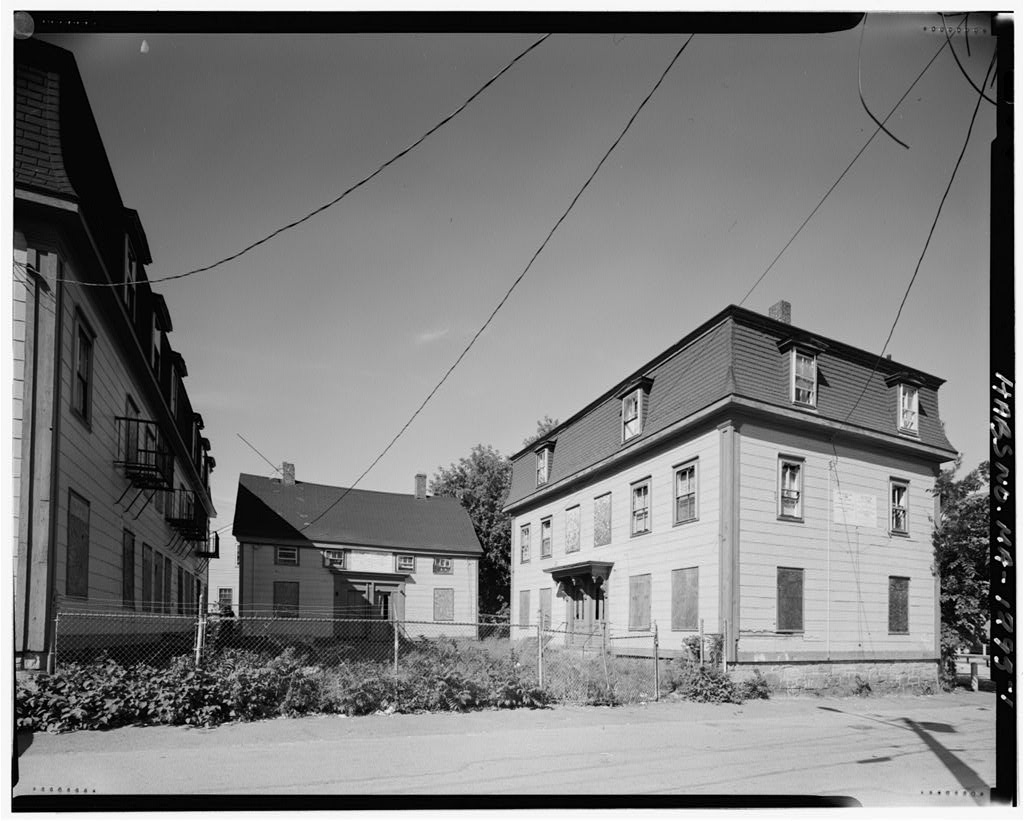
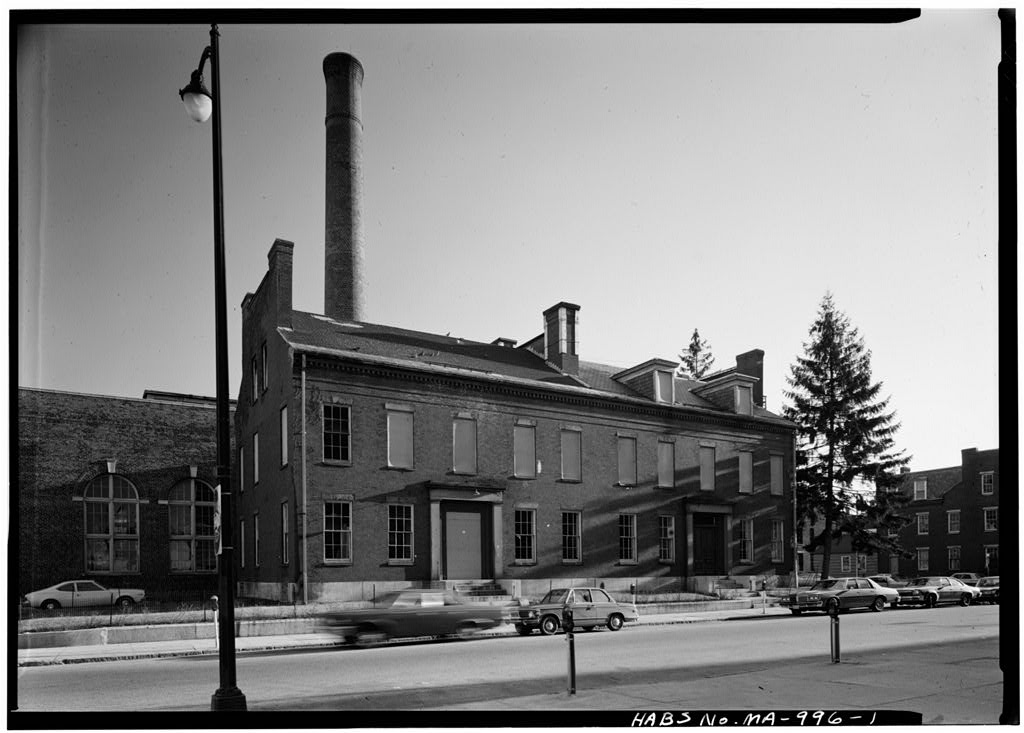
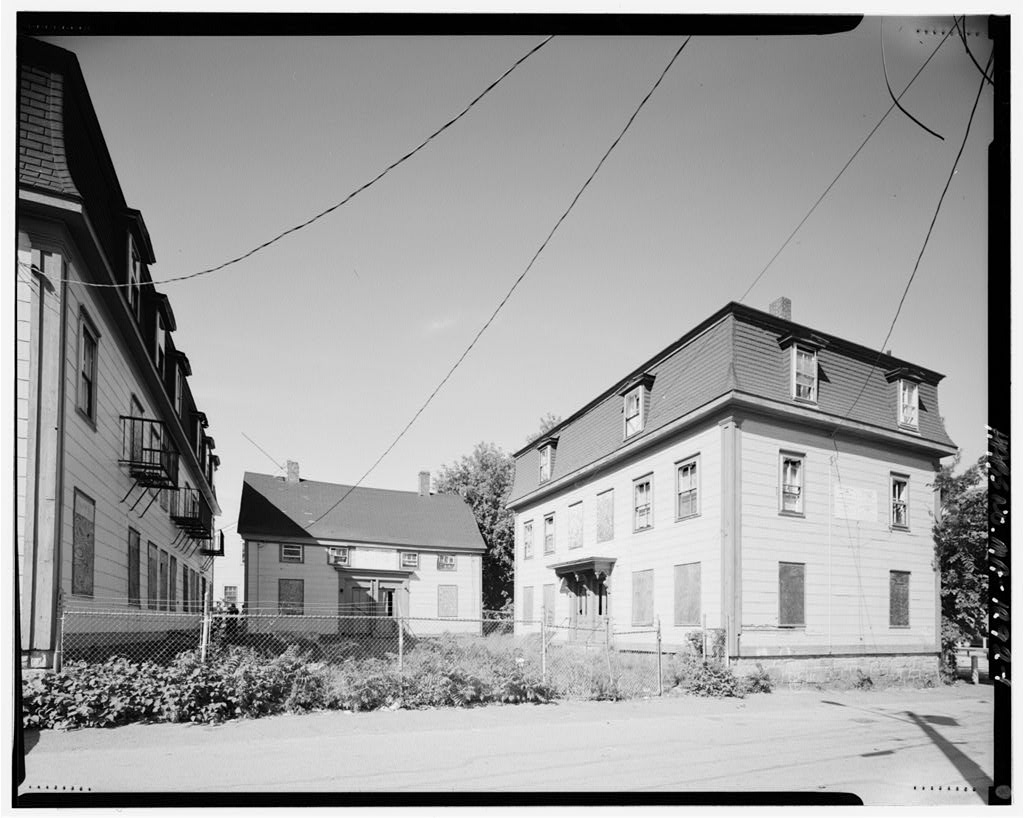
Marion Street is an example of a Greek Revival double house, and represents an early example of modest worker housing which characterizes much of this neighborhood known as The Acre. The development of the site is related to the extension of Broadway Street (the nearest cross street) through the Acre from the Western Canal to Fletcher Street ca. The property was acquired and developed by James J. Morris and the Morris family owned the property through It is one of a cluster of three buildings containing apartments owned by the Morris family. Description: This is a two-story Greek Revival double house, rectangular in plan with a side gable roof.
Facing east toward Marion Street, it opens onto a small lot framed by Marion Street to the north, Marion Street to the west, 199 - 207 Broadway Street to the south and by a chain link fence along Marion Street to the east. The facade is sheathed with a patterned asbestos shingle and the rear and side elevations are clapboard. The foundation and steps to the entries are concrete. Detailing is simple consisting of narrow comerboards, gable end returns, a boxed cornice and a trabeated central double entry with a simple cornice. Two brick interior chimneys rise at the ridge of the asphalt shingle roof. The south chimney has partially collapsed The first story sash are 212 and the sash at the second story are The entry doors are wood four panel doors.
Interior detail includes Greek Revival fireplace surrounds, chair rails, four panel doors and unmolded door and window surrounds. Vertical bead board wainscoting is found at the entry and along the first floor stair hall. The wainscoting is placed on the diagonal along the steep straight run stair which has round balusters and a turned newel post. History: Marion Street is one of two buildings presently located on a lot of land that was purchased by James Morris from Benjamin Adams on October 6, for Adams owned a larger parcel of land, which he sold off in smaller lots to several buyers, which was no doubt prompted by the planned extension of Broadway Street from the Western Canal to Fletcher Street ca. It appears that Morris purchased the Marion Street lot as an investment property.
Morris had purchased the adjacent property at the northwest comer of Broadway and Marion Streets in and his family lived on that property from at least the through the early A James Morris, peddler, was listed at 13 Broadway in which possibly was the present Broadway. No profession was shown in the later listings to confirm that this was the same James Morris. The construction date of the house at Marion Street is unknown. The style suggests it was built before Morris purchased this lot in It is possible that Morris and his family occupied this house on the Broadway Street lot and later moved it to the rear lot when he built the two matching Second Empire buildings that frame this house to the north and south.
Morris was first listed in the unit that was originally 71 Broadway (later in and leased the remaining units on Broadway and Marion Street to tenants. James Morris died on Feb. 26, and his widow Mary Morris continued to live at 203 Broadway until her death in Her son, Francis 0. Morris, opened a grocery store in 1881at67 Broadway, later but the store had closed by MARION STREET (HOUSE) HABS No. MA-1293 (Page 2) The property, including Broadway Street and and Marion Street, was sold by the Morris descendants in to Francis C. Silva of Lowell. It continued to be leased as two units until it was recently acquired by the Coalition for A Better Acre for redevelopment. Plans are to rehabilitate Broadway Street and demolish and Marion Street.
A shed appears at the northwest corner of the lot on maps from through It had been replaced by with a smaller structure. which is no longer extant. The house at Marion Street has historically appeared as 15 or 15 & 17 Marion Street on maps and in the directories, except the Sanborn shows this house as 13 & 15 Marion Street. Tenants traced through the reverse directories, which first appeared in were predominantly Irish and tended to be blue collar workers, including several mill workers, both men and women, firemen, widows and a lab worker. One long term tenant was a Joseph J. Shea, an employee at the Boott Mills.
Shea was listed at 15 Marion Street from through married Elizabeth by and had moved to 11 Marion Street by where he was listed through Tenants with French surnames appeared in followed by Greek and other nationalities. Generally, the property seems to have been occupied, although in the rear buildings were apparently vacant except for Joseph J. Shea.
 Block
Block