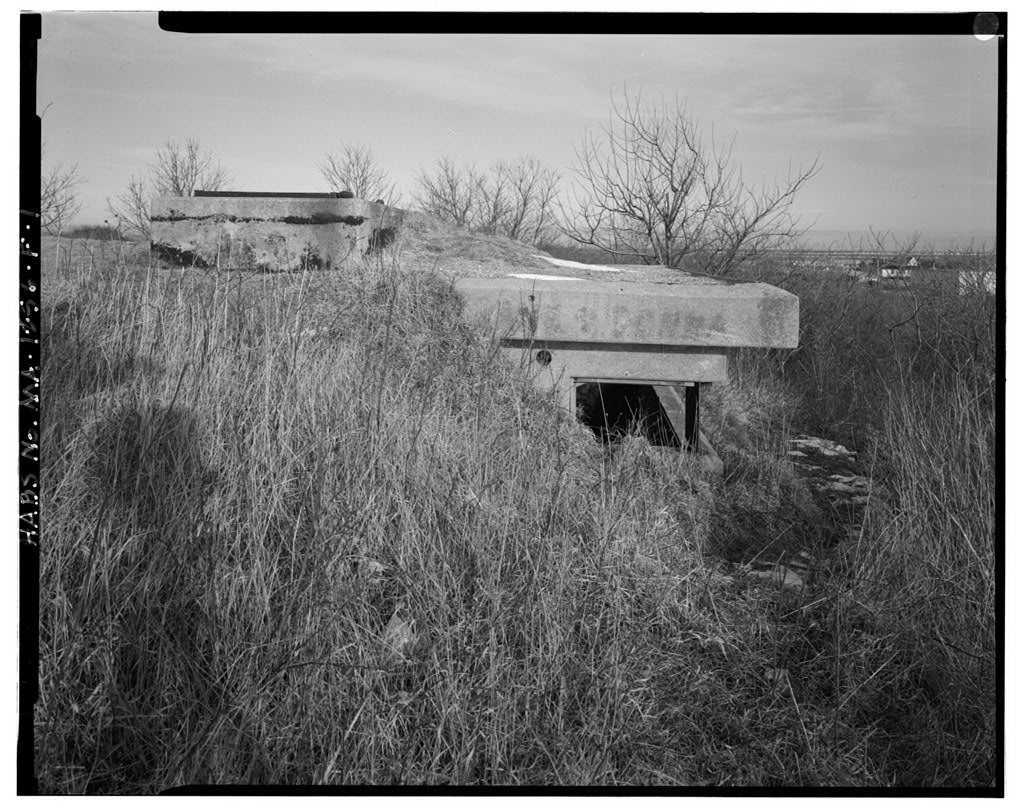
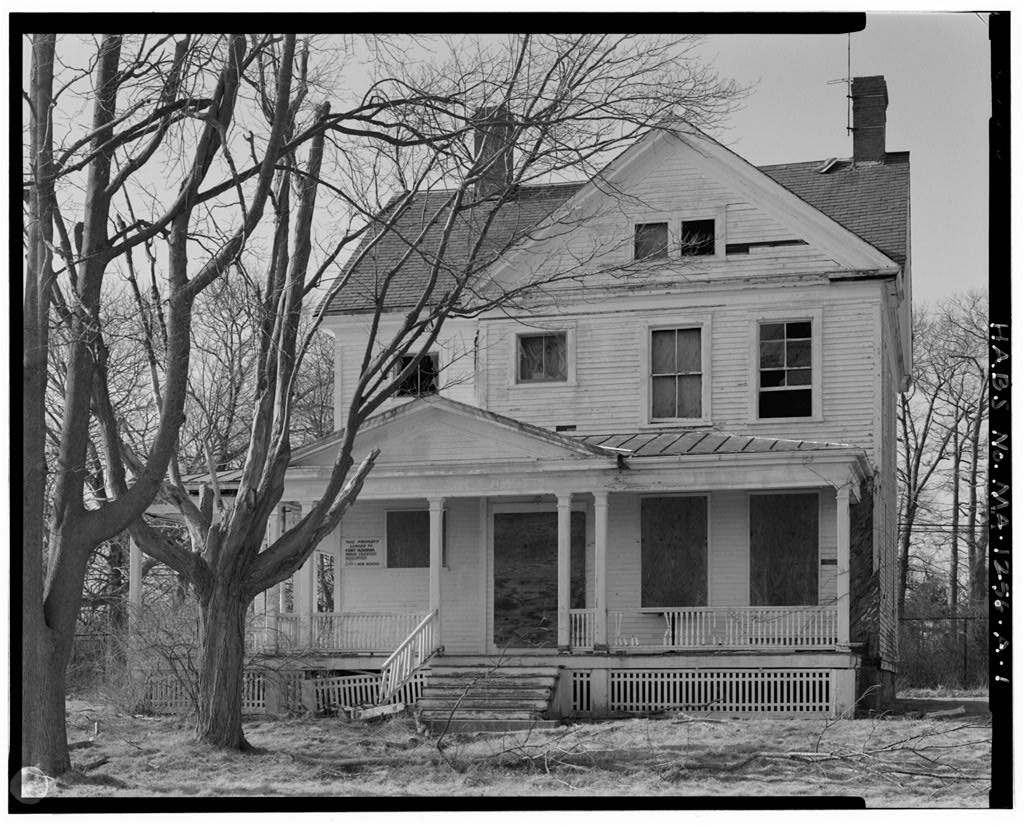
Battery Milliken is a good example of one of nine casemated 12- or 16- inch gun batteries constructed in New England at the beginning of World War II. The existence and evolution of Battery Milliken reflects several different periods, or systems, in United States coastal defense. Description: The visible sections of the battery consist of two high concrete walls, each with an opening in the center surmounted by a semi-circular concrete hood. Under the hood is a large open area, originally for the gun; at the back is a tunnel that extends towards the other gun casemate. A series of rooms open off the tunnel including, about midway between the two casemates, large rooms faced with brick.
These rooms are arranged back- to-back with the front ends open and the side walls separated by about a foot. A ceiling track for transporting the one-ton shells to the guns, runs into each room, so presumably these chambers were used to store shells and the separations between the walls were a precaution in case of an explosion. The condition of the present Battery Milliken varies. The outer rooms have been heavily vandalized and the ammunition tracks ripped from the ceiling or cut away altogether. Aside from extensive graffiti, the interior rooms are better preserved, especially the brick-walled ammunition rooms.
History: Because the increased range of naval guns had made the Endicott Period batteries, such as those at Fort Rodman, obsolete, a War Depart- ment Board of Review recommended that 12- and 16-inch guns be installed at various locations. One of four sites selected in New England was Fort Rodman. Although negotiations for its installation were underway in Battery Milliken was not finished until The battery is named after a soldier from New Bedford killed during World War I. By the mid-1930s, the development of the airplane had made open batteries vulnerable, so a new type was designed with two guns 500 feet apart in heavy concrete casements (gun chambers) protected by rein- FORT RODMAN MILITARY RESERVATION, BATTERY MILLIKEN HABS No.
MA-1256-F (Page 2) forced concrete canopies and separated by a series of underground rooms for ammunition, communications, power and air conditioning, storage, etc. Most of these new batteries were intended for 16-inch guns, but in a few cases, such as Fort Rodman, existing 12-inch gun batteries were casemated. The Army originally planned to casemate fourteen 12-inch and forty-four 16-inch gun batteries. Of the 12-inch, eleven were already in place, like those at Fort Rodman.
It is not clear how many of these projected casemates were actually constructed in the continental United States, but it is clear that nine were built in New England: in Boston, East Point, Fort Ruckman (Nahant), Fort Dawes (Deer Island), and Fort Duvall (Hog Island); in Portland, on Peaks Island and at Fort Levett (Cushing Island); in Portsmouth at Fort Dearborn (Rye); in Providence at Fort Church-- (Sakonnet Point) and Fort Greene (Point Judith); and in New Bedford at Fort Rodman. Of these nine batteries, three including Battery Milliken involved casemating existing 12-inch guns. Thus, while Battery Milliken is not unique, it is one of the few examples of a structure of its type.
The new Battery Milliken at Fort Rodman was completed in but soon afterward it too became outmoded and was never used. Source: Architectural Inventory Form, on file at Massachusetts Historical Commis- sion, Boston, MA.
 Block
Block