 Block
Block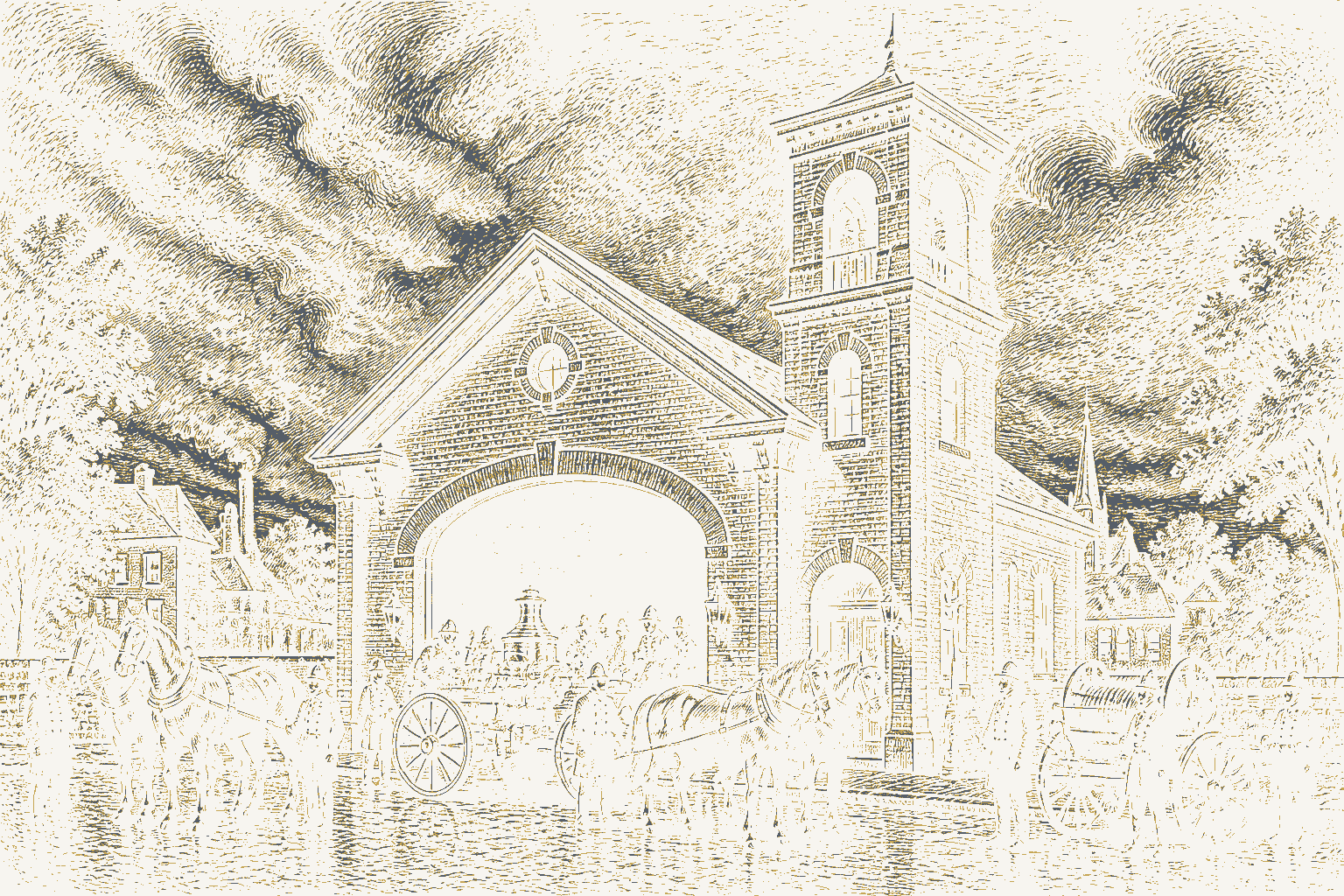
Jackson Township (part 1 of 19)
Part 1 of 19 of the account of this township in A History of Jackson County, Ohio, published 1900. 15,364 words, covering 8 settlements. The chapter predates the incorporation of Jackson Township and Jackson City, so it covers both. Source changes inside the text are labelled at the exact paragraph where the next book begins.
What happened here
One passage from this chapter. Its source year is printed on the inset and the full text labels every source change.
Economic Value
The Portsmouth shales form the basis of the extensive paving brick industry in the vicinity of Portsmouth and Sciotoville. The quantity of suitable material in these beds is practically unlimited, as the shales have been attacked only at a few places along the outcrop. At present the mining is confined to blasting the shales from the sides of the hills, or to working the beds by short entries.
Contents
1 sectionThe section headings the book prints inside this chapter, on this part. Each one jumps to where it begins.
Parts
19 pagesThe source prints this as one continuous account. It is split here so no single page grows too heavy to load; the text runs straight on across the parts and nothing is omitted.
The people it describes
4 namedEveryone the 1900 history stops to write about in this chapter. Each name opens the passage itself.
The modern record here
8 settlementsWhat the federal record holds for each settlement inside this township: wildfires and storm reports since the 1950s, mineral workings, and museum specimens collected nearby. These are counted within a few miles of each settlement, so neighbours share them and the columns are deliberately not added up. Every row links to the settlement's own page, where each figure is broken out.
| Settlement | Fires | Storm reports | Mines and quarries | Specimens |
|---|---|---|---|---|
| Brocks Corner | 24 | - | 3 | 813 |
| Jackson | 26 | 87 | 4 | 1,406 |
| Jackson Heights | 22 | - | 4 | 1,009 |
| Leo | 36 | 10 | - | 1,318 |
| Limerick | 40 | - | 3 | 966 |
| Pine Grove | 32 | - | - | 932 |
| Savageville | 44 | - | 2 | 1,287 |
| Sharon | 30 | - | 4 | 1,312 |
Settlements in this township
8 placesEvery populated place the Geographic Names Information System records inside this township's Census boundary. 0 of the 8 are named in the chapter; the rest were founded later or were never more than a post office.
The chapter
15,364 wordsReproduced complete and unedited from A History of Jackson County, Ohio, published 1900. The text is machine-read from scans, so expect recognition errors: misspelled names, dropped words, and stray characters. Nothing has been corrected, because correcting a proper name invents one. The headings below are the books' own; source changes are labelled in place.
Preface
The preparation of this work has been a labor of love. It was undertaken not for profit, but for the pleasure which I derive from the study of the past. I have been urged to write a complete history of Jackson county. The material for such a work has been collected, but its publication will depend upon the reception accorded to this volume, which is devoted to the period from the
INTRODUCTION - Jackson is the seat of justice of an Ohio county of the same name. It is situated on an eastern branch of the Scioto river, in latitude 39 degrees, 15 minutes, north, and longitude 82 degrees, 41 minutes and 48 seconds, west. It was laid out in 1817, on the north half of Section 29, in the Scioto Salt Reserve. This township had been set aside by Congress May 18, 1796, on account of the salt springs within its limits. These springs or licks, are as old as the hills, for that erosion which carved out the valleys between, exposed the strata from which they flow. They were discovered by the wild animals of the forest, and became one of their most favored resorts long before man appeared upon the earth. No better evidence of this is needed than the great quantity of fossil remains of extinct animals, which have been discovered from time to time in the neighborhood of the licks.
FOSSIL BONES - The story of the bones found imbedded in the valley of Salt creek forms an important chapter in the history of these licks. Fragments have been found in nearly all the wells, cisterns, miueshafts and railroad excavations in the lowland adjoining them. The greater number had decayed, but many of the larger bones were so well preserved that some of them were easily identified as having belonged to the mammoth, the mastodon, the megatherium and other large animals of the prehistoric period. According to Hildreth, the Scioto Saline may be ranked with the Big Bone and Blue Licks in Kentucky for antiquity, from the fact of the fossil bones of the mastodon and elephant being found at the depth of thirty feet, imbedded in mud and clay. The remains of several of these extinct animals were discovered in digging wells for salt water, along the margin of the creek, consisting of tusks, grinders, ribs and vertebrae, showing this creek to have been a noted resort for these huge mammalia. The bones of the mammoth predominated in the deposits discovered.
THE MAMMOTH - This name was probably borrowed from the Russian, although some claim that it is a corruption of the Arabic word, behemoth. In modern usage it is applied to an ex- tinct form of elephant. It dillered greatly from the elephant of today, for it had a thick coat of hair, or wool, which enabled it to withstand the great cold of the Ice Age. The Scioto Licks were situated south of the Glacier, and a remnant of the mammoth may have survived in their neighborhood until after the close of the Glacial Period. There is a local tradition related by an old Indian chief to some of the early salt boilers, which confirms this belief. It is the story of the death of the "Big Buffalo.'' Seeing a pile of bones which had been thrown out of a salt well, he explained that they belonged to the Big Buffalo. The whites questioned him further, and he gladly told the whole story, as follows: '
''Long before the Shawanese came into this land to hunt the buffalo, deer, elk and bear, there was a great water, which filled all the valleys and covered all the low ground and even the tops of the low hills. The water had come slowly from everywhere and flowed in where it had never been before. It drowned all the beaver houses, and was deep over the salt springs and licks. The game was all driven out of the low ground and roamed on the hills. The animals were fearful, for the 'Big Buffalo' were on the hills and killed everything before them. The Indians were forced to fly to the highest rocks, where they looked down upon the great water rising all around and threatening to drown the land. The animals did not fear them, but came near them to escape from the Big Buffalo. At last only the toi)S of the hills and ridges appeared above the waters, and it was very cold. The Indians lived in the rocks and the Big Buffalo could not reach them, but they could shoot their arrows and throw their spears at them, and some of them they killed. At last the water began to fall, but there was a lake left, which reached north and south. But the water would not stay. It broke out to the north, and also to the south, with great roaring, making a way through the hills until the water was all gone except a small lake where the salt springs are. The Big Buffalo went into this lake to drink and became fast in the mud and died there, and their bones are deep in the ground. When the Big Buffalo were all gone, the animals which had fled before them, came back, and the Shawanese came here to hunt them, until the white man forced them to make their home near the Big Lakes."^
A JACKSON COUNTY MAMMOTH - No perfect specimen of this animal has been found in the immediate neighborhood of the iicks, but the last resting place of one was found in 1835, on a branch of Salt creek, not many miles away. An examination of the remains was made by Caleb Briggs in 1837. His report has been preserved and is as follows: About two years ago, some bones so large as to attract the attention of the inhabitants became exposed in the bank of one of the branches of Salt creek, in the northwest part of Jackson county. They were dug out by individuals in the vicinity, from whom we obtained a tooth, a part of the lower jaw, and some ribs. In the examinations at this place during the past season it was concluded to make further explorations, not only with the hope of finding other bones, but with a view to ascertaining the situation and the nature of the materials in which they were found. The explorations were successful. There were found some mutilated and decayed fragments of the skull, two grinders, two patellae, seven or eight ribs, as many vertebrae and a tusk. Most of these are nearly perfect, except the bones of the head. The tusk, though it retained its natural shape as it lay in the' ground, yet being very frail, it was necessary to saw it into four pieces, in order to remove it. The following are the dimensions of the tusk, taken before it was removed from the place in which it was found:
Length on the outer curve, 10 feet 9 inches; on the inner curve, 8 feet 9 inches; circumstances at base, 1 foot 9 inches; 2 feet from base^ 1 foot 10 inches; 4 feet from base, 1 foot 11 inches; iVz feet from base, 1 foot 7^/^ inches. This tusk weighed, when taken from the earth, 180 pounds. The weight of the largest tooth is 8 1-4 pounds.
These bones were dug from the bank of a creek near the water, where they were found under a superincumbent mass of stratified materials 15 to 18 feet in thickness. The section carefully taken on the ground will give a correct idea of the arrangement of the materials, and the relative position in which these interesting fossils were found.
No. 4 is a chocolate colored clay or mud, the inferior part of which contains the remains of a few gramineous plants, very much decayed - 2 feet.
No. 6 is the stratum containing the bones. It consists, judging from external characters, of sand and clay, containing a large proportion of animal and vegetable matter - 1 to 1 1-2 feet.
Those bones, from their position, had evidently been subjected to some violence before they were covered with the stratified deposits which have been described. The jaw and grinders, with the other bones which we have thus slightly noticed, evidently belong to an extinct species of the elephant, now found in a fossil state. As the teeth differ from any which are figured and described in the books to which I have access at the present time, it is possible they may belong to an undescribed species.
THE MASTODON - The last important find of fossil bones near the licks w^as made July 8, 1888. According to the Journal, "workmen, while employed in digging a well near the electric light plant last Friday, discovered jjarts of the skeleton of an animal that are supposed to be the remains of a mastodon. When about 17 feet below the bed of Salt creek they first found some ribs that measured 48 inches from tip to tip, and one and three-fourths inches in width; further down a large bone that weighed eleven pounds, measured eleven and one-half inches in circumference in the center, seventeen and one-third inches at one end, twenty inches in length, and is supposed to be one of the bones of the foreleg. Dr. B. F. Kitchen had some excavating done on Saturday and found a large tooth about four inches in length." Further excavating might have unearthed the whole skeleton, but the city had no time or money to speud on scientific investigations. The mastodon was closely allied to the elephant, and was given its name on account of the conical projections on its molar teeth.
The Megatherium - The following statement is from the pen of Caleb Briggs, who visited the licks in 1837: "Some of the salt wells in Jackson county were dug in a deposit of clay, sand and gravel, occupying a basin shaped cavity in the superior part of the conglomerate. In nearly all these wells were found fossil bones consisting of jaw teeth, tusks, vertebrae, ribs, etc., which from the descriptions given by Mr. Crookham belong to extinct species of animals. From his descriptions, remains of the Megatherium and of the fossil elephant were among the number." Crookham was a born naturalist, and his statements are entitled to credence, but it is rather remarkable that the bones of this gigantic animal, allied to the anteaters and the sloths of the tropics, should have been found in such close proximity to the bones of the mammoth of the arctic circle. This fact goes to prove the great antiquity of the licks, for the megatherium must have visited them long before the Ice Age began. But he had the same apjjetite for salt shared by his fellow victims of later ages. Attracted by the water oozing from the salt marsh above the licks, he ventured in too far a,nd was mired, and his bones marked the spot of his last struggles. In time, they were covered b}' the bones of other victims of the same appetite, and lay commingled until man came to disturb them, and learn the fate of their owners.
WILD GAME - All the animals of the forest resorted to these licks. Many were attracted by the saline waters, while others came to prey upon the former. Great herds of buffalo and elk, a,nd thousands of deer roamed in the valley and upon the hills at certain seasons, and bears, panthers, wolves and wildcats followed in their tiain. The smaller animals, lynxes, foxes, raccoons, wild turkeys and man}' others could not remain away. The presence of so many animals must have been a part of the attraction for the mammalia of the prehistoric period. The region must have been a rich game preserve for primeval man. It is known that it was one of the favorite hunting grounds of the Ohio Indians. The early settlers were attracted to the neigliborbood of the licks for the same reason. Indeed, according to Finle}', the first settlers, could not have sustained themselves had it not been for the wild game that was in the country. This was their principal subsistence; and this they took at the peril of their lives, and often many of them came near starving to death. Wild meat without bread, or salt, was often their food for weeks together. Jf they obtained bread, the meal was pounded in a mortar, or ground in a handraill. Hominy was a good substitute for bread, or parched corn pounded and sifted, then mixed with a little sugar and eaten dry; or mixed with water as a good beverage. On this coarse fare the people were remarkably healthy and cheerful. No comi)laints were heard of dyspepsia; I never heard of this fashionable complaint till I was more than thirty years old; and if the emigrants had come to these backwoods with dyspepsia, the}- would not have been troubled long with it, for a few months' living on buffalo, venison and good fat bear meat, with the oil of the raccoon and opossum mixed up with plenty of hominy would soon, have effected a cure. A more hardy race of men and women grew up in this wilderness than has ever been produced since. Almost every man and boy were hunters, and some of the women of those times were expert in the chase. The game which Avas considered the most profitable and useful was the buffalo, the elk, the bear and the deer. The smaller game consisted of raccoon, turkey, opossum and ground hog. The panther was sometimes used for food, and considered by some as good. The flesh of the wolf and wild cat was only used when nothing else could be obtained.
The licks removed much of the danger of the hunt, for the hunter found it necessary only to wait under cover until the game he sought should appear. In a few minutes his sure rifle brought down enough meat to last him a month. All the old hunters have passed away to the happy hunting ground. James H. Darling, now dead, knew some of them, and on his last visit to Ohio he related the following meager details of the days of wild game: "I have seen bears, wolves, panthers, wild cats and deer in this^ county. I have seen as many as 20 deer together. I once saw a wild cat in a tree, when I was very young, and I thought it was a fox. I climbed the tree and it jumped at me aud knocli;ed me off to the ground. The dogs got after it and Mr. ^Yinfough shot it. We had to pen up the sheep at night to keej) the wolves from liilling them. I have Idlled wild cats and have caught many wild turkeys. ^A'e caught them in rail pens. T^'e would build a square pen and would then dig a trench from the outside to the middle of the pen, covering the part of the trench inside of the pen with boards, all except an opening at the end. \\e then spread corn in the woods and along the bottom of the trench. The wild turkeys would discover the corn and would follow it until they came out at the end of the trench inside of the pen. They would then continue to look up and would never find the hole at which they came in. We would sometimes catch 15 to 20 turkeys at a time. The woods were then full, of wild hogs also, and we killed them to eat. We always skinned them. Their meat was not very good. There was a beai; killed where Coalton now is about 1823. It had broken into the hog pen of a man named Alltire and had almost eaten up one hog when it was discovered. Levi Davis, who lived near Berlin, was a great deer hunter. He would hunt at night, and would carry a pan of coals on his shoulder. The light would attract the attention of the deer, and he would then be able to see its reflection in their eyes and be able to take aim."
THE BUFFALO - Few people ever stop to think that countless herds of buffaloes once roamed in the valleys of the Ohio and its tributaries. They visited the Scioto Licks so regularly and in such numbers that their paths looked like great roads. One of these, which used to run down the middle branch of Salt creek, was visited in 1837 by Charles Whittlesey, who wrote the following description of it: "Down the valley of this branch passes the great 'buffalo path/ leading from the licks at Jackson to licks upon the north fork, about thirty miles distant. It is at present distinctly traceable throughout, over hills and across valleys, and pursues the most direct practicable route. The appearance is that of a gully, cut in the soil from one to four feet deep by a sudden torrent, and partially filled again by the effects of time. There are occasional cavities, called buffalo wallows, where it is said the animal amused himself in his travels bv rolline; and pawing in the dust like cattle. It appears by a statement of Mr. Edward Byers, of Jackson county, that individuals of the bulfalo race have been killed on the Raccoon, Symmes' and Salt creeks within thirty years."
Many have wondered how the huge wallows were formed. Catlin, who was an eye witness of the making of some such wallows on the western plains, furnishes the following description: "In the heat of summer these huge animals, which, no doubt, suffer very much with the great profusion of their long and shaggy hair or fur often graze on the low grounds in the prairies, where there is a little stagnant water lying among the grass, and the ground underneath being saturated with it, is soft, into which the enormous bull, lowered dow^n upon one knee, will plunge his horns, and at last his head, driving up the earth, and soon making An excavation in the ground, into which the water filters from amongst the grass, forming for him in a few moments, a cool and comfortable bath, into which he plunges like a hog in his mire. In this delectable laver he throws himself flat upon his side, and forcing himself violently around, with his horns and his huge hump on his shoulders presented to the sides he ploughs up the ground by his rotary motion, sinking himself deeper and deeper in the ground, continually enlarging his pool, in which he at length becomes nearly immersed, and the water and mud about liim mixed into a complete mortar, which changes his color, and drips in streams from every part of him as he rises up on his feet, R hideous monster of mud and ugliness, too frightful and too eccentric to be described. It is generally the leader of the herd that takes upon himself to make this excavation, and if not (but another one opens the ground), the leader (who is conqueror), marches forward, and driving the other from it, plunges himself into it; and, having cooled his sides and changed himself to a walking mass of mud and mortar, he stands in the pool until inclination induces him to step out and give place to the next in command, who stands ready, and another and another, who advance forward in their turns to enjoy the luxury of a wallow, until the whole band (sometimes a hundred or more) will pass through it in turn; each one throwing his body around in a similar manner and each one adding a little to the dimensions of the pool, while he carries away in his hair an equal share of the clay, which dries to a grey or whitish color, and gradually falls off. By this operation, which is done perhaps in the space of half an hour, a circular excavation of fifteen or twenty feet in diameter, and two feet in depth, is completed and left for the water to run into, which soon fills it to the level of the ground. To these sinks the water lying on the surface of the prairies are continually draining, and in them lodging their vegetable deposits, which after a lapse of years fill them up to the surface with rich soil, which throws up an unusual growth of grass and herbage, forming conspicuous circles, which arrest the eye of the traveler and are calculated to excite his surprise for ages to come." While the buffalo remainded in the county, they served the settlers as their most common food. Finley says that their wool was often spun and woven into cloth by the women, and sometimes it was mixed with raccoon fur and knit into stockings, which were very warm and serviceable. After the wool was taken off, the hide answered a valuable purpose. Being cut into strips and twisted, it made strong tugs, which were used for plowing. When dressed, it was made into shoe packs, or a kind of half shoe and half moccasin. The manner of hunting the buffalo was as follows: A compan^^ was formed, well supplied with dogs and guns. Being mounted on horses, they started for the woods. When a herd was found, one of the company would creep up softly and fire into their midst; then the whole company would rush in upon them with their dogs, which would throw them into confusion. After all had discharged their pieces, the dogs would attack them; and while they were engaged in fighting with the dogs, the hunters would have time to reload and pursue the chase. After the conflict was over, they would return and collect the spoil. To enable the horses to carry them, they would take out the entrails, and split them in two, and then throw them over the packsaddles, and carry them home. The coming of the settlers soon made the Ohio Valley a dangerous range for these animals, but a few lingered on until the end of the last century. It was only natural that they should have lingered longest in the neighborhood of the Scioto licks, which had been their favorite resort for countless centuries. The last biili'aloes in Ohio were killed in Jackson county. Hiklreth wrote in 1837: "Two were killed in the sandy forks of Synimes creek near the southeastern corner of Jackson county in 1800." A letter writer in the Western Agriculturist for October, 1851, corrects and closes the record of the Ohio buffalo, as follows; ^'In 1843, an old hunter of Jackson county, Mr. George Willis, told us that he saw the last buffalo killed within the limits of the state. He was shot by a hunter named Keenes near the headwaters of Symmes creek, in the year 1802. It is, therefore, less than fifty years since the wild ox was finally exterminated in Ohio. The paths made by buffalo in traveling to and from the salt licks in Jackson county are still visible, and look like old and deeply worn wagon roads."
THE ELK - The elk go in droves like the buffaloes, but take alarm more readily and escape faster. They bound away, says Finlej^ with the velocity almost of lightning and run three or four miles in a straight line without stopping. Their antlers are sometimes very large, and this handicaps them in their efforts to escape, when found in the timber. The^^ lingered in Jackson county until about 1805, but after that the hunters became too numerous, and the}' moved on toward the setting sun.
SOME BEAR STORIES - The black bear was common in Jackson county for several years after its organization, and one was killed in Jefferson township as late as 1831. Accortting to Finley, the flesh .of the bear is the most delicious, as Avell as the most nutritious, of any food. The bear seems to be an awkward, clumsy, inactive animal; but they can climb the highest trees with great facility. When lean, they can run with great rapidity and fight with tremendous fury. They will become immensely fat on good mast, so much so that it is sometimes difficult for them to move very quickly. When rendered thus unwieldy, they will, by a, peculiar instinct, seek some cave in a rock, or hollow tree, where they will hibernate, and about the latter part of March, waking from their winter's sleep, they will come forth to greet the opening ^jiring. They prefer the beech nut 1o any other food. Should there be no beech mast, then they must go to the chestnut, and if these fail, to the white and black oak woods. These animals become verj poor in summer, and live on lesser animals, if they can take them, or upon the wild honey, which they take from the yellow jacket or bumblebee. They will turn over large logs in quest of this food. At this season of the year they attack the swine, and have Deen known to carry off large hogs. They were also very troublesome in cornfields about roasting-ear time. These animals, in the fall, before the time of mast, climb up trees, pull in the limbs, and gather the fruit, which is called lopping. The hunter or backwoodsman, for all backwoodsmen were hunters, made his summer bacon out of bear meat. He would take out the fat and salt it, if he had salt, and then hang it up to smoke. The fat was rendered into oil, which was put away in deer skins, neatly and cleanly dressed for the purpose. This oil served many valuable purposes to the hunter, supplying the place of butter and hog's lard. He could fr} his venison and turkey in it, and if he had neither of these, it was admirable sop for corn dodger; and when mixed with his jerk (dried venison) and parched corn, was regarded as one of the greatest delicacies of a hunter's larder.
Perhaps the largest bear ever killed in Jackson county was the one that gave John Farney such a fight near the site of Jackson Furnace, then a part of Scioto county. It was in the year 1813. Farney was out hunting and discovered the bear about the same time that it discovered Farney. He drew up his gun to shoot, but it missed fire, and he had to drop it, for the bear was rushing upon him. He then threw his tomahawk at bruin, but it glanced without injuring him. The bear then closed with him, and Farney was compelled to fight with his hunting knife. He did so to good effect, and lived to be Commissioner of Jackson county. But he never sought another bear fight.
The following account of a bear killed near (^lay was written by ('. W. Brady: "I have been tracing up lately the following story: There is a poplar tree about three and one-half feet in diameter, standing in a patch of timber owned by Aaron Henson, about one-half mile northwest of Cross Roads. The tree is a mere shell and broken off at the top. In this tree was killed what is said to have been the last bear killed in this county. The date was- January 17, 1821. James, Samuel and Smith Stephenson Aveieworkini;' some distance away when two well-trained hunting dogs, which had been brought from Virginia, bayed something in the woods. The boys all ran to, the dogs immediately. Samuel, being fond of such sport, was first to this poplar tree, but, unlike the Apostle John, he put his head in the hole, thinking it w'as an opossum or some other small animal, but he discovered that the animal was too large to be dragged out b}' main strength. Smith was sent for a gun. The dogs were encouraged by the other two boys, and one of them took hold of the bear. In order to catch the dogs, bruin jumped out of the hole far enough to be recognized. James, being equal to the occasion, grasped a pole ax and struck the bear over the head, but the blow w^as not sufficient to kill it. It jumped back and the dogs after it. Being infuriated, it instantly stuck its head out again and James struck it a second blow, which proved fatal. After considerable effort it was delivered from the tree. A horse of medium size was brought and the bear throw-n across his back. The bear was so long that it touched the ground on both sides of the horse. When they got it home they weighed it, and it weighed 400 pounds. It was dressed and many of the neighbors were furnished a mess of bear meat. The parents of Mrs. Henry Hunsinger of Jackson and Dr. Newell of South Webster were married the following day and had bear steak for dinner. The bear was very fat and had made but one trip from its winter lair. William Buckley, of Camba, father of the AYilliam Buckley who now resides there, found its track and followed it almost to its den, but the snow had partly disa]»peared and he could not follow it any fai-ther. Four bears came through here afterwards, but none of them were killed." One pleasant afternoon in October, 1892, I walked out to the old Kessinger homestead east of Jackson to visit William Kessinger, who was then the oldest man living in the county. When 1 turned in at the gate, he was at the woodpile splitting kindling, although he was almost 95 years old. He greeted me cordially and invited me into the house, where he talked to me for an hour about the olden times. His wife, only two years younger than he, w-as present and participated in the conversation. William Kessinger was born November 1, 1797. His wife, Sarah Miller, was born August '24:, 1709. Tliey were married May 27, 1819, and they removed from Virginia to this county in 1820. The most interesting incident related by Mr. Kessinger was the following account of the killing of a bear: "I once helped to kill a bear. This was in February, 1821. Reuben Dickason, near whom I lived then, had a dog that used to hunt alone at night. When it had treed a raccoon, Dickason would go out and kill it. One night, when it had treed an animal of some kind, Dickason asked me to go with him to see what we would find. When we drew near the spot, which was on laud now (1892) owned by H. P. McGhee, we discovered that the dog had treed larger game than usual. He was barking at the foot of a hollow tree, and it did not take us long to discover that there was a bear inside. We had only our axes for weapons, so I kept watch while Dickason went after his gun. It was an old flintlock and would not shoot. He brought it, however, and after loading it and aiming it at the hole in the tree, I touched it otf with a coal of fire. The charge took effect, but we reloaded the gun and touched the old thing off a second time. This put an end to the bear and we dragged it out. Both charges had taken effect. After dragging it out, we found three cubs also in the hollow rrt-e." The last bear killed in the county was shot by William Whitt. at the head of Cub Run, in Jefferson township, in the winter of 1831. It had been discovered earlier in the day neai: Gallia Furnace's site by the Massie boys, who fired at it, but failed to bring it down. They [uirsued it in the snow for several hours, but were disappointed at last, for toward evening they came upon William Whitt in the act of hanging it up. Although he had killed it, they claimed it on the ground that they had wounded it in the morning, a fact that was not clearly established. Whitt was alone and surrendered, the bear to them, but sued them afterwards. The result of the lawsuit has not been ascertained, but the Massies ate the bear meat. The animal was young, and the run on which it was killed has been known as Cub Run ever since.
color three times a year, and every winter they cast their horns. The color they assume in the spring is red, in the fall it is blue, and in the winter it is gray. Their skins are most valuable when in the red or blue. The meat of the deer is the sweetest and most easily digested of all animal food. The skin was manufactured into almost all kinds of clothing, such as hunting shirts, waistcoats, pantaloons, leggins, petticoats, moccasins, sieves, wallets and sometimes shirts. It was perhaps to the backwoods families the most useful of all animals. The dressing of the deer skins did not require a long process. They generally cut out the garment with a butcher knife, and used an awl insteal of a needle, and the sinews of the deer instead of thread.
Deer were common in this county until 1845. Many now living have seen herds of them as late as the years of the war. A few lingered until 1870, visiting the old deer licks at certain periods. Two deei' were killed in 1867, between this city and Raysville, and their skins brought to Jackson for sale. They brought |5 each. These are the last known to have been killed in the county. The hams when salted and dried were known as "jerk." Deer were usually found in the winter time near laurel, on which they fed without any inconvenience to themselves.
PANTHERS - The panther when hungry would attack man himself, and was the most dreaded inhabitant of the forest. Its favorite mode of attack was to leap from a tree upon its victim, and the hunters that visited deer licks to lie in wait for deer, would often find a panther doing the same. This animal left the county early, but a pair were killed near the house of Joshua Evans, in Hewitt's Fork, in the winter of 1837. They had been hunted with dogs from the hills of Scioto county, and were the last seen in this count}'.
WOLVES - Finley well says that the wolf is the most sneakingl and thievish of all animals. He is seldom seen in the daytime, but prowls about and howls all night. He is remarkably cowardly, and will never attack unless he has greatly the advantage. Their skins are worth but little and their flesh is never eaten, except by those who ma}^ be in a starving condition. Wolves were regarded as such pests, that the Legislature passed a law allowing County Commissioners to pay a premium for wolf scalps. On July 3, 1816, the following entry was made in the Journal of the Commissioners of Jackson county: "It is ordered that the premium on wolf scalps be as follows: On wolves under six months, |1; all over the age of six months, |2." The first premium paid under this order was allowed November 25, 1816, to Adam Altire, who had produced the scalps of two young wolves. Jonathan Delay was allowed $2 on April 8, 1817, for the scalp of a grown wolf. With the introduction of sheep into the county, the wolves became such a terror that the Commissioners found it necessary for the public good to increase the premium, and on June 3, 1822, it was ordered that a premium of $1.50 be paid on all wolves under six months, and $3 for the pcalps of all others. This made wolf hunting profitable, and many farmers that raised sheep and young cattle bought wolf traps. Davis Mackley described one of these traps as follows: Wolves were the terror of the early settlers. Sometimes they were caught in large traps. They often killed my father's young cattle, and 1 remember once he borrowed Dr. McNeal's wolf trap, and had it set several nights, but he never caught a wolf in it. One morning he went to the trap and found a very large wildcat in it. He killed it with a club and came home with it on his shoulders. It was a yellowish color, and was as large as he could well carry. These wolf traps were a very powerful thing. A man's weight on the spring was not sufficient to bend the spring so as to set it, and the spring had to be pressed down with a lever. When the trap was sprung, the great jaws, which had teeth fitting between each other, came together with a clash that could be heard a long distance, and the trap would almost jump from the ground.
By the year 1830, wolves had become scarcer, and the premiums were reduced. An occasional pack would be found, however, for several years afterward. Cary Boyd killed a wolf on Black Fork in 1834, which some claim to have been the last killed in the county. The Commissioners' Journal shows, however, that George Byers was allowed |3, May 9, 1838, for the scalps of six wolves under six months.
BEAVER - The Indians and the earliest trappers in this county regarded the several branches of Bymmes and Salt creeks as the richest beaver resorts of the western country. There were quite a number of beaver ponds on Grassy Fork, some half dozen ponds on Salt Creek south of Jackson, and the Black Fork Avas a beaver hive from Gallia Furnace to its headwaters. The Indians secured all the beaver fur they wanted without any wanton destruction of the dams, and the beaver remained in the county until the salt boilers came. Then began a ruthless slaughter. The dams were broken, and the jjonds drained, and the beaver soon disappeared. The last were killed at the pond near the big sul])hur spring on the land now owned by D. W. Davis, of Jefferson township. The agency of the beaver in changing the course of several of the creeks should be mentioned.
THE RACCOOX - This animal was found in such numbers in this section of the state that the name was given to one of its largest streams. It is mentioned here, because its skin was used as a circulating medium among the backwoodsmen. Coin was very scarce, and much of the paper was of no more value than the rags out of which it had been made. But the coon skin was always worth a (juarter of a dollar, and passed for such when coin was not procurable, until after the organization of the county.
THE LAST OTTER - Otters were very numerous in this county in early days, especially near the beaver ponds on the several branches of Symmes Creek. They lived in holes in the rocks near the ponds. One of their peculiar habits was sliding down the steep bank into a creek or pond. It was on account of this habit of theirs that smooth slopes were compared to otter slides. Once the otter entered the water, the hunter found it almost impossible to shoot it with the old fashioned flint-lock gun, for the otter could see the flash and dodge the bullet. After the breaking up of the beaver dams, the otters gradually disappeared, but a few remained on Grassy Fork of Symmes until 1857, three being killed in Madison township that year. The last pair seen in the county were killed in 1874, on Black Fork. The male was discovered one morn- ing by William Jenkins, on tlie farm of his father, Kealva Jenkins, some distance from the creek. He chased it with his dogs, avnd killed it with a club. Some two weeks later, he and his brother John were passing a beaver pond on the land of Mary Uavis further down the creek. T. J. Morgan and his brother S. J. Morgan called to them and informed them that a strange animal was running in the water. The dogs were set on it, and Jenkins soon dispatched it with a club. It was a female, and the supposition is that it was the mate of the one killed two weeks before. The skin of the male measured eight feet and that of the female six feet. They were sold for $8 and |5 respectively.
PRIMEVAL MAN - It is claimed that man appeared upon the earth before the close of the Ice Age. The question is indeterminable, but even the Bible hints that the climate became colder after the creation of Adam, for it says: Unto Adam also, and to his wife did the Lord God make coats of skins, and clothed them. Per-^ sons accustomed to wear only figleaves would not have needed -clothes of skin, unless there had been a change of climate. At any rate it was a cold day when our first parents were turned out ot the Garden of Eden. It will never be known Avhen man appeared in Ohio, but if he came before the close of the Glacial period, there are reasons for believing that he must have lived near the Scioto licks. Geologists tell us that during the floods of that period. Southern Ohio was converted into a lake by the waters backed up by the Cincinnati ice dam. During the existence of that lake, only three of the highest ridges remained above the waters, and they became islands for the time. Two of those ridges were in Jackson county. It is not too violent a presumption to suggest that the men of that period must have sought refuge on these highlands. If this theory be accepted, it will have to be conceded that some of the mounds on the high hills of Jefferson and Hamilton townships may be the oldest human relics in the Ohio valley. Little is known of primeval man. His life was a fierce struggle with the elements and the gigantic animals of his day. He has left no record save his ball of flint and a few rude tools. Carlyle thus describes his lot: Miserable, indeed, was the condition of the aboriginal savage.
glaring fiercely from under his lleece of hair, which, with the beard reached down to his loins and hung round him like a matted cloak;, the rest of his body sheeted in its thick natural fell. He loitered in the sunny glades of the forest, living on wild fruits; or, as the ancient Caledonian, squatted himself in morasses, lurking for his bestial or human prey; without implements, without arms, save the ball of heavy hint, to which, that his sole possession and defense might not be lost, he had attached a long cord of plaited thongs; thereby recovering as w^ell as hurling it with deadly unerring skill." A relic was found by Prof. J. W. Hank, in August,. 1894, which may have been one of those very balls. It was found in digging a grave in Fairmount cemetery. It lay at a depth of three feet under the sod, between the clay and the sandy slate. Its presence at such a depth on a hilltop, indicates that it must have lain in the same spot for scores of centuries, and it may have been employed by an aboriginal savage in one of his conflicts with the mastodon or other animal of that period.
THE MOUND BUILDERS - There are at least five hundred earthworks within twenty miles of the licks, which belong to the age of the Mound Builders. It has not been clearly established who they were or when they lived in this region, but we know that they loved to live near the licks. Their works consist of mounds of all sizes, circles, rectangles, and half enclosed areas. The larger structures in this county are always situated on elevated ground. Their use is not known. Whittlesey, who visited them in 1837,. advanced the theory that they could not have been used in war. He said: "The principal enclosures are rectangles or circles, weak figures, without ditches, made weaker by numerous openings, not onlv in the sides, but at the corners. The subordinate parts of large works, and the small isolated ones, sometimes have ditches,, but always, as far as I have seen, on the inside, though cases of extensive fossa are said to exist. The main figure always occupies ground accessible on all sides, and no spring or receptacle of water is found within the walls. Other equally good reasons might be advanced why these structures are not adapted, and were not designed, either for attack or defense under any supposable mode ot
THK OLD FORT - This is the name by which the ancient earthwork on McKitterick's hill, northwest of Jackson, is generally known. There were two of these works on the McKitterick farm in early days, but the eastern one, inside of which the house was erected, has been almost obliterated. They were visited by Charles Whittlesey in 1837, when he was engaged upon the first geological survey of Ohio and described as follows: "No. 1 is situated in Lick township, Jackson county, Ohio, on the west half of the northeast quarter of section 19, Township 7, Kange 18, on high ground, about one-fourth of a mile northwest of Salt Creek. The soil is clayey, the work slight, with only one opening, which is on the east, and to my knowledge, without running water in the vicinity. The ditch being interior, indicates that the work was built for some other purpose than defence, probably for ceremonial uses. No. 2 is on the same quarter section on the east half, and lies near the road from Jackson to Richmond, on the left hand. The prospect from the mound is extended and delightful. On the west between this and No. 1, is a ravine and a small stream. As the soil is sandy, it is certain that the mound attached to the rectangle on the southwest was somewhat higher at first that it is at present. Neither of these works are perfectly square or rectangular, but irregular in form, approaching a square. No. 2 is clearly not a work of defence, and was probably intended as a high place, for superstitious rites. A more charming spot for such observances could not be chosen, if we admit that external circumstances and scenery had any connect tion with the sentiments of the worshipers, and we must allow that the Mound Builders were alive to the beauty of the scenery.'* The writer had a survey of the Old Fort made in July, 1894. The dimensions were found to be as follows: Length 110 feet, width 100 feet. From bottom of ditch to top of embankment at southwest corner is three feet and four inches; height of embankment six inches. From bottom of ditch at southeast corner to top ot embankment is five feet and six inches; the embankment is two feet high. Distance from inside ditch across to outside of embank- ment is fifty feet. The inclosure is level, and the entrance is on the east side. The inclosui-e is almost rectangular, but the embankment is more irregular. An oak seven feet in circumference stands on the embankment near the southeast corner. There are a number of smaller trees growing on the embankment, and a few in the inclosure, but there are none in the ditch. The Old Fort stands on level ground, overlooked by several higher elevations, which proves conclusively that it could not have been intended for defence. There is no great quantity of water nearer than Salt Creek, a quarter of a mile away, which argues that it was not the long house of a village. AYhittlesey failed to find any running water in the vicinity, but since the ground has been cleared, a number of coal springs have been discovered neai-. In short, there is a coaJ spring at the head of each branch of the several ravines adjacent. In the summer of 1896, one of these springs, located a few hundred feet southeast of the Old Fort, dried up and Milton Cameron, who was clearing the land, cleaned it out in hopes of finding water. At a depth of about three feet, he came upon a pan scooped out in the sandrock where the stream had welled forth. There was nothing to show that the spring had ever been cleaned out by whites, and it is evident that this pan was the work of the fort builders. Its discovery justifies the belief that there may have been other springs nearer the Fort which were stopped up by its users, and have not yet been rediscovered. Only a few relics have been discovered near the Old Fort. The only specimen found inside the inclosure was a fine spear head, about four inches long. It was found accidentally by John F. Motz, when a lad. Samuel McKitterick, the i)resent owner of the land, found a steel bladed ax May 5, 1890, when ])lowing in the field about one hundred yards south of the Fort. The ax weighs one and one-half pounds, is seven inches long, has a three inch blade and the eye measures 1 1-8 in. x 1 1-2 in. The ax Is now owned by J. H. Cochran. Another iron relic was found a few years west of Ihe Fort. It is a ball perhaps intended for a small cannon. It may have been placed long ago in the fork of a tree, and the wood grew over it, imbedding it, where it remained until burned out in the charcoal pit. These two relics, tomahawk and cannon ball, point to a visit from whites at an early day. It is known that Oenei-al' Lewis led an army of Virginians through this country in 1774, and they may have camped over night at the Old Fort, and left these relics. The mound attached to Fort No. 2 was opened by McKitterick, who found a number of flints and the layer of ashes commonly found in the mounds in this county. The opening was utilized for a milk house.
AN ARCHAEOLOGICAL FIND - A volume could be written about the remains of the Mound Builders in the neighborhood of the licks, their works and implements. One mound on the land of Joseph Watson, east of the licks, was opened a few years ago and evidences were found indicating that it had been a house mound, similar to those of the Mandans on the Missouri. Perhaps the most important find in the county was the collection of flints discovered in April, 1898, near the Catholic cemetery. The following account was written at the time by F. E. Bingman, a local archaeologist: A discovery that is of more than usual interest to those who are archaeologically inclined, was made by Mr. George Goddard, one day last week. While engaged in plowing a piece of ground belonging to P. O'Malley, just south of the new Catholic cemetery, he noticed in the dead furrow several implements of flint. His curiosity being excited, he made a further and careful examination, with the result of finding carefully stowed away the large number of 314 implements.
As near as could be determined by an examination made afterward, the flints were placed in a hole about fifteen inches across, and eighteen inches deep, the hole slightly narrowing toward the bottom. The top of the pile was about ten inches beneath the surface.
The flints are all of one pattern, triangular in shape, with straight sides and convex base. In length they vary from one and three-ciuartei'S to three inches. The material of which they are made is foreign to this country, coming from the famous Flint Ridge quarries in Licking county, is fine grained and chipped much more readily than our coarser flint. The color ranges from nearly pure white, through reddish, to dark gray. The reddish colored are almost translucent.
Within a few hundred yards of where this cache was found are five mounds, two of which are of unusual form, being surrounded by a ditch and low embankment. None of the five have been explored, but would doubtless repay examination. The collection referred to is now in the possession of the writer.
SAIjT - According to W. Robertson Smith, salt must have been quite unattainable to primitive man in many parts of the world. Many inland peoples regarded a salt spring as a special gift of the gods. The Germans waged war for saline streams. At a very early stage of progress, salt became a necessary of life to most nations, and it had been conjectured that the oldest trade routes were created for traffic in that commodity. Cakes of salt have been used as money in more than one part of the world, and it has been used as a medium of exchange in the markets of Shan down to our own time. From this it can be readily understood why the Mound Builders chose to dwell near the licks, in a country rough and barren compared with the rich valley of the Scioto. The absence of earthworks intended for protection, indicates that the licks were in a zone of peace. Perhaps a traffic was carried on with distant tribfs. They lived here, at least, and the theory offered is the most plausible explanation for their choice of home.
ROCK SHELTERS - The first topographical survey of Jackson county was made by Charles Whittlesey in the summer of 1837. In his report to W. W. Mather, the State Geologist, he makes special mention of the sand rock bluffs with mural fronts, rising alternately on each bank of Salt Creek between Strong's Mill and Jackson. These bluffs add a wild and romantic feature to the scenery and are visited by thousands of people every year. Some of them rise to the height of one hundred feet. The fronts of many remain comparatively unbroken, but in others, the lower strata have worn away faster than the upper, which now overhang and form rock shelters. In a few instances, the lower strata have receded thirty to forty feet, and such shelters are spoken of locally as "caves." There are fifty or more of these rock shelters in the county. The first white visitors, who were hunters or trappers^ discovered that the floors of these shelters are a mixture of sand and ashes. The makers of saltpetre who came later, disturbed the ashes and unearthed many bone fragments, shells, potsherds, and flints, granite and stone implements, but they were untutored, and these discoveries failed to whet their curiosity. The relics were saved for the moment, perhaps, but were soon cast aside. In some instances, perversity or ignorance led the finders to break the largest stone hammers and axes and to throw smaller ones into the waters of the creek. The extent of this vandalism will never be known. If any human skeletons were found by the saltpetre men, the fact has not been recorded. A few of the early pioneers were educated men, but none of them seem to have attached any special significance to these discoveries, although some of them made collections of the relics. In later years, boys learned to dig in these ash floors whenever they wanted "Indian" relics, and tons of them have been discovered. Many were lost in time, visiting collectors have taken many others out of the county, but there yet remain a great number in private collections, which, if combined, would make a respectable showing.
HUMAN SKELETONS - About thirty years ago a skull and other parts of a human skeleton were found in the ashes in a rock shelter on the land of Captain Samuel White in Liberty township. A similar find was made in a cave in Madison township. A third skeleton was found in 1883 by F. E. Bingman in a shelter on Salt Creek, and a fourth was found at the north end of McKitterick's sand bank. Bingman was digging for relics, but the other discoveries were made by accident. Saturday, March 16, 1900, Strawder J. Swyers and Charles Faught were digging for relics in the ashes at the Tea Rocks and discovered a fifth skeleton. They came upon it unexpectedly and did not observe its position carefully. The skull was shattered in digging and the bones were brittle and broke in handling. The teeth were in good condition, indicating that they had belonged to a young person. The sex could not be determined, but the finding of an arrowhead lying among the ribs in- dicate that the skeleton was that of a yoimg brave who came to an untimel}' death. A number of arrowheads, a bone awl, and a piece of deer horn were found with it. This discovery started others to digging. Gray Halterman found two skeletons, and two young men named McGowan and Hoover found a fourth near by. These boys found also, a number of arrowheads, bone awls, potsherds, shells, bone fragments and broken stone or flint instruments. Wednesday, April 11, I visited the place and began to dig at random. \\ithin five minutes, I shoveled up a fragment, which looked like a bit of pottery, but my son picked it up, and discovered that it was a piece of human skull. Digging more carefully, I uncovered the skull. It was that of a full grown man, and the condition of the teeth indicated that he had reached middle age. The upper part of the skull was intact. When first exposed, it was brown, but a fragment which I preserved is now whiter. The lower part of the skull had practically decomposed, but the teeth and one side of the lower jaw were in fair condition. The skull rested upright on a mass of bones, all of which were badly decomposed, but they were so arranged that it was easy to see that the dead man had been buried in a sitting posture. The skull was found about five feet below the level of the old floor, but my digging was made on the face of an excavation made by sand diggers. I shoveled uj) a number of potsherds, shells and bone fragments, and I dug through a, layer of fine charcoal, which lay about six inches above the skull. The charcoal had not been disturbed since the fire went out in it, until my shovel struck it. Its presence suggests a theory which will be mentioned later. The bones which I discovered had decomposed more than the bones found by Swyer, but the latter lay under shelter and only three feet deep. Altogether, nine human skeletons Lave now been found in Jackson county rock shelters. The skeleton found in Madison township may have been that of a white hunter, trapper or hermit, who died of disease or from the effects of injuries received in falling, or from a wild beast, but the other eight belonged, no doubt, to Indians. They must have been the skeletons of men killed in battle or skirmish, and buried hurriedly by comrades before they retreated from the neighborhood. The Indians always gave their dead decent burial, except in extremity.
A brave has been known to carry the body of his boy home from a distance of one hundred miles, in order to bury him with his kindred. The burials were never made near camps or inside of shelters used as houses; therefore, the skeletons unearthed at the Tea Rocks were not buried in time of peace, or by the occupants of the shelter. The layer of charcoal under which I found skeleton Ko. 9 sujigests the circumstances. The Indian dreads the loss of his scalp in war, and skeleton Xo. 9 was buried by his comrades in the most unlikely place, and a fire kindled over his grave to conceal it, in order to prevent the enemy from scalping the corpse.
STORY OF THE ASHES - The relics found in the rock shelters are prized by collectors, and the skeletons unearthed excite the curiosity of a few, but the ashes themselves have been regarded as of no consequence. And yet they tell a story as interesting and as old as that of all low lying mounds. The earliest rock shelters were formed soon after the close of the Glacial period, but the oldest have disappeared, for the overhanging strata break off from time to time and roll down into the valleys. This seems to occur oftenest in shelters with a northern or western exposure, while those with a southern exposure last longer. Nearly all the rock shelters in the county have had their inhabitants. Their first occupants must have been the primeval men, who had not learned to kindle a fire. They were followed in turn by men who knew the use of fire, but had not learned to build houses. The Mound Builders succeeded these, who in turn were succeeded by the Indians. The favorite shelter with all of them seems to have been the slight one at the Tea Rocks, selected on account of its proximit3" To The salt pans at the ritfie in Salt Creek. The bluff at this place rose only tothe height of about forty feet, and the overhanging shelf was relatively slight, but it had a southern exposure, which compensated for several feet of shelf. The ash heap at this point is the largest in the county. It is over one hundred feet long, and was fully eight feet deep in one place. It slopes down to the creek, W'hich at one time flowed toward the bluff in a sweep from the opposite side of the valley. Hundreds of tons of ashes have been hauled away as fertilizer, and scattered on lawns, gardens and fields, but thousands of tons, i)erhaps, lie yet where they have lain for centuries. The skeletons discovered in March and April, lUOO, were found here. A great number of flint and bone implements have been found in it. Muscle shells are numerous and tons of bone fragments are mingled with its ashes. All the bones have been split for the marrow. The animals represented are the butfalo, bear, deer, elk, fox, raccoon, ground hog, oppossum, beaver, wild turkey and others, which roved or lived in the neighborhood of the licks. Hundreds -of potsherds may be found. One specimen in my possession was a part of a pot which had a rim diameter of five inches. It was regularly formed and the outside bears the impression of a fabric. The greater part of the heap has not yet been examined. It is useless to conjecture how long the shelter was occupied, but the quantity of ashes indicates that the first man kindled a fire in it long before Columbus discovered America. The men who built the mounds in Jamestown may have occupied it. Arrowheads were found in the lower i)art of the heap that may have been fashioned by a man who lived two or three thousand years ago. The pottery broken here may have been brought carefully from the gulf coast, for the fabric marks on some fragments are almost identical with those on specimens which I picked up on an old Indian village site on the banks of the Koxubee river in Mississi])pi. The Mound Builders remained long enough in Jackson county to dot its hills and valleys with earthworks and to leave scattered on its surface tons of flint or stone implements, and must have oceui)ied this shelter. Their fate is a mystery. The claim has been advanced that they were the ancestors of the Indians, while others claim that the Indians drove them out of the country. Some Indians built mounds and it is known also that the Indians dearly loved the hills surrounding the Scioto licks, where the Mound Builders had once been so numerous. The salt si)rings attracted all manner of game, and they came here to hunt, while the squaws made salt.
THE SALT PANS - Jams L. Swj^ers is now engaged in blasting the sand stone in the riffle near Old Paiup Diamond. The blasting has removed the last vestiges of the old Indian salt pans. There were quite a number of them in the sand lock in (lie bc^d of the creek, where it flowed across the valley to the Tea Rocks, but when a ditch was cut through the neck, shortening the loop, the majority of them were covered up. Three remained until a few years ago, but Swyers blasted out the last one in 1899. The Indians were too lazy to dig wells for salt water, preferring to wait until the Fall of the year, when the water would be lowest in the creek, and correspondingly saltier.
THE SHAWANESE - There is no record of the coming of the Indians, but it is known that the Shaw^anese owned and occupied Jackson county when it was discovered by the whites. It appears, however, that all the Ohio tribes were allowed to visit the salt springs and to make salt. Situated as they were on the great Indian trail from the mouth of the Kanawha to the head of the Maumee, they were visited by hundreds, and sometimes, thousands of Indians, during the summer months. These gatherings resembled the Russian markets of the last century. Many of the visiting Indians bought their salt, giving in exchange flint implements, tobacco, beads, pipestone and other articles of aboriginal commerce. It is told that tribes at war with each other would observe a truce during these visits. The squaws performed all the work, chopjDing the saplings for fuel, drawing the water and watching the fires day and night, while the men spent their time hunting, fishing, playing ball, gaming and telling yarns. In later years, they tortured white captives in the presence of the assembled tribes. Even after the whites had taken possession of the licks, the Indians used to revisit them every summer until about 1815. These bands came ostensibly for salt, but it is claimed that they knew of a lead deposit in the county, to which they resorted secretly for many years.
THE HISTORIC PERIOD - John Cabot, a native of Venice, but a subject of England, being ambitious to rival Columbus, applied to the English monarch for a commission. The throne was then occupied by Henry VII, the grandson of a Welshman. He listened to Cabot's plans with interest and granted his request March 5, 1496. The commission authorized Cabot, or any of his three sous, to sail into the easteru, uoitheiii or western seas, with a fleet of five ships, to search for islands or regions inhabited by infidels, and hitherto unknown to Christendom; to take possession in the name of the king of England, and as his vassals, to conquer, possess and occupy; enjoying for themselves, their heirs and assi^^ns forever the sole right of trading thither; paying to the king, in lieu of all customs and imposts, a fifth of all net profits. Cabot acted promptly and sailed away into the unknown region, where Madoc had disappeared three centuries before. He reached the end of his voyage sooner than had been expected, for he sighted land June 24,lS9T,abounding according to his account with white bt»irs and deer of unusual size and inhabited by savage men, clothed in skins and armed with bows, spears and clubs. Thus was discovered the continent of North America.
ANNEXED TO VIRGINIA - One hundred and ten years rolled away before the English effected a permanent settlement upon this continent. This was accomplished by the London Company, which was chartered by James I, April 10, 1G06, and granted a strip of the American coast lying between the thirty-fourth and forty-fir^t parallels north latitude, and extending one hundred miles inland. Its first colony was established on the James river, May 13, 1007, and named Jamestown. The company' met with many reverses, and on May 23, 1609, it was reorganized and rechartered. The new charter defined the boundaries of Virginia as embracing a territory two hundred miles north and south from Old Point Comfort, and reaching up into the land from sea to sea. This grant included the Scioto salt licks, and was the first historical art that concei'ned them.
CAPTAIN BATTS' EXPEDITION - The story of Virginia's dominion in the Ohio Valley during the next c(Milury and a half is soon told. All there is of it, are the meager details of an exjiedition that failed. Rufus King's account is as follows: Cai)tain Thomas Batts, with a party of English and Indians, was sent by Governor Boi'keley in Sejjtember, 1C71, ''to ex])lore and find out the ebbing and flowing of the water behind the mountains, in order to the discovery of the South Sea." After a march of thirteen days from
"Appomatok," through the forests and over steep mountains, they came down upon waters running west of northwest, through pleasant hills and rich meadows. They encountered a river "like the Thames at Chelsea," and following its course, came, on the sixteenth day, to "a fall that made a great noise," probably the falls of Kanawha. Here the journey ended, the Indians refusing to go further, under the pretense that they could catch no game on account of the dryness of the ground and the sticks; but really from dread of the tribes down that river, from whom, as they reported, travelers never returned. In the country below, they also reported, there was a great abundance of salt. - This is the earliest historical - allusion to the salt licks of the Ohio Valley, and, inasmuch as one of the most noted Indian trails ran from the mouth of the Kanawha to the northwest, by way of the Scioto licks, it is possible that they may have been referred to.
LA SALLE - There is something in a name after all. Captain Batts, true to his name, was blind to his opportunity and missed immortality by not pushing on and discovering the Ohio river. It is true that La Salle is said to have discovered the beautiful river a year before Captain Batts' expedition set out, but the news had not reached Europe, and even to this day the fact has not been clearly established. Robert Cavalier was born in 1643 on the La Salle estate near Rouen in France. He came to Montreal in 1666, and entered soon afterward upon his career as explorer. Parkman believes that he discovered the Ohio river in the early months of 1670, and descended it as far as the rapids at Louisville. At any rate, the French laid claim to the Ohio Valley, and annexed it to Louisiana in 1713.
FIRST WHITE VISITORS - The name of the first white man to visit the Scioto licks will never be known, but there is every reason for believing that he was a Frenchman, of that class known as Bushrangers, whom King describes as follows: They were a mixture of the smuggler and trapper, deemed outlaws because they would not purchase licenses under the rigid monopoly in the fur trade as farmed out in Canada. In this way, thousands of French- men disappeared, who had been sent over to the colony at much expense; the king and his ministers constantly complaining of the loss of their subjects. Far out in the forests of the west, safe from the king's reach, they were living with the savages, marrying and hunting, fiddling, drinking and smoking, in entire independence. Of such were many of the earliest settlers of Ohio. Living thus, they must have accompanied some bands of Indians, sooner or later, on a salt-making expedition to these licks. It is probable that many such visitors had learned of their existence before 1725, for the licensed fur traders of Canada began to visit the Southern Ohio country about that time.
FIRST ENGLISH VISITORS - A state of war existed at all times between the French and English borderers. The French found willing allies in the Indians, for the two races understood each other better and mingled more readily. Nearly all the French Bushrangers had Indian wives, and in time their half breed progeny became numerous in the Ohio country. The latter class hated the English with the combined hatred of Frenchman and Indian, and they spared no effort to stir up their savage kindred against the English borderers of Pennsylvania and Virginia. As early as 17.35 they began to make raids into the Alleghenies to destroy isolated and outlying settlements. The border warfare thus instituted was conducted with the greatest ferocity and cruelty, and lasted sixty years. During that period no English settler in the mountains felt himself safe for a day from an attack by the Indians. They went armed at all times, whether at work, or on pleasure bent. When they left their homes in the morning they were never sure that they would live to come back, or that the cabin, which held all that was dear to them, would be standing when they came. From 1735 to 1795, the Indians went on these manhunting excursions just as regularly as Ohio men now go into the mountains of Virginia after game. As a rule they killed every person, man, woman or child; but there were times when a brave chose a handsome lad for adoption, or a half-breed saved an attractive girl or woman for a wife, or some courageous man was spared, that the Indians might have the pleasure and gratification of torturing him at the stake. All the expeditions up the Kanawha returned by way of the Scioto licks, and it is probable that the first English visitors to them, belonged to one or the other of the classes of captives mentioned. The Indians told the early salt boilers that it was the custom to burn white prisoners at the stake during the Indian gatherings at the licks in the summer and fall, and that the stake stood on the point overlooking the Crossin sulphur spring, near the site of the town well. Scores of English captives were tortured at this point between the years 1735 and 1794. 1^^170136
DE CELORON'S EXPEDITION - Notwithstanding the alliance between the French and Indians, daring English traders entered the Ohio country during the first quarter of the Eighteenth century, and by 1731 they had penetrated as far as the Wabash. During the next 1.5 years English traders came in such numbers that the French became alarmed and sent to Canada for a force to drive out the invaders. The government acted promptly and sent out an expedition of 250 French and Indians, under the command of De Celoron. They left Montreal June 15, 1749, moved on by way of Lakes Erie and Chautauqua, down the Allegheny and the Ohio, as far as the Big Miami, and back to the Maumee. They reached the mouth of the Big Miami August 30, 1749. De Celeron everywhere proclaimed the dominion of France and drove out the English traders. The French were now supreme in the valley, and although Gist, an Englishman, succeeded in stirring up some trouble in 1750, their traders had a monopoly of the trade until 1762. During that period they visited the licks regularly.
APPEARANCE OF THE LICKS - The earliest description of an Ohio lick is to be found in the narrative of Colonel James Smith, published in 1799. Smith was captured by the Indians just before the battle in which Braddock met his defeat and death, and was brought to Ohio and adopted by his captors. In August of the same year he accompanied them on a salt making expedition to the "Buffalo Lick," as he calls it, which he describes aa follows: "We then moved to the Buffalo lick, where we killed several buffaloes, and in their small brass kettles they made about half a bushel of salt. I suppose this lick was about thirty op forty miles from the aforesaid town, and somewhere between the Muskingum, Ohio and Scioto. About the lick were clear, open woods, and thin white oak land, and at that time there were large roads leading to the lick, like wagon roads." The town referred to by Smith was on the upper Muskingum, more than 40 miles away from the Scioto licks, but his language is rather indefinite, and the visit may have been made to these very licks. If this theory be accepted, Smith's visit is the first recorded in their history.
THE FIRST MAP - As already indicated, the Indians did not murder all their captives, and a certain proportion of those spared escaped from time to time and returned to their homes in Virginia. It was through the latter that the English learned definitely of the existence of the Scioto licks. A fairly accurate knowledge ot their location was known in Virginia as early as 1755. Lewis Evans, the Welsh geographer, was born in 1700. Adopting a surveyor's career, he came out to the colonies, and he is entitled to the honor of having published the first satisfactory map of the English possessions in America. The first edition appeared in 1749. A second edition, more complete and including Virginia and the Ohio valley, was published in 1755, and the Scioto salt licks are marked upon it. Unfortunately for the cause of science, Evans died in June, 1756, but his fame is secure.
THE HALTERMAN BOYS - Three young boys, the sons of Christopher Halterman of Virginia, were brought to the licks in 1759 as captives of the Shawanese. This tribe, who roamed over the hills of Southern Ohio, and cultivated corn and tobacco patches in its fertile valleys, were the most daring of the Ohio Indians, and their war parties were constantly hovering on the borders of the English settlements. Among the pioneers was one Christopher Halterman, who, with his family, crossed the mountains and settled on the headwaters of one of the tributaries of the Ohio. He built a cabin and cleared an acre or two of rich bottom, and all seemed favorable, when he sickened suddenly and died. The widow was a heroine, and instead of abandoning the claim and clearing, as many would have done, she determined to remain in the wilderness. Her oldest sons were already able to help her, and they might have prospered. Remote from all Indian trails, they had never seen a native of the forest, and lived in security. But the end came unexpectedly. A band of Shawanese passed through the region in the fall of 1759, and one of their scouts discovered the smoke from the widow's cabin. Creeping stealthily forward while the family was at breakfast, the Indians entered the cabin before their presence was discovered. Their yells over the easy victory did not daunt the mother, and she seized an ax to defend herself and children, but before she could deliver a blow an Indian sank a tomahawk in her head. Three little girls were killed in a like manner. The baby was picked up by the feet, and its head dashed against the wall of the cabin. Three likely lads remained. Their sturdy defense with their fists amused the Indians and they spared them. After scalping the dead and looting the cabin they kindled a fire on the floor and left the neighborhood at once. Setting out for the Ohio, they were joined by a number of other bands, who were engaged likewise. In a few days all arrived at the Scioto licks, where they remained for a few weeks. It was now October, and they set out for old Chillicothe, where the three Halterman boys, Christopher, Jacob and Gabriel, were adopted into the Shawanese tribe. The adoption ceremony was very impressive. The best description of it in existence is that written by Colonel James Smith, who was adopted by the Indians four years before the Halterman brothers. His narrative is as follows: "A number of Indians collected about me, and one of them began to pull the hair out of my head. He had some ashes on a piece ot bark, in which he frequently dipped his fingers in order to take the firmer hold, and so he went on, as if he had been plucking a turkey, until he had all the hair clean out of my head, except a small spot about three or four inches square on my crown. This they cut off with a pair of scissors, excepting three locks, which they dressed up in their own mode. Two of these they wrapped round with a narrow beaded garter, made by themselves for that purpose, and the other they plaited at full length, and then stuck it full of silver bruorlies. After this they bored my nose and ears, and fixed me off with earrings and nose jewels; then they ordered me to strip off my clothes and put on a breechclout, which I did. They then painted my head, face and body in various colors. They put a large belt of wampum on my neck, and silver bands on my hands and right arm; and so an old chief led me out in the street, and gave the alarm halloo, "coowigh," several times,. repeated quick; and on this all that were in the town came running and stood round the old chief, who held me by the hand in the midst. As I at that time knew nothing of their mode of adoption^ and had seen them put to death all they had taken, and as I never could find that they saved a man alive at Braddock's defeat, I made no doubt but they were about putting me to death in some cruel manner. The old chief, holding me by the hand,, made a long speech, very loud, and when he had done, he handed me to three young squaws, who led me by the hand down the bank into the river, until the water was up to our middle. The squaws then made signs for me to plunge myself into the water, but I did not understand them. I thought that the result of the council wa» that I should be drowned, and that these young ladies were to be the executioners. They all three laid violent hold of me, and I for some time opposed them with all my might, which occasioned loud laughter by the multitude that were on the bank of the river. At length one of the squaws made out to speak a little English (for I believe they began to be afraid of me), and said 'No hurt you.*" On this I gave myself up to their ladyships, who were as good as their word, for though they plunged me under water, and washed and rubbed me severely, yet I could not say they hurt me much. These young women then led me up to the council house, where some of the tribe were ready with new clothes for me. They gave me a new ruffled shirt, which I put on, also a pair of leggins done off with ribbons and beads, likewise a pair of moccasins and garters dressed with beads, porcupine quills and red hair; also a tinsel laced cappo. They again painted my head and face with various colors, and tied a bunch of red feathers to one of those locks they had left on the crown of my head, which stood up five or six inches. They seated me on a bearskin and gave me a jiipe, tomahawk, and polecat skin pouch, which had been skinned pocket fashion, and contained tobacco, killegenico, or dry sumach leaves, which they mix with their tobacco; also spunk, flint and steel. When I was thus seated the Indians came in, dressed and painted in their grandest manner. As they came in they took their seats, and for a considerable time there was a profound silence; eyeryone was smoking, but not a word was spoken among them. At length one of the chiefs made a speech, which was delivered to me by an interpreter, and was as follows: 'My son, you are now flesh of our flesh, and bone of our bone. By the ceremony which was performed this day, every drop of w^hite blood was washed out of your veins. You are taken into the Caughnewago nation, and initiated into a warlike tribe; you are adopted into a great family, and now received with great seriousness and solemnity in the room and jilace of a great man. After what has passed this day you are now one of us by an old strong law and custom. My son, you have now nothing to fear; we are now under the same obligation to love, support and defend you, that we are to love and to defend one another; therefore you are to consider yourself as one of our people.' "
After the ceremony, each of the boys was introduced to his new kin and feasted by them. Gabriel, the youngest, did not fare well, and died the first winter. Christopher and Jacob were older and better able to withstand the privations of life with the Indians. They were not entirely without the companionship of whites, for more than a hundred prisoners were in the hands of the Shawanese at that time. It is probable that the majority of these prisoners were taken to the licks to make salt every summer, as Daniel Boone was later. The Halterman boys remained with the Indians until they were surrendered to Colonel Bouquet and his army at the forks of the Muskingum November 9, 1764, with 204 other white prisoners. The scene at this surrender was indescribable. According to one writer, many of the prisoners were old enough to remember their kindred, and they w^ere only too glad to exchange the wilderness for civilization. But there were a few, especially women, who had been captured so young, and had lived so long with the Indians, that they were loath to leave, and were removed only by force. Some women, parted from their Indian husbands and children, escaped from the army and returned into the wilder^ ness. The Ilaltermans remembered the murder of their mother only too well, and they were delighted to return to the whites. Christopher was now a young man, and had become an Indian hater. He became conspicuous in later life as an Indian fighter. He has descendants living in this county, one of whom is his grandson, Gabriel Evans, named after the Tittle lad that died in captivity.
END OF FRENCH DOMINION - France set up its claim to the Ohio valley in 1C70, by right of discovery an'd first occupation. It was annexed to Louisiana in 1713, and ruled from New Orleans. De Celoron's expedition in 1749 was intended to establish the claims of France beyond dispute, but, instead, and most fortunately for us, it led to the French and Indian war, by which France lost all her possessions on this continent. The cession was made by the treaty of Fontainebleau, in 1762, and the Ohio valley passed into the undisputed possession of the English.
ANNEXED TO QUEBEC - Colonel Bouquet's expedition in 1764 brought the Ohio valley to the attention of Parliament, and, according to some writers, an act was passed in 1766 making the Ohio river the southwestern boundary of Canada, and placing the region north and northwest of it under the local administration of the Province of Quebec. Later writers claim that this act was not passed until 1774, and King refers to it as follows: "Another event had occurred earlier in the year (1774), unknown to Lord Dunmore, which totally changed the political status and relations of the country, which he had been invading. Parliament on June 22 had passed an act, 'making more efl'ectual provision for the government of the Province of Quebec,' hence known as the Quebec Act. By this, the whole country bounded by the Ohio, the Mississippi and the lakes, west of the west line of Pennsylvania, was annexed and made a part of that province. The declared object of this measure was to extend the boundaries and government of Quebec, so as to secure and satisfy the French inhabitants at Kaskaskias, the Wabash and Detroit. The Quebec act extended to all inhabitants of the province the free exercise and enjoyment of the religion of the Church of Rome, subject, nevertheless, to the king's supremacy. The clergy of that church were to have their accustomed dues and rights with respect to such persons only as professed that religion; provision being reserved also for the maintenance of the Protestant clergy, as the king should deem expedi- and necessary. This act was denounced in and out of Parliament, as arbitrary and dangerous, and yet, though debated by the most eminent men in both houses, was suffered to pass by the insignificant vote of fifty-six against seven in the House of Lords. One of these seven was Lord Chatham, who assailed it as "a child of inordinate power." The Continental Congress also viewed it in that light; not quite the spirit of tolerance which might have been -expected of the Sons of Liberty, animated in some degree perhaps with the temper of sour grapes. This new government, like that which was temporarily imposed by the Ordinance of 1787, was well adapted to an immense country with no population. Such an unexampled concession of religious liberty placed Parliament at an advantage. Ohio was now transferred back to its old connection with Canada, and so remained until the treaty of independence." This act was passed, no doubt, to divide the French and English colonies in the struggle with England, then about to begin. It succeeded admirably, if that was its purpose. But it also laid down a precedent that had much more to do with shaping the Ordinance of 1787 than our historians are willing to admit.
BOTETOURT COUNTY - The Quebec act was passed without any regard to the claims of Virginia based upon the Charter of 1609, notwithstanding the fact that that colony had reasserted its claims in 1769, when its House of Burgesses erected the County of Botetourt, to include all the western part of Virginia as far as the Mississippi river, a territory embracing the Scioto licks. The new county was given that name in honor of Norborne Berkeley, Lord of Botetourt, who was then governor of the colony. His term began in 1768, and he at once became very popular, because -of his action in siding with the colonies against the mother coun- try. But before he had accomplished much for the colony he sickened and died in October, 1770. He was succeeded by John Murray, Earl of Dunmore, who was not so popular.
LORD DUNMORE'S WAR - The successful issue of Colonel Bouquet's expedition caused a partial lull in the border warfare with the Indians, and for ten years there was a period of comparative jpeace. But in 1774 hostilities were renewed on a most bloody scale, both whites and Indians being guilty of the blackest treachery. Among the slain in the spring of that year was the family of Logan, the famous chief, and up to that time a friend of the whites. This was the inception of what is known as Lord Dunmore's War. The Virginia governor began his preparations to penetrate into the heart of the Indian county before the passage of the Quebec act, but there are reasons for believing that he knew of the intentions of the Home government, and that the Indian raids furnished a jjretext for entering the Ohio valley to negotiate with the savages, in furtherance of the plan of Parliament to set Canada and her Indian allies against the Thirteen Colonies. At any rate Dunmore's operations northwest of the Ohio directly concern the history of the Scioto licks.
Provenance
Text from A History of Jackson County, Ohio, published 1900, in the public domain in the United States and digitised by the Internet Archive. The settlements listed against this township are matched by point-in-polygon test of each Geographic Names Information System coordinate against the Census Bureau's county subdivision boundary, not by name.