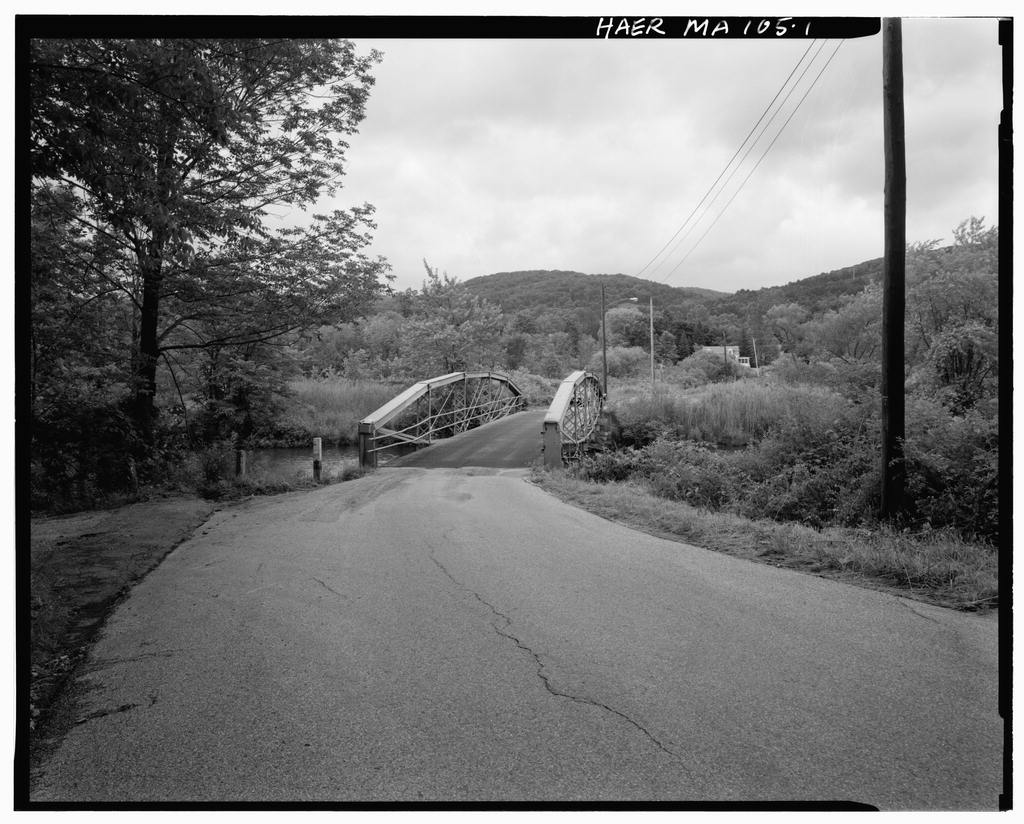
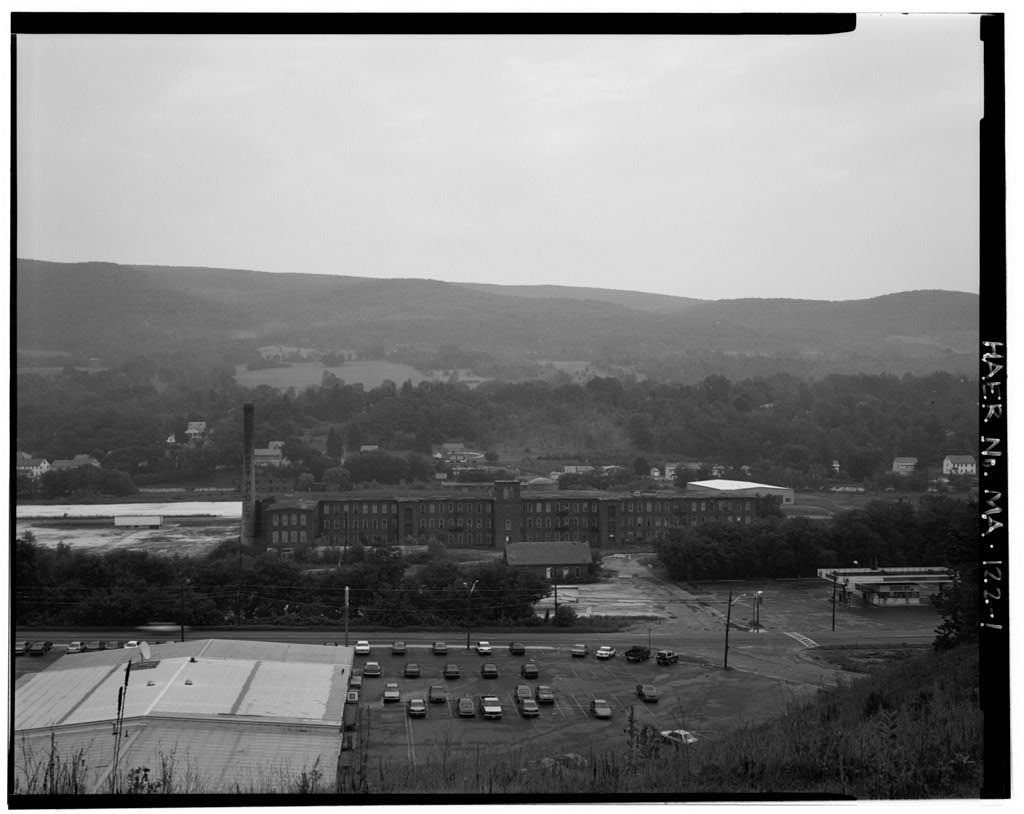
Documentation of the Tuttle Bridge is part of the Massachusetts Historic Bridge Recording Project, conducted during the summer of under the co-sponsorship of HABS/HAER and the Massachusetts Department of Public Works, in cooperation with the Massachusetts Historical Commission. Patrick Harshbarger, HAER Historian, August TUTTLE BRIDGE (GOLDEN HILL ROAD BRIDGE) HAER No. MA-105 (page 2) Description The Tuttle Bridge spans the Housatonic River at Golden Hill Road about one mile northeast of downtown Lee, Massachusetts, in the Berkshire Mountains. The bridge sits in a marshy bottomland just upstream from a large paper mill. To the east, Golden Hill Road crosses the bottomland, and a railroad spur parallels the river. The road rises steeply to the top of a small hill west of the bridge.
The Tuttle Bridge is a single-span lenticular pony truss. Parabolic upper and lower chords characterize the lenticular form. Because of their distinctive shape, such bridges ate often referred to as "pumpkinseed bridges." The Tuttle Bridge is a five-panel pony truss, measuring long and wide. The distance from the bottom chord to the river is approximately 5'. The depth of the structure varies from at the portal ends, to at centerspan. Each truss panel measures in length, with the exception of the eastern end panel, which measures This slight difference may be due to distortion in the bridge and not to design. The segmental upper chord is riveted and bolted together at each panel point.
Each segment is comprised of wrought-iron plates and angles riveted together Into the shape of an inverted trough, with lattice on the underside. The lower chord is comprised of a pair of wrought-iron, eyebars. The lower chord segments are pinned together at each panel point. The vertical endposts are manufactured in a fashion similar to the upper chord. They are built-up in the shape of an inverted trough, with lattice on the underside. The bases of the endposts rest directly upon the stone abutments. The assembly of the upper chord and post is held together by a cast-iron cap, and a pin to which the lower chord's eyebars are connected. The vertical web members are paired, 2H" wrought-iron angles joined by lattice.
The main diagonals are paired, Ik" diameter wrought-iron rods with turnbuckles. The counters are single, IV diameter wrought-iron rods. A "tension floor-line chord," in the form of a wrought-iron rod, runs the length of the truss, and is bolted to the footing of each endpost and to the floor beams. The floor-line rod is IV in diameter and has adjustable turnbuckles near the second and fourth panel points. The rod has been severely twisted, probably from the force of flooding.1 The I-shaped floor beams taper, their deepest point at the center of the bridge and their shallowest at the exterior edges. The floor beams hang from the lower chord panel points by means of U-shaped rods passing over the connecting pins. The lower lateral rods bolt to the floor beams.
The stringers are modern, steel I-beams, which run the length of the bridge. The roadway is Irving open steel grid decking. Lenticular Bridges A number of amateur and professional historians have written about the history of lenticular bridges. The lenticulars' association with a single manufacturer (the Berlin Iron Bridge Company), their predominance in a relatively small geographic region (New England and Upstate New York), and their aesthetically-pleasing form, have made the lenticular truss a popular TUTTLE BRIDGE (GOLDEN HILL ROAD BRIDGE) HAER No. MA-105 (page 3) subject among bridge enthusiasts. Between and the Berlin Iron Bridge Company built well over 600 lenticular bridges in the Northeast.
The Tuttle Bridge is one of approximately fifty lenticular bridges known to survive nationally, and one of only ten known surviving lenticular bridges in Massachusetts (eight of which are under Massachusetts Department of Public Works purview).2 Built in it is a rare example of a structural type that once predominated among the iron truss bridges of Western Massachusetts.3 Lenticular trusses came in a variety of sizes and configurations. They ranged from 20' to over in length, and could be designed as either pony, through, half-through, or deck trusses, although through and pony trusses were by far the most common. When the Corrugated Metal Company, the forerunner of the Berlin Iron Bridge Company, began building trusses in the late the lenticular form had been known for a number of years.
Lenticular trusses had been built in in France, in in Germany, and in in England. Patents for bridges of the lenticular-truss type had been granted in the United States to Edwin Stanley in and to Horace Hervey and Robert Osborne in Considering these earlier structures and patents, historians have considered it somewhat odd that the United States Patent Office granted William O. Douglas a patent for lenticular trusses in Douglas was a West Point graduate and a disabled veteran of the Civil War.
He had spent some time in the Reconstruction government of Texas and moved back to his hometown, Binghamton, New York, to open a hardware business, which failed in Shortly thereafter, Douglas took out a patent on a lenticular truss and entered into business with the new owner of the Corrugated Metal Company of East Berlin, Connecticut. It is not known where Douglas received the inspiration for his patent, although he may have been exposed to its principles in engineering classes at the military academy. Bridge historian Victor Darnell believes that Douglas developed his ideas without any knowledge of European usage or earlier American patents.
Berlin Iron Bridge Company The Corrugated Metal Company had descended from a series of firms that had specialized in tinner's tools and machines, and corrugated Iron for buildings. When an entrepreneur named Wilcox took over the firm in it was on the verge of bankruptcy. Wilcox reorganized the company, obtained the rights to Douglas's bridge patent, and began building lenticular trusses. In Wilcox renamed the enterprise the Berlin Iron Bridge Company.6 In the late-nineteenth century, dozens of engineers and companies experimented with a wide variety of bridge designs. Most of the new trusses proved economically unfeasible, or lacked strength and durability.
The success of the Berlin Iron Bridge Company was unusual and relied upon a combination of marketing savvy, engineering skill, and luck. The firm specialized in highway bridges and salesmen aggressively pursued contracts with nearby towns that were just beginning to replace older wooden bridges with iron spans. With lower transportation and erection costs, the company could underbid many of its competitors from Boston, New York, and TUTTLE BRIDGE (GOLDEN HILL ROAD BRIDGE) HAER No. HA-105 (page 4) Philadelphia.
Guided by Wilcox's entrepreneurial skill, the Berlin Iron Bridge Company designed its product, marketing technique, and price to appeal to the selectmen and bridge committees in charge of purchasing bridges for New England towns.7 In the a new iron truss bridge of substantial length cost little more than a new wooden bridge. When it came time to replace an older bridge that had been washed away in a flood or had simply worn out, a town's citizens often chose to buy an iron truss rather than to continue the tradition of hiring local craftsmen to erect a wooden trestle or covered bridge.
Tuttle Bridge A wooden bridge may have spanned the Housatonic River at the site of the Tuttle Bridge as early as the A map appears to show a bridge near the present location, but changes in the course of the river and the lack of local landmarks make it difficult to verify that this was the Tuttle Bridge. The earliest written report of the Tuttle Bridge is in the edition of the Reports of the Town of Lee. In that year, the selectmen commented that the abutment needed repairing. In the town paid Thatcher, a local millwright, to rebuild the bridge at a cost of The Tuttle Bridge provided local farmers a convenient crossing of the Housatonic River to the main road between Lee and Pittsfield,8 The newspapers often reviewed the conditions of the local roads and bridges prior to town meetings.
The Valley Gleaner. Lee's newspaper, reported on April 1, "The Tuttle bridge is not a very stable affair and It is probable the town will see fit to make some appropriation therefor [sic]." Twenty years was an average lifespan for an uncovered wooden bridge, and it is probable that the bridge had worn out. The following week at Lee's town meeting, Wellington Smith, a prominent citizen and owner of the Smith Mill's Paper Company, located downstream from the Tuttle Bridge, made the motion to raise to erect a "first class iron bridge." The town meeting passed the motion, and the selectmen received the authority to enter into a contract with the bridge manufacturer they felt most fit to complete the work.
On April 22, only two weeks after the town meeting, this notice to bridge builders appeared in the Valley Gleaner: Proposals will be received by the selectmen of the town of Lee at their rooms In Lee, Mass., on the first day of May next, at 2 o'clock for the building of a bridge of about 87 feet span and 14 feet width across the Housatonic River in said town. Further information will be given at that time. On May 1, a number of bridge builders gathered in the town offices to pitch their proposals to the town selectmen. On May 13 the newspaper announced that the selectmen had elected to give the contract to the Berlin company for the lowest bid received. Construction began at once. The town hired a contractor to remove the old bridge, and the abutments needed only minor repairs.
A local stone mason, Patrick Shea, received $24 for his labor. Shortly thereafter, a construction TUTTLE BRIDGE (GOLDEN HILL ROAD BRIDGE) HAER No. MA-105 (page 5) team arrived from Berlin by railroad with the bridge. (According to Victor Darnell, the company had up to thirty erection crews that traveled the countryside during the spring, summer and fall laying the falsework and assembling the lenticular trusses. A medium-size span, such as the Tuttle Bridge, could be erected within a few weeks.) On July 7, the new bridge opened for travel after less than two months of work.
The Valley Gleaner reported, "[The Tuttle Bridge] is a very handsome and substantial structure and will prove a good investment for the town." The total cost was including the expense of lumber for the falsework and bridge deck. An unusual feature of the Tuttle Bridge was the "tension floor-line chord" that ran from the footing of each end post to the end post on the opposite bank.
The Berlin Iron Bridge Company probably had begun adding the floor-line chord to some of its bridges in Douglas applied for a patent for the floor-line chord in October of that year, stating that it resisted the effect of the wind or other forces acting laterally against the bridge.(See appendix.) The lateral system which the "tension floor-line chord" was designed to replace used stiff, heavy struts, capable of resisting compression as well as tension, between the ends of the floor beams.
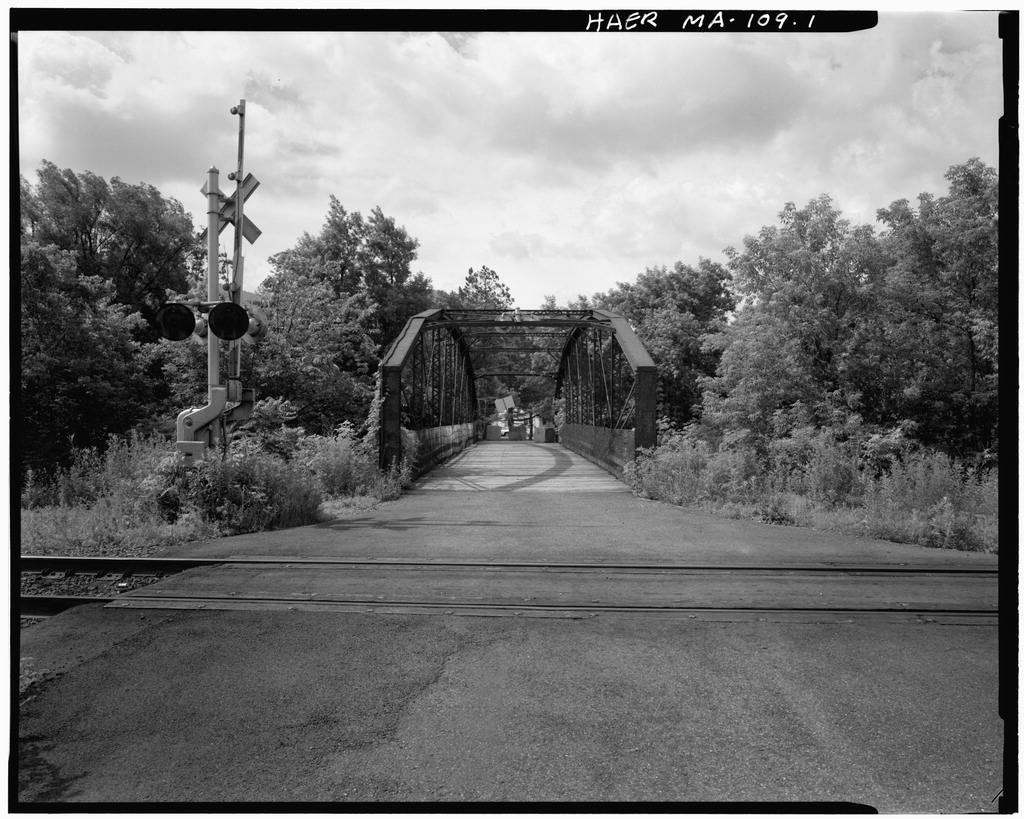
The "tension floor- line chord," designed only to resist tension, could be a single, slender rod, thereby reducing the amount (and cost) of material.10 The Tuttle Bridge is the only one of five remaining lenticular pony trusses in the Massachusetts Department of Public Works database that incorporates the "tension floor-line chord." Victor Darnell is skeptical that the chord served much of a structural purpose, and claims that when Douglas combined the floor-line chord with the inclined strut, such as in the Blackinton Bridge at North Adams (HAER No. MA-109) , he may have actually reduced the truss's lateral stiffness.
Darnell estimates that only about one- third of the Berlin Iron Bridge Company's trusses built after made use of Douglas's second patent.11 Conclusion By the mid-1890s most of New England's wooden bridges had been replaced, and the Berlin company's business had dwindled. The builder phased out the lenticular design in favor of more heavily-constructed Warren trusses. Although the firm hired salesmen in the Midwest, the cost of transportation probably prevented the firm from effectively competing against other bridge manufacturers. Eventually, the company shifted its emphasis to metal-frame factory and mill buildings, evidently a more profitable venture.
In the Berlin Iron Bridge Company, along with twenty-five other regional bridge companies, merged with the American Bridge Company.12 The age of the automobile marked the beginning of the end for the lenticular trusses. Not only did the Berlin Company stop manufacturing them, but many towns found that their lenticular bridges proved inadequate to the increased volume of heavier and faster vehicles. Berlin had built few lenticular trusses wider than and fast-moving cars needed wider clearances. A number of these narrow bridges met their end when an auto or truck rammed the endpost. Throughout the twentieth century, steel and concrete bridges replaced the beautiful lenticular trusses.13 TUTTLE BRIDGE (GOLDEN HILL ROAD BRIDGE) HAER No.
MA-105 (page 6) The Tuttle Bridge was a rare survivor of the automobile age. In the a developer built a colony of low-cost ranch houses to the east of the bridge, significantly increasing the number of automobiles crossing the bridge. Occasional floods have threatened the span, but amazingly little damage has occurred. In the Massachusetts Department of Public Works replaced the bridge's stringers with steel I-beams and laid an open steel grid deck.14 Today, the bridge shows signs of wear, the endpost caps have cracked, and now the posts themselves incline outward. TUTTLE BRIDGE (GOLDEN HILL ROAD BRIDGE) HAER No. MA-105 (page 7) UNITED STATES PATENT OFFICE, WILLIAM O. DOI'dLAS, OF IUXOH AMTON*. NKW YORK. BRIDGE. SPECIFICATION forming part of Litters Patent No.
dated April AM.Uffttliin llVil Orlolicr li, im. (N To all xvliom it may concern: Referring to Fig. A Is tho diagonal Ro it known that I, Wnxi.vM O. I)iM:cr..\s. strut, extending front the first panel-point of 50 n citizen of tho United States, rcslilin^ ut Ring- luwcr chord to a pin near base of end post, to hnintou, hi the county of Rroomo mul Stnto which pin the tension llnor-lino chord 5 of Xcw York, luwe invented certain new and 11 attaches. The strut A might extend from useful Improvements in of which tho b ise of end post to second pnno! of lower chord, following is n description.
to first or second panel of upper chord, or to 55 A very important factor in bridge construc- any convenient point in lliu supporting-truss tion Islhc menus employed tu resist the cU'eet in such nmannertvMo mnkeustitV fixed mem- io of the wind or other furco acting laterally on ber to resist tho pull urlstngfrom tho tension n truss. This'is especially true fu long spans floor-line chord it- but it is preferred as rep- where tho conditions lire such that the resented. In short spans less than aboutscv- 60 tiincc between (he trusses of a bridge is lim- enly-live feet the brace or strut A may bo ited.
In the caso of u parabolic truss (Ids omitted, the tension tloor-Him chord being 15 wind-truss is u very important fiU'tnr in the secured at tho end post by a bolt in the ma- construction of n, bridge, requiring in long sonry. spans with narrow roadway a large mnomit Fig. IV represents a detail side and sec- 63 of mnteriut because the chords or tlanges uf tiomil elevation of tho first panel-point of tho tho wind-truss liuvo been heretofore desiguiMl lower chord, showing lower chord, K, first 20 to resist both compression nnd tens!* w, the web-post F, web-tic (i, suspender li, and tho leeward chord being in tension nnd tin.-wind- diagonal strut -brace A, nil connected at panel- ward chord being in compression alternating point by pin I. 70 upon the chords in character or kind of strain Fig.
V represents a detail side nnd sec- according to tho direction of tho wind or ot Iter tional view of base of end post, (', resting on 25 force applied laterally. a nest of rollers and connected with the diag- My invention is designed to improve this onal strutbrnco A and the tension floor-line condition of tilings In parabolic Irtixs-brltlgcs chord Jl by means of a pin passing through 75 to tho end of cheapening the cost of tho bridge tho three pieces It. both iu tho amount of material and cost of Fig. IV represents a braco between the end 30 construction and increasing its efficiency by posts to keen them from drawing together un- providing a means by which both tlanges of der tho tension of sway-rods J. tho wind-truss shall bo always In tension, Figs.
Viand VII represent the connection Ho which is dono by providing tho brace A to of tension floor-line <diord R with floor-beam resist the pull of tho chords II in a parabolic K nnd sway-rod J. In Fig. VIII the same con- 35 truss. nection Is shown for a bridge askow with tho Flgnro I represents an outline diagram in abutments. Iu alt of tho above figures tho clovatlon of a parabolic truss. Fig. II reprc- connections aro by means of pins; but I do 85 resents an out! I DO diagram of a lloor-phm of not confine myself to the use of pins nlono in tho same. Pig. Ill represents an enlarged tho connections; but my invention would bo 40 view of tho end panol nnd part of tho second . he snmo if tho connections were made by riv- panel of tho trass shown In Fig. I, In which ets or otherwise.
Tho forms of tho different b represents tho top chord of tho supporting- parts as represented arc those, generally used 90 truss; 1% the bottom chord; C, tho end post; in the parabolic lint theso forms may bo Ft the first wcb-postj-G, tho Jirst wcb-tlo; JI, changed to suit tho different conditions or 45 tho suspender: B, tho tension floor-lino chord, difTercut details of construction. and A tho end brnco-strut, all hereinafter de- In a separato application of even date here- scribed, and indifferent figures represented by with I have shown, described, and claimed 95 the same letters. tho tlo-rod B in connection with the rods J TUTTLE BRIDGE (GOLDEN HILL ROAD BRIDGE) HAER No.
MA-105 (page 8) nml lloor-bciiiiw K, forming n lower hitrrnl rigidly us ID itwlat tho pull of tho ehortls !), wlmMrusH; mill I therefore nmko im bruml making both flanges of I ho wind-truss always 10 t'ltiiin to that fi-utiiro It) thi* nuo. In tenxiuu, mibstiintlally as Illustrated and do- What I claim us my invention Is scribed. Tlio combination of a tension floor- linu WILLIAM O. DOUGLAS. chord, Jl, with a strut-brncc, A, or its tic- Wl In esses: aoribed equivalent Inn parabolic I rttsvlirldgu, F. .1. IlAYt.lXS. whereby a point In the cud post is fixed so CirAri. 1>. MATTIIHWH. TUTTLE BRIDGE (GOLDEN HILL ROAD BRIDGE) HAER No. MA-105 (page 9) (Ko Model.) 4 Sbeeti Sheet 1. W. 0. DOUQLAS. BRIDGE. No. Patented Apr.
7, * \y * C * ;> /\* * k '\ WITNE8SES: DT7ENT0R: ATXOBim TUTTLE BRIDGE (GOLDEN HILL ROAD BRIDGE) HAER No. MA-105 (page 10) (Ko Modal.) 4 Sbeeti Sheet 2, W. 0.
No. Patented Apr. 7, no. II WITHIB8E8J 2HYEKT0S: 1TT0BKETS. TUTTLE BRIDGE (GOLDEN HILL ROAD BRIDGE) HAER No. MA-105 (page 11) tHo Model,) A Sheet! Sheet 3. W. 0. DOUGLAS. BRIDGE. No. Patented Apr. 7, no. iv as SiJU^TflH Fiq-. v WITNE88ES: . INVENTOR: ATT0BHEY8. TUTTLE BRIDGE (GOLDEN HILL ROAD BRIDGE) HAER No. MA-105 (page 12) (Ho Model.) 4 Shetti Sheet 4. V. 0. DOUGLAS. BRIDGE. No. Patented Apr. 7, -far rirf ' 1 r\Q vi nq- VII FICJ VIII WITHE8SES: . IKVENTOR: ATTOESEYS. TUTTLE BRIDGE (GOLDEN HILL ROAD BRIDGE) HAER No. MA-105 (page 13) o in o in Ui i 5 < 2 >- or i- LU 5 O LU to O if) if, Z> -3 r cr I- 2 O K tO z < > LJ -J < UJ i O LU O Q Q: CD b < nr o (0. cr _I u X <0 < 5 2 LU lil O J UJ O _J O TUTTLE BRIDGE (GOLDEN KILL ROAD BRIDGE) HAER No. MA-105 (page 14) ENDNOTES 1.
In his patent, William Douglas refers to this feature as a "tension floor- line chord," and to the combination of floor-line chord, floor beams, and lower lateral rods as a "wind truss." 2. See: Victor Darnell, "Lenticular Bridges from East Berlin, Connecticut," The Journal of the Society for Industrial Archeology, vol. 5, no. 1, pp. and Bernard Drew, Spanning Berkshire Waterways (Great Barrington, Massachusetts: Attic Revivals Press, 3. The Massachusetts Historic Bridge Recording Project documented three other lenticular truss bridges: Bardwell's Ferry Bridge at Conway/Shelburne (HAER No. MA-98), Blackinton Bridge at North Adams (HAER No. MA-109), and Aiken Street Bridge at Lowell (HAER No. MA-106), 4. Darnell, p. 19. 5. Ibid, pp. 19 and 27. 6. Ibid, p. 24. 7. Carl W.
Condit, American Building Art: The Nineteenth Century (New York, Darnell, pp. and Drew, pp. 8. Records of the Town of Lee From Its Incorporation to (Lee, Massachusetts: Press of The Valley Gleaner. and Reports of the Town of Lee and 9. Reports of the Town of Lee. and, The Valley Gleaner. 8 July 10. Darnell, p. 20. 11. Ibid. 12. J.A.L. Waddell, Bridge Engineering (New York: John Wiley & Sons, p. Darnell, p. 27; and, Drew, pp. 13. Drew, pp. 14. Florence Consolati, See All the People or. Life in Lee (Lee, Massachusetts, p. TUTTLE BRIDGE (GOLDEN HILL ROAD BRIDGE) HAER No. MA-105 (page 15) BIBLIOGRAPHY "Bridge Massachusetts Department of Public Works Bridge Section files. Condit, Carl W. American Building Art: The Nineteenth Century. New York, Consolati, Florence. See All the People or.
Life in Lee. Lee, Massachusetts, Darnell, Victor C. A Directory of American Bridge-Building Companies Occasional Publication No. 4. Washington, DC: Society for Industrial Archeology, Darnell, Victor. "Lenticular Bridges From East Berlin, Connecticut," The Journal of the Society for Industrial Archeology, vol. 5, no. 1, pp. Douglas, William 0. "U.S. Patent No. April 16, Douglas, William 0. "U.S. Patent No. April 7, Drew, Bernard. Spanning Berkshire Waterways. Great Barrington, Massachusetts: Attic Revivals Press, Records of the Town of Lee From Its Incorporation to Lee, Massachusetts: Press of The Vallev Gleaner. Roth, Matthew. "Berlin Iron Bridge Company Plant," Connecticut: An Inventory of Historic Engineering and Industrial Sites.
Washington, DC: Society for Industrial Archeology, Town of Lee Annual Reports, Lee, Massachusetts. The Valley Gleaner. Lee, Massachusetts. Waddell, J.A.L. The Designing of Ordinary Iron Highway Bridges. New York: John Wiley & Sons, "William 0. Douglas," biographical sketch, in Broome County Biographical Review. Broome County. New York. Boston,
 Block
Block