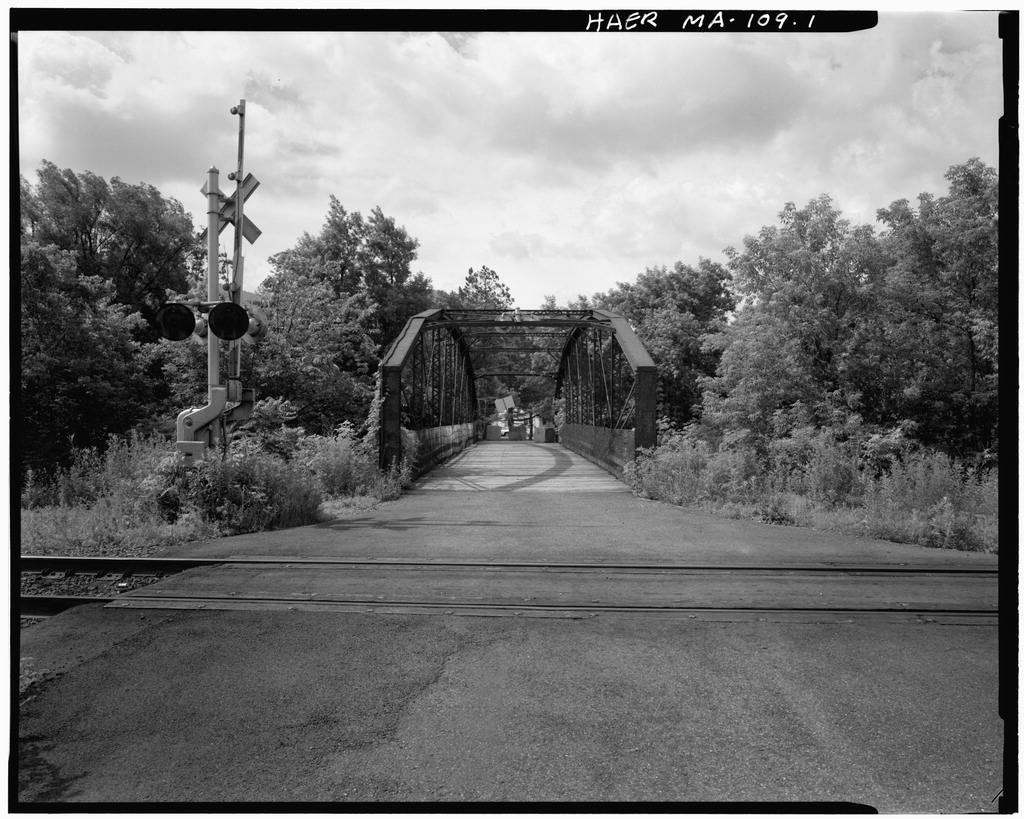
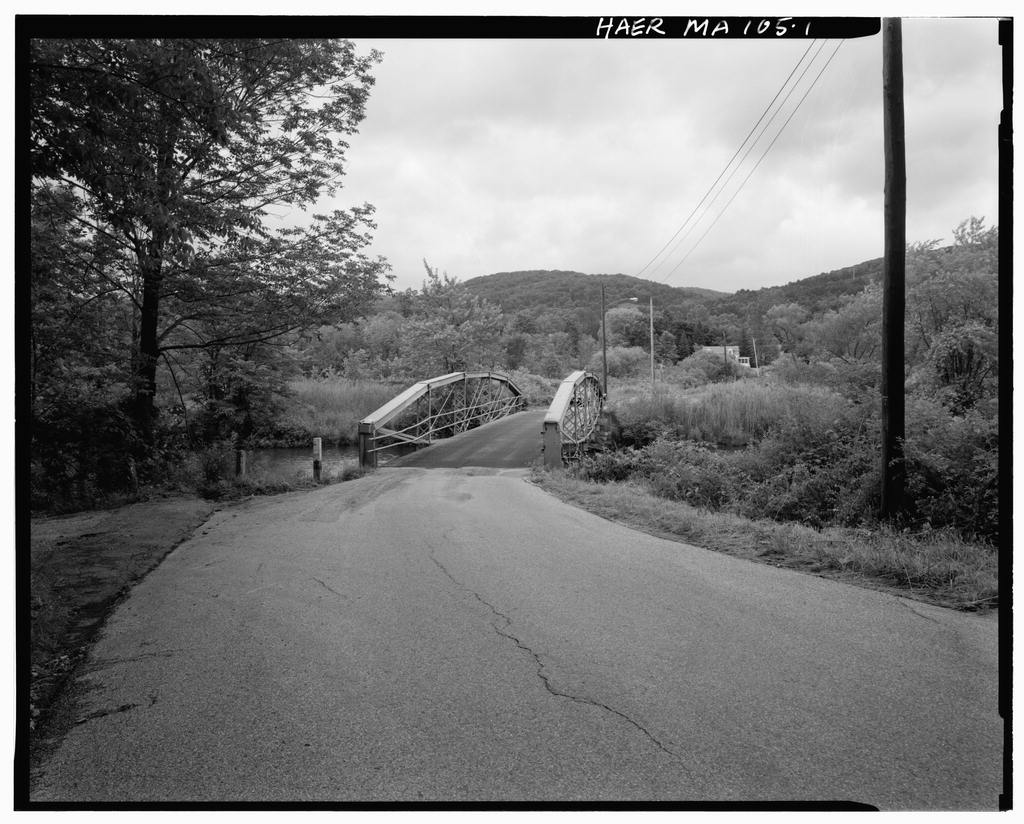
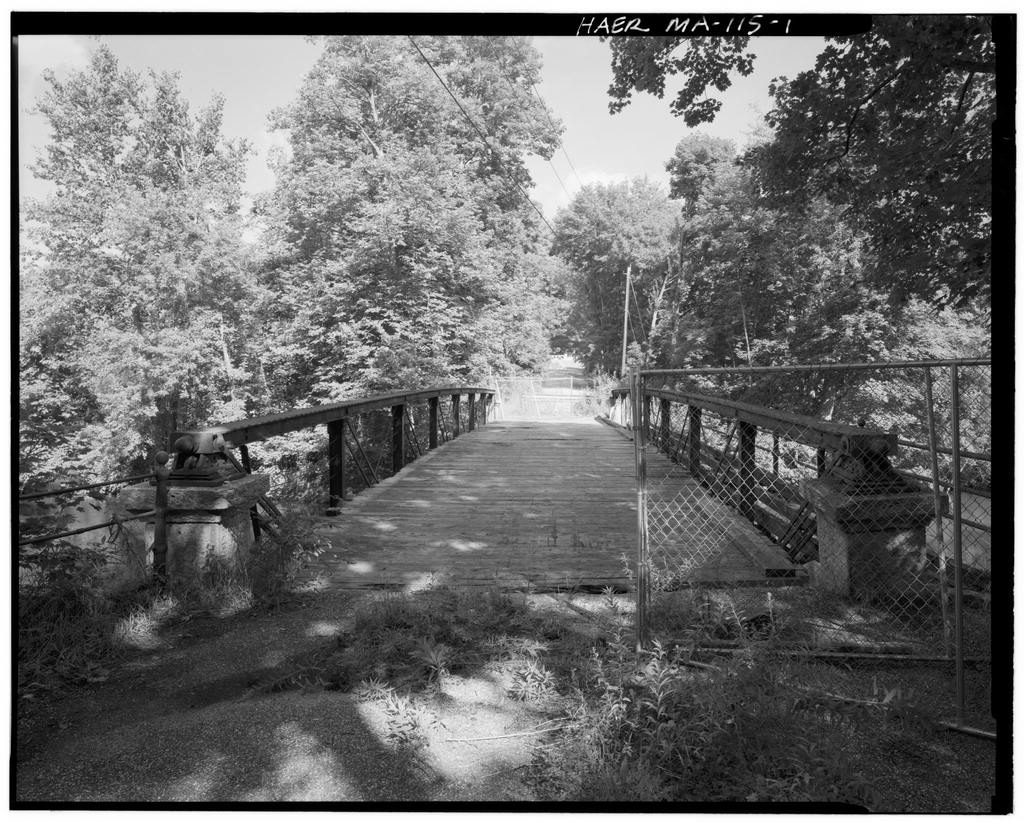
Documentation of the Coleman Bridge is part of the Massachusetts Historic Bridge Recording Project, conducted during the summer of under the co-sponsorship of HABS/HAER and the Massachusetts Department of Public Works, in cooperation with the Massachusetts Historical Commission. Lola Bennett, HAER Historian, August COLEKAN BRIDGE (WINDSOR BUSH ROAD BRIDGE) HAER No. MA-119 (page 2) Windsor Bush The Goleman Bridge is located in a somewhat desolate and remote section of Windsor, Massachusetts, known as "Windsor Bush." Historically, this was always a low, swampy area with dense undergrowth, where the villagers used to go to fish at "Skeeter Pond," now called Windsor Pond, in the northeast corner of town.
During the nineteenth century, however, Windsor Bush was actually quite thickly settled, and while farming was the main industry, at various times Windsor Bush also supported a cider mill, spruce oil distilleries, a number of sugar houses, mines for talc, mica and copper, several saw mills, and an axe factory.1 An map of Windsor shows more than a dozen houses in the Windsor Bush section of town, as well as a school and a cemetery. The area is crisscrossed with several roads and brooks. The map shows the road that is now Windsor Bush Road, crossing the brook near the residences of "H.
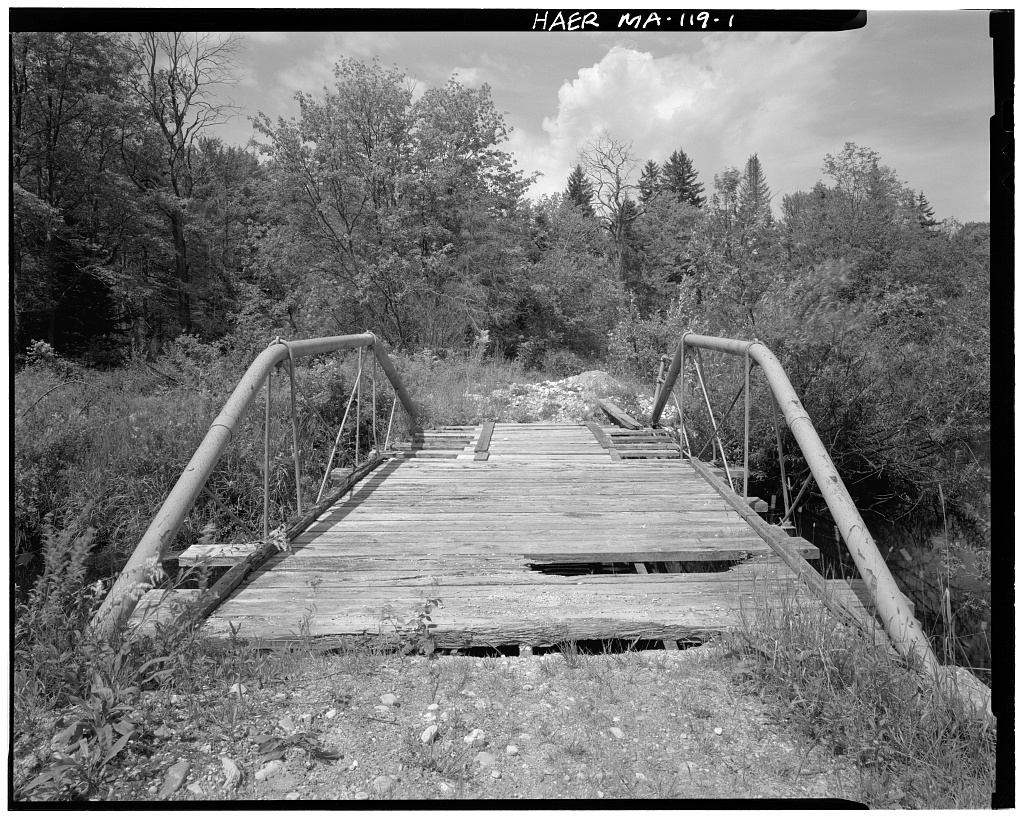
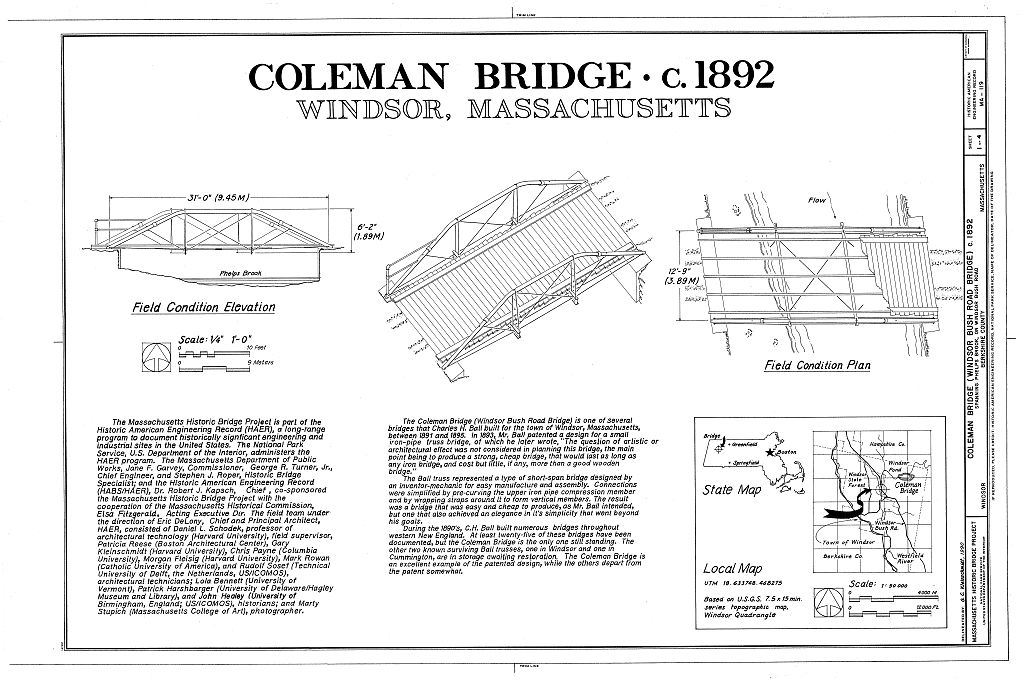
Coleman" and Coleman."(See Figure 1.) Nothing is known about early bridges at that location, other than the fact that whatever bridge was there was referred to as the "Coleman Bridge." Description The Coleman Bridge is a single-span, iron and steel queenpost pony truss, resting on concrete-faced abutments. The bridge measures long, high, and wide. The upper chord is an Iron pipe, measuring 5%" in diameter, with threaded sleeve splices on the inclined sections. The lower chord is comprised of paired, 1W diameter rods with turnbuckles, which pass through the webs of the transverse floor beams, and are attached to the abutment ends of the upper chord by means of a bolt.
The upper and lower chord of each truss are connected by two verticals (1" rods or IV bars), which loop over the upper chord and pass through both the upper and lower flanges of the rolled I-section floor beams. The verticals are secured at the top by a hook-ended bolt passing through the chord, and at the bottom by nuts. Diagonals are W rods with loop-welded upper ends and screw-threaded lower ends, and are secured to the upper and lower chords in the same manner as the verticals, with the exception that the diagonals pass through the webs of the floor beams, rather than the flanges. Five I-section stringers are secured to the two floor beams by straps bolted to the upper flanges of the stringers. The stringers support a 12'-wide wooden deck.
The bridge is laterally braced under the deck by W diameter rods with turnbuckles, although only the rods in the central panel remain intact. The bridge is skewed at an angle of approximately 8 degrees. The present concrete abutment faces have been added--the trusses actually bear well behind them, and a highway report indicates that at that time the bridge had log abutments. The Coleman Bridge follows Charles Ball's patent very closely.(See Figure 2, HAER drawings, and photographs.) COLEMAN BRIDGE (WINDSOR BUSH ROAD BRIDGE) HAER No. MA-119 (page 3) Charles H.
Ball In the late nineteenth century, at a time when the bridge-building craft had been transformed into a high-growth industry, bridges designed and built by local carpenters, masons and mechanics were rapidly becoming relics of the past. The increasing demand for highways, canals, and railroads in mid- century, had created the need for professionally-trained engineers, and by the end of the century, these engineers, working with bridge-manufacturing firms, had largely replaced local builders as the driving force behind the industry. Within this context, Charles Ball, a local bridge-builder with no formal training, was something of an anomaly.
Charles Henry Ball, one of eight children of William Isaac Ball and Mary Pierce Ball, was born at Peru, Massachusetts, on January 14, His father had been somewhat of an adventurer in his youth, traveling to California in the gold rush of and then working as a waterfront policeman in New York City. He finally came to Peru, Massachusetts, to work as a farmer, marry and raise a family. In William Ball received U.S. Patent No. for an "improved potato masher," an indication of the creative spirit that influenced his son Charles' life.2 Charles Ball received his only formal education in the district school, but he read a great deal and was said to be conversant on most subjects.
As a young man, he worked for several years at the Stevens Manufacturing Company in Cummington, a manufacturer of wooden pencils and tool handles.
In the he entered the employ of Granville Jordan, proprietor of an iron foundry and machine shop at East Windsor, Massachusetts, which manufactured "Jordan's Improved Turbine Water Wheels," circular and band saws, and wood-working machinery.3 By Ball had become a partner in the company, then known as "Jordan & Ball," and the shop was also manufacturing wrought iron bridge stringers.4 In Jordan & Ball sold a small bridge to the Town of Peru, for the sum of Whether this project provided the inspiration for Ball's vocation, or whether he was already tinkering with bridge designs and this was merely the first of his bridges to be built, remains somewhat ambiguous, but it was apparently this bridge which marked the beginning of Charles Ball's career as a bridge builder.
That same year, Ball built a machine shop at East Windsor to work on his bridge designs. He employed his brother Frank, and a friend, Harrison Hathaway, in their construction and erection. Several years- -and at least a dozen bridges--later, on July 25, Charles Ball received U.S. Patent No. for an iron pipe truss bridge.(See Appendix A.) During the last decade of the nineteenth century, Ball erected at least twenty-five of these bridges throughout western New England. Exactly how many years Ball devoted to his bridge-building career is uncertain, but it appears that by he was moving on to pursue other interests. The reason for this change is also somewhat ambiguous.
It has been suggested that bridge-building was not a profitable venture for someone like Charles Ball, and that lack of finances forced him to give it up.7 It also seems reasonable to suggest that demand might have dwindled after a few years, if Ball had flooded the local market with his bridges, or that he simply could not--or chose not to--compete with the large bridge-building COLEMAN BRIDGE (WINDSOR BUSH ROAD BRIDGE) HAER No. MA-119 (page 4) companies. But, given the type of person that Charles Ball was inquisitive, creative, ambitious, industrious, a bit eccentric--it does not seem unlike him to have relinquished a proven endeavor for a new and unexplored undertaking.
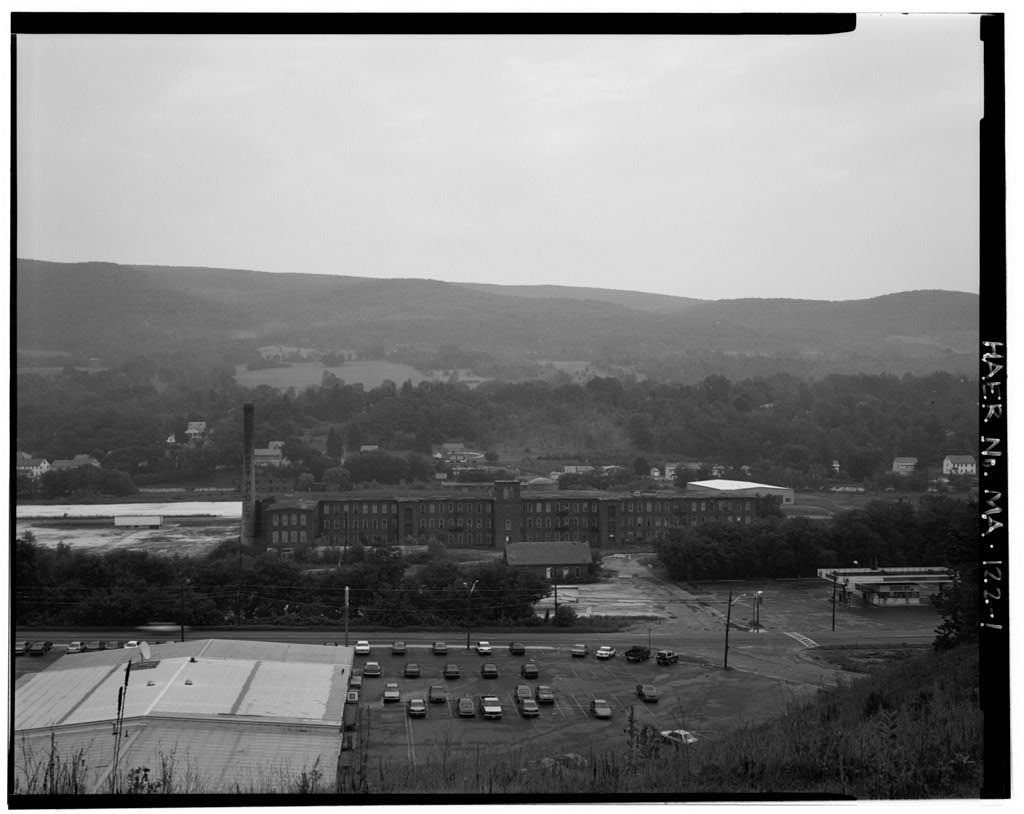
Whatever the case, around Charles Ball purchased a portable sawmill outfit from someone in the nearby town of Savoy, and acquired a factory, known as the "Wooden Bench Screw Factory," at East Windsor.8 He then launched a woodworking enterprise which would grow and thrive into the "The High Ball Mill" at East Windsor, as it became known, manufactured barrel staves and brush handles, and after specialized in the manufacture of lollypop sticks, meat skewers, coat hangers, knitting needles, lead pencils, and other wooden items.(See Figures 3 and 4.) It is said that Ball--always the tinkerer--made improvements in all the existing machinery, redesigning every machine used in his mill.
"This improved equipment greatly increased production, the daily output of the factory in its early days, individual pieces, growing to in later years."9 By a large percentage of the manufactured products were being exported to countries around the world, and while his bridges had never made headlines, Charles Ball's lollipop sticks did.(See Appendix B.) In fact, Ball became so well known as a manufacturer, that he was listed in the National Cyclopaedia of American Biography in 1932.(See Appendix C.) Throughout his life, Charles Ball participated actively in town politics, and held nearly every town office at one time or another.
He was said to be "one of the best known and popular men in Berkshire county."10 His mill employed about thirty people, which, at the time, was most of the available labor at East Windsor.11 He also owned more than acres of land and many of the houses at East Windsor, which he rented to his employees. He was a hard worker and a very generous man, beloved by all. Charles Ball died at East Windsor, May 15, He was buried at the Peru cemetery next to his wife, Cora (Jenkins) Ball, who had died in At the time of Ball's death, David J. Malcolm, Windsor school superintendent, said of him: Charles Ball was a lovable, God-fearing man who loved his neighbors and shared his goods with them.
There are not enough men like "Charlie" Ball, typical of the New England old school--a rare soul who made living a pleasure.12 Ball's Pipe Truss Bridges Charles Ball disparaged most iron bridges being built at the time, saying, "the builders of iron bridges seem to be paying more attention to appearance than to the strength of their bridges."1* He also thought that rivets reduced the strength of the metal, and that their use constituted an unnecessary outlay of labor. Thus, Ball's bridges were designed for easy manufacture and assembly. The main members of the bridges were actually large sections of iron pipe. Connections were simplified by pre-curving the upper iron pipe compression member and by wrapping iron straps around it to form vertical members.
Based on measurements taken at the site, the various members could be cut and bent to the desired shape, prior to the actual erection of the bridge. Once in the field, the various pieces simply needed COLEMAN BRIDGE (WINDSOR BUSH ROAD BRIDGE) HAER No. MA-119 (page 5) to be bolted together and fastened to the abutments. Charles Ball made it clear that aesthetics were not a consideration in his bridges, yet the designs are strikingly elegant in their simplicity. In a sales pamphlet, Ball described the premise of this bridge as follows: To meet the demand for a low priced iron bridge having all the important qualities of strength and durability found in the best iron bridges now made, I have perfected a pipe truss bridge which is shown in the sketches.
The question of artistic or architectural effect was not considered in planning this bridge, the main point being to produce a strong, cheap bridge, that would last as long as any iron bridge, and cost but little, if any, more than a good wooden bridge. 14(See Appendix D.) The majority of the bridges were based on the king- and queen-post trusses, although a drawing in his sales pamphlet suggest that Ball also considered a modified Howe truss design. During the Ball manufactured and erected numerous bridges throughout western New England, at least twenty-five of which have been documented. The concept of an inexpensive iron bridge for short spans was the key to Ball's success.
Small towns could erect several Ball trusses for what it would have cost them to erect a single span designed by an engineer and fabricated by a large company. Thus, the Ball bridges were primarily built by small towns, for spans averaging between 20' and 40' in length. While Ball trusses have been documented as far north as Jericho, Vermont, and as far south as Washington Depot, Connecticut, at least 75 percent of the known Ball trusses were built within a twelve-mile radius of Ball's East Windsor shop.(See Appendix E,) The Town of Windsor was, in fact, one of Mr. Ball's best customers. They bought a number of his bridges, and engaged him in many highway and bridge repair projects through the years.
Annual reports for the town of Windsor indicate that between and the town paid Charles Ball for several bridges, but the details are unclear. The years and amounts are as follows: for "work on bridge and iron work" for "bridge at Patterson's" for "Iron Bridge," (Allen Bridge) for "Iron Bridge at East Windsor" for "bridge work" for "repairs on bridge and plank" These were the largest recorded amounts paid to Charles Ball, specifically for bridges, although nearly every year between and Ball was listed as having received some amount of money out of the town highway fund. Because of the ambiguous nature of the bridge descriptions and locations, it is difficult to determine exactly when the Coleman Bridge was constructed.
Additionally, there has been some speculation that the Coleman Bridge might have been moved at some point from another location, possibly from the COLEMAN BRIDGE (WINDSOR BUSH ROAD BRIDGE) HAER No. MA-119 (page 6) Allenville section of town, but no documentation could be found to support this.15 The fact remains, however, that quite a number of these iron pipe bridges were built by Charles Ball during the last decade of the nineteenth century, and that the design was immensely successful for short-span bridges, given the fact that Ball had never had any formal engineering training, and that he was competing with large bridge-building firms. That Mr.
Ball had great confidence in his bridges is evidenced by his sales brochure, in which he made this offer: As an earnest of my own faith, I will furnish a bridge for any town wishing it, and allow the bridge to be tested up to the point of its guaranteed strength. If any failure or weakness is developed by the test, I will remove the bridge at my own expense.16 Letters from the selectmen of the various towns that purchased Ball's truss bridges, attest to the fact that Ball had, indeed, found a market for his invention. One such letter, dated February 6, from the Selectmen of Worthington, Massachusetts, read as follows: Mr. Ball, East Windsor, Mass. Dear Sir: The bridges you put up for our town are giving good satisfaction. Think you have struck the right thing this time.
It is a good, substantial bridge and comes within reach of small towns.17 Indeed, Charles Ball's bridges proved themselves substantial and able to withstand the test of time, as evidenced by the few surviving examples. There are three known surviving Ball trusses, all in Massachusetts: Holiday Road Bridge, built for the Town of Dalton in Stage Road Bridge (formerly Swift River Bridge), built for the Town of Cummington in and Coleman Bridge (also called Windsor Bush Road Bridge), built for the Town of Windsor at an unknown date.(See Figure 5.) While all three are still intact, the Dalton and Cummington bridges were both moved from their sites in and were put in storage to await restoration.
Although no longer in use, the Coleman Bridge still spans the brook in Windsor Bush, a silent testimony to the creativity and ingenuity of Charles Henry Ball. COLEMAN BRIDGE (WINDSOR BUSH ROAD BRIDGE) HAER No. MA-119 (page 7) COLEMAN BRIDGE (WINDSOR BUSH ROAD BRIDGE) HAER No. MA-119 (page 8) J o Pi 3 CQ U o w O 4 u 0) bO b0 O i-4 o H X S ? 0) U a - 4-1 cQ o c u o <v u pa o CM COLEMAN BRIDGE (WINDSOR BUSH ROAD BRIDGE) HAER No. MA-119 (page 9) w u u > * 0) - en C d 0 ,c r-t o P CO CJ CO 0) to r-4 <0 i-l E 0 U * H >*> o V CO CD o H c O Ho W 4-> r-t CO CO CO o W H-t n U 0 CO 4J W i-t H t-t t-t s a r-t to r-t T3 CO C 03 H . m 0 4J CD O V-i J= 3 PL| t 0 S^' En -'^ L\ arii' triw f r . # ,; -: t -.A **. ,( . r- -f. *^ ; - . tf ~" t' *-.
, ,31 * * t t t ii- i in i TV wr COLEMAN BRIDGE (WINDSOR BUSH ROAD BRIDGE) HAER No. MA-119 (page 10) COLEMAN BRIDGE (WINDSOR BUSH ROAD BRIDGE) HAER No. MA-119 (page 11) Figure 5. The three known surviving Ball truss bridges. Holiday Road Bridge, Dalton, Massachusetts, (Presently in storage at Windsor Historical Society, Windsor, Mass.) Stage Road Bridge, Cummington, Massachusetts, (Presently in storage at Cummington Town Garage, Cummington, Mass.) Coleman (Windsor Bush Road) Bridge, Windsor, Massachusetts, (Spanning Phelps Brook on Windsor Bush Road, Windsor, Mass.) COLEMAN BRIDGE (WINDSOR BUSH ROAD BRIDGE) HAER No. MA-119 (page 12) 1 UNITED STATES PATENT OFFICE. CHARLES II, HAM, OF EAST WINDSOR, MASSACHUSETTS. BRIDGE. &PECICTCATXOH forming part of Lcttera PaUnt No.
<Ut d July Applicttln iM A rU B UtI ffitmfcl.)' la all whom it mat/ ctmecrn; nect with eyes in said tension bars. These He it known that I, CHAKLKS II. HALL, n tension bans pass through |>erforations in the citizen of the United Slates of America, resid- cross-ties I'and arc attached to each other by ingat East Windsor, in thecountynf Herkshire turn-buckle* c. The longitudinal beams FF 5 and StAle of Massachusetts, have in vented cer- of t ho bridge rest upon the cross-lies CC, and 55 tain nen'ami useful tiuproveuit'iitsiii liridge-s; Die fl* *r boards, G, are secured to said beams And I do hereby declare llio following to 1M in the usjal manner.
ft full, clear, ami exact description of tho in* A bridge constructed as hereinbefore de* voution, such as will enable others skilled in serilieil can iw readily made and set up, and to the Art to which it appertains to make and use the chords being tubular are tight and have 60 the same, reference being had to the accom- great strength, and each chord being made of panying drawings, and to letters of reference two pieces permits the parts to be shaped or marked thereon, which form a part of this paltcmotl after each other so u.s to havo uni- specification. form bends or angles.
iS The object of this iiivcuiiuii U in provide a Having thus described tny invention, what 65 truss bridgoof improved coiistrnction; and it I claim as new, and desire- to secure by Letters consists in the construction and combinuiion Patent, is of the paria, as will lm hereinafter fully .set 1. In abridge,thccombinationuf tho tubu- forth, and particularly point ml out in tin- lar chords having inclined end jwrtions and 20 claim?. a horizontal central portion, looped bars con- 70 In the accompanying drawings, forming nee ted to tho central portion of the chords part of this specification. Figure 1 i.sa side ele- and to cross-ties, diagonal b-^co-roda I) ox- vation of ilic improved bridge, and Fig. i is tending from tho inclined ;-vrtions of the a sectional view through the liner xof Fig. 1.
chords through the eross-tios to the horizontal 35 A A designate the piursor abutments upon portion of the chords, and tension bars at- 75 which the ends of iho chords 11 rest and arc inched to the lower ends of the chords and anchored in any suitable manner. Tin- chords extending through the cross-lies and connect- are preferably made up of tubes connected to ed to each other by turn-buckles, substan- each other by sleeves h, and they are su ar- tially 11s shown. JO ranged that they extend upwardlyal an acute 2. A bridge constructed substantially- as 80 angle from the abulincntsnnd are bent to pro- shown and comprising chords having inclined vide a central horizontal portion II'.
From ond portions and horizontal central portions, tlio horizontal portions of the chords depend looped burs connecting the horizontal portion rods a u, which arc made of A single bar of iho chords with the flanges of cross-ties, di- 35 looped over the chords and secured thereto by agonal brace-rods passed through the cross- 85 bolts b' which pass through the chords and ties on a line with the chords, said braco-rods are secured in piaceby nuts.
The lower ends extending from the inclined, jwrtions of the of the rods a re spread and passed through the chords to the central portion, tcosiou bArs E llangcs of the I-railsor cross-ties C, which arc having turn-buckles e, longitudinal beams K e aperturod for the purpose, and the rods or F adapted to rest upon the abutments and 90 supports are screw-threaded lit their bwer upon the croas-ties,and n door secured to the ends to receive nuts c c. longitudinal beams, the parts being organ- I) 11 designate diagonal rod* or braces ized substantially as shown. which are attached at one end to the inclined In testimony whereof I aflix my signature in 45 portions of the chords 11, pass through the presence of two witnesses. cross-ties C on A line with the chords and ex- CIIAKMCS H. HALT.
tend therefrom to the bolts V, E E designate tension bars which iiro held Witnesses: in engagement with the lower ends of the EDTSAK E. JOIUIAK, 30 chords by means of staplosor bolts which con- II. V. HATH WAY. APPENDIX A: Charles Ball's patent, COLEMAN BRIDGE (WINDSOR BUSH ROAD BRIDGE) HAER No. MA-119 (page 13) *< M*OM 0. H. BILL. BBIDOE. So. Patented July 25, WITMX&SXS JW Atiomty, COLEMAN BRIDGE (WINDSOR BUSH ROAD BRIDGE) HAER No. MA-119 (page 14) t "- 5:= = -S "- 3'3-e-,E%-2.-. ' <j 3 e . . eE'--;^nu|j|l. ;i- So-'.* Si " L A~-" - s P. "n * M = - il' n' " ' " - --a a-9ii^ wo is- -- .- - Q.. - u .5 ^ :-. "3 ; COLEMAN BRIDGE (WINDSOR BUSH ROAD BRIDGE) HAER No. MA-119 (page 15) BALL, Charles Henry, manufacturer, was born at Peru, Mass., Jan.
14, BOD of Wil- liam Isaac and Mary Adeline (Pierce) Ball. Hia father joined the emigration to California in sailing around Cape Horn; later he re- B? turned to Massachusetts and engaged in farming. Mr. Ball received his education in the district school at Peru and as a young man be entered the employ of Granville Jordan, proprietor of a machine shop at East Windsor, Mass. By he had become an independent machinist and I^^^^^^^H for a while be was employed in bridge building. He opened a small wood-working shop to make barrel staves, and brush handles, and after f -'je^ specialized in the manufacture of meat skewers and candy sticks. He made many improve- L, ^ISB^MBP ments in all existing machinery, redesigning nearly every machine used in his mill.
This im- proved equipment greatly increased production, the daily output of the factory in its early days, individual pieces, growing to in later years. He served as selectman of Windsor, Mass., for twenty years and was for fifty years moderator of the Windsor town meeting. In he was master of ceremonies upon the occasion of the town's anniversary. He was a member of the Masonic fraternity. He was married, June 4, to Cora, daughter of Marshall Jenkins, of Cummington, Mass.; she died in They had one child, Mary Wash- Hi.JbEl.JMe MUM- - .'-^J**i*fctiSa ington, who was married to Frederick George Bowman. Mr. Ball died at East Windsor, Hats., Mav 15. CHAK1.F.? H. HALL MAM VM 1 APPENDIX C: Biographical sketch of Charles H. Ball. National Cyclopaedia of American Biography.
COLEMAN BRIDGE (WINDSOR BUSH ROAD BRIDGE) HAER No. MA-119 (page 16) CO O >1 4-> = a) V CJ 00 o w )-4 O H to 0) X CM 4J c * o r-t O 03 0) CO 1-1 s <-! - <U U r-4 Q) 4= CQ P. e <a a) ,c ul PM -P 0 W M-l 4) O Q r-l e 5 C/3 O P i? - O UJ *a i-l Icn h CO f> X f-J CO a 1-4 O D o o o z W pq PM P-. < id s $ W to to I * w pq J COLEMAN BRIDGE (WINDSOR BUSH ROAD BRIDGE) HAER No. HA-119 (page 17) U 3 J r2 11~ _ = V sat N 2 I ?1 5 3 5 ~ - 5 = 5 i .2 3 2 Z Z ^=4.a. a m v = - S 3 it - *S - J 3 * i, J ill = 3 r. ^ * tr. 1 -J < m - - -< z: * ^ 5 -' E r .5 .r III X 2 * <- * - S * v * S - ~ ? : = 5 - * i e 3 B-. - - s. >. s i,l | 3 | y H v = _ s *> * 5 z 3 I > J 2. ti > s. = - it 3 ? 5 "v - = = = - s " 3 5 c^ a 3 III " ; i ~ i a * 2 5 T; i a 2 o 3 11 i i -a .5 B-3 3 * ~ ^>: - ^ l e v - i , ^ - at O .
n S "9 A *" _ o 5 J5 s - _ E s a; ^ 5 S 9 =f - = * a - s. * a ' * . * ^ s X t *i k ! I * -5 5 5 si 1*1 is " t S y -s i 5 c - a. * - - * * J r a* - ^ - E s e j, i; 11< Sd 2 * 5 - * a- ' " <? * i^ *- s > = . "- s * : ^* > S s e s > _ **" a. c * = ; ti c "Z fc a. >i, ?- 3 S^ I til? . 5 = 8 K * S * a S o E 2 * % - i I E s & s i * 5 b- e. t * i i . -j , g - * C M K a 2 * o. S t = * |5 a, 3 ^ "'S . I 5 "S S c - g - a. S w p S _ Ed ,= . s * 0. a. 5 s - . " G C V K * | 5 2 5 J -t -5 & ffl - S = e W e 2 =?? si.' = S| I 5 * L IJ sll V JB 2 = 5; 1 !s ^ * SO SHI COLEMAN BRIDGE (WINDSOR BUSH ROAD BRIDGE) PROPOSAL. HAER No. MA-119 (page 18) Chnta $> HI bit Muim^ Jim, 5Ss tfa. o( County of State of. m Charles H.
Ball, of East Windsor, Mass., proposes to do all the work, and furnish all ".^'i' the material of every description except,.. . >^ requisite and necessary to complete in a workmanlike '"<*i JJ 0> u bO a> manner, and ready fur travel, the superstructure for o H T*o A WROUGHT IRON AND STEEL BRIDGE u o * e/> US r-i uvcr the .. '& tf> CO ;it in said County and State; at prices specified below. ' 3 U U H J M Said bridge to he built in accordance with specifications and drawings given belovr orj;I^fj| O submitted herewith. .
^"''ijSIf f* u i-) tQ <fl r-i CQ X u u o o 4-t a T3 4J C O t-i CO & U 4-> 0) c tf o u ;;> 4-1 O Q c o X H t-H -U Q O 55 <x> CxJ r-t OH i t cu O < o Should the above proposal...;be/ accepted, he hereby agrees to enter into Cori*^ tract with your town for the building of said Bridge .with full plans and specifications for such ^-^ Bridge as may be adopted by you, and to form part of said contract Very respectfully, Date._ ;> iit^S.\l:AflAf.i.^^ -J. . COLEMAN BRIDGE (WINDSOR BUSH ROAD BRIDGE) HAER No.
MA-119 (page 19) APPENDIX E: BRIDGES KNOWN TO HAVE BEEN BUILT BY CHARLES BALL (compiled from data and list by Bernard Drew) Peru, Massachusetts, Hawley, Massachusetts, Gummington, Massachusetts, (28 feet) Windsor, Massachusetts, (36 feet), "Allen Bridge" Worthington, Massachusetts, Leverett, Massachusetts, (2 spans of 36 feet) Montague, Massachusetts, (38 feet) Hawley, Massachusetts, Lanesboro, Massachusetts, Jericho, Vermont, Washington Depot, Connecticut, Greenfield, Massachusetts, Worthington, Massachusetts, (22 feet) Windsor, Massachusetts, (25 feet), "Cady's Bridge" Dalton, Massachusetts, (41 feet) Savoy, Massachusetts, (27 feet) Hinsdale, Massachusetts, date unknown Hinsdale, Massachusetts, date unknown Windsor, Massachusetts, date unknown (33 feet), "Axe Factory Bridge" Windsor, Massachusetts, date unknown (29 feet), "Patterson's Bridge" (wood) Windsor, Massachusetts, date unknown (24 feet), "Schoolhouse Road Bridge" (iron stringer) Windsor, Massachusetts, date unknown (30 feet), "Coleman Bridge" Worthington, Massachusetts, date unknown (40 feet) Greenwich, Massachusetts, date unknown COLEMAN BRIDGE (WINDSOR BUSH ROAD BRIDGE) HAER No.
MA-119 (page 20) ENDNOTES 1. Gabrielle T. Drew, Town of Windsor: Anniversary (Windsor, Mass., 2. Ball Family geneological papers, Windsor Historical Society Museum, Windsor, Mass. 3. Hamilton Child, Gazetteer of Berkshire County. Massachusetts. (Syracuse, 4. Ibid, 5. Town of Peru Annual Reports. 6. Bernard Drew, Spanning Berkshire Waterways (Great Barrington, Mass., 7. Drew, "Charlie Ball: One Man Industry," Berkshire Off the Trail (Great Barrington, Mass., 8. "Making Millions of Sticks For Lollypops," newspaper clipping, source unknown, 9. "Ball, Charles Henry," biographical sketch, in National,Cyclopaedia qfi American Biography, vol. 22 (New York, 10. "Making Millions." 11. Ibid. 12. Drew, "Charlie Ball: One Man Industry," 13. Charles H. Ball, Sales Pamphlet, 14. Ibid. 15.
Drew, "Charlie Ball: One Man Industry," 16. Ball, Sales Pamphlet. 17. Ibid. COLEMAN BRIDGE (WINDSOR BUSH ROAD BRIDGE) HAER No. MA-119 (page 21)
Atlas of Berkshire County. Massachusetts. Pittsfield, Massachusetts: Barnes and Farnham, Ball, Charles H. "Ball's Pipe Truss Bridge," sales pamphlet, (Berkshire County Historical Society Collection.) "Ball, Charles Henry," biographical sketch, in National Cyclopaedia of American Biography, vol. 22. New York: James T. White and Co., Ball, Charles H. "U.S. Patent No. July 25, Beers, County Atlas of Berkshire. Massachusetts. New York: Beers and Co., The Berkshire Eagle. Pittsfield, Mass., Berkshire County Directory. Boston: Briggs and Co., "Charles H. Ball, East Windsor Mill Owner and Ex-Town Official, Dead," The Berkshire Eagle. May 15, Child, Hamilton, compiler. Gazetteer of Berkshire County. Mass.. Syracuse, Journal Office, Dalton Bicentennial Committee. A Bicentennial History of Dalton.
Massachusetts North Adams: Excelsior Printing Co., Drew, Bernard A. "Ball Iron Pipe Bridges," Stone Walls. Huntington, Mass., Summer Drew, Bernard A. "Ball's Iron-Pipe Bridges," Society for Industrial Archeology Newsletter, vol. 6, no. 5, September Drew, Bernard A. "Berkshire Bridges: Going, Going, Gone!" The Berkshire Sampler. April 29, Drew, Bernard A. Berkshire Off the Trail. Great Barrington, Mass.: Attic Revivals Press, Drew, Bernard A. Spanning Berkshire Waterways. Great Barrington, Mass.: Attic Revivals Press, Drew, Gabrielle T. Town of Windsor: Anniversary. Windsor, Mass.: Windsor Bicentennial Committee, COLEMAN BRIDGE (WINDSOR BUSH ROAD BRIDGE) HAER No. MA-119 (page 22) Foster, Helen H. and William W. Streeter. Only One Cummington.
Cummington Historical Commission, Historic Photos and Artifacts. Windsor Historical Society Collection, Windsor, Massachusetts. History of Berkshire County. Massachusetts, vol. 2. New York: Beers and Co., "Making Millions of Sticks for Lollypops," newspaper clipping, source unknown, from the files of Bernard Drew, Great Barrington, Massachusetts. Nason, Elias. A Gazetteer of the State of Massachusetts. Boston: Russell, Town of Dalton Annual Reports. Dalton, Massachusetts, Town of Peru Annual Reports. Peru, Massachusetts, Town of Windsor Annual Reports. Windsor, Massachusetts,
 Block
Block