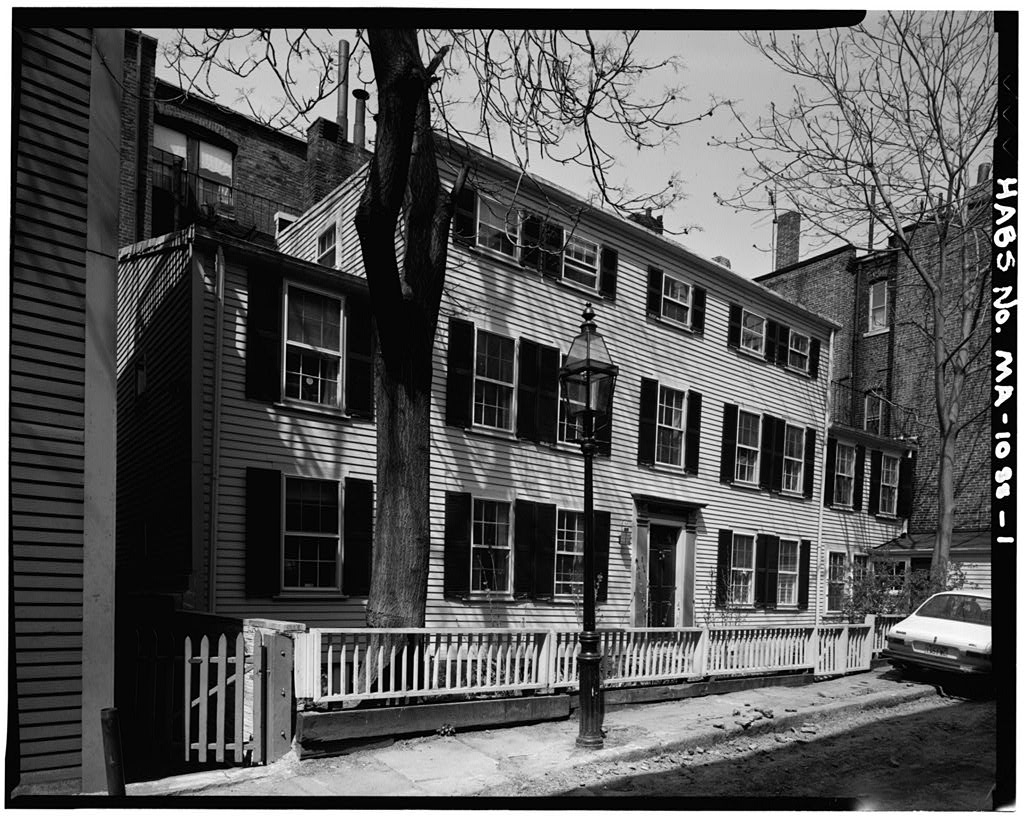
William Cooper Nell was an ardent abolitionist and activist for civil rights for blacks. He campaigned vigorously and successfully for desegregation of the Boston school system, was the first black to be appointed to a Federal job, and wrote and published the first history of black Americans written by a black. Nell resided here from PART I. HISTORICAL INFORMATION A. Physical History: 1. Pate of construction: circa 2. Alterations and additions: The door of the main (south) facade is a replacement of unknown date. All window sash appear to date from the middle or late nineteenth century. The western ell seems to have been added in the late nineteenth or early twentieth century. The iron roof railing was added in the twentieth century.
The shutters, fence, and brick paving in the yard are of mid-twentieth century origin. B. Historical Context: Born in Boston on December 20, William C. Nell learned about racial inequality from his father, William, an associate of militant black abolitionist David Walker. Nell was a charter member of the Massachusetts General Colored Association, an organization founded in for the purpose of encouraging racial uplift and the abolition of slavery. In Nell experienced his first major personal confrontation with racism as a student at the Abiei Smith Negro School, the separate city-supported school for blacks. Here Nell was awarded the highest award for academic achievement given in the school system, the Franklin Medal.
However, he was the only black recipient and was not invited to an honorary dinner given by the mayor of Boston to which the white winners had been invited. Angered but determined, Neil attended the dinner as a waiter, replacing one of his friends. During the dinner a member of the Board of Visitors which had WILLIAM C. NELL HOUSE HABS No. MA-1088 (Page 2) selected the outstanding students recognized him and suggested that he join the other students. Later in his life Neil was to refer to this experience as the one which most influenced his decision to fight for equal rights for blacks. Soon after graduation, Nell became active in the abolitionist movement, working with William Lloyd Garrison and others.
He became particularly active in the collecting of historical information regarding blacks and acquired a reputation for sound research and accuracy of facts. During his participation in abolitionism, Nell was to see both accord and discord in the movement. On the one hand, he was part of the integration of anti-slavery organisations. However, the movement split along Garrisonian and anti-Garrisonian lines. Nell stayed with the former, becoming more active in working on The Liberator.
He ran the paper's Negro Employment Office, wrote articles on the advancement of Boston's black population, and organized mass anti-slavery meetings on subjects ranging from equal educational rights to southern imprisonment of foreign and northern black sailors, In he was among the founders of the Adelphic League and 12 years later helped in establishing the Young Ken's Literary Society of Boston. Interracial in their composition, both of these organizations had as their purpose, the personal development of individuals through self-improvement. This aim was to be achieved through exposure to outstanding speakers and stimulating conversation.
He continued his fight against prejudice in by joining other blacks in the founding of the Freedom Association, an organization formed to assist fugitive slaves. Nell's abhorrence of segregation led to his attack upon the segregated Boston Public Schools. In he and other abolitionists began the campaign by petitioning the city government to eliminate the segregated school system and to grant blacks the right to attend schools on a equal basis with whites. A series of rejections, investigations, petitions, and court cases followed. Although Nell's campaign was initially unsuccessful, the city school board did react by trying the improve the black school by hiring a new teacher. This palliative action was resisted by Nell and his followers who called for a boycott of the black schools.
The boycott, in conjunction with the shifting national temper prior to the Civil War, led to the desegregation of the Boston School System on April 28, The successful, albeit long-fought battle for school integration brought Nell to the attention of the nation. Other desegregationists sought his advice and assistance. WILLIAM C.NELL HOUSE HABS Wo. MA-1088 (Page 3) Throughout the period while Nell was involved with school desegregation, he also found time to write the first history of blacks in America written by a black.
The Colored Patriots of the American Revolution was published in being a revised and enlarged version of an earlier work of Hell's, a 35 page pamphlet called Services of the Colored American in the Wars of and Nell was a pioneer in the field of black history, recording oral accounts, visiting cemeteries, and reading newspapers and official documents. While writing the book, Nell continued to spend time in his crusade for the abolition of slavery and the integration of American society. In response to the Bred Scott decision of Nell participated in the staging of the first Crispus Attucks celebration, giving an address warning of the growing despotism in the United States and its threat to free government.
The following year he continued his attack in an article which he wrote for the newly-published Weekly Anglo-African. He climaxed his attack by petitioning the Massachusetts legislature to declare the Bred Scott decision unconstitutional. He was unsuccessful in that venture, however. The outbreak of the Civil War in I860 started Nell on a crusade for the equal participation of blacks in the war effort. In that same year, he was appointed postal clerk by Boston postmaster John Palfress, becoming the first black to be appointed to a position in the Federal government. He held that distinction until his death. After little is known about Nell except that he married in April, and died in PART II. ARCHITECTURAL INFORMATION A. General Statement: The William C.
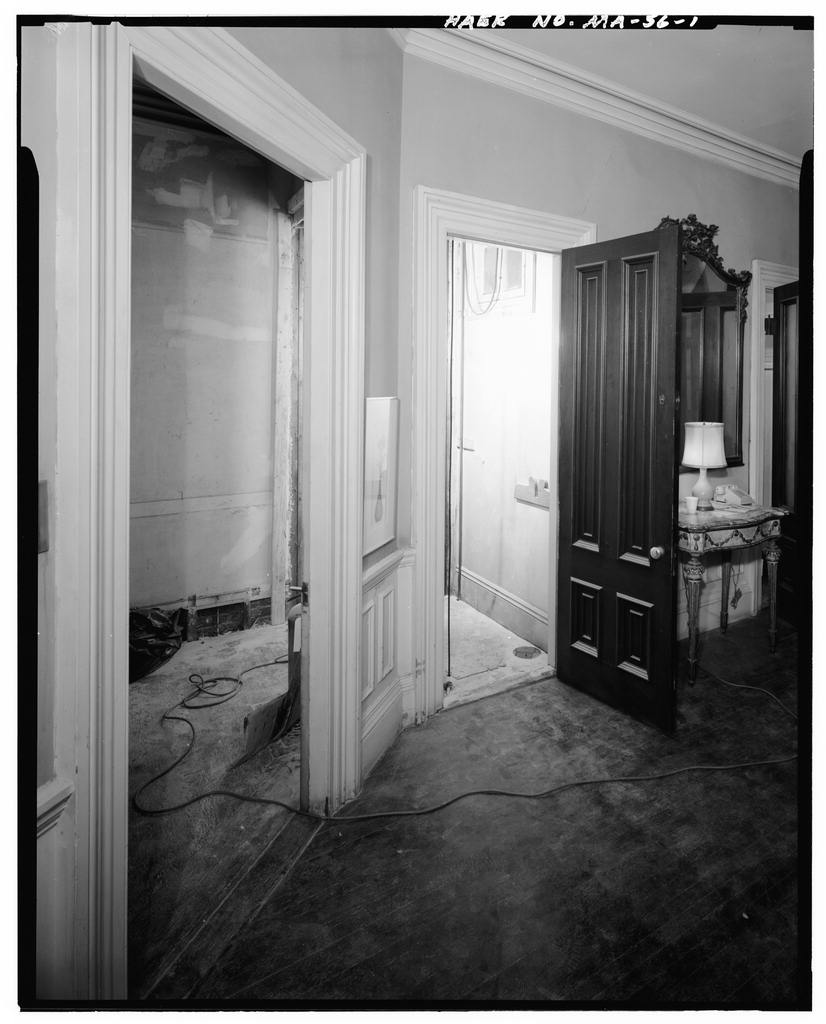
Nell House is a center entrance, three story Federal house with three bays on the main facade, and one bay in depth. The main block is flanked by one ell on each end. B. Description of Exterior: i. Foundation: brick 2. Walls: clapboards 3. Structural system: timber frame 4. Chimney: Two chimneys are built into the rear wall, arranged symmetrically about the center hallway. The east ell has a chimney on the east end, between the Nell house and the house next door. WILLIAK C- NELL HOUSE HABS Ko. KA-1088 (Page 4) 5. Openings: a. Doors: The main entrance is approached from a brick path leading to one step made of a rectangular block of hammered granite (probably original). The entrance consists of a rectangular frame onto which is set pilasters and a cap surrounding the door.
The pilasters are set on nearly square "bases capped by concave moldings from which the pilasters rise with a slight convex curve to their molded capitals. The pilasters support a plain architrave which is separated from the frieze by a band of concave molding. The frieze is undecorated except for a small "S" profile bracket centered above each pilaster. The brackets are capped by a projecting section of the convex molding which forms the top of the frieze. The door is of six panels, with the bottom four being raised rectangles and the top two being nearly square. b. Windows: Fenestration of the main block is symmetrical with five windows across the facade at each floor except the first, where the entrance occupies the center position.
All window frames throughout the house, unless otherwise noted, are of plain boards without decoration of any type. The third floor windows are of three-over-three sliding sash with one window centered on each end wall. The first two floors have windows on the facade only. They are six-over-six sliding sash. The western ell has two six pane sliding sash windows on the south, one on each floor. The west end wall has one immobile six pane window on each story. The eastern ell has one pair of six -over-six windows set west of center on its main facade. At the second floor are two six-over-six windows set in frames with Victorian moldings. They are spaced symmetrically about the center line of the ell. All windows on the main facade of the entire building have two paneled, louvred shutters. 6.
Roof: The main block of the house and the ells are covered by a low sloping roof which rises from south to north and is covered with asphalt sheets, PART III. SOURCES OF INFORMATION Nell, William C., Residence* National Historic Landmark nomination form, Prepared and transmitted by: Holly K. Chamberlain Historian HABS June 25,
 Block
Block