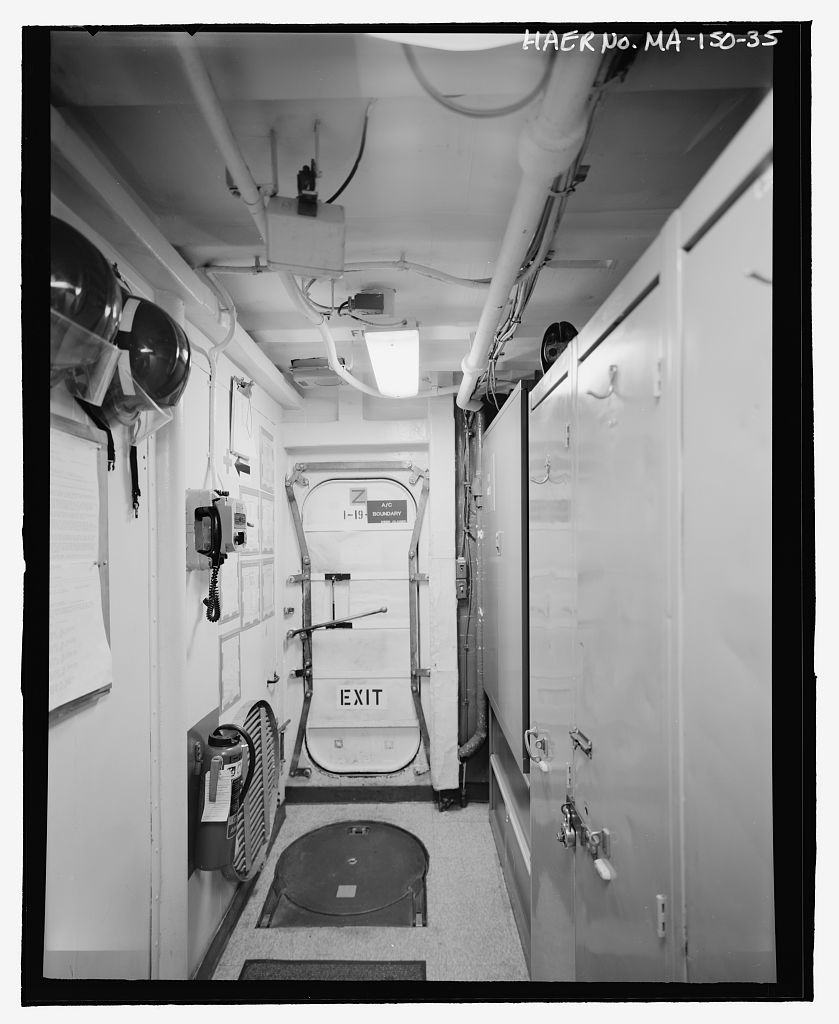
White Heath has been determined eligible for listing in the National Register of Historic Places. The vessel was decommissioned on March 31, and will be transferred from U.S. Government ownership. Since this transfer may have an adverse effect on White Heath, the U.S. Coast Guard requires that the vessel be documented to standards of the Historic American Engineering Record. Written, graphic, and archival photographic documentation was prepared in by: Richard Meyer/Senior Project Manager John Milner Associates, Inc. 535 North Church Street West Chester, PA J. Lee D. Cox, JrVMaritime Historian Dolan Research, Inc. Osage Avenue Philadelphia, PA U.S. COAST GUARD CUTTER WHITE HEATH HAERNo.MA-150 (page 2)
White Heath is a 133-foot long, World War II-era buoy tender that was decommissioned by the U.S. Coast Guard in White Heath started her career in as U.S. Navy lighter After the conclusion of World War II, along with seven sister ships was transferred from the Navy to the Coast Guard in Navy YF classifications referred to "covered lighters, self-propelled." During World War II, at least 76 133-foot YF-257-class lighters were constructed for the Navy at various commercial shipyards across the country. They were designed to carry ammunition and cargo from shore to deep-draft vessels anchored offshore. These Navy lighters were well suited for a variety of coastal tasks because their hull design incorporated a shallow draft with a solid engineering plant.
All of the 133-foot lighters had sufficient cargo space for storing equipment and an open deck and boom for handling large objects. Of the eight 133-foot lighters that were transferred to the Coast Guard, four were built in Erie, Pennsylvania, and two each were constructed in Buffalo, New York, and Napa, California. All Navy YF 133-foot lighters were similarly designed and built entirely of steel. (White Heath) was 132 feet 10 inches long, with an extreme beam (waterline) of 30 feet 9 inches. She displaced 476 tons loaded, had a limiting draft of 8 feet aft when loaded, and was powered by a diesel-electric propulsion system. White Heath originally was outfitted with twin 600 horsepower Union Diesel engines.
She had twin 48 inch diameter, 4-bladed propellers that could generate a maximum speed of knots and a cruising speed of 7.5 knots. The vessel had a fuel capacity of gallons that allowed a cruising range at an economical speed of nautical miles. She was equipped with two main 60 kw Cummings diesel generators. In a crew of one officer and 20 enlisted men operated the vessel. Throughout her career, White Heath was periodically overhauled and modernized during yard availabilities to reflect her evolving missions within the Coast Guard and to remain effective with the advent of more sophisticated shipboard technology.
The U.S. Coast Guard is responsible for maintaining more than navigational aids across the continental United States, Alaska, Hawaii, Puerto Rico, the Virgin Islands, and the U.S. Territories in the Pacific Ocean. These aids-to-navigation include lighthouses, lighted and unlighted buoys, shore lights, ranges, day markers, and long-range electron navigation systems: LORAN and Differential Global Positioning systems. Originally, the establishment and maintenance of navigational aids fell under the auspices of the U.S. Department of Treasury. In August the First Congress created the Lighthouse Service, giving it jurisdiction over existing lighthouses and other aids-to-navigation.
However, this Treasury Department organization relied almost exclusively on private contractors, often local pilots, to administer the service until the This localized system was poorly devised and managed. Congress realized a change was needed to establish a national, standardized aids-to-navigation system. In a Lighthouse Board was formed to handle the management of the aids-to-navigation system. Although the board remained under U.S. COAST GUARD CUTTER WHITE HEATH HAER No. MA-150 (page 3) the control of the Treasury Department, it was administered primarily by the military services. The board was composed of two officers from the U.S. Army Corps of Engineers, two from the Navy, and two civilian scientists. Junior officers from the Army and Navy served as secretaries.
Shortly thereafter, the Lighthouse Board implemented a standardized plan to manage the nation's lighthouses, lightships, and coastal buoys, and channel markers. The Lighthouse Board initiated the transition from sail-powered buoy tenders to steam-powered tenders. In the Philadelphia Navy Yard built the Shubrick, the country's first steam-powered buoy tender. The Shubrick, an immediate success, led the transition to a steam-powered fleet. In the years following the Civil War, the Lighthouse Board authorized the purchase of various steamers to handle the installation and maintenance of coastal buoys. By the start of the twentieth century, the responsibility for maintaining and servicing the coastal navigation system continued to expand.
The country's coastlines were divided into 12 lighthouse districts, each having an Army or Navy officer assigned as Lighthouse Inspector. Although control of the Lighthouse Service was transferred to the newly created Department of Commerce and Labor in the Lighthouse Board continued to administer the agency until when it was replaced by the Bureau of Lighthouses. The Bureau of Lighthouses expanded into 17 lighthouse districts with 17 different superintendents. Each superintendent was allowed autonomy to design vessels according to regional requirements. Thus, a diverse fleet of tenders was built for the Lighthouse Service.
By when President Roosevelt announced his Reorganization Plan II which merged the Bureau of Lighthouses with the Coast Guard, the service had 64 buoy tenders, ranging in size from 72 feet to 200 feet. Standardizing the fleet of tenders became a priority. Under Coast Guard supervision, a class of 180-foot seagoing tenders was built to handle deepwater chores. However, the Coast Guard still lacked smaller, shallower draft tenders to maintain navigational aids closer to shore. In an effort to reevaluate the role and state of the Coast Guard after World War II, Congress funded a thorough investigation of the Coast Guard service. A private management consulting firm, Ebasco Services, Inc.
of New York, was charged with making recommendations for improving the efficiency of the service's operations. Among other conclusions, the report found that the Coast Guard was "under- manned and under-equipped to perform efficiently." Several Coast Guard vessels requisitioned into military service during World War II were returned to their former owners or sold, and the oldest cutters and buoy tenders were decommissioned for disposal in To replace some of these vessels and to address the overall need to increase their fleet size, the Coast Guard turned to the Navy. The transfer of numerous Naval craft to the Coast Guard was authorized.
Among this fleet of transferred vessels were eight steel-hulled, diesel powered, 133-foot YF 257-class lighters that were to be converted to coastal buoy tenders. The 133-foot lighters were needed to complement the Coast Guard's larger seagoing buoy tenders in servicing short-range aids-to-navigation, typically ones in coastal waters and harbors. Although these vessels were not designed for Coast Guard service, they proved to be useful acquisitions. Six of the eight 133-footers remained active in the Coast Guard through the {White Alder sank in the Mississippi River in and White Bush was decommissioned in U.S. COAST GUARD CUTTER WHITE HEATH HAERNo.MA-150 (page 4) was built by the Erie Concrete & Steel Supply Company in Erie, Pennsylvania.
The Erie shipyard built 12 of the class lighters for the Navy during World War II. Her keel was laid on June 4, and she was launched on July 21, However, was not commissioned into the Navy until August 9, At the completion of World War II, she was decommissioned by the Navy in preparation for her transfer to the Coast Guard. On August 9, the vessel was formally commissioned as a Coast Guard cutter and given her present name and mission, that of maintaining aids- to-navigation. Following the custom of the old U.S. Lighthouse Service, along with the other seven lighters was affixed with a plant, shrub, or tree name, prefixed by White. Once commissioned into the Coast Guard, White Heath was sent to the Coast Guard Yard at Curtis Bay, Maryland and refitted for buoy tending service.
Her deck arrangement was converted to include a large derrick to handle buoys as part of her services required by the Coast Guard. Her upper deck was extended while at the Curtis Bay yard in To reflect the transformation to a buoy tender, White Heath was initially designated WAGL, "auxiliary vessel, lighthouse tender." The Coast Guard later changed the class designation to "medium or coastal buoy tender." From her commissioning into the U.S. Coast Guard in August until she was decommissioned in White Heath was assigned to the Coast Guard's 1st District and stationed at Boston, Massachusetts. Although her primary mission was servicing and maintaining aids-to-navigation, her secondary roles included assisting in search and rescue missions and limited ice-breaking duties. NOTE: See HAER No.
ME-63, U.S. Coast Guard Cutter White Lupine another 133-foot class buoy tender. U.S. COAST GUARD CUTTER WHITE HEATH HAERNo.MA-150 (page 5) SOURCES OF INFORMATION/BIBLIOGRAPHY A. Drawings Approximately 23 drawings of the U.S.C.G.C. White Heath showing "as built," as well as altered, conditions are the property of the U.S. Coast Guard and are on file at the Technical Information Branch, Commanding Office, U.S. Coast Guard Engineering Logistics Center, Baltimore, Maryland. B. Historic Photographs Approximately 40 photographs of the U.S.C.G.C. White Heath dating between and are the property of the U.S. Coast Guard and are on file at the Ships History Section, U.S. Coast Guard Historian's Office, U.S. Coast Guard Headquarters, Washington, C. Bibliography 1. Published Works Johnson, Robert E.
Guardians of the Sea, History of the United States Coast Guard to the Present. Naval Institute Press. Annapolis, Maryland. Scheina, Robert L. U.S. Coast Guard Cutters & Craft, Naval Institute Press. Annapolis, Maryland. 2. Unpublished Works Cowart, "Development of Vessels Servicing Aids to Navigation for the U.S. Coast Guard." Paper presented at the annual meeting of the Society of Naval Architects and Marine Engineers, November U.S. Coast Guard Ship's Characteristics Card USCGC White Heath On file at U.S. Coast Guard Historian's Office, Washington, USCGC White Heath Decommissioning Statement. On file at U.S. Coast Guard Historian's Office, Washington, *< U.S. COAST GUARD CUTTER WHITE HEATH { iunh- HAERNo.MA-150 (page 6) r W . ' ' ' ' If jhuti HiU ' i i : N s'- ^ -> i' . * . j* :.. ** , .
k * w. < . r VUr, ' ' ' ."fi i Figure 1. Home port location (detail, Boston South, Massachusetts 7.5 x 15 minute quadrangle, USCG Quadrangle Location
 Block
Block