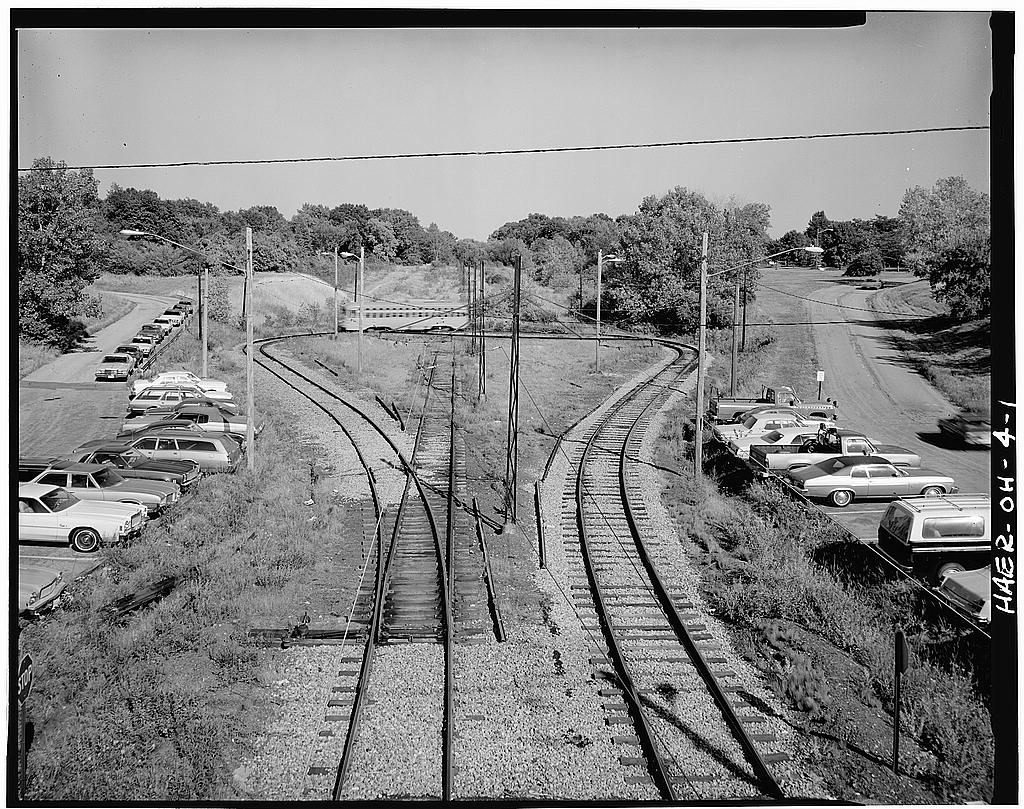
Shaker Heights Rapid Transit Line, Cleveland, Cuyahoga County, OH. Surveyed as HAER OHIO,18-CLEV,28-, with 1 photograph and a 4,952-word written history.
From the record
“The Shaker Heights Rapid Transit is the oldesT segment of the larger regional transportation system.”
Written record, HAER OHIO,18-CLEV,28- survey. Machine-read text.
surveyed by the federal HAER program as HAER OHIO,18-CLEV,28- · the record runs 4952 words · one of 115 surveyed structures published for this county.
Source document
Quoted word for word from HAER OHIO,18-CLEV,28-.
Not written, edited or summarised by this site.
Ed Pershey, SHAKER RAPID The information route maps issued by the Greater Cleveland Regional Transit Authority (RTA) list the Union Terminal-Downtown and East Street-Campus Stations of its "Airport Rapid" line as free-transfer points to "Light-Rail Rapid Transit 11 . The latter line, better known as the Shaker Heights Rapid Transit (simply Shaker Rapid), is the oldest segment of the larger regional system which was established piecemeal in around the former municipally owned Cleveland Transit System. The Shaker Rapid is now the only remaining trolley line in the Cleveland area, as it was the first rapid transit line ever built for the residents of Greater Cleveland.
Built to promote the sale of real estate in the new east- ern suburb of Shaker Heights during the it outlived this phase to service the new homeowners, whom it had lured to the beauty of--the suburbs, transporting them to jobs in the business district of downtown Cleveland. It is the functioning remnant of the early days of urban mass transit in Cleveland when city trolleys inter- connected with electric interurbans in a vast system of electric rail- ways which, before it was ever completed, succumbed to the onslaught of the private automobile and more flexible bus lines.
Significantly the Shaker Rapid was the only electric railway to use the massive Union Terminal Tower complex, promoted and built by the builders of the Shaker Rapid to serve as Cleveland's central steam and interurban rail transportation center in until the Cleveland rapid transit began operations through it in The Shaker Rapid promises to remain an important part of the new regional system, and proposals are being made daily to upgrade the line and extend it even farther east, along never used right-of-way acquired during the early years of its development. In two young brothers, Oris P. and Mantis J.
Van Sweringen, having failed in a real estate venture in Lakewood, a suburb along the lake just west of Cleveland, moved their operations to the east side suburbs of Cleveland Heights and Shaker Village, 1 The land they proposed to develop, some acres, had a natural beauty of a ravine and two lakes. As a residential real estate development Shaker Village held immense potential "provided the principal obstacle to this use could be overcome. The was transportation.'^ The section of the tract north of the ravine lay contiguous with a part of Cleveland already receiving trolley service.
The Van Sweringen's convinced the Cleveland City Railway Company to extend a line along FairmountBoulevard, which ran into their development, by providing the right-of-way and paying the company five-year's interest on the cost of construction.3 However, the city railway could not be convinced of the value of extending a totally new line through the larger southern section (what would become the city of Shaker Heights) By the investment potential of the Van Sweringen's Shaker land lay untapped for the lack of any means to get Cleveland residents out to the horaesites.
Rather than continuing to bargain with an unmoving city railway company, the Van Sweringen brothers began to conceive of their own transit system which would be designed specifically to take people out to their development, as an advertising tool to promote the good life of suburban-mass transit living. The development and build- ing of the Shaker Rapid date from this point. Between then and when the line was completed, the Van Sweringen's found themselves the owners of a major steam railroad, the Nickel Plate, directly as a consequence of their real estate plans for Shaker Heights. By these plans had sprawled out into a major rapid transit proposal for Greater Cleveland and had generated the construction of Cleveland's Union Terminal railroad station complex in the heart of downtown.
The first Shaker trolley car began operating in using the Fairmount Boulevard line and a new section of track laid along Shaker Boulevard.4 Although this served to get people out to part of the real estate, the Van Sweringen's knew that a direct line from Public Square was possible, following a naturally formed right-of-way called Kingsbury Run, a long narrow ravine heading east out of the 'downtown area. The two brothers had realized the potential for this geologic formation as early as and in had bought the four acres of land on Public Square in anticipation of a central railway terminal.
The Cleveland & Youngs town Railroad was formed as a development company to gain arid hold the Kingsbury Run right-of-way.5 World War I intervened, and proposed construction was held off until while the Shaker cars continued to use old Fairmount Boulevard connecting line. In just before the United States entered the war, the'Kingsbury Run land was : acquired by the Van Sweringen's through the purchase of the steam rail- road which ran through it. The Nickel Plate Railroad was largely owned and controlled by the New York Central, a parallel and therefoFe competing line.
Interstate Commerce Commission rulings required that the New York Central divest itself of its Nickel Plate holdings, and the Van Sweringen's were able to obtain the road for The negotiations for the Nickel Plate were generated from the Van Sweringen plans to develop the Public Square area into a railroad terminal facility and also from the fact that a parcel of land adjoining their Shaker project was owned, privately, by a vice president of the Central , whom they came to know very well. The story is rather complex., but basically the Van Sweringen's by had bought the Nickel Plate (a line of over 500 miles), relieved the Central of questionable I.C.C.
violations, and begun plans for a Cleveland downtown terminal project in conjunction with the Central, The Van Sweringen's thereby gained the necessary right-of-way and future terminal facilities which they needed to build the trolley line which would allow them to sell houses in the suburbs.6 The new rapid transit line became known offically as the Cleveland Interurban Railway HAER page 4 a part of the Cleveland and Youngs town Railroad, an adjunct to the newly formed Cleveland Union Terminals Company, and a subsidary of the larger Van Swerigen Company , All this was so much paper until when the first Shaker trolley ran over the new line. As opened on April 11, the Shaker Rapid offered direct service from Public Square to Shaker Heights, with two branches extending through that community.
The run from Public Square to East Street was made on 2 miles of the city streetcar lines of the Cleveland Railway Company, since the terminal project was still only in the planning stages. The latter company, under contract with the Van Sweringen's, actually built and ran the rapid transit.7 From this point at E. the line descended into Kingsbury Run and ran about 5 miles fu^therto a junction point just outside the municipal limits of Shaker Heights.8 HAER OH-4 page 5 Here the line branched into two parts. The Shaker Boulevard line ran slightly over 2 1/2 miles, to a "Y" at Courtland Boulevard, using part of the original track laid in conjunction with the Cleveland Railway Fairmont line. A small branch line headed from there to the Shaker Heights Country Club.
The other branch followed Morel and Boulevard (now called Van Aken after a former mayor of Shaker Heights) for almost 3 miles to a terminal station,. where a dispatcher conducted tours of the available property,9 Small stations were built at Coventry Road on the Shaker branch (at the junction with the Fair- mount line) and at the Courtland end-of-the-line. On the Moreland branch a station was erected at Lynnfield Road, also at the end of the line.
Other staions were planned as focus points for concessions, as well as rider pick-up and drop-off, but except for Moreland Circle, no nother stations were ever built.10 That the construction had been done by Cleveland Railway Company crews is attested by the fact that continuous welded, joints, of a type developed by the electrical engineer of that joints, company were used to connect the rails. A catenary overhead system, carried on concrete poles, had trolley wire, and an electrical feeder wire was carried on side-arm brackets. The Cleveland Railway Company also provided the electrical power.H The construction was totally conventional: The track and overhead are of a high grade construction, following along standard practices. The track is all of open type construction, with A.S.C.E.
rail laid on 8 1/2 ft. x 7 in. x 9-in. oak or yellow pine ties...the roadbed is completely rock ballasted.12 Three facts of the right-of-way of the original construction deserve, however, special mention. After a short high-level viaduct through Cleveland's east side, the Kingsbury Run ravine was mimicked on the approach to Moreland Circle, by blasting through shale rock and constructing a man-made depressed right-of-way lined on either side with a reinforced concrete and brick fence. The surface line of the Moreland Branch was designed in conduc- tion with the layout of city streets in Shaker Heights.
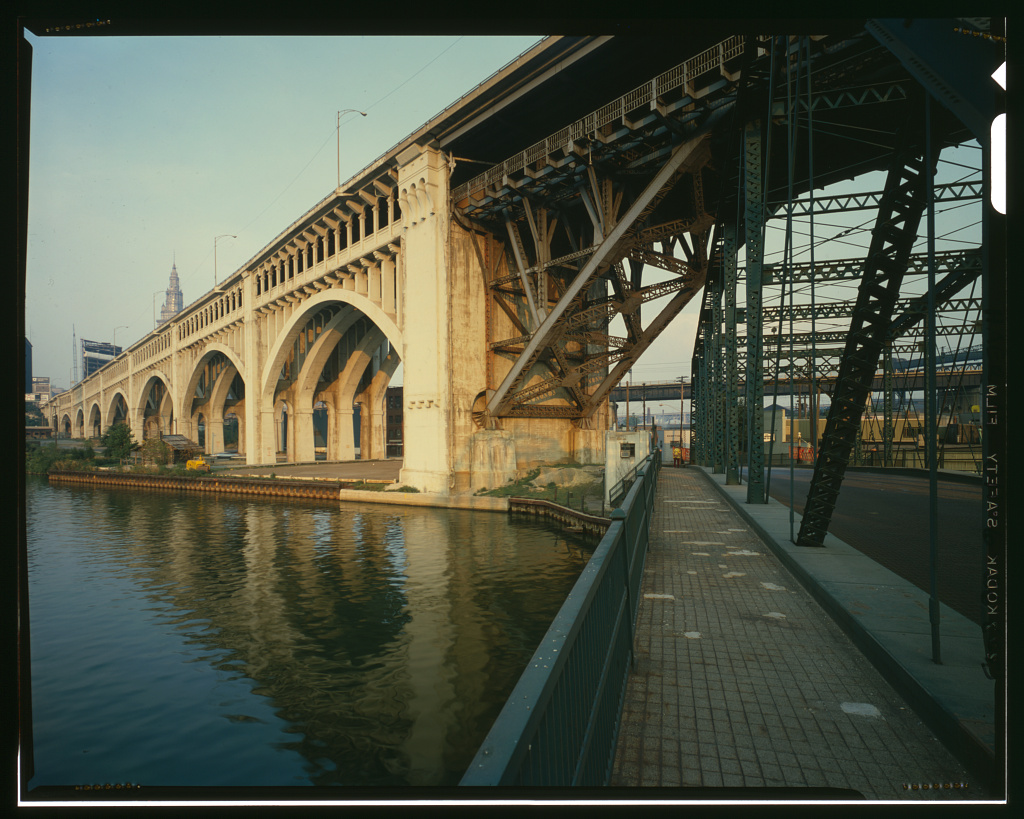
Limited crossing, at only every third-mile, were permitted along this line to prevent as much as possible, train-auto confrontations, and to maintain a smooth flow of rail and street movement. A similar plan was tried on the Shaker line, but plots of land had been laid out much earlier and rearrangement was not Dossible. One sub-grade crossing, using depressed trackage was built on the Moreland line at Lee Road.13 The viaduct across Cleveland's east side was constructed of concrete with two steel truss bridges of four track capacity, to allow for future expansion into express local operation. The bridges were heavy duty, of steam-ratlroad proportions, and carried the Central Railroads. These bridqes still serve the line.
1 4 HAER OH- page 6 The running time from Public Square to the end of either line was 27 minutes, with a 3 minutes layover at the branch terminus, for a scheduled round-trip of one hour. The cars averaged 20 on this schedule. The new line attracted riders along the stops built into the viaduct on Cleveland's east side, even though that area was already serviced by city streetcars, because of the faster running time on the rapid.
From Woodhill road in this section the city streetcars travelled to Public Square in 25 minutes, while the new rapid made it in 14, The 1Q< fare on the Shaker, compared to only 5< on the city lines, di)d not deter even the working class who patronized the new line heavily.15 The major drawback to the installation was the lack of electrical signal lights along the system, and this was the direct cause of two bad accidents in the early Shortly after the second accident in signal lights from the Nickel Plate were installed.16 All the features of this construction are evident in The East Street ramp leading up to the city streetcar lines remains visible, but all track has been removed.
The Kingsbury Run track can be followed by the remaining concrete trolley poles, viaduct crossings and worn path, which lie just to the west and south of the present rapid transit lines between downtown and East Street. From there the Shaker branches off from the Cleveland rapid mainline, and follows the original line, with concrete abuttments, bridges, via- duct and excavated depressed right-of-way". Moreland Circle has since become Shaker Square, but the rapid line is very much a part of its environment, and it is here that the two branches 1 separate.
These two lines, with their small stations, catenary poles and graded right- of-way down the median strip of the two boulevards have not changed appreciably since Most change has been cosmetic, with lines of trees now planted to conceal the trackage from view. However, both lines were eventually extended beyond their original terminal points. The Shaker branch was modified and enlarged <*in with the elimination of the old Coventry line to Fairmount and the branch line to the country club. An extension east to Warrenvilie Center Road, about a mile, was laid, and a loop turn-around was installed there.
The overpass carrying Warrenville Center Road was built with not only tunnels for the rapid tracks, but openings on either side for a parallel "supper roadway" which the Van Sweringen's planned as a major feeder road to the rapid stops and to downtown. The right-of-way was graded farther east to Sulgrave Road, with an overpass earring Richmond Road built even farther to the east in anticipation of future grade extensionsJ? H&ER OH-4 7 These gradings and overpasses are still extant, although most of the proposed extension was^never constructed. Major changes to the system came in the beginning that year with the opening of the Union Terminal Project.
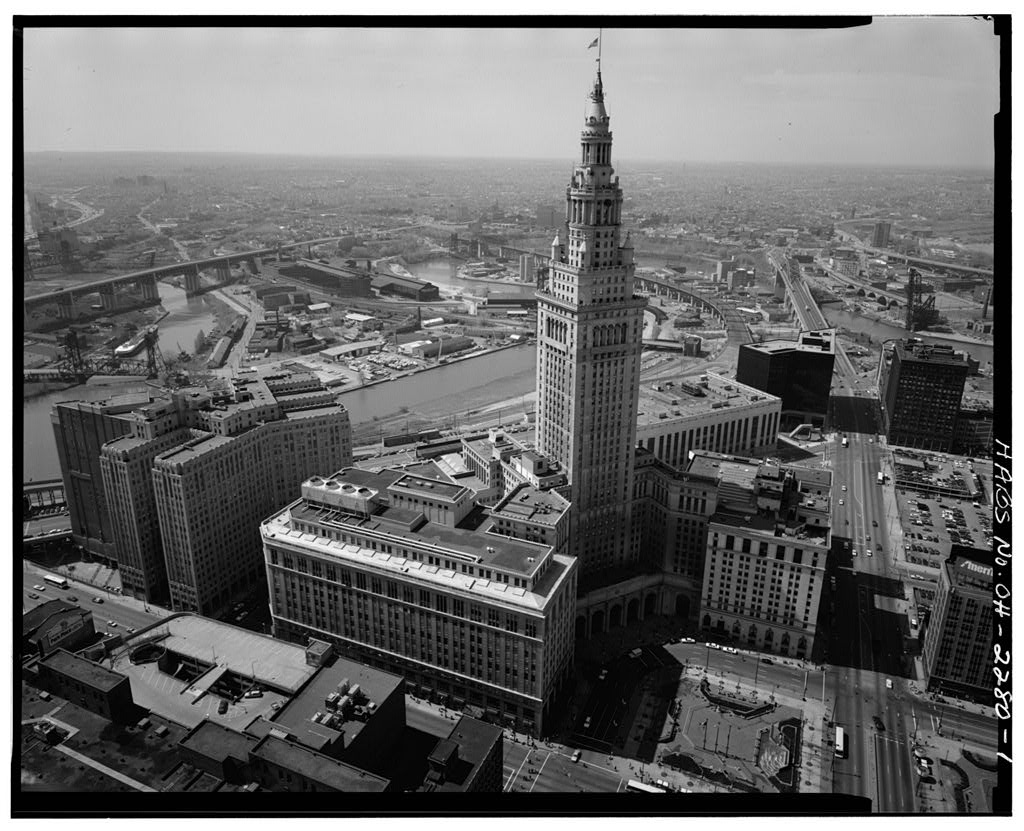
Intended as a major rail center, the Terminal Tower, once the tallest building between New York and Chicago, was also to serve as an interurban terminal. The only interurban still in operation in however, was the Cleveland Interurban the Shaker Rapid.18 Undaunted by the demise of the electric interurban lines, the Van Sweringen's proposed an extensive system of rapid transit and subways for Cleveland, originating at the new terminal, with surface lines along the right- of-ways of their own Nickel Plate, that of the Big Four (Chicago, Cleveland, Cincinnati & St. Louis), and of the Erie. Four major streets in Cleveland-St. Clair, Euclid, Mayfield and West 25th~-were singled out for subway construction.
The Shaker Rapid was intended and promoted as only the first of eight major transit lines.19 Part of the right-of-way along the Nickel Plate was actually constructed, except for the laying of track, along with the still used Cleveland Union Terminal High Level Bridge, just to the west of the Terminal complex. This graded right-of-way sat unused, however, until when the Cleveland Transit System opened its own rapid itransit along the path that had been built almost thirty years earlier. The Cleveland rapid was the first to make use of the underground Un^ion Terminal platforms originally designed for the electric interurbans.
With the opening of the Terminal approaches, the Shaker Rapid discontinued using the East Street ramp to connect with the city streetcar lines, and ran instead directly into the terminal station. This increased the average speed to 27 and decreased the round trip time to 40 minutes. The East Street location remained a Shaker stop after that, and then in the late it Was rennovated as a joint Shaker-Cleveland rapid stop, with downtown loop us feeders This had also been the location of the Cleveland Railway maintenance and repair shops, but as part of the terminal project, these were relocated to East 72 along Kingsburg Run and became strictly Shaker line facilities. The Kingsbury Car Shops remain the maintenance buildings for the Shaker Rapid.
Designed-by Wilbur Watson, the well-known Cleveland engineering & bridge architect, the shops were, nestled into the natural ravine which also separated two ethnic neighbor-hoods on Cleveland's east side. Watson also designed the Sidaway Avenue Footbridge, which spans the site and was built at the same time, to connect the two neigh neighborhoods. Cleveland's only suspension bridge, Sidaway hovers over the Kingsbury Shops to create an impressive and attractive indust- rail setting.
The bridge, in has been closed for many years since the deliberate destruction of the wooden deck which occurred as a side effect of the change in racial make-up of the two neighborhood for whom the bridge was built.20 HAER OH-4 page 8 In the Morel and branch was extended to a new terminus, about 1/2 mile, to Warrensville Center Road, the present end-of-the-line. This was the last change that the Van Sweringen's made before losing control of the line.
The Van Sweringen Company suffered severe losses in the stock market crash of which caused the abandonment of the extensive" Cleveland area transit proposal, although they completed and opened the Union Terminal in The two brothers held onto the Shaker Rapid until their deaths in when i.t was placed in receivership with several Cleveland banks, whose management actually ran the line for another nine years. In the banking management extended the Shaker branch to Green Road, and placed caternary poles out to Sulgrave, along the previously graded right-of-way. Track was laid only to Green. The loop turn-around at Green Road and the overpass there frame the quite visible" r emains of the Sulgrave extension with its unused poles.
The bankers' extension retained the flanking roadway idea.21 During the a freeway, basically following the route laid out by the Van Seringen's was proposed by the County Engineer, but never constructed because of popular sentiment against its transversal of the picturesque Shaker Lakes region. Recent proposals to extend the Shaker branch of the rapid further east, as far as Interstate just beyond the Van Sweringen's Richmond Road overpass, have been met with lukewarm response because of low rider density in that area. In the city of Shaker Heights bought the line from the bankers for (scrap valve) and operated it until RTA took : over in Municipal ownership was championed by Mayor William Van Aken of Shaker Heights, for whom Moreland Boulevard was renamed.
The city management was the first to upgrade the rolling stock of aged Cleveland Railway Company cars, some of which dated back to In and again in the l s and l s PCC (Presidents' Conference Cars) trolleys were purchased to replace the old fleet. Interestingly, several of these PCC-type cars used in the later years of the Cleve- land Railway streetcar operation, and sold by the city of Cleveland to the Toronto street railway system in have been bought back in for use on the Shaker.
These will serve bolster the rolling stock until a new fleet of light-rail vehicles (being built in Italy purchased with federal grant money, arrives sometime in The Cleveland Interurban Railway, alias the Shaker Heights Rapid Transit (and, as noted at the beginning of this report, simply the uninspiring "Light-rail Rapid Transit"), survives in as a work- ing reminder of an earlier concept of suburban mass transit.
It shaped the face of Shaker Heights, for it lay at the core of the Van Sweringen city planning efforts in the Its hybrid character and smaller scale contrast sharply with the functional RTA Airport Rapid which plies between the city's east side and Cleveland Hopkins Airport, along a right-of-way of elevated stations.23 The Shaker HAEH OH-4 page: 9 line recalls the early battle between suburban transit and the system of superhighways designed for the private automobile, and the fact that it survived the period when trolley lines interurbans faded from view, buses appeared and the auto gained suppermacy of the urban and suburban landscape, attests to the importance of making mass transit an intergral part of city plann- ing.
Although forseen as an advertising necessity, the line has evolved into a necessary transportation link for the residents of Shaker Heights who depend on it to reach their employment in downtown Cleveland. HAER OH-4 page 10
Appendix the Rta Kingsbury Car Shops
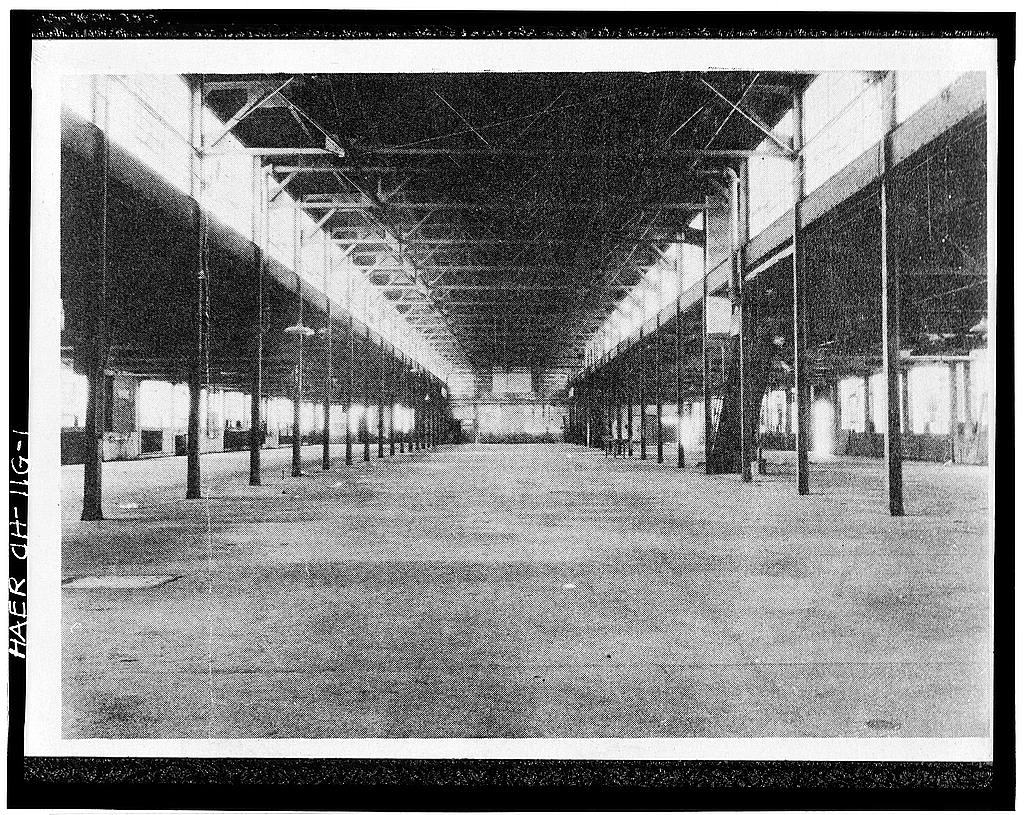
The Kingsbury Car Shops of the Regional Transit Authority are located at East Street in Cleveland, about one half mile south of the present rapid transit lines, just east of the East Street station. Set in a natural ravine, part of the geologic formation of Kingsbury Run, the shop and yards were designed by the Cleveland architectural firm of Wilbur Watson & Associates in built in and added to in Four tracks enter the maintenance building on the north side, through folding doors. Trains pull into the building and exit through the south end, circling back to the yards and mainline on a single track turnabout. The building is not of special construction, the only roof truss running longitudinally along the center to allow skylights.
(Overhanging the site is Cleveland's only suspension bridge, the Sidaway Avenue Footbridge, which was built along with the shops. Watson & Associates also designed the bridge). Facilities include machine shops for overhauling, a blacksmith shop (no longer used), body repair and painting area, and a wash rack. All work, including washing and painting of the cars, is done by hand. Belt-driven machine tools, including a working and occassionally used drill press and a multi-purpose bench tool, are extant, but have been replaced in the daily routine by electric hand power tools. Heat for the shop is provided by a coal-fired boiler.
The shops, when built, included a station for an Akron-Cleveland- Youngstown interurban line, as evidenced by the vestigates of a'ticfcet office, waiting room and track grade along one side of the building. Technological "relics" are scattered about the site, including a few old cars, stone catenary poles, and the machine tools described above. Just north of the shop yards are the reinforced concrete tunnels built by the Van Sweringen's in the late as part of the larger transit and interurban scheme. One of the tunnels has newer had track running through it, a monument to American interurban railways. HAER OH-4 page 11 At the shop offices are extensive material concerning the operation of the line, and information on several of the old inter- urban lines.
Some blueprints of engineering drawings remain-- a few of the shops themselves and some of the rolling stock. Much of the early technological record has been lost with in RTA files, if extant at al 1. Long range plans call for replacement of the shops on a site just to the nocfch, across the RTA mainline, when the new Italian cars arrive in Maintenance personnel at the shops, however, feel that these plans are quite remote, and that the new light-rail cars will be serviced at the Kingsbury site for some time after delivery. Interestingly, the new shop site would lie adjacent to the Norfolk & Western Railroad the successor to the Van Swerigen's Nickef Plate, HAER page 12 MOTES 1 .
The two Van Sweringen brothers, born with the last name of Swerinqen (they added the "Van" after the Lakewood venture) in (Oris) and (Mantis), spent there youth in Cleveland after the family moved from a small community to the south of the city. Their parents claimed Dutch nobility ancestry. The two boys were 21 and 19 when they began the Lakewood real estate project. Harry Christiansen, Northern Ohio's Interurbans and Rapid Transit Railways (Cleveland"! Transit Data, p. 2. As quoted in Christiansen p. Christiansen has a section which he calls "O.P. Van Swerinqen's Own Story", which he claims was handed down to him by a close friend, and implies that it was meant to be the nucleus of an autobiographical book. However, Prof.
Ian Haberman, of Case Western Reserve University, who has researched the work of the Van Sweringen's found this written text to correspond to Oris 1 testimony before the Interstate Commerce Commission in the Nicket Plate Unification Case in Hereafter, this section will be referred to as Christiansen (I.C.C. the author's own text of simply Christiansen 3. Ibid. 4. Christiansen p. 5. Christiansen (I.C.C. p. 6. Ibid., pp. 7. "New Rapid Transit Line in Cleveland," Electric Railway Journal 56 p. 8. This junction, called Morel and Circle, was developed into a retail shopping area and renamed "Shaker Square", an attractive Georgian style architectural area, during the early It remains the pride of Cleveland's east side, since it actually lies wholly in Cleveland and not in Shaker Heights. 9.
Christiansen p. 10. "New Rapid," p. 11. Ibid. 12. Ibid. 13. Ibid., and Christiansen p. HAER OH-4 page 13 14. The bridges appear to be a modified Pratt truss, and have only served the Shaker Rapid. A substantial refinforced concrete approach was built on the eastern end of the west bridge. 15. "New Rapid," p. From the beqinning the line has had consider- able ridership out of the downtown area in the morning hours, and into the city in the afternoon, composed of domestic help working in the upper class houses, of Shaker Heights. This offsetting ridership continues to balance rush hour use. 16. Christiansen p. 17. Ibid., p. 13. Clifford Faust, "Cleveland Terminal Project Nearing Completion," Electric Railway Journal 73 p. 20. No journal article exists on the car barns or the bridge.
Engineer- ing drawings for both are extant. The Watson drawing for the Sidaway bridge is labeled "New York, Chicago & St. Louis RR Co." -- the Nicket Plate's official name. This and the fact that some of the equipment on the Shaker is stamped indicates that some of the line, probably the additions, were built with NickeTl Plate material and crews. However, Prof. Haberman does not believe, from his knowledge of the organization of the Van Sweringen companies, that there was wholesale exchange of goods and labor between the two. The extent of the Nicket Plate involve- ment in the rapid is an open question. No early engineering draw- ings of the right-of the RTA management. See "Appendix" for a description of the Kingsbury Shops as they exist in 19.
"Cleveland Rapid Transit Plan," Electric Traction 25 p. illustrated. 21. Christiansen p. Beyond the sight of the end of the line are the Richmond Road overpass, and Gates Mills Circle and Lander Circle proposed trolley loops for connection with electric railway service to the villages of Gates Mills and Chagrin Falls. The latter had been reached by the Cleveland & Chagrin Falls interurban, a short-lived line that ran along Kinsman Road out of Cleveland. The line failed.for lack of ridership, as did several attempts at bus service, including a Shaker Rapid feeder bus operated for a short time by the bankers in the late 22. See Christiansen pp. 487 or Harry Christiansen, Trolley Trail: "" ' n ' "" "" ..- - - to Today, No. 134 (Cl MAEH page.!.i4 22. pp.
fomninutely detailed descriptions of rolling stock, Also, three PCC cars wereobtained on loan from railway museums, for temporary use, with the understanding that RTA would refur- bish them for the museums. One of these cars is painted cream and green, and marked "Illinois Terminal". 23. Even with upgrading, the line retains a character of its own. For instance, at Shaker Square (.Moreland Circle), when a car is switched to the Van Aken line, the automatic trolley wire sometimes fails, and the motorman must go around to the back of the car and manually pull the trolley pole over to the Van Aken lines. Along the surface lines in Shaker Heights, the trains are regulated by traffic lights at road crossings and often vie with autos for the right-of-way.
Parts of the center Shaker branch retain the look of the long-gone interurban lines, while the sections closer into Shaker Square resemble former streetcar lines. Special trains are sometimes run on the line for rail buffs because of its nostalgic appeal. HAER OH-4 page BIBLIOGRAPHY "Annual Convention Section." Electric Railway Journal 59 pp. A good survey of the.technology, mainly of rolling stock, of streetcars and electric railways at the time of the beginning of the construction of the Shaker Rapid. Christiansen, Harry. Northern Ohio's Interurbans and Rapid Transit Railways .
Cleveland: Transit Data, He served for 20 years as Transportation editor of the old Cleveland News , was an Executive Assistant in the County Engineer's Office and is now Director of Special Projects for the Regional Transit Authority. . "Rapid was Lifeline that Rescued Shaker Heights." Sun Press, October 26, pp. . Trolley Trails Through Greater Cleveland and Northern Ohio from to Today . Western Reserve Historical Society Publication No. Cleveland: Western Reserve Historical Society, "Cleveland Rapid Transit Plan." Electric Traction 25 p. Faust, Clifford. "Cleveland Terminal Project Nearina Completion," Electric Railway Journal 73 p. Harwood, Herbert "Cleveland Rides the Rapid", Trains Magazine , April , pp. Miller, Otto, Jr.
"A History of the Growth and Development of the Van Swerigen Railway System. Bachelor of Arts Thesis, Harvard College, Cleveland: by the author, "New Rapid Transit Line in Cleveland." Electric Railway Journal 56 p. This is the only engineering journal article describing the Shaker Rapid, and contains several photographs and maps. "New Shaker Rapid Cars." Cleveland Plain Dealer Pictorial Magazine , November. 14, "Rapid Transit in Transit Journal 76 11 Transit Journal was a title change from E lectric Railway Journa l, volume numbers continued consecutively. Rose, William B. Cleveland: The Making of a City . Cleveland: World Publishing, "Suburb to Buy Utility". . Business Week , July 22, p. 64. "Two Young Men Who are Real Estate Marvels." American Magazine 83 p.
Character sketch of the Van Sweringen brothers. HAER OH-4 page XS M Warner, Samuel B. Streetcar Suburbs: The Process of Growth in Boston . Cambridge, Mass.: Harvard University Press and M.I.T. Press, Although not directly concerning the time period of the Shaker Rapid development, Warner's book remains the standard classic about the role of urban and suburban steeet railways in the development of outlying city residential areas. A work similar in scope and process to Warner's research needs to be done in Cleveland, with the Shaker Rapid especially offering an exciting example.
The original filed report, and the sheets the survey produced. Those published here appear above.
Also surveyed in Cleveland
24 of 83 records shown
The federal surveyors worked through Cleveland building by building. These are the other structures
they measured and filed a report on, longest report first.
 Block
Block