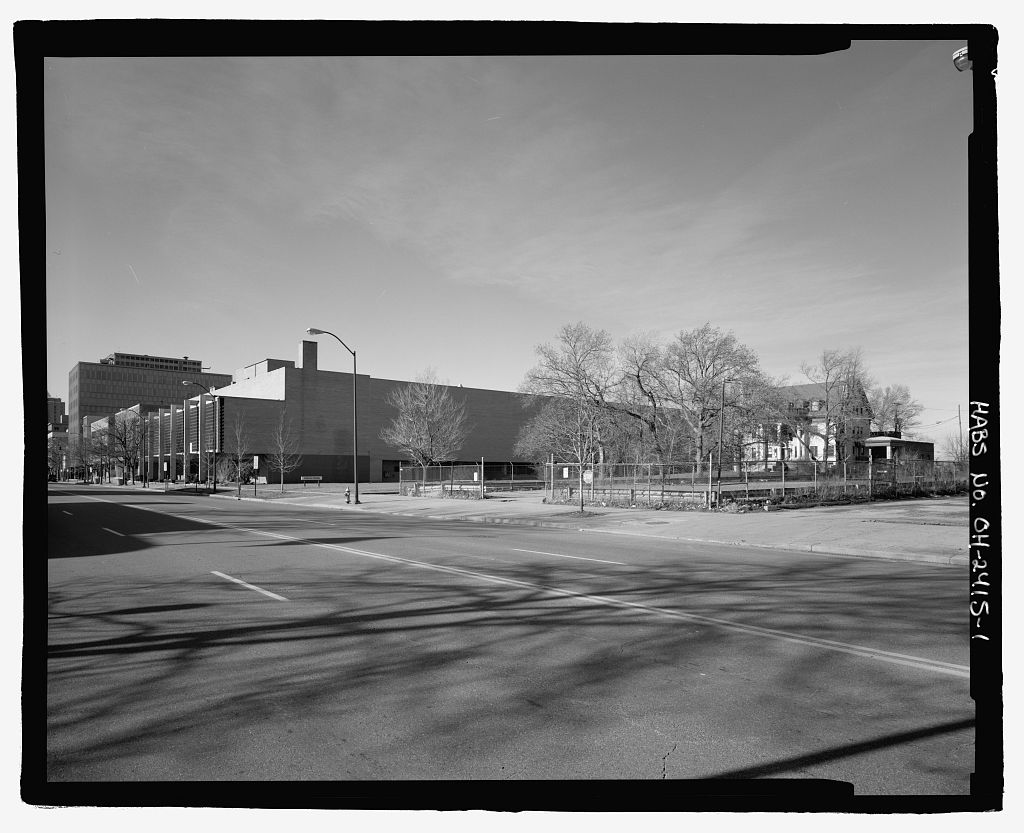
Until the only formal memorial dedicated to World War I casualties from the Greater Cleveland area was Liberty Row. This boulevard of over 800 Memorial Trees, initially dedicated on Decoration Day in recognized each Cleveland area resident who died in service to the nation during the Great War with a tree planting and a bronze marker with their name. The significance of Liberty Row is multi-faceted and revealed in its history as 1) the first Living Memorial of trees in a major American city as a war LIBERTY ROW HALS NO.
OH-13 PAGE 2 memorial; 2) an outgrowth of the City Beautiful movement sweeping the nation in the early part of the century; 3) bolstering the Progressive Era movement to eliminate problems caused by industrialization, urbanization, immigration, and corruption in government; 4) providing a way to invoke patriotism at home and support for the war effort before the war had ended; and 5) establishing reforestation as a conservation measure in a city that had been clear-cut and was in search of its original identity as the Forest City. Description: Liberty Row follows winding boulevards through historically significant park areas that traverse the Doan Brook valley from its genesis in the Heights area of Cleveland to its outfall into Lake Erie.
Adjacent to its path are high end residential neighborhoods, the campus of Case Western University, and the cultural center of Cleveland including its art museum, natural history museum, cultural history museum, botanical garden, and symphony concert hall. Closer to Lake Erie, the boulevard travels through Cleveland s Cultural Gardens and adjacent to older neighborhoods, hospitals, and day use parks. Conservatively, it can be estimated that less than 40% of the trees planted as part of Liberty Row initially, still exist today. However, the size of the remaining trees creates a lasting impression for anyone traveling on the road between them.
History: Who d ever ask anything more, Than to live in the City that grows in the woods, The city upon the Lake shore, The beautiful City, the Forest tree City, The City upon the Lake shore. -J. Griener, February 25, It is debated how the City of Cleveland earned the nickname of Forest City , but it begins to appear regularly in print in the late By the three major cities in the State of Ohio are often referred to as the Queen City (Cincinnati), the Capitol City (Columbus) and the Forest City (Cleveland). To this day, Cleveland is referred to as the Forest City despite the fact that all of its virgin forests have long since disappeared. This image of a forested city has fostered a long tradition of tree-lined boulevards and parkways throughout the Cleveland metropolitan area.
In fact, the regional park district still refers to its ring of parks connected by a tree-lined parkway surrounding the city as the Emerald Necklace. Therefore, it is not surprising that a Living Memorial consisting of trees planted along a 1 Cleveland Plain Dealer, February 26, LIBERTY ROW HALS NO. OH-13 PAGE 3 boulevard in memory of its fallen heroes took hold as an idea in Cleveland in July of before the Armistice was declared in November of As a result, Cleveland was the first major American city to develop such a memorial. An exceptional cast of characters was involved in the development of this early tree memorial called Liberty Row.
It is not known who came up with the initial idea of planting a memorial tree for each Cleveland-area casualty in the Great War, but it is necessary to know who was involved in this effort to better understand and appreciate the significance and history of Liberty Row. The local paper, The Plain Dealer, first reports on July 7, that: A living monument to each of its sons who makes the supreme sacrifice in the service of the nation and for the cause of world democracy this will be the tribute which the city of Cleveland will pay to its soldier dead .
Under the plan, an avenue in Cleveland will be set aside for the planting of a tree for each Cleveland boy who has died in the service of the country since the beginning of the war it was decided to dedicate North Park Boulevard in Shaker Lakes Park to the boys for whom gold stars are placed on service flags The name of this thoroughfare, running from Cedar Road about four miles eastward, is to be changed to Liberty Row. An ordinance providing for this change will be offered tomorrow in city council by Mr. Zmunt.2 Jerimiah (Jerry) R. Zmunt, the first of these exceptional characters, was a first generation American born to parents from Austria. In he graduated from the law department of Western Reserve University and began a private practice.
In he was elected to Cleveland s City Council.3 A City Directory lists him as the Secretary/Treasurer of the Newburgh Brick & Clay Company, a partner in the firm of Zmunt, Zmunt & Mayer, and the Vice President of Cleveland s German Club.4 This last affiliation is most interesting because anti-Hun sentiment was peaking both locally and nationally in In fact, that same summer, two other ordinances were winding their way through Cleveland City Council to change the name of two city streets: Germania Court to Edwards Court and German Street to Simms Street.5 Mr. Zmunt also had new political aspirations in He was running for the Sixty-Sixth U.S. Congress as a republican candidate from the Twentieth District of Ohio.
As a wartime candidate, it was imperative that he show upmost patriotic support for the American war effort, despite his Austrian roots. In fact, a campaign 2 Cleveland Plain Dealer, July 7, 3 4 Cleveland Directory, August 5 The City Record, October 2, LIBERTY ROW HALS NO. OH-13 PAGE 4 advertisement for him proclaimed, ZMUNT for CONGRESS- He is American. 6 In addition to introducing a council ordinance to create Liberty Row in Mr.
Zmunt presided over a hearing to oust two socialists from city council; introduced legislation to create war gardens; was in charge of overseeing the sale of liberty bonds in his ward; introduced legislation to build a permanent memorial to Cleveland s war dead; introduced legislation to place a flag in city hall with gold stars on it for each local casualty; encouraged the city mayor to name the new public auditorium being constructed as Soldiers and Sailors Memorial ; and led the local effort to support adopting Daylight Savings Time as a war time-saving strategy promoted by the federal government. Therefore, it is not surprising that Mr. Zmunt is quoted as saying this about Liberty Row , This is a splendid way of honoring our boys.
It is particularly fitting that one of our finest boulevards in the city be chosen. The naming of trees after our dead heroes is the best tribute we can pay them, as their names will thus be perpetuated in a living thing. 7 It is important to note that Liberty Row was proposed in early July of Up to that time, American Marines had been involved in two battles and the buildup of American troops in France had just started. In fact, forty-four Clevelanders were identified to be on the Liberty Row honor roll in the July 7, newspaper article, with only twelve of these having been killed in action. The vast majority of Cleveland-related fatalities, to date, were due to an outbreak of Spanish Influenza in military training camps that were located stateside. Of course, this would quickly change.
War-related fatalities for Cleveland-area servicemen would greatly accelerate until the cessation of hostilities in November of According to information provided by Greater Cleveland Veteran's Memorial Inc., World War I fatalities of Cleveland-area servicemen by month for are as follows: Period Casualties Prior to 2 January 3 February 1 March 7 April 2 May 5 June 30 July 59 August 28 6 Cleveland Plain Dealer, November 2, 7 Cleveland Plain Dealer, July 7, LIBERTY ROW HALS NO. OH-13 PAGE 5 September 163 October 315 November 96 December 23 After 748 Cleveland Mayor Harry L. Davis was also an important actor in the development of Liberty Row. Like Zmunt, Mayor Davis was a republican and a former steelworker who staunchly supported the war effort.
Five days after President Woodrow Wilson asked Congress for a declaration of war on April 2, Mayor Davis created the Cleveland Mayor s Advisory War Committee. This was the first such committee in the nation and became the model that other large, American cities followed during the Great War.9 Looking back on this committee s accomplishments, Mayor Davis said, "We have tried to make Cleveland worth fighting for to show Cleveland soldiers, and the families of Cleveland soldiers, that their sacrifices and their sufferings have not been in vain. This has been the function of the Advisory War Committee.
I am sure that it has discharged this function and should be credited with this success."10 The accomplishments of this committee are substantial as it coordinated, financed, and supervised almost all of the city's war-relief work, including fundraising projects of public and private institutions. It directed distribution of food and clothing; sponsored Americanization classes for immigrants; organized a speakers' bureau; supervised draft boards; and subsequently supervised rent control. During the early months of the Mayor's Advisory War Committee held homecoming celebrations, opened neighborhood centers for returning soldiers, lobbied for veterans' compensation pay, and funded a city employment service.
11 A review of the committee s work was published in a book called Cleveland In the War. About Mayor Davis involvement with Liberty Row it is written: Probably no activity undertaken by the Mayor s committee met with more pronounced success than a series of public exercises it staged under the direction of the Department of Parks and Public Property, aided by school authorities. These events were intended primarily as a means of stimulating interest in the nation's cause. They proved equally valuable in emphasizing the city's remarkable community spirit The last of these affairs in took the form of an informal dedication of Liberty Row This was in furtherance of the plan 8 9 10 Davis, Harry L., Mayor s Advisory War Committee. Cleveland in the War. 11 LIBERTY ROW HALS NO.
OH-13 PAGE 6 of Mayor Davis to make one of the main park boulevards a memorial thoroughfare, as a tribute by the city to her sons who gave their lives for the nation. North Park Boulevard running from University Circle up through Shaker Lakes Park was chosen and its name changed to Liberty Row. There, a "Victory Oak" will be planted in honor of each of the men who died in the service, each tree to bear a bronze tablet with the name and record of the man whom it honors.12 Myron T. Herrick, another Cleveland resident, was Chairman of the Mayor s Advisory War Committee. Mr. Herrick was already a World War I hero even though it was only five days after President Wilson had asked for a declaration of war against Germany!
In President William Howard Taft had offered, and Herrick accepted, an ambassadorship to France. Little did he know that the following year Woodrow Wilson would be the new president and that on August 3, Germany would declare war on France. A biography of Mr. Herrick summarizes his war time experiences in France as follows: With the election of President Woodrow Wilson in Herrick submitted his resignation. Because of the escalating situation in Europe, however, Herrick remained at his post until November when the new ambassador, William G. Sharp, took over. Herrick played a key role in wartime France and the United States diplomatic relations with the combatants.
He represented the interests of the German, Austrian, Japanese, and British governments at several points during In addition, he helped evacuate United States citizens stranded in Europe by the war and sought to protect historic French monuments, churches, and museums from destruction. He helped in the organization of the American ambulance Hospital at Neuilly, France, in and also established the American Relief Clearing House for war victims. In December because of his wartime efforts, he was awarded the Grand Cross of the Legion of Honor by the French government.13 Only three American ambassadors to France have ever had boulevards named after them in Paris: Benjamin Franklin, Thomas Jefferson, and Myron T. Herrick.
Before his return to Cleveland in December Herrick asked another Clevelander, Dr. George Crile, to consider coming to France to aid at the American ambulance Hospital at Neuilly: 12 Davis, Harry L., Mayor s Advisory War Committee. Cleveland in the War. 13 http://ead.ohiolink.edu/xtf- apers LIBERTY ROW HALS NO. OH-13 PAGE 7 A team of volunteer surgeons and nurses was recruited from Lakeside Hospital and spent three months in Paris in treating more than war-wounded patients. Crile worked with American Red Cross officials on a plan creating 25 units at hospitals across the country that would be able to respond and serve overseas under Army supervision if the U.S.
went to war Less than a month after America declared war on Germany in April of the Lakeside Unit -- including 27 medical officers, 64 nurses, and 155 enlisted men -- was headed back to France. The unit was designated as Base Hospital No. 4 and took over a former British military hospital (No. 9) in Rouen. The unit would stay nearly two years, its ranks swelling to 42 physicians, 124 nurses and 356 Army enlisted men, treating more than patients from both sides of the war in two hospitals.14 The Lakeside Unit is recognized as the first contingent of the American expeditionary forces to be transported to Europe after the U.S. entry into World War I.
15 However, it is not often recognized that this Cleveland-based unit had already served in France nearly two years earlier, simply because a fellow Clevelander, Myron T. Herrick, had asked them to do so. Charles Lathrop Pack, although born in Michigan in grew up, married, and had a family full time in Cleveland between ca He maintained his home and business in Cleveland through the war years while establishing his permanent residence in Lakewood, NJ. He was a third-generation timberman who was "one of the five wealthiest men in America prior to World War I"16 Mr. Pack began his conservation involvement in when he attended a Conference of Governor s hosted by President Theodore Roosevelt.
In October Pack became President-Elect of the National Conservation Congress pronouncing the following: Ladies and Gentlemen: You have a great work before you, not only for the ensuing year, but for all years. The Conservation movement is not one for today, but for all time, and it matters very little the name or the names of the workers in the cause. It matters that you, and every one of you, should have your hearts right and do the right work. Conservation makes for the best use of all resources and is dead against their abuse.17 14 15 16 Eyle, Alexandra. Charles Lathrop Pack. p. xv 17 Proceedings Fourth National Conservation Congress, LIBERTY ROW HALS NO.
OH-13 PAGE 8 While still a timberman, mostly interested in first promoting measures that profited his business, there is little doubt that he was also a Progressive. He became well known for three causes he personally promoted during the Great War: 1) creating, funding and administering the War Garden Program; 2) supporting the Forest Regiments overseas; and 3) promoting Tree Memorials after the armistice. In January Mr. Pack became president of the American Forestry Association and obtained ready access to a popular periodical called American Forestry, self-described in December as An Illustrated Magazine About Forestry and Kindred Subjects Published Each Month.
18 The April edition of this magazine (likely printed in late March announces, Charles Lathrop Pack, of Lakewood, New Jersey, president of the American Forestry Association, has been made the president of the National Emergency Food Garden Commission (later called the War Garden Commission). He is the originator of the Commission and of the idea of a nation-wide campaign for the production of home-grown vegetables. 19 The War Garden Commission was an immediate success with politicians and the public alike. It provided a simple way that anyone and everyone could support the American war effort. Aided with an aggressive publicity effort, the Commission made headlines across the nation and produced, to this day, some of the most memorable American posters of the Great War.
The Commission, itself, had as one of its members, Myron T. Herrick. The June edition of American Forestry announced: Somewhere in France," a full regiment of trained American woodsmen will soon be at work aiding the cause of the Allies The regiment is made up of six companies of 164 men each, with twenty-six men on the battalion and regimental staffs and a driver for each vehicle, in addition to the commissioned officers.20 It is hard to understand now how important the role of woodsmen would be in a war effort, but in the early part of the twentieth century, they were imperative.
A later article describes, The regiment will convert available timber behind the battle lines in France into railroad ties, trench timbers, mine props, bridge timbers, lumber, and cordwood needed in the military operations of the British Army. 21 18 American Forestry, December 19 American Forestry, April 20 American Forestry, June 21 American Forestry, July LIBERTY ROW HALS NO. OH-13 PAGE 9 Charles Pack, through his association s magazine, would vigorously support the over men serving in the and Forestry Regiments through He would support them through the creation of a relief fund, a sweater drive, a cigarette drive, publish their names in American Forestry as an honor roll, and feature the officers in magazine stories.
The work of the Forestry Regiments during the Great War is well documented in old issues of American Forestry. The December edition of American Forestry proclaims, The American Forestry Association has suggested that Memorial Trees be planted in honor of the sailors and soldiers who gave their lives in the Great War and the idea is sweeping the country and receiving the indorsement [sic] of governors, forestry and other state officials and various organizations. 22 This final initiative of Charles L. Pack during the Great War is the one most relevant to Liberty Row. Planting Memorial Trees was popular with both the public and politicians as it was an easy and inexpensive way to honor and remember those who served. Mr.
Pack was relentless in championing this idea in in countless interviews with newspapers across the United States. The extent of the Tree Memorial movement is summarized as: Hundreds of thousands of trees were planted and recorded with the American Forestry Association after WW l. One by one in small towns and communities across the country, by the hundreds in parks and along roads and by the thousands in Memorial Forests. The tributes ranged from the Lincoln Memorial in Washington, DC. and a Grove of States at Exposition Park in Los Angeles, California, to pines in a newly created park in Charlotte, Michigan, and a single tree planted by the Daughters of the American Revolution in Arkadelphia.
Arkansas.23 To this day, the successor to the American Forestry Association, now simply known as American Forests, promotes planting of memorial trees. The group has supported such tree plantings at the Pentagon and Ground Zero as part of the memorials. So how exactly did these four, Cleveland men, Zmunt, Davis, Herrick and Pack influence the development of Liberty Row nearly four months before the armistice and before the idea of planting Memorial Trees was widely promoted in American Forestry? The simple answer is that it is unknown. However, a plausible story line emerges as described below. 22 American Forestry, December 23 American Forests, Spring LIBERTY ROW HALS NO. OH-13 PAGE 10 The most famous city plan ever completed in Cleveland is Daniel Burnham s Group Plan .
This plan, in the Beaux Arts or City Beautiful style was an outgrowth of Burnham s famous plan for the World s Columbian Exposition of The Group Plan was initially developed in and implemented over a fifty-year period. Two of the buildings shown in the plan were either under construction or completed during the Great War including Cleveland City Hall in and Cleveland Public Auditorium in Mayor Davis was in office during this period and Myron T. Herrick served as Head of the Group Plan Commission at this same time. The Group Plan is very much an outgrowth of the influential Ecole des Beaux-Arts in Paris.
In fact, there are photographs in the plan report showing desired character images for Cleveland that were taken at the Palais Royal, Champs- lys es, and Versailles.24 Who would know more about these places than the former ambassador to France, Myron T. Herrick? In fact, both Herrick s residence in Paris as well as his embassy were located within a block of the Champs- lys es. Therefore, perhaps Mr. Herrick is an obvious choice for putting forward the argument for developing a beautiful tree-lined boulevard in Cleveland. He had lived for years in the shadow of the world s most famous one and had actively worked to save the Champs and its monuments during the Great War.
The suggestion of dedicating trees as a memorial to fallen servicemen could have been developed by anyone, as such memorials were not a new idea in However, the idea of creating a Memorial Tree Boulevard in an election year, before the war is over, and when the candidate is vice president of the Cleveland German Club, would have a certain amount of appeal to Republican Councilman Jerry Zmunt, who was running for the U.S. Congress in With the backing of fellow Republican, Mayor Harry L. Davis, Zmunt introduced Ordinance into Cleveland City Council on July 10, to do just that. After its third reading, the Ordinance was adopted on July 31, and became effective on August 25, Mayor Davis appointed Director of Parks and Public Properties, Floyd E.
Waite to be in charge of implementing Liberty Row. Mr. Waite worked closely with City Forester, Harry C. Hyatt to determine that Victory Oaks would be planted along Liberty Row beginning in the Fall of By the end of August the number of Cleveland casualties in the war had climbed from 44 in early July to or a threefold increase, and the worst was yet to come. Preparation began for a Fall dedication of Liberty Row. An announcement in the newspaper on October 18, reads: The first dress rehearsal for The Supreme Sacrifice , memorial 24 Group Plan of the Public Buildings of the City of Cleveland, LIBERTY ROW HALS NO.
OH-13 PAGE 11 pageant to be staged in honor of Clevelanders who have died in war service, was held last evening in Wade Park under direction of Harper Garcia leader of the Cleveland community chorus. The pageant was originally scheduled for presentation at Wade Park this evening as the opening event of the three-day exercises in dedication of Liberty Row, where an oak tree will be planted for every Clevelander who has made the supreme sacrifice. Because of the influenza situation, it was indefinitely postponed. The event will be staged as soon as the city s health conditions will permit it , Mr. stated last night.25 The Spanish Influenza Attack of hit Cleveland particularly hard, especially in the last quarter of Influenza had exacted a heavy toll on Cleveland.
Between late- September and the end of the year, residents fell ill with the disease, with nearly developing pneumonia. Over people died of either influenza or pneumonia that autumn. An additional 800 deaths occurred in January and February In those five months, of the city s population came down with influenza or pneumonia; of those that caught the dreaded disease, 16% passed away. The result was a total excess death rate of 474 per the highest in Ohio, and worse than either New York City or Chicago.26 While the pageant did eventually occur in December dedication of Liberty Row never occurred that year.
Between the influenza epidemic, a dramatically increasing number of war casualties, cold weather and the Armistice declaration on November 11, there seemed little interest in pursuing this activity at the end of Instead, focus shifted to Memorial, or Decoration Day, in Meanwhile, Charles Pack began vigorously promoting the concept of Memorial Trees in December Mr. Pack initially got the idea for planting Memorial Trees from the following short news story published in his own magazine in August we read that the city of Cleveland has hit upon an admirable type of memorial for war heroes. The fallen soldiers are to have 25 Cleveland Plain Dealer, October 18, 26 LIBERTY ROW HALS NO. OH-13 PAGE 12 living monuments. Their memory will literally be kept green.
A boulevard is to be consecrated to them, bearing some such title as "Liberty Row." It will be lined with "Victory Oaks." There will be an oak tree planted there for every Clevelander who makes the supreme sacrifice. It will bear a bronze tablet inscribed with his name and military record. The planting of the trees will be made a civic ceremony, in which the relatives of each hero will participate. What more fitting form of commemoration could there be for the boys who give their lives to their country? They themselves would doubtless prefer such monuments to marble columns. The trees will be, in their very greenness and robust strength, reminders of the youths who gave their vigor to win the big war. There will be no gloom about them.
They will stand as a continual inspiration for the living who look upon them and are sheltered by them from sun and storm. Such a fine innovation, one would think, needs but to be mentioned to win universal approval. Why should it not be adopted in this city? Why not be made a national institution?27 As this story suggests, while the idea to plant trees as memorials to fallen Great War servicemen likely first originated in Cleveland, there is no dispute that it is Mr. Pack who spread the message to the rest of the nation.
He personally financed publishing copies of an 8-page brochure called Memorial Trees that was distributed widely during and greatly promoted the concept of planting living memorials.28 Such widespread national support of the concept likely further inspired the City of Cleveland to become the leader in the nation to implement a Liberty Row. As originally conceived in July Liberty Row was to follow renamed North Park Boulevard between Cedar Road and Center Road (now called Warrensville Center Road), a distance of approximately four miles. By the Spring of it had increased in length, beginning at the shore of Lake Erie in Gordon Park, extending through Rockefeller Park, Wade Park, Ambler Park, and then on to Shaker Lakes, a distance of approximately 7.5 miles.
According to maps of the era, newly planted Memorial Trees followed the park drive through Rockefeller Park to East Boulevard to North Park Boulevard. The park drive through Rockefeller Park was sometimes referred to as Lower East Boulevard or its shortened form of Lower Boulevard. 27 American Forestry, August 28 Eyle, Alexandra. Charles Lathrop Pack. Page 145 LIBERTY ROW HALS NO. OH-13 PAGE 13 Adoption of Ordinance legally changed the name of North Park Boulevard to Liberty Row as of August 25, However, the new name never did take effect. In fact, the name Liberty Row never took hold anywhere in Cleveland. Instead, to this day, North Park Boulevard is still called North Park Boulevard.
However, a portion of the park drive through Rockefeller Park (aka Lower East Boulevard or Lower Boulevard) did become known as Liberty Boulevard until it was changed in to Martin Luther King, Jr. Drive Drive). Victory Oak trees, consisting of mostly Red Oaks (Quercus rubra) did get planted before Decoration Day In addition, a temporary memorial known as the Altar of Sacrifice was constructed at the midpoint of Liberty Row in a place locally known as University Circle.
At AM on May 30, Liberty Row was dedicated by Mayor Davis saying the following at the Altar of Sacrifice : We come here today to pay tribute to those who paid the extreme sacrifice I wonder sometimes if the people of our city realize the sacrifice our boys made when they left relatives, homes, everything they loved, never stopping to count the cost, in order that our country might remain happy and free.29 At noon, Cleveland s Service Flag with 695 gold stars was raised by the Presumably, the number of trees planted as of Memorial Day was also however, there is no way to confirm this fact as no known plans for Liberty Row were ever developed. A list published around the same time in shows 718 Cleveland resident casualties.
An undated list of those memorialized along Liberty Row obtained by the author identifies 832 Victory Oaks being associated with them. As noted earlier, the current official list identifies 808 Cleveland-area casualties from World War I.31 However, it is not easy to determine how many of these casualties are actually from the City of Cleveland and how many come from surrounding communities. It is likely that there were more Victory Oaks planted in Liberty Row than actual City of Cleveland resident casualties from the Great War. Today, Liberty Row is about one-half mile shorter than it was when originally dedicated.
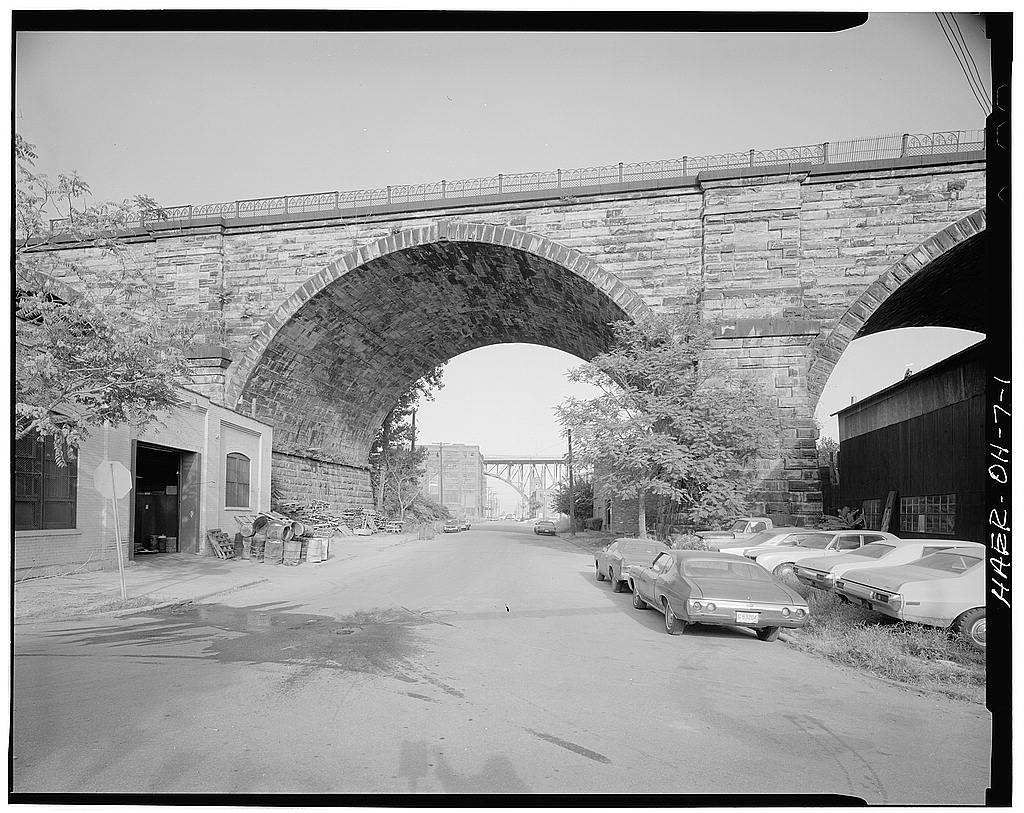
Trees planted north of the Norfolk & Southern Railroad Bridge were lost when the Cleveland Memorial Shoreway, a freeway, was built in the Many of the original oaks are long gone, the victims of vandalism, 29 Cleveland Plain Dealer, March 31, 30 Ibid 31 LIBERTY ROW HALS NO. OH-13 PAGE 14 natural causes, automobile accidents, or changes to the park boulevards. When first planted in the oaks were saplings, likely raised at a city- owned nursery and spaced approximately 50 apart along the boulevards. Reports indicate that the saplings were planted by veteran s groups, schoolchildren, and families of those soldiers who died during the war.
A bronze medallion measuring 4 inches in diameter embedded in an 8-inch square concrete base with the name of the fallen soldier was placed next to each tree. On Memorial (Decoration) Day or Veteran s (Armistice) Day the land around each oak tree would be decorated by families and American Legion Glenville Post A white cross, a poppy, and an American flag were placed in front of each tree. The Jewish War Veterans placed flags and a Star of David on trees dedicated to men of the Jewish faith. There are reports of attempts to grow poppies from famed Flanders Field around the trees in the early but today there remains no evidence of this effort. As early as vandalism became a problem at Liberty Row.
A letter printed June 4, in the local newspaper asks and answers the following questions: Q: Would you kindly give me some information through your answer column in the Plain Dealer in regard to the Liberty Row trees. Why are so many of the nameplates missing? How were the stones broken? Are those missing going to be replaced? A: An invasion of young vandals recently broke off the name plates and otherwise mutilated Liberty Row for the sake of the bronze in the setting. Many of these plates have been recovered by the police department.
All will be replaced and greater vigilance used in guarding the trees in the future.32 A more humorous reporting of vandalism at Liberty Row appears in a July article: Extending from Erie s beach at Gordon Park to the remote picturesqueness of the Shaker Lakes region is an unbroken row of young oaks. Each tree was planted in memory of an American soldier who gave his life in the Great War. The row is unbroken, but many of the trees are dead or dying. They have not been killed and injured by insects or fungus enemies. They are the victims of the heedlessness, callousness or ruthlessness of human 32 Cleveland Plain Dealer, June 4, LIBERTY ROW HALS NO. OH-13 PAGE 15 pests. City Forester Neillie says that petting parties are a prime source of peril to the oaks of Liberty Row.
Callow youths and girls who ought to be at home seek the dark nooks and back their machines into the shadows. They do not see the little oaks. Probably they would not care if they did see them. A tree that is Cleveland s tribute of honor to a dead hero is broken and killed. In a land made safe for petters by the men who struggled through the agony of the Argonne, a broken little oak is scarcely an incident. Its destruction has made a good petting place a little better.33 In 30 of the bronze markers were stolen in the row between Rockefeller and Gordon Parks, and in approximately 100 more bronze markers were stolen.34 Not surprisingly, time and vandalism has taken an even greater toll on the oaks of Liberty Row.
The bronze markers at the southeastern end of the boulevards have survived better than those along MLK Drive. However, most agree that it is impossible to maintain the bronze markers and efforts to replace them have ceased. As of 808 Cleveland-area soldiers who died during the Great War are officially listed on Cleveland s famed Fountain of Eternal Life by sculptor Marshall Fredericks. This fountain is the majestic centerpiece of Veterans Memorial Plaza on the mall built as part of the Group Plan . A study completed by the author s landscape architecture firm in determined that a portion of Liberty Row along MLK Drive only had approximately 150 out of 400 original Victory Oaks remaining. This suggests that only 38% of the trees remain.
This has led to efforts to replace the Victory Oaks that have disappeared along Liberty Row by the Holden Parks Trust and University Circle Inc. showing that Clevelanders remain committed to being The beautiful City, the Forest tree City, The City upon the Lake shore. Epilogue Jerry Zmunt lost his bid for U.S. Congress after President Woodrow Wilson s plea ten days before the election to the return of a Democratic Congress as essential to maintaining the nation s security. 35 However, he was later elected to serve as a Cuyahoga County Commissioner in Mayor Davis went on to become Governor of the State of Ohio in and returned to being Cleveland s mayor in He died at his home in not far from North Park Boulevard.
33 Cleveland Plain Dealer, July 10, 34 Tom Zarfoss personal correspondence 35 LIBERTY ROW HALS NO. OH-13 PAGE 16 Myron T. Herrick returned to be Ambassador to France in and stayed there until his death. He died on Easter Sunday, eleven days after his good friend, Marshal Foch, had also died in Paris. His other friend, Dr. George Crile, was also inducted into the French Legion of Honor and became co-founder and first president of the world-renowned Cleveland Clinic in Charles Pack eventually lost a power struggle to remain President of the American Forestry Association in He did go on to support major forest conservation efforts across the nation despite evidence that suggests he did not practice what he preached with his personal timber holdings.
 Block
Block