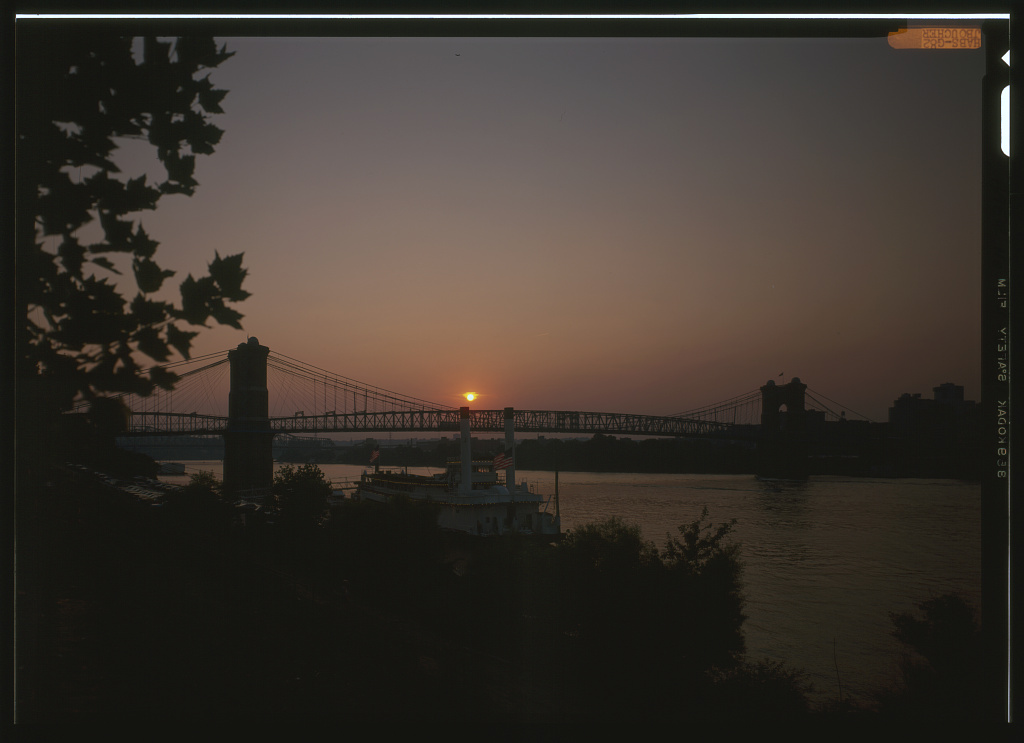
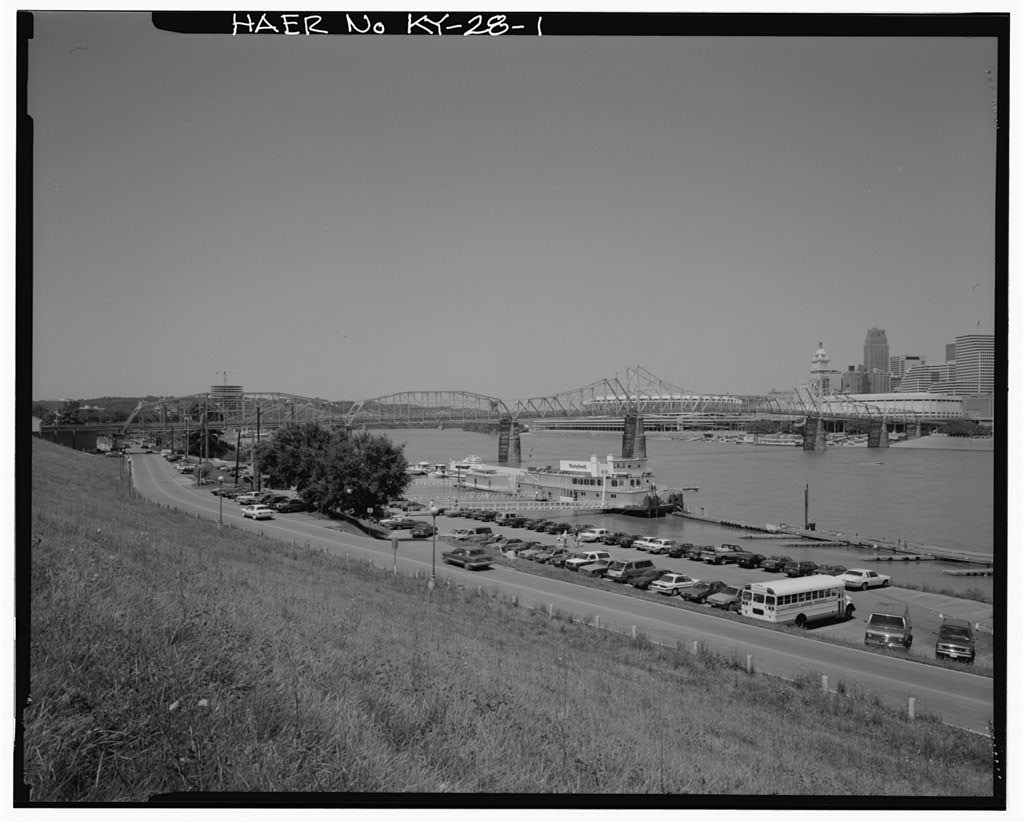
Spanning the Ohio River between Cincinnati, Hamilton County, Ohio, and Covington, Kenton County, Kentucky deck truss altered John A. Roebling deck alterations by Wilhelm Hildebrand Covington & Cincinnati Bridge Company At the time of its completion in the Cincinnati Suspension Bridge was the longest suspension span in the world. Although it had taken over ten years to complete (actual completion of all details was not accomplished until the work was achieved with a noticeable lack of injury or death to those workmen involved with the project. This was the first bridge over the Ohio River at Cincinnati. Lexington, Kentucky, proved to be the moving force in initiating the bridge's construction.
The overland traffic that had made Lexington a major commerce center was now becoming subordinated to steamboat traffic on the Ohio River. The economic well being of the city depended upon establishing a direct commercial link with Cincinnati. Early in Lexington held a public meeting "with reference to the erection of a bridge across the Ohio River, from Covington to Cincinnati." However, public support for the bridge was impeded by a major lobbying effort on the part of the steamboat and ferryboat operators who discouraged the bridge's construction to further their own economic needs. The construction of the Race Street Bridge in served as a precursor of the new Ohio River Bridge. The Race Street Bridge was a 60 foot suspension span across the Miami Canal in the City of Cincinnati.
(continued) Cincinnati Suspension Bridge HAER No. (page 2 The city also closely watched the construction of the Allegheny River Bridge at Pittsburgh. This project demonstrated the possibility of building a long, high span that would allow uninterrupted river traffic. It also placed John Roebling's name in the forefront as a suspension bridge designer. The Kentucky legislature enacted a charter for the bridge's construction in February It assembled 15 leading citizens of Covington & Cincinnati into an incorporated company entitled the "Covington & Cincinnati Bridge Company". The company immediately commissioned John Roebling to design the span. The solution presented was a bridge of feet span from pier to pier, 100 feet above the river surface at mid-point.
While Kentucky was fully committed to the project, Ohio continued to drag its heels. There was immediate and vocal opposition from ferry and steamboat owners, from commission merchants and insurance brokers, and from engine builders and boiler makers. Prior to the Civil War, Cincinnati was the largest city in the Union west of Philadelphia. The affluent river commerce was the life blood for a large segment of the population and they did not want it disturbed. The Ohio legislature finally passed the necessary legislation in but only with the imposition of stipulations that complicated the building of the bridge.
The Ohio legislature specifically precluded building the bridge on a straight axis between major avenues in Cincinnati and Covington, even though the two cities were purposefully built upon the same grid on opposite sides of the river. Further roadblocks were imposed with the collapse of the Licking River Bridge in January of (only two weeks after completion). This did not encourage public confidence in the concept of a large suspension span over the Ohio River. However, in a second design by Roebling that called for a 105 foot main span was accepted by the bridge company. (continued) Cincinnati Suspension Bridge HAER No.
OH-28 (page 3) Excavation for the pier foundations was initiated in September of The work progressed quickly and the foundations were erected above the water line by December. Work was well under way without problems, until the depression of All work on the bridge was stopped for seven months, through the winter and spring. After resumption of the work in the spring of the work ceased again in December and, because of the Civil War, was not resumed again until January of Masonry work began again in July of and the towers had doubled in size by the end of the year. However, the scarcity of skilled workmen, because of the war, seriously impaired the progress of the bridge construction.
The towers were complete enough by September of to begin stringing the wire cables, which arrived from the Roebling factory in Trenton, New Jersey. The final stringing involved strands of wire, bound into two cables that measured 12 1/2 inches in diameter. To augment the suspension cables, Roebling implemented a system of diagonal cross bracing which effectively carried half the weight of the roadway and the "liveload". These "cable stays" were an idea of Roebling's that was designed to stiffen the structure not only under normal loads, but also against undulations caused by heavy winds. When the bridge opened to the public on December 1, it was the longest span in the world.
It has withstood the massive floods of and The bridge also underwent major alteration of the deck structure in the when the roadway was entirely replaced and widened. (continued) Cincinnati Suspension Bridge HAER No. OH-28 (page 4) References: Plowden, David; Bridges: The Spans of North America , The Viking Press, New York: Society For Industrial Archeology; A Guide To Industrial Archeological Sites in Cincinnati, Ohio , 7th Annual Conference, Louisville/Cincinnati, March 30 - April 2, Steinman, D. B.; The Builders of the Bridge , Harcourt, Brace & Co., New York: Transmitted by; Kevin Murphy, Historian HAER, July
 Block
Block