Columbus Road Lift Bridge, Spanning Cuyahoga River at Columbus Road, Cleveland
Columbus Road Lift Bridge, Spanning Cuyahoga River at Columbus Road, Cleveland, Cuyahoga County, OH. Surveyed as HAER OHIO,18-CLEV,38-, with 1 photograph and a 1,456-word written history.
From the record
“Tbis bridge stands at a historic river crossing in tbe city of Cleveland.”
Written record, HAER OHIO,18-CLEV,38- survey. Machine-read text.
surveyed by the federal HAER program as HAER OHIO,18-CLEV,38- · the record runs 1456 words · one of 115 surveyed structures published for this county.
Source document
Quoted word for word from HAER OHIO,18-CLEV,38-.
Not written, edited or summarised by this site.
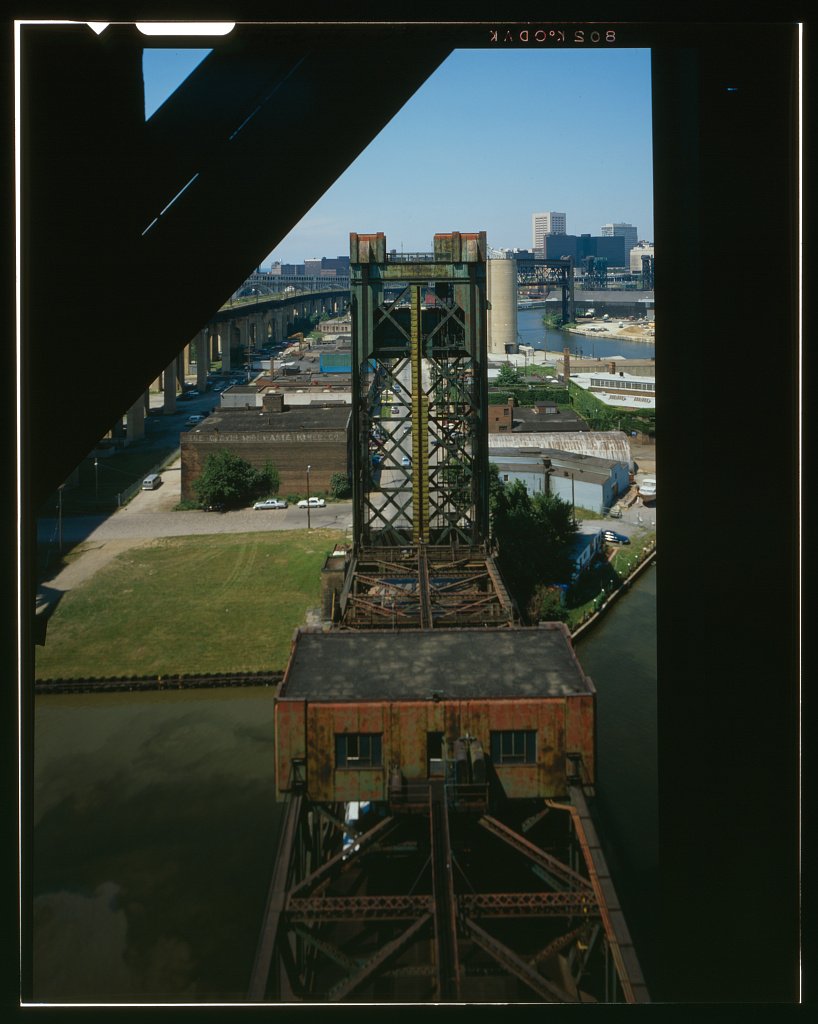
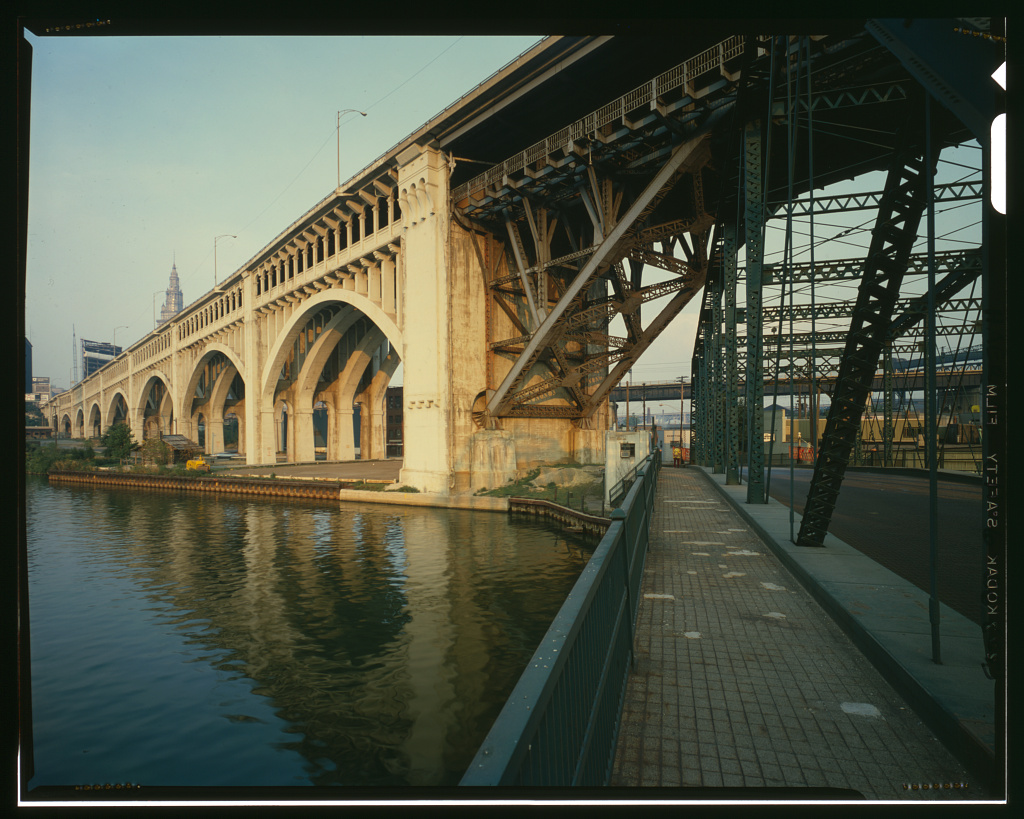
Tbis bridge stands at a historic river crossing in tbe city of Cleveland. Tbe existing vertical lift span, designed by tbe prominent Cleveland engineering firm of Wilbur Watson and Associates, is representative of tbe designs for moveable bridges of tbe vertical lift type being built during tbe Report prepared by: Randall S. Gooden Project Historian Ohio Historic Bridge Recording Project Summer 7 %- # COLUMBUS EOAD BRIDGE HAER NO. OH-55 Page 2 The Columbus Road Lift Bridge, built in replaced a three-span bridge but utilized tbe stone masonry substructure founded on concrete and wooden piles from tbe previous bridge. This bridge has a clear span of 220 feet. Tbe span lifts vertically and is a riveted Pratt through truss, measuring 242 feet from center to center.
Each of tbe other three spans is 46 feet 6 inches in the center with a 42' roadway and 6' canfcilevered walks on each side. The road is a concrete-filled steel grid on tbe approach and tower spans and an open grid steel deck on tbe lift span. All the sidewalks are concrete-filled steel grids. A network of steel stringers and built-up steel floor beams support the deck. The towers consist of riveted, built-up steel and rolled sections and provide for a 79 foot 8 1/4 inch lift. The substructure consists of massive concrete piers, each supported on six concrete caissons with steel beam cores extending 130 downward from the water surface. Bridge builders rehabilitated tbe original stone masonry on tbe south abutment and used it for tbe present structure.
Tbey constructed a full height concrete abutment with a spread footing on tbe north end. Tbe bridge lift mechanism is a span driven steps resistor controlled system. A machinery and operator's bouse at tbe center of tbe lift span COLUMBUS ROAD BRIDGE HAER No. OH-55 Page 3 bouses the operating controls. Gate tender bouses sit on tbe soutb pier and at sidewalk level beside tbe north pier. Shore protection at both ends consists of interlocking sheet piling bulkheads. An "H" pile fender with concrete beam walers is located at the northern end. Tbe bridge allows for a four-lane roadway and sidewalks on each side. Open grid steel flooring on the lift span prevents snow, ice, and dirt build-up and serves to lessen tbe weight to be lifted.
The lift span, resting between two towers, permits river traffic to pass beneath the bridge. It requires one and one-half minutes for the lift span to be entirely raised or lowered. Two 100 horsepower electric motors normally operate tbe lift. In emergency situations, a 115 horsepower gasoline engine can also be utilized. Concealed cables bring electricity to the bridge. Before lifting occurs, red lights switch on to warn highway traffic, a gong sounds, crossing gates close, red lights flash, and a cable net barrier lowers to block traffic. The bridge has a total length of 535 feet and a length between towers of 306 feet. River width between abutments is 230 feet. The minimum clearance above water level is 18 feet when the bridge is closed and 97 feet when it is open.
Tower platforms rise 150 feet above water. The COLUMBUS ROAD BRIDGE HAER No. OH-55 Page 4 bridge cost to construct. In all tons of steel and cubic yards of concrete were used. Wilbur J. Watson (See Cartei^Hoad Lift_Bridge, HAER OH-56) designed the bridge according bo guidelines set by George B. Sowers, the city government's consulting engineer in charge of river improvement. Wisconsin Bridge & Iron Company of Milwaukee constructed the steel work. Western Foundation of Chicago built the caisson foundations. Wellman Engineering Company of Cleveland built the machinery, and Dingle-Clark Company of Cleveland installed the electrical equipment and wiring. Sherwin Williams Company of Cleveland made the bridge paint.
The participation of Cleveland firms in such bridge projects did much to strengthen the local economy as it recovered from the Great 2 Depression. The bridge carries a road that has also been known as Columbus Street and Columbus Avenue and exists at a river crossing that has been important in Cleveland's history. Real estate developers first laid-out Columbus Street when they developed the "ox-bow bend" of the Cuyahoga River in Land owner James S. Clark built the first bridge at the Columbus Street river crossing in That bridge consisted of two COLUMBUS ROAD BRIDGE HAER No. OH-55 Page 5 covered timber spans, one each next to a central draw span which was 200 feet in length, 33 feet wide and 24 feet high.
It bad stone abutments and masonry piers and cost Clark's bridge caused problems between Cleveland, east of Cuyaboga River, and Obio City, west of the river. Rivalries already existed between tbe towns, but Clark increased the jealousy when be gave the bridge to Cleveland. Hard feelings existed between tbe towns becauseof a failed attempt in to link tbe towns by bridge at Euclid Avenue. Obio City blamed Cleveland for tbe failure and resented Cleveland's 4 acquisition of tbe Columbus Street Covered Draw Bridge. By tensions increased as new settlers avoided Cleveland in favor of Obio City. At tbe same time, tbe towns competed in an effort for charters from tbe state legislature.
Cleveland resented Obio City because it received its charter first (the communities merged in Obio City became infuriated when its own attempts to break dependence upon Cleveland through tbe construction of its own canal and harbor system failed, and tbe existence of Columbus Street Bridge boosted Cleveland's economy. Residents of Ohio City refused to use tbe Columbus Street crossing. Instead, they used an old floating bridge at Main Street. COLUMBUS ROAD BRIDGE HAER No. OH-55 Page 6 Violence erupted in when the Cleveland Council ordered the removal of its half of the floating bridge to force Ohio City to use Columbus Street Bridge. Ohio City failed to obtain a court injunction before the destruction occurred.
Ohio City Council ruled that Columbus Street Bridge was a public nuisance, and on October 27, the city marshall and his deputies exploded a charge on the west end of the bridge and dug trenches across the roadway. A mob of Ohio City residents followed and proceeded to wreck the bridge with tools. The mayor of Cleveland ordered his city militia to stop the destruction, and a full-scale battle ensued which included the use of artillery. When the county sheriff and Cleveland marshall intervened, the fight ended. The Cleveland Council ordered the marshall to guard the bridge, and the issue was settled in court. Although a new bridge was needed at Columbus Street by the bitterness prevented the replacement of the bridge. In the county government built an iron bridge at the site.
The first double-wing span lift bridge in the world replaced the iron bridge in Finally, the 7 present bridge was built in The Columbus Road Lift Bridge has deteriorated significantly in recent years. City engineers have discussed the possibility of replacing the COLUMBUS ROAD BRIDGE HAER Wo. OH-55 Page 7 bridge. However, a consultant suggested the rehabilitation of the bridge as the most economical and practical solution. It remains to be seen what course of action the City of Cleveland will take concerning tbis bridge. COLUMBUS ROAD BRIDGE HAER No. OH-55 Page 8 NOTES 1 Dalton-Dalton-Newport, "City of Cleveland Report of Findings for Columbus Lift Bridge over the Cuyaboga River" (Cleveland, p. 4.
2 Ohio, Cleveland, Division of Engineering and Construction, Columbus Road Bridge Built Bridge_J|il9S. 5 William Ganson Rose, Cleveland: The Making of a City (Cleveland: World Publishing, 4 ibid., pp. 5 ibid., pp. 6 Ibid., pp. 7 Sara Rutb Watson and John R. Wolfs, Bridges f_M^ilS 2iii^E Cleveland (Cleveland: Watson and Wolfs, p. 47.
Bibliography
Dalton-Dalton-Newport. "City of Cleveland Report of Findings for Columbus Lift Bridge over the Cuyaboga River." Cleveland, Ohio, Cleveland. Division of Engineering and Construction. Columbus Rose, William Ganson* Cleveland: Tbe Making of A City. Cleveland: World Publishing, ~ Watson, Sara Rutb and John R. Wolfs. Cleveland: Watson and Wolfs,
The original filed report, and the sheets the survey produced. Those published here appear above.
Also surveyed in Cleveland
24 of 83 records shown
The federal surveyors worked through Cleveland building by building. These are the other structures
they measured and filed a report on, longest report first.
 Block
Block