This documentation was prepared under contract with MWH Americas, Inc., program manager for the Plant Enhancement Program of the City of Cleveland Division of Water. This documentation supplements HAER- OH-3, titled Division Avenue Pumping Station, Filtration Plant and the Baldwin Filtration Plant and Reservoir of the Cleveland Water Supply System, prepared by Ed Pershey in as part of the HAER Cleveland Survey, conducted in and augmented by Carol Poh in and This documentation is available from the Library of Congress at: BALDWIN FILTRATION PLANT & RESERVOIR FAIRMOUNT RESERVOIR OH-3-A (Page 2)
As built, the Fairmount Reservoir was an 80,000,000-gallon low-service reservoir. It was divided into two basins, north and south, separated by a narrow embankment. Irregular in plan, its overall dimensions were approximately long on the east, 459 long on the south, 576 long on the north, and long on the west. The elevation of the overflow of each basin was above City Datum1 and represented the height to which water may be put into the reservoir; when this elevation was reached, any surplus water overflowed to a sewer. The bottom elevation of the reservoir was above City Datum. When water reached a depth of 20 , the north basin had a capacity of gallons; the south basin, making the total capacity gallons.
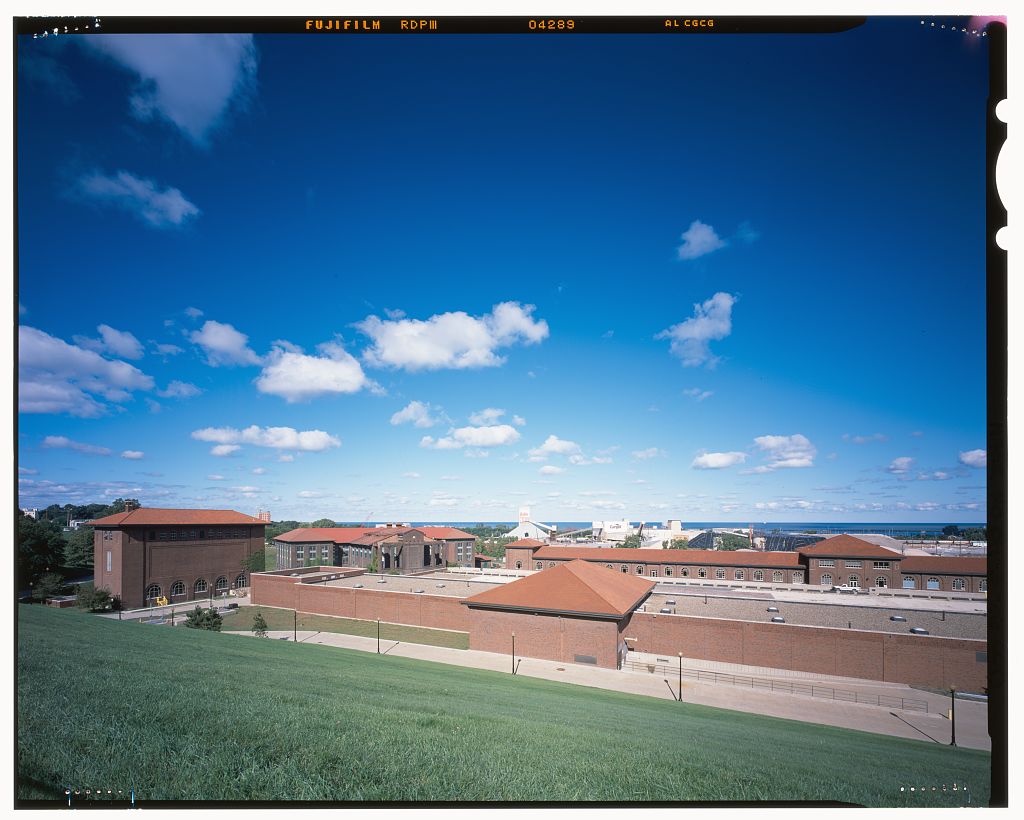
A pair of inlet gate houses and a pair of outlet gate houses regulated the flow of water into and out of the reservoir. The basins were excavated down to shale. On this shale base puddled clay was laid to a depth of 2.5 , topped (on the basins flat bottoms) by a 6 layer of sand, topped by a 4 layer of concrete. The sloped sides of the basins had the same depth of puddled clay, on top of which was laid a 6 layer of broken stone, topped by stone pavement. Only the south basin survives. It measures 720 on the east, 459 on the south, 723 on the west, and 600 on the north. On the north bank, near the northwest corner of the basin, is a brick and stone (outlet) gate house reached by a plate girder bridge.
The gate house has a hipped roof of slate, dressed stone foundation, and steel factory sash; inside are three valves and a half-ton crane. None of the equipment is in use. The bridge has stone veneer and a pipe railing. The south basin is surrounded on three sides (all but the north) by an iron picket fence along the top of the embankments. It is reached from the extension of Woodhill Road, in front of the Fairmount Pumping Station, by a single-flight stairway with a decorative cast-iron railing that ends, top and bottom, in square newel posts. Near the base of the stairway is a large granite boulder inscribed Wm. McReynolds, John Gawne & Sons, Contractors.
The city of Cleveland grew rapidly following the Civil War, requiring the continual expansion and extension of its water works. The Kentucky Reservoir, opened in on the city s near West Side, held only gallons and was only 150 above City Datum in elevation. It was sorely inadequate twenty years later, and in the early plans were made to replace it 1 City Datum is above mean level of Lake Erie. Mean level of Lake Erie is above mean sea level. The City of Cleveland: A Short History and Illustrated Report of the Department of Public Utilities Consisting of the Division of Water and Heat and the Division of Light and Power, 16.
BALDWIN FILTRATION PLANT & RESERVOIR FAIRMOUNT RESERVOIR OH-3-A (Page 3) with two new reservoirs located in the southeast part of the city: a low service reservoir (Fairmount) and a high service reservoir (Kinsman). On February 6, John Whitelaw, superintendent and engineer of the Cleveland Water Works, reported to the City Council on the extension of the water supply: a portion of the land has been obtained, by purchase, for the site of the proposed lower level reservoir, and legal proceedings have been instituted to procure the remainder of the land for both high and low service reservoirs, as proposed.
Therefore we hope during the ensuing season to contract for all of the work contemplated in the enlargement and extension of the works, so as to supply water to the higher portions of the city Whitelaw recommended contracts be let as follows: for a 36 main from Willson Avenue to the low service reservoir at Fairmount Street; for the 30 main from the high service pumping works to the high service reservoir; for the high service engine and boilers; for the extension of the boiler house at the old pumping works; for a ten million gallon pumping engine and three boilers for the low service pumping works, and, as soon as plans and specifications can be prepared, for the construction of the high and low service reservoirs, and high service engine and boiler house.
With these parts of the works under construction, he wrote, the whole can be so nearly completed that water may be furnished to the high service district within two years. 2 The various annual reports of the Cleveland Water Works document the construction of the Fairmount Reservoir.
In June a contract for the construction of the low service reservoir named the Fairmount Reservoir, after its location on Fairmount Street was let to William McReynolds, John Gawne, John Thomas Gawne, and William James Gawne in the amount of This sum included all embankments, excavations, puddle lining, ballasting, concrete, paving, drainage conduit, inlet and outlet chambers, stone stairs, soiling and seeding outer slopes, and all work incidental to that above named but does not include the inlet and outlet pipes and gates, bridges, fencing and railing. The pipes and gates would be furnished by the Water Works department and laid by the experienced pipe layers regularly employed at that kind of work.
The contract for the bridges, fencing, and railing would be let at a later date.3 William McReynolds was born in County Tyrone, Ireland, and came to Cleveland in at the age of sixteen.
He started in the pork packing business, briefly relocating to Texas in the He took up contracting upon his return to Cleveland; in the Cleveland Directory 2 Twenty-Seventh Annual Report of the Board of Trustees of Water Works to the City Council, Together With the Reports of the Officers of the Board, for the Year (Cleveland, 1, 3 Twenty-Eighth Annual Report of the Board of Trustees of Water Works to the City Council, Together With the Reports of the Officers of the Board, for the Year (Cleveland, BALDWIN FILTRATION PLANT & RESERVOIR FAIRMOUNT RESERVOIR OH-3-A (Page 4) for the Year Ending July, he is listed as a contractor associated with the firm of Harrison & McReynolds.4 John Gawne was born at Ballaugh, Isle of Man, where he learned the trade of stonemason.
He immigrated to America in settling in Cleveland in Besides the Fairmount Reservoir, John Gawne had the contracts for the Cleveland National Bank Building, the Otis Steel Company plant, and part of the National Malleable Castings Company plant. Son William J. Gawne who, together with John T. Gawne, is listed as a mason in the Cleveland directory, worked with his father until the latter s retirement in when he established the Gawne Contracting Company.5 At the close of the earthwork in the outer embankments was reported to be nearly completed. Work accomplished by Messrs. McReynolds and Gawne was reported to be as follows: earth excavation cubic yards; hard shale excavation cubic yards; and clay puddle 687 cubic yards.
This work was done at a cost of The report continued: The two lines of 30 inch outlet pipes for supplying water to the high service pumps, and one of the lines of 36 inch pipe for the low service district have been laid under the west embankment. These pipes are respectively inches, and 2 inches thick, and are laid on brick piers reaching down to rock. Two rings of brick masonry, laid in hydraulic cement 8 inches thick and 20 inches lengthwise of the pipe, are built over each length of pipe; the trenches are refilled with puddle clay, thoroughly tamped. They are all laid below the bottom line of the clay puddle lining of the basin.
The cost of this work was In August a newspaper article commented on the enormous force of workmen and teams laboring at the junction of [the Nickel Plate Railroad] and [Fairmount] street, noting that about 170 men and over 50 teams are continually employed, and the work will be pushed steadily forward as fast as the largest possible working force can push it until the frosts of the Winter set in. 7 A year later, the same paper reported labor unrest at the job site: seventy men employed on the new Fairmount Reservoir on being paid off to-day were informed that their wages would hereafter be cut from to per day. They all quit work in a body, and some of them grew so riotous that three arrests were made. All is now quiet.
8 As it detailed the year s progress, the annual report explained the construction methods employed: 4 For a brief biographical sketch, see Mr. William McReynolds in Annals of the Early Settlers Association of Cuyahoga County, Ohio, vol. v, no. 1 5 William J. Gawne in Elroy McKendree Avery, A History of Cleveland and Its Environs: The Heart of New Connecticut (Chicago and New York: Lewis Publishing Co., 3: 6 Ibid., 22. 7 Enormous Reservoirs in Cleveland (From the Cleveland Herald), New York Times, August 24, 3. 8 Reducing Laborers Wages, New York Times, August 15, 5. BALDWIN FILTRATION PLANT & RESERVOIR FAIRMOUNT RESERVOIR OH-3-A (Page 5) Work on this reservoir has progressed in a satisfactory manner.
The earth work in the embankments is nearly completed, the only work remaining to be done is to trim them to line and fill the top where worn away by teams, the soiling and seeding on three of the sides has been done, and the stone steps on the Woodland Hills avenue [Woodhill Road] side are in place. The waste pipe and drainage conduit are both completed, and the overflow pipe is laid to near the water line ready for the branches that will connect both basins with the waste pipe. The puddle lining and concrete bottom in the south basin is completed, the puddle lining of the slopes is carried more than half way to the top, and the paving reaches to an average height of about seven feet.
For the protection of the concrete, during the winter, the gates in the inlet main were opened and the bottom covered with water to a depth of three and a-half feet. The excavation in the north basin is nearly to grade and the bottom covered with clay for puddle, which by the action of the winter frost and rains will be in the best possible condition for working in the spring. Should nothing unusual occur, this work should be fully completed by September next. The amount paid the contractors for work to December 31, is September proved an optimistic prediction.
Not until the end of November was the Fairmount Reservoir so far completed that the gates in the inlet pipes were opened on the and water admitted The same day, across town, the gates in the pipes leading to the Kentucky Street Reservoir were closed, and all the surplus water has been pumped into [Fairmount] reservoir. 10 Contracts for the iron fencing and embankment railing were let to the Van Dorn Iron Works of Cleveland, and that work was well under way at the close of The iron bridges leading to the valve rods work let to Thomas Manning, Jr. of Cleveland were in place, although not yet complete. Shop work for the stair railing, being built by Alexander McCormick of Cleveland, was completed and awaited favorable weather for installation.
Two small leaks were discovered in the north basin and awaited repair; the south basin has been tested to a height of 16 feet, and so far proves to be water tight. 11 The Fairmount Reservoir was built at a final cost of Water has been kept in this reservoir continuously since the first day of December, reads the annual report of the Water Works Department, with the exception of two days in January last when the tunnel 9 Twenty-Ninth Annual Report of the Board of Water Works Trustees of the City of Cleveland, O., for the Year Ending December 31, (Cleveland, 31. 10 Thirtieth Annual Report of the Water Works Trustees of the City of Cleveland, O., for the Year Ending December 31, (Cleveland, 22, 23. 11 Ibid., 23.
BALDWIN FILTRATION PLANT & RESERVOIR FAIRMOUNT RESERVOIR OH-3-A (Page 6) inlet was stopped with ice. The south basin has been filled from a depth of 16 ft. to the over- flow line during all the latter part of the year. The contractors have not yet completed the repairs in the north basin; they have found and repaired the larger leaks, but on account of snow and ice have not restored the pavement The iron fencing and railing is completed with the exception of a few sections of the handrail on the front stairs. 12 The small leaks in the north basin were not stopped until sometime during when water department workmen performed the work and the cost was charged to the contractor.
The reservoir is now in full use, the department reported that year.13 Upon completion, the Fairmount Reservoir stored water for the purposes of peak shaving (that is, to offset higher demand during daylight hours), to effect pressure modulation, and to help weather pump outages. It also stored the water destined to be pumped from Fairmount to the high service Kinsman Reservoir. The reservoir s efficacy was soon proven when, during the water stored there twice served to avert a water famine in the eastern part of the city. Once in February, when one of the large mains broke west of the river during a period of cold weather, and again about the last of August or first of September, during the driest and hottest days of the year.
During both periods the consumption of water was greater than the quantity that could be delivered 14 That the reservoir grounds were considered a public amenity is evidenced by another note in the same report: The beautiful display of flowers along the dividing embankment, maintained from early Spring until killing frost came in November, delighted the many visitors to that attractive spot. The work of propagating and caring for them has been the pride and delight of Mr. Peter Schmitt, the [reservoir] keeper, and I would recommend that a small appropriation be made to enable him to purchase roots and seeds to increase the variety and beauty of the display.15 In addition to the floral display, there apparently was a cast-iron fountain in the south basin of the reservoir.
Its installation cannot be documented, but its removal can be. In the early spring of when the south basin was cleaned, The large fountain in this basin was taken down and abandoned, as the cast iron columns had been split by frost, and the supports were considered 12 Thirty-First Annual Report of the Water Works Trustees of the City of Cleveland, O., for the Year Ending December 31, (Cleveland, 13 Annual Reports of the Departments of Government of the City of Cleveland for the Year Ending December (Cleveland, 14 Annual Reports of the Departments of Government of the City of Cleveland for the Year Ending December (Cleveland, 15 Ibid. BALDWIN FILTRATION PLANT & RESERVOIR FAIRMOUNT RESERVOIR OH-3-A (Page 7) unsafe.
16 It must have been rebuilt, because five years later, in the department reported that the columns supporting the fountain in the basin were judged so badly broken by frost that it was deemed advisable to remove the whole fountain, which was done, together with the pipes leading to it. 17 From until the Fairmount Reservoir was supplied with water pumped from the city s original pumping station on Division Street. Beginning in the reservoir received its water supply from the new Kirtland Pumping Station. In a new filtration plant at Division Avenue was put into service, and the Fairmount Reservoir received a blend of treated water from Division and untreated water (so-called raw water ) from Kirtland.
Department annual reports indicate that the basins were periodically drained and cleaned, the iron fences scraped and painted. In addition, the bridges were regularly re-floored, scraped, and painted. In a neat house for the reservoir keeper was built and fitted up on the Baldwin street side, so that he has comfortable quarters for all seasons of the year, and a place for his tools. 18 In square feet of stone pavement in the north basin was taken up and re-laid, and 382 square feet of pavement pounded down, where the stone lining had reportedly bulged out in a number of places.
The same year, 350 shrubs were set out on the reservoir grounds, 84 poplar trees on the streets surrounding the reservoir were removed, and 86 maple trees were planted in their stead.19 In response to a growing population and the need for cleaner water, the saw a major upgrade of the city s water treatment and storage facilities, including the construction of the Baldwin Reservoir and Filtration Plant, put into service in and a new Fairmount Pumping Station, put into service in January Concurrent with these improvements, the Fairmount Reservoir was extensively renovated.
Extant engineering drawings, prepared by Cleveland s Van Dorn Iron Works Company and dated February and March document the changes, which included four new gate houses, new bridges, a new 7 suction tunnel, and new steel pipe inlets. (See site plan on pg. 9, dated September included with this report.) With the completion of these new facilities, the Fairmount Reservoir s function changed. Now, untreated lake water in the reservoir (pumped, as before, from the Kirtland Station) flowed by gravity to three low-lift pumps in the Fairmount Pumping Station, which pumped the water up to the Baldwin Filtration Plant for chemical treatment and filtration.
From settling basins there, the 16 Annual Reports of the Departments of Government of the City of Cleveland for the Year Ending December (Cleveland, 17 Annual Reports of the Departments of Government of the City of Cleveland for the Year Ending December (Cleveland, 18 Annual Reports of the Departments of Government of the City of Cleveland for the Year Ending December (Cleveland, 19 Annual Reports of the Departments of Government of the City of Cleveland for the Year Ending December (Cleveland, BALDWIN FILTRATION PLANT & RESERVOIR FAIRMOUNT RESERVOIR OH-3-A (Page 8) water flowed by gravity into Baldwin Reservoir. From the Baldwin Reservoir, a large portion of the water flowed by gravity into the network of mains in the Low Service District.
The other portion of this water flowed back to the Fairmount Pumping Station, one set of pumps forcing the water into the mains of the First High Service District, the other set of pumps forcing the water into the mains of the new Second High Service District. Thus, Fairmount Reservoir now served as a way-station for raw water destined for treatment at the adjacent Baldwin Plant. This function remained unchanged until the mid-1980s.20 In environmental regulations required the design and construction of new waste solids handling facilities for the Baldwin Filtration Plant. The reservoir s north basin was removed from service and re-graded for this purpose.
The new facilities treated water from the drainage of settling basins, the backwash from used filters, and the water processed for the first few minutes through newly cleaned filters until it met quality standards. (Prior to the construction of these facilities, these waters and their solids were deposited without treatment into the nearby Doan Creek.) With the construction of the new waste solids handling facilities, the reservoir s remaining south basin blended raw water from the Kirtland Pumping Station with the supernatant (the clear fluid above a sediment or precipitate) from the solids handling facilities and sent the mix to Baldwin for treatment. Beginning in raw water was pumped directly from Kirtland to the Baldwin Filtration Plant for treatment, bypassing the Fairmount Reservoir.
Since then, the Fairmount Reservoir s only role has been to accept the supernatant from the waste solids handling facilities and the overflow and under-drain flows from the Baldwin Reservoir. The resulting blended water in the reservoir is then pumped back to the head end of the Baldwin Plant for treatment. In January the City of Cleveland Division of Water awarded a contract to Brown and Caldwell Ohio for design of the Baldwin Residuals and Fairmount Reservoir Project.
On July 27, the Kokosing Construction Company, Inc., headquartered in Fredericktown, Ohio, was authorized to proceed on the construction of this project, which will include improvements to the raw water/recycle tanks and pumps, equalization basin, backwash clarifiers, sludge transfer pumps, sludge storage tanks, and sludge recirculation and discharge pumps. These improvements are intended to increase the flexibility and operation of the waste solids treatment facilities and to optimize the final waste solids disposal system. As part of this project, the remaining basin of the Fairmount Reservoir will be decommissioned and filled in, and the associated Gate House No. 9 will be demolished.
20 Since all water coming from the Kirtland Station now needed to reach the Fairmount Reservoir for eventual treatment not just the excess necessary for peak shaving new transmission facilities were required. Twin 60 raw water mains from Kirtland to the Fairmount Reservoir were installed and came on line with the Baldwin Filtration Plant in BALDWIN FILTRATION PLANT & RESERVOIR FAIRMOUNT RESERVOIR OH-3-A (Page 9) BALDWIN FILTRATION PLANT & RESERVOIR FAIRMOUNT RESERVOIR OH-3-A (Page 10) SOURCES OF INFORMATION Annals of the Early Settlers Association of Cuyahoga County, Ohio. Vol. v, no. 1.
Annual Report of the Board of Trustees of Water Works to the City Council, Together With the Reports of the Officers of the Board: Annual Report of the Board of Water Works Trustees of the City of Cleveland, O.: Annual Reports of the Departments of Government of the City of Cleveland: Avery, Elroy McKendree. A History of Cleveland and Its Environs: The Heart of New Connecticut. 3 vols. Chicago and New York: Lewis Publishing Co., Cleveland, Ohio. Department of Public Utilities. Division of Water. Drawing files. The author wishes to thank Alex Margevicius, P.E., assistant commissioner, Cleveland Division of Water, for reviewing and commenting on this report.
 Block
Block