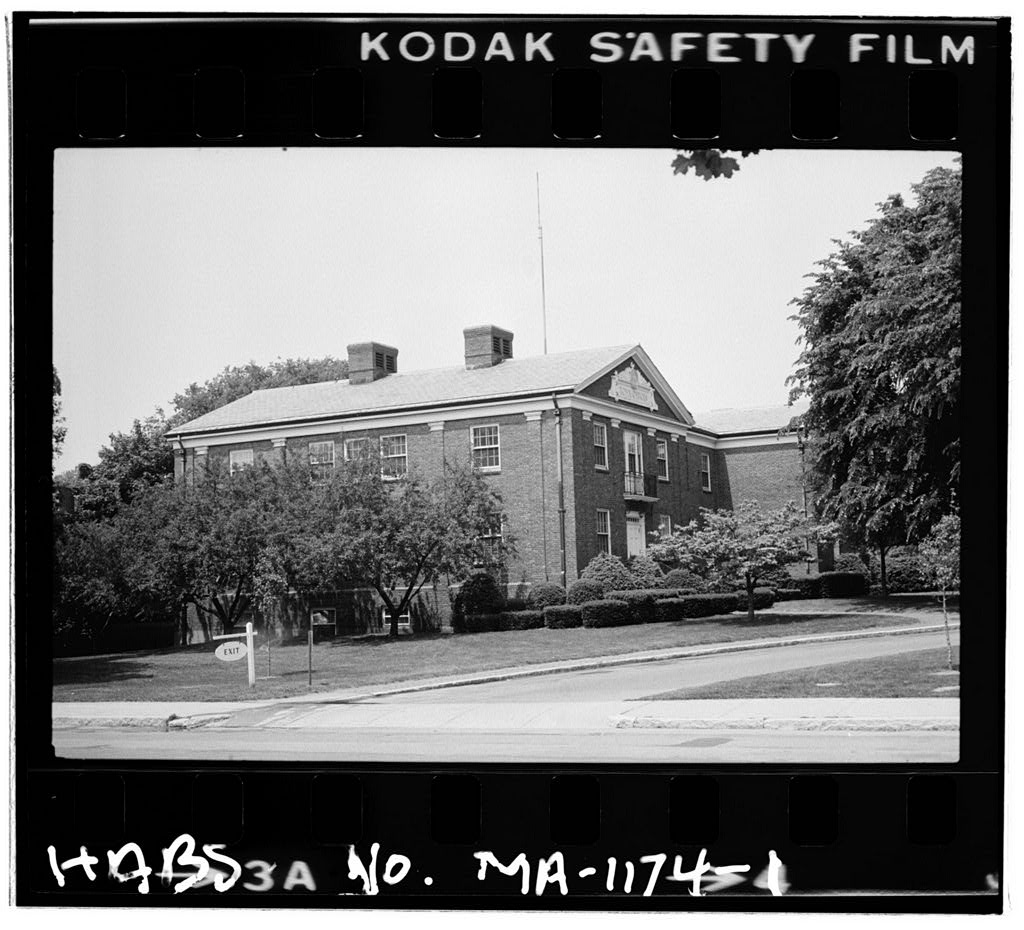
John Wingate Weeks Junior High School, Hereward & Rowena Streets, Newton Center
John Wingate Weeks Junior High School, Hereward & Rowena Streets, Newton Center, Middlesex County, MA. Surveyed as HABS MASS,9-NEWTC,1-, with 1 photograph and a 3,563-word written history.
From the record
“The Weeks Junior High School is a local reflection of the nation-wide education reform movement which created the junior high school concept in the first two decades of the twentieth century.”
Written record, HABS MASS,9-NEWTC,1- survey. Machine-read text.
surveyed by the federal HABS program as HABS MASS,9-NEWTC,1- · the record runs 3563 words · one of 333 surveyed structures published for this county.
Source document
Quoted word for word from HABS MASS,9-NEWTC,1-.
Not written, edited or summarised by this site.
The Weeks Junior High School is a local reflection of the nation-wide education reform movement which created the junior high school concept in the first two decades of the twentieth century. The style and plan of the school are an expression of the educational goals of the period. JOHN WJMiA'ih Wi.i.Kb JUN10K SCHOOL HABS No. MA-1121 (Page 2) The Educational Reform Movement and the Growth of the Concept of a Junior High School. The educational reform movement which produced the John Wingate Weeks Junior High was an aspect of the widespread and revolutionary social changes which took place at the turn of the twentieth century in America.
Among the changes was the accepted view of childhood, which, as it became more enlightened and benevolent, led many educational leaders to question the educational system as it was constituted. The result was that in the last years of the nineteenth century and for the first two decades of the twentieth century, American grammar and secondary schools experienced a major restructuring of orga- nization and aims. At first the reforms focused on making the system more efficient. The recapitulation of curriculum in the sixth, seventh and eighth grades was abolished, school was shortened from nine to eight grades and subjects previously limited to high school were introduced earlier to "economize time" and "prevent waste".
However, by the second decade of the new century, devel- opmental psychology had changed both theory and attitudes towards adolescence, while the democratizing of political and economic power was changing the notion of whom to educate, and for what. Scientists noted that in American children, puberty appeared between the ages of 12 and 16, some two years earlier than had previously been thought. Its onset with the profound transformations in the physical, emotional and mental makeup of the student became the object of serious study.
Educators responding to the data began to believe that special environ- ments and teaching techniques should be devised to deal with this dynamic age group- Moreover, attention was shifting from the student as an undifferentiated unit of the primary-secondary school system who must adopt to the system or fail, to the view that each child was an individual with different needs, for whom oppor- tunities for learning must be created or the system itself would fail. An attempt had recently been made in this direc- tion by adding general, technical and sometimes industrial track courses to the rigid academic course of the traditional high school, but this afforded little help to the adolescent student not yet in high school.
The need for reassessment must have been especially pressing as educators found themselves presiding over a system in which most students dropped out after grammar school, while "not more than one in five, (more often than not one in ten), complete the high school course of his election."(1) JOHN W1NGATE WEEKS JUNIOR HIGH SCHOOL HABS No. MA-1121 (Page 3) These problems appeared to be linked, and the reasons for them complex. Many students never went on to high school be- cause their pay check would be needed at home before they could complete the four year course. Others were not mentally, physically or emotionally ready to decide whether or not to continue, and either neglected to enter high school or chose an inappropriate course of study once they did.
It was felt that a contributing factor of the high drop-out rate was that students had not had a chance to test themselves adequately, or explore their own inclinations and abilities. In short, their decisions were based on insufficient self-knowledge. Another problem, identified early in the reform movement, was that students experienced too difficult a transition from the neighborhood grammar school with its rote learning system to the centralized high school whose courses increasingly demanded independent thinking and study. So educators began thinking of a middle way which could rectify some of these problems while allowing other educational gaps to be addressed. The concept of a Junior High School, usually but not always composed of the seventh, eighth and ninth grades evolved.
It would postpone for two years the crucial school-leaving decision, while allowing the student during this time to better test himself. It would provide curriculums and teaching techniques developed especially for adolescents, and it would be an ideal laboratory in which to implant the new and wider goals of the American educational community. In contrast to the nineteenth century concept of the task of education as teaching the mastery of the "three with perhaps Deportment added, the Committee on Reorganization of the National Education Association articulated in a comprehensive set of aims for each student. In order, they were: health, command of fundamental processes, becoming a worthy home member, vocation, worthy use of leisure time, and ethical character.
To achieve these goals it became obvious that to the traditional curriculum must be added strong programs in vocational education, guidance, extra-curricular activities, physical education, and studies in nutrition with supervised lunchrooms. Additionally, educators saw the adelescent age as an ideal period for both individual socialization and training in good citizenship. Because they saw the insti- tutions of American life after this age as essentially sex, (1) Denberg, Joseph K., The Junior High School Idea. Holt, p. 15. JOHN V1NGATE WEEKS JUNIOR HIGH SCHOOL HABS No. MA-1121 (Page 4) class and status segregated, a junior high school represented a last chance to keep the college-bound students together with their peers who would later enter industry, commerce or homemaking careers.
It is important to stress that the junior high school was conceived as quite distinct, and educators, for the most part agreed with Leonard Koos when he wrote "Experience seems to recommend that, wherever possible, the Junior High School should be housed in a building of its own."(2) When junior high schools came to be built in numbers, we find that these issues had a profound effect on the program given to the architect, and by the late these ideas were accepted as the standard ideal. Newton's Early Experience. When Frank Spaulding, the first of the strong Newton School Superintendants, entered that position in he found an excellent, if conservative, school system dedicated to maintaining the highest standards in preparing students for college.
The town, he noted, was geographically spread out, and its many villages varied from blue collar communities to those of the most well-to-do professionals. Responding to the national movement for shortening the nine years of grammar school, between and Spaulding eliminated the ninth grade in Newton, offering five years of college prep instead. At the same time, he acted on his progressive interests in allowing each student to make the most of his abilities in whatever sphere of endeavor when he procurred private financing to make possible the construction of the town's first vocational school, the Frank Day School of That same year he convinced the town to build its first technical high school.
Spaulding's concern with losing a large percent of the school population after grammar school led him to discontinue the custom of having elaborate graduation ceremonies from that institution. Spaulding felt they symbolized the end of an education. The Superintendant was also very interested in promoting physical education in his schools. He reported that in the first Newton playground was attached to a school, and in the first Playground Commission was formed. Newton was (2) Koos, Leonard, The Junior High School. Ginn & Co., Boston, p. JOHN W1NGATE WEEKS JUNIOR HIGH SCHOOL HABS No. MA-1121 (Page 5) fortunate to have begun the reform of its educational system with this distinguished educator, who later became Dean of Graduate Edication at Yale University.
Creating a Junior High School System in Newton. Spaulding's successor as School Superintendant was Ulysses G. Wheeler. An innovative, thoughtful, but practical man, Wheeler was also extremely energetic. Under his leader- ship Newton's school system continued to respond, usually against its conservative citizens' inclinations, to the reforms proposed by forward-looking educators.
Newton experienced rapid population growth from the mid- nineteenth century to the In Newton Highlands, resi- dential developments multiplied after reaching a cres- cendo in the World War I, however, halted the building of new schools to serve the rising student population, so the need for new construction became particularly urgent in the In a Newton Special Committee to Survey Educational Facilities proposed construction of five new schools: three junior high and two elementary schools. Junior high schools would be an economical solution because classroom space would be provided for only three-fifths of the students, the others being in vocational or other special rooms such as the audi- torium, or lunch rooms.
Aside from the increase in population, the need for junior high education, the Committee said, "had grown with the stricter enforcement of compulsory education laws by which a larger number of children who have a limited taste and aptitude for books is kept in school."(3) The purpose of junior high education, the Committee felt it necessary to state, was to provide different kinds of educational opportunities to children of different abilities and ambitions: ii- ^he distinctly book course leading to college and the technical schools. - The clerical course leading to business. - The industrial courses leading to the trades. (3) City of Newton, Annual Report. "Report of the Survey Committee", p. 42. JOHN WINGATE WEEKS-JUK10R HIGH SCHOOL HABS No.
MA-1121 (Page 6) The Committee stressed that to be successful such schools must have adequate space and special equipment to carry out their purposes. Two years later the large Frank A. Day Junior High School was built on the suggested model, and in at a time when Newton was contemplating the erection of two more junior highs, the Superintendent's Report on the Frank Day School was cal- culated to encourage their construction. The new educational goals and policies were given a full-dress rehearsal; successes were reiterated with pride. At this time the City still offered an optional five year college prep course, but it was hoped that the introduction of more junior high schools would reduce the number of students electing the extra year.
Reducing this burden would place Newton schools in the same favorable position as the best college prep schools in the country. 192 7 saw the building of the Levi Warren Junior High School, leaving to be constructed only the junior high to serve the least congested of districts, the south side and Newton Highlands. Attempts to gain community support included a rhetorical discussion on "Which Plan of Education is Right for Newton?", and the statement, aimed at the pocketbook, that the new school "promises the best relief for the community."(5) Cost was an important issue, as junior high schools were more expensive to build than elementary schools, though less than high schools.
The School Committee argued that, besides being worth the cost for the superior quality of the education, it would reduce the pressure to construct a costly new high school. This theme was discussed repeatedly, and indeed, in the Committee stated that the junior high school organi- zation had been "discouragingly slow due to the fact that each new unit was built only to relieve congestion."(6) Building the John Wingate Weeks Junior High School. Acting on the suggestions of the Special Committee, in the City of Newton purchased a plot of land between Newton Centre and the Highlands for the possible erection of a junior high school. Three years later, the Annual Report was still considering the question of a junior high school for the south side.
But early in 192 9 a Joint Committee was TD wzaz (5) City of Newton, Annual Report. "School Report", p. 63. (6) City of Newton Annual Report School Committee Report, p. 7. JOHN WlNGAiL JU.MOK SCHOOL HABS No. MA-1121 (Page 7) convened to resolve the question. The result was that an architectural firm was engaged to make a survey of the land and prepare preliminary sketches of the building. The firm was Henry and Richmond of Boston. Either the School Committee suddenly developed more ambitious plans for the lot or it wished to avert possible charges of wasteful land use, for it requested the architects to survey the land and prepare preliminary drawings showing the adequacy of the site for housing both a junior and senior high school, or, alternatively, for only a junior high.
The senior school was to serve students, the junior After considering the possible placement of both schools on the lot, Henry, partner in charge, urged in a report dated July 26, that only the junior high school be built, as if both were erected, the area would be utterly inadequate to provide for the minimum requirements of either school in the sphere of outdoor classwork or organized play, even with the purchase of additional land. However, the land, he wrote, "approaches the ideal standard ... of secondary education as it is level, centrally located for the communities it serves, readily accessible from an appropriate thoroughfare . .
Though the architects showed two other rather awkward plans involving bulky massing with interior courtyards, they urged the selection of an E-shaped plan for the junior high. It could be placed parallel to Hereward Street, but the architects imaginatively suggested making two small additional land purchases: one at the triangle of Rowena and Hereward, the other at the southeast corner of the plot near Oxford Road. Together they added less than an acre.
This would allow the placement of the school at the triangle of Hereward and Rowena Street, "a line of natural approach."(8) If the school were placed at this corner and the additional land taken, it would "permit the locker and other ground floor rooms to open directly to the center of the playground area." (9) Moreover, the E-shaped plan developed for the Hereward orientation cpuld be retained, and its wings opened, with the effect of obtaining more light and air.
After the preliminary plans were presented in July, the School Committee decided that no more money could be appro- priated or definite steps taken until after January 1, During this interval, apparently, the decision was made to accept the architects' recommendation and build only the X71 Report on Adequacy and Adaptability for School House Purposes of Land Owned by the City of Newton, July 26, Henry and Richmond. (8) Ibid. (9) Ibid. JOHN WINGATE WEEKS JUNIOR HIGH SCHOOL HABS No. MA-1121 (Page 8) junior high. However, the number of students it was to serve was raised to Early in the spring of plans were completed, money approved, and a beginning was made. The Annual Report for promised that the still-unnamed South Side Junior High would "be one of the finest in Newton . . . having . .
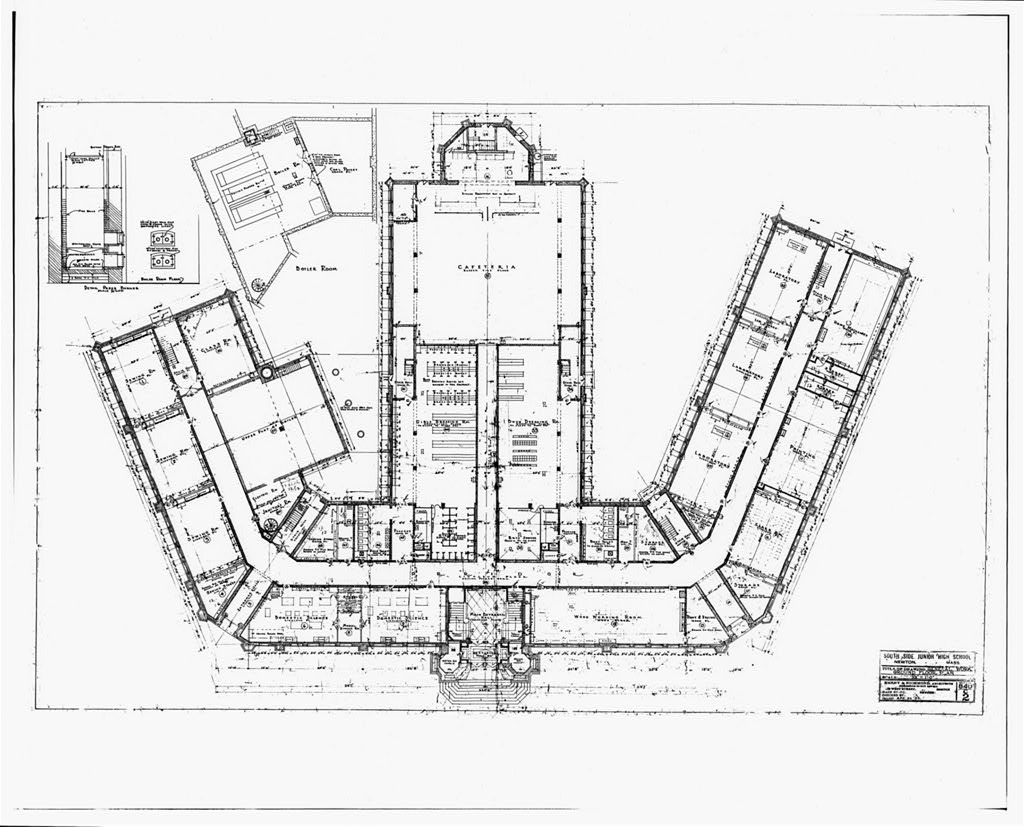
* all the necessities and conveniences for a progressive and up-to-date Junior High School - a school of which the Gity may justly be proud. The program for the school was extensive. Beyond the twenty-eight standard classrooms there were numerous special- ized shops for wood and metal working and printing, mechanical drawing rooms, cooking, and three sewing rooms for the girls. With the lunchroom, kitchen, locker and shower rooms, these were placed on the ground floor. On the first floor were the administrative offices, emergency and doctor's rooms, music room, library, and audi- torium.
By placing two gymnasiums adjacent to each other and separated by a sliding door, the architects arranged to have fixed seating in the auditorium, "since throwing together the two releases a standard basketball court without involving the auditorium."(11) Opening all the doors, the whole sequence could be joined. - The second floor was occupied by classrooms, science rooms with storage facilities, bookkeeping and freehand drawing rooms, and a large, well-lighted study hall. The playing fields were conceived as an integral part of the educational plant, as we saw in the architects' earlier recommendations.
The physical health and development of adoles- cent students was to be encouraged with a three-pronged effort, all with architectural ramifications: organized physical acti- vities and games, doctor's examinations, and nutritional edu- cation and supervision. For these, playing fields and doctor's office and lunchroom were planned. The grouped workshops and specialized rooms, centralized auditorium for civic training and the development of self- expression, the bright study hall to encourage good study habits, and even the democratic equality of access to and showers for girls are evidence that the program and plan supported current progressive ideals of junior high school education. City of Newton, Annual Report p. 10.
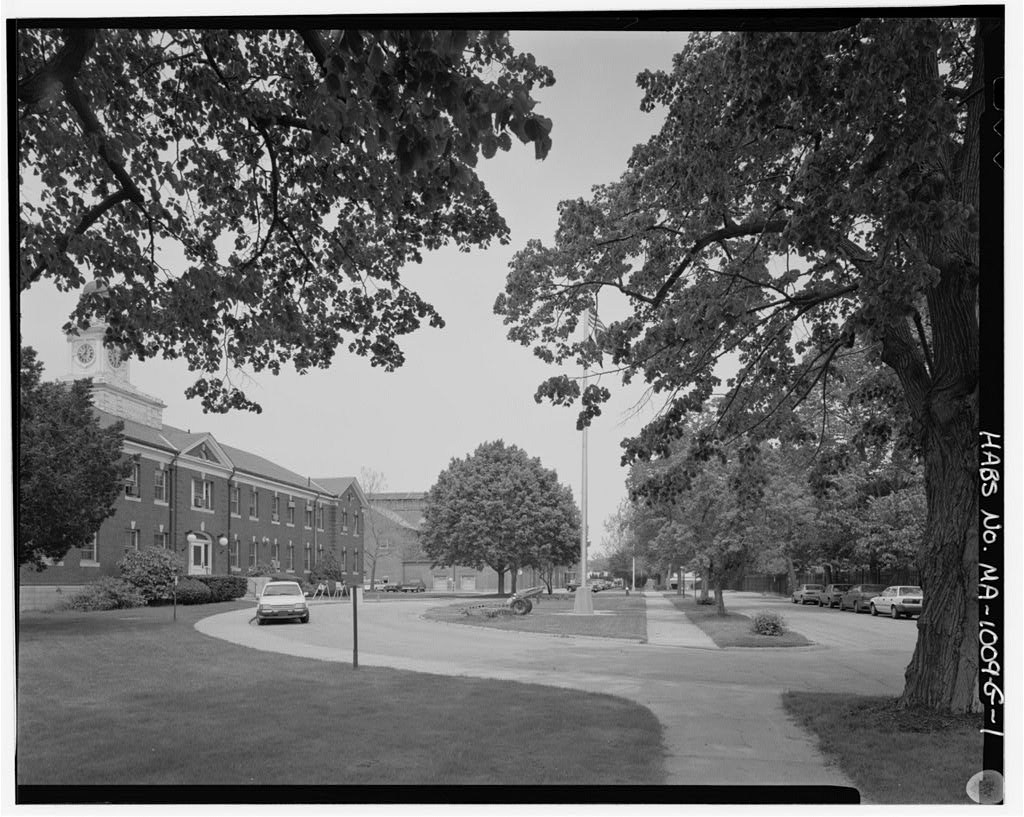
Henry and Richmond, Remarks on the Program, typescript, JOHN WINGATE WEEKS JUNIOR HIGH SCHOOL HABS No. MA-1121 (Page 9) The school's Neo-Gothic style was a sensitive response to the housing plans for the neighborhood. The streets surrounding the school were to be built up in Tudor Revival styles, and the Weeks School would serve as a centerpiece for the area. The school's romanticism, combined with the authority of the tower and the strongly-modeled details, warm brick and well-known banks of school windows, made it special but familiar, demanding but welcoming, just as educators believed a junior high school should be. Considered nationally, both the plan and style of Weeks were responsive rather than innovative.
Plans of schools published in and show E-shaped buildings with at least three of them having the auditorium in the center wing. A California grammar school plan pub- lished in is oriented, like Weeks, towards a corner, with the playing fields integrated into the plan, and the auditorium in the central wing. Across the nation, the Neo-Gothic had been an important style for educational buildings since In the it achieved enormous popularity. The historicizing air of religious power and glory, and its association with the great JSnglish Universities, was a conservative choice among current architectural styles.
Scores of colleges and insti- tutions were constructed using English Gothic Collegiate architecture as their model, or, more accurately, using the American adaptation of this mode as a starting point. Between.1921 and just prior to the construction of Weeks Junior High School, Newton built nine new schools, seven of them in a variety of Neo-Gothic styles. Weeks Junior High School is by far the most elaborate of these schools. All used red brick and contrasting light stone or concrete trim. Several employ features found at Weeks: the Angier School uses crenellations, ogival arched door openings, and multipaned vertical windows.
The Frank Day Junior High School of has angled wings, and a central door highlighted by lighter stonework under elaborated fenestration; the Underwood School of employs strong stone beltcourses. None, however, made use of the tower motif, or is enriched with the buttresses, finials, niches, and elaborated spandrels found at Weeks. JOHN WXNGATE WEEKS JUNIOR HIGH SCHOOL HABS No. MA-1121 (Page 10) The new school was bigger than the two earlier junior high schools, having more classrooms, separate rather than combined gymnasiums and auditoriums, and many more specialized rooms. Cost figures reflect this. In Weeks was built for while the Frank Day cost and the Warren cost A year after the school was opened. Superintendent Ulysses G.
Wheeler called the introduction of the junior high school "the most significant change in school organi- zation in the past 10 years."(12) The schools had been popular, he said, but had been critized because of their greater costs. Though in the last analysis it was impossible to prove, he thoroughly believed that they were worth it. City of Newton, Annual Report p. 16 JOHN WINGATE WEEKS JUNIOR HIGH SCHOOL HABS No. MA-1121 (Page 11)
Bibliography
Ayres, Lenard and M. Ayres. School Buildings and Equipment, Survey Committee of the Cleveland Foundation, Cleveland, City of Newton, Building Department. Correspondence on Weeks Junior Hiffh School, City of Newton Archives. Cox, Phillip The Junior High School and Its Curriculum, Scribner, New York, Davis, Calvin O. Junior High School Education, World Books, Yonkers on Hudson, Donovan, John J. School Architecture: Principles and Practice, MacMillan, New York, Dressier, Fletcher. American Schoolhouse, Government Printing Office, Washington, Henry, Ralph and Henry Richmond. Report on the Adequacy and Adaptability for School House Purposes of Land Owned by the City of Newton, typescript,..JL929,. , .. _, .^ Hines, Harlan C.
Junior High School Curricula, Macmillan & Co., New York, Koos, Leonard V. The Junior High School, Ginn and Co., Boston, Newton, City of. Annual Report, Newton, Smith, William. The Junior High School, Macmillan, New York, Spaulding, Frank. School Superintendent in Action in Five Cities, Smith, Rindge, New Hampshire, Van Denburg, Joseph K. The Junior High School Idea, Holt, New York, JOHN WINGATE WEEKS JUNIOR HIGH SCHOOL HABS No.
MA-U21 (Page 12) Project Information Conversion of Weeks Junior High School to apartments, including demolition of the rear central wing of the school is to be funded by the Department of Housing and Urban Development- Under Section 106 of the National Historic Preservation Act of mitigative documentation was undertaken for the Newton Community Development Foundation by Bonnie Marxer of Architectural Preservation Associates In
The original filed report, and the sheets the survey produced. Those published here appear above.
Also surveyed in Middlesex County
24 of 332 records shown
The federal survey recorded these other structures elsewhere in Middlesex County. These are the other structures
they measured and filed a report on, longest report first.
 Block
Block