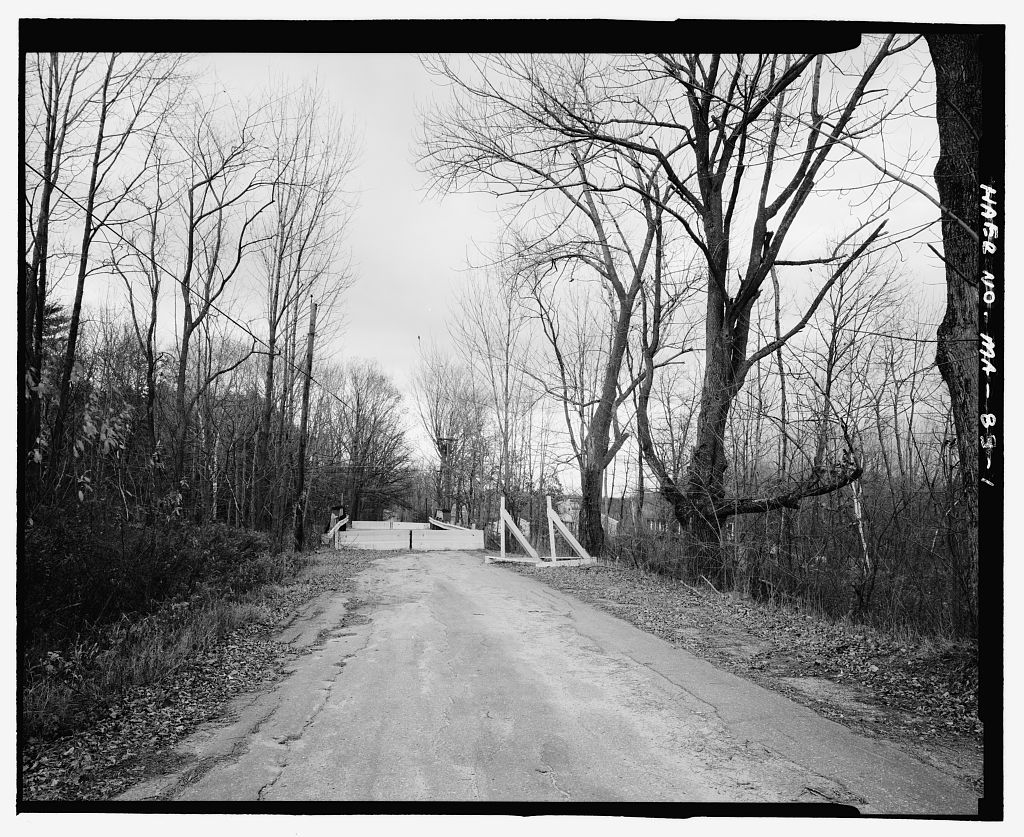
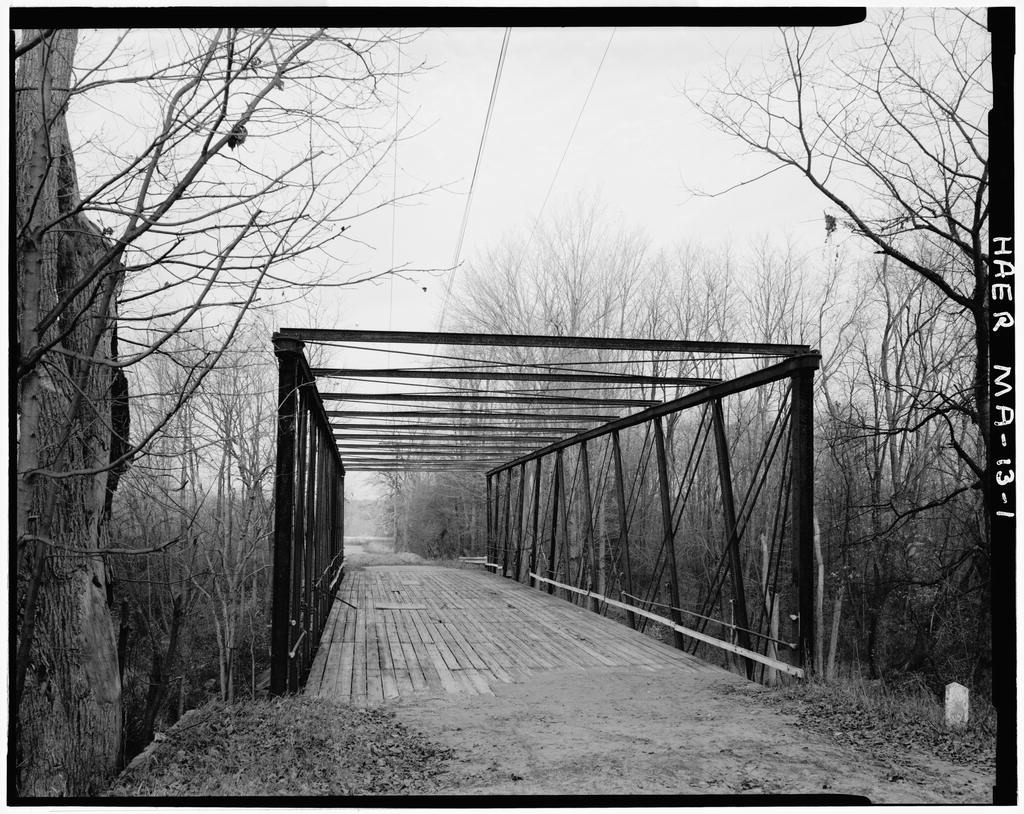
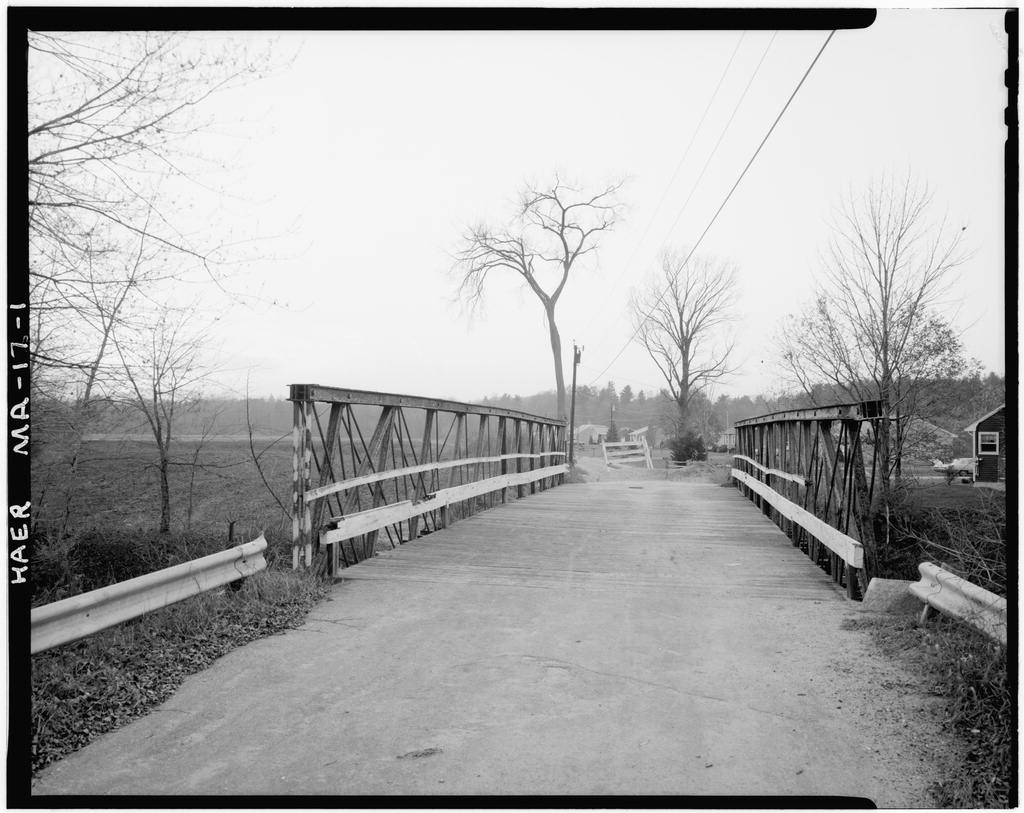
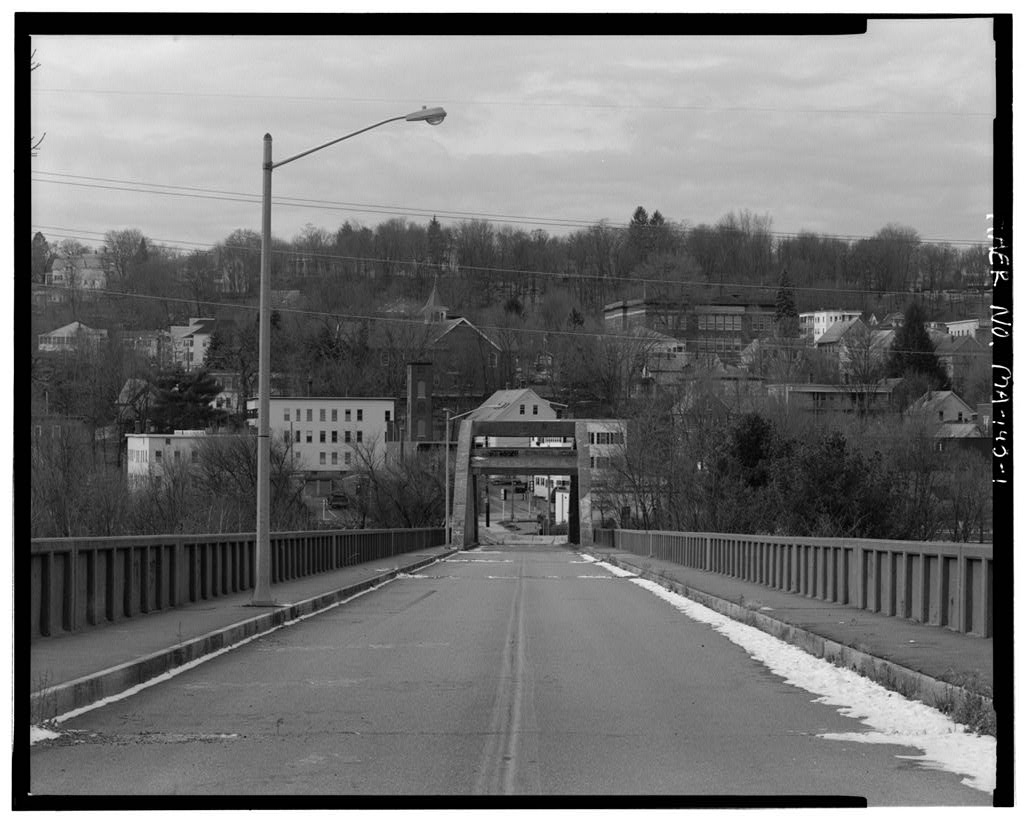
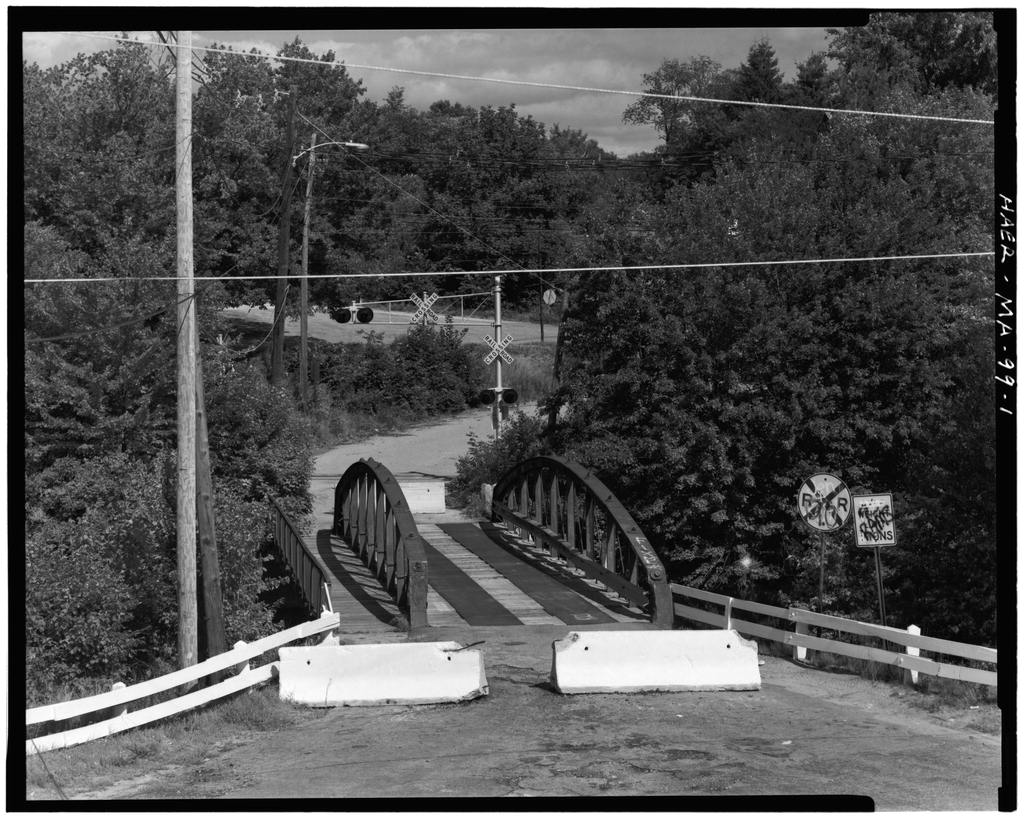
This documentation was undertaken in November in accordance with the Memorandum of Agreement by the Massachusetts Department of Public Works as a mitigative measure prior to the replacement of the bridge in Matthew Roth, Managing Partner Historic Resource Consultants 55 Van Dyke Avenue Hartford, CT HAG TI NGG BR I tJGE ( cawp1jr RO,:td Br id13e) HAER No. MA-83 (Page 2) was built during this period of local recreational development. The Bridge Hastings Bridge is a single-span, modified Howe pony truss, 36 and 1/2 feet long and 21 feet wide. Counting the triangular end panels, it is a four-panel truss.
Timbers of yellow pine make up the chords, end posts and diagonals; all are a single timber except the bottom chord, which ls made of two pieces laid side-by-side, bolted together, and with iron spacers at the panel points. Floor beams, stringers and decking are also yellow pine. The verticals are wrought-iron rods. The third floor beam in from each end extends 2 and 1/2 feet out beyond the trusses to serve as the footing for diagonal sway-bracing that connects to the underside of the top chord; each brace is of yellow pine with an iron tension tie. The trusses were originally covered with matched-board sheathing, which has been replaced by plywood.
(For dimensions of all components see the copy of the original construction drawings and bill of materials in the photographs accompanying this report.) The joints connecting timber members are very complex, each chiseled into at least three mating surfaces and supplemented with iron bolts. The iron tension rods are threaded at either end and secured by nuts and large cast- Iron washers. The north abutment, which probably dates from is ashlar masonry of large granite blocks. In both the north and the above-described south abutments, the joints feature hard mortar (high cement, low-lime, content) of recent origin. The structural members all appear to be original to the bridge.
The major changes from the original appearance are the plywood sheathing, the asphalt covering the deck, and the steel channels bolted to the sides of each floor beam. In additlon, two-by-six boards have been nailed to most of the truss timbers, son~ to anchor the plywood sheathing and some in an apparent attempt to strengthen the truss. The Howe truss, patented in was characterized by the use of timber for the diagonal members that resisted compressive stresses, and iron for the vertical members that resisted tensile stresses. A significant step in the HASTINGS BRIDGE (Campground Road Bridge) HAER No.
MA-83 (Page 3) introduction of iron into bridge construction, it immediately began supplanting all-wood designs like the Town lattice for long spans and the traditional king-post and queen-post trusses for shorter spans. In the New York State Engineer and Surveyor designed a standard short-span Howe pony truss to carry rural roads over the state's canals. Called the "General Plan for Farm Bridge," this standard truss resembled very closely the four-panel configuration later adopted by the Boston and Maine Railroad. Squire Whipple, one of the first American bridge engineers, made some improvements in the standard pony trusses when he worked on the New York state Canals in the He redrew the joints and specified multi-ply chords that allowed the design to be extended up to six panels.
Whipple claimed that "for farm and country road crossings over the State canals . . several hundreds of them are in use."(l) J. Parker Snow and his colleagues in the engineering office of the Boston and Maine Railroad employed wooden-bridge construction for its cost advantages over iron. In designing standardized structures for several common uses, the railroad's structural engineers drew up the "modified pony Howe truss" for carrying highways over the tracks. (Other standardized plans included long-span lattice trusses and short-span timber bents, both for carrying the tracks over rivers or roads.) The Hastings Brjdge precisely follows this standard design.
The most significant modification from the typical practice of the was the addition of the sway bracin<J to "have the top chords stayed against side motion." Snow's office also strengthened the floor system by bolting floor beams under the bottom chords at approximately two-foot intervals, rather than confining them to the panel points and concentrating the load at those locations; this practice doubled the number of floor beams. The Boston And Maine engineers also called for sheathing "to protect the trusses from the weather," and designed the complicated wood-to-wood joints. Snow asserted that a bridge built to these specifications would last ''forty to fifty years."(2) The Boston and Maine began in the as one of three lines connecting Boston with northern New England.
The others were the aforementioned Eastern and the Boston and Lowell. Until the all three were able to survive as HASTINGS BRIDGE_(Campground Road Bridge) HAER No. MA-83 (Page 4) independent, if not- lucrative, lines- because of three factors. First, the rail network was not so densely developed with branch and feeder lines that viable alternatives in rail service were available in most communities: the railroad that was in a town first had a good chance of keeping that town's business. Second, the state legislature was compliant in the face of franchise adjustments and rate requests.
Third, the railroads all benefited initially from local subscription in their service areas, so some portion of ownership had an interest in keeping the lines running at minimal profit, or even at a slight loss, as long as rail service to their towns and businesses was maintained. As railroad development continued, however, the three lines encountered competition with one another. No longer could the state legislature be easily convinced that a town's economy depended critically on the performance of any single one of the railroads. Nor could local ownership be expected to make a financial sacrifice to keep one of the lines running.
After a relatively brief period of bitter competition that lasted through the mid-1880s, the Boston and Haine was able to consolidate its position and dominate rail traffic in northern New England. The Boston and Maine chipped away at the Eastern by buying stock in the various smaller railroads that had been brought into the Eastern system by lease agreements. These leases typically paid a dividend of seven to ten percent on gross revenues to the prior owners, and the Boston and Maine kept the leasehold arrangement when it officially absorbed the Eastern in Keying the payments to gross revenue made the acquisition palatable to the prior owners, as it assured their income whether the lines made money or not.
But it also crippled the Boston and Haine in later years, when it had to keep paying out lease fees that amounted to dividends, even when running at a loss. The Boston and Lowell sought to fight off the Boston and Haine by developing a rail corridor that would dominate the Boston to Montreal route. When court challenges in New Hampshire frustrated that attempt, the Boston and Lowell agreed in to lease lts entire system to the Boston and Maine. Thus by the Boston and Maine had a virtual monopoly over the railroads of northern New England.
In it gained connection with Long Island Sound by securing yet another lease, of the Connecticut River Railroad, running south from Springfield, Massachusetts; this acquisition put the Boston and Maine into competition with HASTINGS BRIDGE (Campground Road Bridge) HAER No. MA-83 (Page 5) - the New York, N~w Haven and Hartford, which dominated southern New England rail traffic. In the its extensive leases put the Boston and Maine in a very precarious financial condition, with no money to pay for capital improvements once the guaranteed leases were paid.
According to the leading chronicler of the railroad, "The Boston and Haine should have spent millions on its roadbed and bridges." The locomotives and cars were obsolete and the stations "a disgrace."(3) The use of wooden-bridge construction in the by J. Parker Snow and the engineers of the Boston and Maine must be understood against this background of economic distress. While they presented defensible technical arguments in favor of wood bridges {and Hasti11gs Bridge did last more than its planned-for life of fifty years), the engineers were clearly aware that iron was by the best available material for bridges.
Snow's almost apologetic explanation for the Boston and Maine's continued reliance on wood verged on regret that his employe~s could not afford iron, and even suggested that the int:erest in his paper might be as much historical as practical: Wooden bridges are seldom discussed, and when mentioned, are generally treated as temporary structures or excuses [are] offered for their use. The building of such bridges is, however, a live business on the Boston and Maine Railroad, although the impression seems to be prevalent in many quarters that such construction is obsolete and out of fashion.
This paper is offered to describe the present practice in wooden bridge construction on the above-named railroad, and if not considered as in line with present approved practice elsewhere, may at least have some interest as a history of one branch of the bridge-building art.(4) Snow noted that more than two-thirds of the Boston and Maine bridges were wood out of and went on to describe the principal designs. Snow offered reasons for favoring wood, such as the intuitive ability of an "intelligent master-carpenter" to design the members, and the advance warning of failure that a wooden member provides.
But Snow himself was not persuaded by these observations and apologized again in his closing remarks: rt is no part of the intention of this paper to advocate building wooden bridges instead of properly designed HASTINGS BRIDGE (Campground Road Bridge) - i HAER No. MA-83 (Page 6)- iron ones, but rather to . . . show that-these styles are not so obsolete as seems to be supposed.CS) In fact, wooden railroad bridges contributed to diminished load capacity on the Boston and Haine that, combined with obsolete rolling stock, hampered its ability to fend off competition and then acquisition by the New York, New Haven and Hartford in the early century.
Though the merger was controversial, and its consummation delayed nearly a decade by regulatory actions, the New Haven did control the Boston and Haine by World War I. But the New Haven proved just as unwilling to fund capital improvements as the prior management, and service and revenues continued to decline. In the holding company the New Haven had set up to run the Boston and Maine was in bankruptcy. Under court administration the railroad was reorganized into a system that, while smaller, still included over miles of rail corridor, and was the direct antecedent of the Boston and Maine Railroad that operates in The wooden bridge carrying Hastings Road is thus a fitting artifact of the firm that created it.
Obsolete when built, it represents that period of the railroad's history when the company began to reap the consequences of pursuing financial manipulation as the motor of growth. NOTES 1. [New York] state Engineer and Surveyor, Engravings of Plans and Maps , . (Albany, Plate L; Squire Whipple, An Elementary and Practical Treatise on Bridge Building (New York: D. Van Nostrand, 2. J. Parker Snow, "Wooden Bridge Construction on the Boston and Maine Railroad," Journal of the Association of Engineering Societies, vol. 15, no. 1 (July economic justification and longevity claim on 32, design comments on 3. Francis Bradlee, The Boston and Maine Railroad: A History of the Hain Road with Its Tributary Lines (Salem, MA.: The Essex Institute, 75. 4. Snow, 31. 5.
Snow, 39 HASTINGS BRIDGE (Campground Road Briage) HAER No. MA-83 (Page 7)
Bradlee, Francis The Boston and Maine Railroad: A History of the Main Road with Its Tributary Lines (Salem, MA.: The Essex Institute, Cunningham, William J., "Alterations in Railroad Status, in Albert Bushnell Hart, ed., Commonwealth History of Massachusetts, 5 volumes (New York: The States History Co., volume 5, Curtis, John, "Industry and Transportation, in Albert Bushnell Hart, ed., Commonwealth History of Massachusetts, 5 volumes (New York: The States History Co., volume 4, Joyce, The Boston & Maine Railroad (Boston: The Boston & Maine Railroad, Marvin, Abijah P., "Sterling," in History of Worcester County, Massachusetts, 2 volumes (Boston: Jewett and Co., volume 2, [New York] State Engineer and Surveyor, Engravings of Plans and Maps from which Are Built the Important Structures on the New York state canals (Albany, Snow, J.
Parker, "Wooden Bridge Construction on the Boston and Maine Railroad," Journal of the Association of Engineering Societies, vol. 15, no. 1 (July 31- 43. Tapley, Frances P., comp., Vital Records of Sterling, Massachusetts (Sterling: Historical Commission, Whipple, Squire, An Elementary and Practical Treatise on Bridge Building (New York: D. Van Nostrand,
 Block
Block