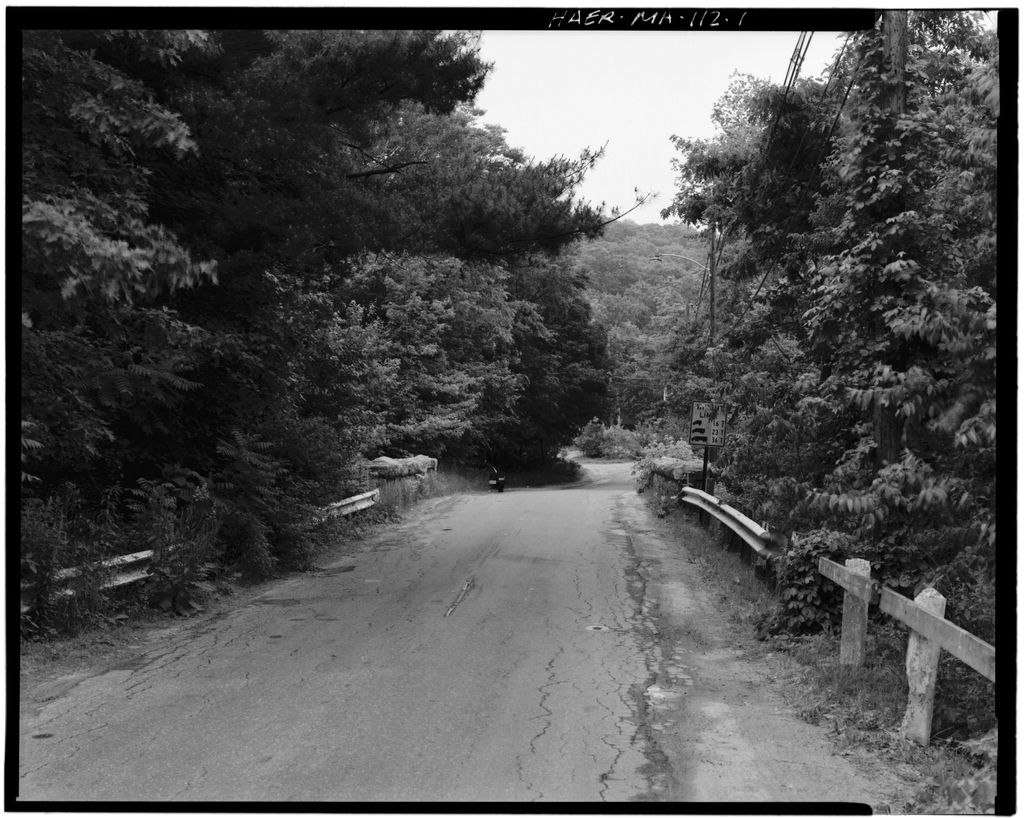
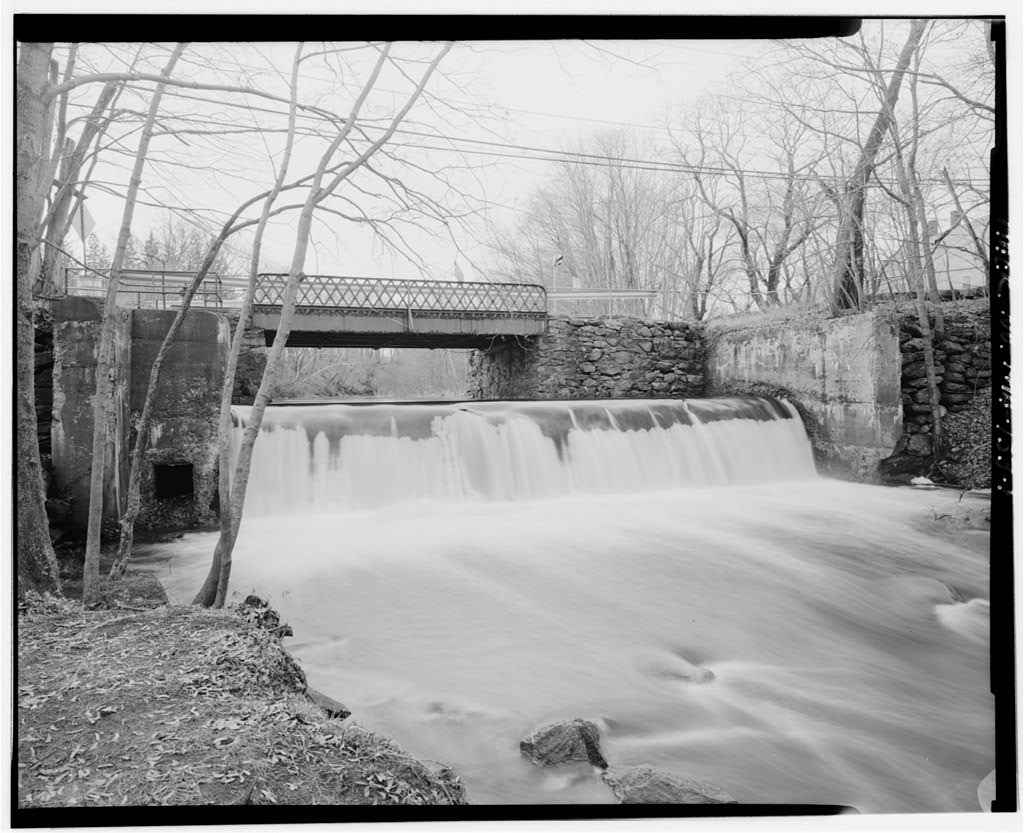
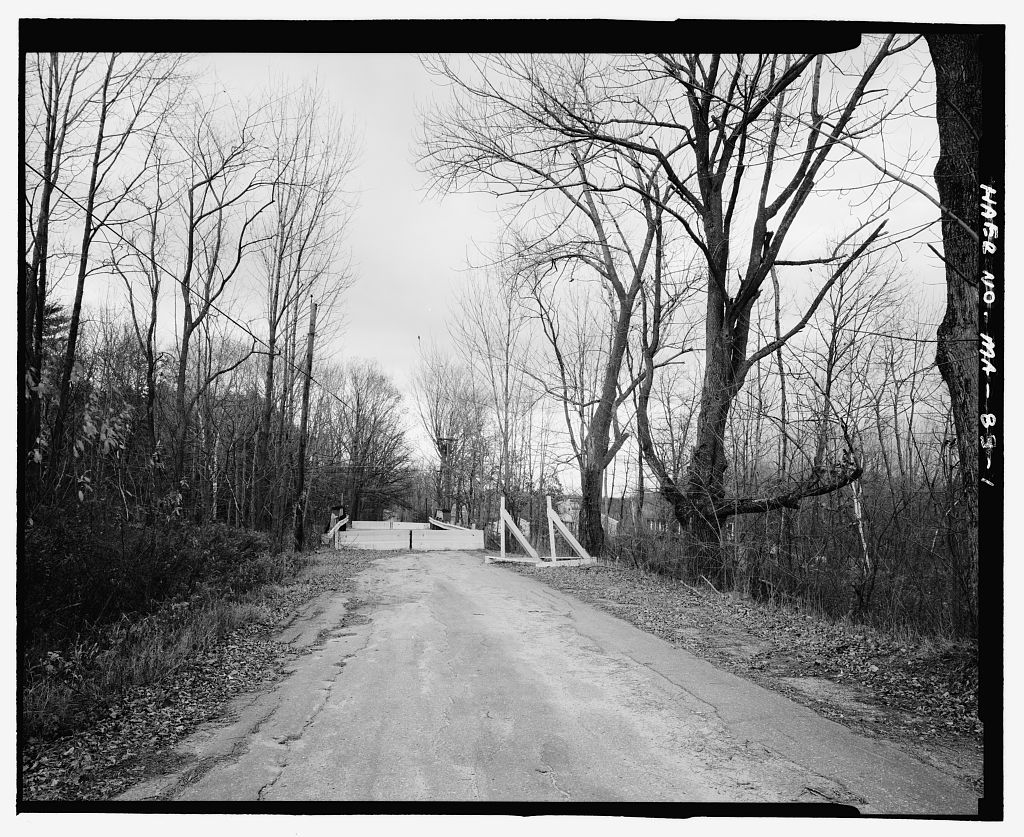
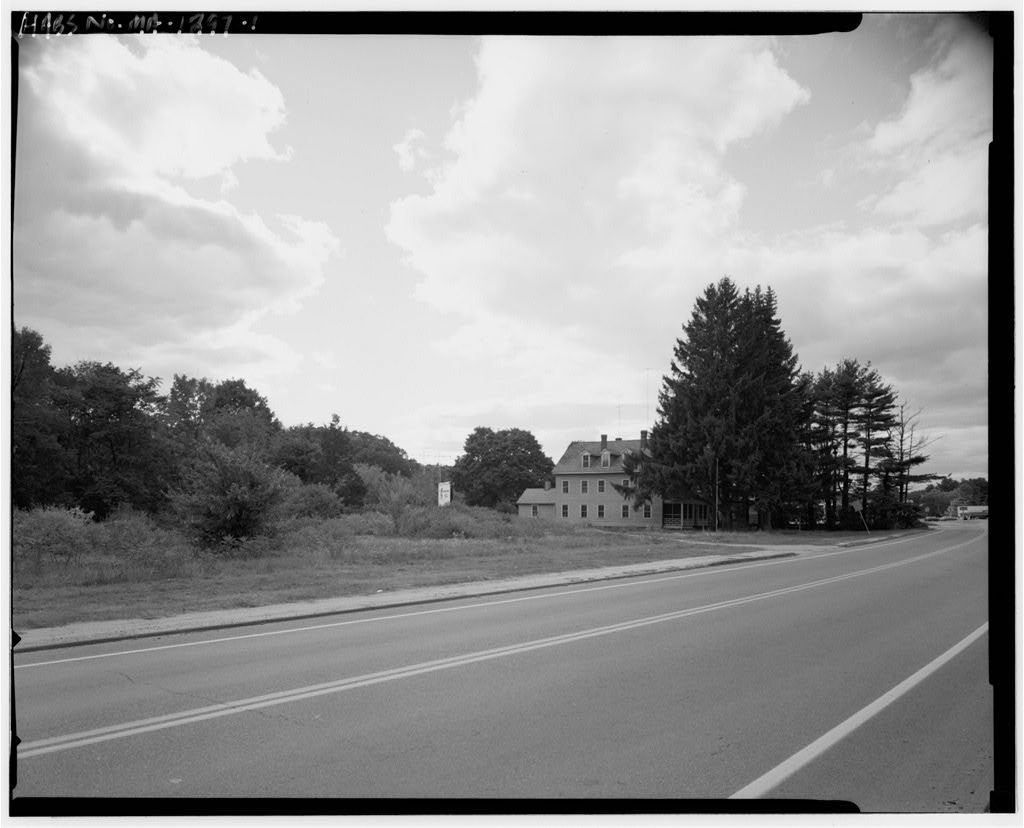
Documentation of Bartlett's Bridge is part of the Massachusetts Historic Bridge Recording Project, conducted during the summer of under the co-sponsorship of HABS/HAER and the Massachusetts Department of Public Works, in cooperation with the Massachusetts Historical Commission. Lola Bennett, HAER Historian, August BARTLETT'S BRIDGE # HAER No. MA-112 (page 2) Description Bartlett's Bridge is a semi-elliptical masonry deck arch, with a parapet wall rising above either side of the asphalt-paved roadway. The bridge is long and wide, with a single arch spanning 3O'-0", and rising above the river. The relatively large blocks of non-coursed granite are drilled-and-split rubble, with the exception of the face-ring voussoirs, whose exposed vertical faces are squared and dressed.
The keystone is emphasized by being slightly larger than the other face-ring stones. Arch sheeting is long slabs of heavily-mortared rubble. The spandrel walls of heavily-mortared random rubble continue upward from the apex of the arch about 7', to form parapet walls, capped with slightly-projecting, rusticated coping stones averaging 11" thick, 44' long, and 2' wide. The dry-laid granite rubble wing walls begin below the level of the coping stones and angle away from the bridge, at about 30 degrees (with the exception of the wing wall at the northeast corner, which projects at about 45 degrees), into the hillside.
Each of these wing walls is about 14' long, and is stepped at the top.(See Figure 1.) History of Oxford Lying approximately ten miles south of the metropolis of Worcester, the rural town of Oxford is probably best known today as the birthplace of Clara Barton, founder of the Red Cross.1 During the nineteenth century, however, the area's primarily agricultural past was superceded by industrial interests, and Oxford became quite an important center for the manufacture of shoes and textiles. Manufacturing at Oxford reached its zenith in the last quarter of the nineteenth century.
Statistics show that the town's population increased rather dramatically between and from to In 790 persons, nearly 27 percent of the total population, were employed in manufacturing.^ To a large degree, the success of these industries was based on two factors: water power provided by the French (Maanexit) River, and the proximity of the railroads to the factories and mills. For many years, while the mills at North Oxford had ready access to water power (supplied by dams across the river), they had limited access to the railroad lines that ran through town.
The Western Railroad just barely intersected Oxford's borders at the northernmost corner, and the tracks of the Norwich & Worcester Railroad ran through Oxford center, but missed North Oxford entirely.(See Figure 2.) It was not until the late nineteenth century, that North Oxford was to have a railroad station. According to maps and railroad timetables, sometime between and the tracks of the Providence, Webster & Springfield Branch of the Boston & Albany Railroad were laid from Auburn to Webster. This railroad line ran through North Oxford, at a point just west of the North Oxford Mills, owned by Edwin Bartlett.
The North Oxford Station was established on the west side of the river, on the road to Charlton (now Clara Barton Road) shortly thereafter.3(See Figure 3.) BARTLETT'S BRIDGE HAER No. MA-112 (page 3) Edwin Bartlett Edwin Bartlett was born October 25, in Webster, Massachusetts. As a boy, he attended public school and worked under his father, Asa Bartlett, at Slater & Howard's woolen mill in Dudley. At the age of twenty-one, Edwin left the mill and went to Philadelphia, where he worked in a wool store for a year. Upon returning to Massachusetts, he accepted a job as a bookkeeper at the Russell Phelps mill in Fitchburg. He remained there five years, until when he became engaged as a accountant for the North Oxford firm of Chamberlain & Burrough.
In Chamberlain having previously sold to Burrough, Mr. Bartlett bought a half-interest in the business, and it became known at Burrough & Bartlett. Until that time, the company's operations had been limited to wool manufacture, but that year they added two cotton mills, one of which was the "Rockdale Mill" at North Oxford. In Oscar F. Chase became a partner, and the firm became known as O.F. Chase & Company.
Four years later, Burrough sold out to Chase and Bartlett, who continued together until when the firm dissolved and a division of the estate was made, Chase taking the woolen mills, and Bartlett the North Oxford mills.* The Edwin Bartlett Company, incorporated in which was mainly concerned with the production of cotton twine and yarn, was still in operation in under the direction of Bartlett's son.5 Edwin Bartlett was one of the leading citizens in the Oxford community, and he held a number of public offices. He was chairman of the board of selectmen, a member of the school committee, moderator at town meetings, and a member of the Society for Village Improvements.
It was said of him: "He is public-spirited and favors advanced methods in municipal affairs; and the appearance of thrift, which his mills and village present, gives evidence of his disposition, ...Personally he is free and social, with a gentlemanly address and a genial temperament, and is much esteemed as a friend and citizen.
"6(See Figure 4.) Bartlett's Bridge In the Town of Oxford voted on a petition from Edwin Bartlett, asking for a new section of road from Leicester Road (now Route 12) to the bridge just beyond his mill, and "an iron bridge over French river on the road between Edwin Bartlett's mill and the North Oxford Mills station."7 Historic maps indicate that there had been a bridge at this location as early as the but if the same bridge was still in existence, it would have been close to 60 years old, and was probably in need of replacement. As a mill owner, Mr. Bartlett no doubt realized that a safe and stable crossing over the French River between his mill and the railroad station was critical to his success.
On April 1, at the annual town meeting, "The town voted to accept the road at North Oxford laid out by the road commissioners; also to build a stone arch bridge over the river near the depot there."9 The annual report of the town indicates that a stone arch bridge was built at North Oxford that year, at a total cost of The engineer was Charles A. Allen, from Worcester, and the masons were Peter and Michael Kenney, also from Worcester. 10 BARTLETT'S BRIDGE HAER No. MA-112 (page 4) It is interesting to note that the town chose to build a masonry bridge instead of the iron bridge requested by Mr. Bartlett, and there are a couple of theories as to why this was done, although there is no documentation to prove or disprove either.
Apparently, Oxford had a long history of building stone arch bridges, a number of them being built by members of the Woodbury family in the mid- to late-nineteenth century.11 Secondly, the construction of stone arch bridges was a fairly common phenomenon in rural New England in the nineteenth century, particularly in areas where stone was readily accessible. Stone for the bridge and dam at the North Oxford Mills was obtained at a small quarry adjacent to the mill pond. The accessibility of this stone could have been one of the primary considerations in the town's decision to build a masonry bridge, rather than an iron one. The third consideration the town may have had was whether or not an iron bridge would hold up under heavy loads to and from the mills.
It seems that there was somewhat of a revival of stone arch bridges in the and in reaction to a number of iron bridge failures, particularly on railroad lines. Whether or not this had any bearing on the town's decision to build a stone bridge will probably never be known, but it is one theory.12 In any case, by July work was underway, and the local newspaper reported, The new bridge at North Oxford has been commenced, and the foundation stones are being laid. The contractors are fortunate to be able to quarry the stone within reach of the derrick.
The builders are Kinney (sic) Bros, of Worcester, and the price On September 18, the newspaper stated that the bridge was in the process of completion, "the arch is finished and the filling and ballasting and the grading of the approaches to the bridge at either end, remain to be done."1* The Kenney Brothers The only information that could be found on the contractors, had to be gleaned from Worcester city directories. Peter and Michael Kenney, brothers, were both stone masons from Worcester. Their father, Hugh Kenney, was also a stone mason. Beginning in both Hugh and Peter Kenney were listed In city directories, as stone masons, living at 12 Lodi Street. Michael Kenney was listed as being a laborer until after which time he was listed as a mason.
Hugh Kenney died in November of but his sons continued in the family tradition, and were both listed as masons until Peter died July 27, at the age of 69, and Michael died two years later, on October 3, Worcester business directories sporadically carried separate advertisements for the brothers in the and Peter Kenney advertised, "Special Attention Given To Bridge Work," while Michael's advertisements emphasized "Heavy Trucking, Excavating, Grading and Stone Work."(See Figure 5.) Peter Kenney is known to have built at least one other surviving stone arch bridge in Grafton, Massachusetts.16 BARTLETT'S BRIDGE HAER No. MA-112 (page 5) Charles A. Allen Charles Albert Allen, the son of Eliza and Albert Allen, was born in Worcester, Massachusetts, January 27, His father was a music teacher.
Charles received his early education in the public schools, and went on to study at Worcester Academy. He graduated in and chose civil engineering as his profession. Among his first projects, was surveying the route of the Massachusetts Central Railroad in The following year he was employed by the Worcester & Nashua Railroad, and in was promoted to the position of chief engineer, a position that he held for three years. During that time he supervised the construction of the viaduct in Worcester.17 He then went into partnership with Fred A. Chase, under the firm name of Allen & Chase.
Within the next three years the firm carried out a number of important engineering projects, among them: "Section A" of the Boston Water Works, the Southbridge Street Bridge in Worcester, and the masonry work on the Worcester Lunatic Hospital.18 In November of Charles Allen was elected city engineer of Worcester. In this capacity he supervised the construction of a large part of the city's sewer system, the construction of a new dam for the storage of water, and a sewerage purification system near the Blackstone River. During that time Charles Allen also contracted for private surveying and engineering projects, including the construction of the new stone arch bridge at North Oxford.
In "finding the pressure of private business increasing," Allen resigned the office of city engineer, and went on to engage in "extensive engineering enterprises in various parts of New England."'9 From until city directories listed C.A. Allen as a Consulting Engineer. On December 9, Charles Allen died in Worcester, at the age of 60.(See Figure 6.) BARTLETT'S BRIDGE HAER No. MA-112 (page 6) o u CQ W LU JJ U 7- 0) r-t U S-i (0 CQ & Ul t CM O C o UJ a: 1 i-t 4-) > (O a) r-i 3 0) I b0 Oxford
Busings Notlrns. HAER No. MA-112 MmtntBcliBrvn. (page 7) Buwieh 4 1.. l,imf r rerioa >*d Wwlta I....... < irlhllih.nl Bultum M li *. . ManiilYmr Wmlrpii. IliiSuntillt C-IIIMII *< o .M-.ni.fn.ofh..-. UUw-i Iwrl J .HiimlfMl inilnn T m~ .--I lV r . 'l-u M"n'i'r .-[ nwiiH'K U-'ITT K. M,n.irr. -Villa. I(.w.l." iiifrn! I'J'Olt'G.K-N, Mltti-Ii.AV<5 Ms; Wilimnh r, imi'rnl llnlhi. hoi 111 111'"til nivrllniiraul. AntrU C. Muliiil. oii.w-1 AiiBiL.irc UT unl-T *nd Armnff 1 Buffflll'T Billhim i' in l>r . umrwi.t. (.iwirry. IL.ii.. xe. -I A l:"-ir .".I IL.rlon .la 1IM<<IIIII K II .M--n-h.ni. Niinh Dilunl Uis'lihlf,- -I .]! I'-in iiuiill'- ln^,li,.m l(. M. M l-in 'I 1...i.l.i ).inn -i-.k M.ifli.mnllii M-illt Tl .\ fh- .1 I HIT .i -hor "i l> f Oln-l w.. Hi- l\ ' I >m>ii.l'iiM< n Hi-.
M.inn f..*i.i la-ahr in l v . .! . IL.K. >=>in . - Ilnn-rii-.. Floi.i noil I,tain I i.- 1U r>l *f. 'PI.Y.. I^.T-4. A^TiriiLlurnl 'luol-. I i.-Flii.*.-im. hmllon rL 4" > < 4 iXorrni OA.OI.IK ^ .TOWN or oxroRo. V^ '. - .J- .W-*A&A.<VA./.^^ AA^-i1 Figure 2. Map of Oxford, Massachusetts, Beers, ISORTH OXFORD. BARTLETT'S BRIDGE TOWN OF "OXFORD.. HAER No. MA-112 (page 8) Location of bridge- Figure 2a. Closeup of North Oxford Map, Beers, Arrow shows location of Bartlett's Bridge. BARTLETT'S BRIDGE HAER No. MA-112 (page 9) - WEW HAMPSHIRE - ? ' ALSTON fftgO. MASSACHUSETTS" OUDll V^ ^ ! C /SOUTHBRIDCtN^-v^^^^ x Uujou WoudstocY 'tufcui\i ou \^_ CO NNECTfCWT RHODE Figure 3. Map of Worcester County, Massachusetts, Hurd, Arrow shows location of North Oxford Station. BARTLETT'S BRIDGE HAER No.
MA-112 (page 10) ( < Figure k. Portrait of Edwin Bartlett (Source: Hurd, BARTLETT'S BRIDGE HAER No. MA-112 Cpage U) PETER ZKEILTIsriE'X", STONE MASON & CONTRACTOR. EwlltnaieH Furnished on all la scs of MASONRY. Special Attention given to Bridge Work. ho. 13 Lodl Street, Worcester, Mass. MICHAEL KENNEY, 'iiu taking, Excavating Grading and Slone foil No.'315 Cambridge Worcester, Mass. All Work Done al Reasonable Rates, PETER F. KENNEY, STONE MASON & CONTRACTOR. Estimates Furnished on all Classes of Masonry. Special Attention Glvcu to Bridge Work. AI *o, nil kinds o( EXCAVATING. LOAM, SAND, or FILLING,Furnished, No. 13 Clifton Street, Worcester, Mass. MICHAEL KENNEY, Fat] Trucking, Era'aliiij Miig anil .SLuuc Wor No. 315 Cambridge Worcester, Mass. All Work Doiie at Reasonable Hates. Figure 5.
Advertisements for Peter and Michael Kenney, from Worcester directories. BARTLETT'S BRIDGE HAER No. MA-112 (page 12) Figure 6. Portrait of Charles Allen. (Source: Rice, BARTLETT'S BRIDGE HAER No. MA-112 (page 13) ENDNOTES 1. The Clara Barton birthplace is located about a mile up the road west of the bridge. Clara Barton's nephew, Samuel R. Barton, was a town selectman and road commissioner in the year that Bartlett's Bridge was built. 2. A.B. Marvin, and others, "Town of Oxford," History of Worcester County. Massachusetts. vol. 2. (Boston: Jewett and Co., 3. New Topographical Atlas of the County of Worcester. Massachusetts (Philadelphia: Richard and Co., plate 7. 4. D. Hamilton Hurd, "Edwin Bartlett," biographical sketch, in History of Worcester County. Massachusetts, vol.
2 (Philadelphia: Lewis and Co., 5. Orra L. Stone, History of Massachusetts Industries: Their Inception. Growth and Success, vol. 2 (Boston/Chicago: Clarke Publishing Co., 6. Hurd, 7. Annual Reports of the Town of Oxford. 8. Sylvester Mclntire, "Map of Oxford, 9. The Mid-Weeklv. Oxford, Massachusetts, April 3, 10. Annual Reports. 11. George F. Daniels, History of the Town of Oxford. Massachusetts (Oxford, Massachusetts: published by author, 12. Discussion with Steve Roper, Massachusetts Department of Public Works Historic Bridge Specialist, July 16, 13. The Mid-Weeklv. July 17, 14. Ibid., September 18, 15. Worcester City Directories. Worcester, Massachusetts, 16. "Bridge No. Massachusetts Department of Public Works Bridge Section files, Boston, Mass. 17. Franklin P.
Rice, The Worcester of Eighteen Hundred and Ninety-Eight (Worcester: Blanchard and Co., 18. Ibid. 19. Ibid. BARTLETT'S BRIDGE HAER No. MA-112 (page 14)
Annual Reports of the Town of Oxford. Beers, Map of Oxford, in Atlas of Worcester County. Massachusetts. New York: Beers and Co., "Bridge No. Massachusetts Department of Public Works Bridge Files, Boston. Crane, Ellery BIcknell, editor. "Charles Albert Allen," biographical sketch, in History of Worcester County. Massachusetts, vol. 1. New York/ Chicago: Lewis Historical Publishing Co., Daniels, George F. History of the Town of Oxford. Massachusetts. Oxford, Massachusetts: published by author, Foss, A.E. and Co., compilers. Directory of Oxford and Auburn. Massachusetts. Hopkinton, Massachusetts, Kurd, D. Hamilton. "Edwin Bartlett," biographical sketch in History of Worcester County, Massachusetts, vol 2. Philadelphia: Lewis and Co., Hurd, D. Hamilton. "Oxford," History of Worcester County.
Massachusetts, vol.2. Philadelphia: Lewis and Co., pp. Marvin, A.B. , et. al. "Town of Oxford," History of Worcester County. Massachusetts, vol 2. Boston: Jewett and Co., The Mid-Weekly: A Journal of Miscellaneous Reading and of Local and General News. Oxford, Massachusetts, Nason, Elias. A Gazetteer of the State of Massachusetts, revised and enlarged by George J. Varney. Boston: Russell, New Topographical Atlas of the County of Worcester. Massachusetts. Philadelphia: Richards and Co., "Peter F. Kenney," obituary, in Worcester Evening Gazette. Worcester, Massachusetts, July 29, Rice, Franklin P. "Charles Albert Allen," biographical sketch, in The Worcester of Eighteen Hundred and Ninety-Eight. Worcester: Blanchard and Co., Worcester City Directories.
 Block
Block