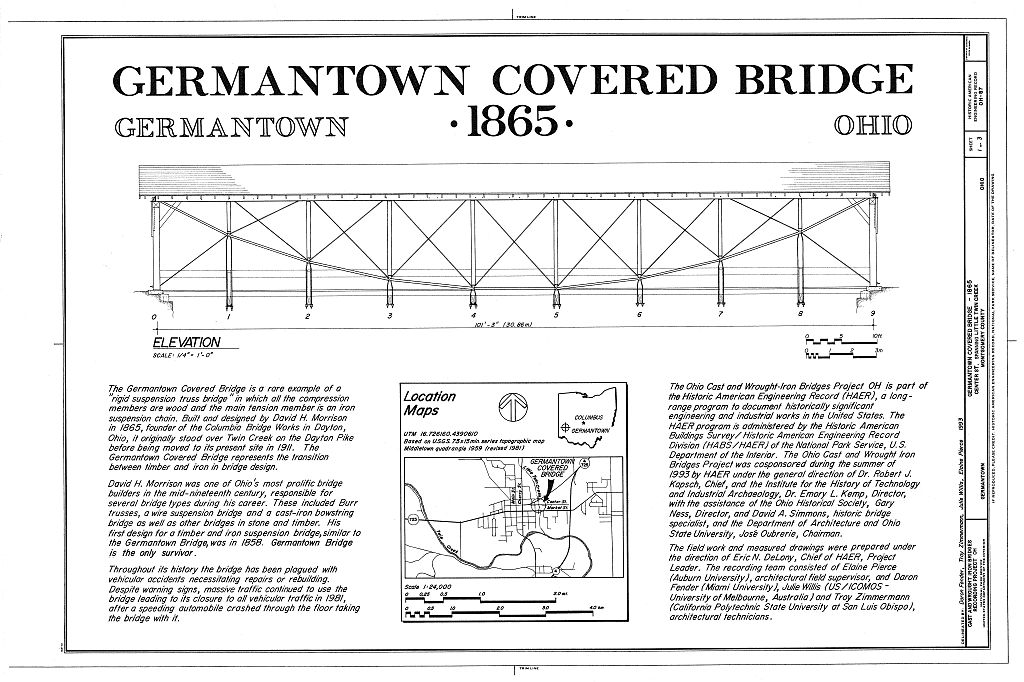
The Ohio Cast- and Wrought-Iron Bridges Project was cosponsored by HAER, Dr. Robert J. Kapsch Chief; the Instute for the History of Technology and Industrial Archaeology, Dr. Emory L. Kemp, Director; the Ohio Historical Society, Gary Ness, Director and David Simmons, Historic Bridge Specialist; and the Department of Architecture, Ohio State University, Jose Obrerie, Chairman. Wm. Michael Lawrence, Historian GERMANTOWN COVERED BRIDGE HAER No. OH-87 (Page 2) The Germantown Covered Bridge is a rare example of a "rigid suspension truss bridge" in which all compression members are of wood and the main tension member is an iron suspension chain. Built by David H.
Morrison on Dayton Pike (Ohio Route 4) over Twin Creek in it was moved to its present site at Center Street in Germantown in Due to various accidents, it has been repaired or rebuilt at least five times and was closed permanently to traffic in It was declared an exceptional landmark by the state of Ohio in an outstanding landmark in Montgomery County in and was listed on the National Register of Historic Places in David H. Morrison, the builder, was one of Ohio's preeminent engineers and bridge builders during the century, and was founder of the Columbia Bridge Works of Dayton, Ohio. The Germantown Covered Bridge has been repaired or restored several times during its existence; therefore, any analysis of the structure must be qualified.
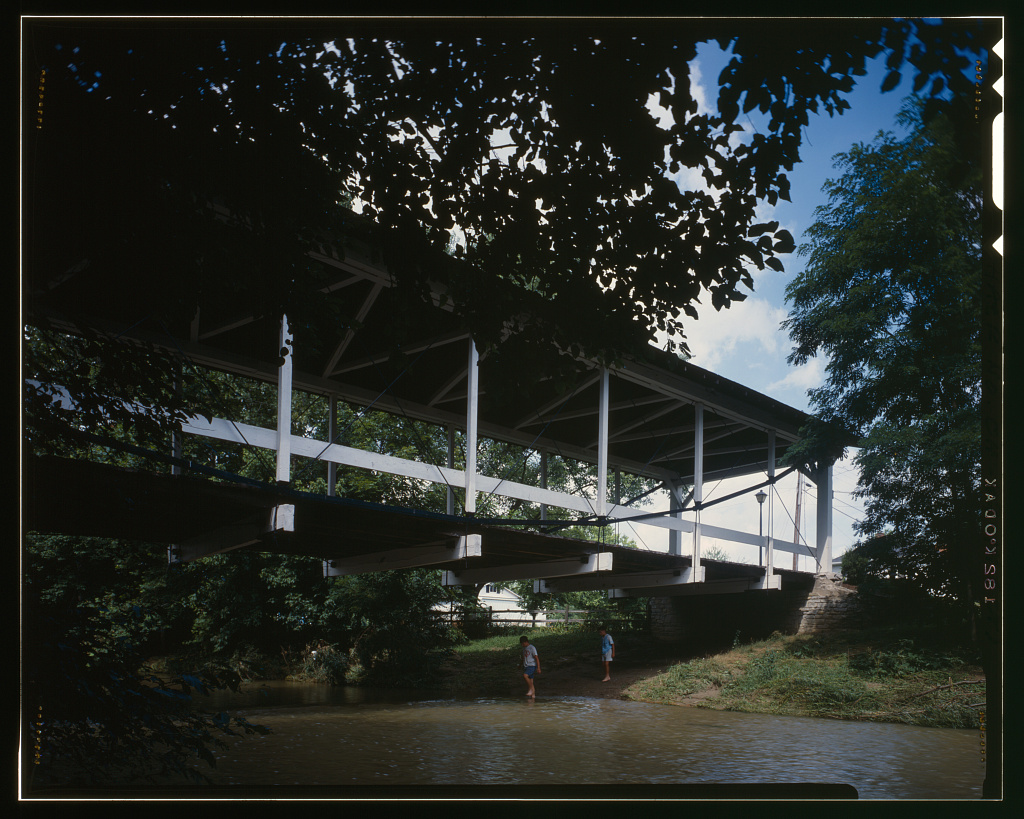
It is a through truss protected by a wood roof; unlike the typical covered bridge, however, it does not have wood siding. The rafters of the roof rest on the upper chords, and a zigzag pattern of wood beams between the upper chords provides lateral bracing. The massive chords act in compression and consist of bundled wood beams. The intermediate posts act in compression to support the chords. These posts bear on iron post shoes which are pin-connected at their bases to paired chains of wrought-iron eye-bars. Iron loops hang from these pins and deep wood cross floor beams bear upon washer plates and nuts at their lower ends. The beams support wood stringers and decking. Each chain is in the form of an inverted curve or arch with its lowest point at the deck near the middle of the bridge.
It is connected to the tops of the end posts, where it resists the tensile forces of the chain. The end posts are perhaps the most critical members in the entire bridge, and also the most vulnerable. Should a vehicle collide with one, which has happened once, the entire structure may collapse. Diagonal iron bracing rods from the upper ends of the intermediate posts to the pins in the chain provide longitudinal bracing. The date is painted on the siding over the portals. The bridge represents the mid-nineteenth century transition period from iron to wood. Iron did not replace wood immediately due to the expense of the stronger material and a certain conservatism.
In the original forms of the Howe truss, for example, all members were wood except the verticals, which acted in tension and were made of iron.1 Bids for bridges after the Civil War, especially for smaller spans, typically included proposals for wood trusses as well as iron, usually at a much lower cost. In the state of Ohio during the last two decades of GERMANTOWN COVERED BRIDGE HAER No. OH-87 (Page 3) the century, a reaction against the growth of large bridge building companies led to an attempt to return to wood construction, if only for small country bridges.2 David H.
Morrison, one of Ohio's most prolific bridge builders during the middle of the century, developed several types of bridges during his career, including what he called the "rigid suspension truss." He used wood, stone and iron in his work of the to erect "Rafter Bridges," composite structures of iron and wood with standard Burr trusses. His first patent, issued in was for a cast iron connection to prevent "the deleterious effects" of wood shrinkage. Morrison built a number of rigid suspension bridges of wood and iron similar to the Germantown bridge. While his first design appeared in the Germantown bridge was likely the first actually built.
Among his works, the most notable example of a rigid suspension bridge constructed completely of iron was the four-span Main Street bridge in Dayton over the Great Miami River.3 Morrison was not the only engineer to work with this design. Iron eye-bar chains supplement the wood arch in the John Bright covered bridge built near Baltimore, Ohio and now located at the Ohio University Branch Campus at Lancaster.4 The John Bright5 bridge No. l is an example of an all iron suspension truss. Archibald McGuffie, of Rochester, New York, experimented with "that class of bridges in which the suspension and arch bridges are combined."6 The bridge's construction history of the bridge is partially documented by the Journal of the Montgomery County Commissioners.
According to the Journal, on Tuesday, June 6, (t)he Commissioners then commenced to examine bids for Bridges over Wolf Creek and Little Twin Creek at Germantown. Upon examination of bids presented, Mr. D. H. Morrison was awarded bridge at Germantown, Superstructure and Mason Work, the said Bridge to be an Iron Suspension bridge with roof.7 Three months later, the Journal reported that Mr. D. H. Morrison by request of the Commissioners appeared before them with regard to Germantown Bridge. Said Morrison is to place one inch Castings under each post of Said Bridge. Said Castings are to Cost from twelve to fourteen dollars. Said Cost is to be added to Contract.8 GERMANTOWN COVERED BRIDGE HAER Mo.
OH-87 (Page 4) The Commissioners apparently decided to change the thickness of the post shoes; it is hard to believe that Morrison had intended to build the bridge without them. The Journal does not record any payments to Morrison for his work. The subsequent history of the bridge has been marked by recurring accidents necessitating repairs or rebuilding. In a steam- driven iron horse fell through the floor. The village of Germantown moved the bridge to the less-travelled Center street in A truck driver tried to cross the bridge in despite "no truck" signs, and his vehicle fell through the floor; the following year, during a flood, a tree smashed into the bridge and it buckled. In the people of Germantown started a campaign to restore the bridge.
The restoration proceeded, even though the county closed the bridge, and it was reopened in In another truck driver ignored warning signs and broke one of the main support beams while crossing; again citizens rebuilt the bridge. Finally, in a speeding automobile raced up the approach, flew into the air momentarily, and crashed through the floor, taking the bridge with it. Once again, the bridge was rebuilt, with private donations and volunteer labor, and, to prevent any more incidents, it was closed to all vehicular traffic. It was declared an exceptional landmark by the state of Ohio in an outstanding landmark in Montgomery County in and was listed on the National Register of Historic Places in Tradition is a powerful force. During the last restoration, David A.
Simmons, of the Ohio Historical Society, informed these local preservationists that research had proven the date above the portals to be wrong. Because they were taking great pains to rebuild the structure "exactly" as it had been, they did not correct the date when they repainted the bridge. David Humphreville Morrison10 The career of David Humphreville Morrison spanned roughly four decades from until his death. He was the son of Thomas Morrison a contractor who instilled in his son a strong sense of integrity and public-spiritedness, and who provided a practical basis for his career. David was also influenced by one of his teachers, Eliam E.
Barney, who encouraged him to enter the field of civil engineering, and by Barney's brother Elijah, an engineer who worked on the Erie Canal and the Ohio Canal system. Morrison's early training as an engineer was typical of his time, that of the apprenticeship. He worked as a rodman under Elijah GERMANTOWN COVERED BRIDGE HAER No. OH-87 (Page 5) Barney on the Miami Canal system in Ohio beginning in was promoted to surveyor the following year, and by was an assistant engineer. After eight years he resigned and returned to Dayton, Ohio, where his subsequent career consisted of consulting work for the non-engineering community, working as a contractor and/or inventor, and activities as a businessman and manager.
He was appointed city engineer for Dayton in superintending contractors, surveying for streets and sidewalks, supervising internal improvements for and by the railroads, and designing bridges. He left the city and became a regular consultant for the Montgomery County Commission in providing designs for bridge contracts well into the He was often called upon to resolve disputes arising during construction projects. During his career Morrison produced many bridge designs in stone, wood, and iron. His first, Morrison's Truss Bridge" of were based at least partially on observation and experimentation. His first exposure to a scientific approach to bridge design was Herman Haupt's General Theory of Bridge Construction.
The list of his various bridge designs is lengthy: an elliptical stone arch on a skew or oblique on Jefferson Street in Dayton his "rafter bridges;" Burr trusses; "rigid suspension trusses," such as the Germantown bridge or the iron Main Street bridge in Dayton; a wire suspension bridge ; a short-span low truss cast- and wrought-iron bridge design that he built up and down the Miami and Erie Canal during the and a cast-iron bowstring bridge His most significant designs 12 were "Morrison's Patent Wrought Iron Arch Truss Bridge" and "Morrison's Patent Wrought Iron Truss Bridge."13 He built numerous examples of these bridges throughout Ohio and the Midwest, and an extensive collection of drawings for such bridges still survives.14 His most notable achievement as a manager and businessman, besides supervising the work of others, was the founding of his own firm in with his brother-in law.
His son, Charles Carroll, joined the firm two years later and became a partner in The firm was named D. H. and C. C. Morrison and was later renamed the Columbia Bridge Works. The business expanded steadily and was incorporated five months after Morrison's death on July 21, Morrison's career represents important developments in bridge building during the middle of the century, and his bridge designs were pivotal in the transition from wood to metal construction. GERMANTOWN COVERED BRIDGE HAER No. OH-87 (Page 6) ENDNOTES I.Carl A. Condit, American Building Art in the Nineteenth Century (New York: The Oxford University Press, 2.David A.
Simmons, "The Risk of Innovation: Ohio Bridge Patents in the Nineteenth Century," in The Proceedings of the First Historic Bridge Conference in Columbus, Ohio (Columbus, Ohio: Ohio State University and the Ohio Historical Society, 3.David A. Simmons, "Dayton's Premier Bridge Builder: David H. Morrison, civil Engineer," in Miami Valley History: A Journal of the Montgomery County Historical Society. Vol. 3 25. Revision of "David H. Morrison: Bridge Builder and Civil Engineer," paper presented at the 9th Annual Conference of the Society for Industrial Archaeology, Detroit, 31 May 4.See HAER No. OH-45. 5. See HAER No. OH-44. 6.Patent No. 17 December Copy in the Bridge Files, Ohio Historical Society (compiled by David A. Simmons).
7.Montgomery County, Journal of the County Commissioners of Montgomery County, Vol. 5, p. 61, 6 June Notes in the Bridge Files. 8.Ibid., p. 70, 6 September 9.Jan Hofmann, "Its1 More Than Just A Bridge," in The Magazine: 20, supplement to The Dayton Daily News (6 June 10.This is a summary of Simmons, "Dayton's Premier Bridge Builder," which is the definitive biography of David H. Morrison. 11.See HAER No. OH-86. 12.See HAER No. OH-88. 13.See HAER No. OH-92 14.Safety negatives of these drawings are available to the scholar at the Ohio Historical Society Library in Columbus, Ohio. Originals are in the Morrison Family Collection, Beaver, Pennsylvania. GERMANTOWN COVERED BRIDGE HAER No. OH-87 (Page 7)
Carl A. Condit. American Building Art in the Nineteenth Century. New York: The Oxford University Press, HAER No. OH-44, John Bright No. 1 Iron Bridge, Carroll Vicinity, Fairfield County, Ohio. HAER No. OH-45, John Bright No. 2 Iron Bridge, Carroll Vicinity, Fairfield County, Ohio. HAER No. OH-86, Blackhoof Street Bridge, New Bremen, Auglaize County, Ohio. HAER No. OH-88, Mallaham Bridge, Columbus Grove, Putnam County, Ohio. HAER No. Howard Bridge, Howard, Knox County, Ohio. Hofmann, Jan. "Its' More Than Just A Bridge," in The Magazine: 20, supplement to The Dayton Daily News. 6 June Montgomery County. Journal of the County Commissioners of Montgomery County. Vol. 5, p. 61, 6 June Ibid., p. 70, 6 September David H. Morrison. Drawings of various bridges.
Safety negatives of these drawings are curated at the Ohio Historical Society Library in Columbus, Ohio and are accessible to the scholar. Originals in the Morrison Family Collection, Beaver, Pennsylvania. Patent No. 17 December Simmons, David A. "Dayton1 Premier Bridge Builder: David H. Morrison, Civil Engineer." Miami Valley History: A Journal of the Montgomery County Historical Society. 3 18- 30. Revision of "David H. Morrison: Bridge Builder and Civil Engineer," paper presented at the 9th Annual Conference of the Society for Industrial Archaeology, Detroit, 31 May GERMANTOWN COVERED BRIDGE HAER No. OH-87 (Page 8) Simmons, David A. "Ohio Bridge From to Reflections of Society," The Old Northwestern, 12 (Spring 95- Simmons, David A.
"The Risk of Innovation: Ohio Bridge Patents in the Nineteenth Century," in The Proceedings of the First Historic Bridge Conference, in Columbus. Ohio (Columbus, Ohio: Ohio State University and the Ohio Historical Society, 1 November ADDENDUM TO HAER No. OH-87
Cast and Wrought Iron Bridges Project U/-r Center Street Spanning Little Twin Creek ' ' '* Germantown -x ' ' - ' Montgomery County /,- < - f al Ohio . ' ' "' ' XEROGRAPHIC COPIES OF COLOR TRANSPARENCIES HISTORIC AMERICAN ENGINEERING RECORD National Park Service U.S. Department of the Interior Washington,
 Block
Block