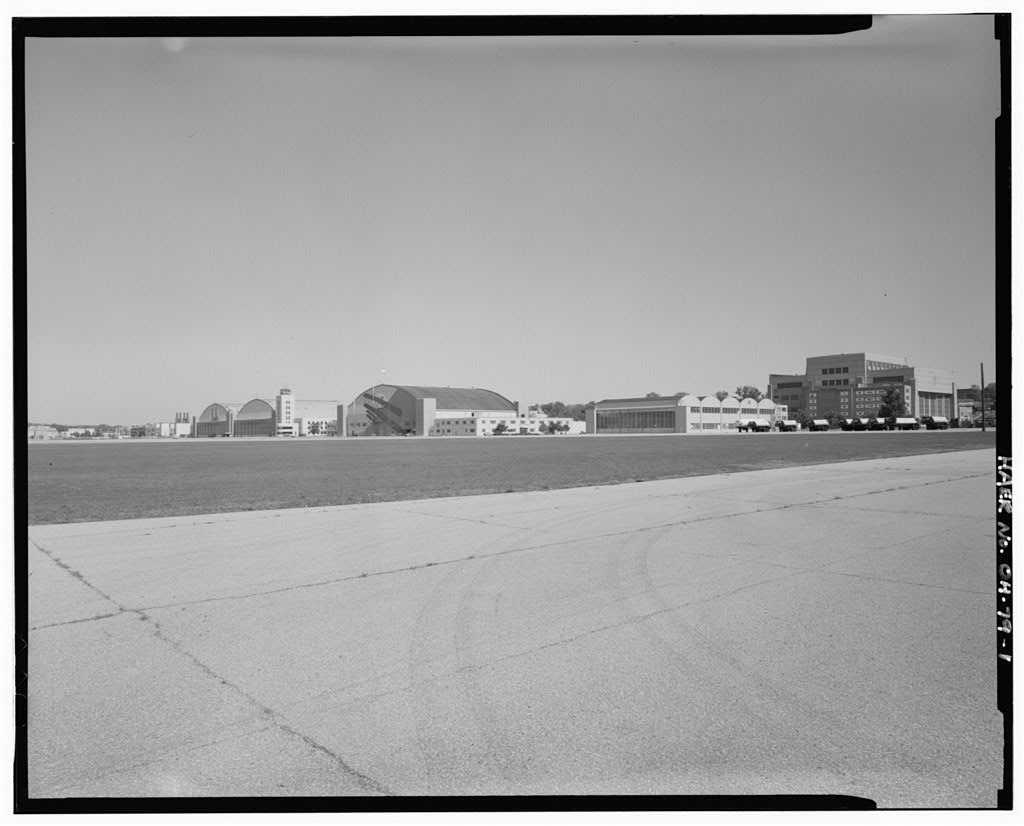
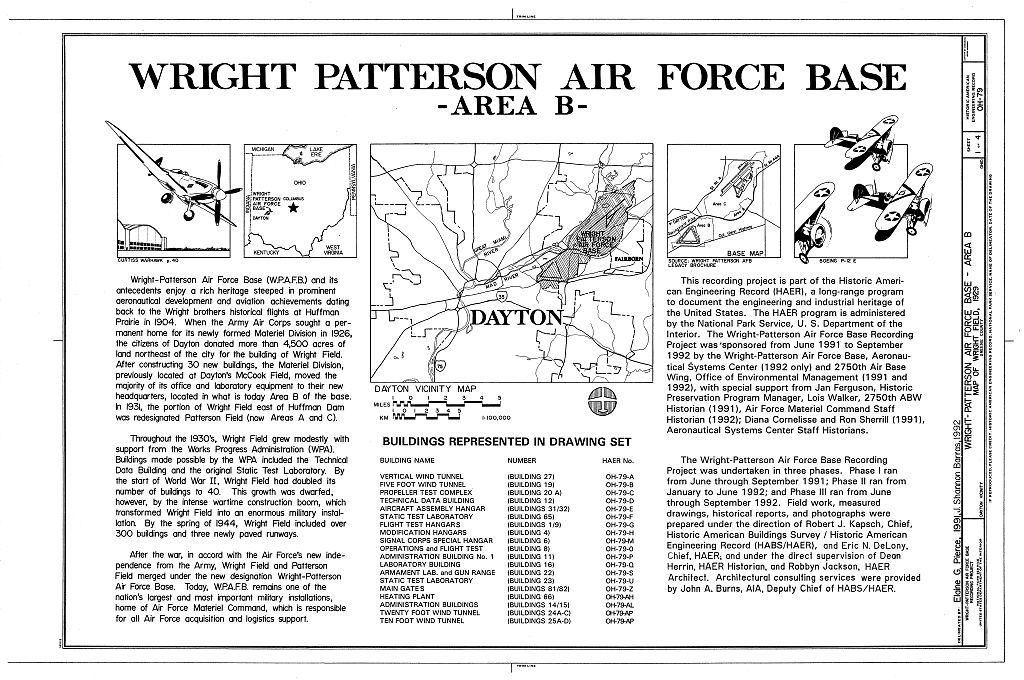
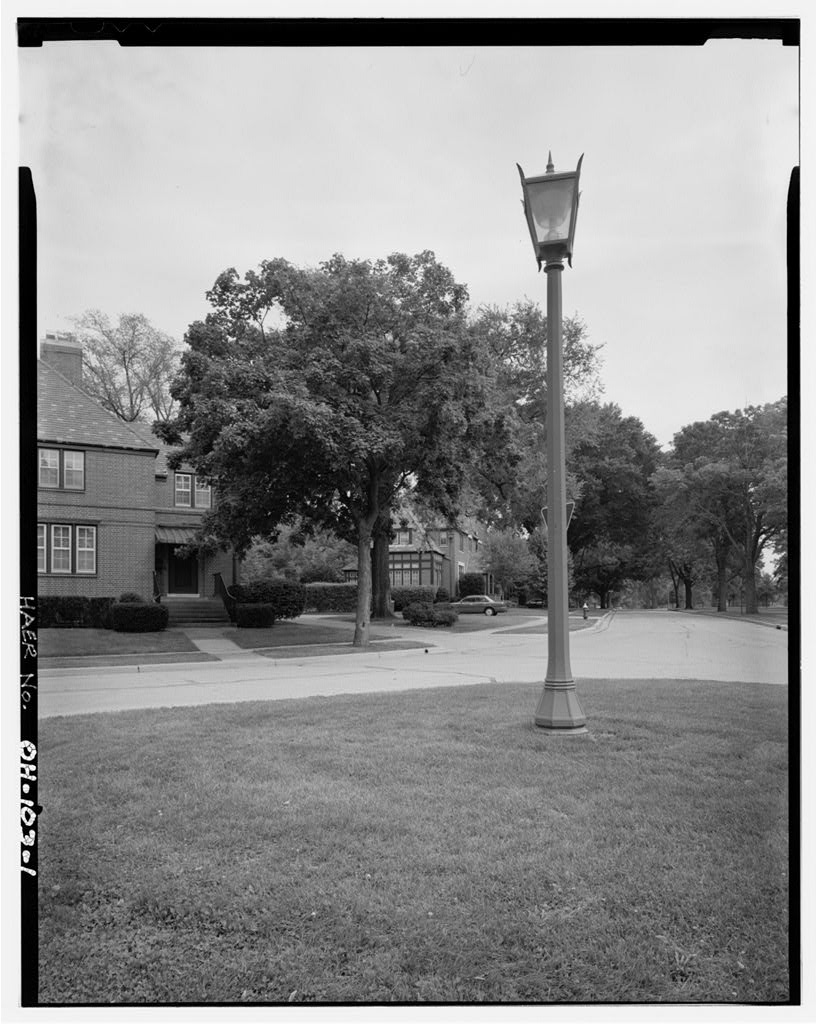
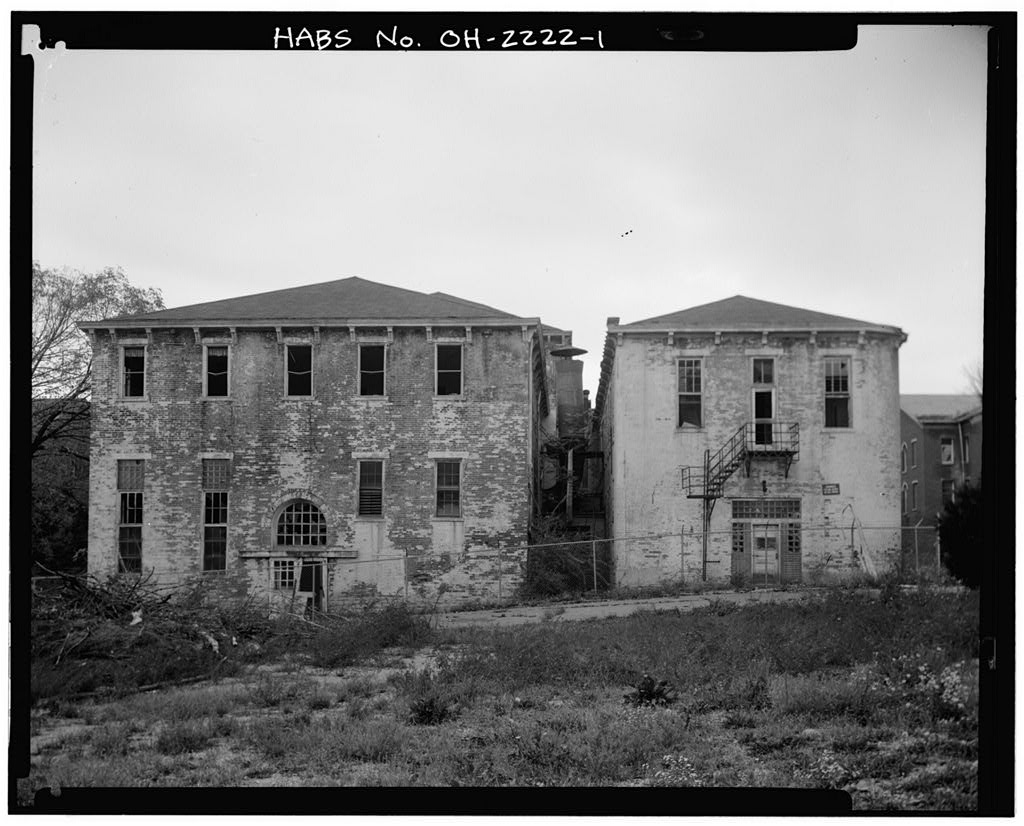
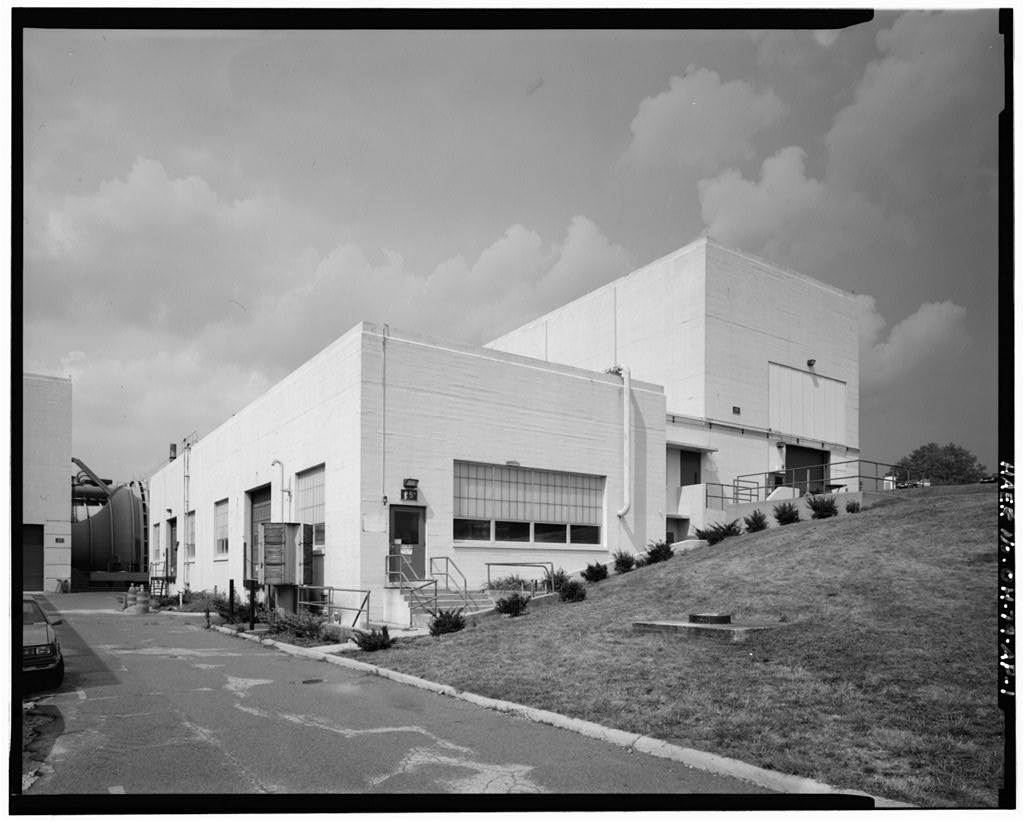
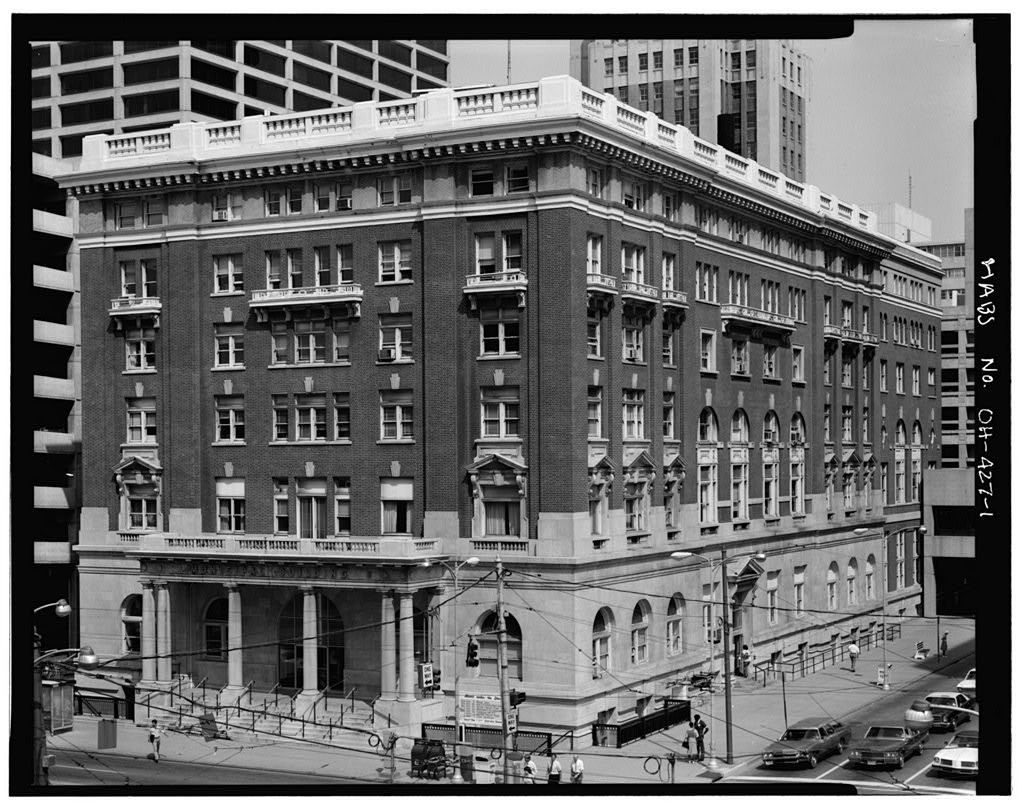
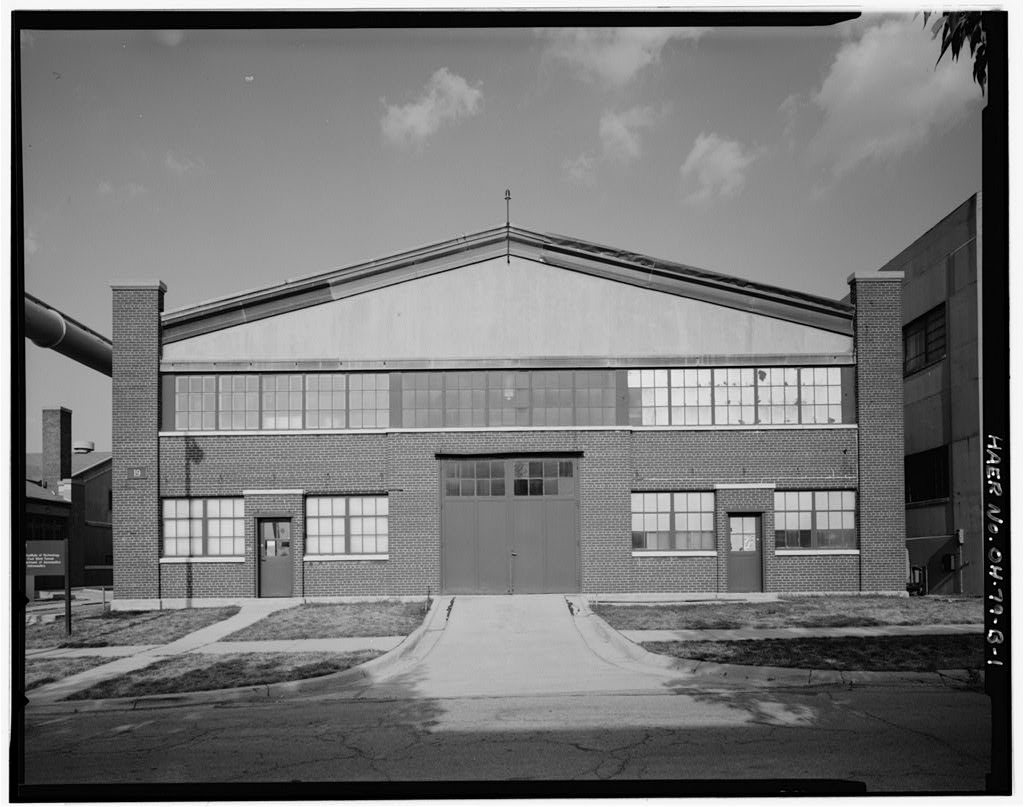
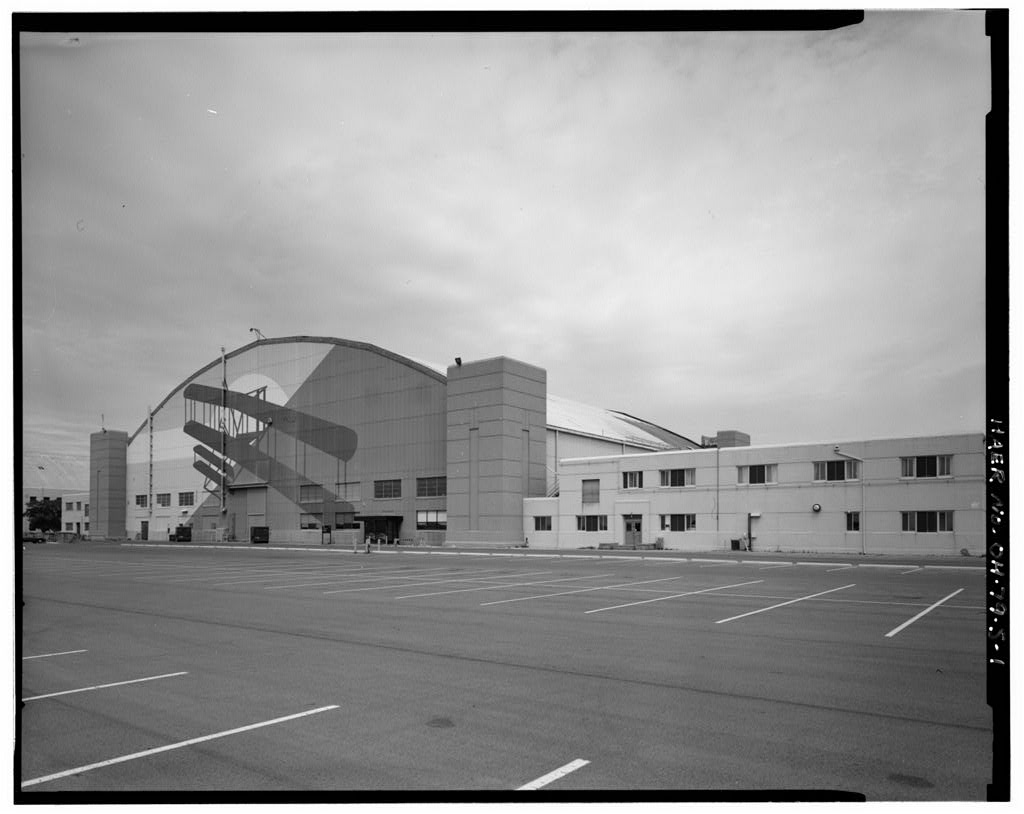
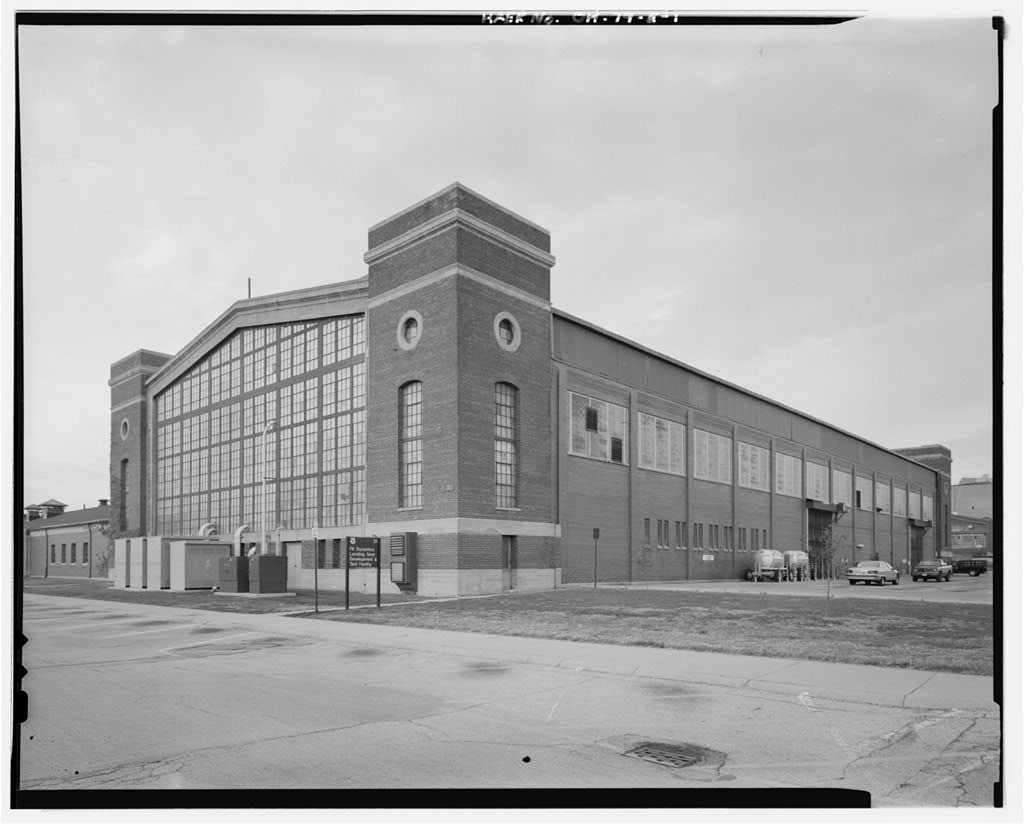
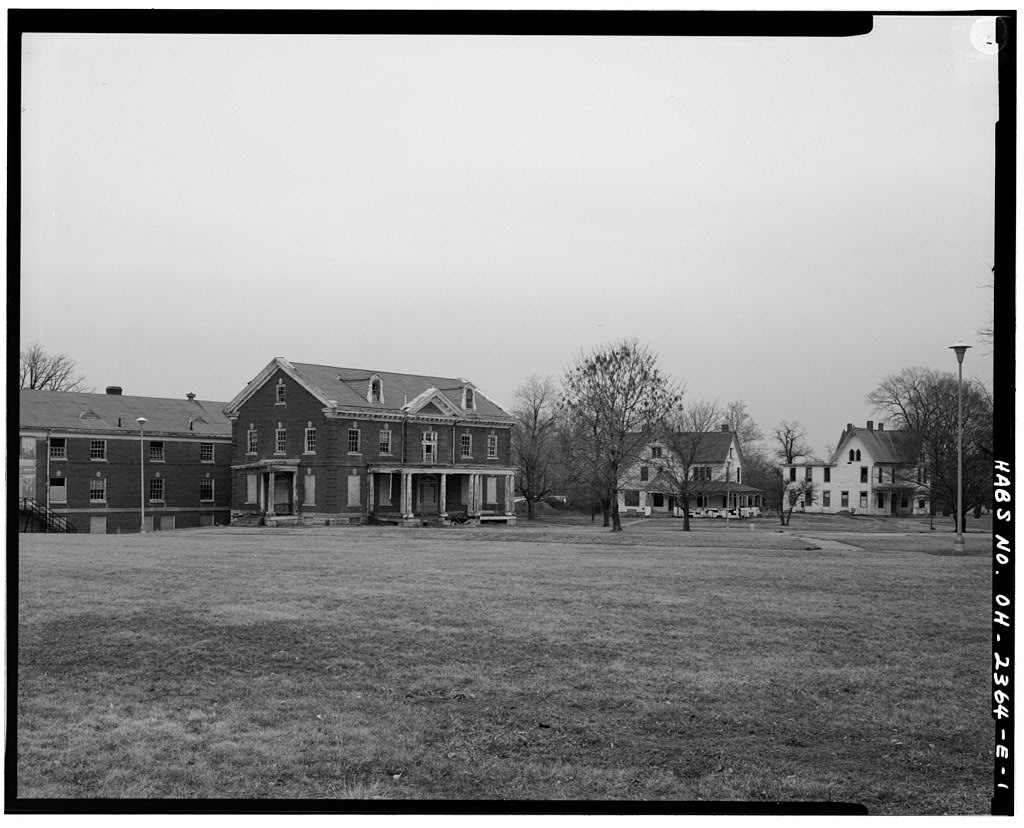
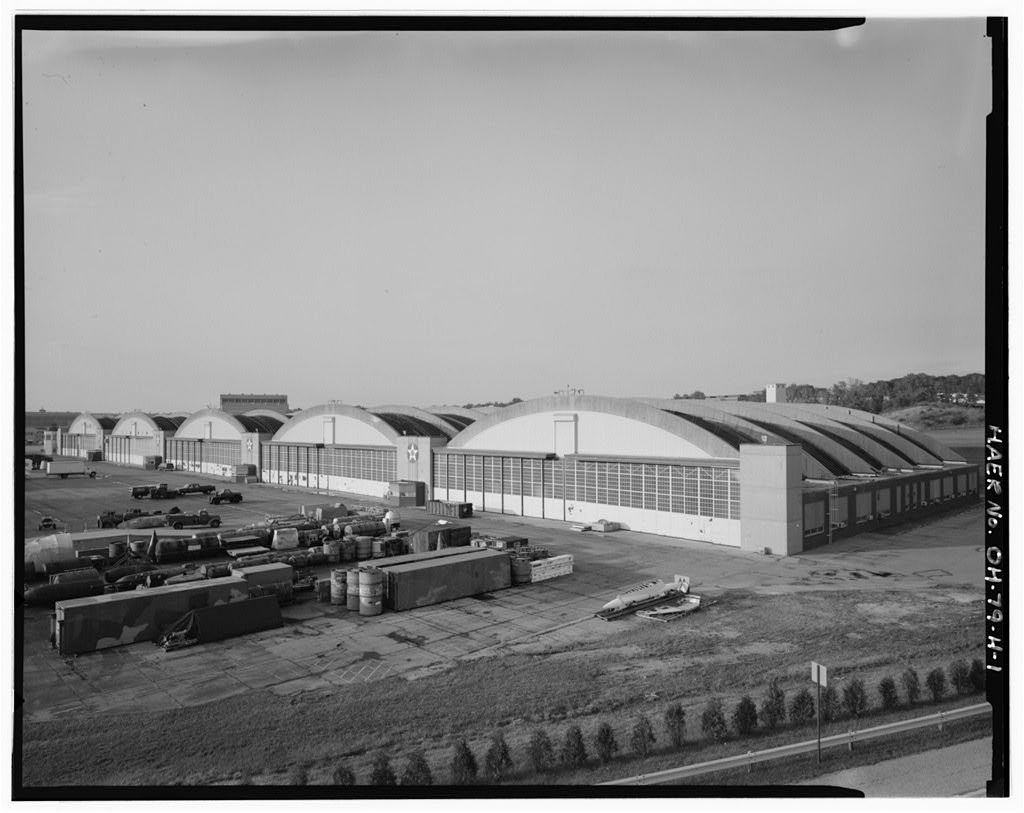
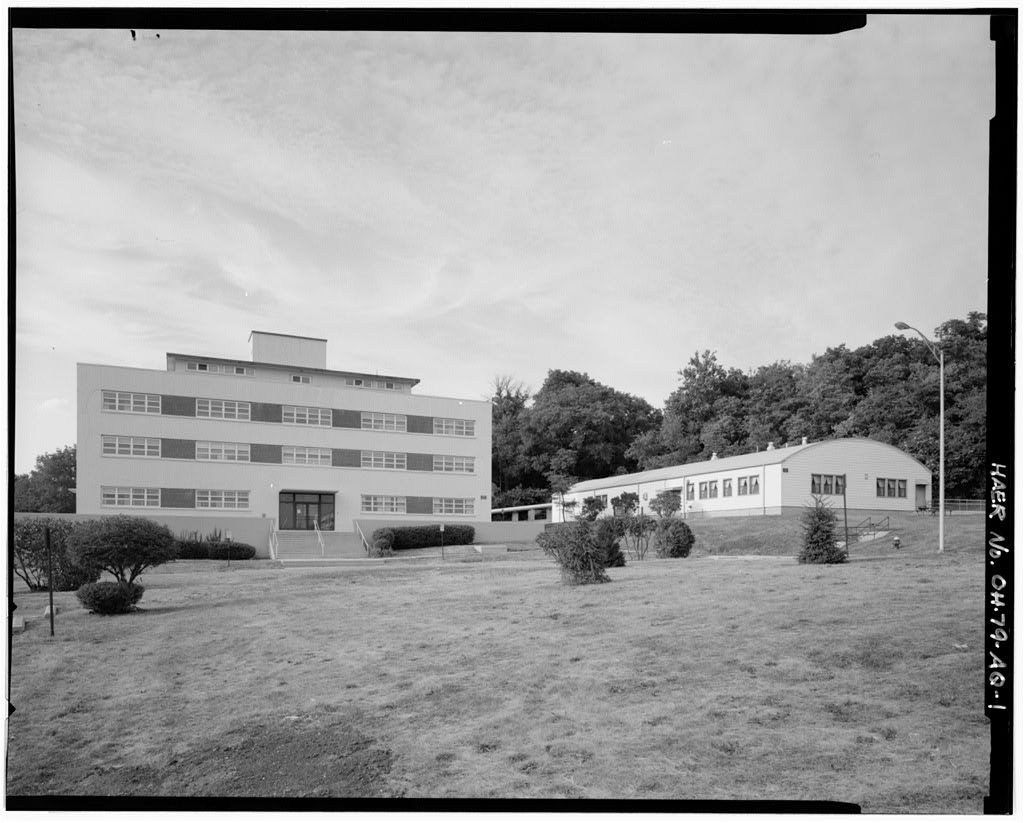
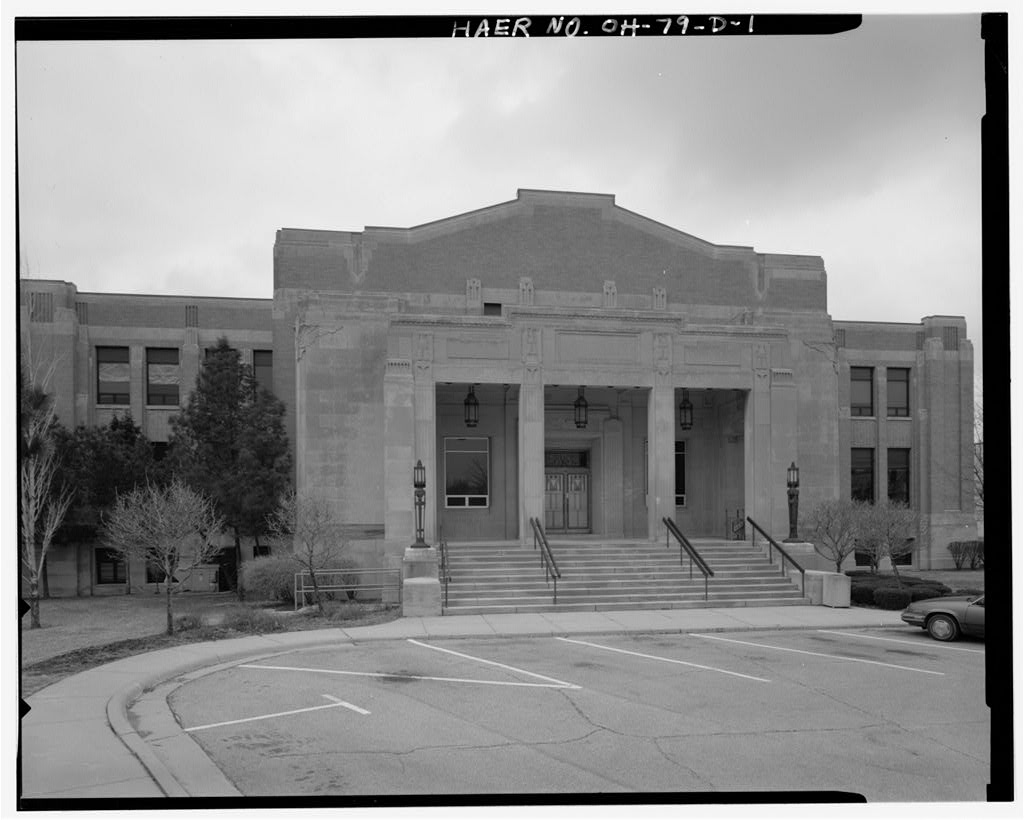
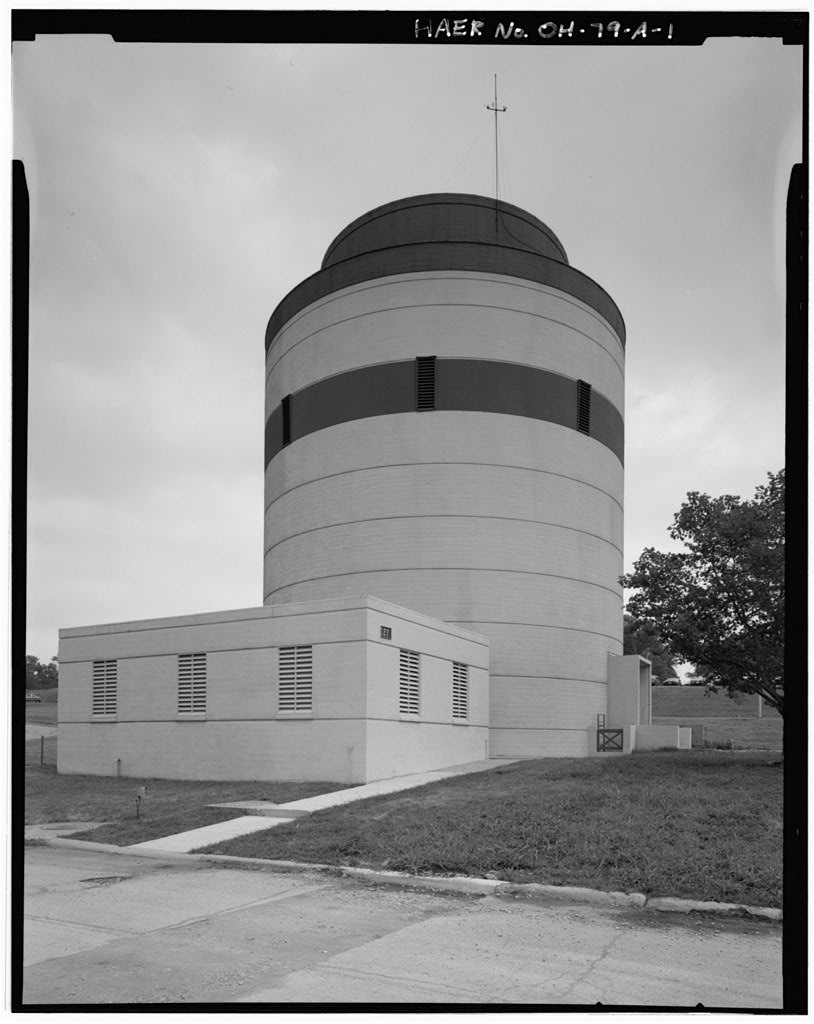
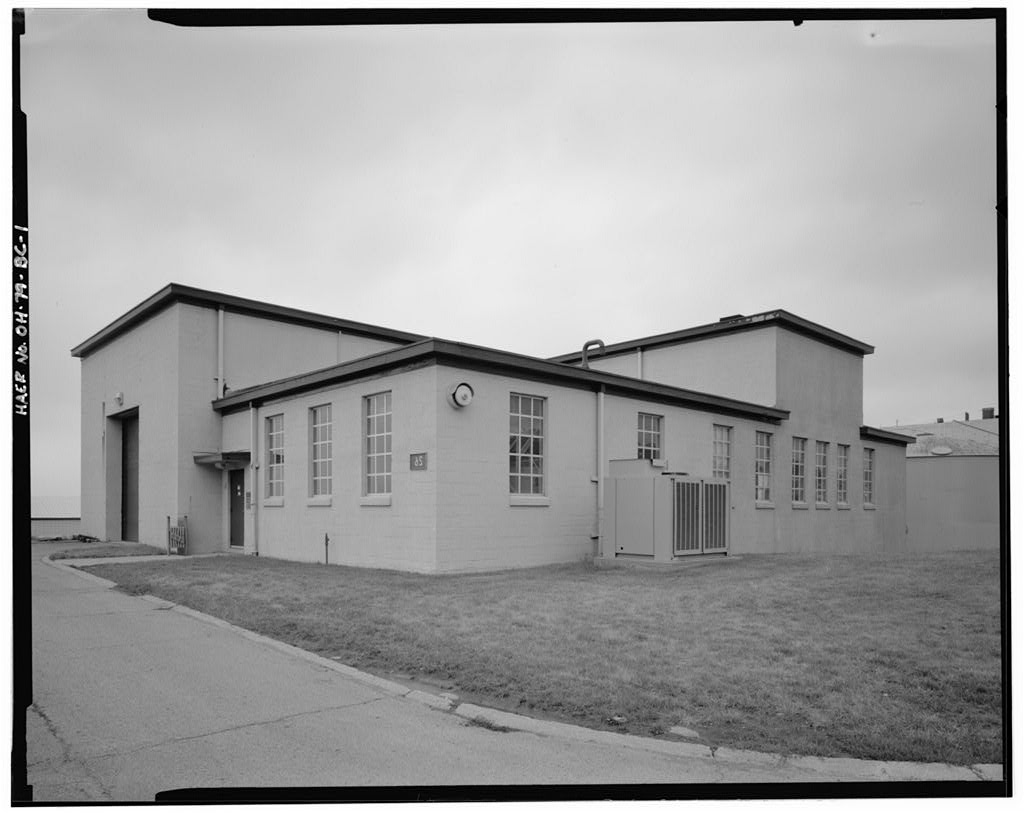
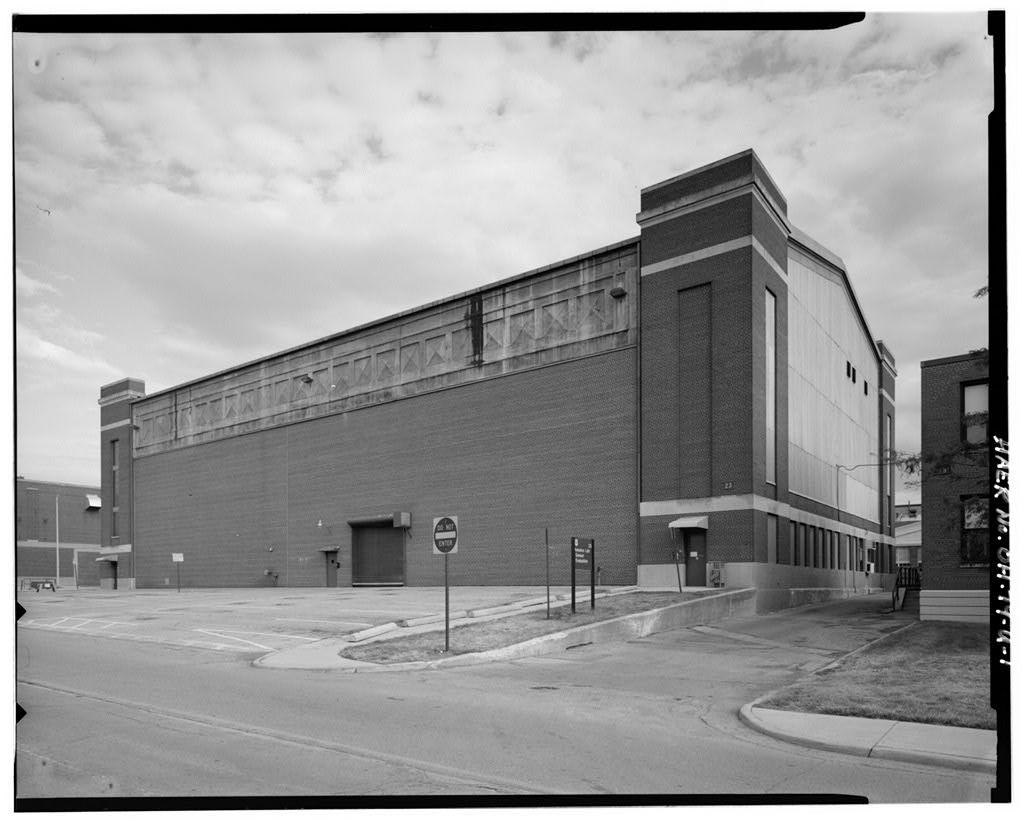
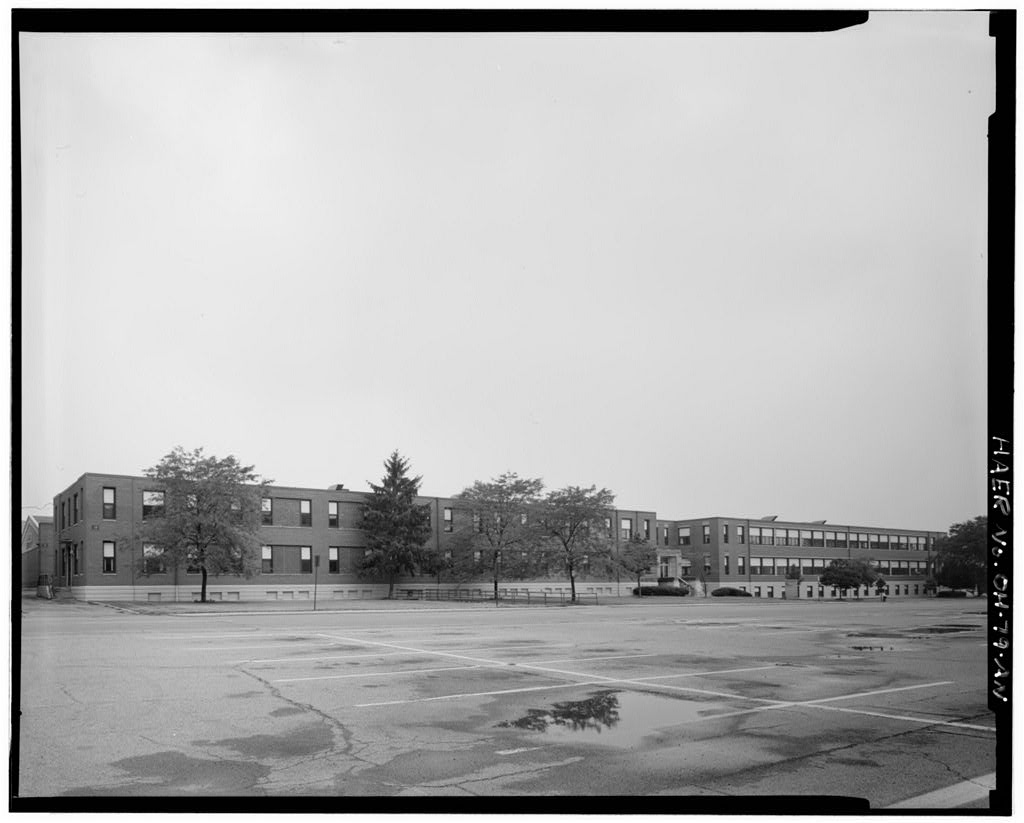
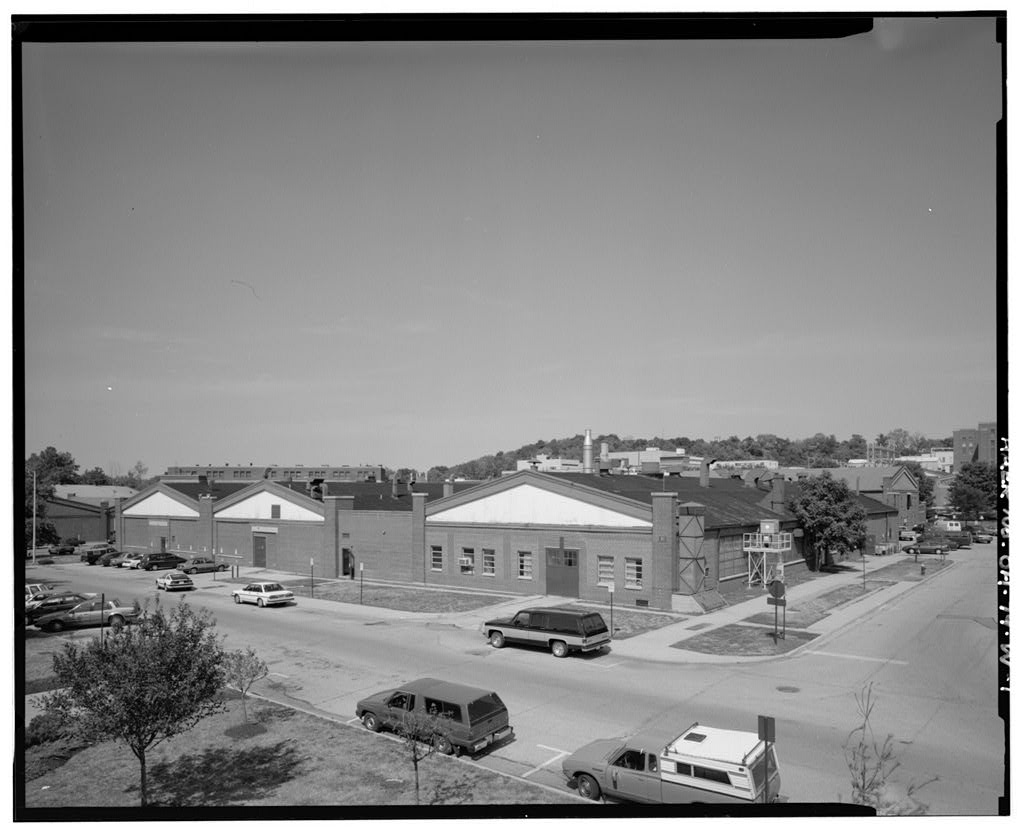
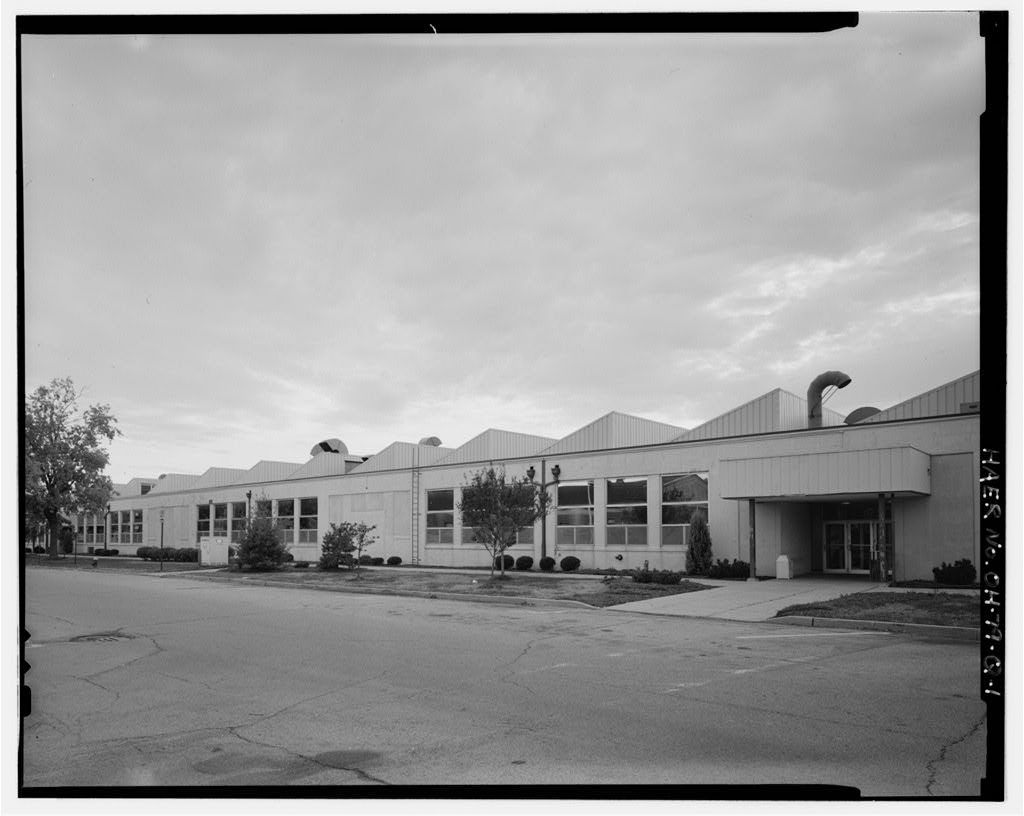
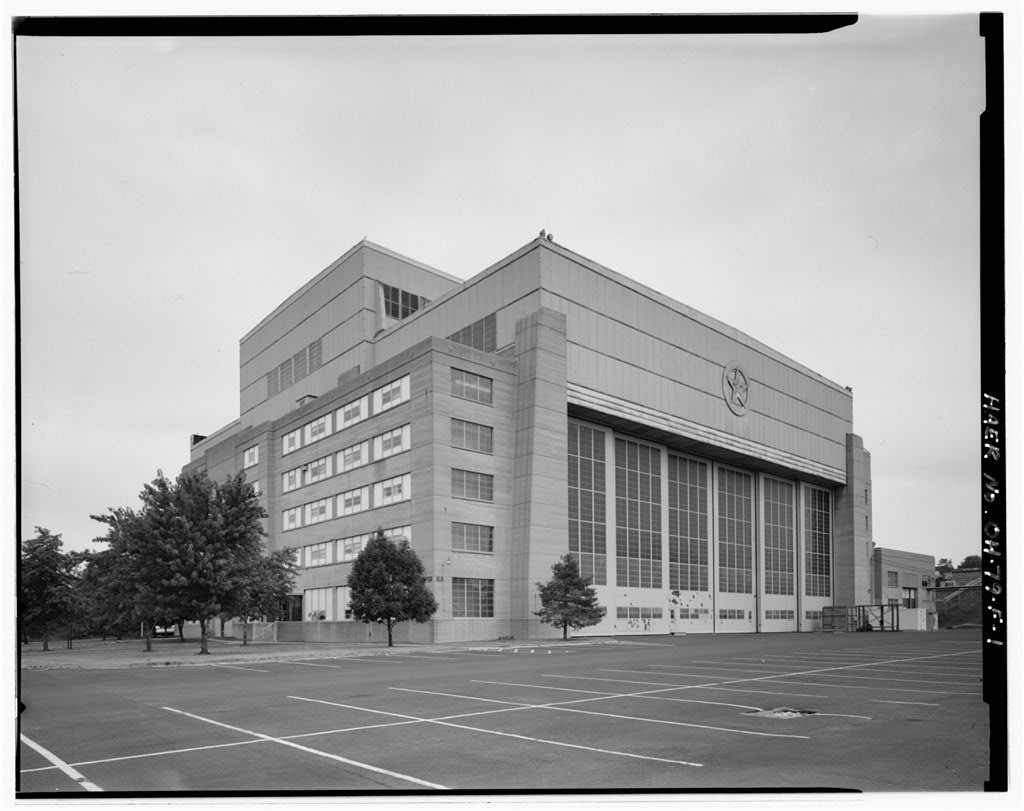
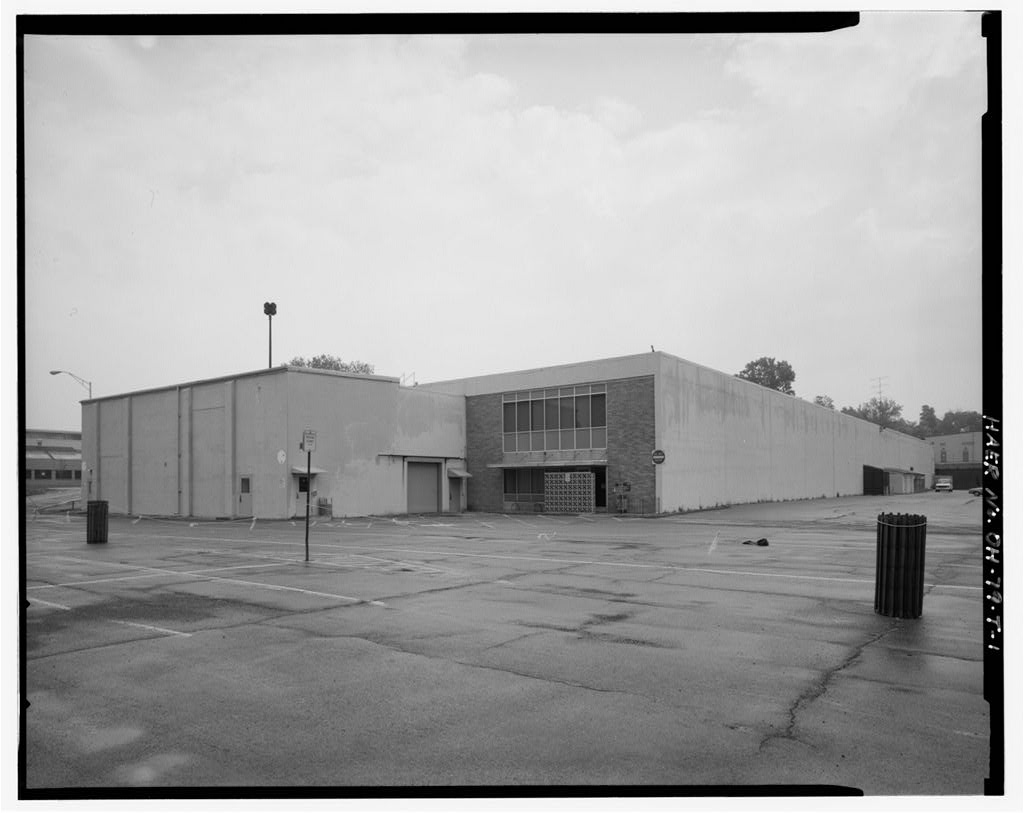
Wright-Patterson Air Force Base, Area B, Dayton, Montgomery County, OH. Surveyed as HAER OHIO,29-DAYT.V,1-, with 1 photograph, 1 measured drawing and a 17,117-word written history.
From the record
“Area B began as Wright Field, an important center for a variety of early aircraft engineering and support systems research.”
Written record, HAER OHIO,29-DAYT.V,1- survey. Machine-read text.
surveyed by the federal HAER program as HAER OHIO,29-DAYT.V,1- · the record runs 17117 words · one of 121 surveyed structures published for this county.
Source document
Quoted word for word from HAER OHIO,29-DAYT.V,1-.
Not written, edited or summarised by this site.
Area B began as Wright Field, an important center for a variety of early aircraft engineering and support systems research. Specialized research and support structures here were the site of many innovations in aircraft and equipment design. During the military build-up generated by World War II, the extent and scope of the research conducted by Army Air Corps engineers expanded considerably, as did the facilities at Wright Field. After the war, cutting edge aeronautical research continued at the field, now a part of Wright-Patterson Air Force Base, including efforts important to early space flight technology.
Its long history of innovation in the field of aeronautical engineering and the intact condition of many of its significant structures make Wright- Patterson Air Force Base, Area Ban important monument to the development of modern flight. Project History: The Wright-Patterson Air Force Base, Area B Project, sponsored by Wright-Patterson Air Force Base, was conducted by the Historic American Engineering Record between and The documentation for HAER was prepared under the direction of Dr. Robert J. Kapsch, Chief, Historic American Buildings Survey/Historic American Engineering Record (HABS/HAER), and Eric DeLony, Chief, HAER. Dr. Dean Herrin, Historian, HAER, and Robbyn Jackson, Architect, HAER, supervised the project.
Team members for HAER included architects Mary Caballero, Elaine Pierce, Mark Pierson, Christopher Widener, and the firm of Hard lines: Design and Delineation ( Charissa Wang and Donald Durst, Principals/Partners); WRIGHT-PATTERSON AIR FORCE BASE, AREA B HAER No. OH-79 (Page 2) historians Emma Dyson, Vance MacDonald, Robert Roggenkamp, and Amy Slaton; and David Diesing, photographer. Additional architectural editing was performed by J. Shannon Barras, Albert Debnam, David Fleming, Natalya Kalinina, and Sanford Garner; and additional historical editing was completed by Lola Bennett, Emma Dyson, and Dean Herrin.
In addition to this documentation, HAER team members also published an inventory, The Engineering of Flight: Aeronautical Engineering Facilities of Area B, Wright- Patterson Air Force Base, and two brochures, "The Legacy of Wright Field," and "Wright Field and World War II." WRIGHT-PATTERSON AIR FORCE BASE, AREA B HAER No. OH-79 (Page 3) For additional information on the following Wright-Patterson Air Force Base, Area B structures, see the additional HAER reports: Building Construction HAER No. Number Date(s) 1/9 Flight Test Hangars OH-79-G 4 Modification Hangar and Flight OH-79-H Research Laboratory 5 Engineering Shops OH-79-L 6 Signal Corps Special Forces Hangar OH-79-M 7 Engineering Shops Office OH-79-N 8 Operations and Flight Test OH-79-0 11 Administration Building No.
1 OH-79-P 12 Technical Data Building OH-79-D 14 Materiel Command Administration OH-79-AL Building No. 1 15 Materiel Command Administration OH-79-AM Building No. 2 16 Wright Field Laboratory OH-79-Q 17 Aircraft Radio Laboratory OH-79-AB 18 Power Plant Laboratory Complex OH-79-AN 19 5-Foot Wind Tunnel OH-79-B 20 Propeller Laboratory OH-79-J 20A Propeller Whirl Rigs Acoustical OH-79-C Enclosure 21 Old Armament Building OH-79-R 22 Armament Laboratory and Gun Range OH-79-S 22B 200-Yard Gun Range Structure OH-79-T 23 Static Test Laboratory No.
1 OH-79-U 24 20-Foot Wind Tunnel Complex OH-79-AP 25 10-Foot Wind Tunnel Complex OH-79-AP 26 Super Sonic Test Laboratory OH-79-BC 27 Vertical Wind Tunnel OH-79-A 28 (New) Aircraft Radio Laboratory OH-79-AC 29 Aero Medical Laboratory OH-79-AQ 30 Audio-Visual Laboratory OH-79-BB 31 Aircraft Assembly Hangar OH-79-E 32 Original Wright Field Shops OH-79-K 36 Maintenance Building No. 2 OH-79-AE 38 Maintenance Building No. 3 OH-79-V 39 Maintenance Building No. 1 OH-79-AD 51 Foundry/Garage OH-79-W 55 Centrifuge Building OH-79-X 56 Wright Field Warehouse OH-79-Y 57 Air Force Supply Warehouse OH-79-AF 59 Dynamometer Storage Building OH-79-AG 61 Torque Stands' Oil Storage OH-79-AR 61A Torque Stands' Fuel Pumping OH-79-AS Facility 62 Ordnance Storage No. 1 OH-79-AT 63 Ordnance Storage No.
2 OH-79-AU 64 Aircraft Parts Warehouse OH-79-AV 65 Static Structural Test Laboratory OH-79-F 66 Central Heating Plant OH-79-AH 67 Emergency Power Plant OH-79-AI WRIGHT-PATTERSON AIR FORCE BASE, AREA B HAER No. OH-79 (Page 4) Building Construction HAER No.
Number Date{s} 70 Fuel and Oil Test Laboratory OH-79-AW 71 Power Plant Engine Test Torque OH-79-AX Stands 71A Propulsion Research Laboratory OH-79-AY 71B Power Plant Laboratory OH-79-AZ 71D Propulsion Research Laboratory, OH-79-BA Fuel and Lubricants 76 Wright Field Firehouse OH-79-AJ Main Gate Guard House and OH-79-Z Passenger Station 86 Main Pump House OH-79-AK 250 Rotor Test Tower OH-79-BD 821 Radar Test Building OH-79-AA * The building names in this list of structures reflect the historical use of the building when constructed, and may not reflect that building's use as of WRIGHT-PATTERSON AIR FORCE BASE, AREA B HAER No. OH-79 {Page 5) AERONAUTICAL ENGINEERING AT WRIGHT-PATTERSON AIR FORCE BASE: A
Historical Overview
The United States Army first demonstrated its commitment to heavier-than-air flight in February when the Army Signal Corps solicited bids for a military airplane. The contract was awarded to Wilbur and Orville Wright, of Dayton, Ohio, who answered the Army's call for a plane that could reach a speed of 36 miles per hour carrying two people and enough fuel for a 125-mile flight. Although these "specs" hardly compare with those of modern aircraft, for its time the undertaking was ambitious, and its successful fulfillment led to the enthusiastic embrace of aviation technology by its sponsors, and ultimately to an extensive organization for military aeronautical development.
After the first contract was awarded to the Wrights, the Army established its Aeronautical Division, with distinct departments to handle aeronautical research and aircraft production. Within a decade, research was itself divided into "basic" and "applied" aspects. Basic, or theoretical research, fell primarily to the National Advisory Committee for Aeronautics (NACA), established in by a Presidential commission.
Applied, or experimental work, was ultimately assigned to the Airplane Engineering Department of the Signal Corps, for which the Army built McCook Field near Dayton in The use of air power in World War I inspired still greater confidence in aviation technologies, and by the late the Army had moved its aviation engineering activities from McCook Field to the new and much larger Wright Field nearby. Grouping its Engineering Section facilities in a single tract (now known as Area B of Wright-Patterson Air Force Base), the Materiel Division brought together military and industrial aeronautical expertise, and encouraged the interaction of different technological disciplines. Wright Field quickly became a center for the most advanced practices of aeronautical engineering in the country.
1 From its inception in the engineering program at Wright Field has been complex and varied. The Materiel Division's engineers developed aircraft equipment (from airframes to engines to instruments), refined the interaction of such parts in the completed aircraft, determined which aspects of airplane design were most important for military purposes (range, speed, or load- 1 Falk Harmel, "A History of Army Aviation," Popular Aviation 3 Materiel Division, United States Army Air Corps, "First Annual Report of the Chief, Materiel Di vision Air Corps, Fiscal Year (henceforth, "Annual Report WRIGHT-PATTERSON AIR FORCE BASE, AREA B HAER No. OH-79 (Page 6) carrying capacity), and created specifications and standards for the new technologies of flight.
In pursuing these tasks, the engineers tested raw materials, parts, and entire airplanes, both at rest and in flight. Careful analysis of technological problems was completed before any innovation was passed along for general commercial use, and in addition to innovating, the Materiel Division solicited ideas from industry and inspected the work of airplane and parts manufacturers. The engineers at Wright Field also maintained active ties with the other public bodies engaged in aeronautical and material research, including the National Bureau of Standards, the Army Corps of Engineers, and the National Advisory Committee for Aeronautics.
This flexible and multi-faceted approach to aeronautical engineering allowed the Air Service ( later called the Army Air Corps, the Army Air Force, and ultimately the Air Force) to ably contend with the budget constraints of peacetime and the production pressures of wartime. From Wright Field's personnel came pioneering work in such areas as wind tunnels, propulsion, static testing and aeromedical investigations; the Air Force remains strong in these fields today. Since World War II, Air Force engineers at Wright- Patterson Air Force Base have contributed to the development of jet propulsion, radar, missile guidance and the automation of flight functions.
The manner in which Wright Field engineers pursued technological advancement and the results which they achieved assure Wright Field an enduring significance in the history of aeronautical engineering. 2 History of the Air Service and McCook Field In charging the Signal Corps with the development of its military airplanes, the U.S. Army indicated its intentions for the new technology: airplanes were to be tools for communication. They would provide a supplement to existing means of scouting and observation. 3 When the Wright brothers produced their airplane for the Signal Corps in Army aviation consisted of only three officers, ten enlisted men, the one airplane, and a single airship.
There was no university support and little industrial support for aeronautics; only Glenn Curtiss presented any real competition to the Wrights in the designing and production of airplanes. Americans soon became aware of a growing European interest in military and commercial aviation, and began to feel the pressure of 2 "Annual Report "Annual Report 3 Cy Caldwell, "The U. s. Army Air Corps Aero Digest 35, no. 2 (August WRIGHT-PATTERSON AIR FORCE BASE, AREA B HAER No. OH-79 (Page 7) international competition, an influence that was to bear continually on American aviation development. 4 In the British government appointed an official advisory committee on aeronautics, and American businessmen and legislators reacted with their own efforts.
Local aeronautical clubs formed to enlist government support for aeronautical research for commercial and military objectives. In response, Congress made its first appropriation specifically for aeronautical purposes in granting for the construction of an airdrome and flying school at College Park, Maryland. Here, the Signal Corps conducted some of its earliest technical experiments on aircraft, including work on aerial photography, radio from aircraft, and machine gun firing from the air to ground targets. 5 As business and military interest in aviation increased, questions emerged about the best way in which to pursue aeronautical advancement.
There was little argument against the idea that this new scientific field would profit most by a centralized approach to research and heavy capitalization. This was a period of great confidence in organized research and development, as is evidenced by the burgeoning federal and industrial laboratories of the day. Accordingly, the National Bureau of Standards, the Army, the Navy, the Smithsonian Ins ti tut ion and several universities each proposed the creation of a large national laboratory to be operated under their direction. Those advocating a more scientific approach to flight technologies supported the creation of a laboratory at the Smithsonian, while those favoring an engineering emphasis suggested that a military venue would be most appropriate.
In President Taft appointed a national commission to study the problem, which recommended a non-military national aeronautical laboratory with a scientific emphasis, to be located in Washington, Growing public sentiment against bureaucratization and governmental favoritism, however, slowed action on the plan, and the recommendation died in Congress. 6 Ultimately, as would be repeated in later years, America's foreign relations determined the country's next major expansion of 4 Harmel, 18; Alex '.Roland, Model Research: The National Advisory Committee for Aeronautics (Washington, DC: National Air and Space Administration, 3. 5 Roland, 5; Harmel, 6 A.
Hunter Dupree, Science and the Federal Government (Baltimore: Johns Hopkins University Press, Roland, WRIGHT-PATTERSON AIR FORCE BASE, AREA B HAER No. OH-79 (Page 8) military aviation engineering. Increasingly strained relations with Mexico in combined with anxiety about growing hostilities in Europe to prompt action by Congress. In and Congress appropriated more than a million dollars for military aeronautics, and ordered the creation of an Aviation Section within the Signal Corps. A personnel of 60 officers and 260 enlisted men was authorized, some of whom were put to the task of experimenting with propellers, automatic stabilizers, parachute packs and other projects.
At the same time, NACA was created by Congressional approval, at first filling an advisory role to industrial aircraft producers and consumers, but soon establishing its own publications and building its own laboratories. These facilities, in Hampton, Virginia, would come into their own as a center for scientific achievement after World War I as Langley Memorial Field, but from their inception, NACA's laboratories signified the formal separation of pure research from military experimental activities.
By September of six months after the United States declared war on Germany, the Army had moved to establish McCook Field as the location for its Airplane Engineering Department, an organization that would use scientific information generated elsewhere to pursue applied aeronautical engineering. While NACA and the National Bureau of Standards investigated fundamental scientific principles applicable to all kinds of aviation, Army engineers at McCook would develop specifications for particular aircraft, supervise the production of prototype airplanes, and rigorously test the aircraft against evolving standards. 7 Following the United States' entry into World War I, reports of French, British, and German aircraft aroused Allied concern that our air def ens es were inadequate.
At the start of the war, 65 officers (of whom 35 could fly airplanes), over enlisted men, and 55 airplanes made up the Army Signal Corps' Aviation Section. Further, the equipment that did exist was largely obsolete when compared with European machinery, and only five officers were trained as aeronautical engineers. With an infusion of million from Congress, the Army addressed these shortcomings. It established ground schools (including Wilbur Wright Field) to train pilots and mechanics, but the problem of keeping trained mechanics when wartime industry offered higher pay was a substantial one. During World War I the situation was partly remedied by transferring men trained in mechanics from other branches into the 7 Harmel, Roland, "Annual Report 11 Roland, 88; George H.
Brett, "Materiel Division of the U.S. Army Air Corps," Aero Digest 35, n.2 (August 47. WRIGHT-PATTERSON AIR FORCE BASE, AREA B HAER No. OH-79 (Page 9) Aviation Section. 8 McCook Field's contributions to World War I aviation included the development of aircraft design, testing of experimental aircraft and standard production models, engine testing and improvements, machine gun and aerial camera testing, and the development of materials for aeronautical uses. However, the process of aircraft design was not pursued along highly organized lines.
9 There existed after the war some feeling that America's pursuit of sophisticated flight technologies had "come too late," and that one of the lessons of the war for Americans was "the absolute necessity for a continuing program of aircraft development. " 10 Thus, in the years following World War I, there emerged an effort to consolidate and organize U.S. military aeronautics.
Army aviation development was at this point transferred from the Signal Corps to the newly created Air Service, within the War Department, and the Air Service branch responsible for experimental engineering was officially named the Engineering Division in Under its auspices, the staff of McCook Field trained mechanical personnel, and took responsibility for the technical development of aircraft, armaments, engines, equipment, and materials. Each task was represented by a section within the Division. The engineering successes and failures that occurred at McCook Field between and the opening of Wright Field laid the groundwork for Army aeronautical engineering in the following decades.
Air Service engineers investigated aerodynamic phenomena, propulsion technologies, and structural attributes of aircraft, often inventing or refining analytical methods as they went. Among McCook's most important work was the testing done in its 14-Inch and 5-Foot Wind Tunnels, and on engine torque stands and propeller whirl rigs, which were among the most powerful in the world. 11 Wind tunnels simulate the flight conditions which airplanes 8 Harmel, Caldwell, "A Little Journey to the Home of the Engineering Division, Army Air Service, McCook Field, Dayton, Ohio," Reprint), 2. 9 Historical Division Wright Air Development Center, "Trends in Research and Development Processes and Techniques, " typed manuscript in "Wright Field Publications File," History Office, 645 ABW, 13.
10 "A Little Journey ... , " 1. 11 "A Little Journey ... ," 4. WRIGHT-PATTERSON AIR FORCE BASE, AREA B HAER No. OH-79 (Page 10) will encounter, and allow measurement of plane lift, drag, and resistance. McCook's 5-Foot Wind Tunnel represented an improvement over earlier examples because it produced winds of much greater speeds for its diameter. It was used to test numerous small scale models, saving the Army thousands of dollars in full-sized prototypes and sparing test pilots significant risks. The McCook wind tunnel was eventually moved to Wright Field (Building in and continues to be used today for student projects and non- military investigations.
12 The thorough testing of propellers became important to engineers when increased engine power, and hence higher propeller-tip speeds, began to tax the strength of traditional propellers. McCook' s Propeller Shop meticulously fabricated specimens from laminated wood, duralumin and Bakelite. Sophisticated tests in the Shop allowed advancements in the synchronization of machine-gun fire and propeller operation, and in the development of a variable pitch propeller that could ease takeoff and cruise conditions. 13 The engineers at McCook also initiated methods of static and impact testing. In the former, the stresses and strains encountered in normal flight were reproduced by placing bags of shot or lead bars on wings or other parts of airplanes.
In impact testing, a part such as an axle or wheel was attached to a skeleton fuselage and loaded with sand or shot bags to approximate the weight it would eventually bear in operation. The entire assembly was then dropped from a scaffold to recreate actual landing conditions. Until when mathematical formulae were deemed reliable for the task, engineers at McCook drop-tested not only parts, but entire prototype planes.M Among other accomplishments of the Engineering Di vision's aircraft engineers were a number of improvements to airplane "power plants,'' or engines. Superchargers, fuel systems, and air-cooled "A Little Journey ... , " 4; E. N.
Fales, "The Wind Tunnel and 12 Its Contribution to Aviation," Aviation 31 (October 13 Roger Bilstein, Fliqht in America From the Wrights to the Astronauts (Baltimore: Johns Hopkins University Press, Lois E. Walker and Shelby E. Wickam, From Huffman Prairie to the Moon: The History of Wright Patterson Air Force Base (WPAFB: Office of History, Air Base Wing, Air Force Logistics Command, 14A.M. Jacobs, "Over the Hump, 11 Popular Aviation (February WRIGHT-PATTERSON AIR FORCE BASE, AREA B HAER No. OH-79 (Page 11) engines (which were more responsive than liquid-cooled engines in climbing and maneuvering) all underwent refinement at McCook, generally through testing on torque stands and dynamometers, where engine power could be measured with great precision.
15 McCook engineers also had success with the development of new protective paints and fabrics, new fuels, and specialized materials for aviation use, including lighter and cheaper substitutes for standard materials. Although the Army's engineers sought to work as closely as possible with supplying manufacturers, elaborate chemical, metallurgical, electrical and other laboratories were maintained at McCook, virtually giving Air Service engineers the capacity to build an entire airplane from scratch if they so desired. In the course of operating McCook's facilities, the Army came to realize that building entire airplanes in-house would not be nearly as economical as utilizing the resources of private industry.
Nor did the Engineering Division wish to operate on a "competitive basis" with industry . 16 Instead, its policy was "to encourage the development of a bigger and better aircraft industry," and the Division implemented practices at McCook that would bring this about. The Army's choice of the Dayton area for its aeronautical engineering center grew in part from the city's proximity to the airplane industry in Ohio, and to the automotive industry in neighboring states. Army engineers would develop precise performance specifications for a new airplane, and then solicit design proposals from industry--usually leaving decisions about actual construction methods to manufacturers.
In some instances the Engineering Division turned over its experimental data or actual parts to manufacturers under contract. In other instances, Air Corps engineers utilized the findings of industry for its own researches.n 15 "A Little Journey ... , " 16"A Little Journey ... , " 4; James J. Niehaus, Five Decades of Materials Progress, (WPAFB:Air Force Materials Laboratory, Research and Technology Division, Air Force Systems Command, 34. 17 Kilmer, Major "Memorandum: For the Engineering Division, War Department, February 13, (in AFLC Archives, "History of McCook Field [Miscellaneous Correspondence 14; Historical Division, Office of Information Services, Air Research and Development Command, "The First 5 Years of the Air Research and Development Command," (January 4; Eric M.
Schatzberg, "Ideology and Technical Change: The Choice of Materials WRIGHT-PATTERSON AIR FORCE BASE, AREA B HAER No. OH-79 (Page 12) These policies had direct practical benefits both for the Army and for industry, and the expansion of Army aeronautical research throughout the and reflected a series of mutually supportive decisions by the two interests. The move of the Engineering Division from McCook to Wright Field in can be traced to this growing belief in aeronautical research as a positive force for both the military and for private economic development.
The Creation of Wright Field As has been the case in most peacetime periods in the United States, funding for military research was limited in the early The Army's decision to pursue a larger, more modern setting for its aviation engineering research can be associated with two related events that together outweighed objections to funding such a project. In a group of Dayton businessmen spearheaded a successful drive to keep the Engineering Division in the locality by providing the U. s. Government with donated property; and in Congress passed the Air Corps Act, significantly increasing the responsibility of the Engineering Division.
These were the immediate causes of the establishment of Wright Field, and they point the way to much broader currents in the development of flight technologies. Local efforts to obtain Congressional funding and a permanent Dayton location for the Engineering Division were led by John H. Patterson, co-founder of the National Cash Register Company and a longtime supporter of the Air Service. The production of aircraft in America had undergone a tremendous expansion over the course of World War I. The census listed only 16 aircraft companies with an output of 49 planes; by there existed 300 manufacturers. Patterson saw the possibility of Dayton-area companies joining in this swell.
Beginning in Patterson, and later his son, worked to garner the support of other prominent Dayton citizens, eventually forming the Dayton Air Service Committee and publishing the promotional journal, Aviation Progress. On the basis that the continued presence of the military facilities would bring employment and revenue to the area, and that the region had a cherished identity as the "Birthplace of Aviation," the Committee mustered wide support, and by the end of had raised over for the purchase of acres of land east of Dayton.
The land included the Air Service's Wilbur Wright Field, a flying field and aviation school leased by the Air Service since and in American Aircraft Design Between the World Wars," Dissertation, University of Pennsylvania, WRIGHT-PATTERSON AIR FORCE BASE, AREA B HAER No. OH-79 (Page 13) abutted the existing Fairfield Air Intermediate Depot, thus ensuring its easy conversion to a large aviation complex. The property was "sold" to the federal government for two dollars, and after Congressional appropriations began in the War Department abandoned the name Wilbur Wright Field to call the entire property Wright Field, honoring both Wilbur and Orville. 18 While the citizens of Dayton worked to prepare a site for Wright Field, Congress was moving to expand the Army's air service.
In the Air Corps Act was passed, and a five-year expansion program undertaken. The functions of the Air Corps were threefold: training, operations, and materiel. The Materiel Di vision was responsible for not only all aviation engineering and research (the Engineering Di vision became a section within the newly created Materiel Division), but also for the procurement, supply and issue of Air Corps aircraft and materiel. The Air Corps Annual Report suggests the complexity of its charter: In general all activities of the Materiel Division have one ultimate objective: to furnish the Air Corps with suitable aircraft materiel.
The attainment of this necessitates the development, procurement and test of aircraft and aircraft accessories; the distribution and maintenance of materiel and supplies in the field; the planning of industrial preparedness; the maintenance of an adequate engineering establishment and testing facilities; the extension of research facilities and technical services to the industry and the other Government agencies; and the dissemination of technical information for the good of the service and the general public. 19 The added scope of Materiel Division responsibilities mandated by the reorganization was a very clear justification for the establishment of a facility like Wright Field, but by no means the only one.
Private, military, and Congressional boosters offered numerous reasons for the huge investment of time and energy a new field would require, and examination of those reasons reveals a great deal about the climate surrounding aeronautical development. They suggest that Army aeronautical engineering activities encouraged the public's interest in flight, and were furthered in turn by such interest. For its part, the military envisioned an industrial complex 18 Walker and Wickam, Roland, 51. 19 "Annual Report 28. WRIGHT-PATTERSON AIR FORCE BASE, AREA B HAER No. OH-79 (Page 14) that could produce state-of-the-art aircraft during peacetime, and in so doing also be at the ready in case of another war.
The Army allotted funds for contracting out their work, and found industry eager to bid on such work. At the same time, dramatic feats such as the setting of altitude and speed records, the first transatlantic crossing in and Lindbergh's flight heightened public interest in aviation. Commercial airlines capitalized on this interest by introducing nationwide and intercontinental schedules. 20 Some of the advantages claimed for a newly built engineering facility were assured and easily measured. Flight tests of new aircraft at McCook had been conducted directly over the residential area of North Dayton in which it stood; crashes there had caused the death of five civilians, and a more remote testing ground would be safer.
The cost of renting and maintaining the buildings at McCook, most of which were erected as temporary structures during World War I, would be eliminated as well. 21 Other justifications offered for Wright Field were less concrete, but apparently no less compelling. Boosters invoked the interests of national security. Al though public sentiment was running against military expansion in the the airplane appeared to be a means to improved global relations, a deterrent to aggression and, in a revival of its earliest military role, a communications tool. 22 The Army's staging of a trip around the world by four single-engine planes in (an attainment to which McCook Field and the Fairfield Depot contributed) bolstered such visions.
23 Perhaps the most thoroughly elaborated justifications for the establishment of Wright Field involved the interaction of military and industrial interests. Both groups produced public relations materials describing the benefits that would accrue to everyone concerned if the Army increased its engineering activities. As had been the practice at McCook, private industry, through a system of competitive bidding, would be used to develop new technologies. McCook had seen this approach work with such significant 20 Bilstein, 79. 21 "Removal of Experimental Station will Save Government Interest on Annually," Aviation Progress, 1 November 36. 22 Bilstein, 76. ~ Walker and Wickam, 63. WRIGHT-PATTERSON AIR FORCE BASE, AREA B HAER No.
OH-79 (Page 15) achievements as the Barling Bomber, earth inductor compass, high- altitude cameras and films, and aerial torpedoes. Expanded activities at Wright Field promised further business to many manufacturers. Proponents of Wright Field also cited the ways in which the findings of the Engineering Division could be of use to industry. Aeronautical advancements would directly aid the aircraft industry, and indirectly produce benefits to American commerce as a whole. Among examples of the latter from McCook's engineers were the first model airways in the U.S. (from Dayton to Washington, night- f lying equipment used by U. s. Air Mail; night illumination of flying fields; and crop dusting.
Most dramatic was the development of new, more reliable instrumentation, "essential," one historian has pointed out, "for commercial airlines strivin:JJ to establish dependable service based on published timetables." The relationship between military and private industry was not entirely congenial, however. As mutually beneficial as a military/manufacturer exchange of data was, patent litigation plagued Army engineering efforts. In the post-World War I period of retrenchment, the Army received complaints from the private sector that too much research work was going to military engineers, and that more should go to private industry.
25 Further, the Engineering Division continually faced the difficult problem of losing skilled personnel to the private sector, a situation that evoked at best mixed feelings on the part of the military.u But if these difficulties indicate the presence of some friction between public and private aviation development, they also indicate a general belief in the capacities of aviation research, and the shared understanding that the fortunes of military and industry were interwoven. They certainly did not stand in the way of Wright Field. In the Army began the process of closing down McCook and transferring operations to Wright Field.
McCook's Dynamometer Laboratory, Propeller Test Laboratory and 5-Foot Wind Tunnel continued to operate for the next two years while facilities at Wright were readied. Most buildings at McCook were demolished, 24"Aeronautical Developments Resulting Exclusively from Design and Experimentation by the Engineering Division," Aviation Progress, 1 November Bilstein, 74. 25 "Annual Report Niehaus, 34. Trubee Davison, "The Army in the Air," Western Flying 4, n.9 (September "Annual Report "Annual Report 15. WRIGHT-PATTERSON AIR FORCE BASE, AREA B HAER No. OH-79 (Page 16) with materials such as piping, light fixtures, windows, and doors being salvaged for use at the new site.
27 Wright Field as Planned and Built Of the acres that came under the Army's control, 750 acres on the protected side of Huffman Dam were allocated for the Materiel Division's engineering laboratories and associated flying field. (This parcel is now known as Area B; the old Wilbur Wright Field and Fairfield Air Depot, in conjunction with later land additions, are known as Areas A & C.) The Army spent three million dollars to create facilities for the Materiel Division's five major sections: administration, experimental engineering, procurement, field service and industrial war-plans.
(A sixth section, Repair and Maintenance, was absorbed into the administration and engineering sections shortly after Wright Field opened.) 28 The government began construction on the site in building large administrative and laboratory buildings, hangars, machine shops, utility buildings, and paved aprons, as well as several specialized structures for the testing of engines and propellers. The transfer of activities from McCook to Wright Field began in March with more complicated technologies, such as the 5-Foot Wind Tunnel and Dynamometer Lab, coming into operation after the completion of more conventional facilities.~ Touring Wright Field today, it is not difficult to distinguish structures that date from the Field's first years in operation.
With the exception of the Administration building (Building the thirty structures that were part of the Army's original conception for the Materiel Division's engineering plant (many of which still stand) were almost all built of brick. Early test hangars and shops all have low-pitched gabled roofs and copper entablature. Many have low, square towers rising from their corners. Two tile-roofed, masonry gatehouses frame the Field's entry. They originally admitted visitors to a long circular drive, beyond which stood the imposing Administration building. This vista was disrupted by the addition of two more office buildings in front of the Administration building during World War II, but a sense of n Walker and Wickam, 28 Brigadier-General W.E.
Gillmore, "The Job of the Materiel Division," U.S. Air Services 13 (December 38; Brigadier- General W.E. Gillmore, "Work of the Materiel Division of the Army Air Corps," Society of Automotive Engineering Journal 25, n. 3 (September Walker and Wickam, 29 "Annual Report WRIGHT-PATTERSON AIR FORCE BASE, AREA B HAER No. OH-79 (Page 17) austerity and order is still suggested in the uniform design of Area B's original structures. All the early brick buildings stand distinct from the clean-lined concrete buildings of the World War II period of sudden growth, and from more recent buildings of less uniform design. The consistent style of Wright Field's original architecture can be attributed to a trend in military construction toward the thoughtful and comprehensive design of military complexes.
In the early military budgets were sharply cut, and many military facilities fell into serious disrepair. Most existing buildings were never meant to outlast World War I, and living and working conditions on many Army posts were almost untenable by the middle of the decade. With the inauguration of the five-year air expansion program in the government moved to correct the situation by modernizing Army plants, and part of its response was to create new posts that had some architectural merit. It fell to the Quartermaster General to fulfill this agenda, and Wright Field, largely designed by the Quartermaster Corps, was one such well- planned post. If not beautiful in the strict sense of the word, it did convey the seriousness of purpose of the Army's aeronautical engineers.
The Field's original buildings combined the functional characteristics of modern factory design--fireproof brick construction, large windows, minimal ornamentation--with the dignified, nee-Classical profiles favored for contemporary institutional architecture.~ Prior to the Army Quartermaster Corps had official responsibility for military construction, but actually had few large-scale commissions. An engineering division generally built all bridges, roads and fortifications, and ordnance divisions erected arsenals, and there were few large permanent posts to require the Corps' services as a construction crew.
World War I created an unprecedented need for large-scale housing, storage and production facilities, and with this change in scale came the new conception that "construction was the key to preparedness. " 31 As had occurred with the development of aviation engineering itself, controversy arose over who should take responsibility for this newly recognized aspect of American defense. In the idea 30Lenore Fine and Jesse Remington, The Corps of Engineers: Construction in the United States (Washington, DC: Office of Military History, Alan Gowans, Styles and Types of North American Architecture: Social Function and Cultural Expression (New York: Harper Collins, 31 Fine and Remington, 7 . WRIGHT-PATTERSON AIR FORCE BASE, AREA B HAER No.
OH-79 (Page 18) of a centralized, independent "Construction Division of the Army" gained popularity. The division would prepare plans, specifications and estimates for all military construction projects. During World War I, a unit along these lines built dozens of camps, training centers and airfields. This independent Construction Division was shifted by law to the jurisdiction of the Quartermaster Corps in 32 Thus, when the Army decided to build Wright Field virtually from scratch, it was the Quartermaster Corps that drew up plans, chose contractors, and supervised construction.
Some construction, particularly on the field's infrastructure, was done by internal repair and maintenance crews, but the appearance and function of the original Wright Field buildings can be attributed to the Quartermaster Corps. Operation of Wright Field Many of Wright Field's buildings were "purpose built" to house particular engineering functions. Over the years, the actual use to which the buildings were put changed frequently, as organizational structures and engineering programs changed. The history of Wright Field operations might best be understood in terms of the general functions that were housed there: administration, engineering, procurement, and testing of Army aviation materiel.
Each of these broad tasks was subdivided into more specific functions as national military agendas evolved. During its early years, Wright Field's facilities provided an integrated, self-sustaining area for aeronautical research and development, with ample and conveniently placed facilities for administrative, technical, and production work. Construction at Wright Field began with the Administration Building (Building 11) and its neighbor, the Main Laboratory Building (Building The two structures share a common foundation. Contractors from Dayton and Columbus followed Quartermaster designs for the Administration Building, and took almost a year to complete the building.
Gas locomotives running on a system of railroad tracks hauled concrete from a central mixing plant; derricks lifted the concrete to the top of the building for placement, following standard practice of the day for efficient and continuous concrete pouring. The building was finished with stucco, and adorned with porcelain shields over the doors. A figure modeled after Rodin's sculpture, "The Thinker, " graced these emblems, pondering a winged globe held in his right hand. As the headquarters of the Army Air Corps Materiel Division, Building 11 contained not only the offices for each section of the Division and such facilities as a dispensary, but also an Air Corps Engineering n Fine and Remington, WRIGHT-PATTERSON AIR FORCE BASE, AREA B HAER No.
OH-79 (Page 19) School and for several years, the Army Aeronautical Museum. The Engineering School produced officers trained in engineering specialties; in the early years of Wright Field when few university aeronautics programs existed, it was one of the only sources of scientifically trained officers for key positions in the Experimental Engineering and Procurement Sections and as Division representatives at factories." The Museum opened at Wright Field in It contained displays and records of aircraft and parts, many of wartime origin, and was a resource not simply for the interested public, but for engineers working at the field.
It was treated as a "living display" where "many hours of needless work might be saved if access could be had to examples of what had already been accomplished." Transferred to the new Technical Data Building (Building 12) in the Museum was also useful in establishing patent priorities for Air Corps inventions.~ In many ways, Wright Field was designed as a self-contained plant. The operation of Wright Field included a post telephone system, telegraph office and radio station, a meteorological station, and complete printing facilities that generated forms for internal use and technical reports for wide distribution. 35 A firehouse (still in use) and heating plant served the field, the latter supplying steam to all of Wright Field through underground tunnels.
Correcting one of the costlier defects of McCook Field, Wright Field's designers included railroad access so that coal for the heating plant and many other supplies could be brought directly to the site. Concern with efficient operation characterized large-scale engineering and manufacturing enterprises of all kinds in the and was carried into the design of buildings at Wright Field. The Main Laboratory Building (Building 16) embodies this goal. The one-story structure, adjacent to the Administration Building from which its operations were directed, provided square feet of uninterrupted floor space for the Materiel Division's Experimental Engineering Section. As was standard practice for modern factories, saw-tooth monitors, or skylights, evenly illuminated the work space.
As was also typical of contemporary factory management, the Main Laboratory provided 33 "Annual Report "Annual Report 34"Wright Field," Brochure, Materiel Division, U.S. Army Air Corps, 29; "Annual Report 11 76. 35 "Annual Report 54. WRIGHT-PATTERSON AIR FORCE BASE, AREA B HAER No. OH-79 (Page 20) physical proximity and thus easy communication between all the different groups working within. The Engineering section was subdivided into five branches--Aircraft, Power Plant, Equipment, Materials and Armament--and interaction between them was an inherent part of Army engineering methodology.
As the Assistant Secretary of War wrote of the Main Laboratory in In this room are housed the various research units, and the fact that they are under one roof, in one room, affords splendid coordination and promotes efficiency of operation to a degree that would be impossible under other conditions. 36 Communication between research units was crucial because changes to the structure or performance of one part of an aircraft affected others. In many cases, the nature of the armaments to be carried by an aircraft, and the manner in which the armament was to be "delivered," determined overall criteria for plane structure and performance.
But within that general hierarchy, different technologies had to be accommodated: a stronger engine might require a larger propeller, which might itself cause heavy vibration, which would in turn require development of a stronger fuselage, and so on. A Air Force report on trends in its own research and development processes claims that, "Between and it was usually possible to create an effective airplane from a collection of parts developed independent of each other." The report explains that the "weapons systems" approach of coordinated research did not find a place in aeronautical engineering until after World War II. The arrangement of laboratories at Wright Field, however, suggests that such a system was actually in place much earlier.
37 The Aircraft Branch of the Engineering Division addressed the structure of military airplanes, and within this branch, the different technologies that comprised the modern aircraft were themselves treated as specializations. Propellers, structural elements, and engines (or power plants) all had their own research facilities, and experts in each area had their own means of organizing their research. From the earliest investigations of powered flight, propeller design and the incorporation of propellers into airplane design were perceived as distinct areas of investigation. Designers had to create a propeller "as efficient as possible in converting rotative 36 Davison, "The Army in the Air," 61. 37"Annual Report 21; "Annual Report 56; "Trends in Research ... ," 2.
WRIGHT-PATTERSON AIR FORCE BASE, AREA B HAER No. OH-79 (Page 21) motion to forward motion," but also capable of operating "in combination with both engine and airframe (airplane less engine and propeller) and ... compatible with the power-output characteristics of the former and the flight requirements of the latter. At Wright Field, as at McCook, the fabrication of propellers was treated with the utmost precision. Using laminated wood, duralumin, and Bakelite, technicians working in the Main Laboratory Building constructed propellers up to 45 feet in diameter, creating specimens "so delicately balanced that even a splash of paint on the tip of one blade is enough to cause unbalance and enough vibration to make operation extremely dangerous.
These, and selected commercially produced specimens, were then tested on the Propeller Test Rigs (Building 20A), constructed on the edge of Wright Field and put into operation in May of 40 Engineers at Wright Field continued the emphasis McCook personnel had placed on the development of controllable pitch propellers. Wright Field's test rigs, however, were through the the largest propeller test rigs in the world. Powered by and 6,000-horsepower electric motors, the three rigs enabled Wright Field engineers to whirl-test propellers at speeds up to revolutions per minute. The rigs were arranged in a line that allowed the slipstream of one propeller to be thrown into the range of the propeller behind it--which would be the propeller under test. Thus, the conditions of flight were simulated.
41 Thick timber- and steel-beam canopies over the rigs prevented pieces of broken blades from flying loose, until World War II prompted the rigs' complete enclosure. An equally important body of research at Wright Field was that done by the Aircraft Branch's Structures Development and Test Laboratory. Through theoretical analysis, static testing, and the work of associated sheet metal, wood and machine shops, this unit created the first practical all-metal monocoque airframe (in which the aircraft's shell absorbs most of its structural stresses), a breakthrough that led to the first sub-stratosphere airplane.
42 38 Walter Vincenti, What Engineers Know and How They Know It (Baltimore: Johns Hopkins University Press, 39"The Materiel Center and You: A Handbook for Your Guidance, 11 Civilian Personnel Section publication, Wright Field, 31. 40 "Annual Report "Annual Report 12. 41 Walker and Wickam, Davison, "The Army in the Air, 11 61. 42 Walker and Wickam, WRIGHT-PATTERSON AIR FORCE BASE, AREA B HAER No.
OH-79 (Page 22) This work was accomplished in the immense, glass-walled Final Assembly Building (Building 31) and attached shops (Building Static and dynamic testing proceeded along the lines of that done at McCook, although on a larger scale: contract airplanes, commercial airplanes bought on the open market, and engine mounts for existing airplanes were all tested in the first year of the facility's operation.c The Aircraft Branch at Wright Field also maintained an Aerodynamic Research and Test Laboratory, the unit responsible for the operation of Wright Field's wind tunnels.
McCook Field had initiated Air Corps work with 14-Inch and 5-Foot Wind Tunnels, both of which were relocated to Wright Field where engineers continued the testing of small airfoils and propellers in the former, and complete airplane models in the latter. Wright Field's wind tunnel engineers demonstrated that the 5-Foot Wind Tunnel could accommodate larger models than had been thought, thus expanding its usefulness. Such work in the early days of Wright Field set the stage for dramatic accomplishments with the much larger 20-Foot Wind Tunnel completed in With the move to Wright Field, the Aircraft Branch also established three new laboratories. The Accessory Design and Test Laboratory had responsibility for testing wheels, brakes, landing gear and other such parts.
The Lighter-Than-Air Unit was responsible for Air Corps balloons and non-rigid airships. The Special Research and Test Laboratory refined design specifications for Air Corps airplanes. These laboratories produced such innovations as separately controlled landing wheels operated by pedals on the rudder bar, and new cockpit arrangements that allowed a forward observer to photograph, bomb, observe, radio, or direct combat from the same position.~ Like the Aircraft Branch, the Power Plant Branch at Wright Field had as its priority the pursuit of greater power for aircraft without added size or weight, in this case through the study of engine design.
The Branch was equipped to test engines with up to horsepower, a level of power not actually attainable by engines when the Power Plant Branch's facilities were constructed. Specific engine research projects were chosen through both laboratory tests and the correction of troubles reported back to the Branch by Air Corps pilots. Both kinds of problems were 43 "Annual Report 11 57. "Annual Report 50; "Wright Field," 10. 45 "Annual Report 11 WRIGHT-PATTERSON AIR FORCE BASE, AREA B HAER No. OH-79 (Page 23) researched on the torque stands and in the dynamometer laboratory, two of the most significant facilities at the original Wright Field. The dynamometer housed in Building 18 calibrated and measured the power of engines.
Wright Field dynamometers could tolerate the running of engines up to horsepower, or furnish a blast of air to air-cooled engines in a simulation of flight conditions. Additionally, the dynamometers held meters for determining fuel or oil consumption, engine revolution counters, tachometers, and instruments for ascertaining operating temperatures. A "cold room" allowed liquid or air-cooled engines to be tested to 50 degrees below zero Fahrenheit. Personnel working in this laboratory wore electrically heated clothing.% The torque stands (Building set in a series of imposing 40-foot-high concrete stacks that barely diminished the noise from within, allowed engines to be endurance tested for up to 150 hours.
There were seven torque stands in the original facility, but over the next decade twelve more were added, all equipped with observation rooms. The Fuel Test Laboratory, in which fuel and lubricant properties were investigated, completed the Power Plant Branch's main facilities. Fuel system pumps submitted to the Air Corps by private manufacturers were also examined here. Another priority of this laboratory was the standardization of both Army and Navy fuel requirements, a method of reducing demands on the oil industry and costs to the government. 47 While cylinders, valves, and carburetors received due attention at the Power Plant laboratories, much research focused on the problems of engine cooling.
The development of the air-cooled engine (especially through designing a ring-type cowling for radial engines) was particularly important to the unit's engineers, but not to the exclusion of work on water- and other liquid-cooled engines. In Power Plant engineers successfully applied high- temperature liquid cooling to the water-cooled engine, an advance that allowed radiators to be reduced in size by 70 percent. These two advances reduced engine weight considerably and provide an example of how the basic flexibility of the Engineering Division led to new innovations. 48 46 "The Materiel Center and You," O; "Wright Field," ~ "The Materiel Center and You," 30; "Wright Field," "Annual Report 73; "Annual Report 17. a "Annual Report 22. WRIGHT-PATTERSON AIR FORCE BASE, AREA B HAER No.
OH-79 (Page 24) In addition to the Aircraft and Power Plant Branches, the Experimental Engineering Section also contained the Equipment Branch, a unit devoted to the development of a large variety of technologies. Navigation equipment and instruments were among its primary responsibilities, including instruments that measured engine performance and other aspects of flight such as altitude or speed. New instruments were among the Equipment Branch's most visible accomplishments. Air Corps engineers and pilots captured public imagination with widely publicized feats of "blind" flying over uncharted waters or through dense fog.
49 This was, in fact, the kind of work that had direct and obvious benefits for commercial aviation, and in the Materiel Division reported "a decided improvement in ( aircraft radio] design and efficiency ... due largely to the interest shown by commercial manufacturers in Government requirements. " Such interest created new sources of supply for technological equipment vital to Army aeronautical projects.so Findings on the operation of instruments contributed to progress in radio investigations.
At Wright Field the Air Corps worked in cooperation with the Signal Corps, which not only aided in the development of aircraft radio equipment, but maintained the Materiel Division's Aircraft Radio Laboratory (Building Radio compasses, radio guiding station trucks for landing fields, and "interphone systems" that allowed passengers in multi-place airplanes to speak with each other emerged from this unit.s 1 The Equipment Branch was also charged with the refinement of aerial photography, used for terrain mapping and reconnaissance. Several sophisticated cameras developed for precision photography and survey work came out of this unit, and were put to use on many peacetime projects.
In addition to aiding in United States Geological Survey mapping, Air Corps aerial cameras were used to photograph natural disasters such as floods and fires, efforts that received much positive attention from the press.s 2 The Equipment Branch's Parachute and Clothing Laboratory also produced notable innovations, particularly the triangle parachute, 49 "The Materiel Center and You," 22. so "Annual Report 11 , 15. si "Annual Report "Wright Field," 25; Gillmore, "The Job of the Materiel Division," 41. il "Annual Report Gillmore, "The Job of the Materiel Division," 41. WRIGHT-PATTERSON AIR FORCE BASE, AREA B HAER No. OH-79 (Page 25) patented by Col. Edward L. Hoffman in This development "represents one of the first formal attempts to apply engineering principles to canopy design.
The Parachute and Clothing Laboratory's work on modifying and standardizing flight clothing later meshed with that of the Physiological Research Laboratory that opened at Wright Field in The existence of these two laboratories within the Engineering Section illustrates the Army's integrated approach to aviation research: the pilot was as much a "researchable" component as any other part of a plane, susceptible to refinements in operation and safety. The Materiel Division's entire approach to aeronautical engineering was characterized by this kind of open inquiry. Virtually any aspect of aviation that could be identified was worthy of careful scientific attention.
The two remaining units of the Equipment Branch, the Electrical and Miscellaneous Equipment laboratories, attended to various small details that nonetheless greatly facilitated Air Corps work. The Electrical Laboratory produced such significant innovations as a portable-by-air field lighting system, and the Miscellaneous Equipment Laboratory developed streamlined generators, highly portable shelters and wing jacks, and oxygen equipment needed for high-altitude flying.~ The Materials Branch of the Materiel Division's Engineering section had far more than a "support" role for the Division's more "complex" technologies.
In fact, the development of high durability, low weight materials for all aspects of aircraft operation was extremely important, particularly because the conditions of war might suddenly render a given raw material unavailable. Cost was sometimes a factor in Air Corps materials researches, but more often, the practicalities of production-- again, with an eye toward the nature of emergency war conditions-- determined viable material innovations." The first scientific investigations of materials for U.S. military aircraft were those that followed the Signal Corps' issuance of military airplane specifications in The specifications set very broad quality requirements for metals, protective coatings, wood and fabric.
In their interpretation and enforcement could not be met by the industrial plants building "Walker and Wickam, ~ Walker and Wickam, 55 Gillmore, "The Job of the Materiel Division, 11 39. WRIGHT-PATTERSON AIR FORCE BASE, AREA B HAER No. OH-79 (Page 26) aircraft at that time. The National Bureau of Standards and the Forest Products Laboratory answered some of the military's early needs in this area before the Signal Corps established its own materials lab.
56 It is also important to note that interest in materials research and development was blossoming throughout the country in this period, resulting in the formation of many trade associations, commercial laboratories and university department laboratories devoted to the precise testing of building and manufacturing materials.fl Materials research at McCook Field was divided into the following tasks: liaison, chemical, physical testing, metallurgical, wood, textile and rubber. By the Materiel Division had exhibited a clear commitment to replacing fabric wing coverings and other airplane parts with metal, and wood was losing its primacy in aircraft design.
58 However, the general organization of materials investigations was carried over from McCook to Wright Field, where the Laboratory's work was assigned to the northeast corner of the Main Laboratory Building and to a foundry and garage (Buildings 46 and across B Street from the Laboratory Building. 59 Because the Materials staff was responsible for the inspection of manufactured airplanes and parts, an expansion of Air Corps procurement (which occurred about the time of the move to Wright Field) meant that less time was available for research. Nonetheless, in its first years at Wright Field the Materials Branch accomplished a great deal in the areas of metal fatigue, magnesium casting, and the strengthening of aluminum alloy and steel tubing for columns.
As with all Engineering Section work, that of the Materials Branch was coordinated with other units on the site, contributing to research on cold-weather starting problems, propeller performance, and flight clothing. 60 The Experimental Engineering Section was also responsible for 56 Niehaus, ~ See Frank G. Tatnell, Tatnell on Testing (Metals Park, Ohio: American Society for Metals, and Gonnerman, "Development of Cement Performance Tests and Requirements," Portland Cement Association Research Department Bulletin 93 (March ~ Niehaus, 9, 57; Schatzberg, 59 Niehaus, 40. ~ Niehaus, WRIGHT-PATTERSON AIR FORCE BASE, AREA B HAER No. OH-79 (Page 27) armament development, not in the area of munitions themselves, but rather their incorporation into aircraft.
The difficulties of attaching 2,000-pound bombs to airplanes built for lightness and agility, and the problems of manipulating machine-guns behind slipstreams of 160 miles per hour were substantial. The Armament Branch refined gun mounts, bomb racks and release mechanisms for greater reliability in the Armament Laboratory (Building A test range to the east of Building 21 allowed for the testing of guns mounted on aircraft. 61 A number of Materiel Division functions placed at Wright Field did not require laboratory facilities because they focused on organizational aspects of Air Corps operation. The Procurement Section issued specifications for planes, purchased most of the equipment and supplies used by the Air Corps, and coordinated inspections at manufacturing plants.
These jobs were difficult because so much of the equipment desired by the Air Corps was either not yet manufactured or not yet standardized when needed. The work of Procurement was ''a process of persistent, creative problem solving." Standardization of manufacturing processes and the elimination of duplicate stock were also pursued by the Procurement Section in its role as primary liaison between the Materiel Division and private manufacturers.~ Other coordination functions were performed for the Air Corps by the Materiel Division's Industrial War Plans and Field Service sections.
The former studied procurement conditions relative to the exigencies of war, following the conception that "the conduct of war is not only a matter of man-power, but it is more particularly a matter of natural resources, engineering skill and production possibilities. As commercial aircraft production grew through the early the task of securing potential sources for raw materials and component parts became somewhat easier. The Field Service Section was responsible for the flow of supplies to Air Corps facilities. It administered the Air Corps' depot system, and tracked storage, salvage and other logistical problems of the Corps.
The trend toward standardization also shaped the Field Service Section's work, as it worked on creating a standardized nomenclature for the myriad pieces of equipment and types of 61"Annual Report 11 97; Gillmore, "The Job of the Materiel Division," 42. ~ Walker and Wickam, 63 Gillmore, "The Job of the Materiel Di vision," 42. WRIGHT-PATTERSON AIR FORCE BASE, AREA B HAER No. OH-79 (Page 28) supplies needed to keep Air Corps operations running smoothly.M Wright Field The early history of Wright Field embodies an interesting set of contradictions. While the nation's interest in aviation was growing, and belief in the possibilities of general technological development was unflagging, an atmosphere of economic and military retrenchment was taking hold.
The beginning of the Great Depression in just as Wright Field opened, brought significant changes to the Engineering Section. Budget cuts curtailed numerous specific projects of the Materiel Division and caused a reduction in paid personnel. Air Corps engineers felt themselves to be "severely handicapped" in their efforts to "maintain leadership in military aeronautics and to solve the problems so vital to the Air Corps but of no immediate interest to the Industry. Yet, work continued at the Wright Field laboratories: new buildings were constructed, and new projects undertaken. A slowdown in the drain of trained personnel to industry helped somewhat, as did lower prices for raw materials and services--both results of the depressed economy.
Overall, however, work at Wright Field during the was done on a selective basis. Army aeronautical engineers simply could not hope to do all the work they thought necessary. Areas of concern to Air Corps engineers in the included landing gear research, for which a new laboratory was created in the old Aircraft Assembly Hangar (Building 31) in refinement of automatic pilots; and equipment for recording and analyzing flight during take off and landing. The new static test facility (Building 23) was built in to accommodate aircraft too large for the static test laboratory in Building 31.
The new laboratory developed cushion and tension loading pads that replaced the use of dead weight for load testing and greatly added to the precision of such research.M Among the most dramatic developments at Wright Field in this decade was the founding of the Physiological Research Laboratory in Located within the Equipment Branch of the Engineering Section and headed by Captain Harry Armstrong, this laboratory was M Ibid., 42; "Annual Report 19. 65 "Annual Report 11 , 58; "Annual Report 5. 66"Wright Field," 22; "Annual Report 11, "Annual Report 13. WRIGHT-PATTERSON AIR FORCE BASE, AREA B HAER No. OH-79 (Page 29) devoted to "the investigation and elimination of hazard to flying personnel.
" These hazards ranged from freezing, loss of consciousness and even death, to the strange phenomenon wherein test pilots tended to lose their dental fillings after repeated high-altitude flights.~ Aeromedicine had attracted military interest since when the Signal Corps established a program for physical exams for its flying personnel with an associated Medical Research Laboratory. A School of Aviation Medicine was formed in but few of its graduates were trained to address the rapidly changing conditions of flight--problems that prompted Captain Armstrong to propose creation of a Medical Research Laboratory to the Materiel Division, the central source for new engineering technologies.
The Administration Section's Medical Branch at Wright Field had little interest in pursuing this type of research, and Armstrong's proposal was accepted.~ In the customary interwoven fashion of much Air Corps research, a portion of the new Physiological Research Laboratory's work was determined by concurrent improvements to power plants, which, by could carry airplanes to feet. Such "over-weather" flying called for the development of a workable pressurized cabin, long a dream of aircraft engineers. A high-altitude laboratory was built to aid this research in (in Building Its pressure chambers could simulate altitudes up to 80, ooo feet above sea level.
(At the time, only Harvard University had a comparable pressure chamber, and that was designed for researching pressures at great depth, rather than high altitudes.) 69 The laboratory treated biomedical and physiological problems as discrete research subjects. The effects of centrifugal force and barometric pressure changes on the body, and issues of physical aptitude were continuing topics of research. Laboratory personnel volunteered to be used as human guinea pigs for most work. 70 67"Annual Report 6; "Captain Harry G. Armstrong Will Head Department ... ", unidentified newspaper clipping in Flat Files, 645 ABW History Office, Wright Patterson Air Force Base.
68Charles Dempsey, 50 Years of Research on Man in Flight, Air Force Aerospace Medical Research Laboratory (Dayton, Ohio: United States Air Force, xxvii-xxix. 69 "Wright Field," "Annual Report 26. 70 Walker and Wickam, "Captain Harry G. Armstrong ... ". WRIGHT-PATTERSON AIR FORCE BASE, AREA B HAER No. OH-79 (Page 30) Some construction at Wright Field during this period proceeded with the assistance of the new national relief programs, under the supervision of the Materiel Division's Chief of Maintenance or the Quartermaster Corps. In the Civil Works Administration provided man hours to Wright Field for such tasks as upgrading the flying field, painting buildings, and landscaping.
On a larger scale, a new static test building (Building a basement for the Main Laboratory Building (Building and an elaborate new Technical Data Building (Building 12} were built as part of Works Progress Administration (WPA) efforts to replace appropriations for military construction that had all but disappeared. Because most WPA money had to be paid out in wages to largely unskilled labor, the Army's Construction Division received what has been called "a low return for its relief dollars." Nonetheless, the new buildings at Wright Field were equipped to do the same kind of sophisticated research work that the original buildings accommodated.
71 The Technical Data Building housed an expanding crew of film makers, script writers, artists, translators, librarians, and experts on foreign aviation. The Air Corps had found that still- and motion picture records of experiments and test procedures were helpful to their researches, supplementing the 21,000-item aeronautical reference library. The new Technical Data Building, which is still one of the most ornate buildings at the field, also became the new home of the Army Aeronautical Museum. 72 Wright Field and world war I I The limited, underfunded nature of the Materiel Division's engineering work changed drastically with the nation's rearmament for World War II. The Air Corps realized that it had fallen behind European countries (both friendly and hostile) in air power.
In April, Congress authorized million for the development of a plane air force. In June the Army Air Corps was reorganized as the Army Air Forces, and comprehensive plans for a wartime force of some planes and two million men were inaugurated. Wright Field, and the adjacent Patterson Field, became the center for logistics support of this effort. 73 The Materiel Division received new technical and 71 "Annual Report 8; Fine and Remington, 54. 72 "The Materiel Center and You," 49; "Wright Field," 29. 73 Walker and Wickam, "Annual Report 11. WRIGHT-PATTERSON AIR FORCE BASE, AREA B HAER No. OH-79 (Page 31) administrative responsibilities during the war, and the Army gradually determined that these functions were best handled separately.
For technical matters, a Production Section was created, and the Engineering Section was expanded and reorganized. In the logistics functions of the Air Corps were fully separated from its materiel work through the creation of the Air Service Command, headquartered at Patterson Field (now Area A). In early the Materiel Division became a command, with its administrative personnel based in Washington and its operations (now designated the "Materiel Center") at Wright Field. A brochure for new employees at Wright Field explained the emerging arrangement: "We may say that Wright Field represents the physical facilities, grounds and personnel to manage and operate them, while the Materiel Center is the en~ineering and procurement organization that works in Wright Field.
114 The nature of engineering work at Wright Field changed with the advent of the emergency. The process of military aircraft design had generally been broken down into three kinds of tasks. Research personnel pursued basic facts of use to the air forces without excessive concern for production practicalities; development specialists carried forward the evolution of a particular technology to gauge its usefulness in operation; and production engineers ensured that a technology could be manufactured and employed without undue difficulty. The first priority of research and development had traditionally been qualitative advancements. With the start of the war, the Army Air Forces concentrated its resources on the production of aircraft-- emphasizing quantity rather than quality.
This production emphasis brought substantial changes to the Materiel Division, primarily the creation of a new kind of organization for handling procurement and supply, and new conditions under which research was conducted. The first of these changes was under consideration even before the United states officially entered the war, when Wright Field started experiencing difficulties in obtaining raw and fabricated material, personnel, and manufacturing facilities as different branches of the armed services sought to arrange their resources for the possibility of war. Wright Field gained a large staff to manage these problems.
The overall trend in this work was toward "decentralized operation with centralized control," a means of taking the most advantage of far-flung material and manufacturing resources, while ensuring efficient management. In the Army Air Forces divided the nation into four Procurement Districts. These District Offices took over such diverse tasks as public relations (sponsoring plant dedications and labor morale projects, 74 "The Materiel Center and You," 53; Walker and Wickam, WRIGHT-PATTERSON AIR FORCE BASE, AREA B HAER No.
OH-79 (Page 32) for example) and the administration of an extensive system of financing for war contractors, without which materiel needs could not have been fulfilled.~ These functions, along with production scheduling, price adjustment, and material redistribution, constituted a growing field arm of the Materiel Command. 76 Engineering also felt the forces of decentralization: new flight testing fields were established as far away from Dayton as Muroc, California (on the premise that the remote site offered better security, as well as less crowded runways than Wright Field), and flight testing was accelerated at the Army's proving grounds in Florida.
But logistical shifts such as these were not as significant to Wright Field engineers as were drastically changed circumstances under which the engineers selected their projects. A report of Materiel Command's wartime activities notes that in with threats of war increasing, the Army decided to "more completely divorce production engineering from experimental and developmental engineering lest striving for perfection on the part of men trained in research retard production. " 77 The decision of when to halt refinement of an article and put it into production had always been subject to jurisdictional disputes within the Air Corps, but in the context of a war, production concerns simply outweighed research agendas.
Wartime objectives of Wright Field laboratories were shaped by administrative and material conditions beyond their control. The technological advances achieved by the Wright Field laboratories during the war were substantial, yet the selection of research projects, dictated by national production plans, ultimately created a military whose strength came from its size, rather than the sophistication of its weaponry. This aspect of Wright Field's history emerged clearly in the nature of its post-war plans.n The physical conditions under which research was done at Wright Field during World War II were extraordinary. Crowding had become a major problem by Rotating eight-hour shifts, and up 75 Mary L.
McMurtrie, "History of Army Air Forces Materiel Command (Materiel Center), [written 76 "History of the Army Air Forces Materiel Command 77 AMC Historical study No. "Administrative History of the Air Technical Service Command, [Written 7. 78 "Trends in Research ... , " 8-1 O. WRIGHT-PATTERSON AIR FORCE BASE, AREA B HAER No. OH-79 (Page 33) to 500 visiting contractors a day pressed the facilities to their limits. The Field's commanding officer wrote in that, "There is not a single activity at this station which is not terrifically overcrowded and becoming more so daily. Efficiency and morale is suffering ...
" 79 Subsequent growth at the site was tremendous: the Field held 20 main buildings in 40 in and 300 by the spring of 80 Structures added at the start of the war included those associated with the greatly increased air traffic at the field. With the Army Corps of Engineers, Wright Field's civil engineers built a new flightline complex that included paved runways to accommodate bombers of unprecedented weight, the first of which was the 140,000-pound Douglas of Three of the new runways were and feet in length, respectively. One unique experimental "accelerated" runway, inspired by reports of a similar German project, was built on a ten percent incline to allow shorter takeoffs; this variation was eventually abandoned. 81 A series of large hangars was also constructed.
Among these were hangars used by the Armament Laboratory (Building 22) ; a Modification Hangar to accompany the new Flight Research; Laboratory (Building 4) ; and twin Flight Test and Modification Hangars (Buildings The Air Corps had developed a "Standardized Air Corps Hangar and Repair Building," designed for "economy of fabrication, rapid erection, and possible reuse," to accommodate the great number of new airfields, but the work done at Wright Field was too unusual and varied to utilize this structure. 82 Instead, the difficulties of quickly building large ( 160-foot) clear span structures, to be used in all weather conditions, were addressed with concrete frame construction methods. Concrete answered the construction needs of the Materiel Command across wartime Wright Field.
Not only was concrete extremely adaptable for large or unusual forms, such as hangars, test rigs and wind tunnels; it was also easily made from widely 79 McMurtrie 80 "History of McCook and Wright Fields," unpublished manuscript in ASD History Office (no date), 5. 81Fine and Remington, "Annual Report 8; Walker and Wickam, 82"Hangar-Repair Shop for the Air Corps, 11 Engineering News- Record (October 23, WRIGHT-PATTERSON AIR FORCE BASE, AREA B HAER No. OH-79 (Page 34) available materials and with little skilled labor. Army engineers designed structures, and private builders from Ohio and neighboring states built them. Two new, L-shaped administration buildings (Buildings 14 and 15) were erected of concrete almost immediately.
The Flight and Modification Test Hangars (Buildings a double hangar with an attached operations tower and test office annex) followed. New torque stands (Buildings of the 18 and 71 series), frame covers for firing ranges (Building and the cold chamber for a new wind tunnel (Building 25) were also built in concrete, but the acoustical enclosure for the main propeller test rigs (Building 20A) presented particular structural challenges. The enclosure had to baffle sound, yet not impede airflow. The solution was found in hollow concrete tubes, laid end-to-end and one atop the other to create a 24-foot-thick wall around the rigs. The work of Wright Field's laboratories during the war reflected the plans and experiences of Army Air Forces combat operations.
Successes and failures experienced by pilots in the field were quickly and carefully reported back to the Engineering Division, which, in the midqle of the war, worked on an average of 4 3 aircraft at any given time. 83 In addition to the quest for airplanes of greater horsepower and maneuverability, significant wartime research projects addressed pressurized cabins for fighter airplanes and the "Superfortress," the Army's first pressurized-cabin bomber; the refinement of rotary wing aircraft; controllable bombs; anti-icing equipment; and new fuel tanks and methods of in-flight refueling.
In keeping with the Air Corps' long-standing approach to aeronautical engineering, specialized laboratories worked on problems in their area of expertise, but in constant association with each other, and with laboratories elsewhere in the public and private sector. The Engineering Di vision's Aircraft Laboratory pursued new "low-drag" wings, experimented on jet-propulsion motors of both solid- and liquid-burning types, and expanded the Army's extensive program for the conservation of materials in airplane construction. The Power Plant Laboratory, working in conjunction with contractors, developed higher horsepower engines for fighter and bombardment aircraft, high-output superchargers, leakproof fuel tanks and high-octane fuels.
These advancements facilitated the creation of Boeing's Flying Fortress, a major contributor to American offensive action. Winterization, a problem of concern to the Navy, NACA and the National Bureau of Standards, was also a subject of Power Plant Laboratory work at Wright Field. The Propeller Laboratory joined this anti-icing research, working with 83Bennett E. Meyers, "History of the Army Air Forces Materiel Command WRIGHT-PATTERSON AIR FORCE BASE, AREA B HAER No. OH-79 (Page 35) the Frigidaire Corporation. Other Propeller Laboratory projects included a large-diameter propeller for use on bomber type airplanes, and work on dual-rotation propellers (in which two sets of blades turn at the same time but in opposite directions).
The emphasis here was on aircraft maneuverability as demanded by combat situations, rather than on sheer speed. 84 In all areas, the Wright Field laboratories were aided by new testing facilities of the highest caliber, particularly the much- publicized 20-Foot Wind Tunnel (Building erected in and a hallmark of the Materiel Command's engineering work. The new wind tunnel was, as one of many contemporary magazine reports put it, "truly colossal. The 20-Foot Tunnel could accommodate test models with wingspans up to 16 feet, full-size fuselages, and engine-nacelle-propeller combinations. Its two fans, each with sixteen meticulously constructed spruce blades, created gusts of 400 miles per hour that rushed through a solid steel, cone-shaped shaft.
The air was recirculated through the tunnel for maximum efficiency, but the horsepower alternating-current induction motor that turned the fans consumed so much power that the local power company had to be given advance notice when the tunnel was to be used. The testing instruments themselves were housed in a 68-foot-high reinforced-concrete building, where technicians could observe and calibrate the behavior of models inside the tunnel.% Built at a cost of the 20-Foot Wind Tunnel offered Wright Field engineers the possibility of testing flight technologies under highly controlled conditions.
It was part of a trend toward tunnels with higher wind velocities that could approximate the flying conditions of new, faster aircraft, and the sophisticated culmination of a long line of wind-producing 84Edwin R. Page, "Power Plants and Propellers," Flying and Popular Aviation, (September 85"Wind Tunnels ... Birthplace of Streamlining, 11 Westinghouse Engineer 1, (November 70. 86"Birthplace of Streamlining ... ," "Wright Field Wind Tunnel," Society of Automotive Engineers Journal 85, (15 May "Army Air Corps Builds 400-mile-an-hour Wind Tunnel," Popular Science n.5 (May 63. WRIGHT-PATTERSON AIR FORCE BASE, AREA B HAER No. OH-79 (Page 36) experimental tools. 87 This tunnel, and many others built in the U.S.
and abroad in this century, were effective in testing the effect of design changes on airplane drag, stability, and maneuverability at far lower costs than would the building of full- size prototype airplanes.~ Despite its impressive specifications, Wright Field's new wind tunnel did not replace the Engineering Division's 14-Inch or 5-Foot tunnels. Nor did it threaten the usefulness of Langley Field's 16 wind tunnels. The need for Wright Field's new tunnel emerged simply because no one kind of tunnel could provide information on all aeronautical questions, no matter how powerful. A small tunnel, such as the Army's 14-inch example, could produce very high wind speeds but hold only very small models and parts.
A large tunnel, such as the one at Langley capable of testing full- sized prototypes, would not be suitable for testing the effects of "air compressibility" on planes because it could only simulate low air speeds. Variable-density wind tunnels--of which England, Germany, M.I.T. and Langley had examples--could be used to address that question with great precision. Before the end of World War II, the Army Air Force itself augmented Wright Field's 20-Foot Tunnel with a 10-Foot Tunnel (Building 25) that could reproduce altitude pressures or temperatures. In a Vertical Wind Tunnel (Building 27) was built to assess airplane spin characteristics, and perform helicopter and parachute tests. An 80-foot-tall concrete tower contained a 12-foot cylinder through which a powerful airstream was sent.
Observations of the behavior of scale models, and then of human test subjects, were conducted from a recessed balcony halfway up the test section. This wind tunnel is still in use today, standing near the other tunnels in an area appropriately nicknamed "Hurricane Hill."~ As the Engineering Division worked on the design of aircraft, other research problems emerged that required rapid solution. The Materials Laboratory developed new finishes for plywoods and other materials that had substituted for the more desirable substances used in peacetime construction. The development of synthetic rubber 87Donald Baals and William R. Corliss, Wind Tunnels of NASA (Washington, DC: National Aeronautics and Space Administration, ~ Baals and Corliss, 2; "Birthplace of Streamlining," 67.
89Baals and Corliss, 2; "New Materiel Command Wind Tunnel Being Built," press release from HQ,AAF Materiel Command, May 16, "Vertical Wind Tunnel," Electrical Engineering 65, n.6 (June WRIGHT-PATTERSON AIR FORCE BASE, AREA B HAER No. OH-79 (Page 37) was particularly important during the war. The Equipment Laboratory augmented the work of aircraft designers with new radio applications, including target-seeking equipment that could respond to light, heat, sound, or reflected radar beams.
Their work conjoined with that of the Armament Laboratory on rocket-propelled projectiles, and radar detection systems.% The Engineering Division's Photographic Laboratory created improved cameras, lenses, and flash uni ts to facilitate aerial photography, which was finding increased applications for combat reconnaissance and for the assessment of foreign industrial strength. 91 Two experimental units at Wright Field attained a new degree of autonomy as the conditions of war dictated their rapid expansion: the Technical Data Section, and the Aeromedical Research Unit.
Technical Data became an independent laboratory when it was realized that most of its editing, publishing and translation work, as well as the Technical Data Library itself, actually "had greatest utility for the Experimental Engineering Section. Its responsibilities included the creation of training films for use at Wright Field and at other Army Air Forces posts, and the analysis and recording of much of the Division's experimental work. The data produced at Wright Field laboratories found audiences at many other institutions, yet had to be handled with high security awareness.
In addition to the Technical Data Digest, all technical reports of the Materiel Center, and Army Air Forces Information Circulars-- together representing thousands of carefully edited pages--the unit also produced important public materials, including booklets of silhouettes of U.S. and foreign aircraft drawn to a uniform scale. 93 The Aeromedical Laboratory became an independent unit at Wright Field in with three subdivisions: Physiological, Biophysical, and Clinical Research. The work of this laboratory followed from improvements to military aircraft that brought greater speeds and altitude, and hence greater stresses on flight personnel. The effects of explosive decompression on air crews caused by the use of the new pressurized cabins were studied with complex equipment.
A low-pressure chamber could imitate the 90 McMurtrie 91 McMurtrie 92 McMurtrie 93 McMurtrie WRIGHT-PATTERSON AIR FORCE BASE, AREA B HAER No. OH-79 (Page 38) decompression a subject experienced from ground level to feet in less than 30 seconds; faster when the subject was an animal rather than a human. Blood, respiration, and circulation changes were studied as well. To examine the risks of black-out in rapid climbs or descents, a human centrifuge subjected volunteers to greatly accelerated G-forces by placing them in spinning cockpits suspended from a central shaft. In work that found immediate application in fighter aircraft, the Aeromedical Laboratory also developed oxygen delivery systems that functioned on demand.
Clothing appropriate for the very low temperatures of high-altitude flight, emergency rations, and sea water purification systems also emerged from the Aeromedical Laboratory before the end of World War II. 94 Wright Field After World war I I By Allied successes were making an end to the war seem possible, and Army concerns about air power were taking on the shape they were to bear in peacetime. Two major trends emerged: the solidification of the Army Air Forces' strong desire to become an autonomous branch of the armed services, co-equal to the Army and Navy; and critical assessments of U.S. technological performance during the war. The first culminated in the creation of an independent U.S.
Air Force in With the Army no longer holding control of military aviation, Air Force aeronautical engineering was more able to pursue the technological strategies it thought best. On January 13, Wright and Patterson Fields were officially merged to become Wright-Patterson Air Force Base. 95 The idea that American air power was less technically advanced than that of the German forces strongly affected post-war military planning. In particular, the Germans' success with jet aircraft and guided missile technologies caused alarm, and called into question the whole United States wartime emphasis on aircraft production, rather than qualitative design improvement. A study by physicist Dr. Theodore von Karman, commissioned by U.S.
Army General Henry "Hap" Arnold and titled "Where We Stand," pointed out that Germany's accomplishments were the product not only of excellent scientific personnel, but of substantial government support as well. In August President Harry Truman ordered the Army Air Forces to "initiate a program of research and development that would insure this country's supremacy in military aviation." The Army Air Forces' program of research and development for was actually conceived as the beginning of a 5-year plan that would ~ McMurtrie 95 "Trends in Research ... , " 13. WRIGHT-PATTERSON AIR FORCE BASE, AREA B HAER No. OH-79 (Page 39) redress the shortcomings of wartime aeronautical engineering.
96 A reorganization of the Engineering Division reveals the direction of Army Air Forces technological concerns. Four subdivisions were formed: "Service Engineering" (for the control of aircraft engineering and engineering standards); "Aircraft and Physical Requirements" (including aeromedical and materials units); "Propulsion and Accessories" (treating power plant, propulsion and armaments as a unified subject); and "Electronics" (representing four laboratories at Wright Field for airborne electronics and a fifth in New Jersey for ground systems, as well as radar, communications, navigation and other such functions). This organizational structure shows that propulsion and electronics had a new significance for the Army Air Forces.
As the massive task of demobilization and the redirection of wartime industries proceeded, the Army Air Forces turned its scientific resources to cutting edge aeronautical research, taking over some of the fundamental work that had been the purview of private industry and the National Defense Research Council during the war.n The trend toward consolidation during the war had resulted in the merger of research, procurement, and logistics functions (as represented by the Materiel Command at Wright Field and the Air Service Command at Patterson Field) to form the Air Technical Service Command (ATSC).
At this juncture, Wright Field became known as "Area B," and portions of Patterson Field as "Area A." The ATSC became the Air Materiel Command in March at the same time that the Army Air Forces were creating other commands to deal with strategic, tactical, and air defense missions. The Air Materiel Command (AMC) had three major directorates--Research and Development, Procurement and Industrial Mobilization Planning, and Supply and Maintenance--with the Engineering Division constituting the largest section of the Research and Development unit.
From until when the Air Research and Development Command (ARDC) became operational, the AMC supervised engineering activities at % See Historical Division, Office of Information Service, "The First Five Years of the Air Research and Development Command, United States Air Force," Clarence J. Geiger, Michael H. Levy and Albert E. Misenko, Thunder in the Skies: The Aeronautical Systems Division and the Development of America's Air Arm, History Office, Aeronautical Systems Division, Air Force Systems Command, 5. n Irvin R. Friend, "History of the Air Technical Service Command, 67; Walker and Wickam, WRIGHT-PATTERSON AIR FORCE BASE, AREA B HAER No. OH-79 (Page 40) Wright Field.
98 In tackling the problems of ever more powerful aircraft, the AMC addressed the difficulty of increasing mechanization in the air to reduce dependence on human efficiency. This called for research into mechanical, hydraulic, pneumatic, and electrical automatic devices for navigation flight control, engine adjustment, and armament use--processes which could become almost infinitely complex if they did not have to be directed by humans.
99 The problem of jet propulsion was the other great task of Wright Field's engineers in the late The Army Air Forces had done some experimentation with jet power during the war, notably on General Electric' s XP-59A "Airacomet," test flown at Rogers Dry Lake in The Airacomet had a top speed of 415 miles per hour, but its range when fully loaded with armaments was only 525 miles. Jet engines could not completely replace conventional power plants because jets consumed huge amounts of fuel, making them impractical for long-range bombers given the technology of the time. still, turbo-jet, gas turbine, and special fuels all received attention.
The Army Air Forces worked closely with NACA, laboratories at the California Institute of Technology and Johns Hopkins, and other institutions in developing jet power. Government programs brought German scientists to work in the United States in the late and bringing some of the most advanced information available on jets to the Air Force's research. The jet engine program, undertaken in Wright Field's Building 18 complex, was headed by Dr. Hans von Chain, inventor of the first jet engine to fly successfully . 100 As jet technology became more and more complex, and Cold War initiatives escalated, propulsion became an increasingly important subject of Air Force research, gradually finding an almost autonomous standing.
In the Propeller and Power Plant Laboratories were merged to form the Propulsion Laboratory. A separate Rocket Propulsion Laboratory was created at Edwards Air Force Base in In the Air Force Systems Command was formed to unite the development and procurement of new weapon systems under a single authority. Thirteen Wright Field 98Walker and Wickam, Albert E. Misenko and Philip H. Pollack, Engineering History McCook Field to the Aeronautical Systems Division (Fourth Edition}, History Office, ASD, xvi, ~ Friend 77. 100 Friend 74. WRIGHT-PATTERSON AIR FORCE BASE, AREA B HAER No. OH-79 (Page 41) laboratories were separated out from the Aeronautical Systems Division to function as a semi-autonomous unit reporting to their own di vision headquarters .
101 Post-war developments in mechanization and jet propulsion brought with them newly sophisticated guided missiles. The "Pilotless Aircraft Branch" had been established in and the first such missiles to issue from Wright Field were combat-fatigued and that were loaded with TNT and more or less pointed at their targets by pilots who bailed out at the last minute. As mechanization and propulsion progressed, however, Air Force engineers developed reliable air-to-air, air-to-ground, and ground- to-ground technologies. Much of the missile work was done in conjunction with other organizations, such as NACA. Interestingly, jurisdictional disputes arose within the armed services over what constituted "pilotless aircraft" and "guided missiles": Were control fins a type of wing?
Did the Army or Navy Air Forces have exclusive rights to the use of wings? The difficulty of designating research tasks was heightened because the Engineering Division also suffered from a shortage of scientific personnel, and could only take on so much work. In addition to contending with the lingering effects of a wartime reduction in scientifically trained university graduates, the problem of competing with inflated private-sector salaries, and some ill feeling about working for the Army, many technicians believed that the Army's bureaucracy restrained initiative and burdened scientists with administrative duties. 1m Gradually, the laboratories at Wright Field built up their staffs. The year saw three particularly important events at Wright Field.
Pilots set two speed records--flying a Lockheed airplane with a jet engine, and a B-29--and the Aeromedical Laboratory enacted the first successful use of an ejection seat during flight . 103 During 194 7 and Wright Field engineers erected the Radar Test Barn (Building Known as "The Cathedral," this 200-foot-long structure was built of 13 parabolic arches, 78 feet high and with 80-foot spans. To create a space in which radar would not "echo," the building was constructed entirely without metal. Under the guidance of Bill Bahret, Air Force radar 101 Fred W. Oliver, Air Force Aero Propulsion Laboratory: Where the Airpower Comes From (WPAFB: Laboratory Operations Office, Air Force Propulsion Laboratory, Air Force Systems Command, 8. im Friend 81.
103 Walker and Wickam, WRIGHT-PATTERSON AIR FORCE BASE, AREA B HAER No. OH-79 {Page 42) engineers in the mid-1950s studied the relationship between radar and objects, developing "signature control technology" for radar evasion. The work of the Propagation Group, and later the Radar Test Laboratory, in Building 821 extended beyond the problems of aircraft detection to missiles and satellites, and the needs of the Army and Navy, as well . 104 Among the projects developed by Wright Field engineers in the immediate post-war period were the propeller-driven Peacemaker inter-continental bomber, and later the and Stratofortress combat-mission airplanes.
By the time the Wright Air Development Center took control of Air Force research and development in research was mostly complete; the first production model flew in and subsequent modified versions were produced ending with model In research was superseded by the program, which developed a bomber that could achieve speeds of Mach 3 at feet, withstanding temperatures of up to 600 F. As part of a program for hypersonic and extreme high altitude flight, the Air Force launched the project in The was conceived to be launched from a aircraft after which its engines would give a ninety-second thrust to take it to extreme velocity and altitude.
The record high for the was feet at a speed of miles per hour in 105 In work began at Wright Field on an orbital vehicle named the Dyna- Soar, capable of maneuverable entry and conventional landing. To accommodate this project and the program, new ground test facilities were constructed in for simulation of aerospace flight. Work on the contributed to the development of the Space Shuttle. As the subject matter of Air Force research shifted after World War II, so did the Air Force's articulated policy about its engineering work. The Air Force began to feel that it could no longer afford the "leisurely cycle of development, testing and production" that had characterized its earlier engineering efforts.
From this perceived pressure came a series of new administrative practices that formalized the "systems" approach to engineering by creating "joint project offices. Working with von Karman's reports, the government's advisers 104 Ibid. 105 Ibid. 106 Misenko and Pollack, WRIGHT-PATTERSON AIR FORCE BASE, AREA B HAER No. OH-79 (Page 43) identified cooperative research as a major component in the progress of German aeronautics, and in the few U.S. wartime projects that had been managed along cooperative lines: particularly the atomic bomb and radar technologies.
They proposed that this systematic approach be built into Air Force administrative structures, guaranteeing the simultaneous development of related technologies, such as a carrier that could keep pace with advancements in atomic weapons, for example. 1w Although presented as a new initiative, this arrangement echoed the structure of Wright Field's earliest researches: coordinated efforts among different laboratories. The scale of engineering research in the late and was much greater than that of the and of course, and required larger managerial frameworks. The technologies associated with the creation of a single kind of aircraft, component, or weapon multiplied, and as more efficient organizations were formed to accommodate this growth, even more complex technologies came about.
Conclusion The history of aeronautical engineering at Wright Field encompasses many very visible changes, and many underlying and significant consistencies that give it its character. When the War Department established McCook Field in it could not have foreseen the tremendous numbers of technological advancements and new areas of inquiry that arose, and the numbers of personnel and facilities these advancements would engender. Great numbers of organizational changes surrounded military aeronautical engineering in the following decades. By Wright Field had undergone approximately 24 major reorganizations, or an average of one every seventeen months .
108 But as technologies and experimental methods superseded each other, many general philosophies held true, unaffected by organizational shifts. A desire to share information among laboratories and disciplines, and between military and public sectors has always been present in the engineering programs of the air services. An ability to adapt research programs to changing budgetary conditions and social pressures, without sacrificing extremely high scientific standards, can be seen as well. Finally, one sees the willingness to invent new scientific experimental methods or equipment where existing analytical tools are not adequate. These priorities have allowed the aeronautical engineers iw "The First 5 Years ... , " 12.
108 Report, USAF R & D Manpower Requirements, Survey Gp, WADC, 15 May 1 (cited in Misenko and Pollack, 1). WRIGHT-PATTERSON AIR FORCE BASE, AREA B HAER No. OH-79 (Page 44) of Wright Field to bring about countless technological advances for military and commercial aviation. The buildings of Area B, Wright- Patterson Air Force Base, today offer a site in which to study and appreciate these unique methods and achievements. WRIGHT-PATTERSON AIR FORCE BASE, AREA B HAER No. OH-79 (Page 45)
Bibliography
Note on Sources Historical information on the engineering activities of the U.S. Air Force is contained in a variety of published and unpublished sources, some of which are listed below. Manuscript materials on the history of the Wright-Patterson Air Force Base can be found at several locations on the base. The History Office of the Air Base Wing (formerly the Air Base Wing), and the History Office of the Aeronautical Systems Center both hold unpublished and published texts, and photographs. Additional materials are held by the History Office of the Air Force Materiel Command Headquarters.
Annual reports, histories, and miscellaneous publications issued by individual laboratories at Wright-Patterson can be found in the Wright Laboratories Technical Library, and in some cases, in the offices of the laboratories themselves. Manuscript materials on the history of McCook Field and the general development of aviation in the Dayton area can be found in the Archives and Special Collections of Wright State University's Paul Laurence Dunbar Library. For an extensive bibliography on activities at Wright-Patterson, see Lois E. Walker and Shelby E.
Wickam, From Huffman Prairie to the Moon: The History of Wright Patterson Air Force Base (WPAFB: Office of History, Air Base Wing, Air Force Logistics Command, "Aeronautical Developments Resulting Exclusively from Design and Experimentation by the Engineering Division," Aviation Progress 1 (November Air Research and Development Command Facilities Board. Wright Air Development Center Facilities Utilization Study. "Smotherman Report." WPAFB: November, Aldridge, James F. , Albert E. Misenko, and Dr. Bruce R. Wolf. History of the Aeronautical Systems Di vision, January-December Vol. I, Narrative. WPAFB: History Office, Aeronautical Systems Division, Air Force Systems Command, AMC Historical study No. "Administrative History of the Air Technical Service Command, Anderson, John D. Jr.
Introduction to Flight. New York:McGraw-Hill Book Company, "Army Air Corps Builds 400-mile-an-hour Wind Tunnel," Popular Science n.5 (May WRIGHT-PATTERSON AIR FORCE BASE, AREA B HAER No. OH-79 (Page 46) Arnold, Major General "The Air Corps' Place in National Defense," Aero Digest 35 (August 37. Atwell, "Selling to the Army Air Forces, Part I," Aero Digest 52 (March Baals, Donald and William R. Corliss. Wind Tunnels of NASA. Washington, DC: National Aeronautics and Space Administration, Bilstein, Roger. Flight in America From the Wrights to the Astronauts. Baltimore: Johns Hopkins University, Boggs, Bernard c. The History of Static Test and Air Force Structures Testing. Technical Report AFFDL-TL-79-3071.
WPAFB: Air Force Flight Dynamics Laboratory, Air Force Wright Aeronautical Laboratories, Air Force Systems Command, June Brett, Brigadier General George H. "Materiel Division of the U.S. Army Air Corps," Aero Digest 35 (August 51, 53. Byrne, J.I. "Hangar Door Design," Aero Digest 35 (October Caldwell, Cy. "Army Air Corps' Procurement Problems," Aero Digest 34 (June Caldwell, Cy. "The U.S. Army Air Corps, Aero Digest 35 (August "Captain Harry G. Armstrong Will Head Department .. " Unidentified newspaper clipping, in Flat Files, 645 ABW History Office, Wright Patterson Air Force Base. "Concrete Construction at Wright Field (Part Architectural Concrete 9 Cornelisse, Diana Good. Remarkable Journev: The Wright Field Heritage in Photographs.
WPAFB: History Office, Aeronautical systems Division, Air Force Systems Command, Davison, F. Trubee. "A Day at Dayton with Air Corps Pioneers," World's Work 61 (January Dempsey, Charles A. 50 Years of Research on Man in Flight. WPAFB: Air Force Aerospace Medical Research Laboratory. Dupree, A. Hunter. Science and the Federal Government. Baltimore: Johns Hopkins Press, WRIGHT-PATTERSON AIR FORCE BASE, AREA B HAER No. OH-79 {Page 47) Fales, E. N. "The Wind Tunnel and Its Contribution to Aviation," Aviation 31 {October Federal Aviation Commission. "Report of the Federal Aviation Commission Containing Its Recommendations of a Broad Policy Covering All Phases of Aviation and the Relation of The United States There To," Senate Document No. 15, 30 January Fine, Lenore and Jesse Remington.
The Corps of Engineers: Construction in the United States. Washington, DC: Office of Military History, Flying and Popular Aviation. Friend, Irvin R. "History of the Air Technical Service Command, 11 Geiger, Clarence J., Michael H. Levy and Albert E. Misenko. Thunder in the Skies: The Aeronautical Systems Division and the Development of America's Air Arm. WPAFB: History Office, Aeronautical Systems Division, Air Force Systems Command, Gillmore, Brigadier General W.E., "The Job of the Materiel Division," U.S. Air Services 13 (December Gillmore, Brigadier General W.E., "Work of the Materiel Division of the Army Air Corps," Society of Automotive Engineers Journal 25 {September Gonnerman, H. F.
"Development of Cement Performance Tests and Requirements, " Portland Cement Association Research Department Bulletin 93 {March Gowans, Alan. stvles and Types of North American Architecture: Social Function and Cultural Expression. New York: Harper Collins, "Hangar-Repair Shop for the Air Corps," Engineering News-Record 127 (23 October Harmel, Falk. "A History of Army Aviation," Popular Aviation 3, n. 6 (December Harvey, Emil K. "General Designs and Materials Used in Hangar Construction," Aero Digest 39 (August Historical Division, Office of Information Services, Air Research and Development Command, "The First Five Years of the Air Research and Development Command, United States Air Force," (Pamphlet), WRIGHT-PATTERSON AIR FORCE BASE, AREA B HAER No.
OH-79 (Page 48) January Historical Division Wright Air Development Center, "Trends in Research and Development Processes and Techniques," (Typed manuscript), May "History of the Air Corps Materiel Division," (Typed manuscript). "History of McCook and Wright Fields," (Typed manuscript). History of Wright Air Development Center, July-December Vol. I. Chapter 11 "Research and Development Facilities, WPAFB: Historical Division, Office of Information, Aeronautical Systems Division, Air Force Systems Command, ''Introduction to Wright Field: Home of the Materiel Division, U.S. Army Air Corps, Dayton, Ohio" (Pamphlet), Jacobs, A.M. "Over the Hump," Popular Aviation and Aeronautics 4 (February 97. Jones, Lloyd S. U.S. Bombers to 3rd ed. Fallbrook, CA: Aero Publishers, Kalinka, John Ernst.
"Monolithic Concrete Construction for Hangars," The Military Engineer 32 (January/February Kilmer, Major "Memorandum for the Engineering Division, War Department, February 13, in AFLC Archives, "History of McCook Field (Miscellaneous Correspondence ." "A Little Journey to the Home of the Engineering Division, Army Air Service, McCook Field, Dayton, Ohio," (Reprinted U.S. Government Printing Office, McMurtrie, Mary L. "History of Army Air Forces Materiel Command (Materiel Center), Martin, Tom. The Heritage of the Fliqht Dynamics Laboratory: Evolution of an Engineering Miracle.
(WPAFB: Flight Dynamics Laboratory, October "The Materiel Center and You: A Handbook for Your Guidance," Civilian Personnel Section Publication, Wright Field, Materiel Division, United States Army Air Corps, "Wright Field." (Pamphlet), Materiel Division, United States Army Air Corps, Annual Reports, WRIGHT-PATTERSON AIR FORCE BASE, AREA B HAER No. OH-79 (Page 49) Meyers, Bennett E. "History of the Army Air Forces Materiel Command, Misenko, Albert E. and Philip H. Pollack, Engineering History McCook Field to the Aeronautical Systems Division (Fourth Edition).
WPAFB: History Office, Aeronautical Systems Division, Air Force Systems Command, "More Concrete Construction at Wright Field (Part 2) I II Architectural Concrete 11 "New Materiel Command Wind Tunnel Being Built," Press Release, Army Air Force Materiel Command, 16 May Niehaus, James J. Five Decades of Materials Progress. WPAFB: Air Force Materials Laboratory, Research and Technology Division, Air Force Systems Command, Office of Construction Quartermaster, "Completion Report, Wright Field, Dayton, Ohio." Vols. I, II, III. About July Oliver, Fred W. Air Force Aero Propulsion Laboratory, Where the Air Power Comes From. WPAFB: Laboratory Operations Office, AFAPL, Air Force Systems Command, August Page, Edwin R.
"Power Plants and Propellers," Flying and Popular Aviation (September "Propeller Testing." Experimental Protocol Brochure. WPAFB, c. "Removal of Experimental Station Will Save Government Interest on Annually," Aviation Progress 1 (November 36. Roland, Alex. Model Research: The National Advisory Committee for Aeronautics Washington, DC: Science and Technology Information Branch, National Air and Space Administration, Schatzberg, Eric M. "Ideology and Technical Change: The Choice of Materials in American Aircraft Design Between the World Wars," Dissertation, University of Pennsylvania, Tatnell, Frank G. Tatnell on Testing. Metals Park, Ohio: American Society for Metals, "Vertical Wind Tunnel," Electrical Engineering 65, n.6 (June WRIGHT-PATTERSON AIR FORCE BASE, AREA B HAER No.
OH-79 (Page 50) Vincenti, Walter. What Engineers Know and How They Know It. Baltimore: Johns Hopkins University Press, United States Army Construction Engineering Research Laboratory. "Wright-Patterson Air Force Base Historic Resources Management Plan (Building Histories and Descriptions)," Draft, Walker, Lois E. Air Base Wing Oral History Program. Interview #5: Daniel Adam Dickey. WPAFB: Office of History, Air Base Wing, Air Force Logistics Command, August Walker, Lois E. and Shelby E. Wickam. From Huffman Prairie to the Moon: The History of Wright-Patterson Air Force Base. WPAFB: Office of History, Air Base Wing, Air Force Logistics Command, "Wind Tunnels ... Birthplace of Streamlining," Westinghouse Engineer 1, n.3 (November 70. Woodring, "Development of U.S.
Military Aviation," Aero Digest 35 (August "Wright Field Wind Tunnel," Society of Automotive Engineers Journal 85, (15 May Interviews with the following Wright-Patterson Air Force Base personnel, conducted in Propulsion Laboratory Buildings: Fred W. Oliver, Charles W. Norman Audio-Visual Laboratory: Dave Baldridge, Earl Becker, John Vovroch Ordance Storage, Armament Laboratory: Ralph Lauzze Firehouse: Chief Darryl Wilcoxin, Neil Mangan Vertical Wind Tunnel: Earl O. Sine Radar Test Building: Bill Bahret Wind Tunnel Complex: Dan Parobek, Stanley R. Palmere
The original filed report, and the sheets the survey produced. Those published here appear above.
Also surveyed in Dayton
24 of 107 records shown
The federal surveyors worked through Dayton building by building. These are the other structures
they measured and filed a report on, longest report first.
 Block
Block