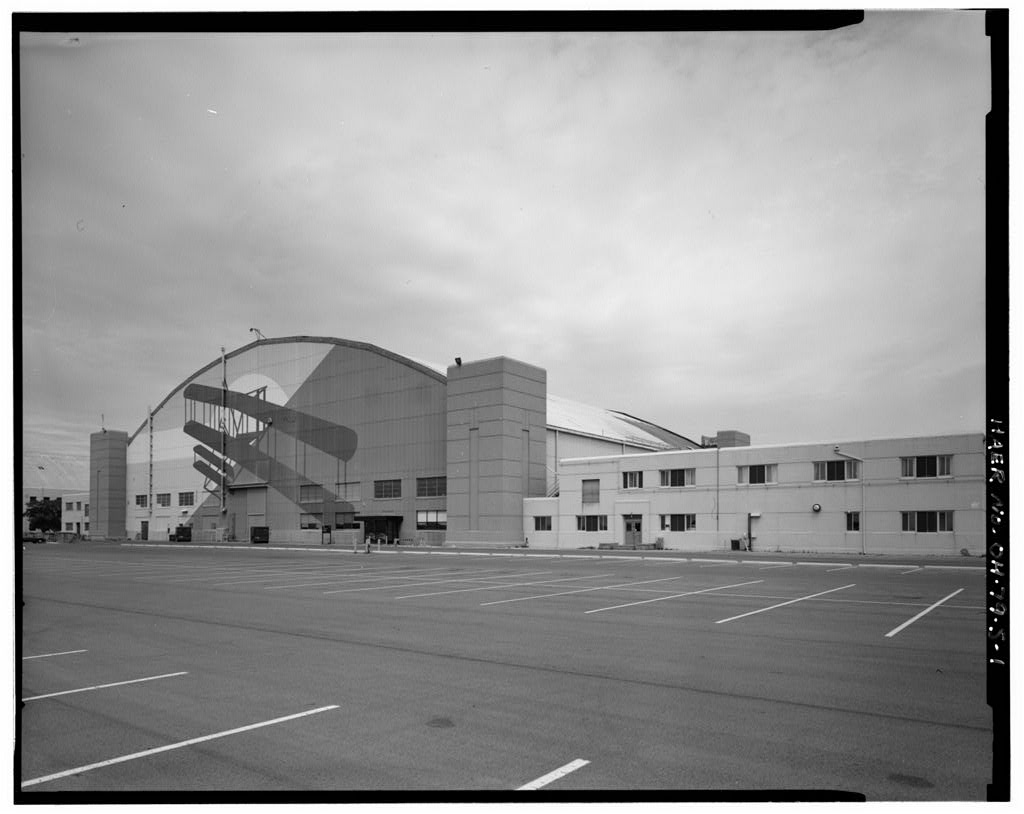
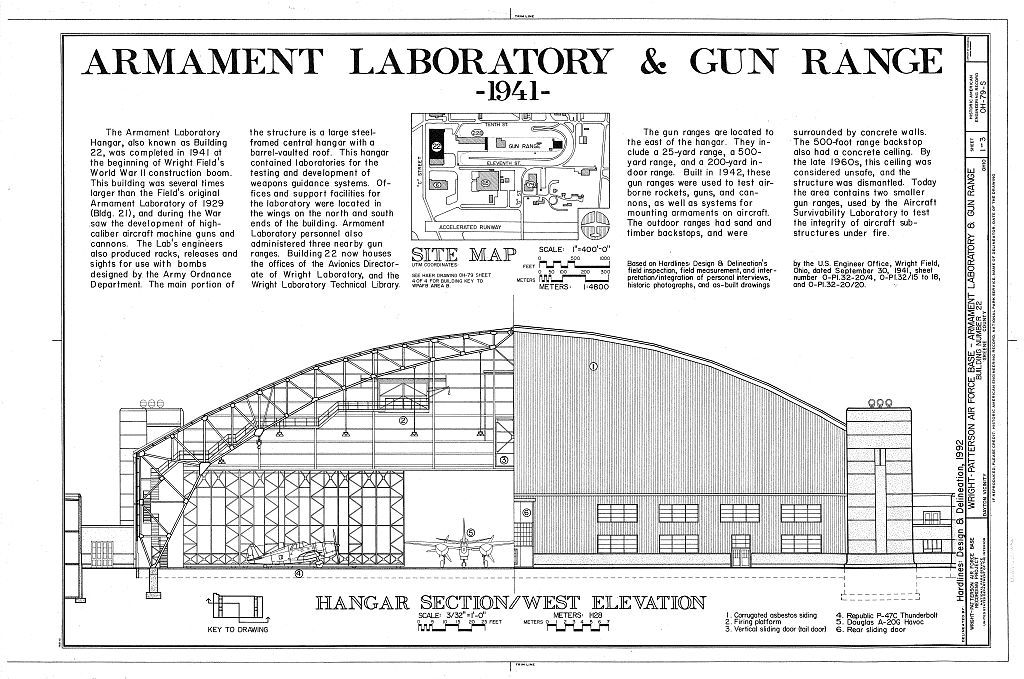
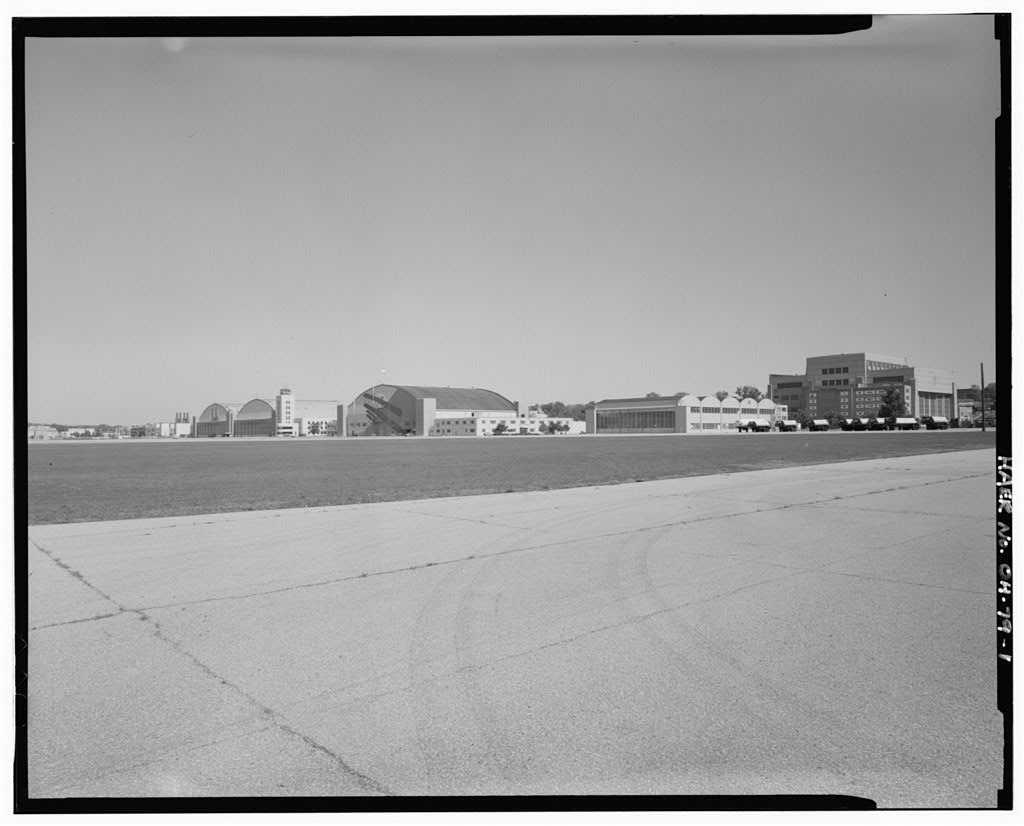
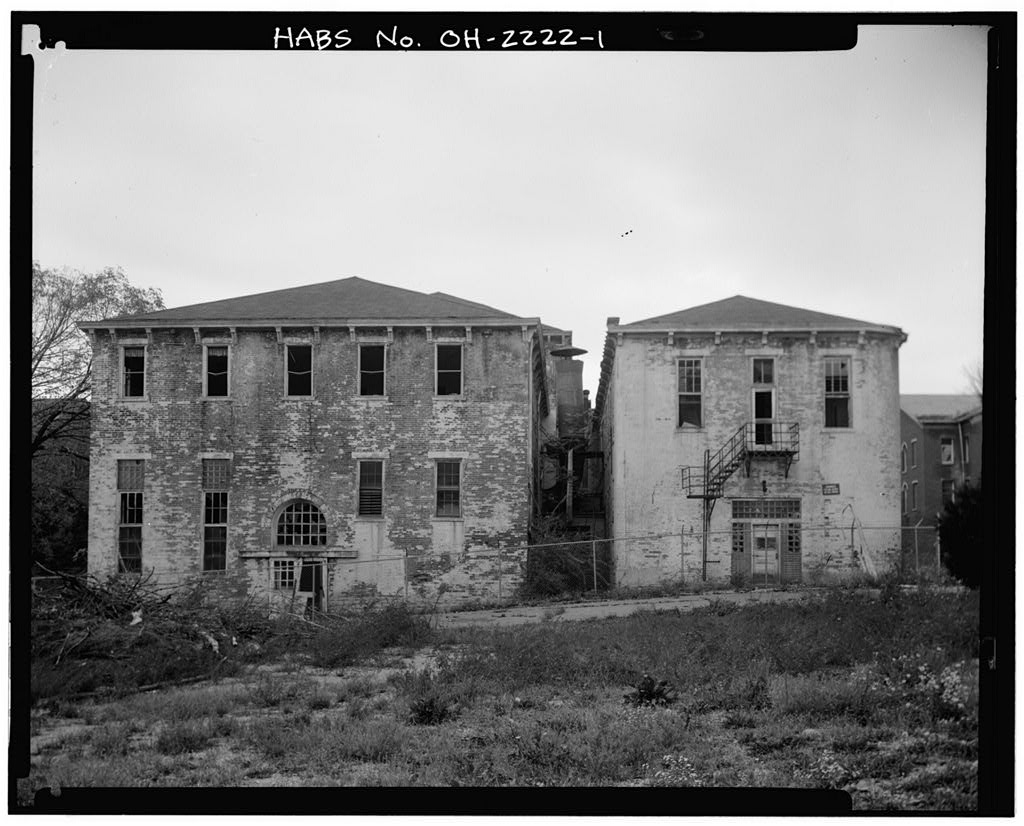
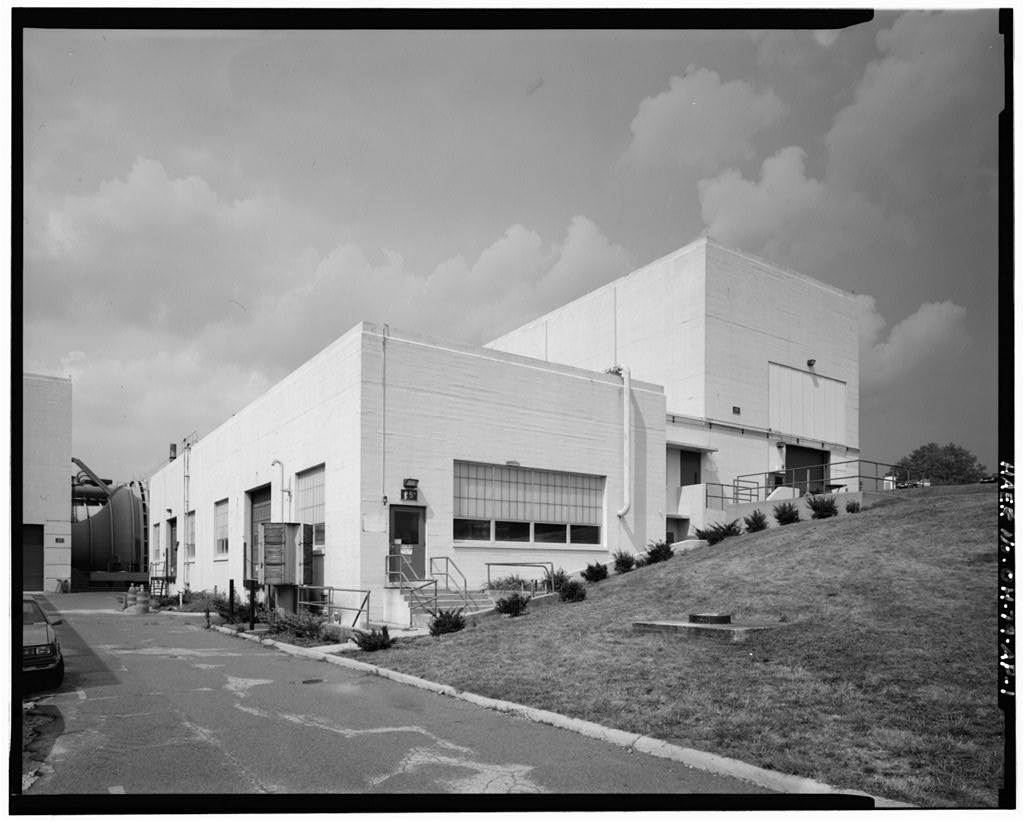
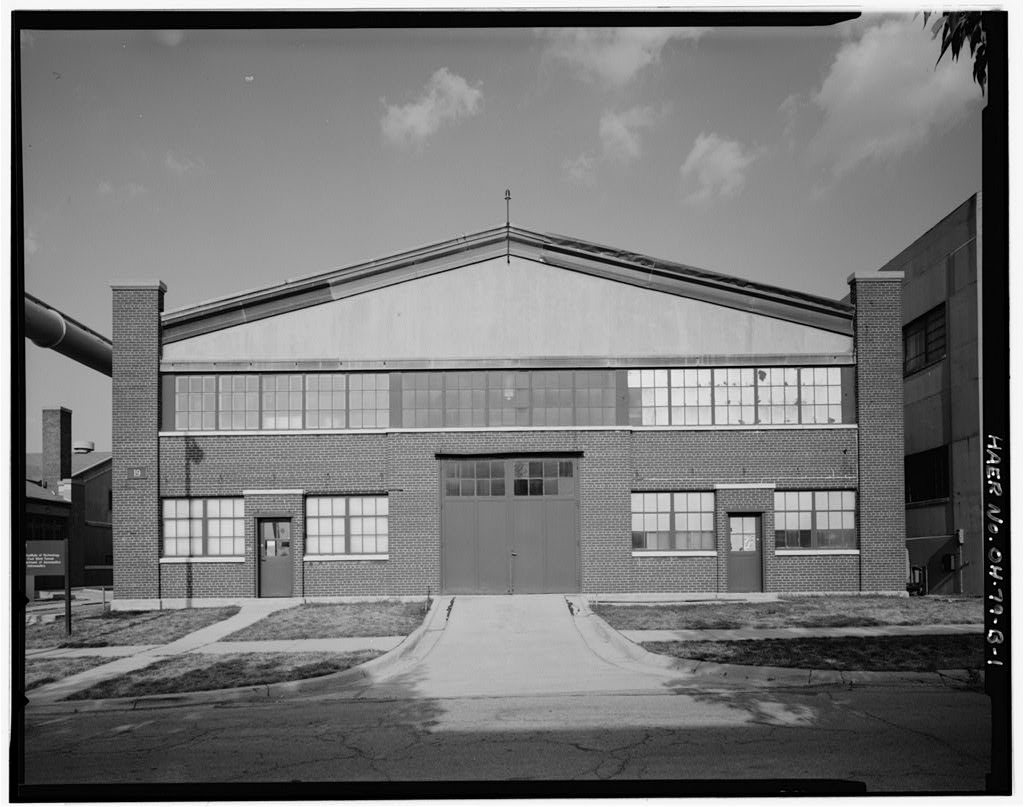
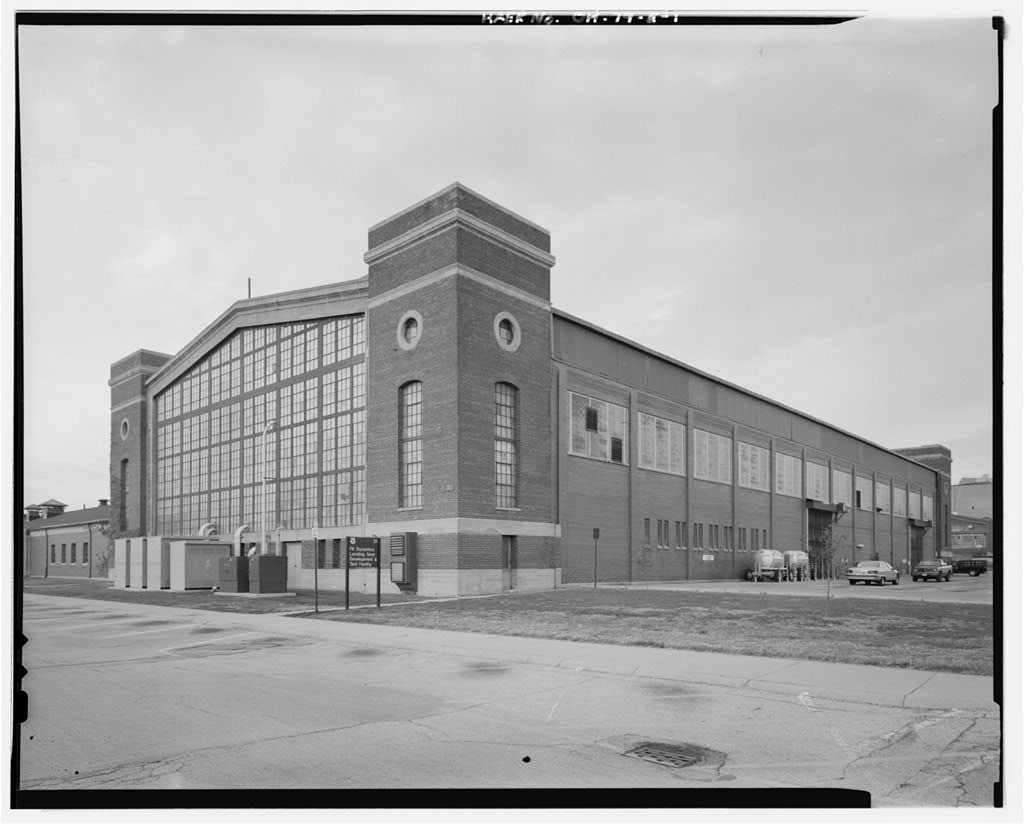
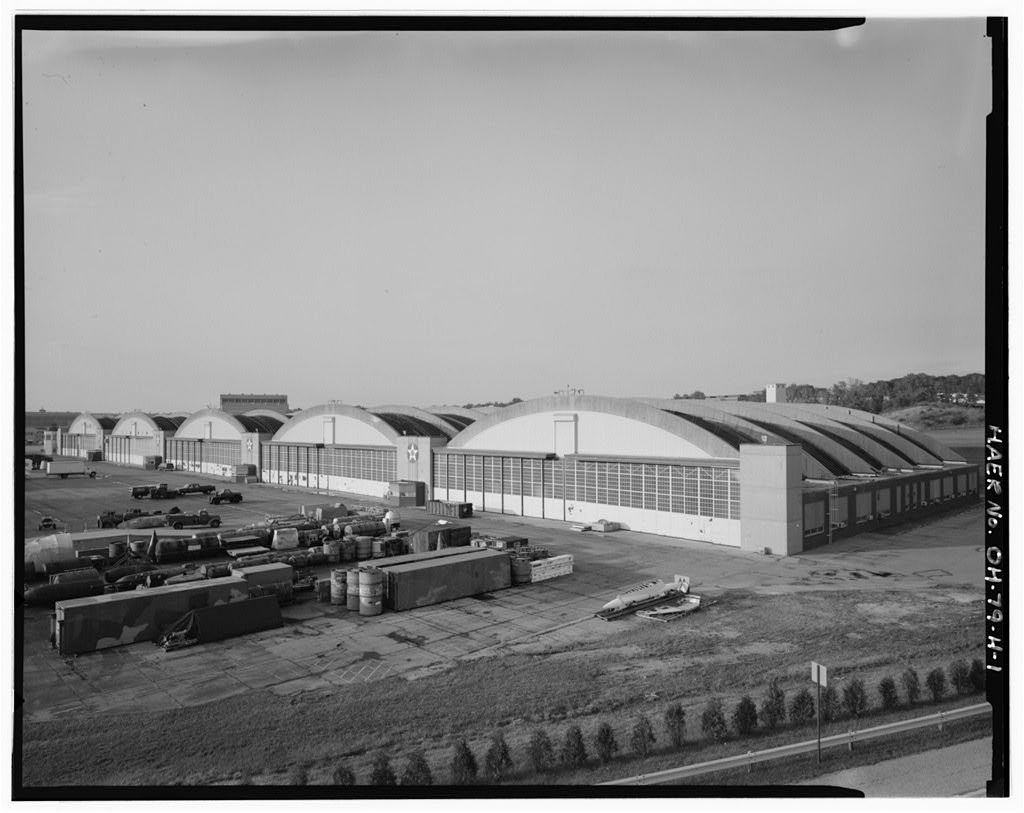
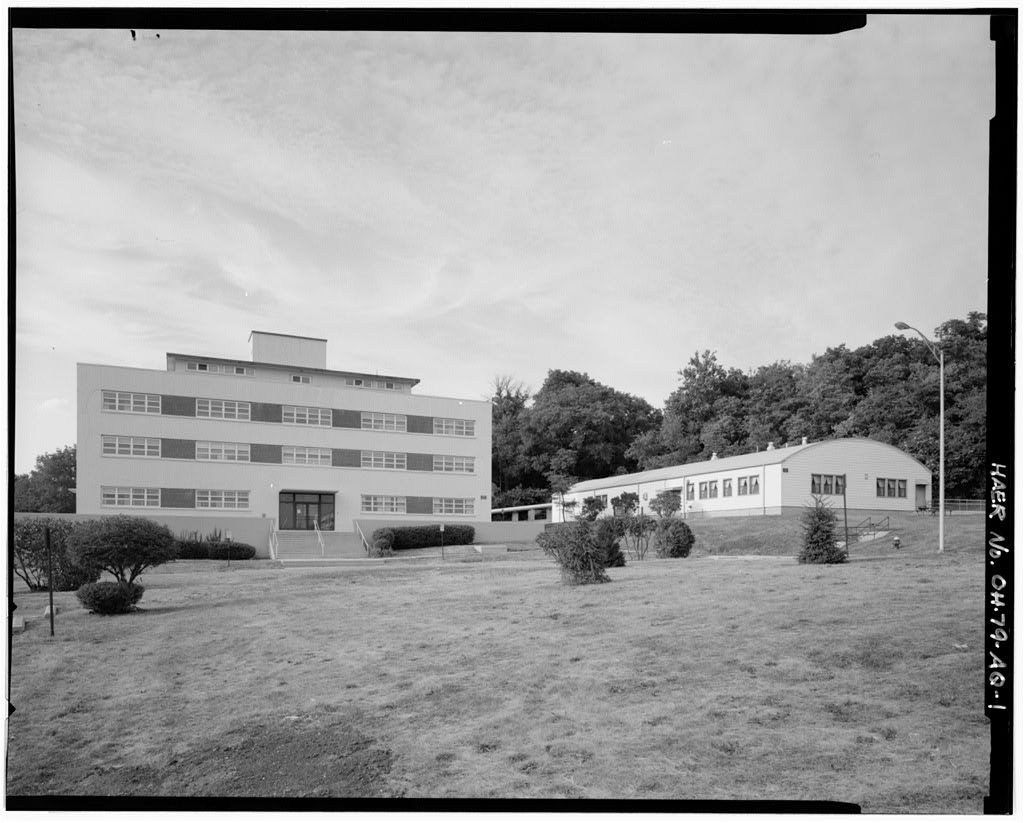
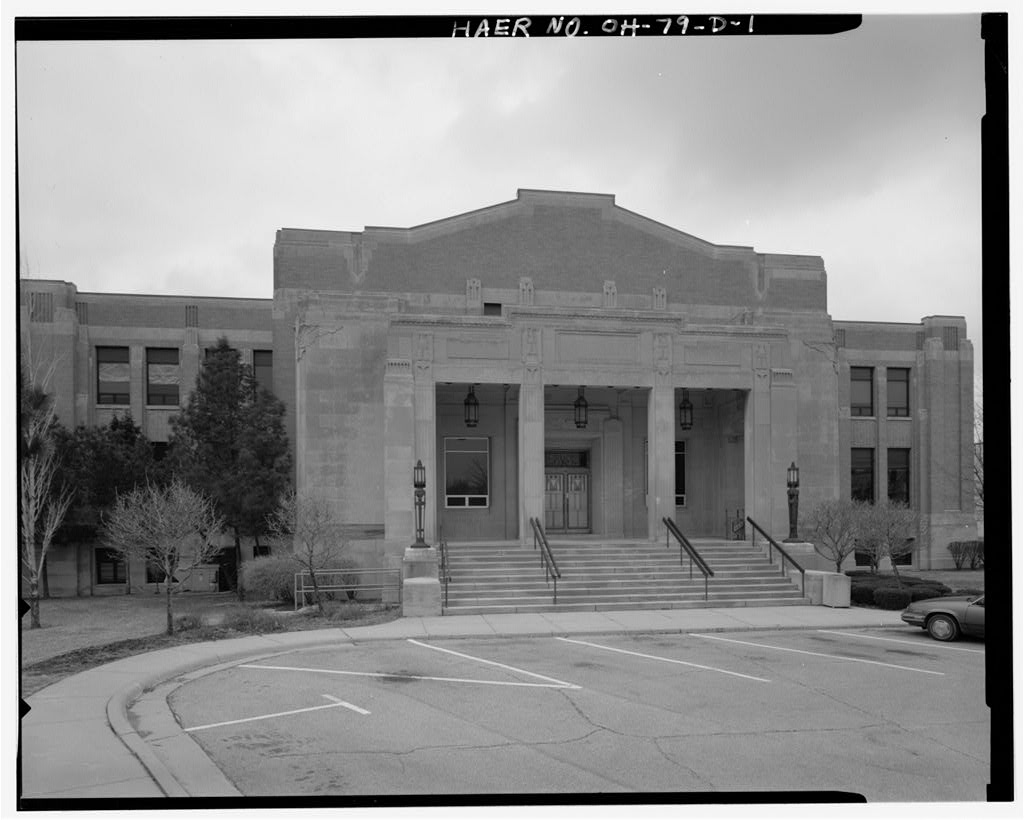
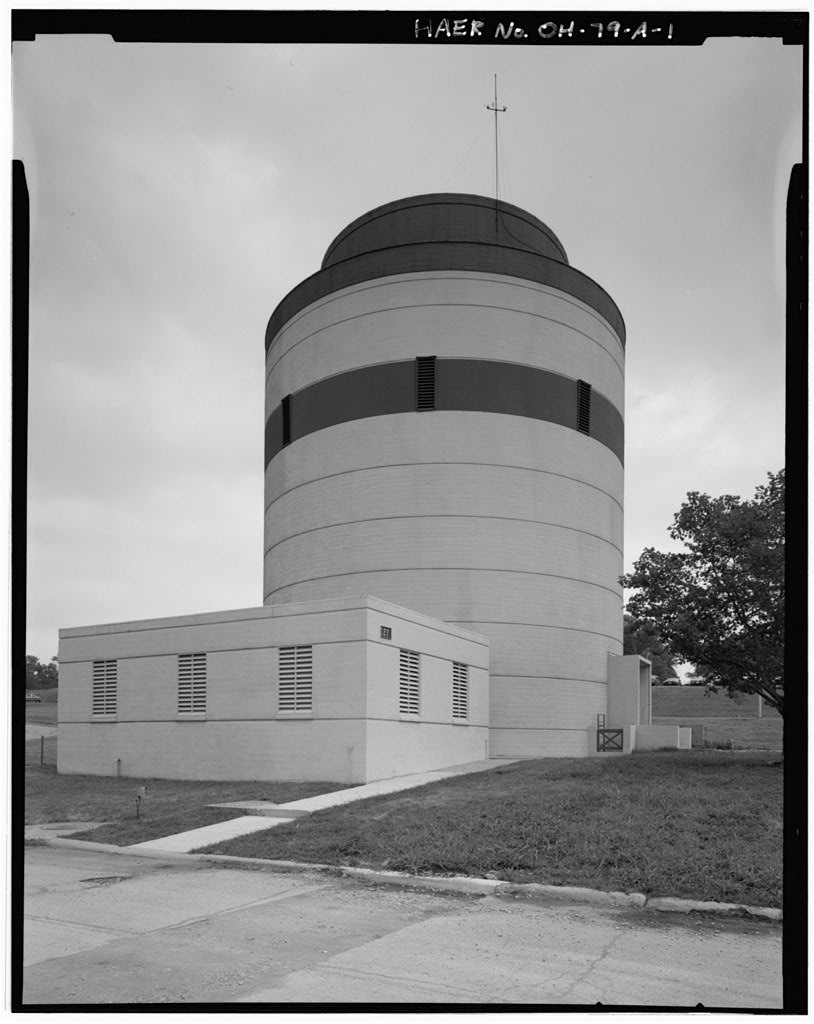
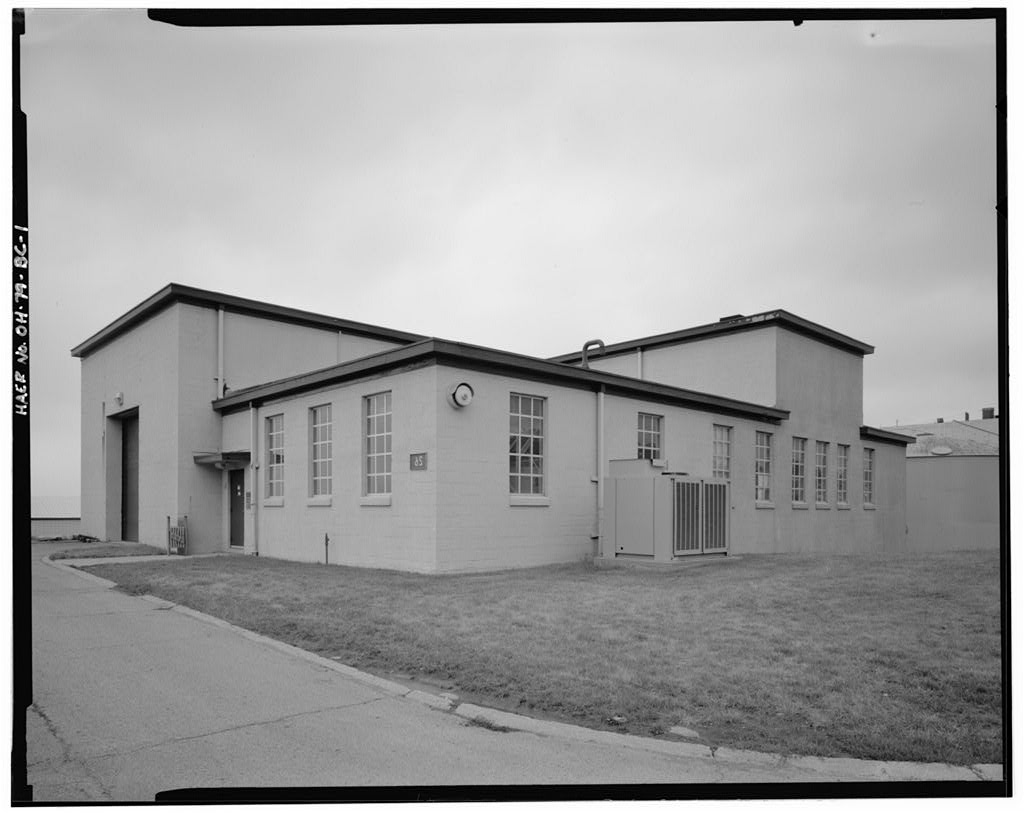
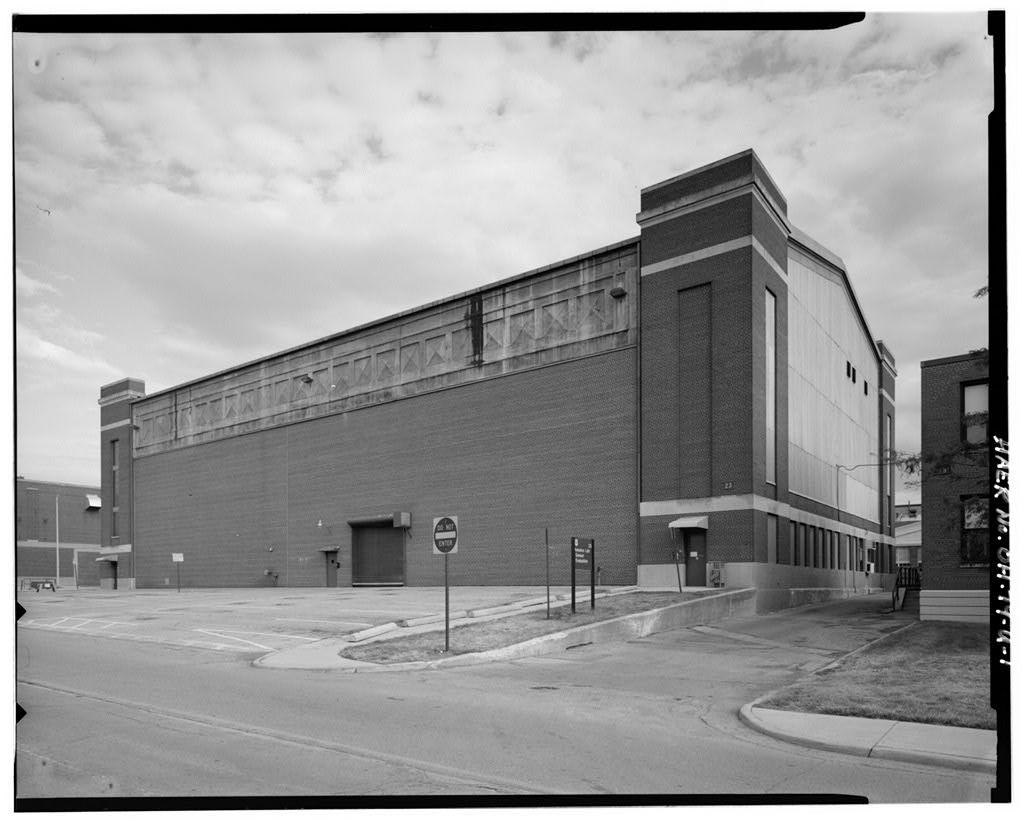
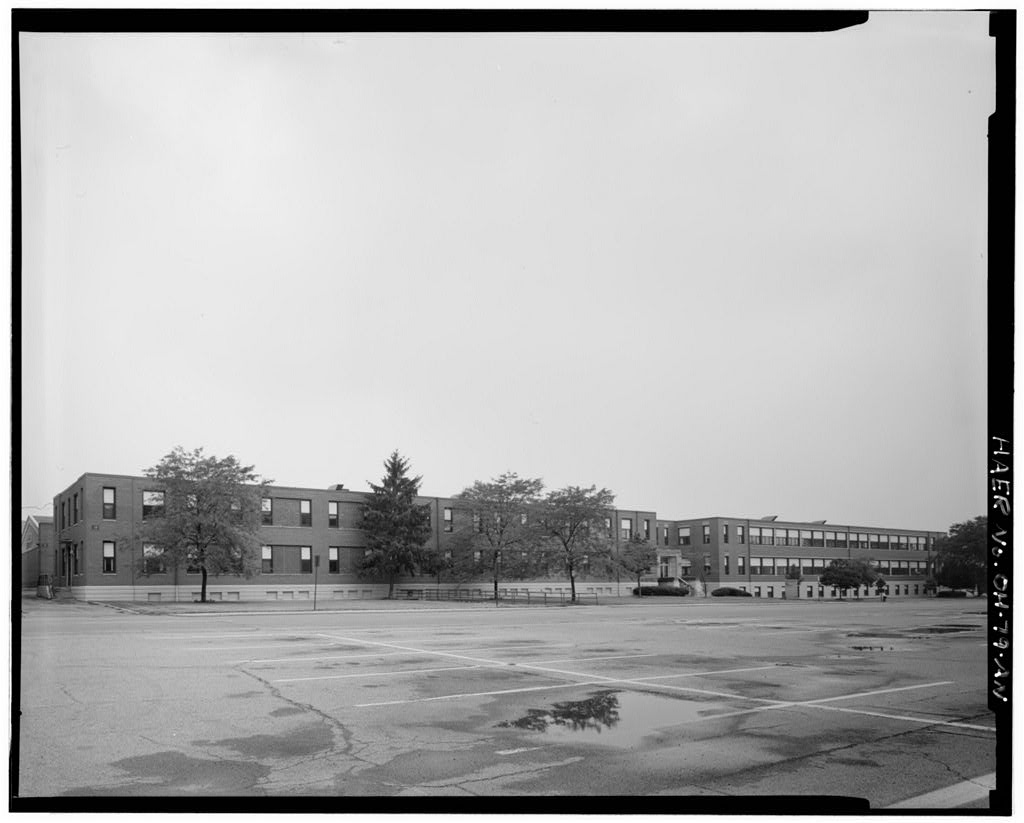
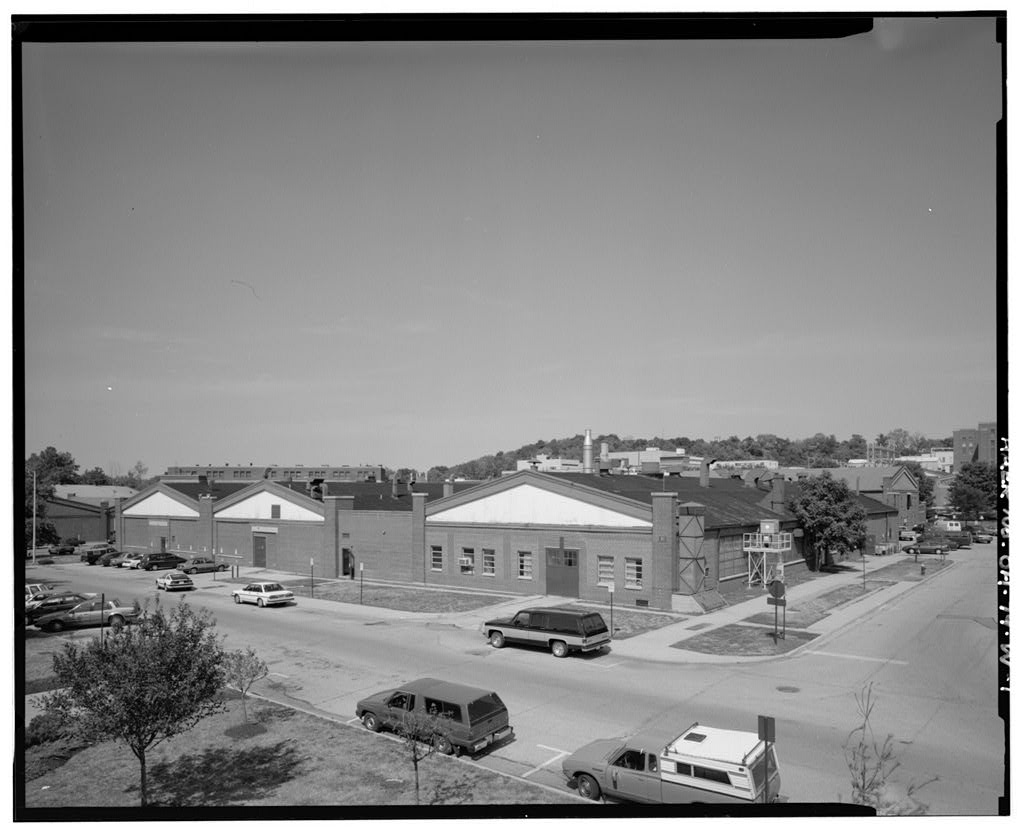
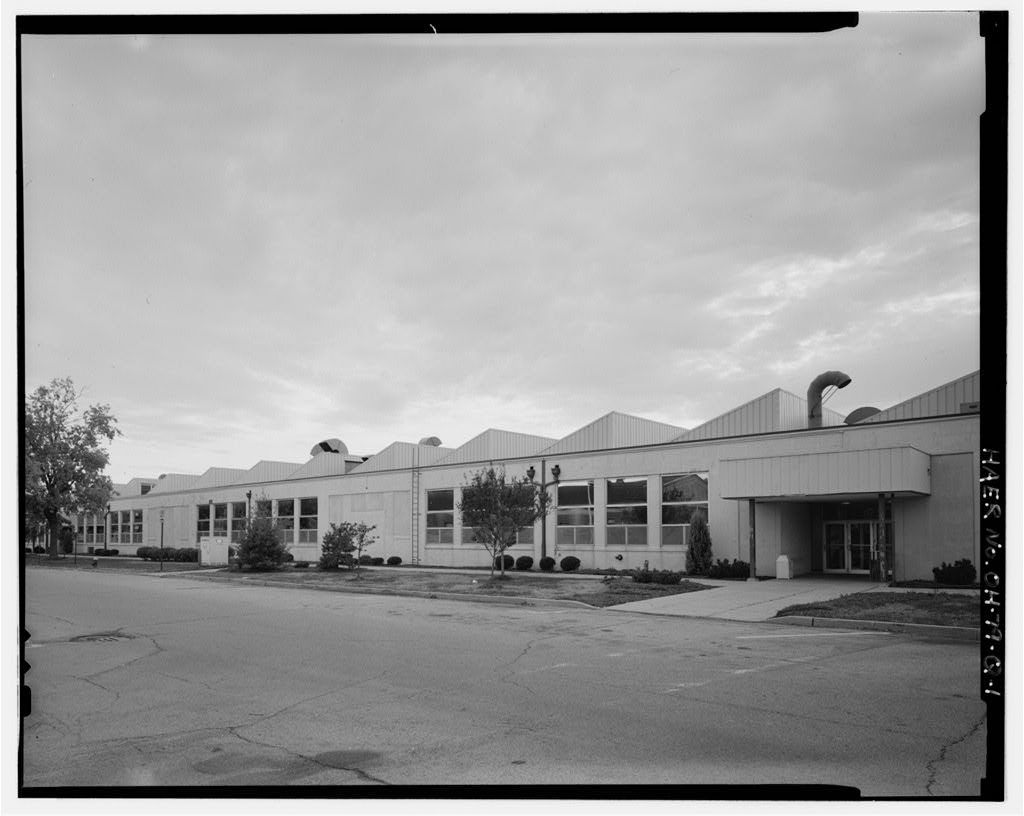
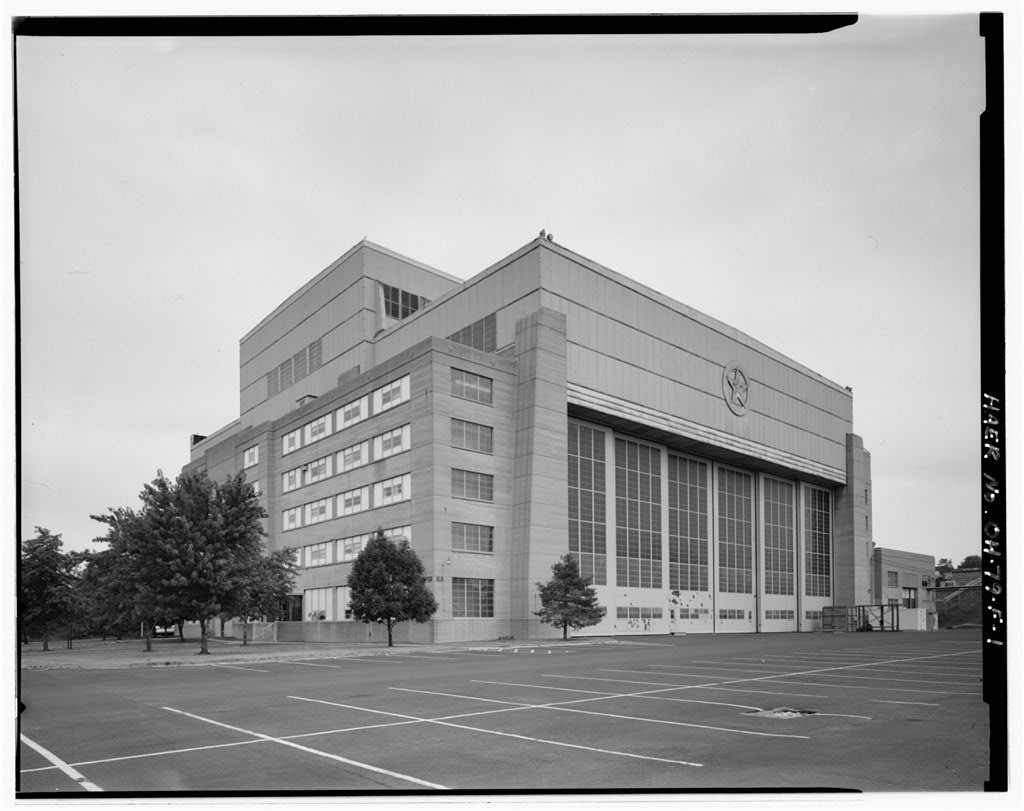
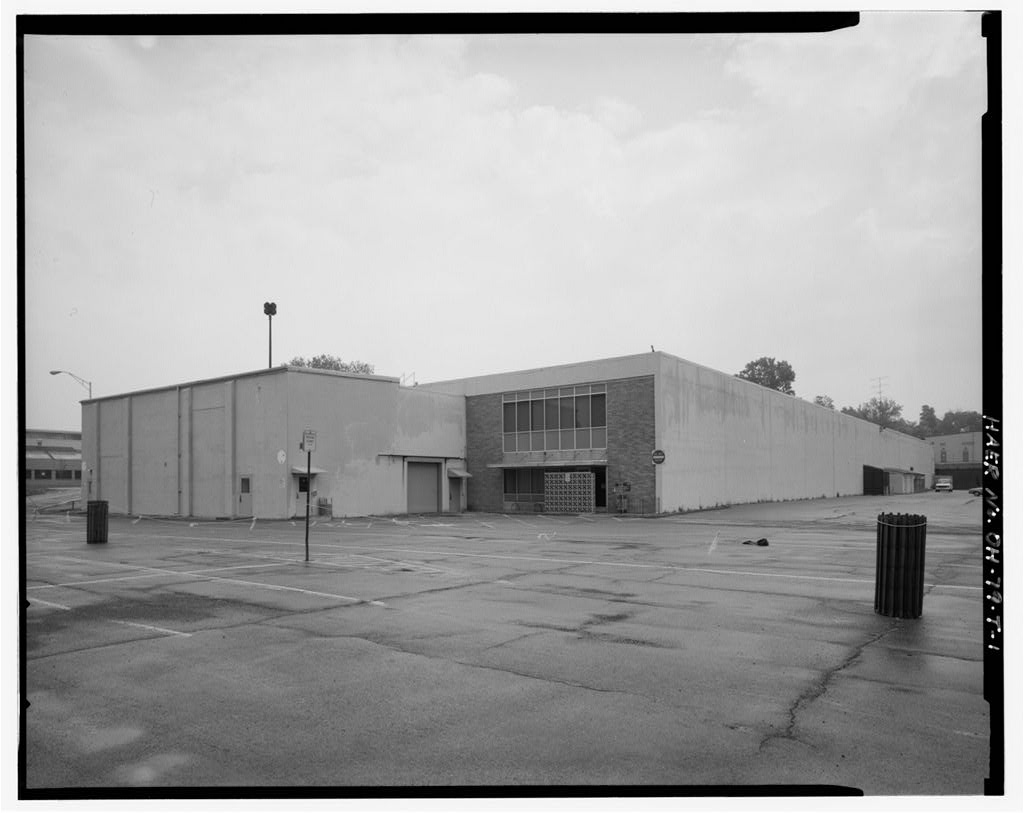
The Armament Laboratory incorporates three interconnected sections. The main portion of the structure is a large steel-framed central hangar with barrel-vaulted roof measuring x The hangar faces east toward the gun range and has large doors consisting of metal-framed windows suspended on rollers. There are tall concrete towers at all four corners. Two smaller concrete wings are attached to the north and south ends. These are rectangular cast-in-place concrete structures, each with a ten-bay front. Originally, these sections were both 51' wide, and and 233 ' long, respectively, but in a two-story addition increased the south wing to twice its original size. Building 22B (the 200 Yard Gun Range Structure) stands to the east of Building 22, on the north side of the Gun Range.
HISTORY: Wright Field's construction boom of World War II increased the number of buildings at the installation almost eight-fold. Building 22 was the first new structure to be completed along the flightline, built in to accommodate the expanded wartime activities of the Materiel Command Armament Laboratory. Building 2 2 was several times larger than Building 21, the Old Armament Laboratory (as it became known) and the hangar's personnel also administered three nearby gun ranges.
These included a 25-yard range adjacent to the hangar, an enormous 500-yard gun range which extended to the east of the hangar, and a 200-yard indoor gun range also to the east and listed separately as Building The two wings were used to house offices and support facilities for the Armament Laboratory, while the hangar itself contained laboratories for the testing and development of weapons guidance systems. The main object of these efforts was a guidance system that would function in a variety of environments.
A report on research and development facilities of the Wright Air Development Center (WADC) stated that Building 22 "contained the most complete environmental equipment in the Air Force." The facility included ten test chambers: Chamber Operational Date Heat and Cold Systems Altitude Firing, Cold, Heat, Humidity, and Temperature Shock (Contained a Firing Range) 194 3 Stratosphere 194 7 Heat Arctic Altitude Systems Humidity Heat, Cold, and Altitude Systems and Components Climatic Humidity Climatic Humidity WRIGHT-PATTERSON AIR FORCE BASE, AREA B# BUILDING 22, ARMAMENT LABORATORY HAER No.
OH-79-S (Page 3) At the founding of the Air Force as a separate military branch in this facility was responsible for research and development on weapons guidance and control systems only, while the Army and Navy developed guns, bombs, and rockets. In the Air Force Armament Center at Eglin Air Force Base took over these responsibilities, while the Armament Laboratory at Wright-Patterson continued its same mission. In the Navigation and Guidance Laboratory in Building 22 became part of the Avionics Division of the Wright Air Development Division (WADD), and in it became the Navigation and Weapon Delivery Division of the Air Force Avionics Laboratory. Prior to Building 22 also contained the Electromagnetic Warfare and Electromagnetic Warfare Applications Branches of the Avionics Laboratory.
Building 22 currently houses offices of the Avionics Directorate of Wright Laboratory, but the laboratories themselves have moved to more modern facilities on base. Two major Air Force technology programs also have their headquarters in the former Armament Hangar. These are PRAM (Productivity, Reliability, Availability, and Maintainability) and RAMTIP (Reliability And Maintainability Technology Insertion Program). PRAM is responsible for directing the development and improvement of various generic aircraft systems, while RAMTIP explores methods to enhance present and future aircraft systems by inserting new technologies into them.
Finally, the Wright Laboratories Technical Library is located in a free standing structure inside the hangar which was constructed for the library in In a mural of the Wright Flyer (the Wright Brothers' first airplane) was painted on the front facade of the hangar to commemorate the fortieth anniversary of the Air Force. Outdoor Gun Ranges Like most engineering facilities, the Army Air Force Materiel Command Armament Laboratory at Wright Field required a test area for the products of its research. In this case it was a complex of three gun ranges to the east of Building 22, the Armament Laboratory Hangar. A 25-yard gun range, completed in was located immediately to the east of the north wing of the building.
It had a timber and sand backstop enclosed with concrete walls and was used as a bullet stop for the projectiles from guns being tested at low temperatures in the firing cold chamber. The aircraft cannon was the largest gun fired on this range. A 500-yard gun range, also built in was surrounded on three sides by an earthen embankment in the form of a hairpin. A WRIGHT-PATTERSON AIR FORCE BASE, AREA B, BUILDING 22, ARMAMENT LABORATORY HAER NO. OH-79-S (Page 4) sand and timber backstop at the closed end of the range protected the earthworks from erosion by the projectiles. On both sides of the backstop, 69'-high reinforced concrete walls supported a reinforced concrete ceiling 90' high at its center.
The walls and ceilings served to catch projectiles which ricocheted off the backstop, and a timber covering on the underside of the ceiling protected the concrete from damage. Although the range was 500 yards long, test specimens were seldom fired or fired at from this distance. The gun was usually brought up and anchored quite close to the backstop whether the gun or the target was the test specimen. Airborne fire control equipment such as rocket guns, all sizes of machine guns and cannon, gun turrets, and the like were tested for mechanical operation and performance on this range. The range was used to fire shells of up to 7 5mm at airplanes, running aircraft engines, oxygen tanks, leak-proof fuel tanks, and other aircraft components.
The Wright Field fire department stood by with carbon dioxide (cardox) equipment when flammable materials were involved in the tests. By the late the original backstop in the 500-yard range was rarely used. The structure's roof was considered a potential safety hazard, and base officials decided to tear it down. The demolition effort succeeded, but the concrete slabs were so well reinforced that breaking them into pieces for removal proved more difficult than imagined, and the rubble was left where it fell. Today the area contains two smaller and more modern gun ranges designated Range 2 and Range 3. These ranges are used by the Aircraft Survivability Laboratory to test the integrity of aircraft substructures under fire from foreign-made weapons.
Substructures tested include wings, stabilizers, fuselages, fuel tanks, cockpit canopies, and instrument casings. Range 2, located on the north side of the original backstop, was erected in the mid-1970s and is called a "shoot and look" range. Small target specimens are fired upon and then examined visually to assess the damage and determine methods to reduce damage in the future. The gun is fired on the object from distances of around To realistically simulate long-range fire, the amount of powder in the ammunition cartridges is reduced, thus lowering the projectile speed to the desired level. The powder is loaded into the bottom of the cartridge next to the primer and the remainder of the normal powder space is filled with rice puffs.
These occupy space to keep the powder in place, but the explosion instantly pulverizes them with insignificant energy loss. Range 3 is an elevated gun range constructed of steel and WRIGHT-PATTERSON AIR FORCE BASE, AREA B, BUILDING 22, AKMAMENT LABORATORY HAER No. OH-79-S (Page 5) concrete to the south of the original backstop in the late 19 Because the target specimen is located on a platform, it can be fired upon from the front, back, bottom or top without being moved. In the early jet engines were added to the apparatus so that their by-pass air could simulate the airflow associated with an aircraft in flight. Ducts direct this air to blow across the test area at normal jet speeds of several hundred miles per hour.
This airflow makes the gunfire simulation more realistic by spreading fire (and sometimes extinguishing it) , applying structural loads, ripping weakened pieces away, and peeling apart damaged composite laminations. Tests on both of these gun ranges are administered from a concrete blockhouse to their west, constructed in This building contains computers which record and process experimental data and can control the firing of guns. Cameras are also controlled from the blockhouse and can record impacts with both normal and high-speed video and still cameras. Blockhouse instruments also control and monitor Range 3's infrared system, which can identify interior fires and can also see through carbon- dioxide fire-suppression clouds to reveal when fires are extinguished.
For additional information, see report for Building 2 00 Yard Gun Range Structure (HAER No. For bibliography, see Wright-Patterson Air Force Base overview report (HAER No. OH-79).
 Block
Block