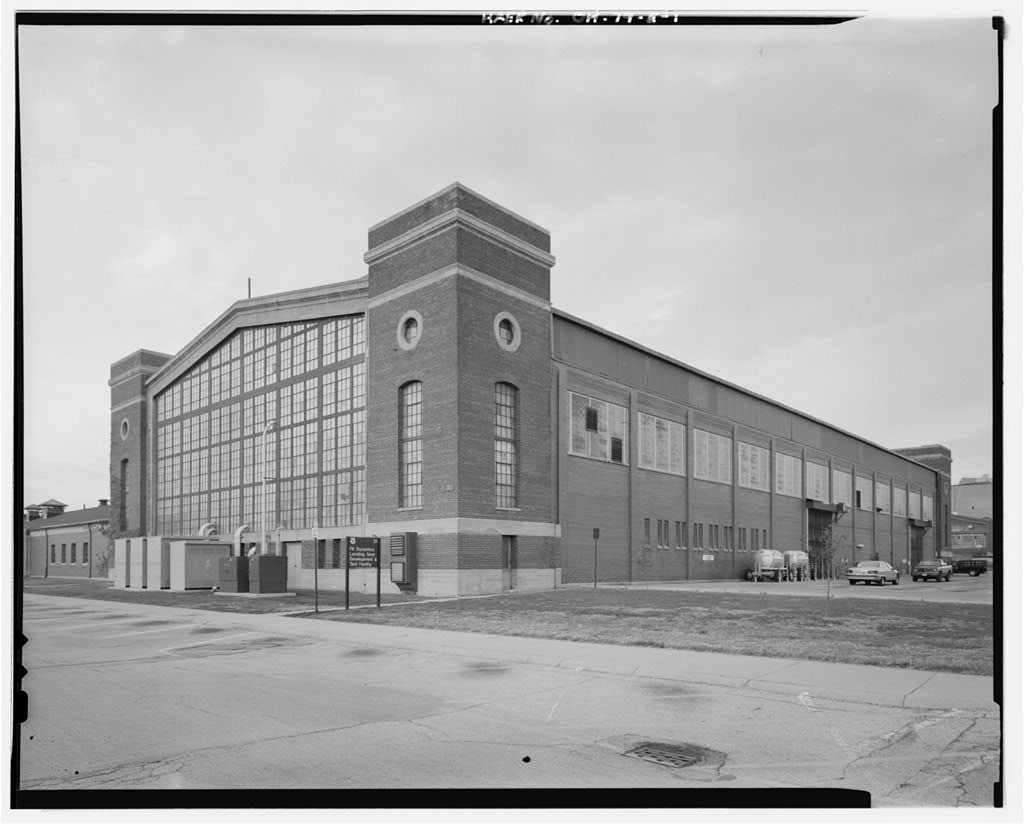
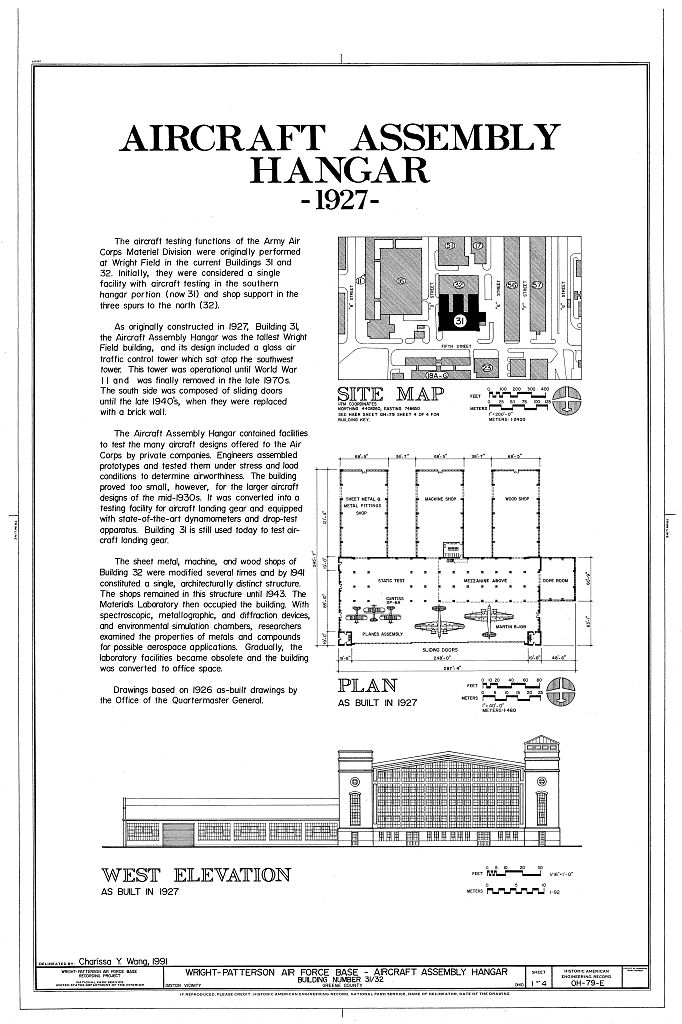
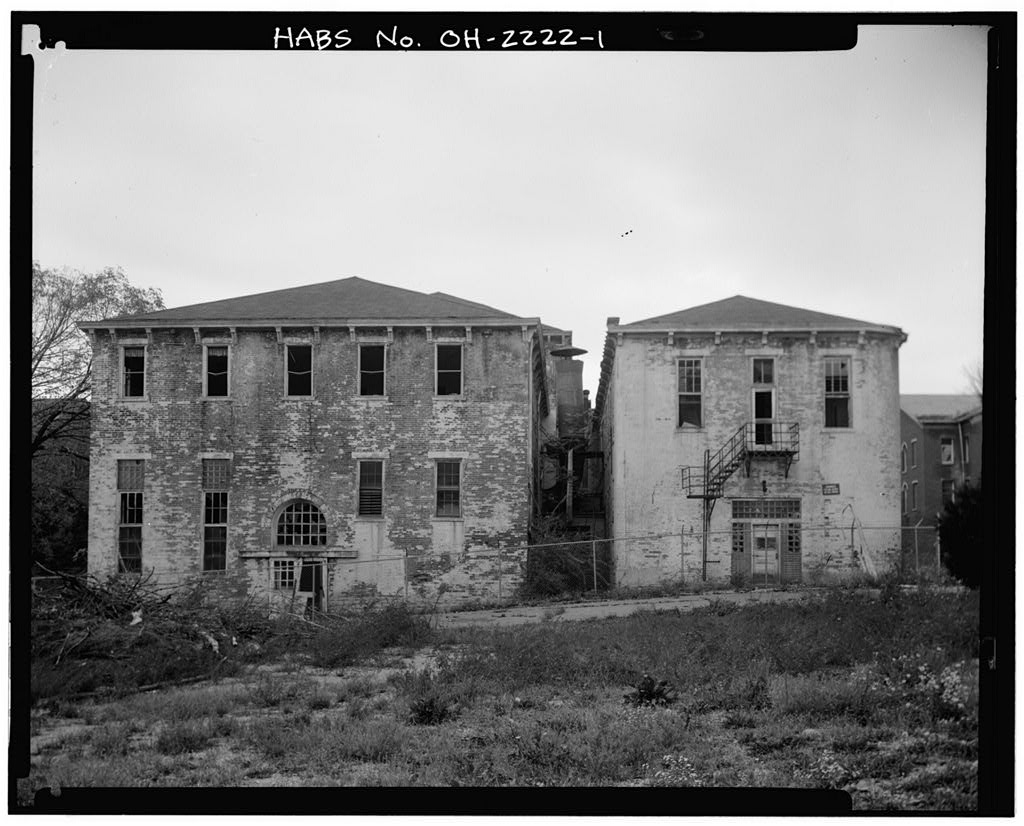
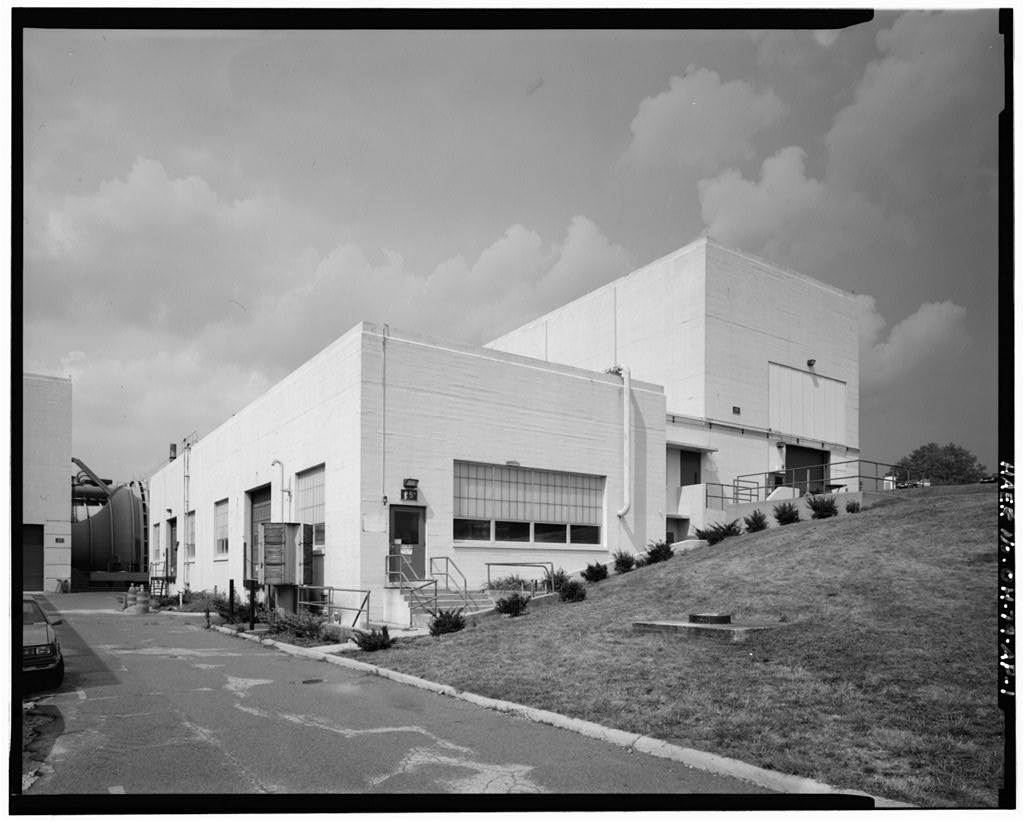
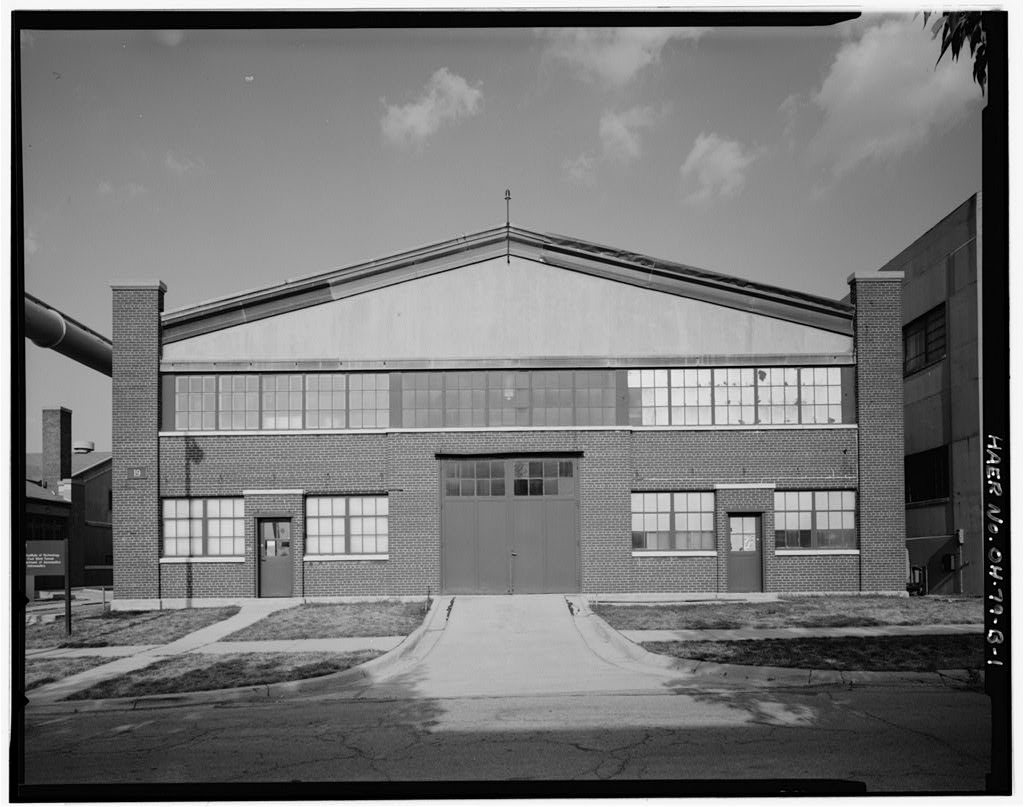
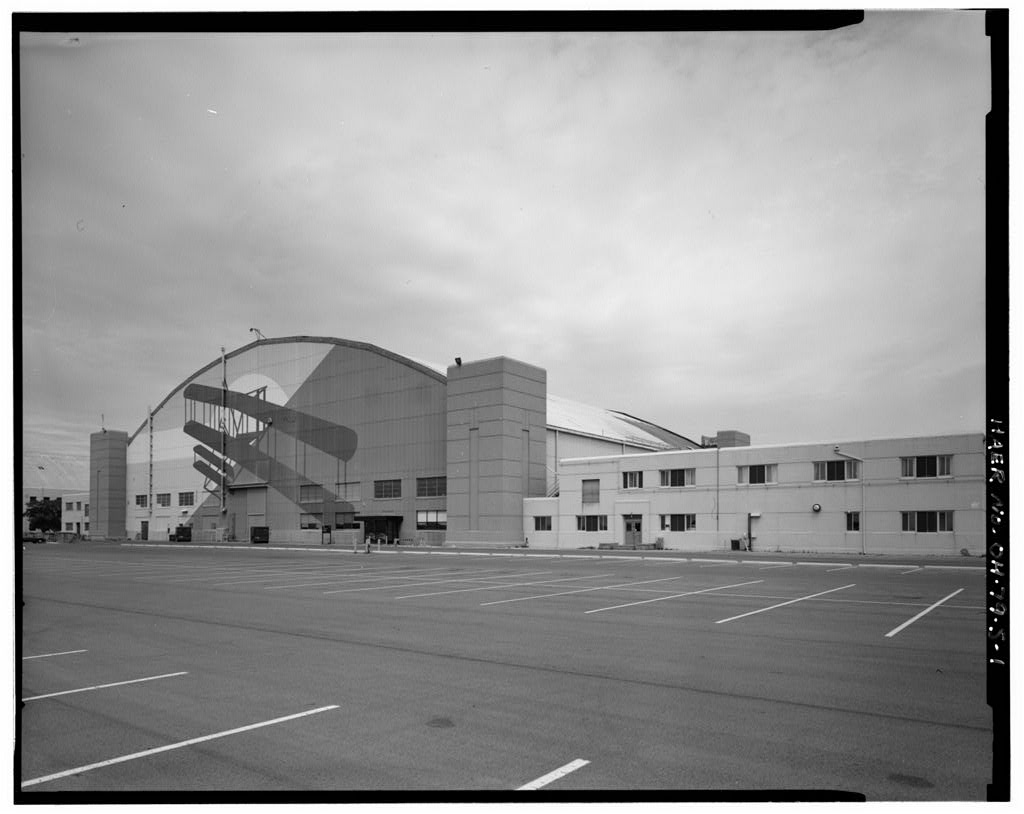
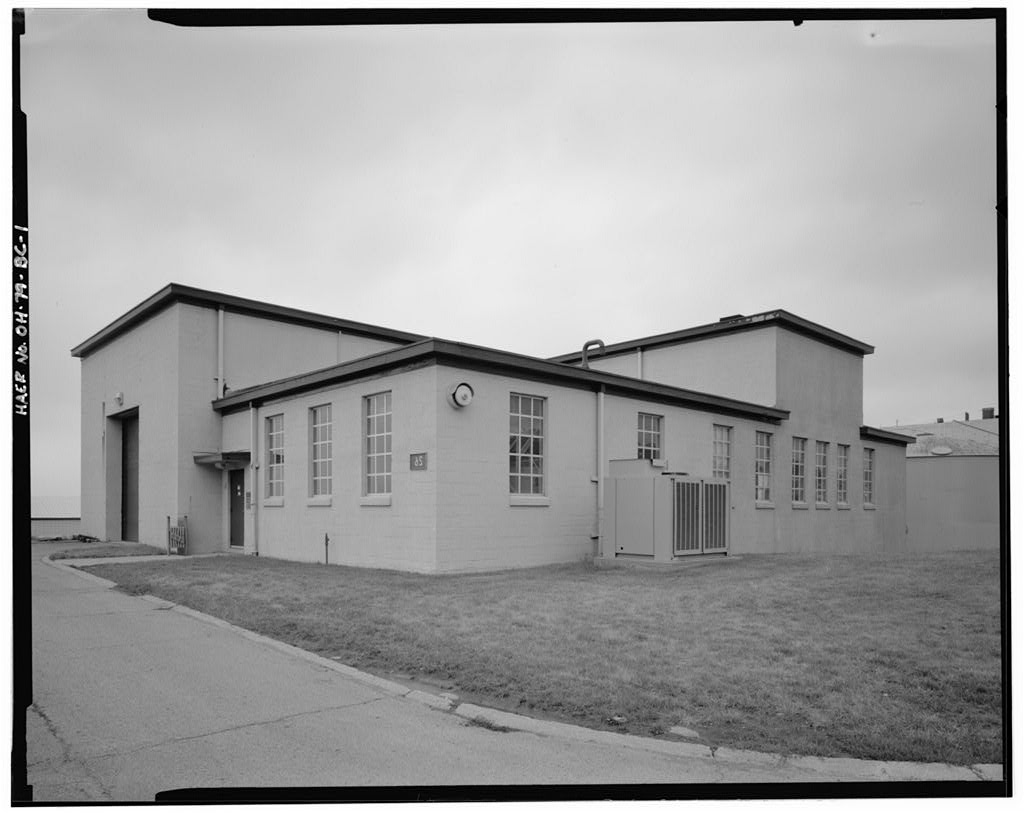
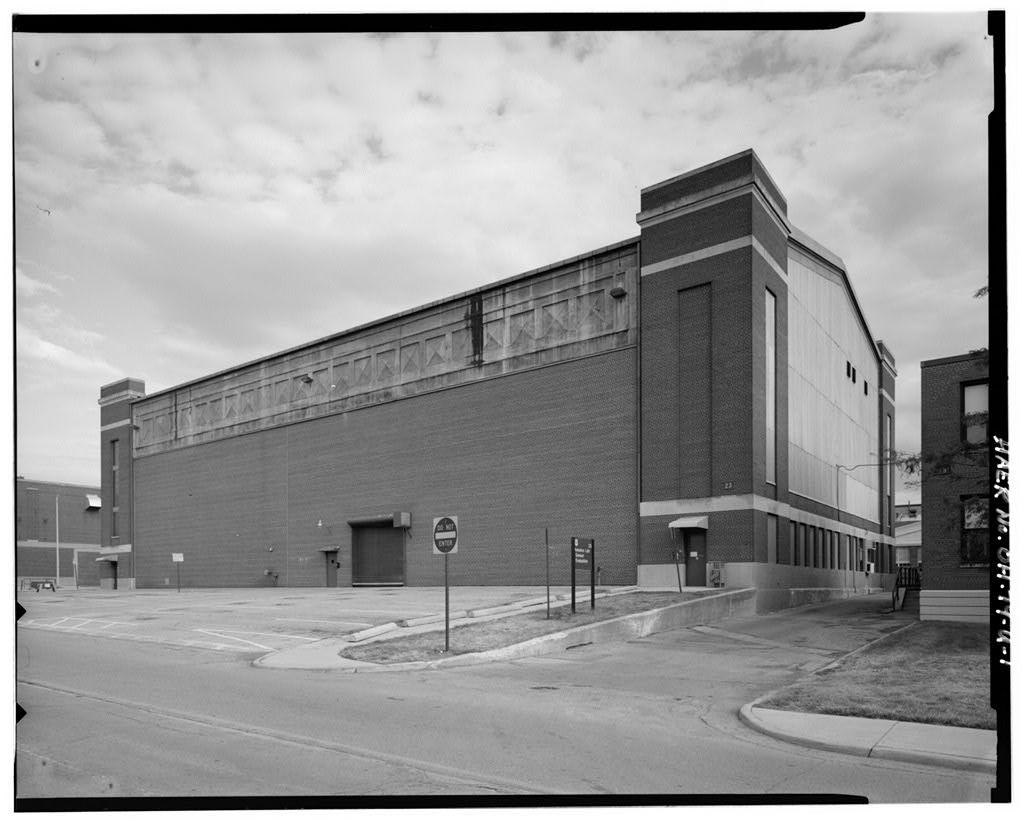
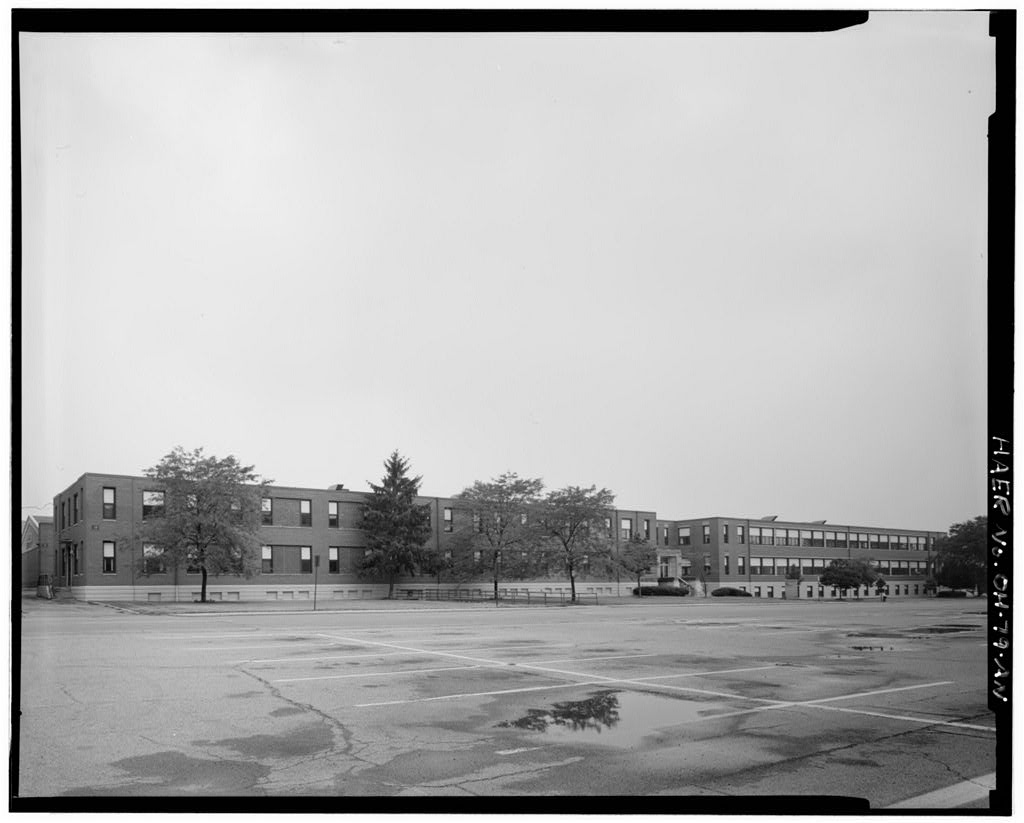
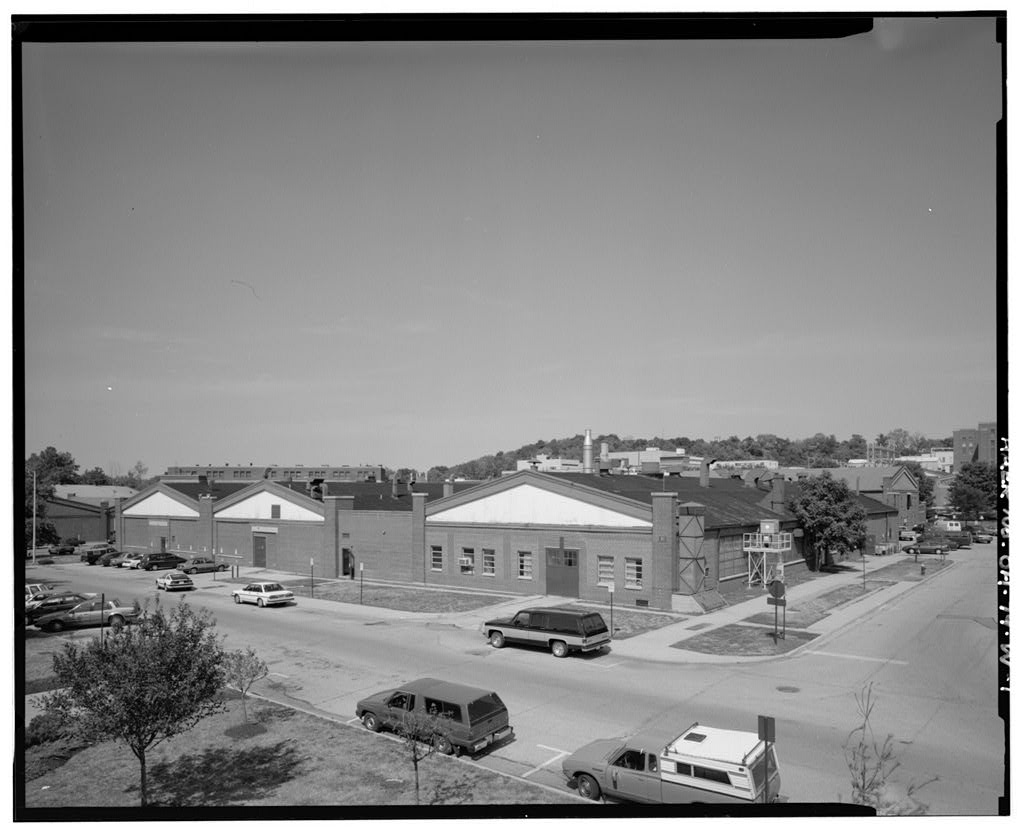
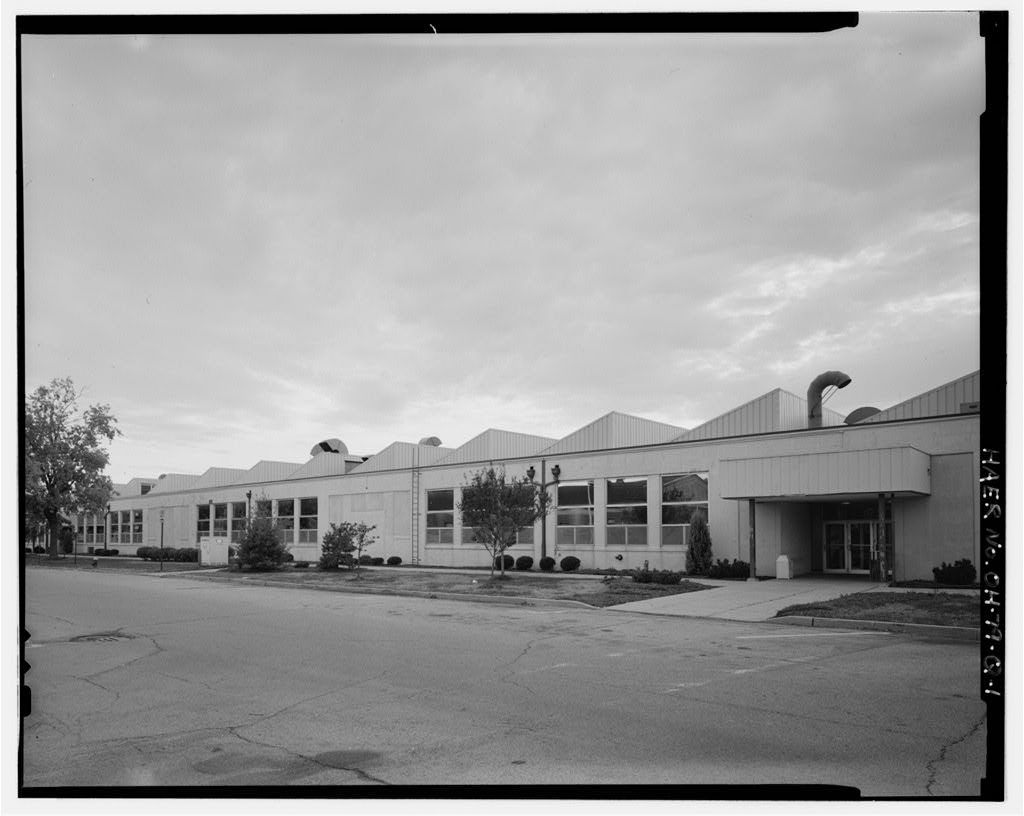
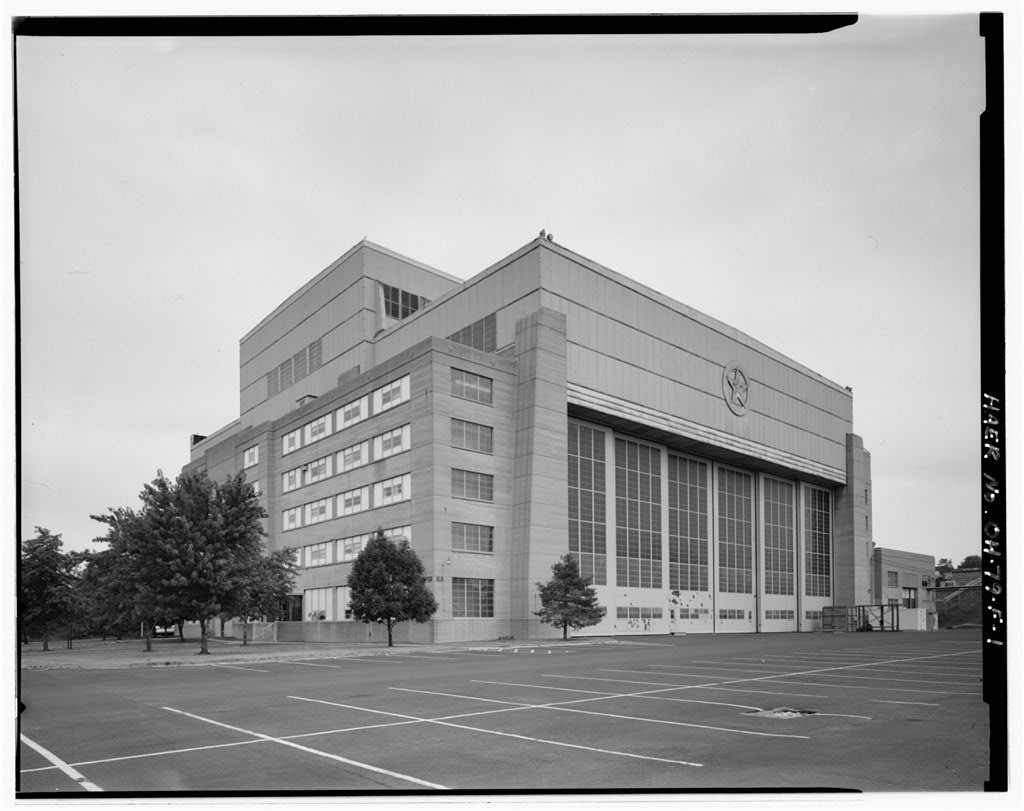
Building 31 is a imposing, single-bay structure with a center height of almost 55 1 Steel roof trusses on the northern half of this central space are supported by columns, but south of the building's axis the trusses are cantilevered, providing an uninterrupted area in which to park and maneuver airplanes. The concrete foundation and floor support brick walls of six-course, American bond brick beneath a low-pitched, single-gabled roof and wide copper entablature. The windows in the east and west ends are in a steel-sashed, factory format.
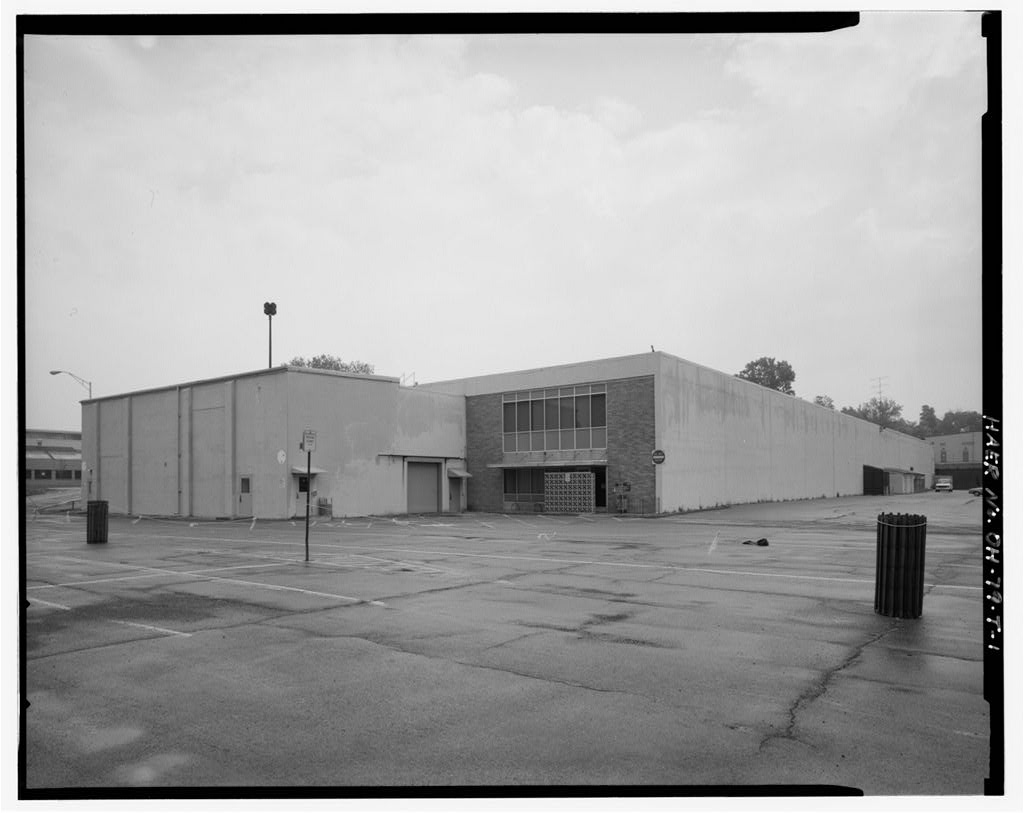
Large hangar doors originally occupied the entire south side, but as the building's function shifted away from experiments on whole airplanes in the late these were replaced by a brick wall with twelve bays of multi-pane, steel-sashed factory windows, two dock entrances, and double doors. The windows were soon filled in as well, because they shattered under the sudden air pressure fluctuations caused by bursting tires. A wide concrete band extends along the top of the twelve long windows in the south wall. Anchoring each corner are large square decorative towers. Single doors on two sides of each tower are topped by elongated Renaissance arch windows. Above the windows are glass-filled bull's-eyes with concrete surrounds and three more concrete belts trimming the brick exterior.
The original glass-enclosed Wright Field control tower perched on the southwest tower until its removal in the late It had been unused since a new tower was included with Building 8 in the flightline complex constructed in Attached to the east end of the building is an original 50 1 x 60' dope room. (Dope was a varnish-like substance used to waterproof and strengthen the cloth covering of early airplane wings.) In a transformer vault of 50 1 x 35 1 was added south of and adjacent to the dope room to support the increased electromechanical requirements of the improved facility. The aircraft assembly process in Building 31 was supported by the wood, metal and machine shops in Building 32 which are attached to the north wall of the hangar.
HISTORY: Building 31 was one of the original Wright Field buildings and was constructed simultaneously with Building 32, the original Wright Field engineering shops facility. (Until they were enlarged in these shops were considered part of Building The building was designed by the Office of the Constructing Quartermaster; the foundation was laid by Green and Sawyer, of Lima, Ohio; and the superstructure was built by E.H. Latham Co. of Columbus, Ohio. Its use as an aircraft assembly and test hangar required a lofty three-story height. Until it also housed WRIGHT-PATTERSON AIR FORCE BASE, AREA B, BUILDING 31, AIRCRAFT ASSEMBLY HANGAR HAER No. OH-79-E {Page 3) static test facilities.
In the and Building 31 began to host research and development on aircraft wheel assemblies and landing gear, and those vital functions have remained there ever since. During the first decade of Wright Field's existence, Building 31 was certainly one of the most vital components of Wright Field's commitment to aeronautical engineering. Engineers in Building 31 tested virtually every model of aircraft that entered Air Corps service through World War II, and discovered the flaws that prevented many other aircraft from entering service. Contemporary photographs are replete with airplanes inside the assembly hangar and outside, either parked or traveling to and from the flying field to the southwest.
The assembly hangar bustled with activity throughout the a period when much of the American military establishment was neglected due to isolationism and the Depression. Aeronautical technology was the cutting edge of military engineering throughout the world, and the United States Army Air Corps was able to carry on its work, albeit under budget constraints. The Air Corps brought to Wright Field all prototype airplanes it wished to test. Before flight testing could begin, engineers and technicians in Building 31 assembled the aircraft and performed laboratory tests on the planes and their various structural components.
The Materiel Division of the Air Corps had the responsibility to test the structural strength of all aircraft obtained from contractors by the Air Corps and to develop improved methods of assembling them. The structures testing in Building 31 continued the earlier work of the Airplane Engineering Division at McCook Field. Engineers calculated the maximum strength of essential structures both at rest and in motion. During static tests the aircraft were held at rest and loaded with lead bars or shot-filled bags until failure occurred or the strength was judged sufficient to support the aircraft in any mission. The dynamic testing involved lifting the structure under examination to a specific height and angle and then dropping it.
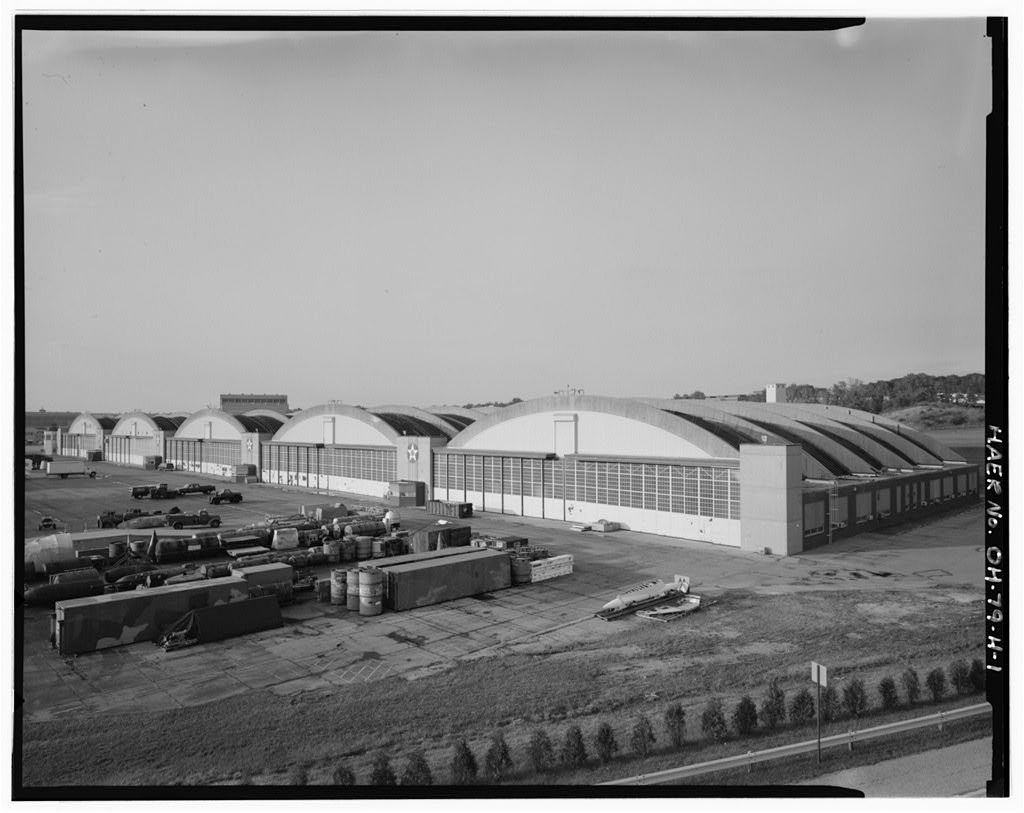
By selecting appropriate positions from which to perform the drops, simulations of specific landing conditions were duplicated. These tests ensured that aircraft and their wheel assemblies could sustain the repeated shock and jar of landing. In December of all static test operations moved to Building 23, a newly completed facility specifically constructed for that function. The aircraft assembly operation remained in Building 31 until World War II, by which time most military aircraft were too large to allow efficient use of that interior WRIGHT-PATTERSON AIR FORCE BASE, AREA B, BUILDING 31, AIRCRAFT ASSEMBLY HANGAR HAER No. OH-79-E (Page 4) space, and new hangars had been constructed along the improved flightline.
This allowed the mission of Building 31 to shift to more specific, but equally vital operations that it has retained to this day. In a wheel brake and tire research facility was set up in Building 31, and in a landing gear test facility also began functioning. These performed research and development on landing gear systems and components, including wheels, tires, inner tubes, braking systems, shimmy and steering devices, and related hardware. Work here was intense during the war, but during the the laboratory experienced a decline in demand for its services. The Air Force used it only when VIPs requested demonstrations of the enormous equipment, although private firms occasionally contracted to use the facility with their own people.
This situation began to change in the early when new aircraft required this unique equipment, rather than the more limited facilities of the defense industry contractors. Both the Dynamometer and the #4 Drop Test Machine were the largest machines of their kind and remain so to the present day. Here follows an account of this laboratory's accoutrements in all of which are still in use, though some have been modified: Landing Gear Drop Test Machines Load Range Max. Head Travel ( lb) #1 - 15 #2 - 20 #3 - 25 #4 - 25 Dynamometers Flywheel Diameter Test Subject Max. Load Max. Speed (inches) 192 Tire/Wheel/Brake 200 120 Tire 300 120 Tire/Wheel/Brake 120 WRIGHT-PATTERSON AIR FORCE BASE, AREA B, BUILDING 31, AIRCRAFT ASSEMBLY HANGAR HAER No.
OH-79-E (Page 5) 84 Tire/Wheel/Brake 250 66 Tire/Wheel/Brake 120 The drop test machines are used to simulate aircraft landing impacts on tires and wheels or entire landing gear. Very simply, the structure to be tested is attached to the movable head and dropped vertically with a known force. This can be performed repeatedly, if desired, and in patterns which simulate the effects of landing and taxi on smooth or rough runways. These tests measure the landing-gear strut pressures, beam stresses, dampening coefficients, and loads transmitted to the aircraft structure. The dynamometers consist of a large flywheel and a carriage to which the aircraft wheel is attached.
The flywheel spins at a known rotational speed, and the carriage moves the tire into contact with it, causing the tire to rotate under a known force. Tire and wheel tests are generally run until failure occurs, both to test the durability of the tire and to observe the reaction of the wheel assembly to the torque stress which it undergoes as the tire rips apart with tremendous moment. These machines are also used to test the effectiveness of braking systems on the wheels. This laboratory facility possesses both the largest dynamometer of this type and the most powerful drop test machine in existence. In addition to aircraft wheel assemblies, they have been used to test land-based earthmover tires and the landing gear for the Space Shuttle.
The modern facility includes all of the original dynamometers and drop test machines as well as newer equipment such as a tire force machine, which measures the forces and moments on a tire on varied landing surfaces, and a burst pit, in which the ultimate strength of a tire is tested in a pit underneath a concrete slab by filling the tire with water and increasing the pressure until it bursts. For bibliography, see Wright-Patterson Air Force Base overview report (HAER No. OH-79-E).
 Block
Block