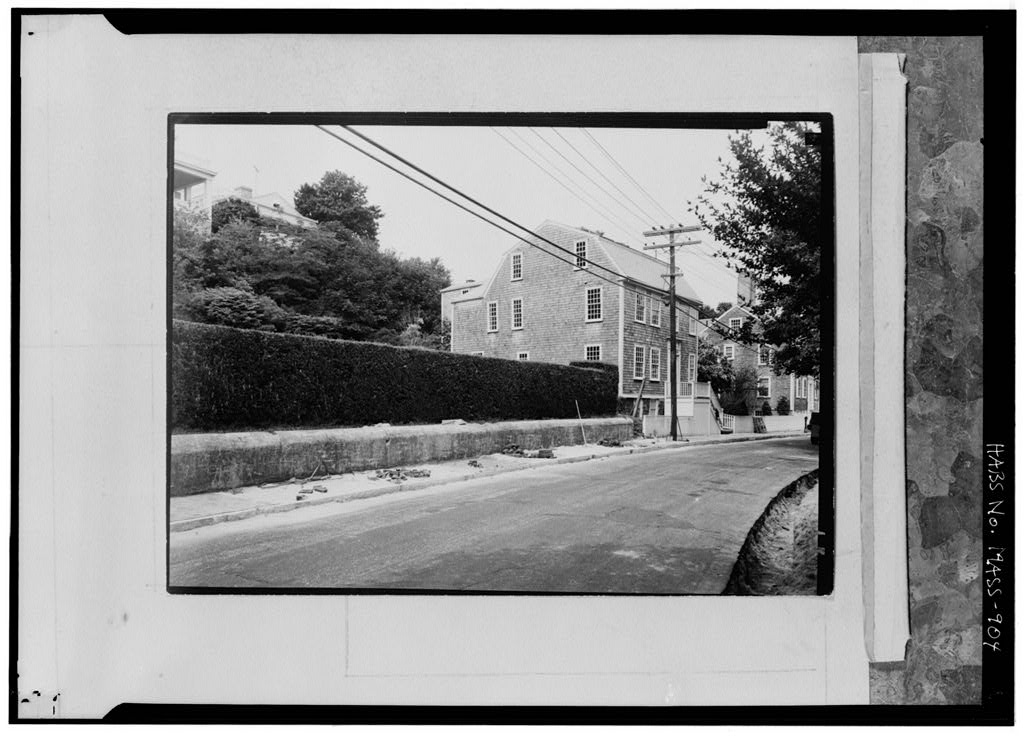
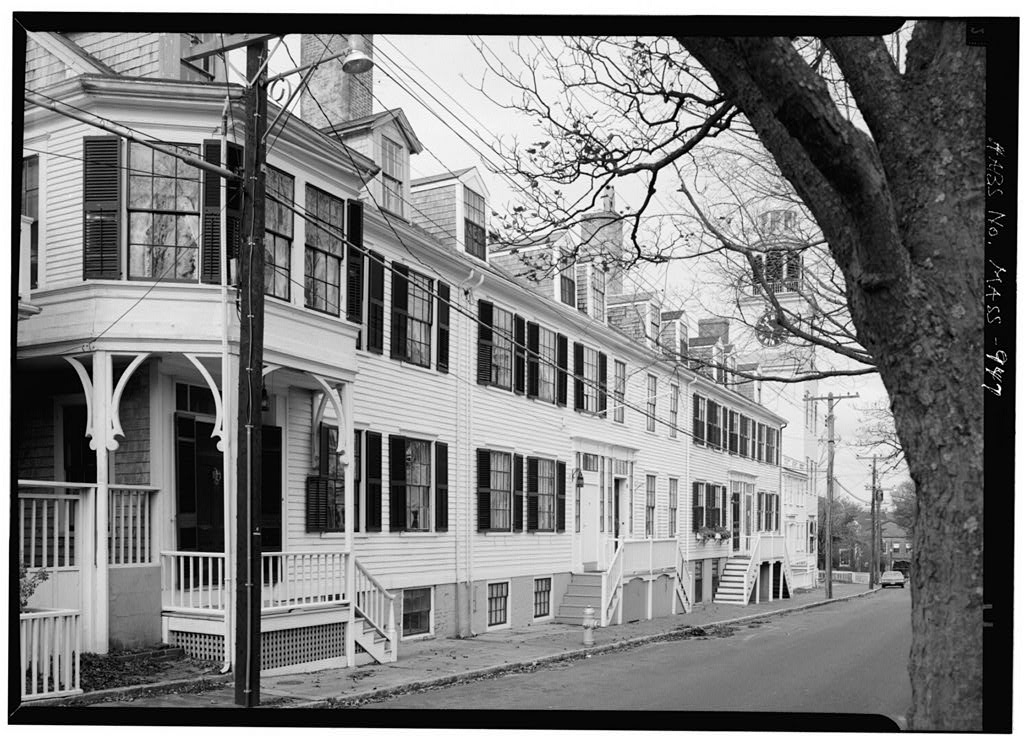
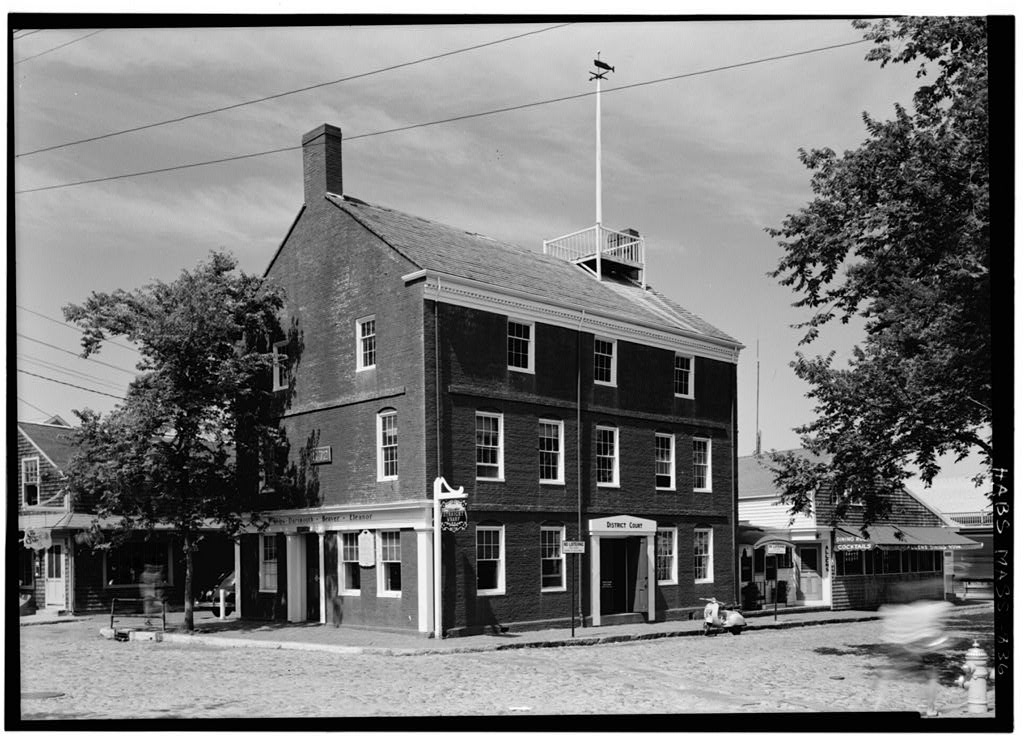
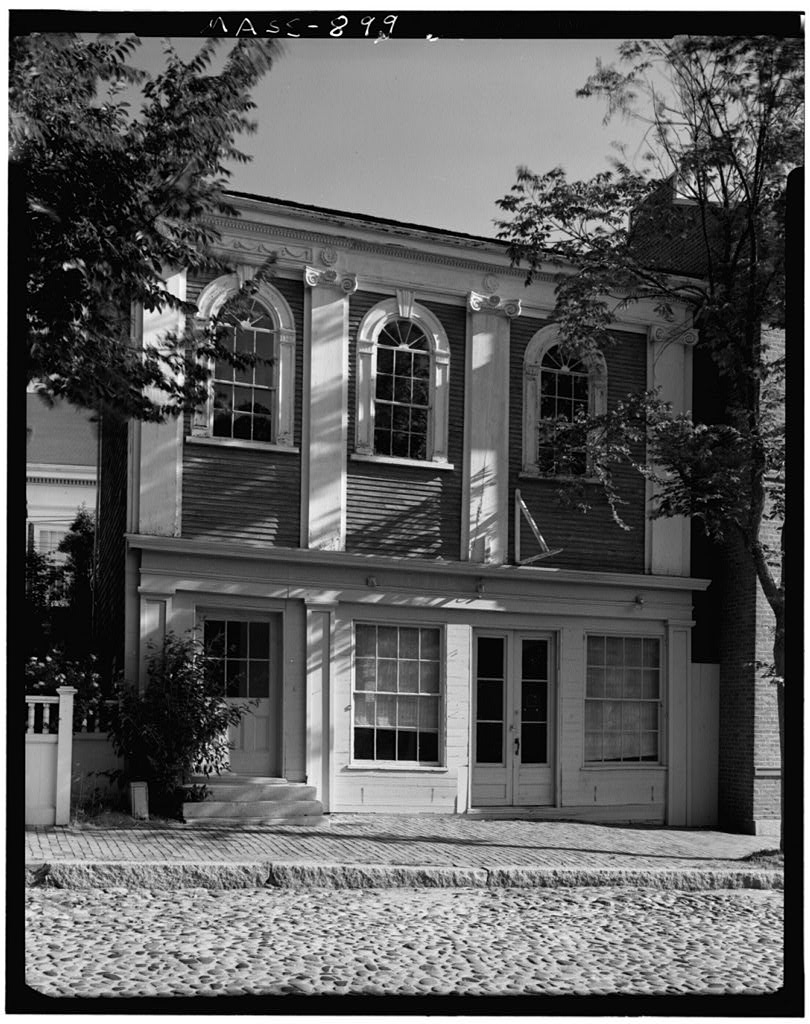
It now contains a good example of the rebuilding and remodeling of commercial properties in to enhance the historic area and economic develop- ment of Nantucket. PART I. HISTORICAL INFORMATION A. Physical History: 1. Original and subsequent owners: Straight Wharf was constructed, running from Candle Street in an easterly direction as a continuation of Main Street, which was then called State Street. This busy section was thickly settled with warehouses, refineries for oil, chandleries, cooper shops, ropewalks, etc., as at that time the business section of the town was closer to the waterfront. Paddock's Paint Shop stood at the corner of Main & Candle Streets.
The Citizens Bank of Nantucket occupied 39' - 10" of the block between Washington and Candle Streets, running in an easterly direction from Washington Street. At this time the building at corner of Main and Candle Streets was owned by William Coffin. The Nantucket newspaper "The Inquirer" began that year in the back room of the second story, while the lower part was used as a post-office with George W. Ewer as postmaster. The whole section was razed in the Great Fire. SOUTH SIDE LOWER MAIN STREET BUILDINGS HABS No. MASS-954 (Page 2) The Citizens Bank went out of business and sold its property in October, to Henry A.
Kelley, mer- chant, for The deed reads in part as follows: "A certain lot of land in said Nantucket represented in the following plot: bounded as follows: beginning at the northwest corner bound of the side site where- on stood the Banking House as the lot now remains (having been reduced by the Town Officers taking a part off to widen the road); thence running by the line of Washington Street southerly 34 feet 11 inches; thence easterly by the land of the heirs of George W. Ewer 16 feet; thence southerly by the same 2 feet; thence easterly by the land of the heirs of Thomas M. & William Coffin 18 feet; thence southerly by the same to Spring Street 18 feet; thence easterly by the line of said street 5 feet 6 inches; thence northerly to the Main St.
60 feet 11 inches; thence westerly to the first bound about 39 feet, 10 inches, together with all the remains of said Banking House." Kelley also purchased the land from John Paddock ex- tending to Candle Street, and land from heirs of William Coffin at the corner of Main and Candle Streets, thus extending his property to cover the block from Washington Street to Candle Street. Charles G. Coffin bought the whole block from Henry A. Kelley for Moses Beach and William H. Chadwick bought from heirs of Charles G. Coffin "all land purchased from Henry A. Kelley, being land and block of brick buildings there- on". Moses Beach sold out his interest to William H.
Chadwick, who took down the brick structures then being used as a sail loft and used the bricks and other material to erect the 0-* x 40' stables at the estate later known as "Chadwick*s Folly" at Squam. Henry Paddock bought from William H. Chadwick the west- erly portion of the property, the land being 30' in width, and carried on his paint business there until This part of the block was sold to Frank F. Sylvia and is still owned by him in Washington L. Fisher bought from William H. Chadwick the easterly portion of the block the present Sher- burne Associates ownership. Augustus L. B. Fisher bought easterly property from the other heirs of Washington L. Fisher. Lawrence Miller bought from Lucy A. Fisher, exec, u/w Augustus L, B. Fisher.
to date Sherburne Associates purchased the easterly part of the block the adjoining westerly part being owned by Frank F. Sylvia. SOUTH SIDE LOWER MAIN STREET BUILDINGS HABS No. MASS-954 (Page 3) 2. Date of erection: Straight Wharf was constructed in The Citizens Bank building was erected about and razed in after which the block of brick buildings was erected, to be torn down in when small wooden structures were put up, in turn taken down in and replaced by a two-story building. The building at the westerly end of the block was originally built as a small shop at the corner of Wash- ington and Spring Streets, and was enlarged and remodelled by Henry Paddock in and in recent years by Frank E. Sylvia. 3. Architect: None. 4.
Original plans, construction, etc.: "Careful and lab- orious crib work was used in the construction of Straight Wharf. As the weighted logs fastened with wooden pegs in the mud and piling on timbers sank into the silt, another layer of logs was put down and rocks added until the sandwiched structure eventually reached above the water. Then pilings were driven around the outline of the expanded layers and Straight Wharf was completed." (Abstract, clipping from Inquirer & Mirror). 5. Notes on alterations and additions: A reconstruction of Straight Wharf was begun in the and extensive changes and improvements in the whole area are now being made in The present building at #14 Main Street was enlarged and remodelled in and again in recent years.
A new two-story building is now feeing erected on the easterly end of the block B. Historical Events Connected with the Structure: Straight Wharf was constructed in by Richard Macy, (son of Thomas Macy, a first settler of Nantucket) and associates. There is a difference of opinion as to whether the wharf begins at Union Street, Washington Street, Candle Street, or even Whale Street. However, when the town was moved to its present site, fish lots were laid out which ran up to what is now Union Street. On each side of the wharves water-lots were sold to fishermen and to those fishing houses or shops in that section, and privileges were from the street to the water. The northern portion of Whale Street has now been absorbed by the newly constructed parking space and mall.
In recent years Straight Wharf has been considered to begin at Candle Street. Straight Wharf received its name from the fact that it ran straight down Main Street, which until was called State Street, and it is the oldest Nantucket wharf still standing. SOUTH SIDE LOWER MAIN STREET BUILDINGS HABS No. MASS-954 (Page 4) It was owned on shares, amounting to by some of the prominent businessmen of that period, 19 in all, including six Macys (Silas, Obed, Thomas, Peter, Barzillai and Franklin), Daniel Jones, John Shaw, William Folger, Peter Chase, Matthew and George Myrick, Kimball Starbuck, Prince, Benjamin IV, Libni, George and Zenas Gardner. "Great was the activity there during the bustling period when Nantucket's whaling industry reached its zenith.
Everything smelled of tar and oil, the air was filled with seamen's chanties and the shouts of the workers. The wharf piled high with goods in hogsheads, bales and cases and great drays filled with casks rumbled up the wharf to cobblestoned Main Street." Nantucket was the whaling capital of the world; in one hundred and eighteen vessels left the Island to sail around the world searching for the valuable spermaceti. Later, Messrs. E. W. Perry & Co. had their lumber yards there where the wood coasters deposited long rows of pine and oak and great piles of lumber. Merchant Edward Perry later bought Straight Wharf from the shareholders and continued it as a freight dock. However, the fate of Straight Wharf followed that of the whaling industry and the wharf fell into disuse.
Around many excursion boats visited the island and it was at this wharf that the passengers disembarked and spent an hour or two about the town before sailing home again. In Killen Bros, bought the wharf and later Killen & Sons sold it to the Pacific Oil Co. In the early Mr. and Lawrence W. Miller bought the wharf and gradual recon- struction was begun by them. Machines dredging the harbor dragged up from the mud many reminders of the cribbing, oddly shaped bottles and whaling implements. In the Nantucket paper, The Inquirer, had its first home on the second floor of a building at the corner of Main and Candle Streets, then owned by William Coffin, at which time the lower floor was used as a post-office. The Inquirer was established by J. T. Melcher, with Samual H. Jenks as editor.
The first issue was on June After the brick structures on the whole block housed among other things, a sail loft and the store of E. G. Kelley. E. G. Kelley and his older brother Henry A. Kelley, sons of a Providence, R. I. silversmith, moved to Nantucket about and married here, becoming prosperous merchants, Henry in the whale-oil business, and E. G. advertising silverware, gold watches, clocks, nautical instruments, fancy goods, etc. The business was carried on until the late The publication Rich Men of Massachusetts, states that Henry A. Kelley "started poor. Oil and candle manufacturer. Industrious, enterprising, and quite benevolent. Worth SOUTH SIDE LOWER MAIN STREET BUILDING HABS No.
MASS-9S4 (Page 5) #14 at the westerly end of the block between Washington and Candle Streets was the location of the Citizens Bank until it burned in and went out of business. C. Sources of Informations 1. Old Views: a. Drawing on file at Nantucket Registry of Deeds attached to deed Book 46, Page showing outline of property with measurements. b. Photographs appearing on Inquirer and Mirror calendar with Lower Main Street in distance in and (in the picture the brick building may be seen). c. Drawing in Our Gold Mine by Everett V. Crosby, showing #14 as it appeared in d. View of Straight Wharf in in Miss Grace Brown Gardner's Scrapbook Collection (microfilm in Atheneum), Nantucket, Massachusetts. 2.
 Block
Block