Mount Healthy Mill, Covered Bridge Road, Mount Healthy
Mount Healthy Mill, Covered Bridge Road, Mount Healthy, Hamilton County, OH. Surveyed as HAER OHIO,31-MOUH,1-, with 1 photograph, 1 measured drawing and a 878-word written history.
From the record
“Mount Healthy Mill is an early nineteenth century saw mill, later converted to a grist mill.”
Written record, HAER OHIO,31-MOUH,1- survey. Machine-read text.
surveyed by the federal HAER program as HAER OHIO,31-MOUH,1- · the record runs 878 words · one of 127 surveyed structures published for this county.
Source document
Quoted word for word from HAER OHIO,31-MOUH,1-.
Not written, edited or summarised by this site.
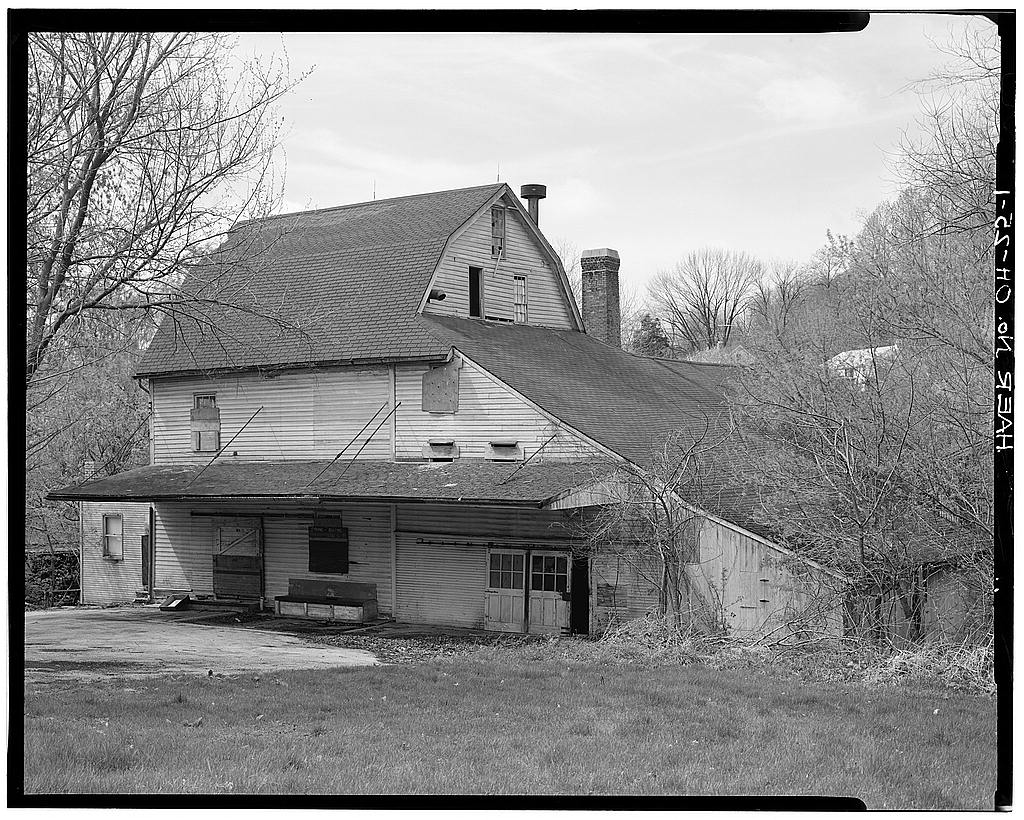
Mount Healthy Mill is an early nineteenth century saw mill, later converted to a grist mill. The predominant remaining element is a five-story wooden structure in which the original grain bins and chutes are still in place. Projec t Informat ion: The U. S. Army Corps of Engineers plans to demolish the Mount Healthy Mill. Under Executive Order mitigative documentation was undertaken in and by Charles E. Parrish, Historian, U. S. Army Corps of Engineers, who prepared the written documentation, and the University of Cincinnati, Department of Architecture; J. William Rudd, project superviszor; Bruce E. Goetzman, field director, and Eric M. Weckel, student architect. Transmitted by: Jean P. Yearby, HAER, Mount Healthy Mill HAER No. OH-25 (Page 2)
Historical Information
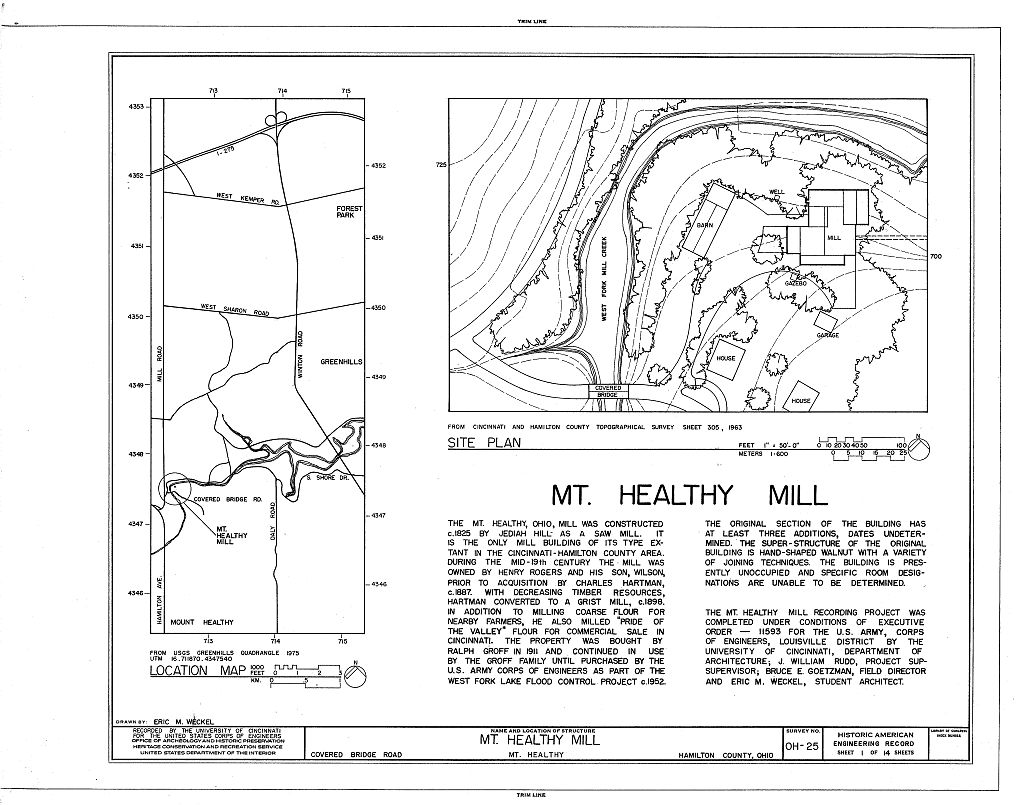
The Mount Healthy Mill, originally a saw mill and later a grist mill, was constructed by Jediah Hill, possibly as early as One source states that Hill came up to this wild area in the year and after builing a cabin, he set up the saw mill." Mount Healthy is the only mill building of its type remaining in the Cincinnati-Hamilton County area, and is important as an early commercial structure. Following Hill's ownership and operation, the mill was owned by Henry Rogers and then by his son, Wilson Rogers, who apparently continued to operate the mill as a sawmill. Around the mill became the property of Charles Hartman. As timber in the area became scarce, Mr. Hartman began to mill coarse flour for nearby farmers for home use, in addition to milling lumber. Sometime around Mr.
Hartman converted the mill to a modern flour mill, employing the local firm of Orville Simpson Company to install the necessary equipment. In order to market his product commercially, Hartman chose the name "Pride of the Valley Flour," since the mill site was in a valley-like setting on Mill Creek. Included among his many customers were fine hotels in Cincinnati as well as bakeries and individuals throughout the area. Daily deliveries to downtown Cincinnati were made by horse and wagon, carrying the flour in large barrels. Within only a few hundred feet of the mill, Hartman dug a well for water to serve the operation. When the water was discovered to contain numerous minerals considered beneficial for one's health, people came from miles around to obtain the mineral water.
Although some consideration was given to bottling and selling the water commercially, Hartman found that endeavor too time-consuming, and decided not to diversity his operation. A small wooden wellhouse over the well still stands. Charles Hartman continued the milling business until when he sold it to Ralph Groff whose family continued to operate the business until the early At that time the property was acquired by the United States Government for construction and operation of the West Fork Lake as a flood control project,
Descriptive Information
Scant inforfmation exists in primary sources which describes the original physical characteristics of the Mount Healthy Mill structure. Although it is difficult to determine the precise components of the orfiginal rectangular structue, at least portions of the original building fabric (i.e., foundation and structural members) are contained within the mill as it presently exists. Mount Healthy Mill HAER No. OH-25 (Page 3) Local informants contend that the original structure, in its entirety, exists within the altered building. Structural and mechanical modifications have taken place over the years, as part of the building's evolution from a saw mill to a flour mill.
In consideration of its probable construction date, the saw mill was no doubt water-powered, and a visible depression in the earth extending fom near the bank of West Fork of Mill Creek to the mill building could well be the mill race which served the water wheel. Not enough structural evidence is extant to determine if the wheel was an under-shot or over-shot wheel. The present mill structure consists of four adjoining components, the predominant element being a five-story, gambrel-roofed, wood-sided structure in which the grain bins and chuts are still in place. The other structural elements consist of storage rooms and an engine room, apparently added when steam or diesel fuel powered the milling equipment.
Within the structure, original materials such as random width flooring and support beams, some of massive walnut wood, are extant. Adjacent to the mill stands a wooden wellhouse enclosing a water welll, dug perhaps as early as In addition, a rectangular two-story barn/garage structure, which appears in old photographs, still stands. SOURCES OF INFORMATION Once Upon a Hilltop, Sesquicentennial Celebration Bulletin of Mount Healthy, Ohio, Interview with Mr. Albert Wolf, former mayor of Mount Healthy, and grandson of Charles Hartman. History of Hamilton County, Ohio, H. A. Ford and K. B. Ford, Atlas of Hamilton County, Waterwheel and Millstones: A History of Ohio Gristmills and Milling. D. W. Garber, Ohio Historical Society, Columbus, Ohio
The original filed report, and the sheets the survey produced. Those published here appear above.
Also surveyed in Hamilton County
24 of 126 records shown
The federal survey recorded these other structures elsewhere in Hamilton County. These are the other structures
they measured and filed a report on, longest report first.
 Block
Block