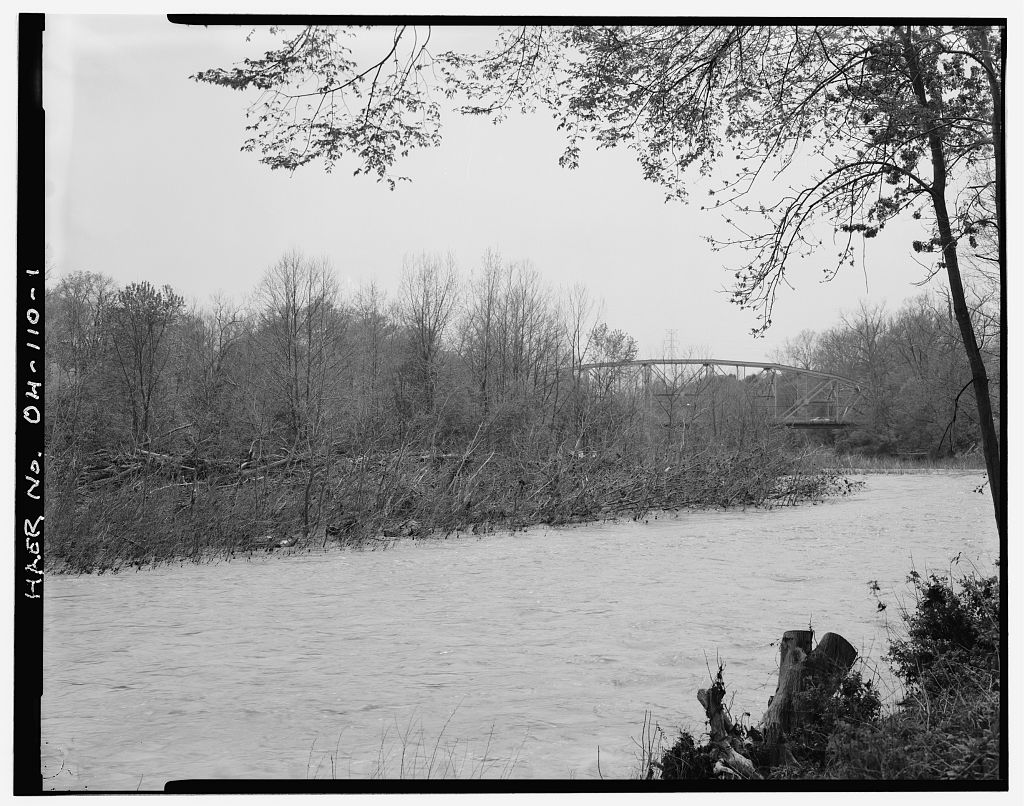
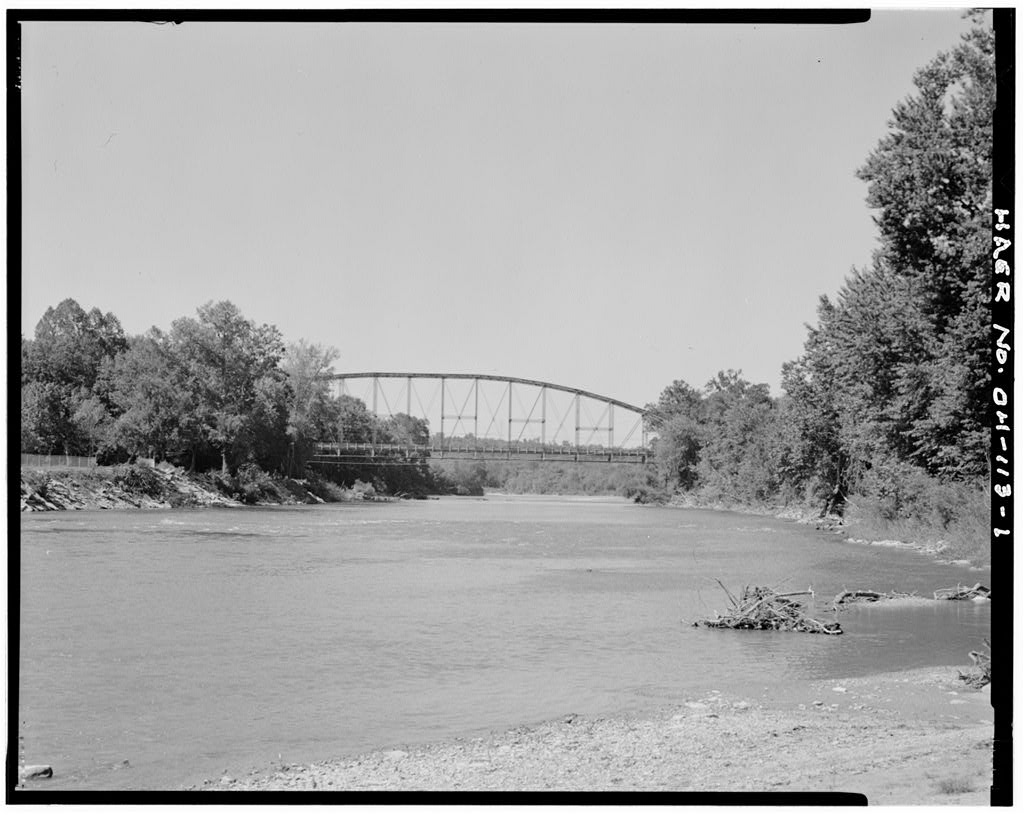
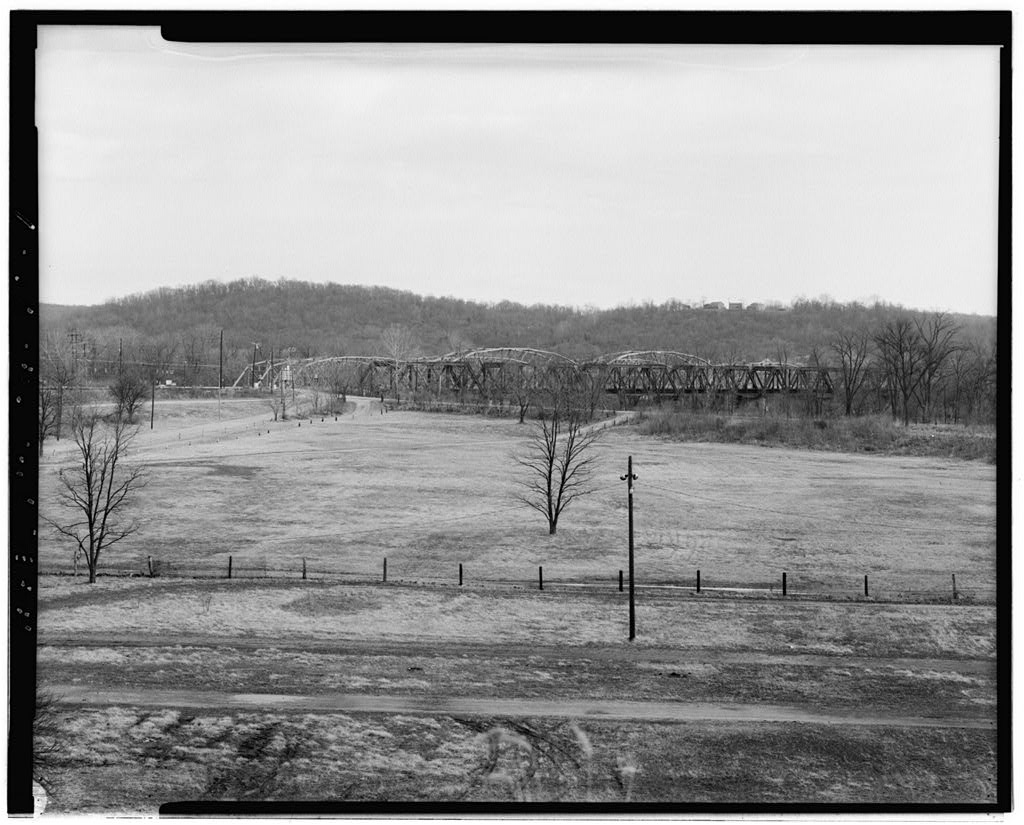
Harrison Road Camelback Through Truss Bridge, Spanning Great Miami River at Harrison Road (Route 457), Miamitown
Harrison Road Camelback Through Truss Bridge, Spanning Great Miami River at Harrison Road (Route 457), Miamitown, Hamilton County, OH. Surveyed as HAER OHIO,31-MIAM,1-, with 1 photograph and a 1,843-word written history.
From the record
“The Harrison Road Camelback Through Truss Bridge was built in by the King Bridge Company, one of the largest and most important bridge building concerns in the United States during the late century.”
Written record, HAER OHIO,31-MIAM,1- survey. Machine-read text.
surveyed by the federal HAER program as HAER OHIO,31-MIAM,1- · the record runs 1843 words · one of 127 surveyed structures published for this county.
Source document
Quoted word for word from HAER OHIO,31-MIAM,1-.
Not written, edited or summarised by this site.
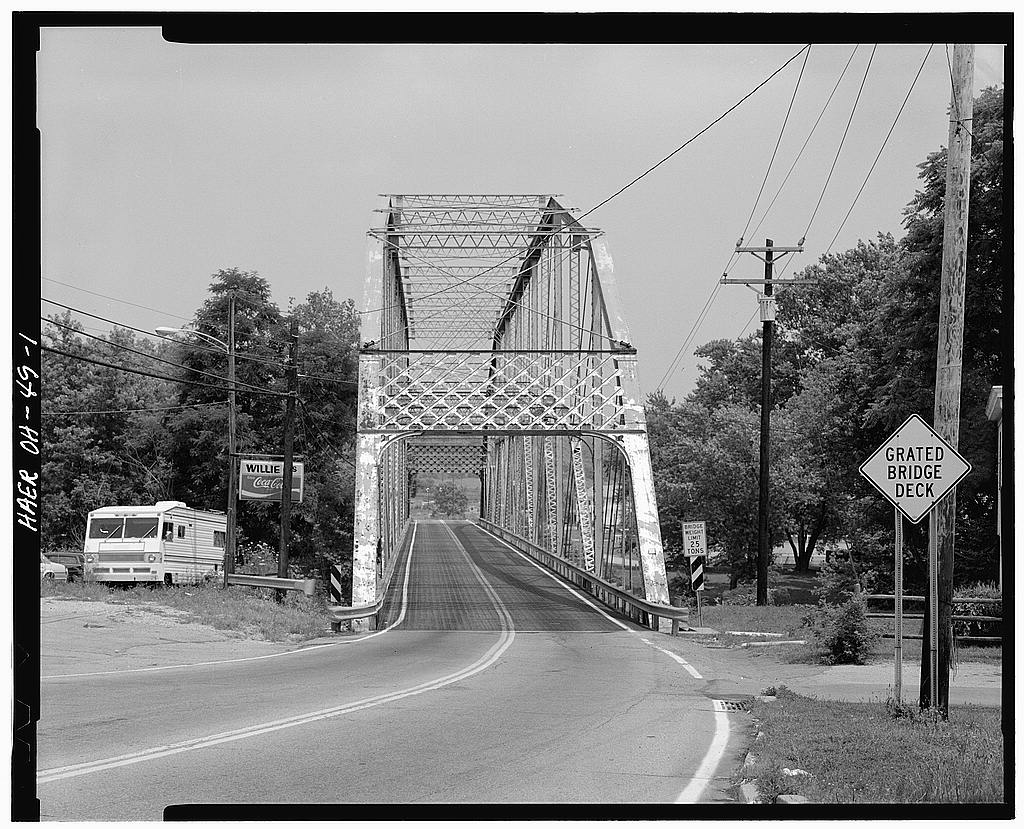
The Harrison Road Camelback Through Truss Bridge was built in by the King Bridge Company, one of the largest and most important bridge building concerns in the United States during the late century. The company's reputation was made by the bowstring arch truss for which Zenas King was granted several patents. However, the bowstring design was virtually abandoned after and replaced with more conventional designs such as the Pratt and Parker. This is a good example of the long span metal truss bridge that the company's founder, Zenas King, became interested in towards the end of his life. The bridge is listed as a "selected bridge" in the Ohio Department of Transportation's Ohio Historic Bridge Inventory Evaluation and Perservation Plan. Report prepared by: Frances A.
Jones Project Historian Ohio Historic Bridge Recording Project Summer HARRISON ROAD CALLBACK THROUGH TRUSS BRIDGE HAER No. OH-49 Page 2 This bridge was built in by the King Bridge Company. It is a single span, with an overall length of 444 feet, which is quite long for its type. The roadway is 23 feet 4 inches wide. The bridge is supported on stone abutments. It is a camelback truss which is a Parker truss with a polygonal upper chord of exactly five slopes. A Parker truss is in fact a Pratt truss with a polygonal upper chord. The upper chord and vertical posts are in compression, while the lighter diagonals and bottom chord are in tension. The upper chord is composed of plates and channels, riveted together. The posts and bracing are formed of channels and lattice work.
The bridge is braced transversely by channels and lattice work running between the two upper chords, and by diagonal bars. There is a rather elaborate lattice-work and portal with ornamental curved corner braces and cut-out designs. It has already been mentioned that the bridge design is basically a Pratt truss. The Pratt truss is considered by some commentators to be the first scientifically designed truss. Thomas Pratt, its inventor, was born in the son of Caleb Pratt, a Boston architect. He was something of a child prodigy as he was preparing plans in his father's office at the age of 12, and at 14 he was admitted to Rensselaer Polytechnic Institute in Troy, New York. He joined the United States Army Engineers when he left RPI, and worked or?
the construction of dry docks at Charleston, South Carolina, and Norfolk, Virginia. His bridge designing career started properly when he began work in as a HARRISON ROAD CALLBACK THROUGH TRUSS BRIDGE HAER No. OH-49 3 bridge and general structural engineer for various New England railroad companies. He invented the bridge truss for which he is best known early in his railroad career. His first truss, designed about was a modification of the Howe-Stone truss. In William Howe had patented his design for a truss with parallel upper and lower chords and single diagonals extending across two panels. The diagonals were in compression, while the verticals were in tension. The bridge was designed to be built of wood, though the vertical tension rods were of wrought iron.
A subsequent variation on the design by Amasa Stone had one pair of diagonals crossing a single panel. Pratt's design differed from the Howe-Stone truss because he treated the vertical posts as compression members, and the diagonals as tension members. He put the posts in compression in order to shorten the compression members as much as possible to reduce the possibility of lateral buckling. Like Howe, he also originally specified that only the tension rods would be of wrought iron, while the rest would be wood. In Pratt and his father received a joint patent for a truss with either parallel chords, or with a polygonal top chord. It was for a combination wood and iron truss.
Pratt's design was an improvement on Howe's because of the more functional distribution of tensile and compressive stresses in the various members. His design was simplified later, and the diagonals were reduced to a single one in all but the HARRISON ROAD CAMELBACK THROUGH TRUSS BRIDGE HAER No. OH-49 Page 4 center panels. The Pratt configuration was widely used for iron and steel truss bridge's. The first group of iron Pratt trusses were "built by the Pennsylvania Railroad, the earliest one dating from The Railroad must have distrusted the design at first because it used extra reinforcing when building a Pratt truss. By though the standard Pratt truss, without extra reinforcing, was common.
Hew bridge trusses were designed for long span bridges, but the standard designs continued to be used as well. Virtually all basic bridge trusses designed between and had parallel top and bottom chords, but by the end of the century a polygonal top chord had become a standard feature of long span bridges. A design which had parallel chords did not reflect the increase in bending moment from the ends to the center of the span. The increase in bending moment had been recognized fairly early on, and was reflected by the addition of a second set of diagonals in the center panels of Pratt and Whipple trusses. If such a truss was rigid enough at the center, however, it had an increasingly redundant amount of material towards the ends.
A truss with a polygonal upper chord provided the answer to this, and was more economical in the use of material. The one disadvantage was that it was more costly to produce than the more old fashioned form of truss with parallel chords, because there was more variation in the sise of the individual members and the connections between members needed to 2 produce a polygonal upper chord. HARRISON ROAD CAMELBACK THROUGH TRUSS BRIDGE HAER No. OH-49 Page 5 The County Commissioners Journal entries for Hamilton County are quite detailed concerning the letting of the contract for this bridge. It is noted on 10 January that the County Engineer had received bids.
He had checked the strain sheets and had found "discrepancies" in nearly all of them," Two consultants were called in to assist the County Commissioners in evaluating the plans. The consultants were a Mr. Osborne, and a Mr. Randolph, who were the General Superintendant, and Chief Engineer respectively of the Chesapeake, Ohio and South Western Railroad Company. Because of the large amount of money involved the consultants were requested to recommend the best designs. In Randolph's opinion: "None of the plans submitted combine so many desireable points as does the King Bridge Company's and therefore I unhesitatingly recommend its adoption, provided the price they ask for the bridge is not too high." The County Engineer was unsure what Mr.
Randolph would consider to be too high a price, but he recommended that the suggestion be adopted. The choice of designs lay between those submitted by the King Bridge Company, The Wrought Iron Bridge Company, and the Detroit Bridge and Iron Works. None of the designs submitted by any other companies were the same, but Randolph felt that the King Bridge Company's plan was "excellent" and "the only one to equal or exceed the standard in all particulars". He thought the floorbeams were particularly good, as instead of using wooden members, King's Company proposed to use steel HARRISON ROAD CAMELBACK THROUGH TRUSS BRIDGE HAER No. OH-49 Page 6 I-beams and channels "which are of course much better".
It was believed that they would avoid the need for renewal that was a problem with wooden beams which rot. In Randolph's opinion: "The truss is also particularly good in its general design. It varies from the others in having a strut connection from the foot (?) posts to the lower panel point toward the abutment instead of a tie to the top panel toward the center of the bridge This connection will make it a stiffer bridge than any of the others and will render it a great deal less susceptible to vibrations." The King Bridge Company's bid was relatively high against the Canton Bridge Company's and the Detroit Bridge and Iron Works' Their plan was felt to be so much better than any of the others, however, both in general and in detail that it was recommended for adoption.
There are various records of bills being paid to the King Bridge Company 4 for work on the bridge , but the bridge is noted as being completed on 12 October The bridge was built by the King Bridge Company two years after Zenas King's death in King had founded the company and run it with his family, and it continued to operate until well into the twentieth century. A metal truss bridge of the kind built at Harrison Road is typical of the kind of bridges the company was producing at that time. King made his reputation on his patented bowstring bridge design. HARRISON ROAE CAMELBACK THROUGH TRUSS BRIDGE HAER No.
OH-49 Page 7 Bowstring bridges were popular in the 60s and but were rarely built after King began to employ professionally trained engineers in the and generally speaking professional engineers disliked the bowstring design as it was difficult to brace properly overhead and so had a strong tendency to sway sideways. The company's move towards bridges of the type built at Harrison Road may be more than a little due to the influence of these engineers on the company's work. Apart from this, however, King himself had become interested in long spans towards the end of his life.
The company did not hold particular patents for bridges of this type, as they were fairly standard designs used by all the bridge companies by For a history of the King Bridge Company, and for details of another long span bridge built by the company in please see the report on the Old Colerain Pennsylvania Through Truss Bridge (HAER No. OH-54). HARRISON ROAD CAMELBACK THROUGH TRUSS BRIDGE HAER No. OH-49 Page 8 NOTES 1 Carl W. Condit, American Building Art: The Century (New York: Oxford University Press, I960) pp. 2 Carl . Condit, American Building Art, pp. Hamilton County Ohio, County Commissioners Journal (10 January vol. 22: p. 4 e.g. Hamilton County, Ohio, County Commissioners Journal, vol. 23: 5 May p. 82, and 16 June p.
5 Hamilton County, Ohio, County Commisioners Journal (12 October vol. 23, p.
Bibliography
Condit, Carl V, American Building Art: The Century. New York: Oxford University Press, I960. Hamilton County, Ohio. County Commissioners Journal vol.
The original filed report, and the sheets the survey produced. Those published here appear above.
Also surveyed in Hamilton County
24 of 126 records shown
The federal survey recorded these other structures elsewhere in Hamilton County. These are the other structures
they measured and filed a report on, longest report first.
 Block
Block