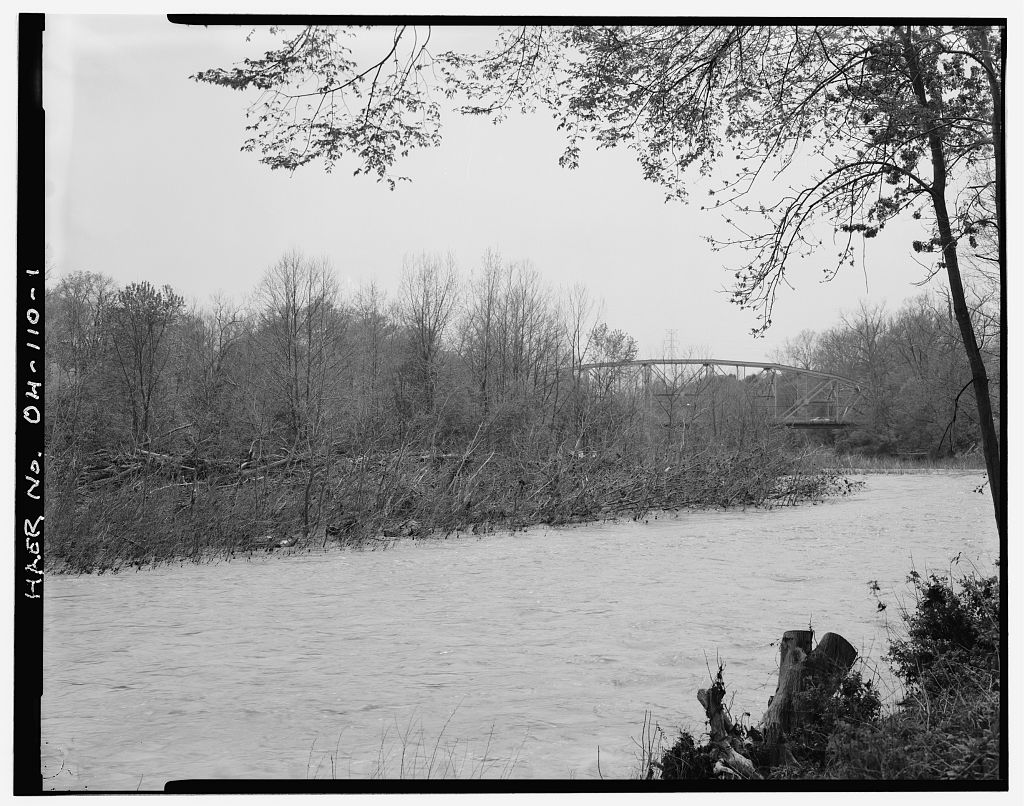
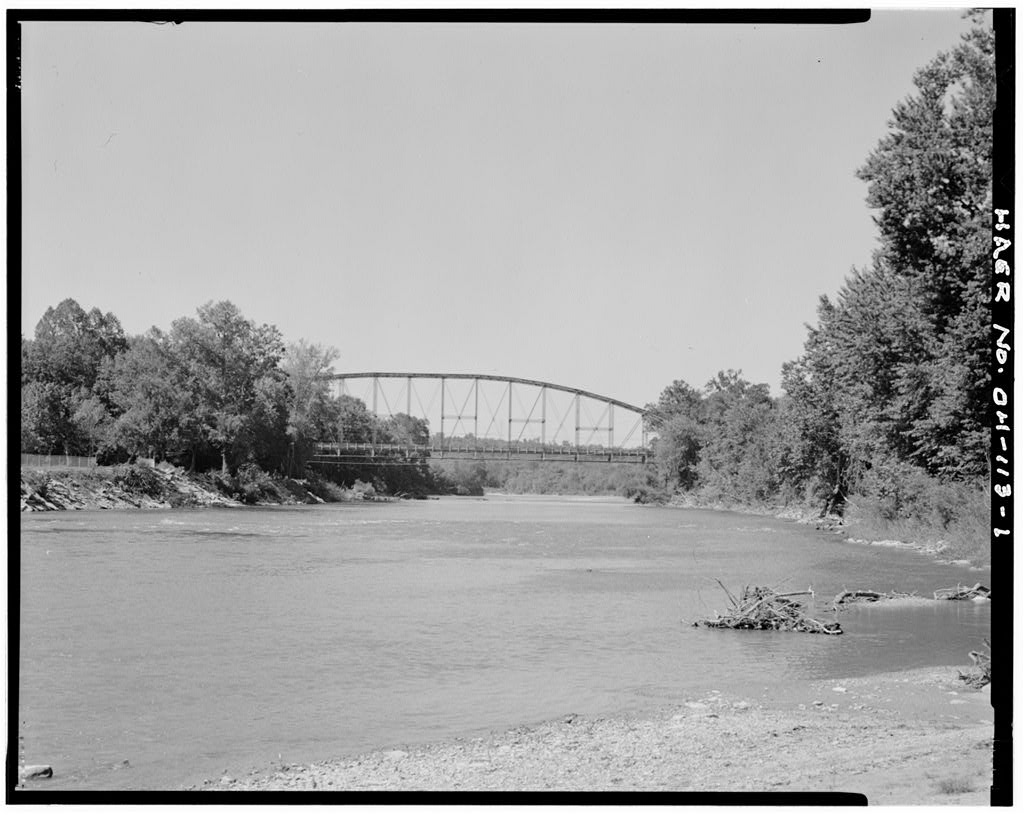
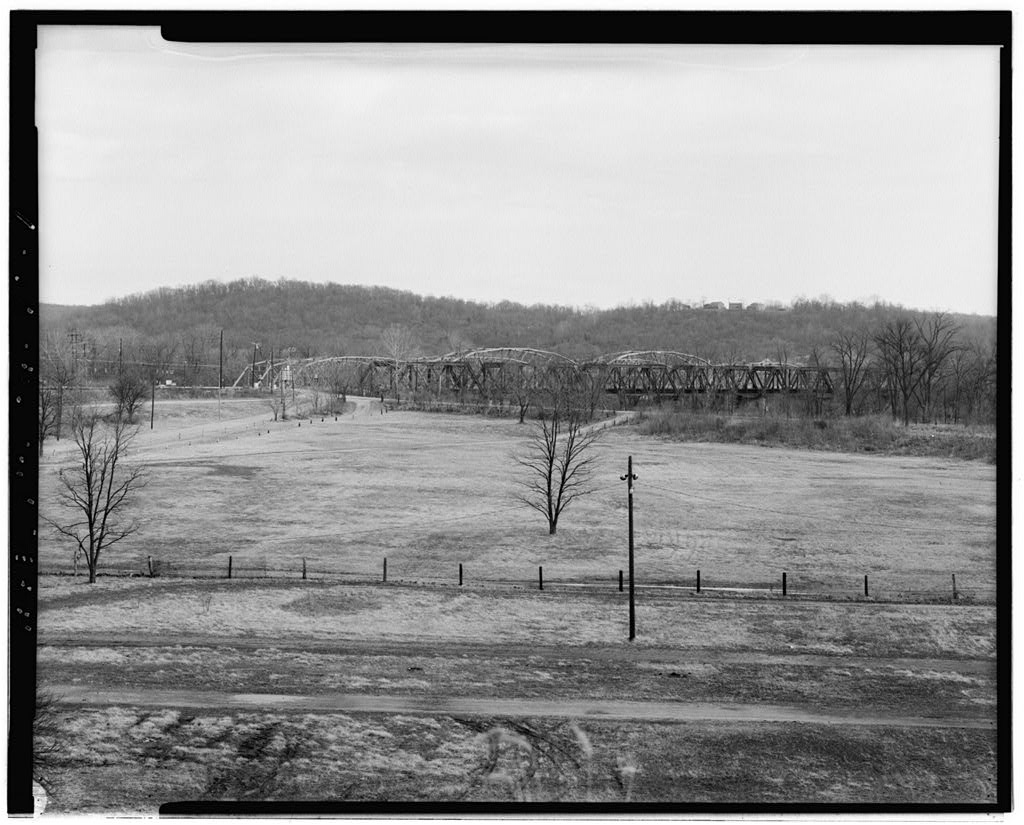
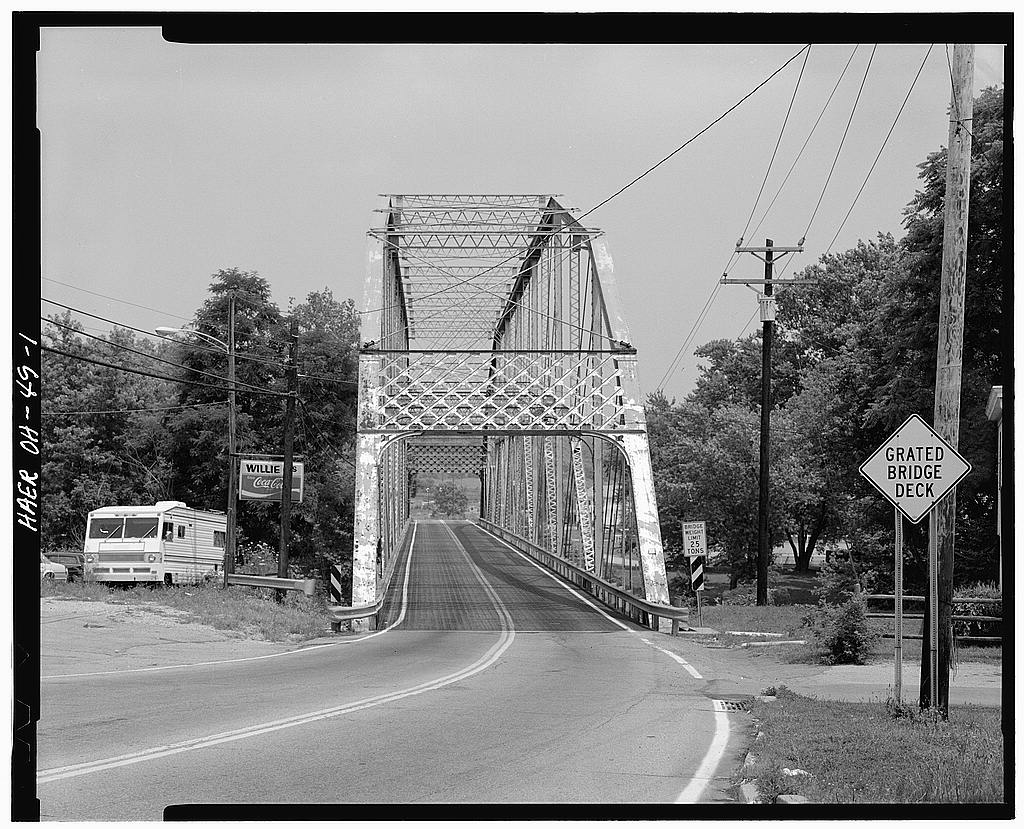
Fred Mitchell Historic Preservation Associates Lenox Place Cincinnati, Ohio Hopewell Road Bridge HAER NO. OH-110 (page 2) The Hopewell Road Bridge serves to move local vehicular traffic over the Little Miami River between portions of Hamilton County and Clermont County in southwestern Ohio. The river cuts through a moderate valley. The location has historically served as a river crossing since early settlement and development of the surrounding rural agricultural and suburban landscape. The bridge is located opposite the small hamlet of Branch Hill and downstream approximately two miles from the village of Loveland. Both of these communities are located in Clermont County.
Early settlement into the general area of the bridge loca- tion had occurred by Within Hamilton County, land was made available for sale by John Cleves Symmes. Mr. Symmes had pur- chased over acres from the federal government and sold parcels to early settlers. Within the area of the bridge lo- cation, many early settlers were of German origin who had migra- ted into Ohio from Norristown, Pennsylvania. One of these migrants was Christian Waldschmidt who was to establish a small German enclave a few miles to the south of the bridge on the western bank of the Little Miami River. Also in the State of Virginia had established the Virginia Military District. This was land set aside and granted to Revolutionary War soldiers who had helped Virginia during that period.
The district incorpora- ted all of Clermont County and additional land that extended into portions of what was to become southern Ohio in Thus, the area adjacent to the bridge location in Clermont County was settled by veterans of the Revolutionary War or by pioneers who purchased their land from the Revolutionary War soldiers. Settlement into the area was a slow process with clearing of the fields and subsistence agriculture being the major rural activity. As agricultural development increased, several mills were constructed along the Little Miami River and its nearby tributaries. One mill, Pollacks Mill, was located just upstream from the bridge location.
In addition, several small market centers were established to serve the needs of the farmsteads as well as provide for housing within a small village setting. The largest of these was the village of Loveland which was establish- ed by and located a few miles upstream from the bridge location. By a local system of roads had developed that was primarily based on the use of older Indian trails and newer roads that had been established to link Cincinnati with other communi- ties in central Ohio. Additionally, there were now enough property owners within the area that they were asking for more roads to be constructed and older roads to be improved. In December, a group of citizens petitioned Hamilton County to Hopewell Road Bridge % HAER No.
OH-110 (page 3) survey a new road that would become the major route at the bridge crossing. They asked for a road that would cross the Little Miami River and serve the adjacent area of Clermont County. Clermont County residents also petitioned for a road improvement that extended to the bridge location. To link the new and improved roads, a river crossing was required. Little is known of the early mode of river crossing at the present bridge location. The Little Miami River has a deep channel at the Hopewell Road Bridge location. This would have made it difficult to ford the river on foot, horse, or by wagon. A bridge was constructed by the to facilitate movement between the predominantly agricultural landscape found on both sides of the river.
In the Little Miami Railroad constructed the first railroad into the area. The community of Loveland was designated as a major switching location. In addition, a small station was established at Branch Hill, the community located adjacent to the bridge in Clermont County. This was important to the bridge location because the railroad soon attracted suburban development into the area. People were beginning to use the railroad as one means to commute to and from nearby Cincinnati as well as to ship farm produce into the Cincinnati markets. Thus, the bridge loca- tion became very important to farmers and commuters who resided on the Hamilton County side of the Little Miami River. A small construction boom was experienced because of the railroad and its Branch Hill station.
The general area was beginning to slowly change with the original larger farmsteads being subdivided into smaller farms and with the addition of new suburban homes. The Atlas of Clermont County, Ohio gives an indication to the character of the bridge on Hopewell Road at the time. A "wire suspension bridge" was noted as having been in place at the bridge location. By that time, it must have been in poor con- dition because the Hamilton and Clermont Commissioners would construct a new suspension bridge in A description of that new bridge contained the following: One of the finest bridges in southern Ohio is that between Branch Hill and Symmes Station.
It is a suspension bridge three hundred and fifty feet long, built at the joint expense of the two counties connected by it and costing It was formally dedicated and opened to travel at a great celebration at this point on the Fourth of July, when appropriate addresses were delivered by Governor Noyes and the Honorable Samuel F. Hunt (Source: Ford and Ford, p. 396 Hopewell Road Bridge HAER No. OH-110 (page 4) It is important to note the significance placed upon the new bridge. Both counties held the bridge in high regard. The added emphasis of importance given to the bridge, by the presence of the Governor of Ohio at the dedication, attested to the role the bridge played in the daily lives of local citizens.
The expendi- ture of was also a testimony to the importance of a bridge at that location. The new suspension bridge allowed for the rapid movement of commuters, farm produce, commerce, and local residents across the river. By the early Branch Hill and Loveland were well established. The agricultural economy was also stable with Cincinnati being the prime market for produce and livestock. The railroad continued to allow for easy access to and from the city as well to communities in southern and central Ohio. The suspension bridge had withstood several disastrous floods in southwestern Ohio. In and widespread flood- ing had destroyed numerous bridges in Hamilton and Clermont counties. The Hopewell Road bridge survived.
However, the effects of long term use and increased "traffic had begun to impact its structural integrity. One contributor to the decline of the bridge was the increase in automobile, truck, and farm implement traffic. The bridge was not designed for the amount of traffic it was carrying during the early part of this century. By mid-1921, the Commissioners from Hamilton and Clermont County were aware of the poor condition to which the suspension bridge had deteriorated. Complaints from citizens of both counties had expressed the need to construct a new bridge. By November, the Hamilton County Engineer had prepared plans and specifications for a new metal truss bridge. On March 7, the Hamilton County Commissioners met to discuss the deterioration of the fifty year old suspension bridge.
A resolution was passed in which the bridge was con- demned. The resolution read as follows: By the Board: WHEREAS, the Board of County Commissioners of Hamilton County have made a careful examination and inspection of the present bridge spanning the Little Miami River on Hopewell Road, Symmes Township, Hamilton County, Ohio, and have been requested by various delegations of citizens to replace the present structure, NOW THEREFORE BE IT RESOLVED by the Board of County t Hopewell Road Bridge HAER No.
OH-110 (page 5) Commissioners of Hamilton County, Ohio that finding the present bridge belonging to and maintained in part by Hamilton County over the Little Miami River on Hopewell Road is dangerous to public travel by decay and its general un- fitness to withstand the present and future volume of vehic- ular travel, hereby condemn the said bridge, and BE IT FURTHER RESOLVED that a certified copy of this resolution be sent to the Board of County Commissioners of Clermont County, proposing the erection of a new bridge to take the place of the structure herein condemned, as a joint improvement under and by virtue of the provisions of Section of the General Code.
BE IT FURTHER RESOLVED by the Commissioners of Hamilton County, all members duly elected thereto concur- ring, that the County of Clermont is to pay into the Treas- ury of Hamilton County, Ohio, the sum of Ten Thousand Dollars as their sole and only contribution to the costs and expenses of erecting and constructing the new structure, the balance and remainder of said costs and ex- penses to be paid by the County of Hamilton. BE IT FURTHER RESOLVED that a contract be entered into by this Board with the Commissioners of Clermont County, embodying therein the proposed terms of the above agreement.
(Source: Hamilton County Commissioners Minutes, Book 68, Page March 7, Also on March 7, the Commissioners of Hamilton and Clermont counties approved the plans and specifications pre- viously prepared by the Hamilton County Engineer for a new bridge. The Engineer had estimated that the new superstructure and substructure would cost The contribution of from Clermont was approximately twenty percent of the Engineer's estimate. The bids for the superstructure and substructure were open and read on April 25, They were as follows: For the superstructure: Brackett Construction Company Independent Bridge Company E. M. Scully Middle States Construction Company Standard Engineering & Construction Co. $3 Penn Bridge Company Hopewell Road Bridge % HAER No.
OH-110 (page 6) For the substructure floor and approaches: Middle States Construction Company Nolte Construction Company Allan & Walter William Keller Cleary, Hailey & Barry John A Foley M. Hanlon & Son Brackett Construction Company After review and consideration of the bids received, the Hamilton County Engineer made his recommendations for the con- struction of the superstructure and substructure. He recommend- ed that the superstructure contract be awarded to the Middle States Construction Company. Although they were not the lowest bidder, their bid was recommended for approval. This was done so because the engineer felt that the lowest bid was too low to provide for adequate materials of construction.
The Engineer recommended that the Nolte Construction Company receive the con- tract for the substructure floor and construction of the abut- ments and wing walls. The Hamilton County Commissioners met on May 12, to consider the recommendation of the County Engineer with respect to the bids to construct the new bridge. Following the Engineer's recommendations, the Commissioners approved the bid of by the Middle States Construction Company for the superstructure and the bid of from the Nolte Construction Company for the floor, abutments, wing walls, and demolition of the old bridge. The total cost to construct the new bridge and demolish and remove the old suspension bridge was approved for This was higher than the Engineer's estimate.
There is little documentation concerning the Middle States Construction Company and its bridge building activities. A review of an inventory prepared by the Ohio Department of Transportation of significant bridges constructed in Ohio does not identify this company as having constructed any other important bridges. It is believed that they were an out of state construction company involved with the erection of structural steel. By it was a common practice in bridge building for a successful bidder to purchase the required structural steel from a fabricator; a company that specialized in the manufacture of structural steel, riveted steel trusses, and other components. The Nolte Construction Company was a local firm which specialized in stone and concrete construction.
They contracted Hopewell Road Bridge % HAER No. OH-110 (page 7) to build foundations, roads, piers and abutments, and buildings where poured concrete was required. The construction of the Hopewell Road Bridge consists of a single span riveted iron superstructure incorporating details of the Pennsylvania Through Truss design. This design is sometimes referred to as a Petit Through Truss. It was a popular bridge type from ca. to ca. It was used when a long distance needed to be covered with a single span. The design was derived from the Parker Through Truss and differs in that the Pennsylvania design incorporates sub-ties which equalizes the stresses in the web and chord members. Both designs incorporate the curved upper chord.
The Pennsylvania Through Truss is the culmination of various aspects of bridge engineering and design. These elements produced a bridge type that was efficient to construct and incorporated the stability necessary to traverse long distances. The overall length of the span is three hundred three feet and four inches. The width, across the deck, is twenty-two feet. The height, extending from the top of the deck to the bottom of the sway brace is eighteen feet. The superstructure is composed of fourteen panels each extending for a distance of twenty-one feet and eight inches. The span exhibits a configuration compos- ed of two incline end and twelve interior panels.
Incline end posts and curved top chords are fabricated from a cover plate twenty six and five eights inches wide and two channel beams twenty-four and nine-sixteenth inches wide. All are riveted. The underside is held together by metal lattice work. The portal ends exhibit a heavy sway brace. Bottom chords are composed of two riveted channel beams twenty four and one half inch wide. These are separated by the use of riveted gusset plates. Verticals and full diagonals are composed of twelve inch wide H beams. Sub-ties, within each web, are composed of twelve inch I beams. Interior struts and top lateral bracing are composed of open metal lattice twenty-six inches wide. The sway braces vary in height depending on location with the highest being located at the central panels.
They are held in place to the verticals and top chord by large metal gussets. The sways are composed of two metal bars five inches by three and one half inches. Small lattice work separates the bars. The deck is composed of an open mesh metal floor. This rests atop eleven I bar stringers that are fifteen inches high. The stringers tie into thirteen floor beams that are thirty-six inches high. Bottom lateral bracing is composed of five inch square steel beams. Adjacent to the deck on one side is found a pedestrian walkway. This is five feet six inches wide with a decorative wrought iron fence that extends up three feet six inches from the floor of the walkway. The original newel posts have been previously removed. Originally, Hopewell Road Bridge HAER No.
OH-110 (page 8) the entire superstructure rested atop bearing plates. These were removed and replaced with roller bearings. Concrete faced piers with small wing walls anchor the bridge. At different periods in time, extensive rehabilitation has been undertaken to maintain the load limit and to continue use of the bridge. At an unknown date, the original bearing plates were replaced with roller bearings. In extensive work was undertaken to reinforce floor beams and repair the abutments and wing walls. In the concrete floor was removed and replaced with an open grid steel mesh. Also at that time, the pedestrian side- walk was reinforced and the concrete floor was replaced with metal flooring. Today, the superstructure exhibits deteri- oration to various metal members.
Rust and structural decay are evident. The existing Hopewell Road Bridge was not designed to carry the amount of traffic it presently does. Intensified suburban development, especially since the has accelerated vehicular use. Projected future needs will strain -the bridge beyond its capacity to smoothly move vehicular traffic. A new structure will provide for safe and efficient vehicular traffic flow within an area that is experiencing rapid suburban expan- sion. Hopewell Road Bridge HAER No. OH-110 (page 9) SOURCES OF INFORMATION Emerson, William D., Map of Hamilton County, Ohio, C. S. Williams Publishing Company, Everts, Louis H, History of Clermont County, Ohio, J. B. Lippicott and Company, Philadelphia, Ford, Henry A. and K. B.
Ford, History of Hamilton County, Ohio, Cincinnati, Ohio, Greve, Charles T., Centennial History of Cincinnati, Biographical Publishing Company, Chicago, Hamilton County Commissioners Minutes: Book 68, Page 503 (March 7, Book 68, Page 580 (March 21, Book 69, Page 160 (April 25, Book 69, Page 204 (May 5, Book 69, page (May 12, Hamilton County Engineer's Office, Bridge Inspection Report: Hopewell Road Bridge, Hamilton County Engineer's Office, Documentation for survey of Hopewell Road in Lake, D. J., Atlas of Clermont County, Ohio, C. O. Titus Publishing Company, Philadelphia, Lake, D.
J., Atlas of Clermont County, Ohio, Lake and Gordon Publishing Company, Philadelphia, Moessinger, George and Frederick Bertsch, Map of Hamilton County, Ohio, Cincinnati, Ohio, Ohio Department of Transportation, The Second Ohio Historic Bridge Inventory, Evaluation and Plan, Williams, Byron, History of Clermont and Brown Counties, Ohio, Clermont County Genealogical Society, Batavia, Ohio, Note: Engineering drawings prepared by the Hamilton County Engineer's Office in Truman P. Young and Associates in and Young, Russo, Graham and Obermeyer in are on file at the Hamilton County Engineer's Office. An aerial photograph from is at the Hamilton County Engineer's Office showing the Hopewell Road Bridge in its # setting. Hopewell Road Bridge HAER No.
OH-110 (page 10) General Location of Hopewell Road Bridge within the State of Ohio -.Mich. Will!**' I'""" TittBbxK "a Pan* " JL 1 t 1*1 tow TOUM "Ti rv HflKMI V^iWirl 1 (CrvvfaH JAuglai I t*e ' o*fk. Pr fcU : HAMiLTON TON \ D r ^iqKlond _. >n I Mf Hi* t 0 h A e~ f f v m Hopewell Road Bridge HAER NO. OH-110 (page 11) Hopewell Road Bridge HAER NO. OH-110 (page 12) 4 Hopewell Road Bridge HAER No. OH-110 (page 13) o Development Pattern in Hamilton County Vicinity of Hopewell Road Bridge Source: Titus, Atias of Hamilton County, Ohio Hopewell Road Bridge HAER NO. OH-110 (page 14) ADDENDUM TO: HAER OH-110 HOPEWELL ROAD BRIDGE HAER OHIO,31-LOVE.V,1- Spanning Little Miami River Loveland vicinity Hamilton County Ohio FIELD RECORDS HISTORIC AMERICAN ENGINEERING RECORD National Park Service U.S.
Department of the Interior C Street NW Washington, DC
 Block
Block