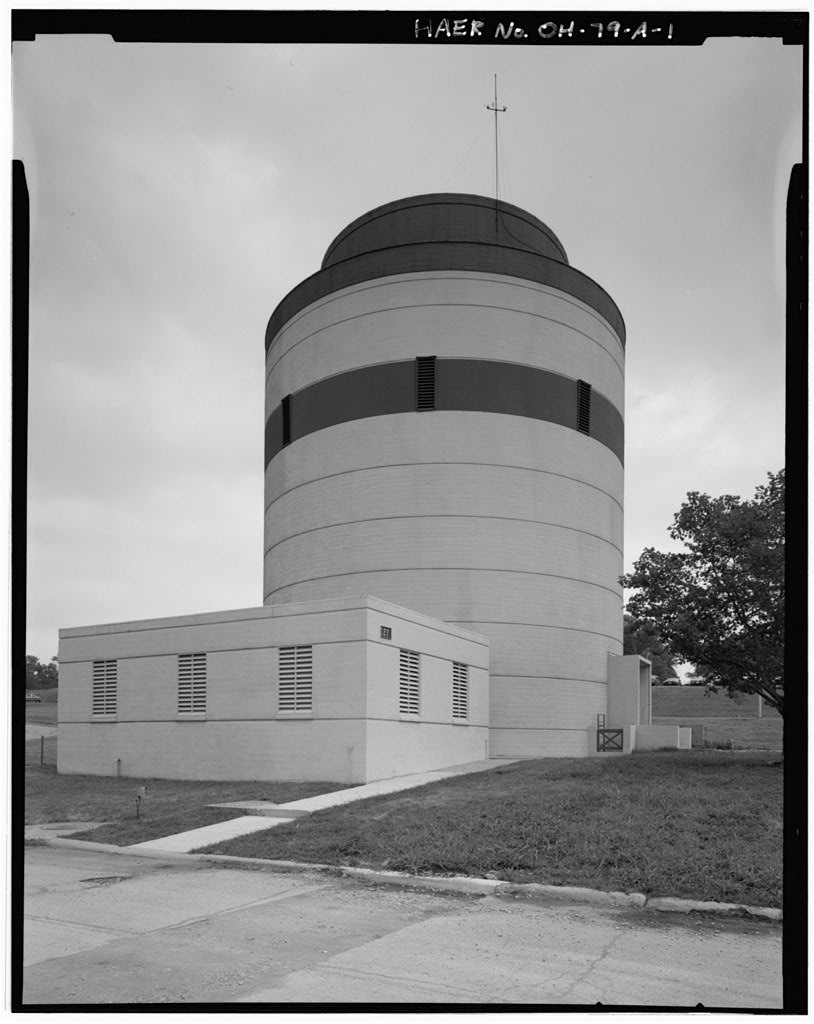
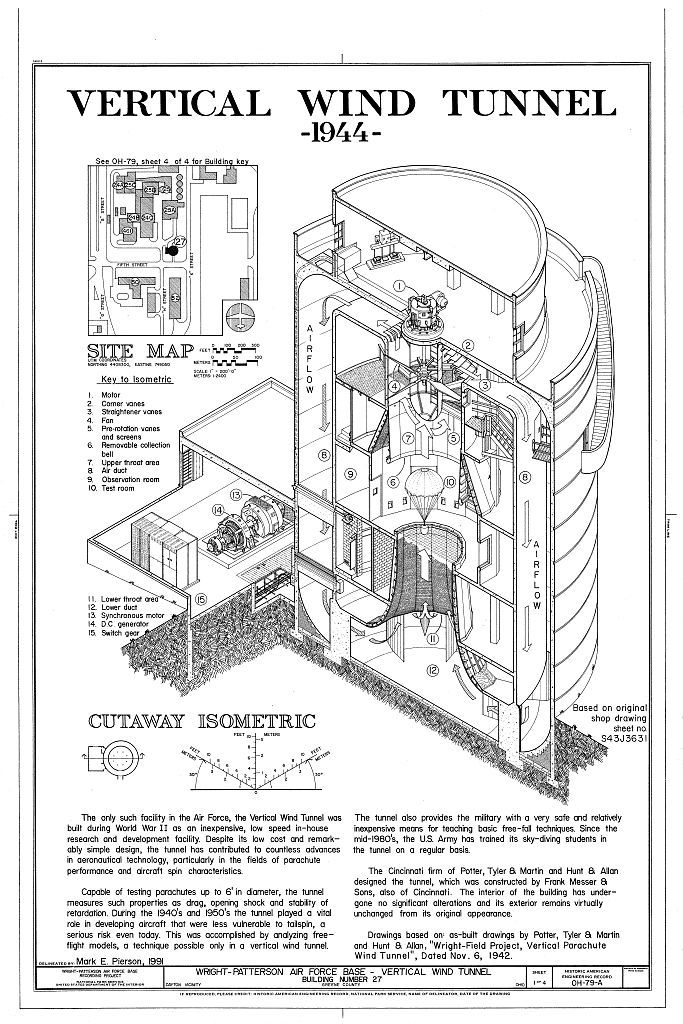
The cylindrical Vertical Wind Tunnel building rises 75' above the ground with an outside diameter of 65 The reinforced concrete structure consists of the foundation wall, a main section, measuring 58 topped by a 16' penthouse. The inner shell of the wind tunnel and the penthouse are both 4 O' in diameter. The penthouse, which contains the horsepower motor for the wind tunnel fan and a 5-ton crane, has six windows, an access door and a set of double doors. The fan propeller at the top of the tower is 16' in diameter and is set in a circle of concrete faced with steel. The outer shell contains no windows, but has seven vents that span the height of the seventh lift. In the space where an eighth vent would be, an access door opens to a concrete stairway which winds to the penthouse level.
On the west side of the building, a one-story motor generator house adjoins the outer shell. HISTORY: One of the most interesting buildings at Wright-Patterson Air Force Base is the Vertical Wind Tunnel. It was built during World War II as an inexpensive, low-speed, in-house research and development facility to test parachute performance and aircraft spin characteristics. Despite a remarkably simple design and a relatively low operating cost, the tunnel has contributed to numerous advances in aeronautical technology. Approaching its fiftieth year of virtually trouble-free operation, the Vertical Wind Tunnel has been one of the most economically efficient pieces of equipment in Air Force history.
Construction began on the Vertical Wind Tunnel in The structures were designed by the Cincinnati, Ohio, firms of Potter, Tyler & Martin, and Hunt & Allen, and constructed by Frank Messer & Sons, also of Cincinnati. The wind tunnel was partly operational by May and completed in August The Vertical Wind Tunnel at Wright-Patterson Air Force Base is the only one operated by the Air Force. currently, the only comparable facility in the country is NASA's vertical wind tunnel at Langley Air Force Base, although it has a larger test section and operates at slower air speeds. One of the primary functions of the Vertical Wind Tunnel was to test aircraft spin characteristics.
By spin testing prototypes in a vertical wind tunnel, designers could identify which designs or components made the aircraft least susceptible to "tailspin." Tailspin was one of the more significant risks in aircraft testing, occurring when an aircraft spiralled uncontrollably to the ground. For example, early models of the X-5 were plagued with a persistent inability to recover from tailspin, but after Vertical Wind Tunnel testing, engineers eliminated the problem by adding a simple ventral fin. Among the other aircraft tested in the Vertical Wind Tunnel, usually in scale, were the WRIGHT-PATTERSON AIR FORCE BASE, AREA B, BUILDING 27, VERTICAL WIND TUNNEL HAER No. OH-79-A (Page 3) and Century series fighters.
The Vertical Wind Tunnel has also made many notable contributions in the field of parachute dynamics. Capable of testing parachutes up to 6' in diameter, the tunnel performs experiments that measure such properties as drag, opening shock and stability of retardation. Similarly, the tunnel has also been involved in studying the drag and stability of missiles and re- entry bodies with and without drag-producing devices attached. For example, the tunnel has played an integral role in the development of Sense and Destroy Armor missiles (SADARM). The SADARM system uses a vortex ring parachute that maintains a constant spin rate and drop velocity to provide a high degree of stability for its missile.
Other types of testing that have been conducted in the tunnel include rotary wing characteristics, ejection seat stabilization systems, and model tests such as oil flow experiments and force-pressure measurements. Beginning in the Vertical Wind Tunnel spent several years operating on a stand-by basis only. It is still operational, however, and appears to be in no danger of shutting down. Aside from parachute testing, the tunnel is occasionally used for aircraft model tests. It also provides the military with a very safe and relatively inexpensive means of teaching basic free-fall techniques. Since the mid the U.S. Army has trained its diving students in the tunnel on a regular basis.
The building's exterior has undergone no significant alterations and, other than having the penthouse and seventh lift painted dark brown, its exterior remains virtually unchanged from its original appearance. The interior and the tunnel itself have been modified only slightly. The original corner vanes that guided the airflow near the top of the tunnel were removed, and replaced by a metal shroud that wraps the 90 corner with a more efficient curve. Moreover, the return section has been augmented with a plywood sheath. Attached to the inside wall of the tunnel with timber scaffolding, the sheath lifts away from the wall, narrowing the return duct at the top of the tunnel.
The sheath then gradually merges back with the inside wall near the bottom, expanding the duct to the original 7 '6 11 The shroud and sheath both work to speed and smooth the airflow through the return section. For bibliography, see Wright-Patterson Air Force Base overview report (HAER No. OH-79). WRIGHT-PATTERSON AIR FORCE BASE, AREA B, BUILDING 27, VERTICAL WIND TUNNEL HAER No. OH-79-A (Page 4) Vertical Wind Tunnel Type: Annular return overall Size: Diameter, 75' total height Centerline Circuit Length: Model Type: 3 dimensional free flight Test Section: 16 sided polygon, 12' across, 15' high, open throat Max. Diameter: Not available Contraction Ratio: Max. Velocity: 95 mph (roach 102 mph (roach when empty and without net Max.
Dynamic Pressure: 25 psf Power: hp DC synchronous motor, Ward Leonard speed control system Energy Ratio: .65 Temp. Control: None Operating Temp. & Press. Range: Atmospheric Air Drive: One 16' diameter fan with a laminated maple blades; variable pitch has been disconnected, but still adjustable manually. Drive Shaft: 10' long, 6" diameter solid steel shaft Max. Fan 875 Model Support System: Horizontal Parachute Test Strut; vertical, light weight sting mounted models; many tests done in free flight, such as radio controlled models for spin testing WRIGHT-PATTERSON AIR FORCE BASE, AREA B, BUILDING 27, VERTICAL WIND TUNNEL HAER No.
OH-79-A (Page 5) Balance Capacity and Range: Parachute Drag 200 Parachute Side Force 100 Data system: Electronic and video systems Cost: estimated replacement value:
 Block
Block